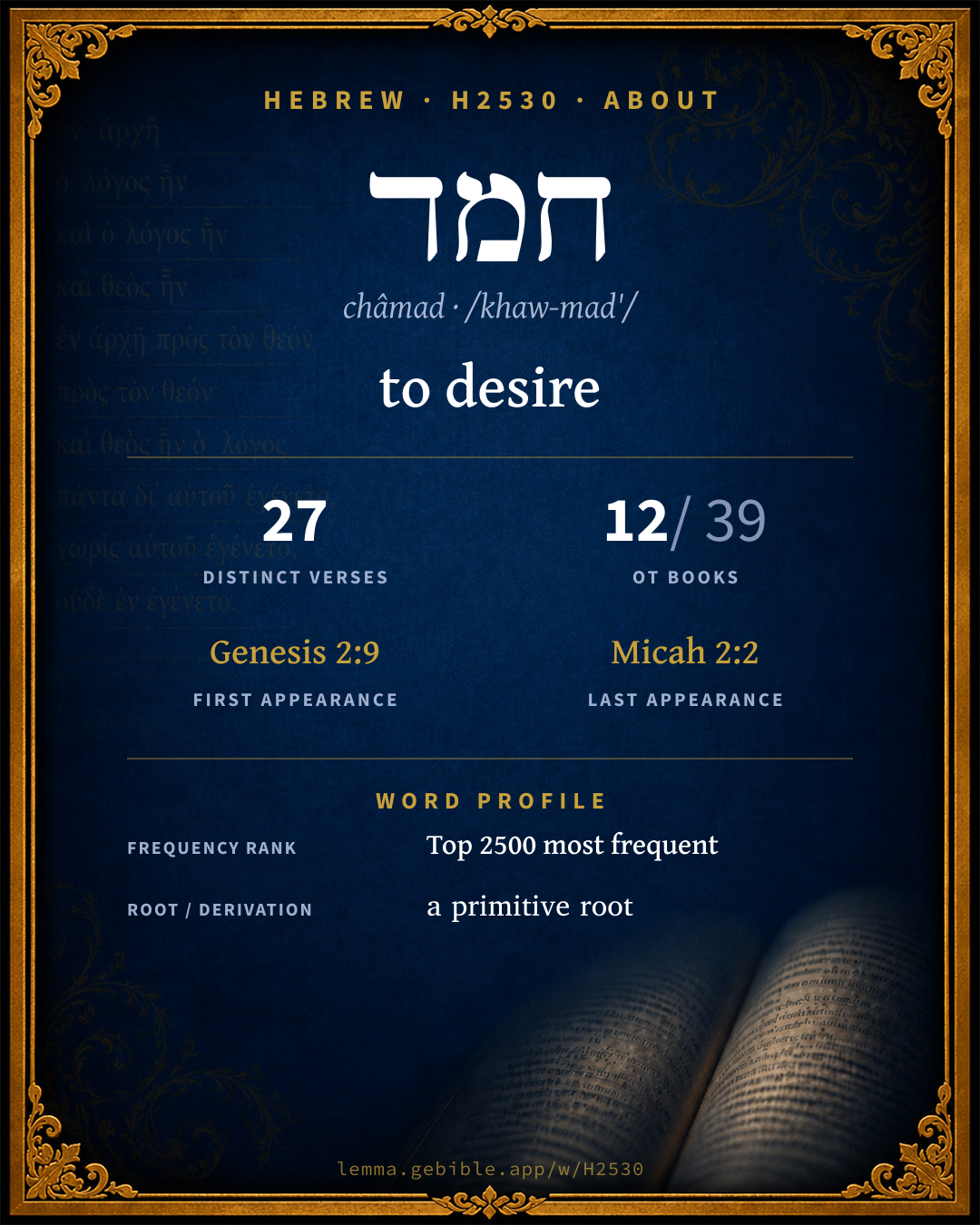
חָמַד
to desire
also: covet, take pleasure in, delight in fuller range ↓
Full lexicon entry — Brown-Driver-Briggs (BDB)
From Brown-Driver-Briggs (BDB)
Where this word appears
See every Qal verb in the Hebrew Bible →
Grammar key — what these labels mean
Part of speech
- Noun
- A naming word — a person, place, thing, or idea.
- Verb
- An action or state-of-being word.
Noun type
- Common
- A common noun — a general class of person, place, or thing (“king,” “city,” “water”), not a specific name.
Stem
- Qal
- The basic, simple active stem — the plain form of the verb (“he wrote”). Here: ‘desire’
- Niphal
- Usually the simple passive or reflexive of the Qal (“he was written”).
- Piel
- An intensive or resultative active stem.
Form
- Imperfect
- An incomplete, ongoing, or future action (“he will / would write”).
- Participle Active
- A verbal adjective expressing ongoing or characteristic action (“writing / one who writes”).
- Perfect
- A completed action or state — Hebrew marks aspect (completeness) more than strict tense (“he wrote”).
- Sequential Perfect
- A perfect with prefixed waw continuing a preceding imperfect or command (waw-consecutive perfect).
- Participle Passive
- A verbal adjective expressing action received (“written”).
- Sequential Imperfect
- An imperfect with prefixed waw — the standard past-narrative form (waw-consecutive imperfect).
- Jussive
- A third- or second-person volitional form expressing wish or command (“let him write”).
State
- Absolute
- The independent form of a noun, not bound to a following word.
- Construct
- A noun bound to a following noun in a possessive / “of” relationship (the construct chain).
Person
- 2nd Person
- The one addressed (“you”).
- 3rd Person
- The one spoken about (“he / she / it / they”).
- 1st Person
- The speaker (“I / we”).
Gender
- Feminine
- Grammatically feminine.
- Masculine
- Grammatically masculine.
- Common
- Either gender — not distinguished for this form.
Number
- Plural
- More than one (in Hebrew, generally three or more).
- Singular
- One.
Grammatical forms 16 distinct
- Noun, Common, Feminine, Plural, Absolute 6 times (21%)
- Verb, Qal, Imperfect, 2nd Person, Masculine, Singular 4 times (14%)
- Verb, Niphal, Participle Active, Masculine, Singular, Absolute 3 times (11%)
- Verb, Qal, Perfect, 3rd Person, Masculine, Singular 2 times (7%)
- Verb, Qal, Participle Passive, Masculine, Singular, Construct 2 times (7%)
- Verb, Qal, Imperfect, 1st Person, Common, Plural 1 time (4%)
- Verb, Qal, Sequential Perfect, 3rd Person, Common, Plural 1 time (4%)
- Verb, Qal, Participle Passive, Masculine, Plural, Construct 1 time (4%)
+8 more forms (8 occurrences)
Parsed forms decoded from the imported morphology (morphhb / Westminster Leningrad Codex — WLC text public domain, morphhb tagging CC BY 4.0), counted across 28 parsed occurrences — not distinct verses.
Every verse where H2530 appears — 27 distinct verses across 12 books. Click any verse to open its interlinear word-by-word view. Verse text shown in the World English Bible for context — . Each verse’s Hebrew form is shown with its reference; the English is not keyword-highlighted, since the data carries no word-level English alignment. Use “Compare translations” on any verse to read it across multiple English versions. This concordance covers the Hebrew Bible; Septuagint (Greek Old Testament) occurrences are not indexed here.
Genesis 2 verses
- Genesis 2:9 נֶחְמָ֥ד Niphal ptcp.act ms Out of the ground Yahweh God made every tree to grow that is pleasant to the sight, and good for food; the tree of life also in the midst of the garden, and the tree of the knowledge of good and evil.
- Genesis 3:6 וְ/נֶחְמָ֤ד conj + Niphal ptcp.act ms When the woman saw that the tree was good for food, and that it was a delight to the eyes, and that the tree was to be desired to make one wise, she took of the fruit of it, and ate; and she gave some to her husband with her, and he ate.
Exodus 2 verses
- Exodus 20:17 תַחְמֹ֖ד תַחְמֹ֞ד Qal impf 2ms Qal impf 2ms "You shall not covet your neighbor's house. You shall not covet your neighbor's wife, nor his man-servant, nor his maid-servant, nor his ox, nor his donkey, nor anything that is your neighbor's."
- Exodus 34:24 יַחְמֹ֥ד Qal impf 3ms For I will drive out nations before you and enlarge your borders; neither shall any man desire your land when you go up to appear before Yahweh, your God, three times in the year.
Deuteronomy 2 verses
- Deuteronomy 5:21 תַחְמֹ֖ד Qal impf 2ms "Neither shall you covet your neighbor's wife; neither shall you desire your neighbor's house, his field, or his man-servant, or his maid-servant, his ox, or his donkey, or anything that is your neighbor's."
- Deuteronomy 7:25 תַחְמֹד֩ Qal impf 2ms The engraved images of their gods shall you burn with fire: you shall not covet the silver or the gold that is on them, nor take it to you, lest you be snared therein; for it is an abomination to Yahweh your God.
Joshua 1 verse
2 Chronicles 1 verse
Job 1 verse
Psalms 3 verses
- Psalms 19:10 הַֽ/נֶּחֱמָדִ֗ים ptcl def.art + Niphal ptcp.act mp More to be desired are they than gold, yes, than much fine gold; Sweeter also than honey and the extract of the honeycomb.
- Psalms 39:11 חֲמוּד֑/וֹ Qal ptcp.pass ms cs + sfx pers 3ms When you rebuke and correct man for iniquity, You consume his wealth like a moth. Surely every man is but a breath." Selah.
- Psalms 68:16 חָמַ֣ד Qal pf 3ms Why do you look in envy, you rugged mountains, At the mountain where God chooses to reign? Yes, Yahweh will dwell there forever.
Proverbs 4 verses
- Proverbs 1:22 חָמְד֣וּ Qal pf 3cp "How long, you simple ones, will you love simplicity? How long will mockers delight themselves in mockery, And fools hate knowledge?
- Proverbs 6:25 תַּחְמֹ֣ד Qal juss 2ms Don't lust after her beauty in your heart, Neither let her captivate you with her eyelids.
- Proverbs 12:12 חָמַ֣ד Qal pf 3ms The wicked desires the plunder of evil men, But the root of the righteous flourishes.
- Proverbs 21:20 נֶחְמָ֣ד Niphal ptcp.act ms There is precious treasure and oil in the dwelling of the wise; But a foolish man swallows it up.
Song of Solomon 1 verse
Isaiah 3 verses
- Isaiah 1:29 חֲמַדְתֶּ֑ם Qal pf 2mp For they shall be ashamed of the oaks which you have desired, And you shall be confounded for the gardens that you have chosen.
- Isaiah 44:9 וַ/חֲמוּדֵי/הֶ֖ם conj + Qal ptcp.pass mp cs + sfx pers 3mp Those who fashion an engraved image are all of them vanity; and the things that they delight in shall not profit; and their own witnesses don't see, nor know: that they may be disappointed.
- Isaiah 53:2 וְ/נֶחְמְדֵֽ/הוּ conj + Qal impf 1cp + sfx pers 3ms For he grew up before him as a tender plant, and as a root out of a dry ground: he has no form nor comeliness; and when we see him, there is no beauty that we should desire him.
Daniel 6 verses
- Daniel 9:23 חֲמוּד֖וֹת n c fp At the beginning of your petitions the commandment went forth, and I am come to tell you; for you are greatly beloved: therefore consider the matter, and understand the vision.
- Daniel 10:3 חֲמֻד֞וֹת n c fp I ate no pleasant bread, neither came flesh nor wine into my mouth, neither did I anoint myself at all, until three whole weeks were fulfilled.
- Daniel 10:11 חֲ֠מֻדוֹת n c fp He said to me, Daniel, you man greatly beloved, understand the words that I speak to you, and stand upright; for to you am I now sent. When he had spoken this word to me, I stood trembling.
- Daniel 10:19 חֲמֻד֛וֹת n c fp He said, "Greatly beloved man, don't be afraid: peace be to you, be strong, yes, be strong." When he spoke to me, I was strengthened, and said, "Let my lord speak; for you have strengthened me."
- Daniel 11:38 וּ/בַ/חֲמֻדֽוֹת conj + prep + n c fp But in his place shall he honor the god of fortresses; and a god whom his fathers didn't know shall he honor with gold, and silver, and with precious stones, and pleasant things.
- Daniel 11:43 חֲמֻד֣וֹת n c fp cs But he shall have power over the treasures of gold and of silver, and over all the precious things of Egypt; and the Libyans and the Ethiopians shall be at his steps.
Micah 1 verse
About this entry
At a glance — auto-summarized from this page’s data, not written by a person. Every figure links to its source below. This summary describes the numbers; it doesn’t interpret them.
At its core, חמד (châmad) means “to desire.” It first appears in Genesis 2:9. Spanning 27 verses in 12 books, it ranks among the moderately common words of the Hebrew Bible. Beyond its headline sense, its full sense range takes in “covet”, “take pleasure in”, and “delight in”. Sharing its root, it stands alongside חמד, מחמד and מחמד. Each statement above links to its evidence; the full detail follows below.
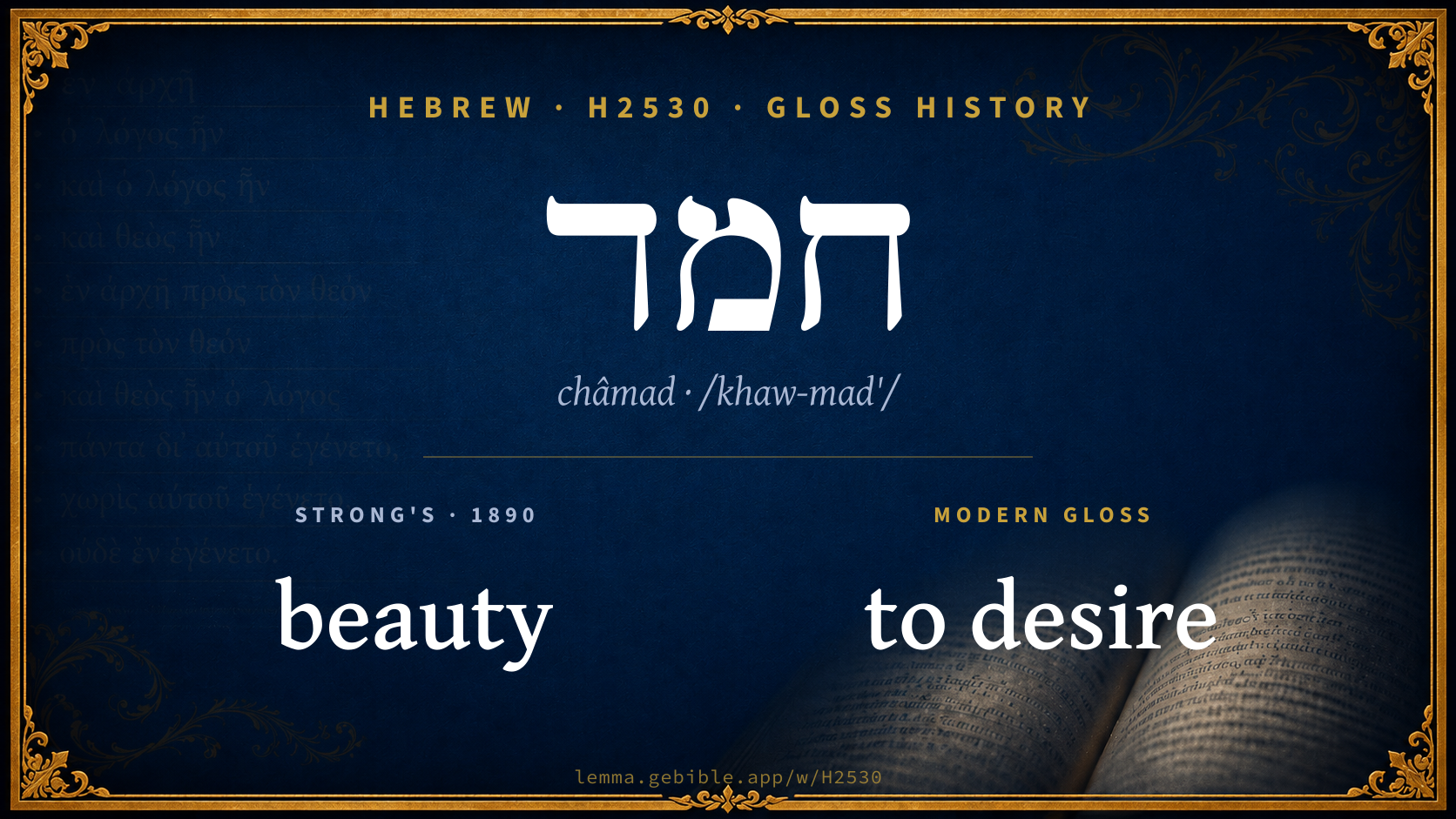
Gloss history
Strong's 1890 vs modern scholarship
About this word
Strong's H2530 catalogs a Hebrew word from the Hebrew Old Testament.
These counts are not copied from any lexicon or concordance. They are computed here, from the morphology-tagged Hebrew Old Testament. What Lemma adds →
- 27
- distinct verses
- The word appears in 27 distinct verses.
- 12 / 39
- OT books
- The word appears in 12 of 39 Old Testament books.
- #1,190
- by frequency
- Top 2500 most frequent Hebrew words (rank 1,190 of 8,640 Hebrew words by occurrence).
View all 27 occurrences in the concordance →
By section of the Old Testament
By traditional corpus
Conventional, traditional groupings — biblical authorship is debated, so this is a traditional corpus grouping, not an authorship claim. Each share is this word’s portion of its verses in that division of the Hebrew canon. Each figure is a share of the word’s 27 distinct verses.
- Writings (Ketuvim) 16 verses · 59%
- Torah (Pentateuch) 6 verses · 22%
- Prophets (Nevi'im) 5 verses · 19%
How translations render this word
Counts come from each version’s own published word-to-Strong’s tagging or interlinear alignment — an approximate guide to how each version renders this word, not a word-level alignment the data otherwise carries. Because each total is that version’s own tagged count, the per-version totals vary from one another and need not match the appearance or distinct-verse counts above. These counts may also differ from a printed concordance because Lemma counts each distinctly tagged rendering and does not collapse phrase taggings into a single head-word total. This is a fixed set of word-tagged versions (KJV, ASV, BSB, ULT) and does not change with the reading translation you choose elsewhere. Each version’s license is shown beside its name below (and on Sources).
BDB lists this Strong’s number as 2 distinct words (homographs). Each count above pools all of them and is not split by sense — see the Senses section below. A low-frequency rendering may belong to a different one of those words, not the primary meaning.
- King James Version†: Be desired 2×, Desireth 2×, Thou shalt not covet 2×
- American Standard Version†: Thou shalt not covet 3×
- Berean Standard Bible†: Covet 4×
- unfoldingWord Literal Text†: Covet 3×, Desire 3×, Desired 3×
King James Version Public Domain
Renders H2530 across 21† tagged occurrences — most commonly:
Plus 15 renderings that appear only once — usually multi-word phrases or single function words the recovered tagging swept in, not distinct renderings.
American Standard Version Public Domain
Renders H2530 across 21† tagged occurrences — most commonly:
Plus 18 renderings that appear only once — usually multi-word phrases or single function words the recovered tagging swept in, not distinct renderings.
Berean Standard Bible Public Domain
Renders H2530 across 23† tagged occurrences — most commonly:
Plus 19 renderings that appear only once — usually multi-word phrases or single function words the recovered tagging swept in, not distinct renderings.
unfoldingWord Literal Text CC BY-SA 4.0
Renders H2530 across 38† tagged occurrences — most commonly:
Plus 23 renderings that appear only once — usually multi-word phrases or single function words the recovered tagging swept in, not distinct renderings.
Senses in the full BDB
Hebrew verbs can shift meaning by stem (binyan): Qal is the basic action, Niphal is often passive or reflexive, Piel often intensifies or makes it factitive, and Hiphil is typically causative. The senses below are grouped under the stem BDB assigns to each.
What do BDB’s symbols mean?
BDB uses these scholarly abbreviations:
| Symbol | Meaning |
|---|---|
| 𝔊 | the Septuagint (the ancient Greek translation, LXX) |
| 𝔙 | the Vulgate (the Latin translation) |
| 𝔖 | the Syriac version (the Peshitta) |
| 𝔗 | the Targum (the Aramaic translation) |
| ψ | the Psalms |
| √ | root (the underlying root or stem) |
| ‖ | parallel passage (a synonymous or contrasted parallel) |
| † | the dagger: every passage where the word occurs is cited |
The 3 senses and sub-senses the full Brown-Driver-Briggs lexicon distinguishes for this word, in lexicon order (not ranked by frequency), with BDB’s own verbatim wording and sub-sense lettering. Shown in Hebrew script with BDB’s own scholarly abbreviations. The condensed entry is in the Lexicon Entry tab. See also the Forms in the corpus table below.
חמד I desire, take pleasure in
Qal
- desire
Niphal
- . desirable
Piel
- . delight greatly
חמד II desirableness, preciousness
Senses from the full Brown-Driver-Briggs lexicon (Brown, Driver, Briggs; Oxford 1906 — public domain), digitized via Sefaria, supplemented by the OpenScriptures HebrewLexicon (CC BY 4.0). Full attribution on Sources.
Word origin
חָמַד vb. desire, take pleasure in
[ חֲמוּדָה ] n.f. desirableness, preciousness
— Brown-Driver-Briggs (Oxford 1906, public domain), digitized via Sefaria, supplemented by the OpenScriptures HebrewLexicon (CC BY 4.0). See Sources.
Origin: a primitive root
Jastrow Dictionary
A second Hebrew/Aramaic lexicon for comparison, covering Aramaic and post-biblical (Talmudic, Targumic, Midrashic) usage that the biblical-Hebrew BDB does not. Matched by lemma rather than by Strong’s number, so a lemma may carry more than one Jastrow headword (shown separately below), and the entries cover usage well beyond the Bible.
חָמַד
- 1. [to be hot,] to desire, covet; to be carnally excited. Nidd. 20ᵇ חֲמַדְתִּיו (or חִמַּ׳ Pi.) I had a desire for his embrace. Midr. Till. to Ps. XIX, 11 מי חְמָדָן which (of the two) holds them desirable; Yalk. ib. 676 [read]: מי החוֹמְדִין. Mekh. Yithro, Baḥod. s. 8 שאתה חומד וכ׳ that you may desire his daughter for your son; ח׳ בדבור expressing a desire by words (without thinking of means to obtain the object of his desire). [Ib. ed. Weiss, אם התאוה סופו לַחֲמוֹד if one desires (what belongs to his neighbor), he will finally covet it (think of means to obtain it). Ib. אם ח׳ סופו וכ׳ if he covets, he will finally use force and rob. B. Mets. 5ᵇ לאו דלא תַחְמוֹד, v. לַאו; a. fr.—Part. pass. חָמוּד, f. חֲמוּדָה desirable, precious. Pesik. R. s. 36 ח׳ ונאה precious and fine (of conduct).—Sabb. 88ᵇ ח׳ גנוזה ed., v. חֶמְדָּה.—[
- 2. (= חָמַר) to produce shrivelling by heat. Snh. VII, 2 (52ᵃ) Ar. (ref. to Dan. X, 3; Var. חמר). e.g. Daniel 10:3
- 1. to be desired, desirable. Tanḥ. Vayera 5 שאתה נֶחְמָד לפני וכ׳ that thou art held desirable before the Lord; a. e.—[
- 2. to be shrivelled. Ḥull. III, 3 Ar., Var. נחמר, v. supra.]
- to covet. Macc. III, 15 שנפשו … מתאוה להן ומְחַמַּדְתָּן which man longs for and covets.
- (with ל) to be anxious for; to be pleased with. Tanḥ. Mishp. 17 ארץ שנִתְחַמְּדוּ לה וכ׳ a land which all the great men were anxious to possess (Yalk. Jer. 271 שהָמְדוּ). Koh. R. to IX, 7 בוראך מִתְחַמֵּד לך thy Creator is pleased with thee; תורתו מִתְחַמֶּדֶת לך His law is &c.
חֲמַד
- Targ. Is. I, 29; a. fr.—Part. f. (חֲמֵידַת) חְמֵידָא. Targ. Y. Gen. IV, 1.
- same, to long. Targ. O. Gen. XXXI, 30 (Y. מִתְחַמְדָּא חֲמִדְתָּא).—Nidd. 66ᵃ bot. מְחַמְּדָא, v. חִימּוּד.
- same.—Targ. Y. Gen. l. c.—Ib. XXVIII, 10.—Y. Taan. III, 66ᵈ top מִתְחֲמַד וכ׳ being desirous to hear her talk. Y. Sabb. VI, 8ᶜ bot. הוו מִתְחַמְּדִין וכ׳ were anxious to see &c. Koh. R. to IX, 10; a. e.
A Dictionary of the Targumim, the Talmud Babli and Yerushalmi, and the Midrashic Literature (Marcus Jastrow; London, Luzac, 1903) — Public Domain. Digitized via Sefaria. Digitized via Sefaria. Full attribution on Sources.
Forms in the corpus
The 26 distinct written forms H2530 takes in the Hebrew Bible, most frequent first — each parse links to that stem’s occurrences in the concordance. Hebrew forms include their vowel points and cantillation, so a single lemma takes many written forms.
Same root — word family
Other BDB entries built from the same root as H2530, grouped by Strong’s listed origin. These share a root / origin per the lexicon — not necessarily a shared meaning. Each links to that word’s own entry.
Derived from this word
Compare all same-root words → They share a root, not necessarily a meaning.
Septuagint verse parallels
This word appears in 27 verses that also exist in the Greek Old Testament (Septuagint), out of the 27 Hebrew verses it occurs in. You can read those verses in Greek by switching the Old Testament edition to the Septuagint.
Read these verses in the Septuagint
- Genesis 2:9
- Exodus 20:17
- Deuteronomy 5:21
- Joshua 7:21
- 2 Chronicles 20:25
- Job 20:20
- Psalms 19:10
- Proverbs 1:22
- Song of Solomon 2:3
- Isaiah 1:29
- Daniel 9:23
- Micah 2:2
This is a verse-level parallel only — the same verses exist in both the Hebrew and Greek Old Testaments. No word-level Hebrew↔Greek correspondence is claimed: the data carries no such alignment, so no Greek word is shown as this Hebrew word’s translation. Coverage is not total — the Septuagint omits the deuterocanon and renumbers the Psalms, so some Hebrew verses have no direct Greek parallel.