Isaiah 59:18

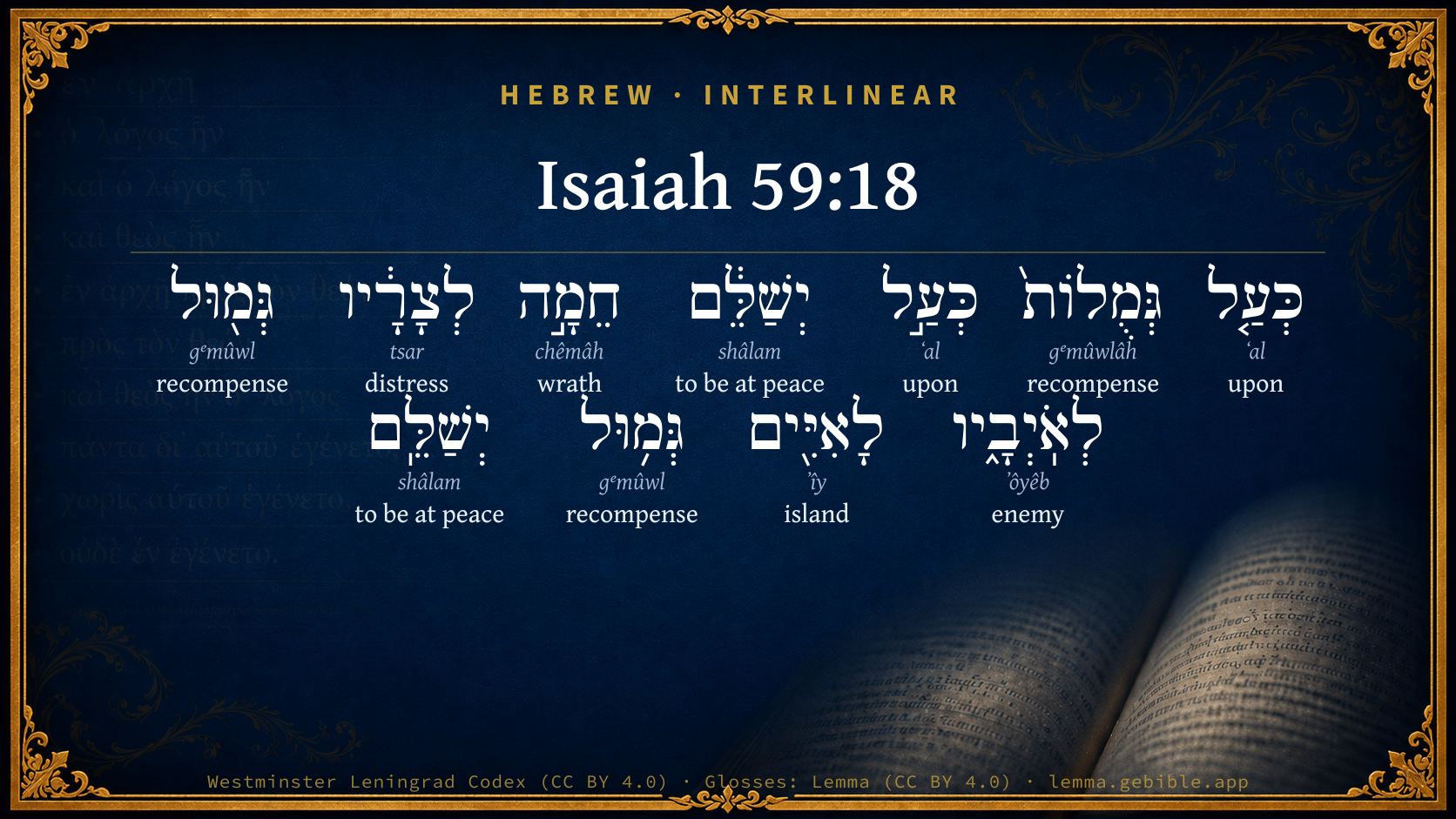
Hebrew (Westminster Leningrad Codex) Isaiah 59:18 appears in the Hebrew Old Testament. The text above is from the Westminster Leningrad Codex. Each word links to its Strong’s number, a concise gloss, and parsing drawn from the Open Scriptures Hebrew Bible morphology. Click any word for its full Brown-Driver-Briggs (BDB) entry.
Download image
Cite this verse

Isaiah 59:18 (World English Bible). Public Domain. Lemma interlinear Bible study tool, https://lemma.gebible.app/v/isaiah/59/18.

Show BibTeX & RIS
BibTeX
RIS
English Translation
According to their deeds, accordingly he will repay, wrath to his adversaries, recompense to his enemies; to the islands he will repay recompense.
World English Bible · Public Domain
Download a study sheet

One document with this verse’s original text, its word-by-word gloss line, the meaning frame, cross-references with their text, attributed commentary, and full source and license credits — printable, and it pastes into notes with its structure intact.

This verse Autodidact and up

Study sheet (.html) Plain text (.txt)

A passage Seminary Student

Up to 50 verses in one chapter. A passage sheet keeps up to 6 commentary sources and 12 cross-references per verse, in the order this page ranks them, and says so on the sheet whenever that leaves anything out. Ask for a single verse and you get the Autodidact verse sheet above.

Everything on this page stays free to read, with no account — the sheet is a download of what is already on screen, not access to it.

Want to remove ads? Support Godless Engineer
Compare translations 3

The same verse in 3 English versions, stacked beneath the original-language interlinear above. Click any original word for its lexicon entry.

Each is an independent rendering of the whole verse — the interlinear is not word-aligned to these translations.

Highlighted words mark where these versions differ — a whole-verse word diff, not a word-by-word alignment.

  • World English Bible Public Domain
    According to their deeds, accordingly he will repay, wrath to his adversaries, recompense to his enemies; to the islands he will repay recompense.
  • King James Version Public Domain
    According to their deeds, accordingly he will repay, fury to his adversaries, recompence to his enemies; to the islands he will repay recompence.
  • unfoldingWord Literal Text CC BY-SA 4.0
    According to deeds, according to he will repay: heat to his adversaries, recompense to his enemies; he will repay the recompense to the coastlands.

unfoldingWord Literal Text — © unfoldingWord, licensed CC BY-SA 4.0. Word-aligned USFM3 via Door43 (git.door43.org/unfoldingWord/en_ult).

Versions to compare (up to 4)

3 of 4 selected

Show all 18 translations

Every available English version of this verse, each an independent rendering of the whole verse.

  • World English Bible Public Domain
    According to their deeds, accordingly he will repay, wrath to his adversaries, recompense to his enemies; to the islands he will repay recompense.
  • Berean Standard Bible Public Domain
    So He will repay according to their deeds: fury to His enemies, retribution to His foes, and recompense to the islands.
  • Majority Standard Bible Public Domain
    So He will repay according to their deeds: fury to His enemies, retribution to His foes, and recompense to the islands.
  • King James Version Public Domain
    According to their deeds, accordingly he will repay, fury to his adversaries, recompence to his enemies; to the islands he will repay recompence.
  • American Standard Version (1901) Public Domain
    According to their deeds, accordingly he will repay, wrath to his adversaries, recompense to his enemies; to the islands he will repay recompense.
  • Revised Version (1885) Public Domain
    According to their deeds, accordingly he will repay, fury to his adversaries, recompence to his enemies; to the islands he will repay recompence.
  • Geneva Bible (1599) Public Domain
    As to make recompence, as to requite the furie of the aduersaries with a recompence to his enemies: he will fully repaire the ylands.
  • Douay-Rheims (1899) Public Domain
    As unto revenge, as it were to repay wrath to his adversaries, and a reward to his enemies: he will repay the like to the islands.
  • Young's Literal Translation Public Domain
    According to deeds -- so He repayeth. Fury to His adversaries, `their' deed to His enemies, To the isles `their' deed He repayeth.
  • Literal Standard Version CC BY-SA 4.0
    According to deeds—so He repays. Fury to His adversaries, [their] deed to His enemies, || To the islands He repays [their] deed.
  • Unlocked Literal Bible CC BY-SA 4.0
    He repaid them for what they had done, angry judgment to his adversaries, vengeance to his enemies, to the islands punishment as their reward.
  • unfoldingWord Literal Text CC BY-SA 4.0
    According to deeds, according to he will repay: heat to his adversaries, recompense to his enemies; he will repay the recompense to the coastlands.
  • Darby Bible Public Domain
    According to deeds, so will he repay: fury to his adversaries, recompence to his enemies; to the islands he will repay recompence.
  • World Messianic Bible Public Domain
    According to their deeds, he will repay as appropriate: wrath to his adversaries, recompense to his enemies. He will repay the islands their due.
  • Webster's Bible Public Domain
    According to their deeds, accordingly he will repay, fury to his adversaries, recompense to his enemies; to the isles he will repay recompense.
  • Free Bible Version CC BY-SA 4.0
    He will repay everyone for what they've done: fury to his enemies, revenge to those who oppose him, payback to the distant lands.
  • Bible in Basic English Public Domain
    He will give them the right reward of their doings, wrath to his attackers, punishment to his haters, and even on the sea-lands he will send punishment.
  • JPS Tanakh (1917) Public Domain
    According to their deeds, accordingly He will repay, fury to His adversaries, recompense to His enemies; to the islands He will repay recompense.

Literal Standard Version (2020), Covenant Press — licensed CC BY-SA 4.0. Text via the HelloAO Bible API (eBible.org). Unlocked Literal Bible (unfoldingWord) — licensed CC BY-SA 4.0. Text via the HelloAO Bible API (eBible.org). unfoldingWord Literal Text — © unfoldingWord, licensed CC BY-SA 4.0. Word-aligned USFM3 via Door43 (git.door43.org/unfoldingWord/en_ult). Free Bible Version, Dr. Jonathan Gallagher — licensed CC BY-SA 4.0. Text via the HelloAO Bible API (eBible.org).

Word by word

More ways to search: Search by grammar → Find every occurrence → Compare this word →

Practice this passage: Drill this verse → Learn its vocabulary →

גְּמֻלוֹת֙
gᵉmûwlâh
H1578
“recompenses”
Noun, Common, Feminine, Plural, Absolute
Part of Speech
Noun
Type
Common
Gender
Feminine
Number
Plural
State
Absolute
Full BDB Definition

Origin: from H1576

TWOT: 360b

dealing, recompense
  1. כְּעַ֤ל ʻal H5921 “like/as · upon” Preposition + Preposition
  2. כְּעַ֣ל ʻal H5921 “like/as · upon” Preposition + Preposition
  3. יְשַׁלֵּ֔ם shâlam H7999 “to be at peace” Verb, Piel, Imperfect, 3rd Person, Masculine, Singular
  4. חֵמָ֣ה chêmâh H2534 “wrath” Noun, Common, Feminine, Singular, Absolute
  5. לְצָרָ֔יו tsar H6862 “to/for · distresses · his” Preposition + Noun, Common, Masculine, Plural, Construct + Suffix, Personal, 3rd Person, Masculine, Singular
  6. גְּמ֖וּל gᵉmûwl H1576 “recompense” Noun, Common, Masculine, Singular, Absolute
  7. לְאֹֽיְבָ֑יו ʼôyêb H341 “to/for · enemy · him” Preposition + Verb, Qal, Participle Active, Masculine, Plural, Construct + Suffix, Personal, 3rd Person, Masculine, Singular
  8. לָאִיִּ֖ים ʼîy H339 “to/for the · islands” Preposition, Determined + Noun, Common, Masculine, Plural, Absolute
  9. גְּמ֥וּל gᵉmûwl H1576 “recompense” Noun, Common, Masculine, Singular, Absolute
  10. יְשַׁלֵּֽם shâlam H7999 “to be at peace” Verb, Piel, Imperfect, 3rd Person, Masculine, Singular

About this verse

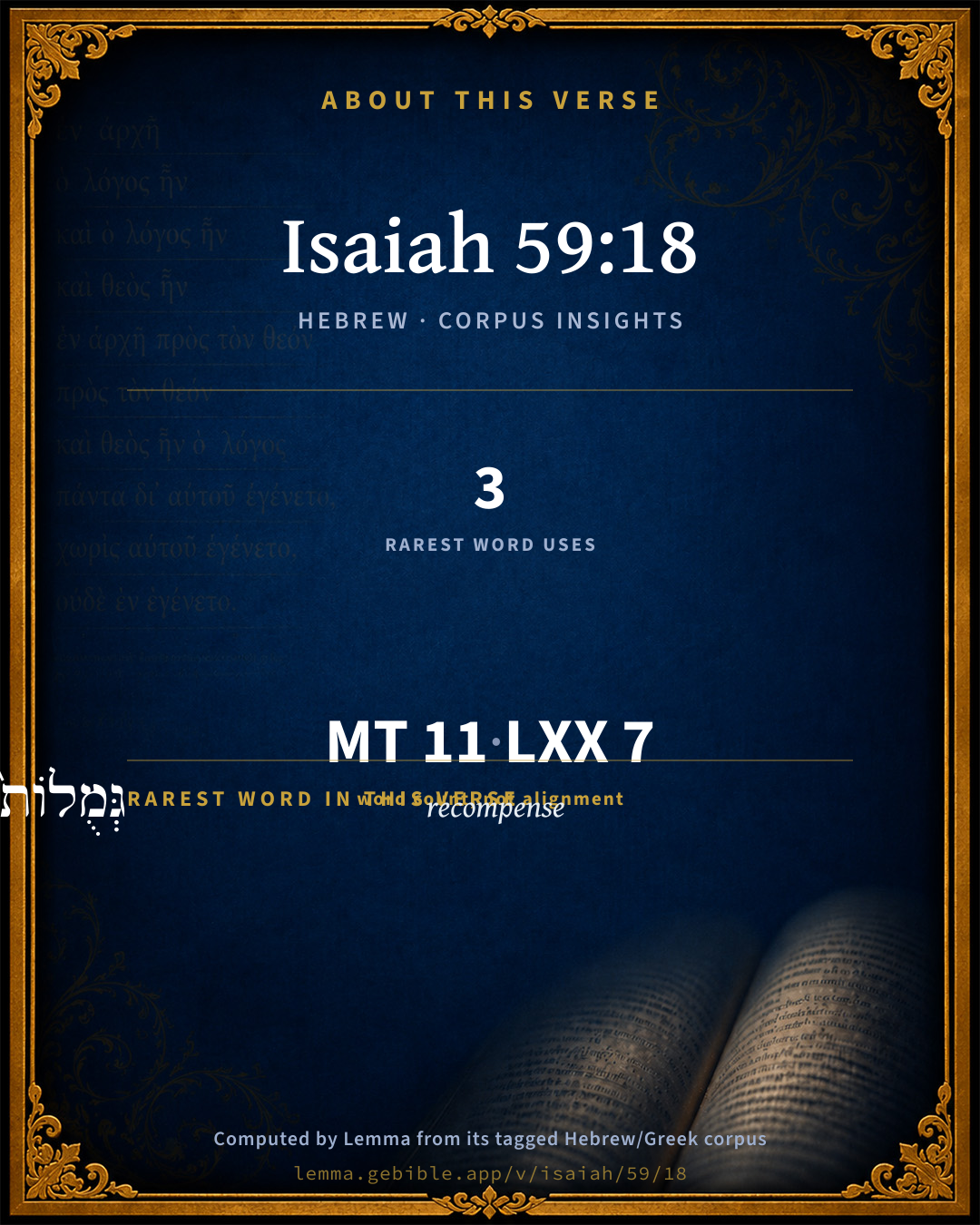
These counts appear in no published source. They are computed here, from the morphology-tagged text and Lemma’s own curated glosses. What Lemma adds →

11
words
8
distinct lemmas
Prophets
section

Notable vocabulary

The rarest word here is גְּמֻלוֹת֙ recompense H1578 — appearing just 3 times in the whole Hebrew Bible.

Shared distinctive vocabulary

גְּמֻלוֹת֙ recompense H1578 occurs in 3 verses of the Hebrew Bible. Also found in:

Grammatical profile

  • 3 verbs
  • 6 nouns
  • 2 prepositions

Verb forms

  • יְשַׁלֵּ֔ם Piel · Imperfect
  • לְאֹֽיְבָ֑יו Qal · Participle Active
  • יְשַׁלֵּֽם Piel · Imperfect

Repetition

Words recur within this verse — often emphatic in Hebrew:

  • כְּעַ֤ל upon H5921 ×2
  • יְשַׁלֵּ֔ם to be at peace H7999 ×2
  • גְּמ֖וּל recompense H1576 ×2

Hebrew & Septuagint length

In English translation the verse runs 23 words from the Hebrew and 12 from the Septuagint (LXX English) — the Septuagint runs noticeably shorter here. See the side-by-side →

A rough comparison of the two English renderings, which tokenize alike — not a word-level alignment.

Word counts can differ between the Hebrew and the Greek without any difference in meaning — e.g. the Hebrew direct-object marker אֵת has no separate Greek word, and Greek often adds the article ὁ.

In the original languages it is 11 Hebrew tokens and 7 Greek tokens — but the two are counted differently (Hebrew bundles its prefixes and suffixes into one token; the Greek is in lemma form), so that isn’t a like-for-like length.

Cross-references

23

Topical passages linked to Isaiah 59:18 in the Treasury of Scripture Knowledge — connected by theme and wording, ordered by reader-vote popularity; previews shown in the World English Bible.

  • Jeremiah 17:10 I, Yahweh, search the mind, I try the heart, even to give every man according to his ways, according to the fruit of his doings.
  • Isaiah 63:6 I trod down the peoples in my anger, and made them drunk in my wrath, and I poured out their lifeblood on the earth.
  • Matthew 16:27 For the Son of Man will come in the glory of his Father with his angels, and then he will render to everyone according to his deeds.
  • Romans 2:6 who "will pay back to everyone according to their works:"
  • Nahum 1:2 Yahweh is a jealous God and avenges. Yahweh avenges and is full of wrath. Yahweh takes vengeance on his adversaries, and he maintains wrath against his enemies.
  • Job 34:11 For the work of a man will he render to him, And cause every man to find according to his ways.
  • Psalms 18:24–26 Therefore Yahweh has rewarded me according to my righteousness, According to the cleanness of my hands in his eyesight.
  • Psalms 21:8–9 Your hand will find out all of your enemies. Your right hand will find out those who hate you.
  • Psalms 62:12 Also to you, Lord, belongs loving kindness, For you reward every man according to his work.
  • Isaiah 1:24 Therefore the Lord, Yahweh of Hosts, The Mighty One of Israel, says: "Ah, I will get relief from my adversaries, And avenge myself of my enemies;
  • Isaiah 49:25–26 But thus says Yahweh, Even the captives of the mighty shall be taken away, and the prey of the terrible shall be delivered; for I will contend with him who contends with you, and I will save your children.
  • Isaiah 63:3 I have trodden the winepress alone; and of the peoples there was no man with me: yes, I trod them in my anger, and trampled them in my wrath; and their lifeblood is sprinkled on my garments, and I have stained all my clothing.
  • Isaiah 66:15 For, behold, Yahweh will come with fire, and his chariots shall be like the whirlwind; to render his anger with fierceness, and his rebuke with flames of fire.
  • Lamentations 4:11 Yahweh has accomplished his wrath, he has poured out his fierce anger; He has kindled a fire in Zion, which has devoured the foundations of it.
  • Luke 21:22 For these are days of vengeance, that all things which are written may be fulfilled.
  • Jeremiah 50:29 Call together the archers against Babylon, all those who bend the bow; encamp against her round about; let none of it escape: recompense her according to her work; according to all that she has done, do to her; for she has been proud against Yahweh, against the Holy One of Israel.
  • Ezekiel 5:13 Thus shall my anger be accomplished, and I will cause my wrath toward them to rest, and I shall be comforted; and they shall know that I, Yahweh, have spoken in my zeal, when I have accomplished my wrath on them.
  • Ezekiel 6:12 He who is far off shall die of the pestilence; and he who is near shall fall by the sword; and he who remains and is besieged shall die by the famine: thus will I accomplish my wrath on them.
  • Ezekiel 38:18 It shall happen in that day, when Gog shall come against the land of Israel, says the Lord Yahweh, that my wrath shall come up into my nostrils.
  • Luke 19:27 But bring those enemies of mine who didn't want me to reign over them here, and kill them before me.'"
  • Revelation 16:19 The great city was divided into three parts, and the cities of the nations fell. Babylon the great was remembered in the sight of God, to give to her the cup of the wine of the fierceness of his wrath.
  • Revelation 19:15 Out of his mouth proceeds a sharp, double-edged sword, that with it he should strike the nations. He will rule them with a rod of iron. He treads the winepress of the fierceness of the wrath of God, the Almighty.
  • Revelation 20:12–13 I saw the dead, the great and the small, standing before the throne, and they opened books. Another book was opened, which is the book of life. The dead were judged out of the things which were written in the books, according to their works.

Cross-references courtesy of OpenBible.info (CC BY 4.0).

Hebrew and Greek witnesses Masoretic Hebrew ↔ Greek Septuagint

The same verse in the two great witnesses to the Old Testament, shown verse-for-verse.

Here the Septuagint runs noticeably shorter than the Hebrew — LXX2012 (modern English Septuagint) 12 words vs World English Bible 23. A rough length comparison of the two English translations, not a word-level alignment — read both below.

These are two independent witnesses, not word-aligned to each other, and the Septuagint is shown in lemma (dictionary) form.

Hebrew Isaiah 59:18 Masoretic · Westminster Leningrad Codex

כְּעַ֤ל גְּמֻלוֹת֙ כְּעַ֣ל יְשַׁלֵּ֔ם חֵמָ֣ה לְצָרָ֔יו גְּמ֖וּל לְאֹֽיְבָ֑יו לָאִיִּ֖ים גְּמ֥וּל יְשַׁלֵּֽם

According to their deeds, accordingly he will repay, wrath to his adversaries, recompense to his enemies; to the islands he will repay recompense.

World English Bible · Public Domain

Greek LXX Isaiah 59:18 Septuagint · lemma form

ὡς ἀντι ἀποδίδωμι ἀνταπόδοσις ὄνειδος ὁ ὑπεναντίος

as one about to render a recompence, even reproach to his adversaries.

LXX2012 (modern English Septuagint) · Public Domain

On this verse, Adam Clarke's Commentary discusses the Septuagint’s reading. Read the note in Commentary ↓

Hebrew: Westminster Leningrad Codex (CC BY 4.0). Greek: Septuagint (public domain); English from LXX2012 (modern English Septuagint) (Public Domain). How the Septuagint differs from the Hebrew →

Targum (Aramaic paraphrase)

1

The Targum is the ancient Jewish Aramaic paraphrase of the Hebrew Scriptures — an interpretive translation, not the Hebrew text itself. Onkelos (literal) and Pseudo-Jonathan (expansive) render the Torah, and Jonathan the Prophets. Coverage is partial: where no permissively-licensed English translation exists for a verse, only the Aramaic is shown. This is verse-level text, not a word-by-word alignment to the Hebrew.

  1. Targum Jonathan Prophets (Joshua–Malachi)
    מָרֵי גַמְלַיָא הוּא גִמְלָא יְשַׁלֵם פּוּרְעֲנוּתָא לְסָנְאוֹהִי גִמְלָא לְבַעֲלֵי דְבָבוֹהִי לְנַנְוָתָא גִמְלָא יְשַׁלֵם:

    He is the Lord of retributions, He shall render recompense vengeance to His enemies, retribution to His adversaries; He shall render recompense to the islands.

    Targum Jonathan — Aramaic: “Mikraot Gedolot” (public domain). English: “Sefaria Community Translation” (CC0 1.0 (public-domain dedication)); “London "Chaldee Paraphrase," 1871” (public domain). Text via Sefaria.

Commentary

Notes on Isaiah 59:18 from classic Christian and Jewish commentators (each source and its license shown beneath its notes). The classic Christian expositions comment on the surrounding passage and are grouped to its opening verse, so a note may address several verses; the Jewish commentaries on the Tanakh (Rashi and others) are per-verse, so they appear only where the commentator wrote on this verse.

Lemma curates 59 commentaries, every one of them public domain or Creative Commons licensed, each selected and text-cleaned for this edition rather than reprinted as found. About our sources →

Trapp's Complete Commentary

John Trapp

Isa 59:18 According to [their] deeds, accordingly he will repay, fury to his adversaries, recompence to his enemies; to the islands he will repay recompence.

Ver. 18. Fury to his adversaries,] viz., The devil and his agents, his people’s adversaries.

John Trapp, A Commentary or Exposition upon All the Books of the Old and New Testament (1647–1656) — public domain. Text from a community e-Sword module.

Tyndale Open Study Notes

Tyndale Open Resources

59:18 repay his enemies: The Lord will dole out righteous retribution on the whole earth. His justice requires people to be judged for the evil they have done (see also 3:9-11; 13:9).

Tyndale Open Study Notes — © Tyndale Open Resources, licensed CC BY-SA 4.0. Text via the HelloAO Bible API.

Geneva Bible (1599)

Geneva Bible translators

To wit, your enemies, which dwell in divers places, and beyond the sea.

Geneva Bible (1599) marginal notes — public domain. Text via Bolls.life.

Jamieson, Fausset & Brown

Robert Jamieson, A. R. Fausset & David Brown

deeds--Hebrew, "recompenses"; "according as their deeds demand" [MAURER]. This verse predicts the judgments at the Lord's second coming, which shall precede the final redemption of His people (Isa 66:18, Isa 66:15-16).

islands--(See on Isa 41:1). Distant countries.

Jamieson, Fausset & Brown — Commentary Critical and Explanatory on the Whole Bible (1871) — public domain (CC PDM 1.0). Text via the HelloAO Bible API.

Adam Clarke's Commentary

Verse 18. According to their deeds, accordingly he will repay - "He is mighty to recompense; he that is mighty to recompense will requite"] The former part of this verse, as it stands at present in the Hebrew text, seems to me to be very imperfect, and absolutely unintelligible. The learned Vitringa has taken a great deal of pains upon it after Cocceius, who he says is the only one of all the interpreters, ancient or modern, who has at all understood it, and has opened the way for him. He thinks that both of them together have clearly made out the sense; I do not expect that any third person will ever be of that opinion. He says, Videtur sententia ad verbum sonare: quasi propter facta [adversariorum] quasi propter rependet; excandescentiam, c., et sic reddidit Pagnimus. "According to the height of their demerits, he will repay them to the height: fury to his adversaries, recompense to his enemies," c. - Waterland. This he converts, by a process which will not much edify my reader, into Secundum summe merita, secundum summe (merita) rependet which is his translation. They that hold the present Hebrew text to be absolutely infallible must make their way through it as they can but they ought surely to give us somewhat that has at least the appearance of sense. However, I hope the case here is not quite desperate; the Chaldee leads us very fairly to the correction of the text, which is both corrupted and defective. The paraphrase runs thus: מרי גמליא הוא גמלא ישלם marey gumlaiya hu gimla yeshallem, "The Lord of retribution, he will render recompense." He manifestly read בעל baal instead of כעל keal. מרי גמליא marey gumlaiya is בעל גמלות baal gemuloth; as מרי מרירותא marey merirutha is בעל אף baal aph. Pr 22:24. And so in the Chaldee paraphrase on Isa 35:4: מרי גמליא יי הוא יתגלי marey gamlaiya yeya hu yithgeley, "The Lord of retribution, Jehovah himself, shall be revealed;" words very near to those of the prophet in this place.

The second כעל keal, which the Chaldee has omitted, must be read בעל baal likewise. With this only addition to the Chaldee, which the Hebrew text justifies, we are supplied with the following clear reading of the passage: -

הוא גמלות בעל

hu gemuloth baal

ישלם גמלות בעל

yeshallem gemuloth baal

The Lord of retributions he

The Lord of retributions, shall repay.

The כ caph in כעל keal twice seems to have been at first ב beth, in MS. This verse in the Septuagint is very imperfect. In the first part of it they give us no assistance: the latter part is wholly omitted in the printed copies; but it is thus supplied by MSS. Pachom. and I. D. II: Τοις ὑπεναντιοις αυτου· αμυναν τοις εχθροις αυτου· ταις νησοις αποδομα αποτισει. - L.

Adam Clarke's Commentary on the Bible (1810–1826) — public domain. Text from a community e-Sword/MySword module.

Ellicott's Commentary for English Readers

(18) To his adversaries . . .—The judgment is generally against all, in Israel or outside it, who come under this description. The word “islands” is used, as elsewhere, for far-off lands. The words point to every such judgment, from that of Cyrus to the great final day.

A Bible Commentary for English Readers, edited by Charles John Ellicott (1878–1897) — public domain. Text from a community e-Sword module.

The Cambridge Bible for Schools and Colleges

gen. ed. J. J. S. Perowne

18. According to their deeds] Or deserts. The word means simply an accomplished deed, either in a good or bad sense; but it is chiefly used in expressions which imply a reference to reward or retribution. In the next line it denotes the recompence itself (cf. ch. Isa_35:4).

According to … accordingly] The form of the comparative sentence is hardly grammatical. The compound preposition which introduces both protasis and apodosis has in the second case no noun to govern, and it cannot be treated either as a conjunction or as an adverb. We must either (with Dillmann) omit “accordingly” as dittography, or (with Duhm) change “he will repay” into a noun; rendering, “as the deserts so the retribution.” The sentence, however, would read awkwardly without a verb.

to the islands he will repay recompence] The clause seems to identify the “adversaries” and “enemies” of Jehovah with the “islands” (cf. Isa_41:1), i.e. the heathen world; but that is almost certainly a misinterpretation of the sense of the passage. If there is any connexion with the earlier part of the discourse, the “adversaries” spoken of must be the apostate Jews,—those who by their sins hindered the coming of salvation. The prophet cannot mean that because Israel’s sin has separated it from Jehovah, therefore judgement will descend on the heathen. Apart from this clause, indeed, there is nothing in the context to suggest the thought of a world-judgement, although of course the conception of a judgement beginning with Israel and extending to the nations is possible (see on ch. Isa_3:13). The words, however, are wanting in the LXX., and the verse would be greatly simplified by their removal. Their insertion is easily accounted for through a misunderstanding of Isa_59:19.

18–20. The consequences of Jehovah’s interposition.

The Cambridge Bible for Schools and Colleges (gen. ed. J. J. S. Perowne; Cambridge University Press, 1878–1918) — public domain. Text from a community e-Sword module.

John Gill's Exposition

According to their deeds, accordingly he will repay,.... As the enemies of his people have treated them, so will the Lord deal with them; as they have shed their blood, he will, according to the laws of retribution and retaliation, give them blood to drink, as they deserve. The whore of Rome shall be rewarded as the followers of Christ have been rewarded by her, and double shall be rendered to her double, according to her works, Rev 16:6,

fury to his adversaries, recompence to his enemies: the church's adversaries and enemies are Christ's, and so he esteems them; and therefore his wrath and fury is poured out by way of recompence to them, for all the ill they have done them, even the cup of the wine of the fierceness of his wrath, Rev 16:19,

to the islands he will repay recompence; even to those who dwell in the more distant and remote parts of the antichristian jurisdiction; for when the cup of wrath shall be given to Babylon every island will flee away, Rev 16:20.

John Gill's Exposition of the Whole Bible (1746–1763) — public domain (CC PDM 1.0). Text via the HelloAO Bible API.

Albert Barnes' Notes on the Bible

According to their deeds - The general sentiment of this verse is plain, though there is not a little difficulty in the construction of the Hebrew. Lowth pronounces the former part of the verse, as it stands in the Hebrew text, to be ‘absolutely unintelligible. By a slight change in the Hebrew as it now stands (reading בעל ba‛al, “lord,” instead of כעל ke‛al “as according to”), Lowth supposes that he has obtained the true sense, and accordingly translates it:

He is mighty to recompense;

He that is mighty to recompense shall requite.

This translation is substantially according to the Chaldee, but there is no authority from manuscripts to change the text in this place. Nor is it necessary. The particle כעל ke‛al occurs as a preposition in Isa 63:7, in the sense of ‘as according to,’ or ‘according to,’ and is similar in its form to the word מעל mē‛al, which often occurs in the sense of from above, or from upon Gen 24:64; Gen 40:19; Isa 34:16; Jer 36:11; Amo 7:11. The sense of the verse before us is, that God would inflict just punishment on his enemies. It is a general sentiment, applicable alike to the deliverance from Babylon and the redemption of his church and people at all times. In order to effect the deliverance of his people it was necessary to take vengeance on those who had oppressed and enslaved them. So in order to redeem his church, it is often necessary to inflict punishment on the nations that oppose it, or to remove by death the adversaries that stand in his way. This punishment is inflicted strictly according to their deeds. The principal thought here is, undoubtedly, that as they had opposed and oppressed the people of God, so he would take vengeance on them. He would remove his enemies, and prepare the way in this manner for the coming of his kingdom.

To the islands - On the use of the word ‘islands’ in Isaiah, see the notes at Isa 41:1. The idea here is, that he would ‘repay recompence’ or take vengeance on the foreign nations which had oppressed them.

Albert Barnes' Notes on the Bible (1834–1885) — public domain. Text from a community e-Sword/MySword module.

Matthew Poole's English Annotations

Deeds, Heb. recompences or deserts, i.e. he will recompense his adversaries with those effects of his fury that they have deserved.

Fury; a metonymy of the efficient, for the effects of his fury.

Islands; or, islanders; a metonymy of the containing for the contained; either Mesopotamia, and other adjacent islands, encompassed by Tigris and Euphrates; or those remoter nations (for the Hebrews call nations remote from Judea islands, Gen 10:5; Isa 41:1. See Poole "Isa 20:6", and the reason of it) under the king of Babylon, that thought themselves secure.

Matthew Poole's English Annotations on the Holy Bible (1683–1685) — public domain. Text from a community e-Sword/MySword module.

Whedon's Commentary on the Bible

Daniel D. Whedon

18. According… deeds… he will repay — Dealing fury, terrible retribution, but only to the incorrigible.

To the islands — See chap. Isa_41:1. To the western heathen world-power, Rome, embracing the world now or soon to be in complicity with apostate Israel in throwing down all righteous equity and judgment.

He — The Eternal Jehovah. Review the course of thought thus far in the chapter. The points are: Keen self-reproach on account of sins; dark descriptions of characters on this head, followed by sorrowful confession and admissions of apostasy on the part of the great mass of Israel; the crucible of judgment is employed; worthless dross is rejected; genuine material is preserved.

Daniel D. Whedon (gen. ed.), Commentary on the Old and New Testaments (1874–1909) — public domain. Text from a community e-Sword module.

The Pulpit Commentary

According to their deeds; rather, according to their deserts. (Psa_28:4, ad fin. ) He will repay. The ordinary future here, and in the remainder of the prophecy, replaces the "perfect of prophetic certitude," which has been employed in vers. 16, 17. Fury to his adversaries, recompense to his enemies. God"s "adversaries" are those of his own household his people, the ungodly Israelites; his "enemies" are the heathen that oppress his people. (comp. Isa_1:24, which is very similar) To the islands; i.e. the maritime lands, which, under Assyria, and afterwards under Babylon, took part in the oppression of his people.

The Pulpit Commentary (1880–1919), ed. H.D.M. Spence-Jones & Joseph S. Exell — public domain. Text from a community e-Sword module.

John Wesley's Explanatory Notes

Deeds - Hebrew. recompences or deserts. That is, he will recompence his adversaries with those effects of his fury that they have deserved. Islands - To those remoter nations under the king of Babylon, that thought themselves secure.

John Wesley, Explanatory Notes Upon the Whole Bible (1754–1765) — public domain. Text via the GEBible commentary corpus.

J. A. Alexander on Isaiah

Joseph Addison Alexander

“According to (their) deeds, accordingly will He repay, wrath to His enemies, (their) desert to His foes, to the isles (their) desert will He repay.” The essential meaning of this verse is evident and undisputed; but the form of expression in the first clause is singular, if not anomalous. The difficulty, however, is not exegetical, but purely grammatical, arising from the unexampled use of the preposition ‘al (according to) without an object: ‘According to their deeds according to—will he repay.’ The latest writers seem to have come back to the simple and obvious supposition of the oldest that it is a case of anomalous ellipsis, the object of the preposition being not expressed, but mentally repeated from the foregoing clause: ‘According to their deeds, according to (them), He will repay.’ (Compare the Hebrew of Psalms 45) In the mere repetition there is nothing singular, but rather something characteristic of the Prophet. (See above, Isa 52:6) The English Version happily approaches to a perfect reproduction of the Hebrew expression by employing the cognate terms according and accordingly, which has the advantage of retaining essentially the same term, and yet varying it so as to avoid a grammatical anomaly by which it might have been rendered unintelligible. The only satisfactory solution of the last clause is the one afforded by the hypothesis that the salvation here intended is salvation in the highest sense from sin and all its consequences, and that by Israel and the Isles (or Gentiles) we are to understand the church or people of God, and the world considered as its enemies and His.

Joseph Addison Alexander, The Prophecies of Isaiah (1846–1847; New York: Scribner, 1870–1878) — public domain. Text from a community e-Sword module.

Rashi

Rabbi Shlomo Yitzchaki (Rashi)

According to their deeds As is fitting to recompense for what the enemies dealt to them.

accordingly He shall repay As is fitting to repay them He shall repay.

Rashi on the Tanakh — English translations: “The Judaica Press complete Tanach with Rashi, translated by A. J. Rosenberg” (CC BY 4.0); “Pentateuch with Rashi's commentary by M. Rosenbaum and A.M. Silbermann, 1929-1934” (public domain); “The Metsudah Tanach series, Lakewood, N.J” (CC BY 4.0); and “The Book of Joshua, Metsudah Publications, 1997” (CC BY 4.0). Text via Sefaria.

Ibn Ezra

Rabbi Abraham ibn Ezra

כעל גמלות Like a man who is zealous for repaying. Fury to his adversaries, etc. He will repay fury to his adversaries, etc.

To the islands, etc. By his adversaries and enemies mentioned before, those on the continent are meant; the prophet continues, therefore, to the islands, etc.

Ibn Ezra on the Tanakh — English translations: “Sefaria Community Translation” (CC0 1.0 (public-domain dedication)); “Yalkut, Sifsei Chachomim Chumash, Metsudah Publications, 2009” (CC BY 4.0); and “Commentary of Ibn Ezra on Isaiah - trans. by M. Friedlander, 1873” (public domain). Text via Sefaria.

Lesson kit

Teaching starters — assembled from the data on this page, not authored interpretation. Every prompt links to the verse data it draws on. Edit before teaching.

Isaiah, in the Prophets, opens this verse with 11 words (8 distinct Hebrew lemmas). Its most distinctive word is gᵉmûwlâh (“recompense”). The Greek Septuagint runs shorter here. A historical commentator’s framing appears above. Read the whole chapter for the surrounding context.

Discussion questions

  1. What does “recompense” (gᵉmûwlâh) contribute to the verse as a whole?
  2. 2 Samuel 19:36 shares the word «recompense» with this verse. How do the two illuminate each other?
  3. “upon” occurs 2× in this one verse. What is the effect of the repetition?
  4. Compared with the Hebrew, the Septuagint runs shorter here. What questions does that raise?
  5. The translations on this page render this verse differently — a whole-verse word diff, not a word-by-word alignment. What might account for the different wordings?
  6. The verb «יְשַׁלֵּ֔ם» is Piel Imperfect. How does its form color the action?
  7. Reading how Trapp's Complete Commentary and Tyndale Open Study Notes read this verse, where do the two commentators agree and where do they part?

Things to notice

Reading settings

Reading text

Shown beneath each verse's original-language words.

Old Testament
Old Testament edition

Read the OT as the Masoretic Hebrew (MT) or the Greek Septuagint (LXX).

English shown for the Greek Septuagint (in the Hebrew ↔ Greek comparison).

Comparing translations? Open the Compare panel on any verse page to stack up to four side by side.