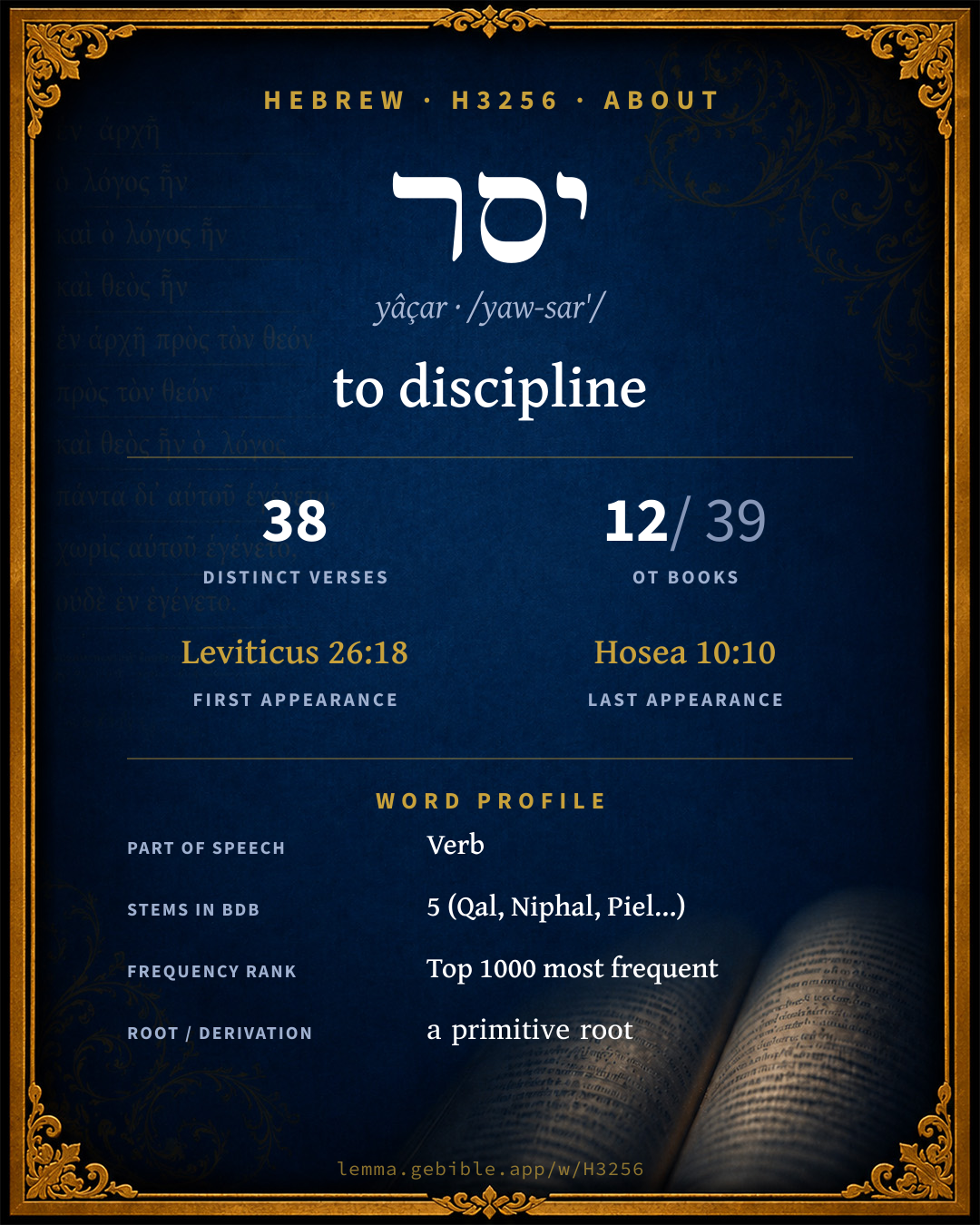
יָסַר
to discipline
‘to discipline’ is one of 4 main senses fuller range ↓
Full lexicon entry — Brown-Driver-Briggs (BDB)
From Brown-Driver-Briggs (BDB)
Where this word appears
See every Piel verb in the Hebrew Bible →
Grammar key — what these labels mean
Part of speech
- Verb
- An action or state-of-being word.
Stem
- Piel
- An intensive or resultative active stem. Here: ‘discipline’
- Niphal
- Usually the simple passive or reflexive of the Qal (“he was written”).
- Qal
- The basic, simple active stem — the plain form of the verb (“he wrote”). Here: ‘admonish Is 8’
- Hiphil
- The causative active stem (“he caused / brought about”).
Form
- Perfect
- A completed action or state — Hebrew marks aspect (completeness) more than strict tense (“he wrote”).
- Sequential Perfect
- A perfect with prefixed waw continuing a preceding imperfect or command (waw-consecutive perfect).
- Imperfect
- An incomplete, ongoing, or future action (“he will / would write”).
- Imperative
- A direct command (“write!”).
- Sequential Imperfect
- An imperfect with prefixed waw — the standard past-narrative form (waw-consecutive imperfect).
- Infinitive Construct
- A bound verbal noun, frequently with prepositions (“to write / in writing”).
- Participle Active
- A verbal adjective expressing ongoing or characteristic action (“writing / one who writes”).
- Infinitive Absolute
- An unbound verbal noun, often intensifying or standing in for a finite verb.
State
- Construct
- A noun bound to a following noun in a possessive / “of” relationship (the construct chain).
- Absolute
- The independent form of a noun, not bound to a following word.
Person
- 3rd Person
- The one spoken about (“he / she / it / they”).
- 1st Person
- The speaker (“I / we”).
- 2nd Person
- The one addressed (“you”).
Gender
- Masculine
- Grammatically masculine.
- Common
- Either gender — not distinguished for this form.
- Feminine
- Grammatically feminine.
Number
- Singular
- One.
- Plural
- More than one (in Hebrew, generally three or more).
Grammatical forms 28 distinct
- Verb, Piel, Perfect, 3rd Person, Masculine, Singular 5 times (12%)
- Verb, Piel, Sequential Perfect, 1st Person, Common, Singular 3 times (7%)
- Verb, Piel, Imperfect, 2nd Person, Masculine, Singular 3 times (7%)
- Verb, Piel, Perfect, 2nd Person, Masculine, Singular 3 times (7%)
- Verb, Piel, Imperative, 2nd Person, Masculine, Singular 3 times (7%)
- Verb, Piel, Sequential Perfect, 3rd Person, Common, Plural 2 times (5%)
- Verb, Piel, Imperfect, 1st Person, Common, Singular 2 times (5%)
- Verb, Piel, Infinitive Construct 2 times (5%)
+20 more forms (20 occurrences)
Parsed forms decoded from the imported morphology (morphhb / Westminster Leningrad Codex — WLC text public domain, morphhb tagging CC BY 4.0), counted across 43 parsed occurrences — not distinct verses.
Every verse where H3256 appears — 38 distinct verses across 12 books. Click any verse to open its interlinear word-by-word view. Verse text shown in the World English Bible for context — . Each verse’s Hebrew form is shown with its reference; the English is not keyword-highlighted, since the data carries no word-level English alignment. Use “Compare translations” on any verse to read it across multiple English versions. This concordance covers the Hebrew Bible; Septuagint (Greek Old Testament) occurrences are not indexed here.
Leviticus 3 verses
- Leviticus 26:18 לְ/יַסְּרָ֣ה prep + Piel inf.cs "'If you in spite of these things will not listen to me, then I will chastise you seven times more for your sins.
- Leviticus 26:23 תִוָּסְר֖וּ Niphal impf 2mp "'If by these things you won't be reformed to me, but will walk contrary to me;
- Leviticus 26:28 וְ/יִסַּרְתִּ֤י conj + Piel wpf 1cs then I will walk contrary to you in wrath; and I also will chastise you seven times for your sins.
Deuteronomy 4 verses
- Deuteronomy 4:36 לְ/יַסְּרֶ֑/ךָּ prep + Piel inf.cs + sfx pers 2ms Out of heaven he made you to hear his voice, that he might instruct you: and on earth he made you to see his great fire; and you heard his words out of the midst of the fire.
- Deuteronomy 8:5 יְיַסֵּ֥ר מְיַסְּרֶֽ/ךָּ Piel impf 3ms Piel ptcp.act ms cs + sfx pers 2ms You shall consider in your heart that as a man chastens his son, so Yahweh your God chastens you.
- Deuteronomy 21:18 וְ/יסְּר֣וּ conj + Piel wpf 3cp If a man have a stubborn and rebellious son, who will not obey the voice of his father, or the voice of his mother, and, though they chasten him, will not listen to them;
- Deuteronomy 22:18 וְ/יִסְּר֖וּ conj + Piel wpf 3cp The elders of that city shall take the man and chastise him;
1 Kings 2 verses
- 1 Kings 12:11 יִסַּ֤ר אֲיַסֵּ֥ר Piel pf 3ms Piel impf 1cs Now whereas my father did lade you with a heavy yoke, I will add to your yoke: my father chastised you with whips, but I will chastise you with scorpions.
- 1 Kings 12:14 יִסַּ֤ר אֲיַסֵּ֥ר Piel pf 3ms Piel impf 1cs and spoke to them after the counsel of the young men, saying, My father made your yoke heavy, but I will add to your yoke: my father chastised you with whips, but I will chastise you with scorpions.
1 Chronicles 1 verse
2 Chronicles 2 verses
- 2 Chronicles 10:11 יִסַּ֤ר Piel pf 3ms Now whereas my father did lade you with a heavy yoke, I will add to your yoke: my father chastised you with whips, but I [will chastise you] with scorpions.
- 2 Chronicles 10:14 יִסַּ֤ר Piel pf 3ms and spoke to them after the counsel of the young men, saying, My father made your yoke heavy, but I will add thereto: my father chastised you with whips, but I [will chastise you] with scorpions.
Job 1 verse
Psalms 8 verses
- Psalms 2:10 הִ֝וָּסְר֗וּ Niphal impv 2mp Now therefore be wise, you kings. Be instructed, you judges of the earth.
- Psalms 6:1 תְיַסְּרֵֽ/נִי Piel impf 2ms + sfx pers 1cs Yahweh, don't rebuke me in your anger, Neither discipline me in your wrath.
- Psalms 16:7 יִסְּר֥וּ/נִי Piel pf 3cp + sfx pers 1cs I will bless Yahweh, who has given me counsel. Yes, my heart instructs me in the night seasons.
- Psalms 38:1 תְיַסְּרֵֽ/נִי Piel impf 2ms + sfx pers 1cs Yahweh, don't rebuke me in your wrath, Neither chasten me in your hot displeasure.
- Psalms 39:11 יִסַּ֬רְתָּ Piel pf 2ms When you rebuke and correct man for iniquity, You consume his wealth like a moth. Surely every man is but a breath." Selah.
- Psalms 94:10 הֲ/יֹסֵ֣ר ptcl inter + Qal ptcp.act ms cs He who disciplines the nations, won't he punish? He who teaches man knows.
- Psalms 94:12 תְּיַסְּרֶ֣/נּוּ Piel impf 2ms + sfx pers 3ms Blessed is the man whom you discipline, Yah, And teach out of your law;
- Psalms 118:18 יַסֹּ֣ר יִסְּרַ֣/נִּי Piel inf.abs Piel pf 3ms + sfx pers 1cs Yah has punished me severely, But he has not given me over to death.
Proverbs 5 verses
- Proverbs 9:7 יֹ֤סֵ֨ר Qal ptcp.act ms He who corrects a mocker invites insult. He who reproves a wicked man invites abuse.
- Proverbs 19:18 יַסֵּ֣ר Piel impv 2ms Discipline your son, for there is hope; Don't be a willing party to his death.
- Proverbs 29:17 יַסֵּ֣ר Piel impv 2ms Correct your son, and he will give you peace; Yes, he will bring delight to your soul.
- Proverbs 29:19 יִוָּ֣סֶר Niphal impf 3ms A servant can't be corrected by words. Though he understands, yet he will not respond.
- Proverbs 31:1 יִסְּרַ֥תּ/וּ Piel pf 3fs + sfx pers 3ms The words of king Lemuel; the oracle which his mother taught him.
Isaiah 2 verses
Jeremiah 6 verses
- Jeremiah 2:19 תְּיַסְּרֵ֣/ךְ Piel impf 3fs + sfx pers 2fs Your own wickedness shall correct you, and your backsliding shall reprove you: know therefore and see that it is an evil thing and a bitter, that you have forsaken Yahweh your God, and that my fear is not in you, says the Lord, Yahweh of Hosts.
- Jeremiah 6:8 הִוָּסְרִי֙ Niphal impv 2fs Be instructed, Jerusalem, lest my soul be alienated from you; lest I make you a desolation, a land not inhabited.
- Jeremiah 10:24 יַסְּרֵ֥/נִי Piel impv 2ms + sfx pers 1cs Yahweh, correct me, but in measure: not in your anger, lest you bring me to nothing.
- Jeremiah 30:11 וְ/יִסַּרְתִּ֨י/ךָ֙ conj + Piel wpf 1cs + sfx pers 2ms For I am with you, says Yahweh, to save you: for I will make a full end of all the nations where I have scattered you, but I will not make a full end of you; but I will correct you in measure, and will in no way leave you unpunished.
- Jeremiah 31:18 יִסַּרְתַּ֨/נִי֙ וָֽ/אִוָּסֵ֔ר Piel pf 2ms + sfx pers 1cs conj + Niphal wimpf 1cs I have surely heard Ephraim bemoaning himself [thus], You have chastised me, and I was chastised, as a calf unaccustomed [to the yoke]: turn you me, and I shall be turned; for you are Yahweh my God.
- Jeremiah 46:28 וְ/יִסַּרְתִּ֨י/ךָ֙ conj + Piel wpf 1cs + sfx pers 2ms Don't be afraid you, O Jacob my servant, says Yahweh; for I am with you: for I will make a full end of all the nations where I have driven you; but I will not make a full end of you, but I will correct you in measure, and will in no way leave you unpunished.
Ezekiel 1 verse
Hosea 3 verses
- Hosea 7:12 אַיְסִרֵ֕/ם Hiphil impf 1cs + sfx pers 3mp When they go, I will spread my net on them. I will bring them down like the birds of the sky. I will chastise them, as their congregation has heard.
- Hosea 7:15 יִסַּ֔רְתִּי Piel pf 1cs Though I have taught and strengthened their arms, Yet they plot evil against me.
- Hosea 10:10 וְ/אֶסֳּרֵ֑/ם conj + Qal impf 1cs + sfx pers 3mp When it is my desire, I will chastise them; And the nations will be gathered against them, When they are bound to their two transgressions.
About this entry
At a glance — auto-summarized from this page’s data, not written by a person. Every figure links to its source below. This summary describes the numbers; it doesn’t interpret them.
יסר (yâçar) is a Hebrew verb most often rendered “to discipline.” As a verb its force shifts by stem, across 5 stems (Qal, Niphal, and more). The Hebrew Bible uses it across 38 verses — moderately common. It first appears in Leviticus 26:18. Sharing its root, it stands alongside יסור, מוסר and מוסר. The sections below give every sense, occurrence, and version rendering.
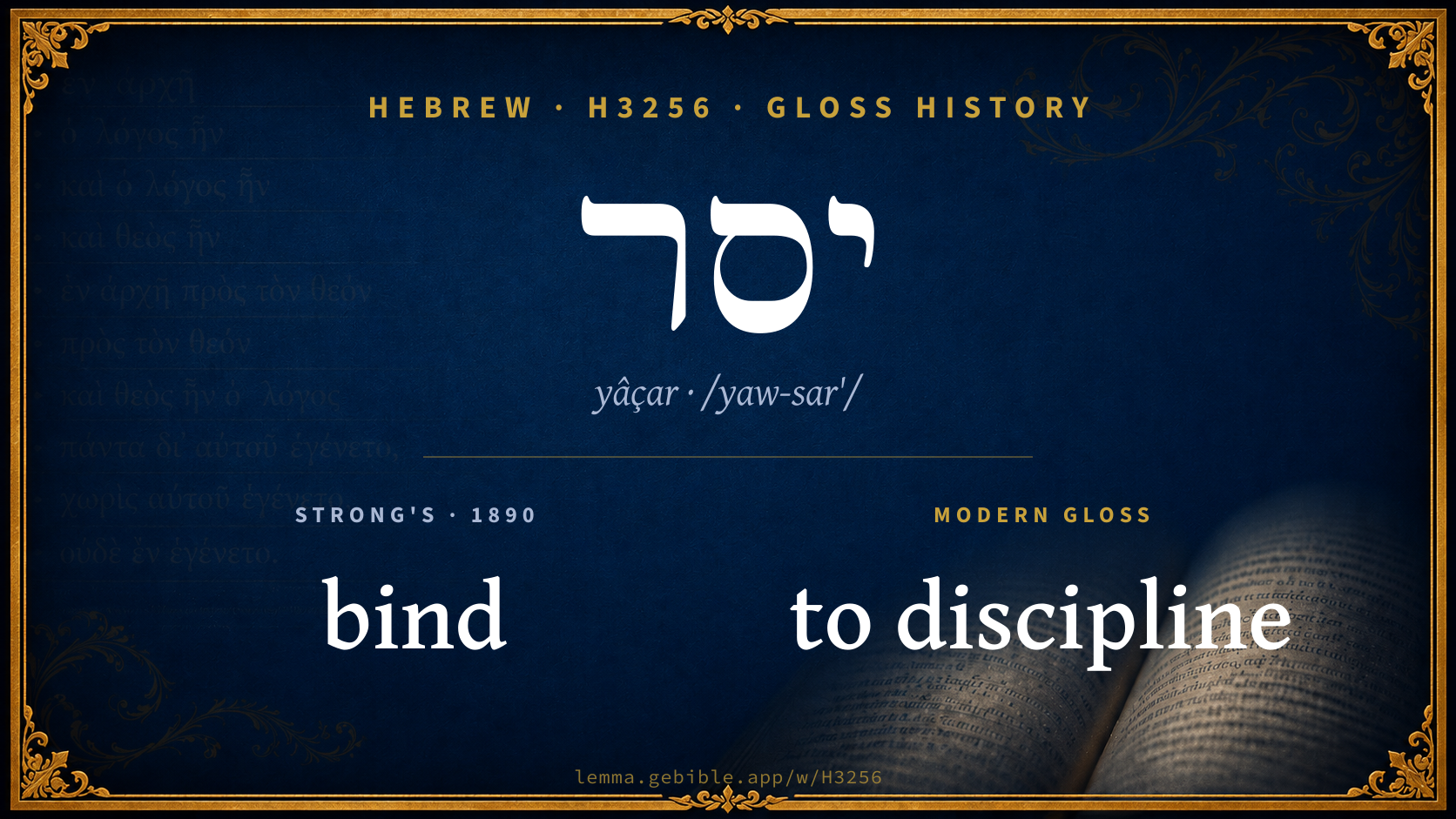
Gloss history
Strong's 1890 vs modern scholarship
About this word
Strong's H3256 catalogs a Hebrew word from the Hebrew Old Testament.
These counts are not copied from any lexicon or concordance. They are computed here, from the morphology-tagged Hebrew Old Testament. What Lemma adds →
- 38
- distinct verses
- The word appears in 38 distinct verses.
- 12 / 39
- OT books
- The word appears in 12 of 39 Old Testament books.
- #837
- by frequency
- Top 1000 most frequent Hebrew words (rank 837 of 8,640 Hebrew words by occurrence).
View all 38 occurrences in the concordance →
By section of the Old Testament
By traditional corpus
Conventional, traditional groupings — biblical authorship is debated, so this is a traditional corpus grouping, not an authorship claim. Each share is this word’s portion of its verses in that division of the Hebrew canon. Each figure is a share of the word’s 38 distinct verses.
- Writings (Ketuvim) 17 verses · 45%
- Prophets (Nevi'im) 14 verses · 37%
- Torah (Pentateuch) 7 verses · 18%
How translations render this word
Counts come from each version’s own published word-to-Strong’s tagging or interlinear alignment — an approximate guide to how each version renders this word, not a word-level alignment the data otherwise carries. Because each total is that version’s own tagged count, the per-version totals vary from one another and need not match the appearance or distinct-verse counts above. These counts may also differ from a printed concordance because Lemma counts each distinctly tagged rendering and does not collapse phrase taggings into a single head-word total. This is a fixed set of word-tagged versions (KJV, ASV, BSB, ULT) and does not change with the reading translation you choose elsewhere. Each version’s license is shown beside its name below (and on Sources).
- King James Version: I will chastise 4×, Chasten 3×, Chastised 3×
- American Standard Version: I will chastise 4×, Chasten 3×, Chastised 3×
- Berean Standard Bible: Scourged 4×, Discipline 2×, I will discipline you 2×
- unfoldingWord Literal Text: Discipline 5×, Discipline me 3×, Disciplined 2×
King James Version Public Domain
Renders H3256 across 43 tagged occurrences — most commonly:
Plus 29 renderings that appear only once — usually multi-word phrases or single function words the recovered tagging swept in, not distinct renderings.
American Standard Version Public Domain
Renders H3256 across 43 tagged occurrences — most commonly:
Plus 29 renderings that appear only once — usually multi-word phrases or single function words the recovered tagging swept in, not distinct renderings.
Berean Standard Bible Public Domain
Renders H3256 across 41 tagged occurrences — most commonly:
Plus 29 renderings that appear only once — usually multi-word phrases or single function words the recovered tagging swept in, not distinct renderings. Not rendered by a distinct English word in 2 further occurrences.
unfoldingWord Literal Text CC BY-SA 4.0
Renders H3256 across 44 tagged occurrences — most commonly:
Plus 28 renderings that appear only once — usually multi-word phrases or single function words the recovered tagging swept in, not distinct renderings.
15 senses and sub-senses in the full BDB
Hebrew verbs can shift meaning by stem (binyan): Qal is the basic action, Niphal is often passive or reflexive, Piel often intensifies or makes it factitive, and Hiphil is typically causative. The senses below are grouped under the stem BDB assigns to each. This entry also uses Nithp (a late reflexive/passive stem (Nithpael)).
What do BDB’s symbols mean?
BDB uses these scholarly abbreviations:
| Symbol | Meaning |
|---|---|
| 𝔊 | the Septuagint (the ancient Greek translation, LXX) |
| 𝔙 | the Vulgate (the Latin translation) |
| 𝔖 | the Syriac version (the Peshitta) |
| 𝔗 | the Targum (the Aramaic translation) |
| ψ | the Psalms |
| √ | root (the underlying root or stem) |
| ‖ | parallel passage (a synonymous or contrasted parallel) |
| † | the dagger: every passage where the word occurs is cited |
The 15 senses and sub-senses the full Brown-Driver-Briggs lexicon distinguishes for this word, in lexicon order (not ranked by frequency), with BDB’s own verbatim wording and sub-sense lettering. Shown in Hebrew script with BDB’s own scholarly abbreviations. The condensed entry is in the Lexicon Entry tab. See also the Forms in the corpus table below.
Qal
- Impf. 3 m. sf. וְיִסְּרֵנִי Is 8:11 (Di De SS see Bö§ 1103 Ew§ 249 d, but Thes MV Che al. Pi. Pf.); 1 s. sf. וְאֶסֳּרֵם Ho 10:10 (Ges§ 71); Inf. abs. יָסֹר 1 Ch 15:22 (noun Ke, point as pt. Öt); Pt. יֹסֵר Pr 9:7 ψ 94:10; יסורי Je 17:13 Kt v. סוּר;— e.g. Isaiah 8:11
- 1. admonish Is 8:11 (sq. sf. + מִלֶּכֶת away from walking, i.e. not to walk), Pr 9:7 (‖ מוֹכִיחַ). e.g. Isaiah 8:11
- 2. instruct, 1 Ch 15:22. e.g. 1 Chronicles 15:22
- 3. discipline, of God Ho 10:10 ψ 94:10. e.g. Hosea 10:10
Niphal
- Impf. יִוָּ֫סֶר עֶ֫בֶד Pr 29:19; אִוָּסֵר Je 31:18; תִּוָּֽסְרוּ Lv 26:23; Imv. f. הִוָּֽסְרִי Je 6:8; mpl. חִיָּסְרוּ ψ 2:10;—(Niph. tolerat., Ges§ 51. 2), let oneself be corrected, admonished by words of man ψ 2:10; Pr 29:19; let oneself be chastened by discipline of God Je 6:8; 31:18; Lv 26:23. e.g. Proverbs 29:19
Piel
- Pf. יִסַּר 1 K 12:11 + 3 times; sf. יִסְּרַנִּי ψ 118:18; יִסְּרוֹ Is 28:26; 3 f. sf. יִסְּרַתּוּ Pr 31:1; 2 m. יִסַּרְתָּ ψ 39:12 Jb 4:3, etc. + 8 times Pf.; Impf. יְיַסֵּר Dt 8:5; 2 m. sf. תְּיַסְּרֶנּוּ ψ 94:12, etc. + 5 times Impf.; Imv. יַסֵּר Pr 19:18; 29:17; sf. יַסְּרֵנִי Je 10:24; Inf. abs. יַסֹּר ψ 118:18; cstr. יַסְּרָה Lv 26:18; sf. יַסְּרֶ֑ךָּ Dt 4:36; Pt. מְיַסְּרֶ֑ךָּ Dt 8:5;— e.g. 1 Kings 12:11
- 1. discipline, correct (the moral nature, with more or less severity according to circumstances):
- a. of God, c. acc. Ho 7:15 (of training arms), Dt 4:36 (v. Dr), 8:5 (Israel as son), Is 28:26, happy the man אשׁר תיסרנו יהּ ψ 94:12, 118:18(×2). e.g. Hosea 7:15
- b. of man, c. acc. Dt 8:5 Pr 19:18; 29:17 (all of a father his son), Jb 4:3 Pr 31:1, ψ 16:7 my reins (the emotions of my own heart) correct, admonish me. e.g. Deuteronomy 8:5
- 2. more severely, chasten, chastise:
- a. of God, sq. acc. pers., Je 31:18; אַל־בַּחֲמָֽתְךָ תְיַסְּרֵנִי ψ 6:2; 38:2; בְּמשׁפט אל באף Je 10:24; למשׁפט 30:11 = 46:28; על חטאת Lv 26:18, 28; בתוכחות על עון ψ 39:12. e.g. Jeremiah 31:18
- b. of man, a father his son Dt 21:18; elders a man Dt 22:18 (including, as perhaps 21:18, bodily chastisement); a king his subjects בַּשּׁוֹטִים and בָּעַקְרַבִּים 1 K 12:11, 14 = 2 Ch 10:11, 14. e.g. Deuteronomy 21:18
- c. תְּיַסְּרֵךְ רָֽעָתֵךְ Je 2:19 thy badness will chastise thee. e.g. Jeremiah 2:19
Nithp
- Pf. נִוַּסְּרוּ Ez 23:48 (for נִתְוַסְּרוּ Ges§ 55 k); pass. be disciplined, corrected. e.g. Ezekiel 23:48
Hiphil
- Impf. 1 s. sf. אַיְסִירֵם (Ew§ 131 c, but error for אֲיַסְּרֵם Bö§ 437 f SS), c. acc. chasten Ho 7:12. e.g. Hosea 7:12
Senses from the full Brown-Driver-Briggs lexicon (Brown, Driver, Briggs; Oxford 1906 — public domain), digitized via Sefaria, supplemented by the OpenScriptures HebrewLexicon (CC BY 4.0). Full attribution on Sources.
Word origin
vb. discipline, chasten, admonish (Talm 𝔗 יִ(י)סּוֹר. chastisement; but Aramaic יְסַר is bind)—
— Brown-Driver-Briggs (Oxford 1906, public domain), digitized via Sefaria, supplemented by the OpenScriptures HebrewLexicon (CC BY 4.0). See Sources.
Origin: a primitive root
Jastrow Dictionary
A second Hebrew/Aramaic lexicon for comparison, covering Aramaic and post-biblical (Talmudic, Targumic, Midrashic) usage that the biblical-Hebrew BDB does not. Matched by lemma rather than by Strong’s number, so a lemma may carry more than one Jastrow headword (shown separately below), and the entries cover usage well beyond the Bible.
יָסַר
- [to tie up; cmp. חוּב.]
- to chastise, chasten, try. Snh. 39ᵃ מְיַיסֵּר … ביסורין he (the king) punishes the prominent among them (the rebellious citizens); כך הקב"ה מי׳ וכ׳ so did the Lord visit Ezekiel in order to wash away the sins of Israel. Ab. Zar. 4ᵃ אֲיַסְּרֵם ביסורין וכ׳ I would visit them with afflictions in this world, in order that their arms be strengthened &c. Ex. R. s. 3, end המטה שתְּיַיסְּרֶנּוּ בו the staff wherewith to strike him (Pharaoh); a. fr.
- , Nithpa. נִתְיַסֵּר to be chastened, tried. Gen. R. s. 62 היו מִתְיַיסְּרִין בחולי וכ׳ used to be visited with bowel diseases for ten days &c. (prior to their death), to indicate that the disease purifies (from sin); Treat. S’maḥ. ch. III. Y. Snh. X, 27ᵈ נתיי׳ בבנו הבכור he was punished with the death of his first-born son. Tanḥ. Noah 14 נתי׳ בבנו he was visited with trials through his son (being asked to sacrifice him). Ib. Vayigg. 6 נתי׳ בבנו was tried by his son (Joseph being sold); a. e.
יְסַר
- 1. to tie, put on. Targ. Is. XV, 3 יֵיסְרוּן וכ׳ ed. Lag. (ed. יִסְרוּן; h. text חגרו); a. e.
- 2. to bind one’s self, to vow. Targ. Num. XXX, 3, sq.—Y. Taan. II, 66ᵃ top (quot. fr. Meg. Taan. ch. XII) יֵיסַר בצלו (Meg. Taan. l. c. יאסר) may vow (a fast) in his prayer; Bab. Taan. 12ᵃ (v. corr. vers. Ms. M. in Rabb. D. S. a. l. notes); v. אֲסַר.
- to be tried. Cant. R. to II, 16 ר׳ י׳ א׳ ועבד וכ׳ R. J. was tried and suffered with fever &c.
A Dictionary of the Targumim, the Talmud Babli and Yerushalmi, and the Midrashic Literature (Marcus Jastrow; London, Luzac, 1903) — Public Domain. Digitized via Sefaria. Digitized via Sefaria. Full attribution on Sources.
Forms in the corpus
The 36 distinct written forms H3256 takes in the Hebrew Bible, most frequent first — each parse links to that stem’s occurrences in the concordance. Hebrew forms include their vowel points and cantillation, so a single lemma takes many written forms.
Same root — word family
Other BDB entries built from the same root as H3256, grouped by Strong’s listed origin. These share a root / origin per the lexicon — not necessarily a shared meaning. Each links to that word’s own entry.
Derived from this word
- יסור yiççôwr H3250 reprover
- מוסר môwçêr H4147 bond
- מוסר mûwçâr H4148 discipline
- מסר môçâr H4561 correction
Compare all same-root words → Showing 4 of 5 — not the complete family. They share a root, not necessarily a meaning.
Septuagint verse parallels
This word appears in 36 verses that also exist in the Greek Old Testament (Septuagint), out of the 38 Hebrew verses it occurs in. You can read those verses in Greek by switching the Old Testament edition to the Septuagint.
Read these verses in the Septuagint
- Leviticus 26:18
- Deuteronomy 4:36
- 1 Kings 12:11
- 1 Chronicles 15:22
- 2 Chronicles 10:11
- Job 4:3
- Psalms 2:10
- Proverbs 9:7
- Isaiah 8:11
- Jeremiah 2:19
- Ezekiel 23:48
- Hosea 7:12
This is a verse-level parallel only — the same verses exist in both the Hebrew and Greek Old Testaments. No word-level Hebrew↔Greek correspondence is claimed: the data carries no such alignment, so no Greek word is shown as this Hebrew word’s translation. Coverage is not total — the Septuagint omits the deuterocanon and renumbers the Psalms, so some Hebrew verses have no direct Greek parallel.