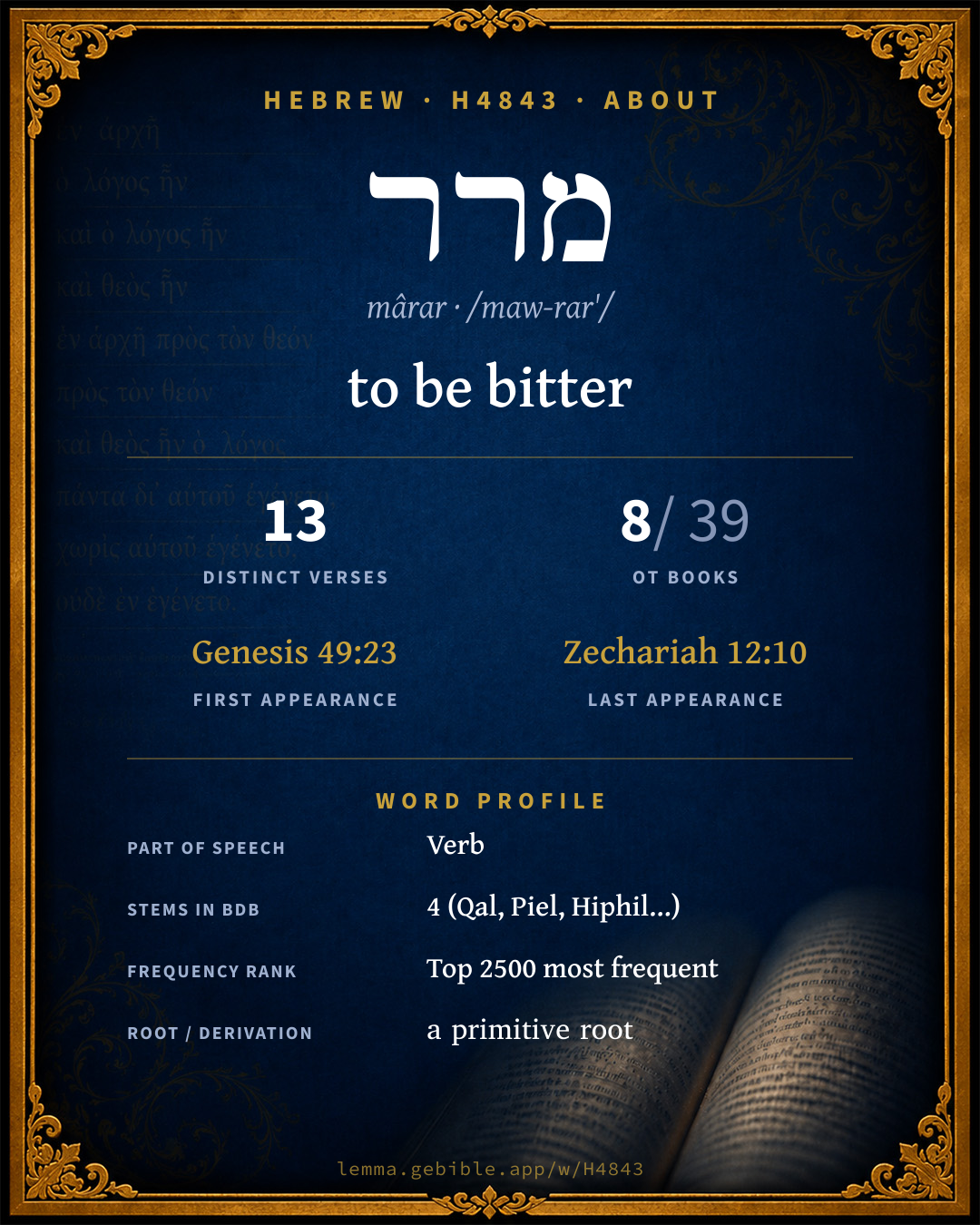
מָרַר
to be bitter
‘to be bitter’ is one of 2 main senses fuller range ↓
Full lexicon entry — Brown-Driver-Briggs (BDB)
From Brown-Driver-Briggs (BDB)
Where this word appears
See every Hiphil verb in the Hebrew Bible →
Grammar key — what these labels mean
Part of speech
- Verb
- An action or state-of-being word.
Stem
- Hiphil
- The causative active stem (“he caused / brought about”).
- Qal
- The basic, simple active stem — the plain form of the verb (“he wrote”). Here: ‘lit.’
- Piel
- An intensive or resultative active stem.
Form
- Perfect
- A completed action or state — Hebrew marks aspect (completeness) more than strict tense (“he wrote”).
- Imperfect
- An incomplete, ongoing, or future action (“he will / would write”).
- Sequential Imperfect
- An imperfect with prefixed waw — the standard past-narrative form (waw-consecutive imperfect).
- Infinitive Absolute
- An unbound verbal noun, often intensifying or standing in for a finite verb.
- Infinitive Construct
- A bound verbal noun, frequently with prepositions (“to write / in writing”).
- Jussive
- A third- or second-person volitional form expressing wish or command (“let him write”).
Person
- 3rd Person
- The one spoken about (“he / she / it / they”).
- 2nd Person
- The one addressed (“you”).
- 1st Person
- The speaker (“I / we”).
Gender
- Masculine
- Grammatically masculine.
- Common
- Either gender — not distinguished for this form.
- Feminine
- Grammatically feminine.
Number
- Singular
- One.
- Plural
- More than one (in Hebrew, generally three or more).
Grammatical forms 11 distinct
- Verb, Hiphil, Perfect, 3rd Person, Masculine, Singular 2 times (14%)
- Verb, Qal, Perfect, 3rd Person, Masculine, Singular 2 times (14%)
- Verb, Piel, Sequential Imperfect, 3rd Person, Masculine, Plural 2 times (14%)
- Verb, Hithpalpel, Imperfect, 3rd Person, Masculine, Singular 1 time (7%)
- Verb, Hithpalpel, Sequential Imperfect, 3rd Person, Masculine, Singular 1 time (7%)
- Verb, Hiphil, Infinitive Absolute 1 time (7%)
- Verb, Hiphil, Infinitive Construct 1 time (7%)
- Verb, Hiphil, Jussive, 2nd Person, Masculine, Singular 1 time (7%)
+3 more forms (3 occurrences)
Parsed forms decoded from the imported morphology (morphhb / Westminster Leningrad Codex — WLC text public domain, morphhb tagging CC BY 4.0), counted across 14 parsed occurrences — not distinct verses.
Every verse where H4843 appears — 13 distinct verses across 8 books. Click any verse to open its interlinear word-by-word view. Verse text shown in the World English Bible for context — . Each verse’s Hebrew form is shown with its reference; the English is not keyword-highlighted, since the data carries no word-level English alignment. Use “Compare translations” on any verse to read it across multiple English versions. This concordance covers the Hebrew Bible; Septuagint (Greek Old Testament) occurrences are not indexed here.
Genesis 1 verse
Exodus 2 verses
- Exodus 1:14 וַ/יְמָרְר֨וּ conj + Piel wimpf 3mp and they made their lives bitter with hard service, in mortar and in brick, and in all manner of service in the field, all their service, in which they ruthlessly made them serve.
- Exodus 23:21 תַּמֵּ֣ר Hiphil juss 2ms Pay attention to him, and listen to his voice. Don't provoke him, for he will not pardon your disobedience, for my name is in him.
Ruth 2 verses
- Ruth 1:13 מַר Qal pf 3ms would you therefore wait until they were grown? would you therefore stay from having husbands? nay, my daughters, for it grieves me much for your sakes, for the hand of Yahweh is gone forth against me.
- Ruth 1:20 הֵמַ֥ר Hiphil pf 3ms She said to them, "Don't call me Naomi, call me Mara; for the Almighty has dealt very bitterly with me.
2 Kings 1 verse
Job 1 verse
Isaiah 3 verses
- Isaiah 22:4 אֲמָרֵ֣ר Piel impf 1cs Therefore said I, Look away from me, I will weep bitterly; don't labor to comfort me for the destruction of the daughter of my people.
- Isaiah 24:9 יֵמַ֥ר Qal impf 3ms They shall not drink wine with a song; strong drink shall be bitter to those who drink it.
- Isaiah 38:17 מָ֑ר Qal pf 3ms Behold, [it was] for [my] peace [that] I had great bitterness: But you have in love to my soul delivered it from the pit of corruption; For you have cast all my sins behind your back.
Daniel 2 verses
- Daniel 8:7 וַ/יִּתְמַרְמַ֤ר conj + Hithpalpel wimpf 3ms I saw him come close to the ram, and he was moved with anger against him, and struck the ram, and broke his two horns; and there was no power in the ram to stand before him; but he cast him down to the ground, and trampled on him; and there was none who could deliver the ram out of his hand.
- Daniel 11:11 וְ/יִתְמַרְמַר֙ conj + Hithpalpel impf 3ms The king of the south shall be moved with anger, and shall come forth and fight with him, even with the king of the north; and he shall set forth a great multitude, and the multitude shall be given into his hand.
Zechariah 1 verse
About this entry
At a glance — auto-summarized from this page’s data, not written by a person. Every figure links to its source below. This summary describes the numbers; it doesn’t interpret them.
At its core, מרר (mârar) means “to be bitter.” Different stems carry different senses — BDB groups them under 4 stems, among them Qal and Piel. With 13 verses in 8 books, it is an uncommon word in the Hebrew Bible. First canonically at Genesis 49:23, it enters the text early. From the same root come ממרר, מר and מר. Each statement above links to its evidence; the full detail follows below.
Gloss history
Strong's 1890 vs modern scholarship
About this word
Strong's H4843 catalogs a Hebrew word from the Hebrew Old Testament.
These counts are not copied from any lexicon or concordance. They are computed here, from the morphology-tagged Hebrew Old Testament. What Lemma adds →
- 13
- distinct verses
- The word appears in 13 distinct verses.
- 8 / 39
- OT books
- The word appears in 8 of 39 Old Testament books.
- #1,910
- by frequency
- Top 2500 most frequent Hebrew words (rank 1,910 of 8,640 Hebrew words by occurrence).
View all 13 occurrences in the concordance →
By section of the Old Testament
By traditional corpus
Conventional, traditional groupings — biblical authorship is debated, so this is a traditional corpus grouping, not an authorship claim. Each share is this word’s portion of its verses in that division of the Hebrew canon. Each figure is a share of the word’s 13 distinct verses.
- Prophets (Nevi'im) 5 verses · 38%
- Writings (Ketuvim) 5 verses · 38%
- Torah (Pentateuch) 3 verses · 23%
How translations render this word
Counts come from each version’s own published word-to-Strong’s tagging or interlinear alignment — an approximate guide to how each version renders this word, not a word-level alignment the data otherwise carries. Because each total is that version’s own tagged count, the per-version totals vary from one another and need not match the appearance or distinct-verse counts above. These counts may also differ from a printed concordance because Lemma counts each distinctly tagged rendering and does not collapse phrase taggings into a single head-word total. This is a fixed set of word-tagged versions (KJV, ASV, BSB, ULT) and does not change with the reading translation you choose elsewhere. Each version’s license is shown beside its name below (and on Sources).
- King James Version: Bitterly 2×
- American Standard Version: Bitter 1×, Bitterly with me 1×, Daughters for it grieveth 1×
- Berean Standard Bible: Rage 2×
- unfoldingWord Literal Text: Bitter 3×, Is bitter 2×
King James Version Public Domain
Renders H4843 across 16 tagged occurrences — most commonly:
Plus 14 renderings that appear only once — usually multi-word phrases or single function words the recovered tagging swept in, not distinct renderings. Not rendered by a distinct English word in 1 further occurrence.
American Standard Version Public Domain
Renders H4843 across 16 tagged occurrences — most commonly:
Plus other, less common renderings.
Berean Standard Bible Public Domain
Renders H4843 across 14 tagged occurrences — most commonly:
Plus 12 renderings that appear only once — usually multi-word phrases or single function words the recovered tagging swept in, not distinct renderings.
unfoldingWord Literal Text CC BY-SA 4.0
Renders H4843 across 20 tagged occurrences — most commonly:
Plus 15 renderings that appear only once — usually multi-word phrases or single function words the recovered tagging swept in, not distinct renderings.
10 senses and sub-senses in the full BDB
Hebrew verbs can shift meaning by stem (binyan): Qal is the basic action, Niphal is often passive or reflexive, Piel often intensifies or makes it factitive, and Hiphil is typically causative. The senses below are grouped under the stem BDB assigns to each. This entry also uses one or more reduplicated stems (the Pōlēl/Pilpēl type), which for hollow or geminate roots behave much like Piel — often intensive or iterative.
What do BDB’s symbols mean?
BDB uses these scholarly abbreviations:
| Symbol | Meaning |
|---|---|
| 𝔊 | the Septuagint (the ancient Greek translation, LXX) |
| 𝔙 | the Vulgate (the Latin translation) |
| 𝔖 | the Syriac version (the Peshitta) |
| 𝔗 | the Targum (the Aramaic translation) |
| ψ | the Psalms |
| √ | root (the underlying root or stem) |
| ‖ | parallel passage (a synonymous or contrasted parallel) |
| † | the dagger: every passage where the word occurs is cited |
The 10 senses and sub-senses the full Brown-Driver-Briggs lexicon distinguishes for this word, in lexicon order (not ranked by frequency), with BDB’s own verbatim wording and sub-sense lettering. Shown in Hebrew script with BDB’s own scholarly abbreviations. The condensed entry is in the Lexicon Entry tab. See also the Forms in the corpus table below.
Qal
- Pf. 3 ms. מַר Is 38:17 + 2 times; 3 fs. מָ֫רָה 1 S 30:6 2 K 4:27; Impf. 3 ms. יֵמַר Is 24:9;—be bitter: e.g. Isaiah 38:17
- 1. lit. יֵמַר שֵׁכָר לְשֹׁתָיו Is 24:9. e.g. Isaiah 24:9
- 2. fig. מָ֫רָה נֶפֶשׁ 1 S 30:6 the soul of all the people was bitter against (עַל־); נַפְשָׁהּ מָ֫רָה־לָהּ 2 K 4:27 her soul, it is bitter to her (i.e. she is in bitter distress); impers. מַר־לִי מְאֹד מִכֶּם Ru 1:13 it is very bitter to me on your account (I am much distressed), cf. La 1:4.—לְשָׁלוֹם מַר־לִי מָ֑ר Is 38:17 is dub.; Che Comm. for (my) welfare was it (so) bitter to me, (so) bitter, cf. Brd; so De Kau (treating מר appar. as adj.); for my welfare did the bitter become bitter to me (מָ֑ר adj.); Lo Gr, cf. Buhl (sub מַר adj.), read מָר for מַר (√ מור), the bitter is changed for me into welfare; CheHpt. del. מָ֑ר; Du (after 𝔊) del. cl. as gloss. e.g. 1 Samuel 30:6
Piel
- Impf. i s. אֲמָרֵר Is 22:4; 3 mpl. וַיְמָֽרֲרוּ Ex 1:14, sf. וַיְמָֽרֲרֻהוּ Gn 49:23;—make bitter, shew bitterness:— e.g. Isaiah 22:4
- 1. וַיְמ׳ Gn 49:23 (poem) and the arches shewed bitterness (i.e. bitter hostility) toward him (sf. of indir. obj.); אֲמָרֵר בַּבֶּ֑כִי Is 22:4 I will shew bitterness in weeping (=weep bitterly). e.g. Genesis 49:23
- 2. וַיְמ׳ אֶת־חַיֵּיהֶם Ex 1:14 (P) and they made their lives bitter by slavery. e.g. Exodus 1:14
Hiphil
- Pf. 3 ms. הֵמַר Ru 1:20 Jb 27:2; Impf. 2 ms. תַּמֵּר Ex 23:21 (but read תֶּ֫מֶר √ מרה Hiph. q.v.); Inf. abs. הָמֵר Zc 12:10(×2);—make bitter, shew bitterness: e.g. Ruth 1:20
- 1. שַׁדַּי הֵמַר נַפְשִׁי Jb 27:2 Shadday, who hath embittered my soul; הֵמַר שַׁדַּי לִי מְאֹד Ru 1:20. e.g. Job 27:2
- 2. וְהָמֵר עָלָיו כְּהָמֵר עַל־הַבְּכוֹר Zc 12:10(×2) and a bitter outcry (=lit. shewing bitterness; ‖ מִסְפֵּד, סָפַד) over him, like a bitter outcry over the first-born. e.g. Zechariah 12:10
Hithpalp
- Impf. וְיִתְמַרְמַר Dn 11:11 and the king of the south shall embitter himself (be enraged); וַיִּתְמ׳ אֶל־ 8:7 and he was enraged against. e.g. Daniel 11:11
Senses from the full Brown-Driver-Briggs lexicon (Brown, Driver, Briggs; Oxford 1906 — public domain), digitized via Sefaria, supplemented by the OpenScriptures HebrewLexicon (CC BY 4.0). Full attribution on Sources.
Word origin
vb. be bitter (NH id.; Assyrian marâru and deriv. DlHWB 427; Arabic مُرَّ become roused (of bile), ii. make bitter, iv. become bitter; مُرٌّ bitter; Ethiopic መረረ; Aramaic ܡܰܪ, מְרַר);—
— Brown-Driver-Briggs (Oxford 1906, public domain), digitized via Sefaria, supplemented by the OpenScriptures HebrewLexicon (CC BY 4.0). See Sources.
Origin: a primitive root
Jastrow Dictionary
A second Hebrew/Aramaic lexicon for comparison, covering Aramaic and post-biblical (Talmudic, Targumic, Midrashic) usage that the biblical-Hebrew BDB does not. Matched by lemma rather than by Strong’s number, so a lemma may carry more than one Jastrow headword (shown separately below), and the entries cover usage well beyond the Bible.
מָרַר
- (b. h.)
- 1. to drip;
- 2. (cmp. אֶרֶס) to be bitter.—V. מוֹר, מַר, מָרוֹר &c.
- to make bitter; to afflict. Pes. X, 5 מרור על שום שמֵרְרוּ המצרים וכ׳ we eat bitter herbs in memory of the Egyptians embittering the lives of our fathers in Egypt. Cant. R. to I, 13 (play on מֹר, ib.) אברהם מְמָרֵר עצמו וכ׳ Abraham afflicted himself and plagued himself with sufferings; ib. to III, 6; a. e.
- same. Gen. R. s. 98 (play on וימררהו, Gen. XLIX, 23) שה׳ לאחיו who made his brothers suffer; שהֵמֵירוּ לו אחיו whom his brothers made suffer; שה׳ לאדונתו who made his mistress suffer; שהֵמֵירָה לו אדונתו (v. Matt. K.) whom his mistress made suffer. Sabb. 88ᵇ (play on צ̇ר̇ר המ̇ר̇, Cant. I, 13) אע"פ שמיצ̇ר̇ ומֵימַ֗ר̇ לי וכ׳ although my Beloved decrees anguish and suffering for me; a. e. e.g. Genesis 49:23
- to become sticky and bitter from handling myrrh. Cant. R. to I, 13 כל … ידיו מִתְמָרְרוֹת (Matt. K. מִתְמוֹרְר׳, Hithpol.) whoever plucks it (myrrh), gets his hands sticky (and bitter). Num. R. s. 13 (play on מוֹרִי, Cant. V, 1) נִתְמָרְרוּ בגלות וכ׳ they became bitter (affected with sin) in captivity, and were sweetened (atoned for their sins) by martyrdom. e.g. Song of Solomon 5:1
- , Nithpalp. נִתְמַרְמֵר to get excited (in battle); to be enraged. Pesik. R. s. 29-30-30 (ed. Fr., p. 140ᵃ) מיד היה מִתְמַרְמֵר וכ׳ at once he became enraged and kicked it (the missile) &c. Ib. נתמ׳ לצאת he was excited in rushing out.
מְרַר
- same, to be bitter; to grieve, mourn. Perf. מַר, imperf. יֵימַר, יֵמַר. Targ. Is. XXIV, 9. Targ. I Sam. XXX, 6; a. fr.—Targ. Zech. XII, 10 ויֵימְרוּן, v. infra.
- to embitter, aggrieve. Targ. Ruth I, 13 תְמָרְרוּן (ed. Amst. תִמְרְ׳). Targ. Y. I Deut. XXXII, 32 מְמַרְרִין (some ed. מְמַרְרַן; Y. II מַרְרַן).
- 1. same. Targ. Ruth I, 20 (not same. Targ. Ruth I, 20 (not אֲמַרִ׳). Targ. Ex. I, 14; a. e.
- 2. to arrange mourning. Targ. Zech. XII, 10 ויימרון … כמא דמַמְרִין וכ׳ they shall arrange mourning for him, as is arranged for &c. (v. infra).—[אָמְרָרוּ, v. Ithpa.]
- to aggrieve. Targ. Prov. XVII, 25. Targ. Y. I Gen. XLIX, 23 ממרירו, read: מַרְמִירוּ; (Y. II אֲמָרוּ, read: אַמָּ׳ Af.).
- 1. to be enraged, fight. Targ. O. Gen. l. c. (Var. אָמְרָרוּ, v. Berl. Targ. O. II, p. 18; oth. ed. אַמְרָרוּ Af.).
- 2. to mourn. Targ. Zech. l. c. Var. (v. Lag. Proph. I, p. XLII).
מֶרֶר
- (preced. wds.)
- 1. bitterness; trouble; במ׳ bitterly. Esth. R. to III, 9 (ref. to Is. XXXIII, 7) וכל צבא … בוכים במ׳ all the hosts on high weep bitterly. e.g. Isaiah 33:7
- 2. sin. Cant. R. to V, 5 (play on מור עבר, ib.) עבר על מְרָרִי he passed over (pardoned) my sin.—Pl. מְרָרִים. Ib. מ׳ דגזר כורש וכ׳ troubles,—when Cyrus decreed and said &c. Ib. מ׳ שאמרתי לעגל וכ׳ sins,—when I said of the calf, these are thy gods &c.
מְרָר
- , מֶרֶר, מְרָרָא ch. same,
- 1. trouble. Snh. 19ᵃ אגב מְרָרֵיה in his trouble (excitement of mourning).—במ׳ bitterly. Targ. Esth. VI, 1; a. fr.
- 2. curse. Targ. O. Num. V, 24; 27, v. מְרִירוּ.
- 3. bitter herb.—Pl. מְרָרִין. Targ. O. Ex. XII, 8; a. e.; v. מְרוֹרָא.
A Dictionary of the Targumim, the Talmud Babli and Yerushalmi, and the Midrashic Literature (Marcus Jastrow; London, Luzac, 1903) — Public Domain. Digitized via Sefaria. Digitized via Sefaria. Full attribution on Sources.
Forms in the corpus
The 13 distinct written forms H4843 takes in the Hebrew Bible, most frequent first — each parse links to that stem’s occurrences in the concordance. Hebrew forms include their vowel points and cantillation, so a single lemma takes many written forms.
Same root — word family
Other BDB entries built from the same root as H4843, grouped by Strong’s listed origin. These share a root / origin per the lexicon — not necessarily a shared meaning. Each links to that word’s own entry.
Derived from this word
- ממרר mamrôr H4472 bitterness
- מר mar H4751 bitter
- מר mar H4752 drop
- מר môr H4753 myrrh
- מרה môrâh H4786 bitterness
- מרירות mᵉrîyrûwth H4814 bitterness
- מרירי mᵉrîyrîy H4815 bitter
- מרר mᵉrôr H4844 bitter herb
- מררה mᵉrêrâh H4845 gall
- מררה mᵉrôrâh H4846 poison
- תמרור tamrûwr H8563 bitterness
Proper names from this root
People and places named from this root — a name, not an additional meaning of the word.
Compare all same-root words → Showing 4 of 13 — not the complete family. 1 of the same-root words is a proper name (a person or place). They share a root, not necessarily a meaning.
Septuagint verse parallels
This word appears in 13 verses that also exist in the Greek Old Testament (Septuagint), out of the 13 Hebrew verses it occurs in. You can read those verses in Greek by switching the Old Testament edition to the Septuagint.
Read these verses in the Septuagint
This is a verse-level parallel only — the same verses exist in both the Hebrew and Greek Old Testaments. No word-level Hebrew↔Greek correspondence is claimed: the data carries no such alignment, so no Greek word is shown as this Hebrew word’s translation. Coverage is not total — the Septuagint omits the deuterocanon and renumbers the Psalms, so some Hebrew verses have no direct Greek parallel.