Jeremiah 50:8

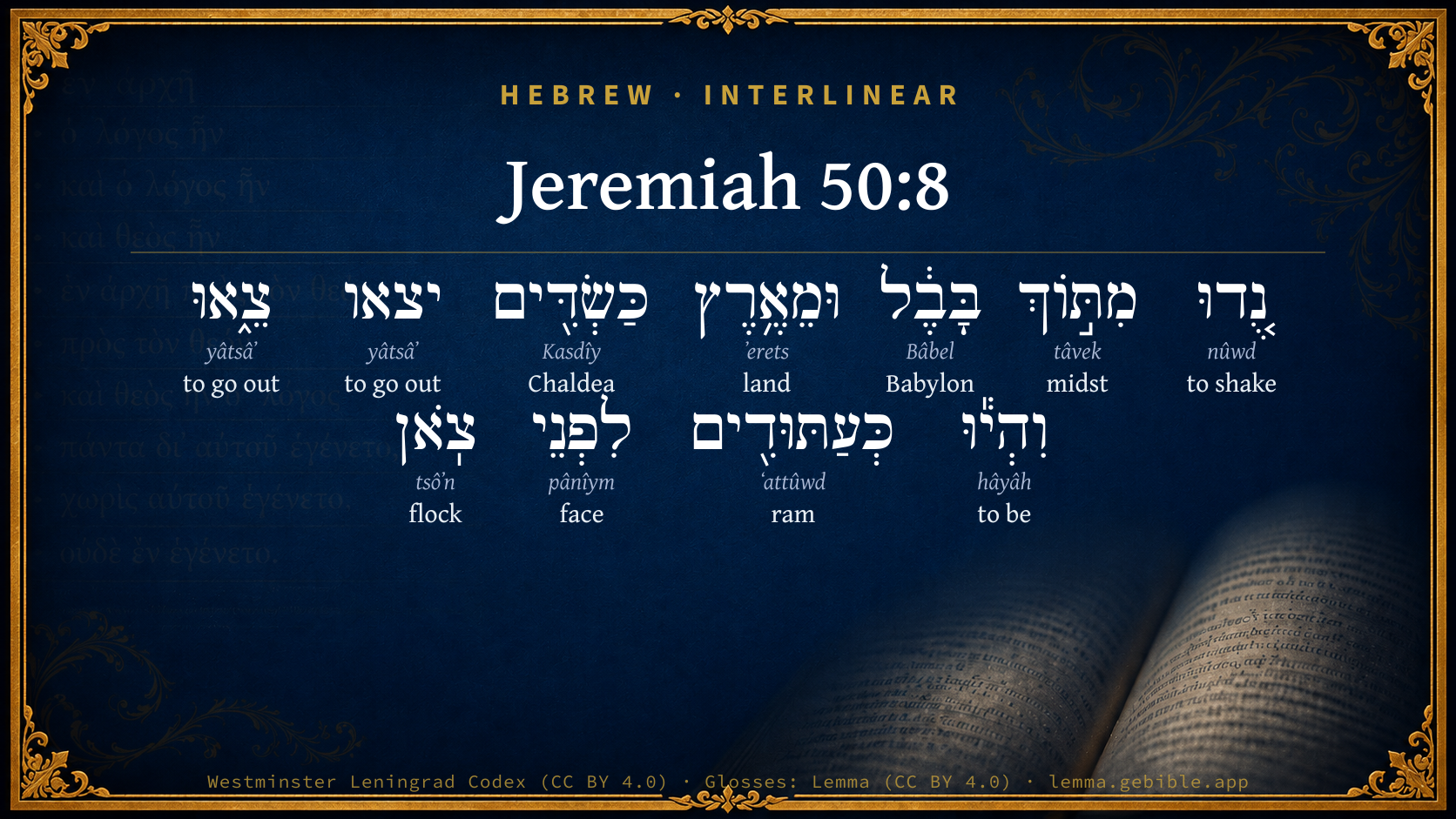
Hebrew (Westminster Leningrad Codex) Jeremiah 50:8 appears in the Hebrew Old Testament. The text above is from the Westminster Leningrad Codex. Each word links to its Strong’s number, a concise gloss, and parsing drawn from the Open Scriptures Hebrew Bible morphology. Click any word for its full Brown-Driver-Briggs (BDB) entry.
Download image
Cite this verse

Jeremiah 50:8 (World English Bible). Public Domain. Lemma interlinear Bible study tool, https://lemma.gebible.app/v/jeremiah/50/8.

Show BibTeX & RIS
BibTeX
RIS
English Translation
Flee out of the midst of Babylon, and go forth out of the land of the Chaldeans, and be as the male goats before the flocks.
World English Bible · Public Domain
Download a study sheet

One document with this verse’s original text, its word-by-word gloss line, the meaning frame, cross-references with their text, attributed commentary, and full source and license credits — printable, and it pastes into notes with its structure intact.

This verse Autodidact and up

Study sheet (.html) Plain text (.txt)

A passage Seminary Student

Up to 50 verses in one chapter. A passage sheet keeps up to 6 commentary sources and 12 cross-references per verse, in the order this page ranks them, and says so on the sheet whenever that leaves anything out. Ask for a single verse and you get the Autodidact verse sheet above.

Everything on this page stays free to read, with no account — the sheet is a download of what is already on screen, not access to it.

Want to remove ads? Support Godless Engineer
Compare translations 3

The same verse in 3 English versions, stacked beneath the original-language interlinear above. Click any original word for its lexicon entry.

Each is an independent rendering of the whole verse — the interlinear is not word-aligned to these translations.

Highlighted words mark where these versions differ — a whole-verse word diff, not a word-by-word alignment.

  • World English Bible Public Domain
    Flee out of the midst of Babylon, and go forth out of the land of the Chaldeans, and be as the male goats before the flocks.
  • King James Version Public Domain
    Remove out of the midst of Babylon, and go forth out of the land of the Chaldeans, and be as the he goats before the flocks.
  • unfoldingWord Literal Text CC BY-SA 4.0
    Leave from the midst of Babylon; go out from the land of the Chaldeans; be like male goats that leave before the rest of the flock does.

unfoldingWord Literal Text — © unfoldingWord, licensed CC BY-SA 4.0. Word-aligned USFM3 via Door43 (git.door43.org/unfoldingWord/en_ult).

Versions to compare (up to 4)

3 of 4 selected

Show all 18 translations

Every available English version of this verse, each an independent rendering of the whole verse.

  • World English Bible Public Domain
    Flee out of the midst of Babylon, and go forth out of the land of the Chaldeans, and be as the male goats before the flocks.
  • Berean Standard Bible Public Domain
    Flee from the midst of Babylon; depart from the land of the Chaldeans; be like the he-goats that lead the flock.
  • Majority Standard Bible Public Domain
    Flee from the midst of Babylon; depart from the land of the Chaldeans; be like the he-goats that lead the flock.
  • King James Version Public Domain
    Remove out of the midst of Babylon, and go forth out of the land of the Chaldeans, and be as the he goats before the flocks.
  • American Standard Version (1901) Public Domain
    Flee out of the midst of Babylon, and go forth out of the land of the Chaldeans, and be as the he-goats before the flocks.
  • Revised Version (1885) Public Domain
    Flee out of the midst of Babylon, and go forth out of the land of the Chaldeans, and be as the he-goats before the flocks.
  • Geneva Bible (1599) Public Domain
    Flee from the middes of Babel, and depart out of the lande of the Caldeans, and be ye as the hee goates before the flocke.
  • Douay-Rheims (1899) Public Domain
    Remove out of the midst of Babylon, and go forth out of the land of the Chaldeans: and be ye as kids at the head of the flock.
  • Young's Literal Translation Public Domain
    Move ye from the midst of Babylon, And from the land of the Chaldeans go out. And be as he-goats before a flock.
  • Literal Standard Version CC BY-SA 4.0
    Move from the midst of Babylon, || And go out from the land of the Chaldeans; And be as male goats before a flock.
  • Unlocked Literal Bible CC BY-SA 4.0
    Leave from the midst of Babylon; go out from the land of the Chaldeans; be like male goats that leave before the rest of the flock does.
  • unfoldingWord Literal Text CC BY-SA 4.0
    Leave from the midst of Babylon; go out from the land of the Chaldeans; be like male goats that leave before the rest of the flock does.
  • Darby Bible Public Domain
    Flee out of the midst of Babylon, and go forth out of the land of the Chaldeans, and be as the he-goats before the flock.
  • World Messianic Bible Public Domain
    “Flee out of the middle of Babylon! Go out of the land of the Kasdim, and be as the male goats before the flocks.
  • Webster's Bible Public Domain
    Remove out of the midst of Babylon, and go forth from the land of the Chaldeans, and be as the he-goats before the flocks.
  • Free Bible Version CC BY-SA 4.0
    Run away from the city of Babylon; get away from the country of Babylonia! Lead the way like the male goats that lead the flock.
  • Bible in Basic English Public Domain
    Go in flight out of Babylon, go out of the land of the Chaldaeans, and be like he-goats before the flocks.
  • JPS Tanakh (1917) Public Domain
    Flee out of the midst of Babylon, and go forth out of the land of the Chaldeans, and be as the he-goats before the flocks.

Literal Standard Version (2020), Covenant Press — licensed CC BY-SA 4.0. Text via the HelloAO Bible API (eBible.org). Unlocked Literal Bible (unfoldingWord) — licensed CC BY-SA 4.0. Text via the HelloAO Bible API (eBible.org). unfoldingWord Literal Text — © unfoldingWord, licensed CC BY-SA 4.0. Word-aligned USFM3 via Door43 (git.door43.org/unfoldingWord/en_ult). Free Bible Version, Dr. Jonathan Gallagher — licensed CC BY-SA 4.0. Text via the HelloAO Bible API (eBible.org).

Word by word

More ways to search: Search by grammar → Find every occurrence → Compare this word →

Practice this passage: Drill this verse → Learn its vocabulary →

נֻ֚דוּ
nûwd
H5110
“shake”
Verb, Qal, Imperative, 2nd Person, Masculine, Plural
Part of Speech
Verb
Stem
Qal
Form
Imperative
Person
2nd Person
Gender
Masculine
Number
Plural
Full BDB Definition

Origin: a primitive root

TWOT: 1319

to shake, waver, wander, move to and fro, flutter, show grief, have compassion on - (Qal) - to move to and fro, wander (aimlessly), take flight - to flutter - to waver, wave, shake - to show grief - to lament, condole, show sympathy - (Hiphil) - to cause to wander (aimlessly) - to make a wagging, wag (with the head) - (Hithpolel) - to move oneself to and fro, sway, totter - to shake oneself - to bemoan oneself
  1. מִתּ֣וֹךְ tâvek H8432 “from · midst of” Preposition + Noun, Common, Masculine, Singular, Construct
  2. בָּבֶ֔ל Bâbel H894 “Babylon” Noun, Proper
  3. וּמֵאֶ֥רֶץ ʼerets H776 “and · from · land of” Conjunction + Preposition + Noun, Common, Both, Singular, Construct
  4. כַּשְׂדִּ֖ים Kasdîy H3778 “Chaldea” Noun, Proper
  5. יצאו yâtsâʼ H3318 “to go out” Verb, Qal, Perfect, 3rd Person, Common, Plural
  6. צֵ֑אוּ yâtsâʼ H3318 “go out” Verb, Qal, Imperative, 2nd Person, Masculine, Plural
  7. וִהְי֕וּ hâyâh H1961 “and · be” Conjunction + Verb, Qal, Imperative, 2nd Person, Masculine, Plural
  8. כְּעַתּוּדִ֖ים ʻattûwd H6260 “like/as · rams” Preposition + Noun, Common, Masculine, Plural, Absolute
  9. לִפְנֵי pânîym H6440 “to/for · face(s) of” Preposition + Noun, Common, Both, Plural, Construct
  10. צֹֽאן tsôʼn H6629 “flock” Noun, Common, Both, Singular, Absolute

About this verse

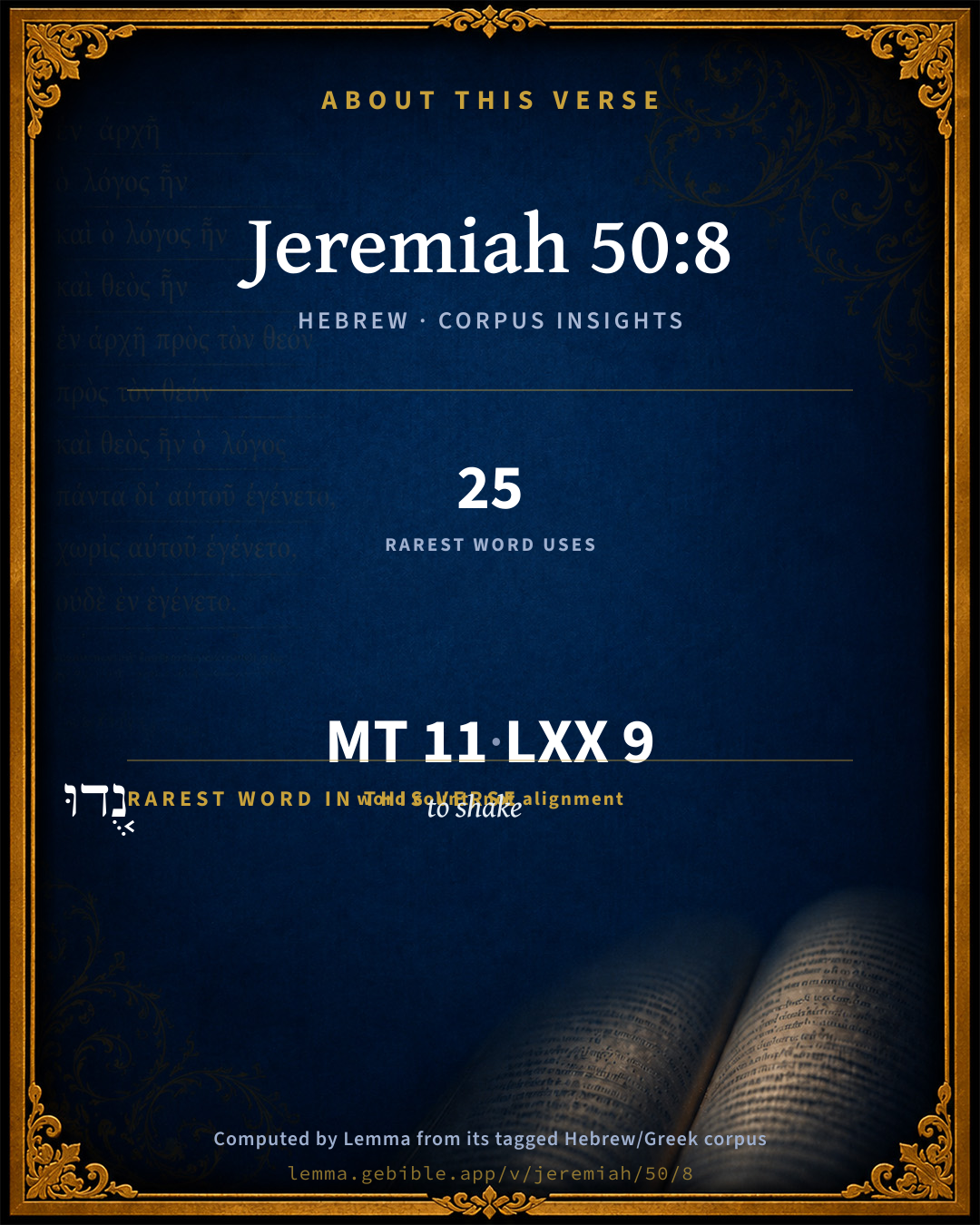
These counts appear in no published source. They are computed here, from the morphology-tagged text and Lemma’s own curated glosses. What Lemma adds →

11
words
10
distinct lemmas
Prophets
section

Notable vocabulary

The rarest word here is נֻ֚דוּ to shake H5110 — appearing just 25 times in the whole Hebrew Bible.

Shared distinctive vocabulary

נֻ֚דוּ to shake H5110 occurs in 24 verses of the Hebrew Bible. Also found in:

Grammatical profile

  • 4 verbs
  • 7 nouns

Verb forms

  • נֻ֚דוּ Qal · Imperative
  • יצאו Qal · Perfect
  • צֵ֑אוּ Qal · Imperative
  • וִהְי֕וּ Qal · Imperative

Repetition

A word recurs within this verse — often emphatic in Hebrew:

  • יצאו to go out H3318 ×2

Hebrew & Septuagint length

In the original languages it is 11 Hebrew tokens and 9 Greek tokens — but the two are counted differently (Hebrew bundles its prefixes and suffixes into one token; the Greek is in lemma form), so that isn’t a like-for-like length.

Cross-references

9

Topical passages linked to Jeremiah 50:8 in the Treasury of Scripture Knowledge — connected by theme and wording, ordered by reader-vote popularity; previews shown in the World English Bible.

  • Isaiah 48:20 Go you forth from Babylon, flee you from the Chaldeans; with a voice of singing declare you, tell this, utter it even to the end of the earth: say you, Yahweh has redeemed his servant Jacob.
  • Jeremiah 51:6 Flee out of the midst of Babylon, and save every man his life; don't be cut off in her iniquity: for it is the time of Yahweh's vengeance; he will render to her a recompense.
  • Revelation 18:4 I heard another voice from heaven, saying, "Come out of her, my people, that you have no participation in her sins, and that you don't receive of her plagues,
  • Jeremiah 51:45 My people, go you out of the midst of her, and save yourselves every man from the fierce anger of Yahweh.
  • Numbers 16:26 He spoke to the congregation, saying, Depart, I pray you, from the tents of these wicked men, and touch nothing of theirs, lest you be consumed in all their sins.
  • Proverbs 30:31 The greyhound, The male goat also; And the king against whom there is no rising up.
  • Isaiah 52:1 Awake, awake, put on your strength, Zion; put on your beautiful garments, Jerusalem, the holy city: for henceforth there shall no more come into you the uncircumcised and the unclean.
  • Zechariah 2:6–7 Come! Come! Flee from the land of the north,' says Yahweh; 'for I have spread you abroad as the four winds of the sky,' says Yahweh.
  • 2 Corinthians 6:17 Therefore, "'Come out from among them, And be separate,' says the Lord, 'Touch no unclean thing. I will receive you.

Cross-references courtesy of OpenBible.info (CC BY 4.0).

Hebrew and Greek witnesses Masoretic Hebrew ↔ Greek Septuagint

The same verse in the two great witnesses to the Old Testament, shown verse-for-verse.

These are two independent witnesses, not word-aligned to each other, and the Septuagint is shown in lemma (dictionary) form.

Hebrew Jeremiah 50:8 Masoretic · Westminster Leningrad Codex

נֻ֚דוּ מִתּ֣וֹךְ בָּבֶ֔ל וּמֵאֶ֥רֶץ כַּשְׂדִּ֖ים יצאו צֵ֑אוּ וִהְי֕וּ כְּעַתּוּדִ֖ים לִפְנֵי צֹֽאן

Flee out of the midst of Babylon, and go forth out of the land of the Chaldeans, and be as the male goats before the flocks.

World English Bible · Public Domain

Greek LXX Structure differs

In the Septuagint, Jeremiah is about an eighth shorter than the Hebrew and arranges its material differently — the Oracles Against the Nations (Hebrew chapters 46–51) appear in the middle of the Greek book, after 25:13. Because the chapter and verse boundaries do not line up, a verse-for-verse comparison with the Hebrew is not shown.

A verse-for-verse comparison isn’t shown here because the chapters and verses don’t line up. Switch to the LXX edition with the MT / LXX toggle above to read the Greek directly.

Hebrew: Westminster Leningrad Codex (CC BY 4.0). Greek: Septuagint (public domain); English from a public-domain English Septuagint. How the Septuagint differs from the Hebrew →

Targum (Aramaic paraphrase)

1

The Targum is the ancient Jewish Aramaic paraphrase of the Hebrew Scriptures — an interpretive translation, not the Hebrew text itself. Onkelos (literal) and Pseudo-Jonathan (expansive) render the Torah, and Jonathan the Prophets. Coverage is partial: where no permissively-licensed English translation exists for a verse, only the Aramaic is shown. This is verse-level text, not a word-by-word alignment to the Hebrew.

  1. Targum Jonathan Prophets (Joshua–Malachi)
    גְלוֹ מִגוֹ בָּבֶל וּמֵאֲרַע כַּסְדָאֵי פּוּקוּ וַהֲווֹ כְּרַבְרְבִין בְּרֵישׁ עַמָא:

    (no public-domain English translation for this verse)

    Targum Jonathan — Aramaic: “Mikraot Gedolot” (public domain). English: “Sefaria Community Translation” (CC0 1.0 (public-domain dedication)); “London "Chaldee Paraphrase," 1871” (public domain). Text via Sefaria.

Commentary

Notes on Jeremiah 50:8 from classic Christian and Jewish commentators (each source and its license shown beneath its notes). The classic Christian expositions comment on the surrounding passage and are grouped to its opening verse, so a note may address several verses; the Jewish commentaries on the Tanakh (Rashi and others) are per-verse, so they appear only where the commentator wrote on this verse.

Lemma curates 59 commentaries, every one of them public domain or Creative Commons licensed, each selected and text-cleaned for this edition rather than reprinted as found. About our sources →

Trapp's Complete Commentary

John Trapp

Jer 50:8 Remove out of the midst of Babylon, and go forth out of the land of the Chaldeans, and be as the he goats before the flocks.

Ver. 8. Remove out of the midst of Babylon.] "Ho, ho, come forth." {as Zec 2:6} "Away, this is not your rest, for it is polluted." {Mic 2:10} See Isa 48:20 Rev 18:4.

Be as the he-goats.] That lead the flocks, generose et festinanter, freely and readily. Sheep are fearful, and therefore go behind; goats are not so, and therefore go before. There is good hope, saith one, that we are going out of Babylon, when the he-goats go before the flock; when men of public place and authority are active for reformation.

John Trapp, A Commentary or Exposition upon All the Books of the Old and New Testament (1647–1656) — public domain. Text from a community e-Sword module.

Joseph Benson's Commentary

Jer 50:8. Remove out of the midst of Babylon — All exhortation often used by the prophets on this subject: see the margin. Some learned men suppose that this exhortation relates to the siege of Babylon carried on by Darius Hystaspes in the fifth and sixth years of his reign. Before which time God had warned the Jews, by the Prophet Zechariah, (Zec 2:6-7,) to flee out of Babylon, and to deliver themselves from the miseries that should befall that city during the siege: see Dr. Prideaux. And be as the he-goats before the flocks — “Let every one strive to lead the way to others, and give them an example of speedily obeying God’s call, without showing any fondness to the place, or the idolatries there practised.”

Joseph Benson's Commentary on the Old and New Testaments (1811–1818) — public domain. Text from a community e-Sword module.

Tyndale Open Study Notes

Tyndale Open Resources

50:8-9 The Lord urged the Israelites to leave when he ordered an army of great nations (Persia and its allies) to attack Babylon in 539 BC.

Tyndale Open Study Notes — © Tyndale Open Resources, licensed CC BY-SA 4.0. Text via the HelloAO Bible API.

Geneva Bible (1599)

Geneva Bible translators

That is, most forward and without fear.

When God shall deliver you by Cyrus.

Geneva Bible (1599) marginal notes — public domain. Text via Bolls.life.

Jamieson, Fausset & Brown

Robert Jamieson, A. R. Fausset & David Brown

(Jer 51:6, Jer 51:45; Isa 48:20; Zac 2:6-7; Rev 18:4). Immediately avail yourselves of the opportunity of escape.

be as . . . he-goats before . . . flocks--Let each try to be foremost in returning, animating the weak, as he-goats lead the flock; such were the companions of Ezra (Ezr 1:5-6).

Jamieson, Fausset & Brown — Commentary Critical and Explanatory on the Whole Bible (1871) — public domain (CC PDM 1.0). Text via the HelloAO Bible API.

Adam Clarke's Commentary

Verse 8. Remove out of the midst of Babylon] The sentence of destruction is gone out against it; prepare for your flight, that ye be not overwhelmed in its ruin.

Be as the he-goats before the flocks.] Who always run to the head of the flock, giving the example for others to follow. This may be addressed to the elders and persons of authority among the people.

Adam Clarke's Commentary on the Bible (1810–1826) — public domain. Text from a community e-Sword/MySword module.

John Calvin's Commentaries

This verse confirms the exposition which I have given; for God does not now reprove his people, nor does he condemn their sins; but on the contrary, he exhorts them to entertain good hope, though they were overwhelmed with extreme miseries, he then pursues the same subject when he bids them to flee from Babylon and to go forth from Chaldea; for he promises deliverance to the faithful, and at the same time reminds them of the coming ruin of the Chaldean empire, so that they who went the farthest off would best consult their own safety. For the Prophet intimates that all found in Chaldea would be exposed to the violence of enemies; hence he bids them to flee and to go forth quickly. But as I have before said, he promises a free exit to the Jews; for he would have in vain exhorted them to depart had they been shut up, for we know that they had been confined as within inclosures. Had they then been thus captives, the Prophet would have spoken in mockery by saying to them, Flee and go forth But he shows that their captivity would not be perpetual, because God would remove all obstacles and open a way for the miserable exiles to return to their own country.

He bids them to be as he-goats before the flocks: by which he means that they were to hasten with all confidence. For the he-goats possess more boldness than sheep, and they go before the flock because no fear restrains them. So God takes away every fear of danger from the Jews when he bids them to be as he-goats before the flock; as though he had said that they were no more to fear, lest the Chaldeans should punish them for avowing their wish to return to their own country; for it was a capital offense to speak of their return as long as the Chaldeans ruled over the Jews. But God now promises a change, for he would dissipate the terror by which they had been for a time restrained. It follows, —

John Calvin's Commentaries (1540-1563) — public domain. Text from the Calvin Translation Society English edition (1840s-50s) via the Christian Classics Ethereal Library (ccel.org). Calvin's coverage is partial (roughly two-thirds of the Bible); uncommented books and verses are honest gaps, never fabricated. The 19th-century editor's footnotes and remarks are omitted so the notes are faithfully Calvin's own voice.

Ellicott's Commentary for English Readers

(8) Remove out of the midst of Babylon . . .—The prophet re-echoes almost the very words of Isa_48:20; Isa_52:11. It is obviously in marked contrast with the counsels in Jer_29:5-7 that the exiles should build houses and plant gardens, and seek the peace of the city of their conquerors. That was a wise and right counsel for the time, but it was for a time only; and when the hour of the fall of Babylon came they were to be as the he-goats (better, rams) of the flock, leading the captives of other nations in the work of liberation and of flight. That was their only way of escape from being involved in the destruction of the doomed city.

A Bible Commentary for English Readers, edited by Charles John Ellicott (1878–1897) — public domain. Text from a community e-Sword module.

The Cambridge Bible for Schools and Colleges

gen. ed. J. J. S. Perowne

8. Having told of the repentance of Israel, and of their sufferings in the land of exile, the prophet now calls upon them to set out upon their return. Cp. Isa_48:20.

be as the he-goats] who press to the front of the flock. So be ye the first of the exiled nations to leave before the crash comes.

The Cambridge Bible for Schools and Colleges (gen. ed. J. J. S. Perowne; Cambridge University Press, 1878–1918) — public domain. Text from a community e-Sword module.

John Gill's Exposition

Remove out of the midst of Babylon, and go forth out of the land of the Chaldeans,.... This, in the literal sense, is a call to the Jews in Babylon, and in other parts of Chaldea, to go out from thence upon the proclamation of Cyrus; and especially to the chief of them, to animate the rest, and set them an example; such as Zerubbabel, Jeshua, Ezra, and others: and, in the mystical sense, is a call to the people of God in Rome, and the antichristian states, to come out from thence, a little before the destruction thereof, as in Rev 18:4; which seems to refer to this passage:

and be as the he goats before the flocks; which walk stately and nimbly, cheerfully and readily, without fear and dread, boldly and confidently, and encourage others to follow them. The Targum is,

"as princes at the head of their people.''

John Gill's Exposition of the Whole Bible (1746–1763) — public domain (CC PDM 1.0). Text via the HelloAO Bible API.

Albert Barnes' Notes on the Bible

So firmly did the Jews settle themselves in Babylon under Jeremiah’s counsels, that they were the last to abandon the place.

He goats - See Isa 14:9 note.

Albert Barnes' Notes on the Bible (1834–1885) — public domain. Text from a community e-Sword/MySword module.

Haydock's Catholic Bible Commentary

Kids; rams. This comparison was not ignoble. Go boldly out of the city, before it be besieged.

George Leo Haydock (1774–1849), Haydock's Catholic Family Bible and Commentary, 1859 edition — public domain. Excludes Psalms (Douay-Rheims chapter numbering differs from Protestant) and Deuterocanonical books (Catholic canon only).

Matthew Poole's English Annotations

These words immediately following the other, confirm Mr. Calvin’s notion. God by his prophet commanding his people to remove out of Babylon, and to go forth cheerfully, and skipping like the he-goats of the flock leading the way, and setting an example unto others. We find much such a call Isa 48:20; Jer 51:6, which is applied to spiritual Babylon, Rev 18:4, where the coming out is to be understood of a separation from them as to any religious communion, which also was their duty as to old Babylon; but that is not the coming out here spoken of.

Matthew Poole's English Annotations on the Holy Bible (1683–1685) — public domain. Text from a community e-Sword/MySword module.

Whedon's Commentary on the Bible

Daniel D. Whedon

8. As the he goats before the flocks — Israel should be as an example and leader, strengthening the weak, guiding the bewildered, and animating and encouraging the despondent.

Daniel D. Whedon (gen. ed.), Commentary on the Old and New Testaments (1874–1909) — public domain. Text from a community e-Sword module.

John Wesley's Explanatory Notes

Remove - God commands his people to remove out of Babylon, and to go forth cheerfully like the he-goats of a flock leading the way.

John Wesley, Explanatory Notes Upon the Whole Bible (1754–1765) — public domain. Text via the GEBible commentary corpus.

unfoldingWord translationNotes

Door43 World Missions Community

General Information:

Yahweh is speaking to his people in captivity in Babylon.

Leave from the midst of Babylon

This command is addressed to the people of Israel who were in exile in Babylon.

be like male goats that leave

Male goats tend to be more independent than the rest of the flock. Possible meanings are 1) they should be the first to leave Babylon or 2) they should lead the rest of the Israelites away from Babylon. (See: Simile)

For see

The word "see" alerts the reader to pay attention to what follows. AT: "Pay attention, because"

set in motion

"stir up"

Babylon will be captured from there

This can be stated in active form. AT: "These nations will capture Babylon" (See: Active or Passive)

from there

Possible meanings are 1) "from the north" or 2) "from their battle positions."

this is Yahweh's declaration

Yahweh speaks of himself by name to express the certainty of what he is declaring. See how you translated this in Jeremiah 1:8. AT: "this is what Yahweh declares" or "this is what I, Yahweh, declare" (See: First, Second, or Third Person)

Their arrows are like a skilled warrior who does not return empty-handed

The effectiveness of the arrows of the attacking nations are spoken of as if they were soldiers that always accomplish their mission. The idiom "empty-handed" means "without success." AT: Each of their arrows are like skilled soldiers that always hit their target" (See: Simile and Idiom)

Chaldea will become plunder

"They will plunder Chaldea"

translationWords

Chaldea

goat

bow and arrow

Yahweh

declare

unfoldingWord translationNotes — © Distant Shores Media and the Door43 World Missions Community, licensed CC BY-SA 4.0. Source: git.door43.org/Door43/en_tn.

Rashi

Rabbi Shlomo Yitzchaki (Rashi)

Wander out of Babylon Accordingly, go out of there.

like the he goats before the flocks It is customary for the he-goats to go before the flock, at the head of the she-goats.

Rashi on the Tanakh — English translations: “The Judaica Press complete Tanach with Rashi, translated by A. J. Rosenberg” (CC BY 4.0); “Pentateuch with Rashi's commentary by M. Rosenbaum and A.M. Silbermann, 1929-1934” (public domain); “The Metsudah Tanach series, Lakewood, N.J” (CC BY 4.0); and “The Book of Joshua, Metsudah Publications, 1997” (CC BY 4.0). Text via Sefaria.

Lesson kit

Teaching starters — assembled from the data on this page, not authored interpretation. Every prompt links to the verse data it draws on. Edit before teaching.

Jeremiah, in the Prophets, opens this verse with 11 words (10 distinct Hebrew lemmas). Its most distinctive word is nûwd (“to shake”). A historical commentator’s framing appears above. Read the whole chapter for the surrounding context.

Discussion questions

  1. How does “to shake” (nûwd) shape what this verse is saying?
  2. Genesis 4:12 shares the word «to shake» with this verse. How do the two illuminate each other?
  3. “to go out” occurs 2× in this one verse. What is the effect of the repetition?
  4. The translations on this page render this verse differently — a whole-verse word diff, not a word-by-word alignment. What might account for the different wordings?
  5. The verb «נֻ֚דוּ» is Qal Imperative. How does its form color the action?
  6. Reading how Trapp's Complete Commentary and Joseph Benson's Commentary read this verse, where do the two commentators agree and where do they part?

Things to notice

Reading settings

Reading text

Shown beneath each verse's original-language words.

Old Testament
Old Testament edition

Read the OT as the Masoretic Hebrew (MT) or the Greek Septuagint (LXX).

English shown for the Greek Septuagint (in the Hebrew ↔ Greek comparison).

Comparing translations? Open the Compare panel on any verse page to stack up to four side by side.