
Jeremiah 27:7

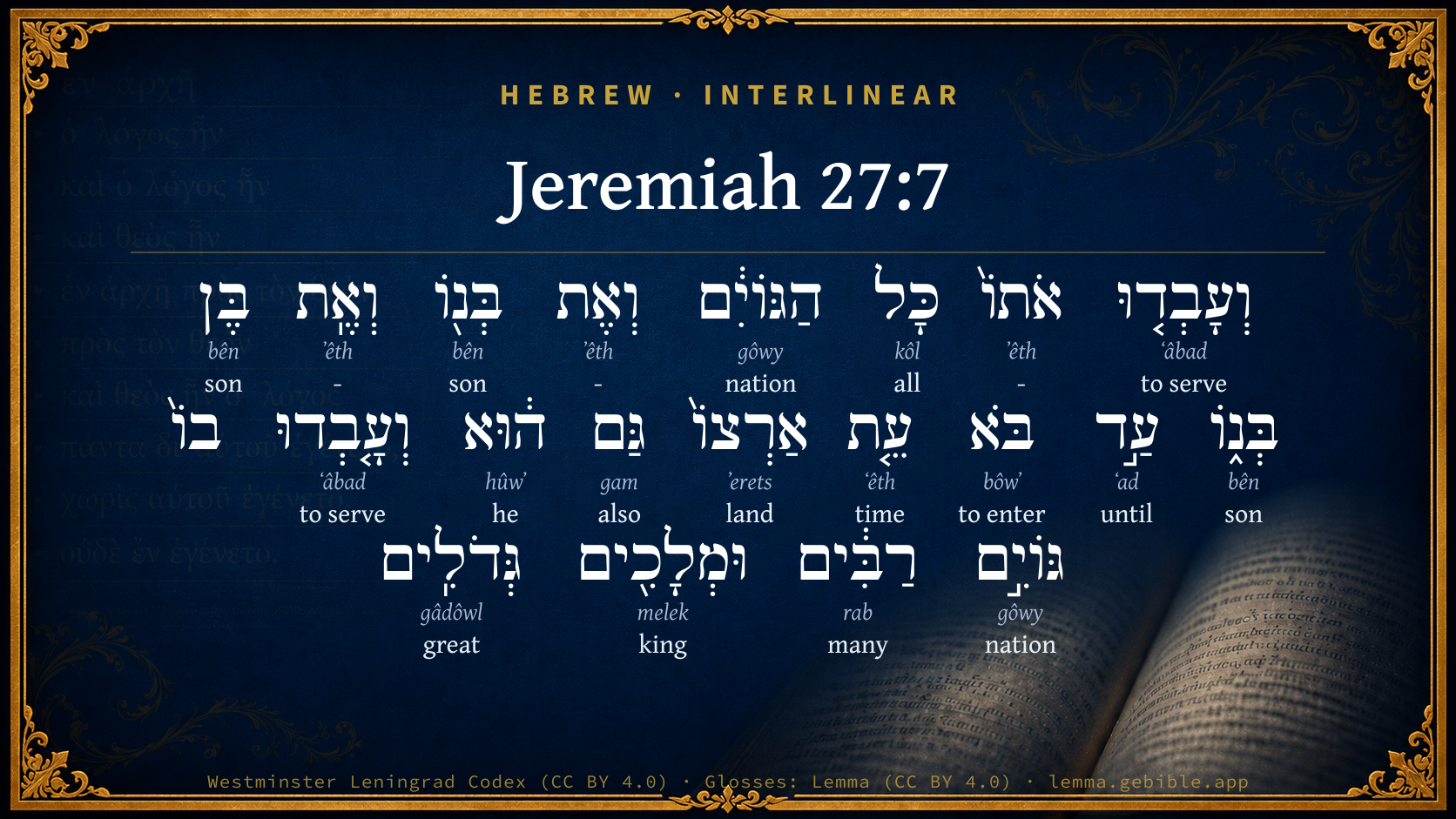
Hebrew (Westminster Leningrad Codex) Jeremiah 27:7 appears in the Hebrew Old Testament. The text above is from the Westminster Leningrad Codex. Each word links to its Strong’s number, a concise gloss, and parsing drawn from the Open Scriptures Hebrew Bible morphology. Click any word for its full Brown-Driver-Briggs (BDB) entry.
Download image
Cite this verse

Jeremiah 27:7 (World English Bible). Public Domain. Lemma interlinear Bible study tool, https://lemma.gebible.app/v/jeremiah/27/7.

Show BibTeX & RIS
BibTeX
RIS
English Translation
All the nations shall serve him, and his son, and his son's son, until the time of his own land come: and then many nations and great kings shall make him their bondservant.
World English Bible · Public Domain
Download a study sheet

One document with this verse’s original text, its word-by-word gloss line, the meaning frame, cross-references with their text, attributed commentary, and full source and license credits — printable, and it pastes into notes with its structure intact.

This verse Autodidact and up

Study sheet (.html) Plain text (.txt)

A passage Seminary Student

Up to 50 verses in one chapter. A passage sheet keeps up to 6 commentary sources and 12 cross-references per verse, in the order this page ranks them, and says so on the sheet whenever that leaves anything out. Ask for a single verse and you get the Autodidact verse sheet above.

Everything on this page stays free to read, with no account — the sheet is a download of what is already on screen, not access to it.

Want to remove ads? Support Godless Engineer
Compare translations 3

The same verse in 3 English versions, stacked beneath the original-language interlinear above. Click any original word for its lexicon entry.

Each is an independent rendering of the whole verse — the interlinear is not word-aligned to these translations.

Highlighted words mark where these versions differ — a whole-verse word diff, not a word-by-word alignment.

  • World English Bible Public Domain
    All the nations shall serve him, and his son, and his son's son, until the time of his own land come: and then many nations and great kings shall make him their bondservant.
  • King James Version Public Domain
    And all nations shall serve him, and his son, and his son's son, until the very time of his land come: and then many nations and great kings shall serve themselves of him.
  • unfoldingWord Literal Text CC BY-SA 4.0
    And all the nations will serve him and his son and the son of his son, until the time of his own land comes, even it. And many nations and great kings will make him serve them.

unfoldingWord Literal Text — © unfoldingWord, licensed CC BY-SA 4.0. Word-aligned USFM3 via Door43 (git.door43.org/unfoldingWord/en_ult).

Versions to compare (up to 4)

3 of 4 selected

Show all 18 translations

Every available English version of this verse, each an independent rendering of the whole verse.

  • World English Bible Public Domain
    All the nations shall serve him, and his son, and his son's son, until the time of his own land come: and then many nations and great kings shall make him their bondservant.
  • Berean Standard Bible Public Domain
    All nations will serve him and his son and grandson, until the time of his own land comes; then many nations and great kings will enslave him.
  • Majority Standard Bible Public Domain
    All nations will serve him and his son and grandson, until the time of his own land comes; then many nations and great kings will enslave him.
  • King James Version Public Domain
    And all nations shall serve him, and his son, and his son's son, until the very time of his land come: and then many nations and great kings shall serve themselves of him.
  • American Standard Version (1901) Public Domain
    And all the nations shall serve him, and his son, and his son's son, until the time of his own land come: and then many nations and great kings shall make him their bondman.
  • Revised Version (1885) Public Domain
    And all the nations shall serve him, and his son, and his son’s son, until the time of his own land come: and then many nations and great kings shall serve themselves of him.
  • Geneva Bible (1599) Public Domain
    And all nations shall serue him, and his sonne, and his sonnes sonne vntill the very time of his lande come also: then many nations and great Kinges shall serue themselues of him.
  • Douay-Rheims (1899) Public Domain
    And all nations shall serve him, and his son, and his son's son: till the time come for his land and himself: and many nations and great kings shall serve him.
  • Young's Literal Translation Public Domain
    And served him have all the nations, and his son, and his son's son, till the coming in of the time of his land, also it; and done service for him have many nations and great kings.
  • Literal Standard Version CC BY-SA 4.0
    and all the nations have served him, and his son, and his son’s son, until the coming in of the time of his land, also it; and many nations and great kings have made him serve them.
  • Unlocked Literal Bible CC BY-SA 4.0
    For all the nations will serve him, his son, and his grandson until the time for his land comes. Then many nations and great kings will subdue him.
  • unfoldingWord Literal Text CC BY-SA 4.0
    And all the nations will serve him and his son and the son of his son, until the time of his own land comes, even it. And many nations and great kings will make him serve them.
  • Darby Bible Public Domain
    And all the nations shall serve him, and his son, and his son's son, until the time of his land also come, when many nations and great kings shall reduce him to servitude.
  • World Messianic Bible Public Domain
    All the nations will serve him, his son, and his son’s son, until the time of his own land comes. Then many nations and great kings will make him their bondservant.
  • Webster's Bible Public Domain
    And all nations shall serve him, and his son, and his son's son, until the very time of his land shall come: and then many nations and great kings shall bring him into subjection.
  • Free Bible Version CC BY-SA 4.0
    All nations will serve him and his son and grandson, until the time that his own land comes under the control of other nations and powerful kings.
  • Bible in Basic English Public Domain
    And all the nations will be servants to him and to his son and to his son's son, till the time comes for his land to be overcome: and then a number of nations and great kings will take it for their use.
  • JPS Tanakh (1917) Public Domain
    And all the nations shall serve him, and his son, and his son's son, until the time of his own land come; and then many nations and great kings shall make him their bondman.

Literal Standard Version (2020), Covenant Press — licensed CC BY-SA 4.0. Text via the HelloAO Bible API (eBible.org). Unlocked Literal Bible (unfoldingWord) — licensed CC BY-SA 4.0. Text via the HelloAO Bible API (eBible.org). unfoldingWord Literal Text — © unfoldingWord, licensed CC BY-SA 4.0. Word-aligned USFM3 via Door43 (git.door43.org/unfoldingWord/en_ult). Free Bible Version, Dr. Jonathan Gallagher — licensed CC BY-SA 4.0. Text via the HelloAO Bible API (eBible.org).

Word by word

More ways to search: Search by grammar → Find every occurrence → Compare this word →

Practice this passage: Drill this verse → Learn its vocabulary →

וְעָבְד֤וּ
ʻâbad
H5647
“and · to serve”
Conjunction + Verb, Qal, Sequential Perfect, 3rd Person, Common, Plural
Part of Speech
Conjunction + Verb
Stem
Qal
Form
Sequential Perfect
Person
3rd Person
Gender
Common
Number
Plural
Full BDB Definition

Origin: a primitive root

TWOT: 1553

to work, serve - (Qal) - to labour, work, do work - to work for another, serve another by labour - to serve as subjects - to serve (God) - to serve (with Levitical service) - (Niphal) - to be worked, be tilled (of land) - to make oneself a servant - (Pual) to be worked - (Hiphil) - to compel to labour or work, cause to labour, cause to serve - to cause to serve as subjects - (Hophal) to be led or enticed to serve
  1. אֹתוֹ֙ ʼêth H853 “- · him” Particle, Direct Object + Suffix, Personal, 3rd Person, Masculine, Singular
  2. כָּל kôl H3605 “all of” Noun, Common, Masculine, Singular, Construct
  3. הַגּוֹיִ֔ם gôwy H1471 “the · nations” Particle, Definite Article + Noun, Common, Masculine, Plural, Absolute
  4. וְאֶת ʼêth H853 “and · -” Conjunction + Particle, Direct Object
  5. בְּנ֖וֹ bên H1121 “son · his” Noun, Common, Masculine, Singular, Construct + Suffix, Personal, 3rd Person, Masculine, Singular
  6. וְאֶֽת ʼêth H853 “and · -” Conjunction + Particle, Direct Object
  7. בֶּן bên H1121 “son of” Noun, Common, Masculine, Singular, Construct
  8. בְּנ֑וֹ bên H1121 “son · his” Noun, Common, Masculine, Singular, Construct + Suffix, Personal, 3rd Person, Masculine, Singular
  9. עַ֣ד ʻad H5704 “until” Preposition
  10. בֹּא bôwʼ H935 “to enter” Verb, Qal, Infinitive Construct
  11. עֵ֤ת ʻêth H6256 “time of” Noun, Common, Both, Singular, Construct
  12. אַרְצוֹ֙ ʼerets H776 “land · his” Noun, Common, Both, Singular, Construct + Suffix, Personal, 3rd Person, Masculine, Singular
  13. גַּם gam H1571 “also” Particle, Accusative
  14. ה֔וּא hûwʼ H1931 “he” Pronoun, Personal, 3rd Person, Masculine, Singular
  15. וְעָ֤בְדוּ ʻâbad H5647 “and · to serve” Conjunction + Verb, Qal, Sequential Perfect, 3rd Person, Common, Plural
  16. גּוֹיִ֣ם gôwy H1471 “nations” Noun, Common, Masculine, Plural, Absolute
  17. רַבִּ֔ים rab H7227 “many” Adjective, Adjective, Masculine, Plural, Absolute
  18. וּמְלָכִ֖ים melek H4428 “and · kings” Conjunction + Noun, Common, Masculine, Plural, Absolute
  19. גְּדֹלִֽים gâdôwl H1419 “great” Adjective, Adjective, Masculine, Plural, Absolute

About this verse

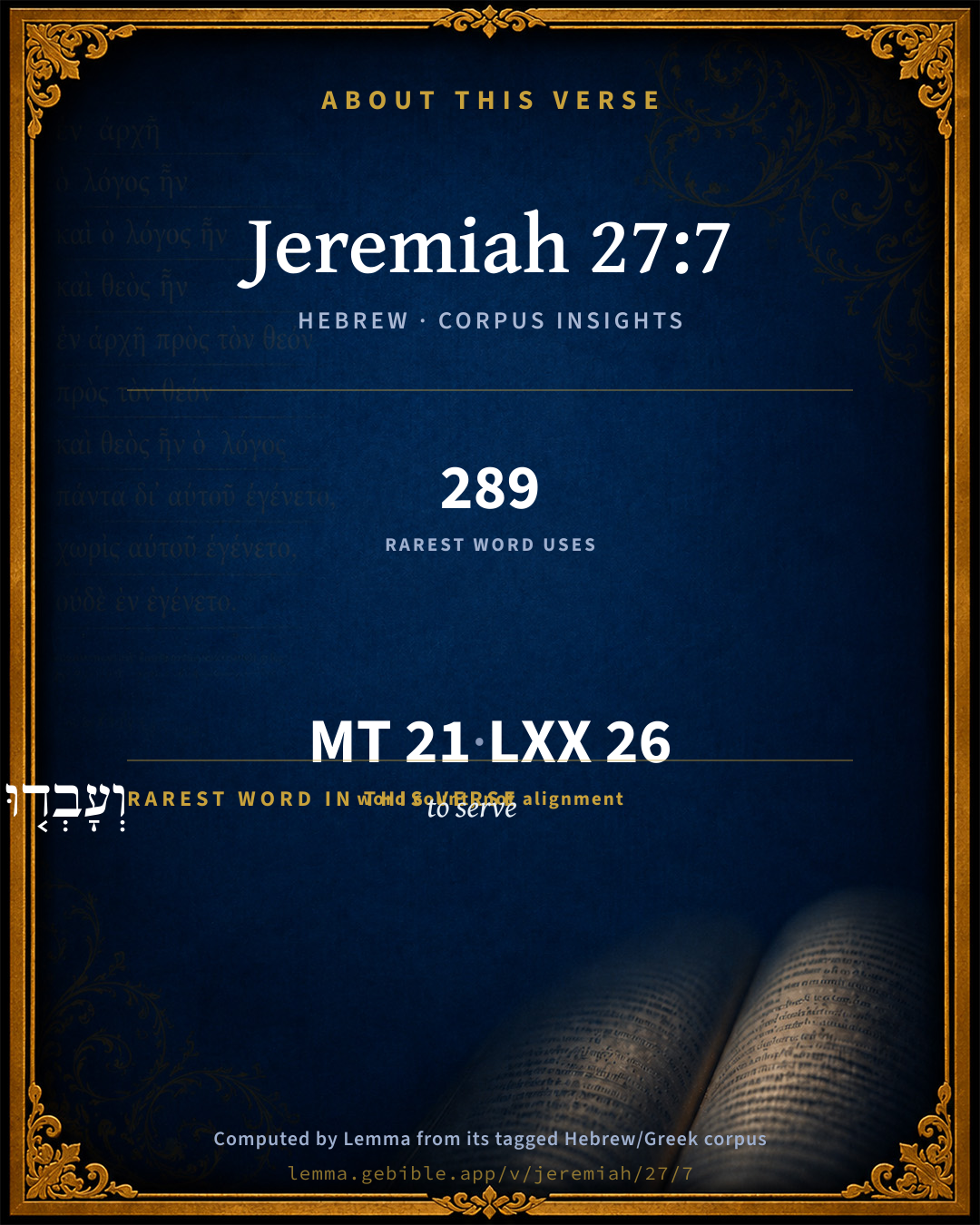
These counts appear in no published source. They are computed here, from the morphology-tagged text and Lemma’s own curated glosses. What Lemma adds →

21
words
14
distinct lemmas
Prophets
section

Grammatical profile

  • 3 verbs
  • 9 nouns
  • 2 adjectives
  • 1 pronoun
  • 2 prepositions
  • 4 particles

Verb forms

  • וְעָבְד֤וּ Qal · Sequential Perfect
  • בֹּא Qal · Infinitive Construct
  • וְעָ֤בְדוּ Qal · Sequential Perfect

Repetition

Words recur within this verse — often emphatic in Hebrew:

  • בְּנ֖וֹ son H1121 ×3
  • וְעָבְד֤וּ to serve H5647 ×2
  • הַגּוֹיִ֔ם nation H1471 ×2

Hebrew & Septuagint length

In the original languages it is 21 Hebrew tokens and 26 Greek tokens — but the two are counted differently (Hebrew bundles its prefixes and suffixes into one token; the Greek is in lemma form), so that isn’t a like-for-like length.

Cross-references

21

Topical passages linked to Jeremiah 27:7 in the Treasury of Scripture Knowledge — connected by theme and wording, ordered by reader-vote popularity; previews shown in the World English Bible.

  • Jeremiah 52:31 It happened in the seven and thirtieth year of the captivity of Jehoiachin king of Judah, in the twelfth month, in the five and twentieth day of the month, that Evilmerodach king of Babylon, in the [first] year of his reign, lifted up the head of Jehoiachin king of Judah, and brought him forth out of prison;
  • Isaiah 14:4–6 that you shall take up this parable against the king of Babylon, and say, How has the oppressor ceased! the golden city ceased!
  • Jeremiah 25:11–14 This whole land shall be a desolation, and an astonishment; and these nations shall serve the king of Babylon seventy years.
  • Daniel 5:25–31 This is the writing that was inscribed: MENE, MENE, TEKEL, UPHARSIN.
  • Zechariah 2:8–9 For thus says Yahweh of hosts: 'For honor he has sent me to the nations which plundered you; for he who touches you touches the apple of his eye.
  • Revelation 13:5–10 A mouth speaking great things and blasphemy was given to him. Authority to make war for forty-two months was given to him.
  • 2 Chronicles 36:20–21 Those who had escaped from the sword carried he away to Babylon; and they were servants to him and his sons until the reign of the kingdom of Persia:
  • Psalms 37:13 The Lord will laugh at him, For he sees that his day is coming.
  • Psalms 137:8–9 Daughter of Babylon, doomed to destruction, He will be happy who rewards you, As you have served us.
  • Isaiah 13:1 The burden of Babylon, which Isaiah the son of Amoz did see.
  • Isaiah 13:8–22 and they shall be dismayed; pangs and sorrows shall take hold [of them]; they shall be in pain as a woman in travail: they shall look in amazement one at another; their faces [shall be] faces of flame.
  • Isaiah 14:22–23 I will rise up against them, says Yahweh of Hosts, and cut off from Babylon name and remnant, and son and son's son, says Yahweh.
  • Isaiah 21:9 and, behold, here comes a troop of men, horsemen in pairs. He answered, Fallen, fallen is Babylon; and all the engraved images of her gods are broken to the ground.
  • Isaiah 47:1–5 Come down, and sit in the dust, virgin daughter of Babylon; sit on the ground without a throne, daughter of the Chaldeans: for you shall no more be called tender and delicate.
  • Jeremiah 50:1–46 The word that Yahweh spoke concerning Babylon, concerning the land of the Chaldeans, by Jeremiah the prophet.
  • Habakkuk 2:7 Won't your debtors rise up suddenly, and wake up those who make you tremble, and you will be their victim?
  • Revelation 14:8 Another, a second angel, followed, saying, "Babylon the great has fallen, which has made all the nations to drink of the wine of the wrath of her sexual immorality."
  • Revelation 14:15–20 Another angel came out from the temple, crying with a loud voice to him who sat on the cloud, "Send forth your sickle, and reap; for the hour to reap has come; for the harvest of the earth is ripe!"
  • Revelation 16:19 The great city was divided into three parts, and the cities of the nations fell. Babylon the great was remembered in the sight of God, to give to her the cup of the wine of the fierceness of his wrath.
  • Revelation 17:16–17 The ten horns which you saw, and the beast, these will hate the prostitute, and will make her desolate, and will make her naked, and will eat her flesh, and will burn her utterly with fire.
  • Revelation 18:2–8 He cried with a mighty voice, saying, "Fallen, fallen is Babylon the great, and she has become a habitation of demons, a prison of every unclean spirit, and a prison of every unclean and hateful bird!

Cross-references courtesy of OpenBible.info (CC BY 4.0).

Hebrew and Greek witnesses Masoretic Hebrew ↔ Greek Septuagint

The same verse in the two great witnesses to the Old Testament, shown verse-for-verse.

These are two independent witnesses, not word-aligned to each other, and the Septuagint is shown in lemma (dictionary) form.

Hebrew Jeremiah 27:7 Masoretic · Westminster Leningrad Codex

וְעָבְד֤וּ אֹתוֹ֙ כָּל הַגּוֹיִ֔ם וְאֶת בְּנ֖וֹ וְאֶֽת בֶּן בְּנ֑וֹ עַ֣ד בֹּא עֵ֤ת אַרְצוֹ֙ גַּם ה֔וּא וְעָ֤בְדוּ בוֹ֙ גּוֹיִ֣ם רַבִּ֔ים וּמְלָכִ֖ים גְּדֹלִֽים

All the nations shall serve him, and his son, and his son's son, until the time of his own land come: and then many nations and great kings shall make him their bondservant.

World English Bible · Public Domain

Greek LXX Structure differs

In the Septuagint, Jeremiah is about an eighth shorter than the Hebrew and arranges its material differently — the Oracles Against the Nations (Hebrew chapters 46–51) appear in the middle of the Greek book, after 25:13. Because the chapter and verse boundaries do not line up, a verse-for-verse comparison with the Hebrew is not shown.

A verse-for-verse comparison isn’t shown here because the chapters and verses don’t line up. Switch to the LXX edition with the MT / LXX toggle above to read the Greek directly.

On this verse, Ellicott's Commentary for English Readers discusses the Septuagint’s reading. Read the note in Commentary ↓

Hebrew: Westminster Leningrad Codex (CC BY 4.0). Greek: Septuagint (public domain); English from a public-domain English Septuagint. How the Septuagint differs from the Hebrew →

Targum (Aramaic paraphrase)

1

The Targum is the ancient Jewish Aramaic paraphrase of the Hebrew Scriptures — an interpretive translation, not the Hebrew text itself. Onkelos (literal) and Pseudo-Jonathan (expansive) render the Torah, and Jonathan the Prophets. Coverage is partial: where no permissively-licensed English translation exists for a verse, only the Aramaic is shown. This is verse-level text, not a word-by-word alignment to the Hebrew.

  1. Targum Jonathan Prophets (Joshua–Malachi)
    וְיִפְלְחוּן יָתֵיהּ כָּל עַמְמַיָא וְיַת בְּרֵיהּ וְיַת בַּר בְּרֵיהּ עַד דְיִמְטֵי עִדַן תְּבַר אַרְעֵיהּ אַף הוּא וְיִפְלְחוּן בֵּיהּ עַמְמִין סַגִיאִין וּמַלְכִין רַבְרְבִין:

    (no public-domain English translation for this verse)

    Targum Jonathan — Aramaic: “Mikraot Gedolot” (public domain). English: “Sefaria Community Translation” (CC0 1.0 (public-domain dedication)); “London "Chaldee Paraphrase," 1871” (public domain). Text via Sefaria.

Commentary

Notes on Jeremiah 27:7 from classic Christian and Jewish commentators (each source and its license shown beneath its notes). The classic Christian expositions comment on the surrounding passage and are grouped to its opening verse, so a note may address several verses; the Jewish commentaries on the Tanakh (Rashi and others) are per-verse, so they appear only where the commentator wrote on this verse.

Lemma curates 59 commentaries, every one of them public domain or Creative Commons licensed, each selected and text-cleaned for this edition rather than reprinted as found. About our sources →

Ellicott's Commentary for English Readers

(7) And his son, and his son’s son.—The words may have had the meaning that this was to be the farthest limit of Nebuchadnezzar’s dynasty, as defined by the “seventy years” of Jer_25:11. The use of the phrase, however, in Exo_34:7, Deu_4:25, points rather to an undefined prolongation, subject only to the fact that there was an appointed limit. Historically we may note the fact that Nebuchadnezzar was succeeded by his son, Evil-merodach (Jer_52:31); he by his brother-in-law, Neriglissar, and he by Nabouahid and his son Belshazzar. (See Introduction.)

Shall serve themselves of him.—Better, shall make him to serve. It lies in the nature of the case that the pronoun refers to the King of Babylon for the time being. The confederacy of nations which shall overthrow the Babylonian monarchy, Medes and others, is described more fully in Jer_51:11; Jer_51:27-28. The words were clearly meant to point both ways. They warn the nations not to resist the Chaldæan king then. They warn the king not to think that he is founding a dynasty of long duration. The whole verse is wanting in the LXX., perhaps because they imagined that the “son’s son” of Jer_27:7 was inconsistent with the facts of history, as they read them.

A Bible Commentary for English Readers, edited by Charles John Ellicott (1878–1897) — public domain. Text from a community e-Sword module.

Trapp's Complete Commentary

John Trapp

Jer 27:7 And all nations shall serve him, and his son, and his son’s son, until the very time of his land come: and then many nations and great kings shall serve themselves of him.

Ver. 7. And all nations shall serve him.] All the neighbouring nations, and some others more remote; but never was any man παντοκρατωρ, universal monarch, though some have styled themselves so, as did Sesostris King of Egypt:

“ Qui Pharios currus regum cervicibus egit. ”

Until the very time of his land come.] The greatest monarchies had their times and their turns, their rise and their ruin.

And then many nations and great kings shall serve themselves of him.] As the Chaldeans had served themselves of the Assyrians, so did the Persians of the Chaldeans, the Greeks of the Persians, the Romans of the Greeks, the Goths and Vandals, and now the Turks, of the Romans; such an aestuaria vicissitudo there is in earthly kingdoms, such a strange uncertainty in all things here below. "Wherefore we receiving a kingdom which cannot be moved, let us have grace, whereby we may serve God acceptably with reverence and godly fear." {Heb 12:28} Let us serve him, and not serve ourselves upon him, as self-seekers do.

John Trapp, A Commentary or Exposition upon All the Books of the Old and New Testament (1647–1656) — public domain. Text from a community e-Sword module.

Joseph Benson's Commentary

Jer 27:7-8. All nations shall serve him, his son, and his son’s son — His son was Evil-merodach, and his son’s son Belshazzar, in whom his kingdom ended. Then the time of reckoning with his land came, when the tables were turned; and many nations and great kings — Incorporated in the empire of the Medes and Persians, served themselves of him. The nation, &c., that will not put their neck under the yoke of the king of Babylon — That will not submit to that servitude, represented by the yoke, mentioned Jer 27:2-3; will I punish with the sword, &c. — With one judgment after another, until they are wasted and ruined. Nebuchadnezzar was very unjust and barbarous in invading the rights and liberties of his neighbours, and forcing them into a subjection to him; yet God had just and holy ends in view in permitting it, namely, to punish those nations for their idolatry and gross immoralities. They that would not serve the God that made and preserved them, were justly made to serve their enemies that sought to ruin them.

Joseph Benson's Commentary on the Old and New Testaments (1811–1818) — public domain. Text from a community e-Sword module.

Geneva Bible (1599)

Geneva Bible translators

They shall bring him and his kingdom in subjection, as Jer. 25:14.

Meaning, Evil-Merodach, and his son Belshazzar.

Geneva Bible (1599) marginal notes — public domain. Text via Bolls.life.

Jamieson, Fausset & Brown

Robert Jamieson, A. R. Fausset & David Brown

son . . . son's son-- (Ch2 36:20). Nebuchadnezzar had four successors--Evil-merodach, his son; Neriglissar, husband of Nebuchadnezzar's daughter; his son, Labosodarchod; and Naboned (with whom his son, Belshazzar, was joint king), son of Evil-merodach. But Neriglissar and Labosodarchod were not in the direct male line; so that the prophecy held good to "his son and his son's son," and the intermediate two are omitted.

time of his land--that is, of its subjugation or its being "visited" in wrath (Jer 27:22; Jer 25:12; Jer 29:10; Jer 50:27; Dan 5:26).

serve themselves of him--make him their servant (Jer 25:14; Isa 13:22). So "his day" for the destined day of his calamity (Job 18:20).

Jamieson, Fausset & Brown — Commentary Critical and Explanatory on the Whole Bible (1871) — public domain (CC PDM 1.0). Text via the HelloAO Bible API.

Adam Clarke's Commentary

Verse 7. And all nations shall serve him, (Nebuchadnezzar,) and his son, (Evil-merodach, Jer 52:31,) and his son's son, (Belshazzar, Da 5:11.) All which was literally fulfilled.

Adam Clarke's Commentary on the Bible (1810–1826) — public domain. Text from a community e-Sword/MySword module.

John Calvin's Commentaries

Serve him shall all nations, and his son, and the son of his son The greater part think that Nebuchadnezzar had only two successors of his own posterity, Evil-merodach and Belshazar; others name five, and two of them between Evil-merodach and Belshazar. Those who think that there were no more than three, quote this testimony of the Prophet, for he names only the king’s son and his grandson; but this would be no sufficient reason. I am, however, disposed to follow what has been more commonly received, that Belshazar, the last king of Babylon, who was slain by Cyrus, was the third from Nebuchadnezzar.

But this is not the main thing; for the Prophet speaks of the time of the Chaldean monarchy as well as of the king, until the time of his land shall come. The time of the land was that determined by heaven; for as to every one of us there is a limit fixed beyond which no one can pass, so we ought to judge of kingdoms. As, then, the life of every individual has its fixed limits, so God has determined with regard to the empires of the whole earth; thus the life and death of every kingdom and nation are in the hand and at the will of God. For this reason it is now said, that the time of Chaldea would come, and then it is added, and of the king himself. This ought not to be confined to Nebuchadnezzar himself; but as his grandson represented him, the time, though not strictly, may yet be aptly said to have been that, when God had put an end to him and to his power when Babylon was taken by the Medes and Persians. This was, however, at the same time for the comfort of the godly; for it was not God’s design to leave the faithful without some alleviation in their trouble, lest grief should overpower them; when they found themselves oppressed by the Chaldeans, and in a manner overwhelmed, doubtless despair might have crept in, and hence murmurings and blasphemies might have followed. It was, therefore, God’s purpose to mitigate in some measure their bitterness when he added, that the time of Nebuchadnezzar himself would come, that is, the time in which he was to perish. When, therefore, the faithful saw him taking possession of all lands, and dreaded by all nations, they were not to despond, but rather to extend their thoughts to that time of which Jeremiah had predicted, that they might receive some alleviation to their grief, and be enabled to bear with more resignation the cross laid on them. In this expression, then, is included a promise; for the hope of deliverance was set before them, when they understood that reverses would soon happen to King Nebuchadnezzar.

He afterwards adds, serve him shall great, or many nations (for the word רבים, rebim, means both) and great kings This was distinctly expressed, that no conspiracy might deceive the Jews and other nations; for they thought that when united together they could offer an effectual resistance: “Accumulate your forces and your efforts,” says God; “yet all these shall be dissipated; for my decree is, that great kings and many nations shall serve the Chaldeans.” It follows —

John Calvin's Commentaries (1540-1563) — public domain. Text from the Calvin Translation Society English edition (1840s-50s) via the Christian Classics Ethereal Library (ccel.org). Calvin's coverage is partial (roughly two-thirds of the Bible); uncommented books and verses are honest gaps, never fabricated. The 19th-century editor's footnotes and remarks are omitted so the notes are faithfully Calvin's own voice.

The Cambridge Bible for Schools and Colleges

gen. ed. J. J. S. Perowne

7. him, and his son, and his son’s son] If this prophecy be meant to be taken literally, it will signify that the power of Babylon would last for two generations of rulers after Nebuchadnezzar. According to profane history however it was more prolonged. Evil-Merodach (Amil-Marduk, man or servant of Marduk the chief Babylonian divinity), son and successor to Nebuchadnezzar (b.c. 561), reigned two years, or two years and a few months, according to the tablets dated in his reign. He was killed in a rebellion led by his sister’s husband, Neriglissar (Nergal-Sharezer), who in three or four years was succeeded by a young son Laborosoarchod, murdered after a nine months’ reign. Thus, unless the v. merely means that for the Jews or other nations there was to be no speedy riddance of Babylon, as the false prophets taught, it is at variance with history. It is possible that this fact may be the cause of its omission by LXX, but a view much to be preferred is that the apparently definite fixing of a termination to the power of Babylon, an announcement quite out of harmony with the context (cp. end of note on Jer_25:11), stamps it as a gloss. As Co. (Heb. p. 70) says “The idea that the dominion of the Chaldæns is to be merely transitory … is decidedly inappropriate in this place, where it is much more to the interest of the prophet to depict the power of Nebuchadnezzar as terribly as possible.”

the time of his own land come] As he acted, so shall he in like manner suffer.

many nations and great kings shall serve themselves of him] See on Jer_25:14.

The Cambridge Bible for Schools and Colleges (gen. ed. J. J. S. Perowne; Cambridge University Press, 1878–1918) — public domain. Text from a community e-Sword module.

John Gill's Exposition

And all nations shall serve him,.... That is, all those, all above mentioned; though there were others also that were tributary to him, but not every nation under heaven:

and his son, and his son's son; their Scripture names were Evilmerodach and Belshazzar, Jer 52:31; and by Ptolemy, in his canon, are called Iloarudamus and Nabonadius; between whom he places Niricassolassarus, or Neriglissarus; who was not a son of Evilmerodach, but his sister's husband. A son of his succeeded him, called Laborosoarchod; who, reigning but nine months, is not placed in the canon; agreeably to which is the account of Berosus (h); by whom the immediate son of Nebuchadnezzar is named Evilmaradouchus; or Evilmalaurouchus, as in Eusebius (i); who, after he had reigned two years, was slain by Neriglissoor, or Neriglissar, as in the above writer, his sister's husband; who, after he had enjoyed the kingdom four years, died, and left it to his son, whom he calls Chabaessoarachus, or Laborosoarchados, as before, who reigned but nine months; and then Nabonnidus succeeded, the name he gives him who was conquered by Cyrus in the seventeenth year of his reign; and not very different is the account of Nebuchadnezzar's successors, and the names of them, as given by Abydenus, out of Megasthenes (k); according to whom, Evilmalaurouchus, the son of Nebuchadnezzar, was his successor; then Neriglissar, his sister's husband, who left a son called Labassoarascus; and after him Nabannidochus, in whose times Cyrus took Babylon; and who appears to be the same with Belshazzar, the grandson of Nebuchadnezzar; so that the Scripture is very just and accurate in mentioning these two only as the son, and son's son of Nebuchadnezzar, whom the nations should serve; for in the last of these ended the Babylonish monarchy:

until the very time of his land come; or that "itself; also he himself" (l) or, "also of himself", as the Vulgate Latin version. The Targum is,

"until the time of the destruction of his land come, also of himself;''

there was a time fixed for his life, and so long the nations were to serve, and did serve, him personally; and there was a time fixed for the continuance of his monarchy, in his son, and son's son; when it was to end, as it did, in Belshazzar's reign; and when the seventy years' captivity of the Jews was up:

and then many nations and great kings shall serve themselves of him; and his kingdom; subdue it, and make it tributary to them. This was accomplished by the Medes and Persians, with Darius and Cyrus at the head of them, and other nations and kings, allies and auxiliaries to them, and associates with them; see Jer 25:14. The Vulgate Latin version renders it, "and many nations and great kings shall serve him"; so the Targum; which falls in with the former part of the verse; wherefore the other sense is best.

(h) Apud Joseph. contra Apion. I. 1. sect. 20. p. 1344. (i) Praepar. Evangel. I. 9. c. 40. p. 455. (k) Apud Euseb. Praepar. Evangel. l. 9. c. 41. p. 457. (l) "etiam illud, vel ipsum", Junius & Tremellius, Piscator, Schmidt.

John Gill's Exposition of the Whole Bible (1746–1763) — public domain (CC PDM 1.0). Text via the HelloAO Bible API.

Albert Barnes' Notes on the Bible

His son, and his son’s son - Evil-Merodach and Nabonadius (see Dan 5:1 note).

Shall serve themselves of him - See the marginal reference. After long servitude to the Persian and Median kings, the Selucidae ruined the remains of Babylon.

Albert Barnes' Notes on the Bible (1834–1885) — public domain. Text from a community e-Sword/MySword module.

Haydock's Catholic Bible Commentary

His son; viz., Evilmerodach, and his son’s son, viz., Nabonydus, or Nabonadius, the Baltassar of Daniel, (chap. v.) and the last of the Chaldean kings. (Challoner) --- Come. It will not be long before this rod is cast into the fire, the usual fate of those who execute God’s vengeance.

George Leo Haydock (1774–1849), Haydock's Catholic Family Bible and Commentary, 1859 edition — public domain. Excludes Psalms (Douay-Rheims chapter numbering differs from Protestant) and Deuterocanonical books (Catholic canon only).

Matthew Poole's English Annotations

All nations shall serve him; that is, all these nations; and some think that it is expressed in the article used here demonstratively, though not so taken notice of by our translators. And his son, and his son’s son; and Evil-merodach his son, who succeeded him, Jer 52:31, and Belshazzar his grandchild, Dan 4:1,11. Until the period of his kingdom shall come, (for nations have their periods,) which was after seventy years, according to Jer 29:10, during which years some say four princes ruled in Babylon, the Scripture mentions but three. After that he shall himself be conquered, as it came to pass in Belshazzar’s time, Dan 5:30, Darius the emperor of the Medes taking his kingdom.

Matthew Poole's English Annotations on the Holy Bible (1683–1685) — public domain. Text from a community e-Sword/MySword module.

Whedon's Commentary on the Bible

Daniel D. Whedon

7. The very time of his land — The time when it, too, shall be given to the speller.

Shall serve themselves of him — That is, shall make him to serve them.

Son, and his son’s son — The actual facts do not certainly accord with this form of expression. Nebuchadnezzar was succeeded by his son, and then by his son-in-law, and he by his own son in turn. But the phrase here used is proverbial in form, (see Deu_6:2,) and only implies the long duration of Nebuchadnezzar’s dynasty.

Daniel D. Whedon (gen. ed.), Commentary on the Old and New Testaments (1874–1909) — public domain. Text from a community e-Sword module.

The Pulpit Commentary

Him, and his son, and his son"s son. This is intelligible only if the seventy years predicted by Jeremiah in Jer_25:11, 12 29:10, are a round number. Nebuchadnezzar died in B.C. 561, and was succeeded by his son Evil-Merodach, who, after two years, was put to death by Neriglissar. In B.C. 555 Laberosoarchod(?) became king, but after nine months a usurper belonging to another family, Nabonedus or Nabunita, ascended the throne, which he occupied till B.C. 538, the year of the fall of Babylon. "Seventy years," taken literally, only brings us to B.C. 555, seventeen years short of the conquest of Babylon by Cyrus. Until the very time of his land come; rather, until the time of his own land come. Nebuchadnezzar cannot ensure his realm against captivity. Shall serve themselves of him (For the meaning of the phrase, see on Jer_25:14)

The Pulpit Commentary (1880–1919), ed. H.D.M. Spence-Jones & Joseph S. Exell — public domain. Text from a community e-Sword module.

John Wesley's Explanatory Notes

All nations - That is, all these nations. His son - And Evil- Merodach his son, and Belshazzar his grand-child. Until - Until the period of his kingdom shall come, which was after seventy years, according to chap. xxix, 10.

John Wesley, Explanatory Notes Upon the Whole Bible (1754–1765) — public domain. Text via the GEBible commentary corpus.

Rashi

Rabbi Shlomo Yitzchaki (Rashi)

and his son Evil-Merodach.

and his son’s son Belshazzar.

until the time of his own land come When Darius the Mede and Cyrus come and slay Belshazzar.

Rashi on the Tanakh — English translations: “The Judaica Press complete Tanach with Rashi, translated by A. J. Rosenberg” (CC BY 4.0); “Pentateuch with Rashi's commentary by M. Rosenbaum and A.M. Silbermann, 1929-1934” (public domain); “The Metsudah Tanach series, Lakewood, N.J” (CC BY 4.0); and “The Book of Joshua, Metsudah Publications, 1997” (CC BY 4.0). Text via Sefaria.

Lesson kit

Teaching starters — assembled from the data on this page, not authored interpretation. Every prompt links to the verse data it draws on. Edit before teaching.

Jeremiah, in the Prophets, opens this verse with 21 words (14 distinct Hebrew lemmas). Its most distinctive word is ʻâbad (“to serve”). A historical commentator’s framing appears above. Read the whole chapter for the surrounding context.

Discussion questions

  1. What does “to serve” (ʻâbad) contribute to the verse as a whole?
  2. How does Jeremiah 52:31, which shares this passage’s theme, read alongside this verse?
  3. What does the repetition of “son” (3× in this one verse) do in this verse?
  4. The translations on this page render this verse differently — a whole-verse word diff, not a word-by-word alignment. What might account for the different wordings?
  5. «וְעָבְד֤וּ» is a Qal Sequential Perfect verb. How does that grammatical form shape the action described?
  6. Compare how Ellicott's Commentary for English Readers and Trapp's Complete Commentary read this verse. Where do they agree or differ?

Things to notice

Reading settings

Reading text

Shown beneath each verse's original-language words.

Old Testament
Old Testament edition

Read the OT as the Masoretic Hebrew (MT) or the Greek Septuagint (LXX).

English shown for the Greek Septuagint (in the Hebrew ↔ Greek comparison).

Comparing translations? Open the Compare panel on any verse page to stack up to four side by side.