
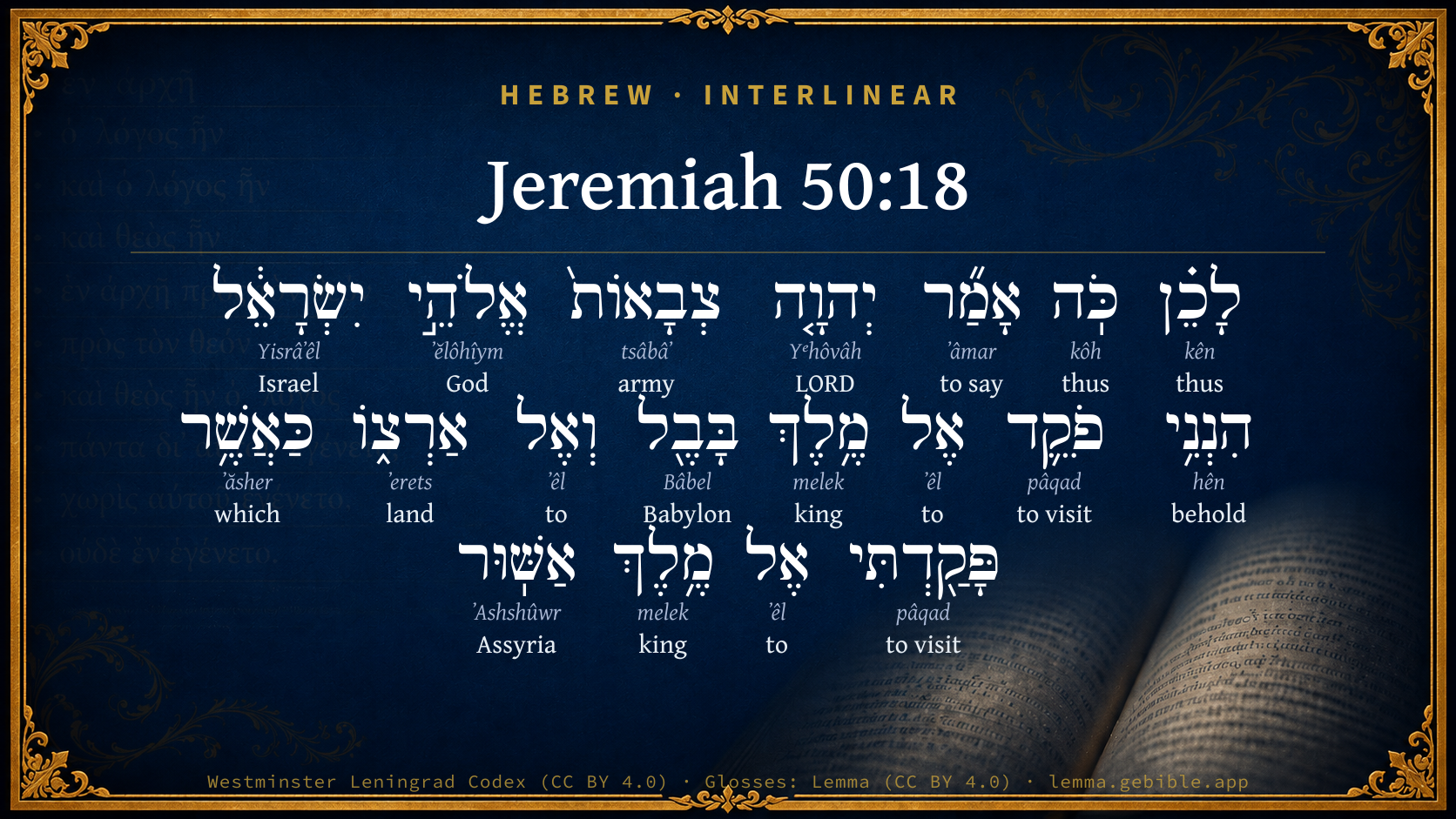
Jeremiah 50:18

Hebrew (Westminster Leningrad Codex) Jeremiah 50:18 appears in the Hebrew Old Testament. The text above is from the Westminster Leningrad Codex. Each word links to its Strong’s number, a concise gloss, and parsing drawn from the Open Scriptures Hebrew Bible morphology. Click any word for its full Brown-Driver-Briggs (BDB) entry.
Download image
Cite this verse

Jeremiah 50:18 (World English Bible). Public Domain. Lemma interlinear Bible study tool, https://lemma.gebible.app/v/jeremiah/50/18.

Show BibTeX & RIS
BibTeX
RIS
English Translation
Therefore thus says Yahweh of Hosts, the God of Israel: Behold, I will punish the king of Babylon and his land, as I have punished the king of Assyria.
World English Bible · Public Domain
Download a study sheet

One document with this verse’s original text, its word-by-word gloss line, the meaning frame, cross-references with their text, attributed commentary, and full source and license credits — printable, and it pastes into notes with its structure intact.

This verse Autodidact and up

Study sheet (.html) Plain text (.txt)

A passage Seminary Student

Up to 50 verses in one chapter. A passage sheet keeps up to 6 commentary sources and 12 cross-references per verse, in the order this page ranks them, and says so on the sheet whenever that leaves anything out. Ask for a single verse and you get the Autodidact verse sheet above.

Everything on this page stays free to read, with no account — the sheet is a download of what is already on screen, not access to it.

Want to remove ads? Support Godless Engineer
Compare translations 3

The same verse in 3 English versions, stacked beneath the original-language interlinear above. Click any original word for its lexicon entry.

Each is an independent rendering of the whole verse — the interlinear is not word-aligned to these translations.

Highlighted words mark where these versions differ — a whole-verse word diff, not a word-by-word alignment.

  • World English Bible Public Domain
    Therefore thus says Yahweh of Hosts, the God of Israel: Behold, I will punish the king of Babylon and his land, as I have punished the king of Assyria.
  • King James Version Public Domain
    Therefore thus saith the LORD of hosts, the God of Israel; Behold, I will punish the king of Babylon and his land, as I have punished the king of Assyria.
  • unfoldingWord Literal Text CC BY-SA 4.0
    Therefore Yahweh of hosts, the God of Israel, says this: See, I am about to punish the king of Babylon and his land, just as I punished the king of Assyria.

unfoldingWord Literal Text — © unfoldingWord, licensed CC BY-SA 4.0. Word-aligned USFM3 via Door43 (git.door43.org/unfoldingWord/en_ult).

Versions to compare (up to 4)

3 of 4 selected

Show all 18 translations

Every available English version of this verse, each an independent rendering of the whole verse.

  • World English Bible Public Domain
    Therefore thus says Yahweh of Hosts, the God of Israel: Behold, I will punish the king of Babylon and his land, as I have punished the king of Assyria.
  • Berean Standard Bible Public Domain
    Therefore this is what the LORD of Hosts, the God of Israel, says: “I will punish the king of Babylon and his land as I punished the king of Assyria.
  • Majority Standard Bible Public Domain
    Therefore this is what the LORD of Hosts, the God of Israel, says: “I will punish the king of Babylon and his land as I punished the king of Assyria.
  • King James Version Public Domain
    Therefore thus saith the LORD of hosts, the God of Israel; Behold, I will punish the king of Babylon and his land, as I have punished the king of Assyria.
  • American Standard Version (1901) Public Domain
    Therefore thus saith Jehovah of hosts, the God of Israel: Behold, I will punish the king of Babylon and his land, as I have punished the king of Assyria.
  • Revised Version (1885) Public Domain
    Therefore thus saith the LORD of hosts, the God of Israel: Behold, I will punish the king of Babylon and his land, as I have punished the king of Assyria;
  • Geneva Bible (1599) Public Domain
    Therefore thus saith the Lord of hostes the God of Israel, Behold, I wil visit ye King of Babel, and his land, as I haue visited the King of Asshur.
  • Douay-Rheims (1899) Public Domain
    Therefore thus saith the Lord of hosts the God of Israel: Behold I will visit the king of Babylon and his land, as I have visited the king of Assyria.
  • Young's Literal Translation Public Domain
    Therefore thus said Jehovah of Hosts, God of Israel: Lo, I am seeing after the king of Babylon, And after his land, As I have seen after the king of Asshur;
  • Literal Standard Version CC BY-SA 4.0
    Therefore, thus said YHWH of Hosts, God of Israel: Behold, I am seeing after the king of Babylon, || And after his land, || As I have seen after the king of Asshur;
  • Unlocked Literal Bible CC BY-SA 4.0
    Therefore Yahweh of hosts, the God of Israel, says this: See, I am about to punish the king of Babylon and his land, just as I punished the king of Assyria.
  • unfoldingWord Literal Text CC BY-SA 4.0
    Therefore Yahweh of hosts, the God of Israel, says this: See, I am about to punish the king of Babylon and his land, just as I punished the king of Assyria.
  • Darby Bible Public Domain
    Therefore thus saith Jehovah of hosts, the God of Israel: Behold, I will visit the king of Babylon and his land, like as I have visited the king of Assyria.
  • World Messianic Bible Public Domain
    Therefore the LORD of Hosts, the God of Israel, says: “Behold, I will punish the king of Babylon and his land, as I have punished the king of Assyria.
  • Webster's Bible Public Domain
    Therefore thus saith the LORD of hosts, the God of Israel; Behold, I will punish the king of Babylon and his land, as I have punished the king of Assyria.
  • Free Bible Version CC BY-SA 4.0
    So this is what the Lord Almighty, the God of Israel, says: I'm going to punish the king of Babylon and his country just like I punished the king of Assyria.
  • Bible in Basic English Public Domain
    So this is what the Lord of armies, the God of Israel, has said: See, I will send punishment on the king of Babylon and on his land, as I have given punishment to the king of Assyria.
  • JPS Tanakh (1917) Public Domain
    Therefore thus saith the LORD of hosts, the God of Israel: Behold, I will punish the king of Babylon and his land, as I have punished the king of Assyria.

Literal Standard Version (2020), Covenant Press — licensed CC BY-SA 4.0. Text via the HelloAO Bible API (eBible.org). Unlocked Literal Bible (unfoldingWord) — licensed CC BY-SA 4.0. Text via the HelloAO Bible API (eBible.org). unfoldingWord Literal Text — © unfoldingWord, licensed CC BY-SA 4.0. Word-aligned USFM3 via Door43 (git.door43.org/unfoldingWord/en_ult). Free Bible Version, Dr. Jonathan Gallagher — licensed CC BY-SA 4.0. Text via the HelloAO Bible API (eBible.org).

Word by word

More ways to search: Search by grammar → Find every occurrence → Compare this word →

Practice this passage: Drill this verse → Learn its vocabulary →

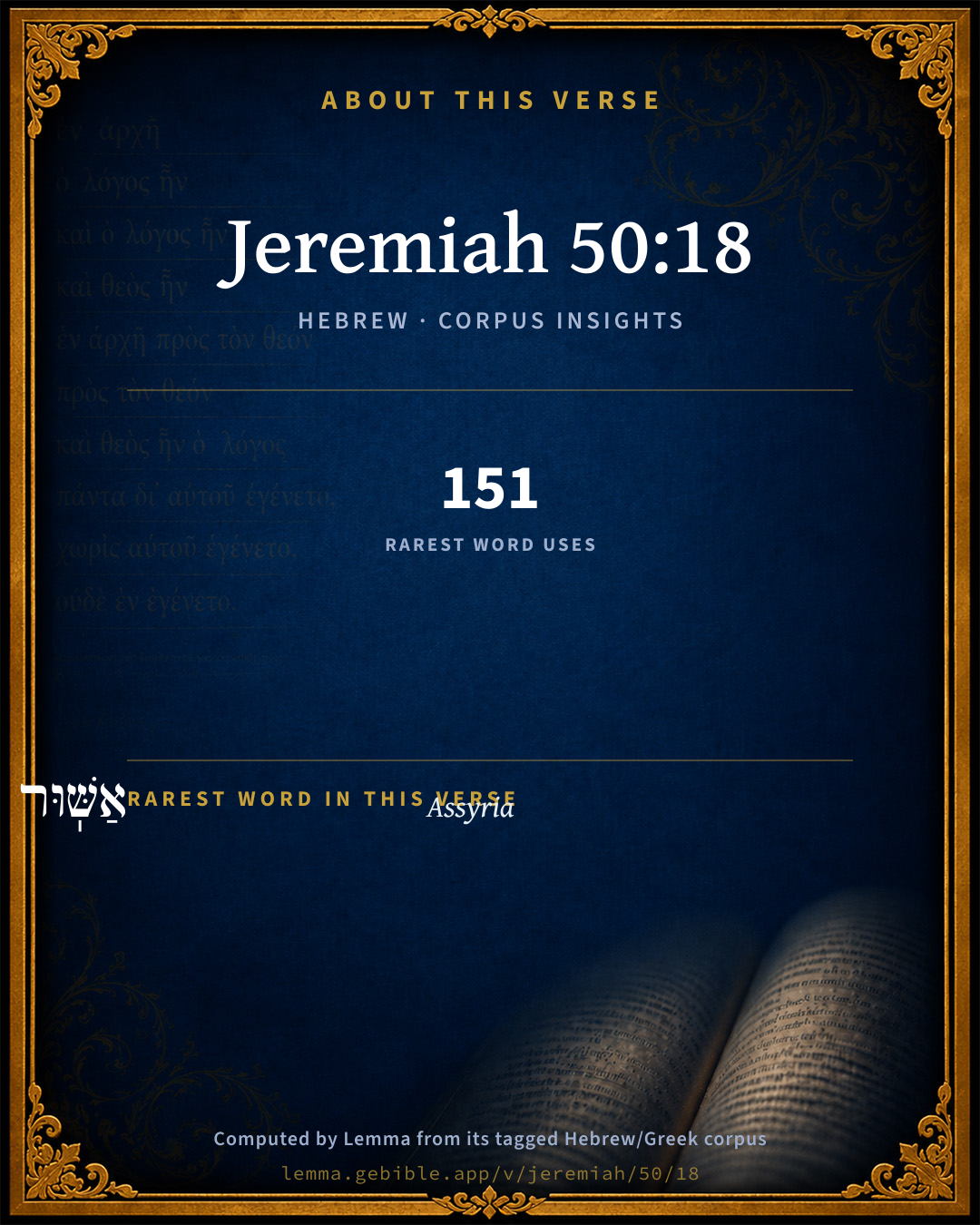
אַשּֽׁוּר
ʼAshshûwr
H804
“Assyria”
Noun, Proper
Part of Speech
Noun
Type
Proper
Full BDB Definition

Origin: apparently from H833 (in the sense of successful)

TWOT: 176

Asshur or Assyria = "a step" - the second son of Shem, eponymous ancestor of the Assyrians (noun proper masculine) - the people of Assyria (noun proper masculine) - the nation, Assyria (noun proper locative) - the land, Assyria or Asshur (noun proper locative)
  1. לָכֵ֗ן kên H3651 “to/for · thus” Preposition + Adverb
  2. כֹּֽה kôh H3541 “thus” Adverb
  3. אָמַ֞ר ʼâmar H559 “to say” Verb, Qal, Perfect, 3rd Person, Masculine, Singular
  4. יְהוָ֤ה Yᵉhôvâh H3068 “LORD” Noun, Proper
  5. צְבָאוֹת֙ tsâbâʼ H6635 “armies” Noun, Common, Both, Plural, Absolute
  6. אֱלֹהֵ֣י ʼĕlôhîym H430 “God(s) of” Noun, Common, Masculine, Plural, Construct
  7. יִשְׂרָאֵ֔ל Yisrâʼêl H3478 “Israel” Noun, Proper
  8. הִנְנִ֥י hên H2005 “behold · me” Particle, Demonstrative + Suffix, Personal, 1st Person, Common, Singular
  9. פֹקֵ֛ד pâqad H6485 “visiting” Verb, Qal, Participle Active, Masculine, Singular, Absolute
  10. אֶל ʼêl H413 “to” Preposition
  11. מֶ֥לֶךְ melek H4428 “king of” Noun, Common, Masculine, Singular, Construct
  12. בָּבֶ֖ל Bâbel H894 “Babylon” Noun, Proper
  13. וְאֶל ʼêl H413 “and · to” Conjunction + Preposition
  14. אַרְצ֑וֹ ʼerets H776 “land · his” Noun, Common, Both, Singular, Construct + Suffix, Personal, 3rd Person, Masculine, Singular
  15. כַּאֲשֶׁ֥ר ʼăsher H834 “like/as · which” Preposition + Particle, Relative
  16. פָּקַ֖דְתִּי pâqad H6485 “to visit” Verb, Qal, Perfect, 1st Person, Common, Singular
  17. אֶל ʼêl H413 “to” Preposition
  18. מֶ֥לֶךְ melek H4428 “king of” Noun, Common, Masculine, Singular, Construct

About this verse

These counts appear in no published source. They are computed here, from the morphology-tagged text and Lemma’s own curated glosses. What Lemma adds →

19
words
15
distinct lemmas
Prophets
section

Grammatical profile

  • 3 verbs
  • 9 nouns
  • 3 prepositions
  • 2 adverbs
  • 2 particles

Verb forms

  • אָמַ֞ר Qal · Perfect
  • פֹקֵ֛ד Qal · Participle Active
  • פָּקַ֖דְתִּי Qal · Perfect

Repetition

Words recur within this verse — often emphatic in Hebrew:

  • פֹקֵ֛ד to visit H6485 ×2
  • מֶ֥לֶךְ king H4428 ×2
  • אֶל to H413 ×3

Cross-references

5

Topical passages linked to Jeremiah 50:18 in the Treasury of Scripture Knowledge — connected by theme and wording, ordered by reader-vote popularity; previews shown in the World English Bible.

  • Isaiah 10:12 Therefore it shall happen that, when the Lord has performed his whole work on Mount Zion and on Jerusalem, I will punish the fruit of the stout heart of the king of Assyria, and the glory of his high looks.
  • Isaiah 37:36–38 The angel of Yahweh went forth, and struck in the camp of the Assyrians one hundred and eighty-five thousand; and when men arose early in the morning, behold, these were all dead bodies.
  • Ezekiel 31:3–17 Behold, the Assyrian was a cedar in Lebanon with beautiful branches, and with a forest-like shade, and of high stature; and its top was among the thick boughs.
  • Nahum 1:1–3 An oracle about Nineveh. The book of the vision of Nahum the Elkoshite.
  • Zephaniah 2:13–15 He will stretch out his hand against the north, destroy Assyria, and will make Nineveh a desolation, and dry like the wilderness.

Cross-references courtesy of OpenBible.info (CC BY 4.0).

Hebrew and Greek witnesses Masoretic Hebrew ↔ Greek Septuagint

The same verse in the two great witnesses to the Old Testament, shown verse-for-verse.

These are two independent witnesses, not word-aligned to each other, and the Septuagint is shown in lemma (dictionary) form.

Hebrew Jeremiah 50:18 Masoretic · Westminster Leningrad Codex

לָכֵ֗ן כֹּֽה אָמַ֞ר יְהוָ֤ה צְבָאוֹת֙ אֱלֹהֵ֣י יִשְׂרָאֵ֔ל הִנְנִ֥י פֹקֵ֛ד אֶל מֶ֥לֶךְ בָּבֶ֖ל וְאֶל אַרְצ֑וֹ כַּאֲשֶׁ֥ר פָּקַ֖דְתִּי אֶל מֶ֥לֶךְ אַשּֽׁוּר

Therefore thus says Yahweh of Hosts, the God of Israel: Behold, I will punish the king of Babylon and his land, as I have punished the king of Assyria.

World English Bible · Public Domain

Greek LXX Structure differs

In the Septuagint, Jeremiah is about an eighth shorter than the Hebrew and arranges its material differently — the Oracles Against the Nations (Hebrew chapters 46–51) appear in the middle of the Greek book, after 25:13. Because the chapter and verse boundaries do not line up, a verse-for-verse comparison with the Hebrew is not shown.

A verse-for-verse comparison isn’t shown here because the chapters and verses don’t line up. Switch to the LXX edition with the MT / LXX toggle above to read the Greek directly.

Hebrew: Westminster Leningrad Codex (CC BY 4.0). Greek: Septuagint (public domain); English from a public-domain English Septuagint. How the Septuagint differs from the Hebrew →

Targum (Aramaic paraphrase)

1

The Targum is the ancient Jewish Aramaic paraphrase of the Hebrew Scriptures — an interpretive translation, not the Hebrew text itself. Onkelos (literal) and Pseudo-Jonathan (expansive) render the Torah, and Jonathan the Prophets. Coverage is partial: where no permissively-licensed English translation exists for a verse, only the Aramaic is shown. This is verse-level text, not a word-by-word alignment to the Hebrew.

  1. Targum Jonathan Prophets (Joshua–Malachi)
    בְּכֵן כִּדְנַן אֲמַר יְיָ צְבָאוֹת אֱלָהָא דְיִשְׂרָאֵל הָא אֲנָא מַסְעֵר עַל מַלְכָּא דְבָבֶל וְעַל אַרְעֵיהּ כְּמָא דְאַסְעֲרֵית עַל מַלְכָּא דְאַתּוּר:

    (no public-domain English translation for this verse)

    Targum Jonathan — Aramaic: “Mikraot Gedolot” (public domain). English: “Sefaria Community Translation” (CC0 1.0 (public-domain dedication)); “London "Chaldee Paraphrase," 1871” (public domain). Text via Sefaria.

Commentary

Notes on Jeremiah 50:18 from classic Christian and Jewish commentators (each source and its license shown beneath its notes). The classic Christian expositions comment on the surrounding passage and are grouped to its opening verse, so a note may address several verses; the Jewish commentaries on the Tanakh (Rashi and others) are per-verse, so they appear only where the commentator wrote on this verse.

Lemma curates 59 commentaries, every one of them public domain or Creative Commons licensed, each selected and text-cleaned for this edition rather than reprinted as found. About our sources →

Trapp's Complete Commentary

John Trapp

Jer 50:18 Therefore thus saith the LORD of hosts, the God of Israel; Behold, I will punish the king of Babylon and his land, as I have punished the king of Assyria.

Ver. 18. As I have punished the king of Assyria.] And accordingly so he did; for as Sennacherib first lost his army, and then his life, and then soon after that monarchy was dissolved; so after that Belshazzar was slain, the empire was translated unto the Persians.

John Trapp, A Commentary or Exposition upon All the Books of the Old and New Testament (1647–1656) — public domain. Text from a community e-Sword module.

Joseph Benson's Commentary

Jer 50:18. Behold, I will punish the king of Babylon, and his land — God may justly punish those who do the things that he hath commanded them to do, if they do them not in that manner in which he directs, or, if what they do be not done in obedience to his command, but for the satisfaction of their own lusts: which was the case, as with the king of Assyria, Isa 10:5-7, so also with the king of Babylon; as I have punished the king of Assyria — Some refer this to the punishment of the Assyrians, in the destruction of Sennacherib and his army, in the time of Hezekiah; but the prophet seems rather to speak of a destruction of Assyria which followed the carrying of the ten tribes into captivity, and therefore may most probably be understood of the destruction of Nineveh, the chief seat of the Assyrian empire, by Nebuchadnezzar, and Assuerus or Astyages, as it is related in Tobit, chap. Jer 14:15. At the taking of this great city, foretold by Jonah, Nahum, and Zephaniah, Chynadanus, the last king of the Assyrian race, was killed; and the seat and title of the empire removed to Babylon, which was no longer called the Assyrian, but the Babylonian monarchy. See Dr. Prideaux, pages 47, 48.

Joseph Benson's Commentary on the Old and New Testaments (1811–1818) — public domain. Text from a community e-Sword module.

Tyndale Open Study Notes

Tyndale Open Resources

50:18-19 Therefore: This word introduces two divine decrees. The first decree condemned Babylon to complete annihilation, like the punishment the Lord gave Assyria (Nah 3). Assyria fell in 612 BC; Babylon fell in 539 BC. • I will bring Israel home: The second divine decree promises restoration for Israel, specifically the people of the northern tribes, whose land was defined by the indicated landmarks. • Carmel is a mountain range close to the Mediterranean Sea in the northwestern corner of Israel. • Bashan was a region in the highlands rising east of the Sea of Galilee. • The tribe of Ephraim occupied the hill country in the central part of Israel west of the Jordan River. • Gilead was a highland area that rose on the east side of the Jordan River, opposite Ephraim.

Tyndale Open Study Notes — © Tyndale Open Resources, licensed CC BY-SA 4.0. Text via the HelloAO Bible API.

Jamieson, Fausset & Brown

Robert Jamieson, A. R. Fausset & David Brown

punish . . . king of Babylon--Nabonidus, or Labynitus.

as . . . punished . . . Assyrian--Sennacherib and other kings [GROTIUS] (Kg2 19:37).

Jamieson, Fausset & Brown — Commentary Critical and Explanatory on the Whole Bible (1871) — public domain (CC PDM 1.0). Text via the HelloAO Bible API.

Adam Clarke's Commentary

Verse 18. As I have punished the king of Assyria.] The Assyrians were overthrown by the Medes and the Chaldeans. The king is here taken for all their kings, generals, c., Tiglath-pileser, Shalmaneser, Sennacherib, Esar-haddon, &c. To them succeeded the Chaldean or Babylonish kings. Nebuchadnezzar came against Judea several times and at last took the city and burnt it, profaned and demolished the temple, wasted the land, and carried the princes and people into captivity.

Adam Clarke's Commentary on the Bible (1810–1826) — public domain. Text from a community e-Sword/MySword module.

John Calvin's Commentaries

What I have said may hence with more certainty be inferred — that the similitude which God employed was intended for this end, that having assumed the person of one in sorrow, he might represent as it were to their eyes his sympathy, he then shows that he would be the avenger of the cruelty which the Chaldeans had practiced, as he had already been the avenger of all the evils which the Assyrians had done to his people.

We must bear in mind the time — for the meaning of this passage depends on history. The Assyrians were stronger than the Chaldeans when they harassed the kingdom of Israel: for we know that in the time of Hezekiah the king of Babylon sent to him to seek his favor, and to allure him to a confederacy. While then the monarchy of Assyria was formidable, the Assyrians were very hostile to the Israelites and also to the Jews: what followed? Nineveh was overthrown, and Babylon succeeded in its place; and so they who had ruled were constrained to bear the yoke, and thus Babylon made the Assyrians captive to itself. God now refers to this judgment, which was known to all. The Assyrians themselves did not indeed think that the God of Israel was the avenger of his people, but yet it was so. Hence God here declares that he had already given a manifest proof of the solicitude which he had for the welfare of his people: as then he had punished Assyria, so he declares that he would take vengeance on the Babylonians. And thus, by an example, he confirms what might have appeared incredible. For who could have thought that that monarchy could so suddenly fall? And yet it happened beyond what any could have anticipated. God here repeats what had taken place, that the faithful might feel assured that the judgment which the Assyrians had experienced, awaited the Babylonians. This is the plain meaning of the Prophet. It follows, —

John Calvin's Commentaries (1540-1563) — public domain. Text from the Calvin Translation Society English edition (1840s-50s) via the Christian Classics Ethereal Library (ccel.org). Calvin's coverage is partial (roughly two-thirds of the Bible); uncommented books and verses are honest gaps, never fabricated. The 19th-century editor's footnotes and remarks are omitted so the notes are faithfully Calvin's own voice.

Ellicott's Commentary for English Readers

(18) As I have punished the king of Assyria.—Nineveh had fallen before Cyaxares and Nabopolassar, and Babylon was in like manner to fall before Cyrus. The one judgment was the pledge and earnest of the other.

A Bible Commentary for English Readers, edited by Charles John Ellicott (1878–1897) — public domain. Text from a community e-Sword module.

John Gill's Exposition

Therefore thus saith the Lord of hosts, the God of Israel,.... Because of this cruel treatment of his people, whose God he was; and being the Lord of hosts, and able to avenge himself on their enemies, he threatens as follows:

behold, I will punish the king of Babylon and his land; not Nebuchadnezzar, but a successor of his, Belshazzar, who was slain the night Babylon was taken:

as I have punished the king of Assyria; not Shalmaneser, that carried the tribes captive; but a successor of his, Chynilidanus, the last king of Assyria; who was killed when Nineveh was taken, the metropolis of Assyria, and which was done before this prophecy was delivered. These two kings may figuratively design the Turk and Pope, who will both be destroyed at, or just before, the conversion of the Jews, and their return to their own land; which is prophesied of in Jer 50:19.

John Gill's Exposition of the Whole Bible (1746–1763) — public domain (CC PDM 1.0). Text via the HelloAO Bible API.

Haydock's Catholic Bible Commentary

Assyria. This monarchy was subdued by Nabopolasser.

George Leo Haydock (1774–1849), Haydock's Catholic Family Bible and Commentary, 1859 edition — public domain. Excludes Psalms (Douay-Rheims chapter numbering differs from Protestant) and Deuterocanonical books (Catholic canon only).

Matthew Poole's English Annotations

God may justly punish those who do the things which he hath commanded them to do, if they do it not in that manner which. he directeth, or if what they do be not done in obedience to his command, but in satisfaction to their own lusts, which was the case of the Assyrians, Isa 10:7.

As I have punished the king of Assyria: some refer this to the punishment of the Assyrians in the destruction of Sennacherib and his army in the time of Hezekiah, but the prophet seemeth here to speak of a destruction of Assyria which followed after his devouring of the ten tribes, from whence we may conclude that Assyria was destroyed before the time of this revelation.

Matthew Poole's English Annotations on the Holy Bible (1683–1685) — public domain. Text from a community e-Sword/MySword module.

Whedon's Commentary on the Bible

Daniel D. Whedon

18. I will punish… Babylon — Assyria has already been destroyed, and a like destruction shall come upon Babylon. Nothing could be in itself more incredible than that Nineveh should be overthrown; but now that this had actually taken place, it adds force and probability to the threatened overthrow of Babylon.

Daniel D. Whedon (gen. ed.), Commentary on the Old and New Testaments (1874–1909) — public domain. Text from a community e-Sword module.

Lesson kit

Teaching starters — assembled from the data on this page, not authored interpretation. Every prompt links to the verse data it draws on. Edit before teaching.

Jeremiah, in the Prophets, opens this verse with 19 words (15 distinct Hebrew lemmas). Its most distinctive word is ʼAshshûwr (“Assyria”). A historical commentator’s framing appears above. Read the whole chapter for the surrounding context.

Discussion questions

  1. How does “Assyria” (ʼAshshûwr) shape what this verse is saying?
  2. How does Isaiah 10:12, which shares this passage’s theme, read alongside this verse?
  3. What does the repetition of “to visit” (2× in this one verse) do in this verse?
  4. These translations render this verse differently; the difference is in the English rendering, not the original. What questions does that raise?
  5. «אָמַ֞ר» is a Qal Perfect verb. How does that grammatical form shape the action described?
  6. Compare how Trapp's Complete Commentary and Joseph Benson's Commentary read this verse. Where do they agree or differ?

Things to notice

Reading settings

Reading text

Shown beneath each verse's original-language words.

Old Testament
Old Testament edition

Read the OT as the Masoretic Hebrew (MT) or the Greek Septuagint (LXX).

English shown for the Greek Septuagint (in the Hebrew ↔ Greek comparison).

Comparing translations? Open the Compare panel on any verse page to stack up to four side by side.