
Jeremiah 31:25

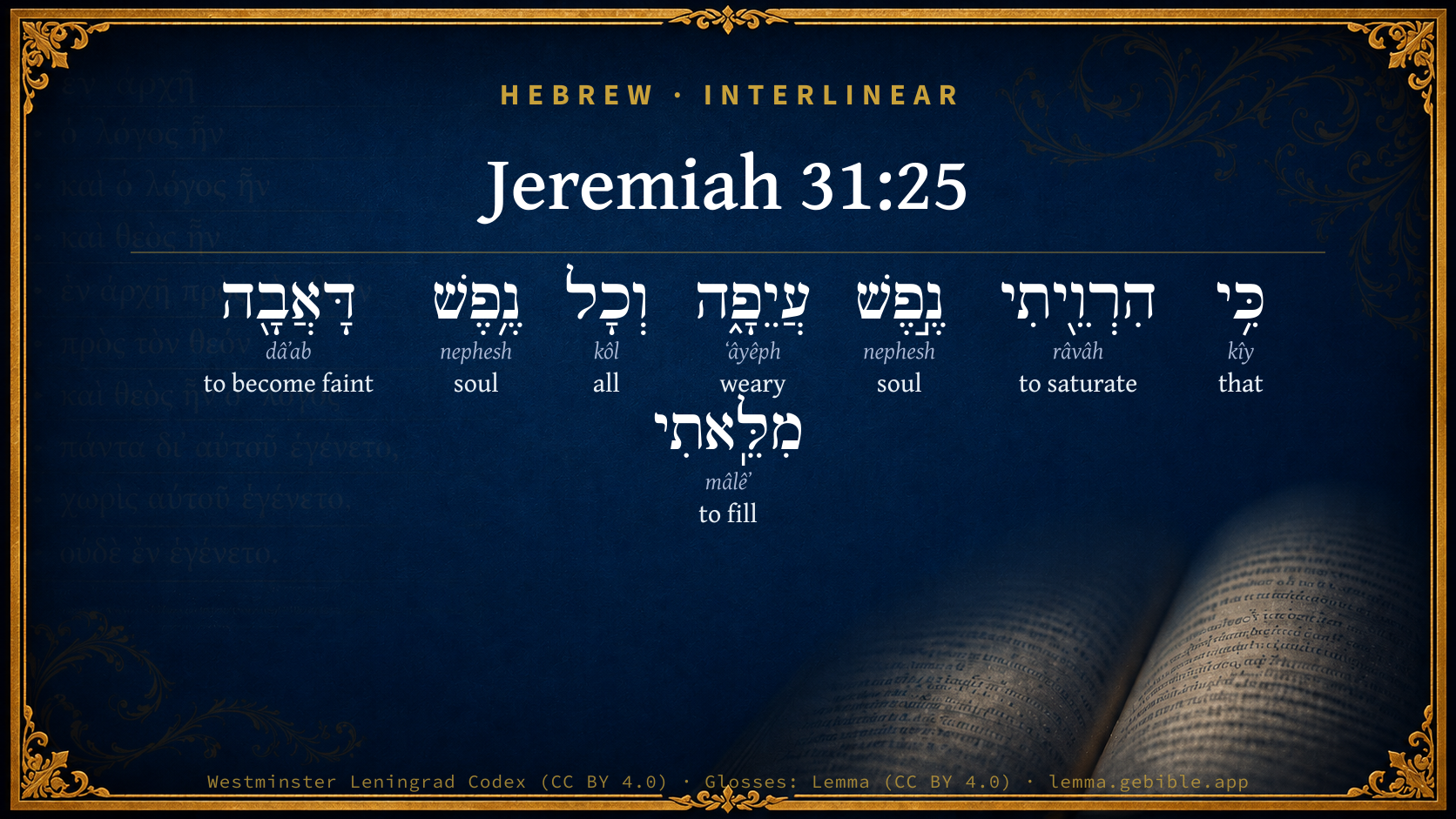
Hebrew (Westminster Leningrad Codex) Jeremiah 31:25 appears in the Hebrew Old Testament. The text above is from the Westminster Leningrad Codex. Each word links to its Strong’s number, a concise gloss, and parsing drawn from the Open Scriptures Hebrew Bible morphology. Click any word for its full Brown-Driver-Briggs (BDB) entry.
Download image
Cite this verse

Jeremiah 31:25 (World English Bible). Public Domain. Lemma interlinear Bible study tool, https://lemma.gebible.app/v/jeremiah/31/25.

Show BibTeX & RIS
BibTeX
RIS
English Translation
For I have satiated the weary soul, and every sorrowful soul have I replenished.
World English Bible · Public Domain
Download a study sheet

One document with this verse’s original text, its word-by-word gloss line, the meaning frame, cross-references with their text, attributed commentary, and full source and license credits — printable, and it pastes into notes with its structure intact.

This verse Autodidact and up

Study sheet (.html) Plain text (.txt)

A passage Seminary Student

Up to 50 verses in one chapter. A passage sheet keeps up to 6 commentary sources and 12 cross-references per verse, in the order this page ranks them, and says so on the sheet whenever that leaves anything out. Ask for a single verse and you get the Autodidact verse sheet above.

Everything on this page stays free to read, with no account — the sheet is a download of what is already on screen, not access to it.

Want to remove ads? Support Godless Engineer
Compare translations 3

The same verse in 3 English versions, stacked beneath the original-language interlinear above. Click any original word for its lexicon entry.

Each is an independent rendering of the whole verse — the interlinear is not word-aligned to these translations.

Highlighted words mark where these versions differ — a whole-verse word diff, not a word-by-word alignment.

  • World English Bible Public Domain
    For I have satiated the weary soul, and every sorrowful soul have I replenished.
  • King James Version Public Domain
    For I have satiated the weary soul, and I have replenished every sorrowful soul.
  • unfoldingWord Literal Text CC BY-SA 4.0
    For I will cause those who are weary to drink, and I fill up those who are faint.”

unfoldingWord Literal Text — © unfoldingWord, licensed CC BY-SA 4.0. Word-aligned USFM3 via Door43 (git.door43.org/unfoldingWord/en_ult).

Versions to compare (up to 4)

3 of 4 selected

Show all 18 translations

Every available English version of this verse, each an independent rendering of the whole verse.

  • World English Bible Public Domain
    For I have satiated the weary soul, and every sorrowful soul have I replenished.
  • Berean Standard Bible Public Domain
    for I will refresh the weary soul and replenish all who are weak.”
  • Majority Standard Bible Public Domain
    for I will refresh the weary soul and replenish all who are weak.”
  • King James Version Public Domain
    For I have satiated the weary soul, and I have replenished every sorrowful soul.
  • American Standard Version (1901) Public Domain
    For I have satiated the weary soul, and every sorrowful soul have I replenished.
  • Revised Version (1885) Public Domain
    For I have satiated the weary soul, and every sorrowful soul have I replenished.
  • Geneva Bible (1599) Public Domain
    For I haue saciate the wearie soule, and I haue replenished euery sorowfull soule.
  • Douay-Rheims (1899) Public Domain
    For I have inebriated the weary soul: and I have filled every hungry soul.
  • Young's Literal Translation Public Domain
    For I have satiated the weary soul, And every grieved soul I have filled.'
  • Literal Standard Version CC BY-SA 4.0
    For I have satiated the weary soul, || And I have filled every grieved soul.”
  • Unlocked Literal Bible CC BY-SA 4.0
    For I will cause those who are weary to drink, and I fill up those who are faint.”
  • unfoldingWord Literal Text CC BY-SA 4.0
    For I will cause those who are weary to drink, and I fill up those who are faint.”
  • Darby Bible Public Domain
    For I have satiated the weary soul, and every languishing soul have I replenished.
  • World Messianic Bible Public Domain
    For I have satiated the weary soul, and I have replenished every sorrowful soul.”
  • Webster's Bible Public Domain
    For I have satiated the weary soul, and I have replenished every sorrowful soul.
  • Free Bible Version CC BY-SA 4.0
    because I'm going to give rest to those who are tired and give strength to all those who are weak.”
  • Bible in Basic English Public Domain
    For I have given new strength to the tired soul and to every sorrowing soul in full measure.
  • JPS Tanakh (1917) Public Domain
    For I have satiated the weary soul, and every pining soul have I replenished.

Literal Standard Version (2020), Covenant Press — licensed CC BY-SA 4.0. Text via the HelloAO Bible API (eBible.org). Unlocked Literal Bible (unfoldingWord) — licensed CC BY-SA 4.0. Text via the HelloAO Bible API (eBible.org). unfoldingWord Literal Text — © unfoldingWord, licensed CC BY-SA 4.0. Word-aligned USFM3 via Door43 (git.door43.org/unfoldingWord/en_ult). Free Bible Version, Dr. Jonathan Gallagher — licensed CC BY-SA 4.0. Text via the HelloAO Bible API (eBible.org).

Word by word

More ways to search: Search by grammar → Find every occurrence → Compare this word →

Practice this passage: Drill this verse → Learn its vocabulary →

About this verse

These counts appear in no published source. They are computed here, from the morphology-tagged text and Lemma’s own curated glosses. What Lemma adds →

8
words
7
distinct lemmas
Prophets
section

Notable vocabulary

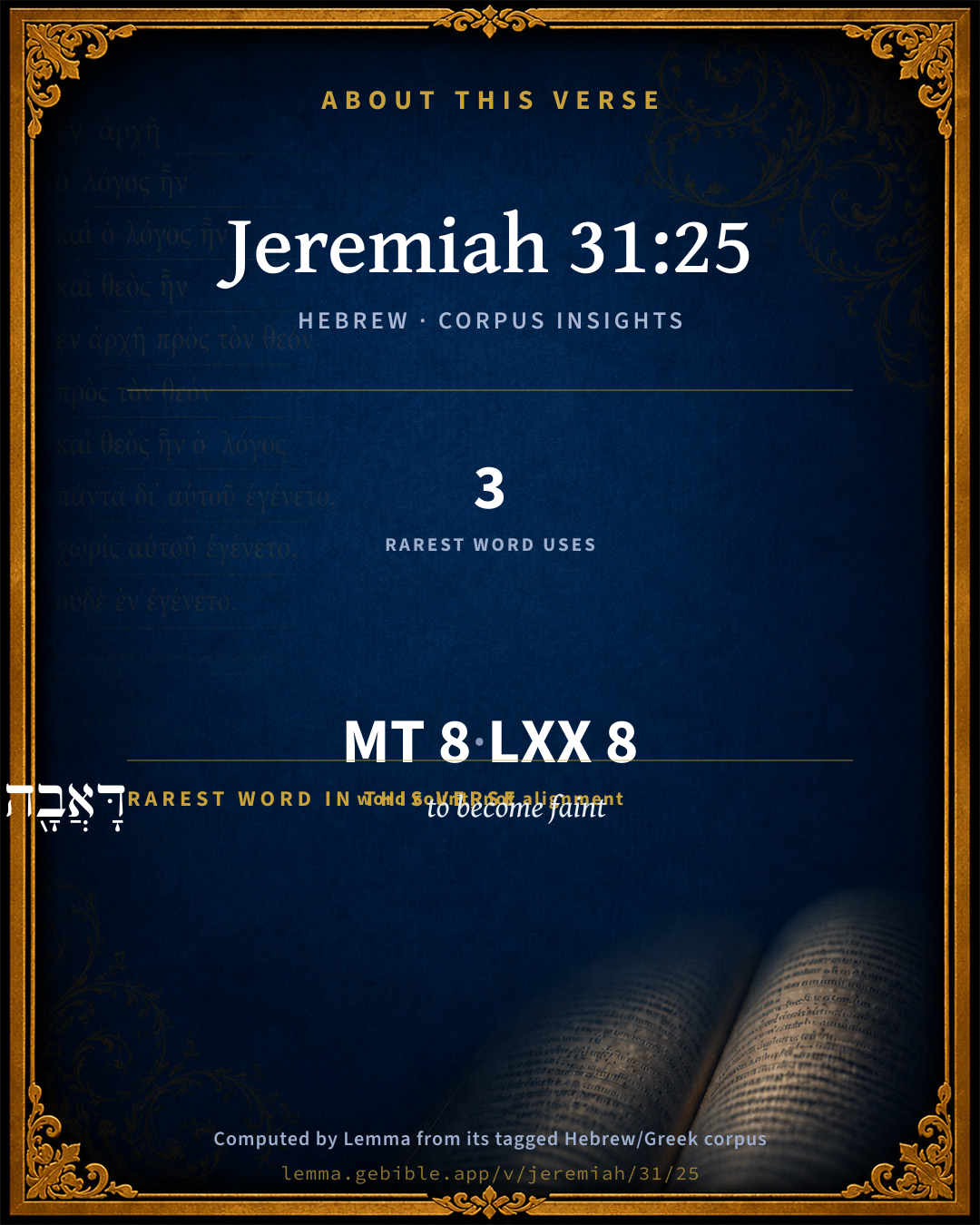
The rarest word here is דָּאֲבָ֖ה to become faint H1669 — appearing just 3 times in the whole Hebrew Bible.

Shared distinctive vocabulary

דָּאֲבָ֖ה to become faint H1669 occurs in 3 verses of the Hebrew Bible. Also found in:

Grammatical profile

  • 3 verbs
  • 3 nouns
  • 1 adjective
  • 1 conjunction

Verb forms

  • הִרְוֵ֖יתִי Hiphil · Perfect
  • דָּאֲבָ֖ה Qal · Perfect
  • מִלֵּֽאתִי Piel · Perfect

Repetition

A word recurs within this verse — often emphatic in Hebrew:

  • נֶ֣פֶשׁ soul H5315 ×2

Hebrew & Septuagint length

In the original languages it is 8 Hebrew tokens and 8 Greek tokens — but the two are counted differently (Hebrew bundles its prefixes and suffixes into one token; the Greek is in lemma form), so that isn’t a like-for-like length.

Cross-references

9

Topical passages linked to Jeremiah 31:25 in the Treasury of Scripture Knowledge — connected by theme and wording, ordered by reader-vote popularity; previews shown in the World English Bible.

  • Matthew 5:6 Blessed are those who hunger and thirst after righteousness, For they shall be filled.
  • Matthew 11:28 "Come to me, all you who labor and are heavily burdened, and I will give you rest.
  • Psalms 107:9 For he satisfies the longing soul. He fills the hungry soul with good.
  • John 4:14 but whoever drinks of the water that I will give him will never thirst again; but the water that I will give him will become in him a well of water springing up to eternal life."
  • Jeremiah 31:14 I will satiate the soul of the priests with fatness, and my people shall be satisfied with my goodness, says Yahweh.
  • Isaiah 50:4 The Lord Yahweh has given me the tongue of those who are taught, that I may know how to sustain with words him who is weary: he wakens morning by morning, he wakens my ear to hear as those who are taught.
  • Luke 1:53 He has filled the hungry with good things. He has sent the rich away empty.
  • 2 Corinthians 7:6 Nevertheless, he who comforts the lowly, God, comforted us by the coming of Titus;
  • Isaiah 32:2 A man shall be as a hiding-place from the wind, and a covert from the tempest, as streams of water in a dry place, as the shade of a great rock in a weary land.

Cross-references courtesy of OpenBible.info (CC BY 4.0).

Hebrew and Greek witnesses Masoretic Hebrew ↔ Greek Septuagint

The same verse in the two great witnesses to the Old Testament, shown verse-for-verse.

These are two independent witnesses, not word-aligned to each other, and the Septuagint is shown in lemma (dictionary) form.

Hebrew Jeremiah 31:25 Masoretic · Westminster Leningrad Codex

כִּ֥י הִרְוֵ֖יתִי נֶ֣פֶשׁ עֲיֵפָ֑ה וְכָל נֶ֥פֶשׁ דָּאֲבָ֖ה מִלֵּֽאתִי

For I have satiated the weary soul, and every sorrowful soul have I replenished.

World English Bible · Public Domain

Greek LXX Structure differs

In the Septuagint, Jeremiah is about an eighth shorter than the Hebrew and arranges its material differently — the Oracles Against the Nations (Hebrew chapters 46–51) appear in the middle of the Greek book, after 25:13. Because the chapter and verse boundaries do not line up, a verse-for-verse comparison with the Hebrew is not shown.

A verse-for-verse comparison isn’t shown here because the chapters and verses don’t line up. Switch to the LXX edition with the MT / LXX toggle above to read the Greek directly.

On this verse, John Gill's Exposition discusses the Septuagint’s reading. Read the note in Commentary ↓

Hebrew: Westminster Leningrad Codex (CC BY 4.0). Greek: Septuagint (public domain); English from a public-domain English Septuagint. How the Septuagint differs from the Hebrew →

Targum (Aramaic paraphrase)

1

The Targum is the ancient Jewish Aramaic paraphrase of the Hebrew Scriptures — an interpretive translation, not the Hebrew text itself. Onkelos (literal) and Pseudo-Jonathan (expansive) render the Torah, and Jonathan the Prophets. Coverage is partial: where no permissively-licensed English translation exists for a verse, only the Aramaic is shown. This is verse-level text, not a word-by-word alignment to the Hebrew.

  1. Targum Jonathan Prophets (Joshua–Malachi)
    אֲרֵי שִׂבָעֵית נְפַשׁ מְשַׁלְהֲיָא וְכָל נְפַשׁ יִצְפָּא מַלֵיתִי כָּל טוּב:

    For I will satiate the soul of the weary and fill every languishing soul with goodness.

    Targum Jonathan — Aramaic: “Mikraot Gedolot” (public domain). English: “Sefaria Community Translation” (CC0 1.0 (public-domain dedication)); “London "Chaldee Paraphrase," 1871” (public domain). Text via Sefaria.

Commentary

Notes on Jeremiah 31:25 from classic Christian and Jewish commentators (each source and its license shown beneath its notes). The classic Christian expositions comment on the surrounding passage and are grouped to its opening verse, so a note may address several verses; the Jewish commentaries on the Tanakh (Rashi and others) are per-verse, so they appear only where the commentator wrote on this verse.

Lemma curates 59 commentaries, every one of them public domain or Creative Commons licensed, each selected and text-cleaned for this edition rather than reprinted as found. About our sources →

Trapp's Complete Commentary

John Trapp

Jer 31:25 For I have satiated the weary soul, and I have replenished every sorrowful soul.

Ver. 25. For I have satiated the weary soul.] Or, I will satiate, fill them with my fulness, so that they shall have enough for their own, and not emulate others. A good man shall be satisfied from himself, {Pro 14:14} as knowing within himself that, whatever he hath here, little or much, he hath in heaven a better and more enduring substance. {Heb 10:34}

John Trapp, A Commentary or Exposition upon All the Books of the Old and New Testament (1647–1656) — public domain. Text from a community e-Sword module.

Jamieson, Fausset & Brown

Robert Jamieson, A. R. Fausset & David Brown

The "weary, sorrowful," and indigent state of Israel will prove no obstacle in the way of My helping them.

Jamieson, Fausset & Brown — Commentary Critical and Explanatory on the Whole Bible (1871) — public domain (CC PDM 1.0). Text via the HelloAO Bible API.

John Calvin's Commentaries

By this verse he removes every doubt, lest any one should reject what he had promised as to the restoration of the people, because the Jews and the Israelites were at the time as dead men. He therefore says, I will water the thirsty soul; some render it “the weary soul;” but נפש עיפה, nupesh oiphe, is often taken metaphorically for a thirsty soul. So in Psalm 143:6, it is said,

“I am as a dry land;”

weariness cannot be suitably applied to land; and in Isaiah 29:8, we have these words,

“As one dreaming he thinks that he eats; afterwards, when awake, his soul is empty: and as one who thinks that he drinks,”

etc. The Prophet employs there the same word, because there is hardly ever weariness without thirst; we contract thirst by weariness. Then the soul is said to be עיפה, oiphe, by a metaphor, not weary, but on the contrary thirsty; and the verb corresponds, which means to inebriate, to irrigate, or to water, and often to satiate. I will then irrigate, or water to satiety, thy dry soul, and every soul which faints, etc., but as דאב, dab, means to be deficient, and sometimes to be wearied, here it denotes a defect, for it follows, I will fill It is then to be taken for a famished soul.

The meaning is, that though the Israelites should hunger and thirst, and be for a time without food and drink, yet their want would not prevent God from affording them relief, for he had the power and the will to satisfy the hungry, and to give drink to the thirsty, or to those who were fainting on account of thirst. It now follows, —

John Calvin's Commentaries (1540-1563) — public domain. Text from the Calvin Translation Society English edition (1840s-50s) via the Christian Classics Ethereal Library (ccel.org). Calvin's coverage is partial (roughly two-thirds of the Bible); uncommented books and verses are honest gaps, never fabricated. The 19th-century editor's footnotes and remarks are omitted so the notes are faithfully Calvin's own voice.

Ellicott's Commentary for English Readers

(25) I have satiated the weary soul . . .—Here again we note an instance of an anticipation of the thought, almost of the very language, of the Gospel, “The hungry and the thirsty” shall be “filled” (Mat_5:6), the weary shall be refreshed (Mat_11:28-29).

A Bible Commentary for English Readers, edited by Charles John Ellicott (1878–1897) — public domain. Text from a community e-Sword module.

The Cambridge Bible for Schools and Colleges

gen. ed. J. J. S. Perowne

25. sorrowful] pining, virtually the same word as that rendered “sorrow” in Jer_31:12, where see note.

The Cambridge Bible for Schools and Colleges (gen. ed. J. J. S. Perowne; Cambridge University Press, 1878–1918) — public domain. Text from a community e-Sword module.

John Gill's Exposition

For I have satiated the weary soul,.... As sinners are at first awakenings and convictions; when sin is made exceeding sinful and loathsome to them, and becomes an uneasiness, and they a burden to themselves on account of it; when they labour, till they are weary, to get food for their famishing souls; weary in seeking for righteousness to cover them, in working for life to save them, and inquiring after rest; but cannot find neither food, nor righteousness, nor life, nor rest, till they come to Christ; and as all the saints are weary of a body of sin and death, with mourning over it, and groaning under it; weary of Satan's temptations and buffetings; weary of the world, and the men of it, and with afflictive dispensations of Providence in it; and are as weary travellers passing through a waste howling wilderness; these the Lord "satiates", refreshes, and even "inebriates" (h), as the word used signifies, with his love; which is very reviving and refreshing, and is a feast of itself; and is very satisfying when it is shed abroad in the heart; when souls have a delightful sense of it, and see their interest in it; particularly satiates with his pardoning grace and mercy, and with food, and fulness of it, in Christ; with righteousness, life, and salvation by him; and with rest, peace, joy, and comfort in him: and this, though a promise and prophecy of what would be, yet, because of the certainty of it, is represented as if it had been done already; as also what follows:

and I have replenished every sorrowful soul; that is sorry for sin after a godly sort, and mourns for it after an evangelical manner; is troubled for want of the divine presence, and is pressed with afflictions inward and outward: these the Lord "replenishes" or "fills" (i); that is, with all good, as the Targum adds, and fills them to satisfaction; with Christ, and all good things by him; with peace, pardon, righteousness, and salvation; with the Spirit, his gifts and graces; with Gospel provisions, the goodness and fatness of his house; with all spiritual blessings now, and with glory and happiness hereafter. The Septuagint, and all the Oriental versions, instead of "weary" and "sorrowful", render the words "thirsty and hungry"; and such as hunger and thirst after righteousness; after the discoveries of pardoning grace; after Christ, and salvation by him; after more knowledge of him, and communion with him; are, sooner or later, filled with those things they are hungering and thirsting after; see Mat 5:6.

(h) "inebriavi", V. L. Vatablus; "inebriabo", Piscator. (i) "implebo", Schmidt; "explebo", Piscator; "explevero", Junius & Tremellius; "implevero", Cocceius.

John Gill's Exposition of the Whole Bible (1746–1763) — public domain (CC PDM 1.0). Text via the HelloAO Bible API.

Albert Barnes' Notes on the Bible

Sorrowful - Or, languishing Jer 31:12.

Albert Barnes' Notes on the Bible (1834–1885) — public domain. Text from a community e-Sword/MySword module.

Matthew Poole's English Annotations

I have here is of the same significancy with I will, as ordinarily in prophetical promises, which are the words of Him who calleth the things that are not as if they were, and would have his people look upon the things which he hath promised to do as certain as if they were already done. The words are only a promise to the same sense as before, that God would give his people abundance of ease and plenty, and wipe all tears from their eyes.

Matthew Poole's English Annotations on the Holy Bible (1683–1685) — public domain. Text from a community e-Sword/MySword module.

The Pulpit Commentary

For Jehovah will have fulfilled every unsatisfied craving. I have satiated (literally, watered) means "I have decreed to satiate;" it is the perfect of prophetic certitude, which represents an event as already having taken place in the Divine counsels. Sorrowful; rather, languishing (see on ver. 12).

Divine satisfaction.

There are always the weary who need rest, the sorrowful who need consolation.

1. Naturally we all have restless longing, large desires that go out beyond the present and the attainable. The soul has its appetites, its hunger, its thirst.

2. Sin and sorrow have deepened our need. The Jews in their calamities were a type of mankind in its sin and weariness.

I NO EARTHLY SATISFACTION WILL MEET THESE WANTS. Food for the body cannot satisfy the soul. Man is not able to live by bread alone. The life is more than meat. We are too large for the world and its gifts, rich and abundant as they may be. We look before and after, And pine for what is not; Our sincerest laughter With some pain is fraught,

Our sweetest songs are those that tell of saddest thought." (Shelley.) Hence the restlessness and dissatisfaction we experience in the height of prosperity. Thank God for these feelings. They are indications of a heavenly birth, indications of immortality.

II GOD OFFERS US FULL SATISFACTION. He will satisfy satiate.

1. God gives all we need. God does not keep his children on half rations. He has rich stores, and he offers freely. From our broken cisterns we turn to his ever-flowing fountains.

2. What God gives is of the kind we need true light, not mocking speculations; Divine consolations of hope and peace, not barren philosophic maxims, but full and free forgiveness. What God does he does perfectly. He does not call us to a bare salvation, but to a full satisfaction, meeting the peculiar and deep wants of the soul with the special satisfaction they need, and bestowing this to satiation.

III THE FULL ENJOYMENT OF DIVINE SATISFACTION BELONGS TO THE FUTURE. Much may be enjoyed now. Larger faith would open at once more abundant stores. God"s hand is not shortened. It is we who limit our own enjoyment of his grace by unbelief and sinfulness. Still there can be no perfect satisfaction in this imperfect world. Heaven will be totally different from earth in the fact that here we are always reaching out to the beyond; there for the first time all needs will be satisfied. The hope of such a condition should lead to patience and a faithful following of the way of the cross now that leads to the home of rest hereafter.

The Pulpit Commentary (1880–1919), ed. H.D.M. Spence-Jones & Joseph S. Exell — public domain. Text from a community e-Sword module.

John Wesley's Explanatory Notes

For - The words are a promise, that God would give his people abundance of ease and plenty.

John Wesley, Explanatory Notes Upon the Whole Bible (1754–1765) — public domain. Text via the GEBible commentary corpus.

Lesson kit

Teaching starters — assembled from the data on this page, not authored interpretation. Every prompt links to the verse data it draws on. Edit before teaching.

Jeremiah, in the Prophets, opens this verse with 8 words (7 distinct Hebrew lemmas). Its most distinctive word is dâʼab (“to become faint”). A historical commentator’s framing appears above. Read the whole chapter for the surrounding context.

Discussion questions

  1. What does “to become faint” (dâʼab) contribute to the verse as a whole?
  2. Psalms 88:9 shares the word «to become faint» with this verse. How do the two illuminate each other?
  3. “soul” occurs 2× in this one verse. What is the effect of the repetition?
  4. The translations on this page render this verse differently — a whole-verse word diff, not a word-by-word alignment. What might account for the different wordings?
  5. The verb «הִרְוֵ֖יתִי» is Hiphil Perfect. How does its form color the action?
  6. Reading how Trapp's Complete Commentary and Jamieson, Fausset & Brown read this verse, where do the two commentators agree and where do they part?

Things to notice

Reading settings

Reading text

Shown beneath each verse's original-language words.

Old Testament
Old Testament edition

Read the OT as the Masoretic Hebrew (MT) or the Greek Septuagint (LXX).

English shown for the Greek Septuagint (in the Hebrew ↔ Greek comparison).

Comparing translations? Open the Compare panel on any verse page to stack up to four side by side.