
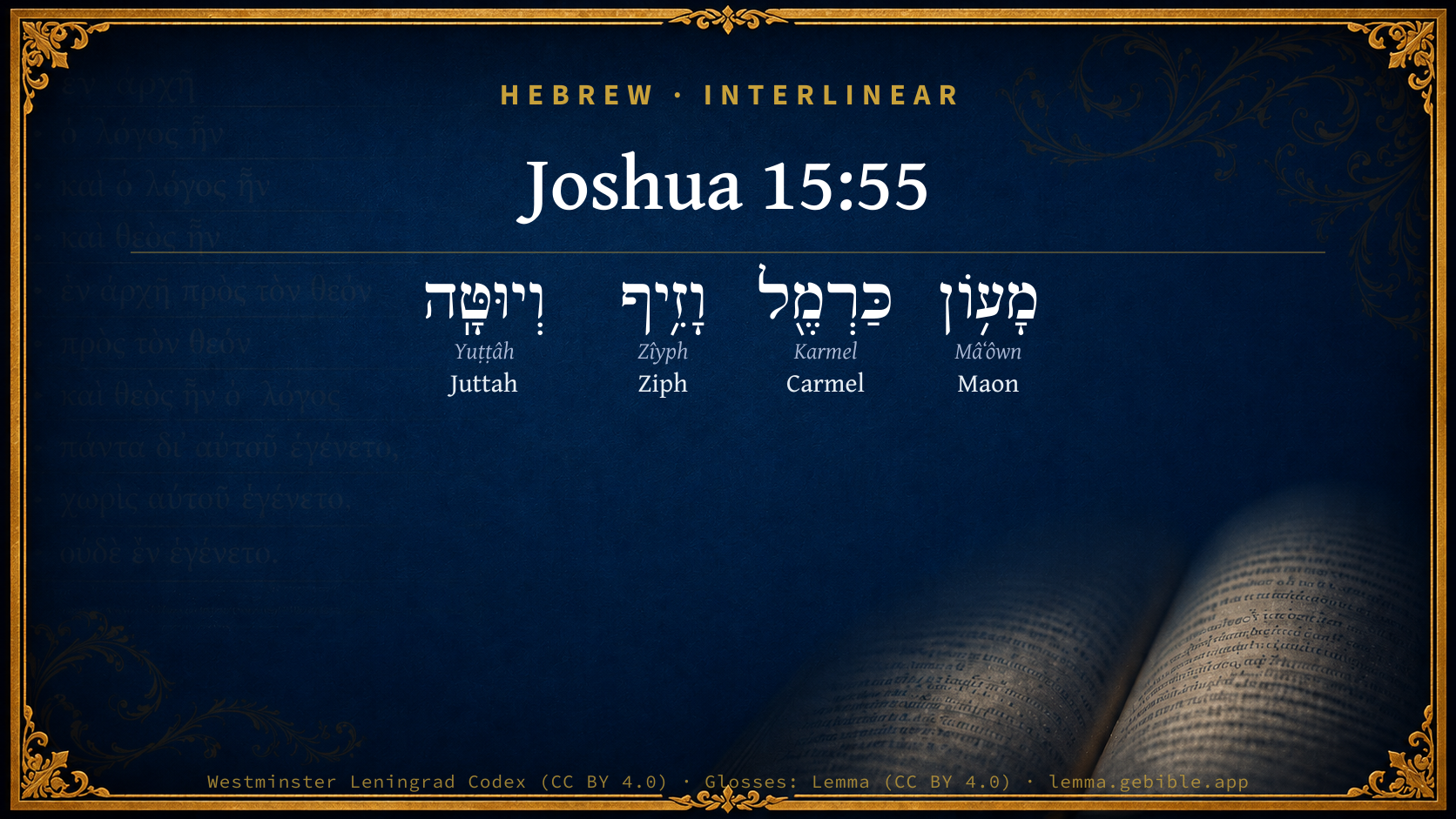
Joshua 15:55

Hebrew (Westminster Leningrad Codex) Joshua 15:55 appears in the Hebrew Old Testament. The text above is from the Westminster Leningrad Codex. Each word links to its Strong’s number, a concise gloss, and parsing drawn from the Open Scriptures Hebrew Bible morphology. Click any word for its full Brown-Driver-Briggs (BDB) entry.
Download image
Cite this verse

Joshua 15:55 (World English Bible). Public Domain. Lemma interlinear Bible study tool, https://lemma.gebible.app/v/joshua/15/55.

Show BibTeX & RIS
BibTeX
RIS
English Translation
Maon, Carmel, and Ziph, and Jutah,
World English Bible · Public Domain
Highlights
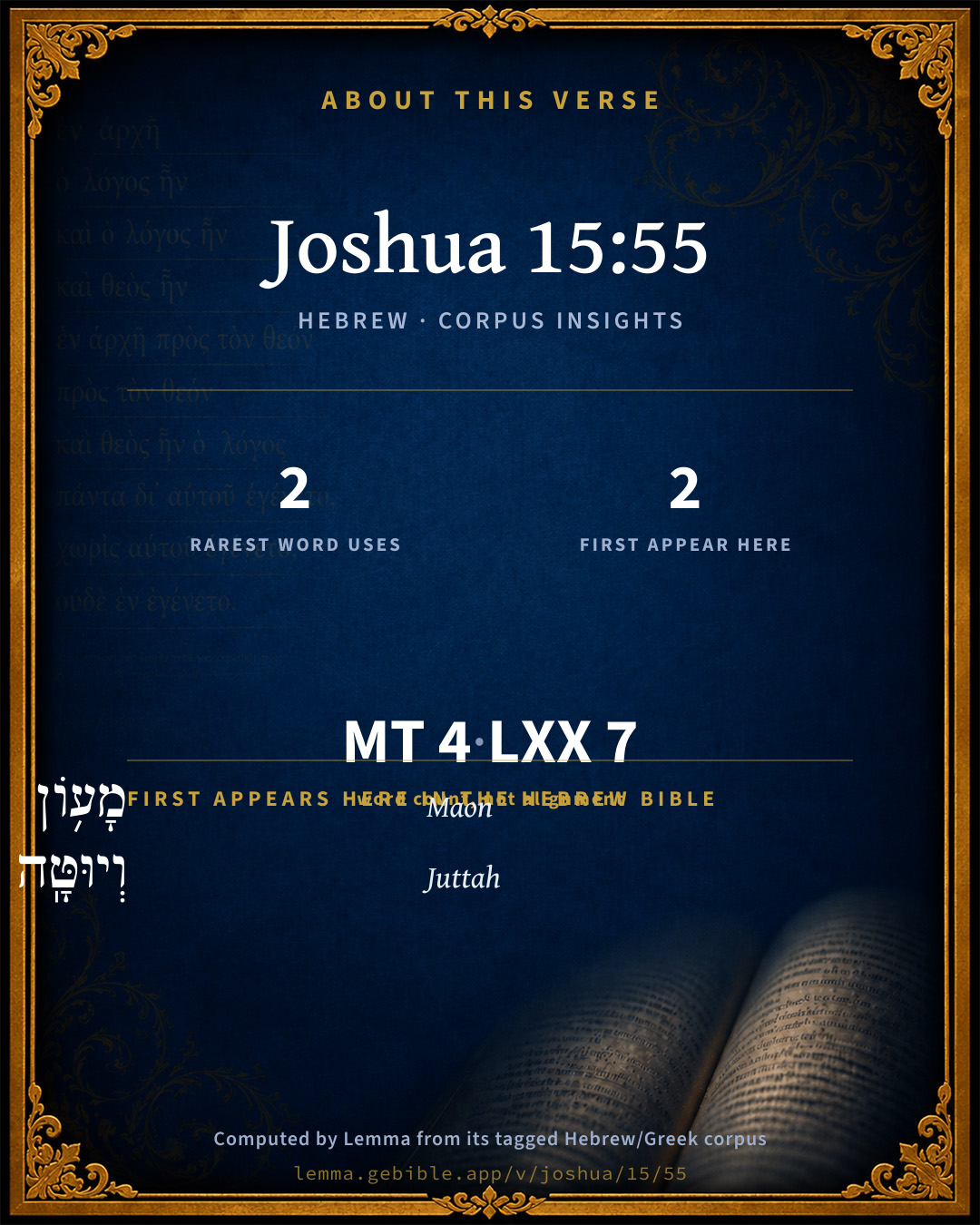
  • 2 first appearances in the Hebrew Bible
Full analysis ↓
Download a study sheet

One document with this verse’s original text, its word-by-word gloss line, the meaning frame, cross-references with their text, attributed commentary, and full source and license credits — printable, and it pastes into notes with its structure intact.

This verse Autodidact and up

Study sheet (.html) Plain text (.txt)

A passage Seminary Student

Up to 50 verses in one chapter. A passage sheet keeps up to 6 commentary sources and 12 cross-references per verse, in the order this page ranks them, and says so on the sheet whenever that leaves anything out. Ask for a single verse and you get the Autodidact verse sheet above.

Everything on this page stays free to read, with no account — the sheet is a download of what is already on screen, not access to it.

Want to remove ads? Support Godless Engineer
Compare translations 3

The same verse in 3 English versions, stacked beneath the original-language interlinear above. Click any original word for its lexicon entry.

Each is an independent rendering of the whole verse — the interlinear is not word-aligned to these translations.

Highlighted words mark where these versions differ — a whole-verse word diff, not a word-by-word alignment.

  • World English Bible Public Domain
    Maon, Carmel, and Ziph, and Jutah,
  • King James Version Public Domain
    Maon, Carmel, and Ziph, and Juttah,
  • unfoldingWord Literal Text CC BY-SA 4.0
    Maon, Carmel and Ziph and Juttah

unfoldingWord Literal Text — © unfoldingWord, licensed CC BY-SA 4.0. Word-aligned USFM3 via Door43 (git.door43.org/unfoldingWord/en_ult).

Versions to compare (up to 4)

3 of 4 selected

Show all 18 translations

Every available English version of this verse, each an independent rendering of the whole verse.

  • World English Bible Public Domain
    Maon, Carmel, and Ziph, and Jutah,
  • Berean Standard Bible Public Domain
    Maon, Carmel, Ziph, Juttah,
  • Majority Standard Bible Public Domain
    Maon, Carmel, Ziph, Juttah,
  • King James Version Public Domain
    Maon, Carmel, and Ziph, and Juttah,
  • American Standard Version (1901) Public Domain
    Maon, Carmel, and Ziph, and Jutah,
  • Revised Version (1885) Public Domain
    Maon, Carmel, and Ziph, and Jutah;
  • Geneva Bible (1599) Public Domain
    Maon, Carmel, and Ziph, and Iuttah,
  • Douay-Rheims (1899) Public Domain
    Maon and Carmel and Ziph and Jota,
  • Young's Literal Translation Public Domain
    Maon, Carmel, and Ziph, and Juttah,
  • Literal Standard Version CC BY-SA 4.0
    Maon, Carmel, and Ziph, and Juttah,
  • Unlocked Literal Bible CC BY-SA 4.0
    Maon, Carmel, Ziph, Juttah,
  • unfoldingWord Literal Text CC BY-SA 4.0
    Maon, Carmel and Ziph and Juttah
  • Darby Bible Public Domain
    Maon, Carmel, and Ziph, and Jutah,
  • World Messianic Bible Public Domain
    Maon, Carmel, Ziph, Jutah,
  • Webster's Bible Public Domain
    Maon, Carmel, and Ziph, and Juttah,
  • Free Bible Version CC BY-SA 4.0
    In addition: Maon, Carmel, Ziph, Juttah,
  • Bible in Basic English Public Domain
    Maon, Carmel, and Ziph, and Jutah;
  • JPS Tanakh (1917) Public Domain
    Maon, Carmel, and Ziph, and Juttah;

Literal Standard Version (2020), Covenant Press — licensed CC BY-SA 4.0. Text via the HelloAO Bible API (eBible.org). Unlocked Literal Bible (unfoldingWord) — licensed CC BY-SA 4.0. Text via the HelloAO Bible API (eBible.org). unfoldingWord Literal Text — © unfoldingWord, licensed CC BY-SA 4.0. Word-aligned USFM3 via Door43 (git.door43.org/unfoldingWord/en_ult). Free Bible Version, Dr. Jonathan Gallagher — licensed CC BY-SA 4.0. Text via the HelloAO Bible API (eBible.org).

Word by word

More ways to search: Search by grammar → Find every occurrence → Compare this word →

Practice this passage: Drill this verse → Learn its vocabulary →

וְיוּטָּֽה
Yuṭṭâh
H3194
“and · Juttah”
Conjunction + Noun, Proper
Part of Speech
Conjunction + Noun
Type
Proper
Full BDB Definition

Origin: from H5186

TWOT: None

Juttah = "stretched out" - a town in the mountains of Judah, in the neighbourhood of Maon and Carmel; modern 'Yutta'
  1. מָע֥וֹן Mâʻôwn H4584 “Maon” Noun, Proper
  2. כַּרְמֶ֖ל Karmel H3760 “Carmel” Noun, Proper
  3. וָזִ֥יף Zîyph H2128 “and · Ziph” Conjunction + Noun, Proper

About this verse

These counts appear in no published source. They are computed here, from the morphology-tagged text and Lemma’s own curated glosses. What Lemma adds →

4
words
4
distinct lemmas
Historical
section

Notable vocabulary

The rarest word here is וְיוּטָּֽה Juttah H3194 — appearing just 2 times in the whole Hebrew Bible.

First appearance in Scripture

These words make their first canonical appearance in the Hebrew Bible here:

  • מָע֥וֹן Maon H4584
  • וְיוּטָּֽה Juttah H3194

Shared distinctive vocabulary

וְיוּטָּֽה Juttah H3194 occurs in 2 verses of the Hebrew Bible. Also found in:

Grammatical profile

  • 4 nouns

Hebrew & Septuagint length

In English translation the verse runs 6 words from the Hebrew and 7 from the Septuagint (LXX English) — closely comparable.

A rough comparison of the two English renderings, which tokenize alike — not a word-level alignment.

Word counts can differ between the Hebrew and the Greek without any difference in meaning — e.g. the Hebrew direct-object marker אֵת has no separate Greek word, and Greek often adds the article ὁ.

In the original languages it is 4 Hebrew tokens and 7 Greek tokens — but the two are counted differently (Hebrew bundles its prefixes and suffixes into one token; the Greek is in lemma form), so that isn’t a like-for-like length.

Cross-references

9

Topical passages linked to Joshua 15:55 in the Treasury of Scripture Knowledge — connected by theme and wording, ordered by reader-vote popularity; previews shown in the World English Bible.

  • Joshua 15:24 Ziph, and Telem, and Bealoth,
  • 1 Samuel 23:25 Saul and his men went to seek him. They told David: why he came down to the rock, and abode in the wilderness of Maon. When Saul heard [that], he pursued after David in the wilderness of Maon.
  • 1 Samuel 25:2 There was a man in Maon, whose possessions were in Carmel; and the man was very great, and he had three thousand sheep, and a thousand goats: and he was shearing his sheep in Carmel.
  • 1 Samuel 23:14–15 David abode in the wilderness in the strongholds, and remained in the hill-country in the wilderness of Ziph. Saul sought him every day, but God didn't deliver him into his hand.
  • 1 Samuel 25:7 Now I have heard that you have shearers: your shepherds have now been with us, and we did them no hurt, neither was there anything missing to them, all the while they were in Carmel.
  • 1 Samuel 26:1–2 The Ziphites came to Saul to Gibeah, saying, Doesn't David hide himself in the hill of Hachilah, which is before the desert?
  • 1 Kings 18:42 So Ahab went up to eat and to drink. Elijah went up to the top of Carmel; and he bowed himself down on the earth, and put his face between his knees.
  • 2 Chronicles 26:10 He built towers in the wilderness, and hewed out many cisterns, for he had much cattle; in the lowland also, and in the plain: [and he had] farmers and vineyard keepers in the mountains and in the fruitful fields; for he loved farming.
  • Isaiah 35:2 It shall blossom abundantly, and rejoice even with joy and singing; the glory of Lebanon shall be given to it, the excellency of Carmel and Sharon: they shall see the glory of Yahweh, the excellency of our God.

Cross-references courtesy of OpenBible.info (CC BY 4.0).

Hebrew and Greek witnesses Masoretic Hebrew ↔ Greek Septuagint

The same verse in the two great witnesses to the Old Testament, shown verse-for-verse.

These are two independent witnesses, not word-aligned to each other, and the Septuagint is shown in lemma (dictionary) form.

Hebrew Joshua 15:55 Masoretic · Westminster Leningrad Codex

מָע֥וֹן כַּרְמֶ֖ל וָזִ֥יף וְיוּטָּֽה

Maon, Carmel, and Ziph, and Jutah,

World English Bible · Public Domain

Greek LXX Joshua 15:55 Septuagint · lemma form

μαωρ καί χερμελ καί οζιβ καί ιταν

Maor, and Chermel, and Ozib, and Itan,

LXX2012 (modern English Septuagint) · Public Domain

Hebrew: Westminster Leningrad Codex (CC BY 4.0). Greek: Septuagint (public domain); English from LXX2012 (modern English Septuagint) (Public Domain). How the Septuagint differs from the Hebrew →

Targum (Aramaic paraphrase)

1

The Targum is the ancient Jewish Aramaic paraphrase of the Hebrew Scriptures — an interpretive translation, not the Hebrew text itself. Onkelos (literal) and Pseudo-Jonathan (expansive) render the Torah, and Jonathan the Prophets. Coverage is partial: where no permissively-licensed English translation exists for a verse, only the Aramaic is shown. This is verse-level text, not a word-by-word alignment to the Hebrew.

  1. Targum Jonathan Prophets (Joshua–Malachi)
    מָעוֹן כַּרְמֶל וָזִיף וְיוּטָה:

    (no public-domain English translation for this verse)

    Targum Jonathan — Aramaic: “Mikraot Gedolot” (public domain). English: “Sefaria Community Translation” (CC0 1.0 (public-domain dedication)); “London "Chaldee Paraphrase," 1871” (public domain). Text via Sefaria.

Commentary

Notes on Joshua 15:55 from classic Christian and Jewish commentators (each source and its license shown beneath its notes). The classic Christian expositions comment on the surrounding passage and are grouped to its opening verse, so a note may address several verses; the Jewish commentaries on the Tanakh (Rashi and others) are per-verse, so they appear only where the commentator wrote on this verse.

Lemma curates 59 commentaries, every one of them public domain or Creative Commons licensed, each selected and text-cleaned for this edition rather than reprinted as found. About our sources →

Adam Clarke's Commentary

Verse 55. Maon] In a desert to which this town gave name, David took refuge for a considerable time from the persecution of Saul; and in this place Nabal the Carmelite had great possessions. See 1Sa 23:24-25; 1Sa 25:2.

Carmel] Not the celebrated mount of that name, but a village, the residence of Nabal. See 1Sa 25:2. It was near Maon, mentioned above, and was about ten miles eastward of Hebron. It is the place where Saul erected a trophy to himself after the defeat of the Amalekites; see 1Sa 15:12.

Ziph] See Clarke on Jos 15:24.

Adam Clarke's Commentary on the Bible (1810–1826) — public domain. Text from a community e-Sword/MySword module.

The Cambridge Bible for Schools and Colleges

gen. ed. J. J. S. Perowne

55. Maon] Group III, consists of ten cities, on the south-east of the two preceding groups, towards the desert:—

The Cambridge Bible for Schools and Colleges (gen. ed. J. J. S. Perowne; Cambridge University Press, 1878–1918) — public domain. Text from a community e-Sword module.

John Gill's Exposition

Halhul,.... Here begins a fourth division, or list, of the cities in the mountains. Halhul Jerom calls Ehul, and says (w) there was in his time in the country belonging to Aelia (or Jerusalem) a village by the name of Ahula, near Hebron; and

Bethzur, Jerom says (x), was then called Bethseron, a village as you go from Aelia to Hebron, in the twentieth mile, near which was a fountain at the bottom of a mount, where it is said the eunuch was baptized by Philip: he makes mention of another village called Bethsur in the tribe of Judah, a mile from Eleutheropolis. In the Apocrypha:"So he came to Judea, and drew near to Bethsura, which was a strong town, but distant from Jerusalem about five furlongs, and he laid sore siege unto it.'' (2 Maccabees 11:5)it is said to be but five furlongs from Jerusalem, but it must have been at a greater distance:

Gedor, of this city; see Gill on Jos 12:13.

(w) De loc. Heb. fol. 91. B. (x) De loc. Heb. fol. 89. G.

John Gill's Exposition of the Whole Bible (1746–1763) — public domain (CC PDM 1.0). Text via the HelloAO Bible API.

Haydock's Catholic Bible Commentary

Carmel. Not where Elias dwelt, but a city and mountain 10 miles east of Eleutheropolis. Nabal rendered it famous by his imprudence, (1 Kings xxv.) and Saul by a triumphal arch, 1 Kings xv. 12.

George Leo Haydock (1774–1849), Haydock's Catholic Family Bible and Commentary, 1859 edition — public domain. Excludes Psalms (Douay-Rheims chapter numbering differs from Protestant) and Deuterocanonical books (Catholic canon only).

Matthew Poole's English Annotations

Maon; of which see 1Sa 23:25; 25:2.

Carmel; Nabal’s country, 1Sa 25.

Ziph; which gave its name to the neighbouring mountain, 1Sa 26:1.

Matthew Poole's English Annotations on the Holy Bible (1683–1685) — public domain. Text from a community e-Sword/MySword module.

Whedon's Commentary on the Bible

Daniel D. Whedon

55. The third cluster of mountain cities lies east of the other two, toward the desert.

Maon, modern Main, nine miles south-southeast of Hebron, is conspicuously situated on a conical hill. The summit is crowned with ruins, foundations of hewn stone, a square enclosure, and several cisterns. The view is fine. Many towns of Judah are in sight.

Carmel, now called Kurmul, is a few miles northwest of Maon. Robinson says that here he found more extensive ruins than he had yet anywhere seen, unless perhaps at Beth-el. The city was built in a semicircular amphitheatre shut in by rocks, in which there is an artificial reservoir one hundred and seventeen by seventy-four feet. The ruins consist chiefly of foundations and broken walls, scattered in every direction, and thrown together in mournful confusion and desolation.

Ziph, modern Zif, five miles southeast of Hebron, is in ruins. Twice did its treacherous people attempt to betray David, the youthful outlaw, into the hands of his persecutor, Saul. 1Sa_23:19; 1Sa_26:1.

Juttah is in the vicinity of Ziph, at the southwest, and is now called Yutta. Robinson describes it as having the appearance of a large Mohammedan town, on a low eminence, with trees around. He agrees with Reland that this is the city Juda, (Luk_1:39,) the residence of Zacharias and Elizabeth, and the birthplace of John the Baptist. The pronunciation is softened in the New Testament.

Daniel D. Whedon (gen. ed.), Commentary on the Old and New Testaments (1874–1909) — public domain. Text from a community e-Sword module.

The Pulpit Commentary

Maon, Carmel, and Ziph. These, as Dean Stanley reminds us ("Sinai and Palestine," p. 101), still retain unaltered their old names. "That long line of hills was the beginning of the "hill country of Judaea," and when we began to ascend it the first answer to our inquiries after the route told us that it was "Carmel," on which Nabal fed his flocks, and close below its long ranges was the hill and ruins of Ziph," close above the hill of Maon, Wilson also ("Lands of the Bible," 1:380) makes the same remark. Maon is to be remembered as David"s hiding place from the enmity of Saul, (1Sa_23:24-26) and as the home of Nabal. (1Sa_25:2) Carmel (not the famous mountain of that name) meets us again in the history of Saul and of David. (1Sa_15:12 1Sa_25:2, 1Sa_25:5, 1Sa_25:7, 1Sa_25:40) The neighbourhood of Ziph was also one of David"s hiding places, and is described as a "wilderness" in which there was a "wood" in 1Sa_23:15, 19 26:1, 2. See also the prologue to Psalm 54. Another Ziph is mentioned in ver. 24.

The Pulpit Commentary (1880–1919), ed. H.D.M. Spence-Jones & Joseph S. Exell — public domain. Text from a community e-Sword module.

John Wesley's Explanatory Notes

Ziph - Which gave its name to the neighbouring mountains, 1 Sam. xxvi, 1.

John Wesley, Explanatory Notes Upon the Whole Bible (1754–1765) — public domain. Text via the GEBible commentary corpus.

unfoldingWord translationNotes

Door43 World Missions Community

Connecting Statement:

The writer lists cities of which Judah took possession. (See: How to Translate Names)

translationWords

Carmel

Jezreel

unfoldingWord translationNotes — © Distant Shores Media and the Door43 World Missions Community, licensed CC BY-SA 4.0. Source: git.door43.org/Door43/en_tn.

Lesson kit

Teaching starters — assembled from the data on this page, not authored interpretation. Every prompt links to the verse data it draws on. Edit before teaching.

Joshua, in the Historical, opens this verse with 4 words (4 distinct Hebrew lemmas). Its most distinctive word is Yuṭṭâh (“Juttah”). A historical commentator’s framing appears above. Read the whole chapter for the surrounding context.

Discussion questions

  1. How does “Juttah” (Yuṭṭâh) shape what this verse is saying?
  2. 2 words here appear for the first time in Scripture. What is being introduced at this debut?
  3. Joshua 21:16 shares the word «Juttah» with this verse. How do the two illuminate each other?
  4. These translations render this verse differently. What is at stake in choosing one wording over another?
  5. Reading how Adam Clarke's Commentary and The Cambridge Bible for Schools and Colleges read this verse, where do the two commentators agree and where do they part?

Things to notice

Reading settings

Reading text

Shown beneath each verse's original-language words.

Old Testament
Old Testament edition

Read the OT as the Masoretic Hebrew (MT) or the Greek Septuagint (LXX).

English shown for the Greek Septuagint (in the Hebrew ↔ Greek comparison).

Comparing translations? Open the Compare panel on any verse page to stack up to four side by side.