Jeremiah 31:14

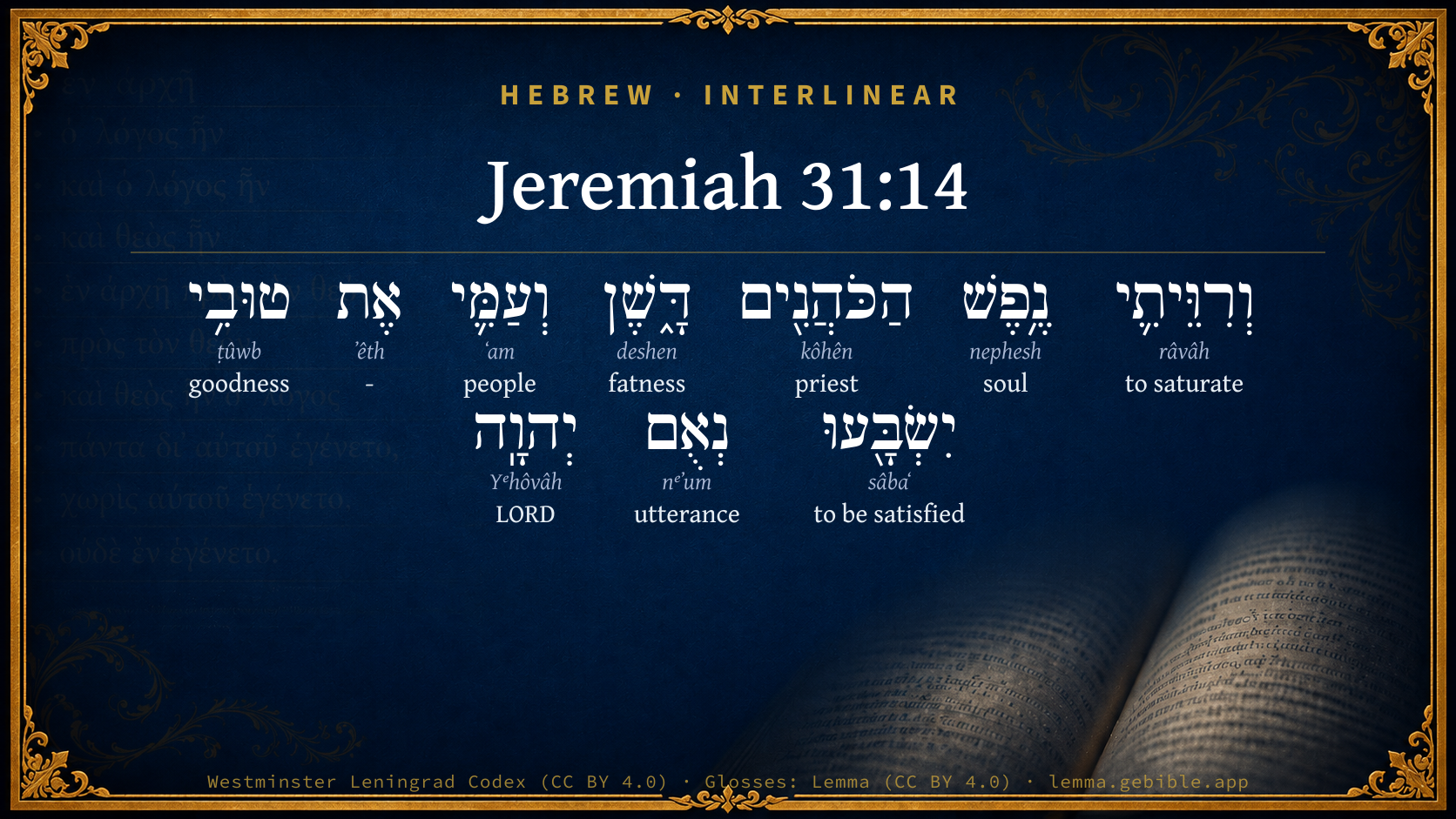
Hebrew (Westminster Leningrad Codex) Jeremiah 31:14 appears in the Hebrew Old Testament. The text above is from the Westminster Leningrad Codex. Each word links to its Strong’s number, a concise gloss, and parsing drawn from the Open Scriptures Hebrew Bible morphology. Click any word for its full Brown-Driver-Briggs (BDB) entry.
Download image
Cite this verse

Jeremiah 31:14 (World English Bible). Public Domain. Lemma interlinear Bible study tool, https://lemma.gebible.app/v/jeremiah/31/14.

Show BibTeX & RIS
BibTeX
RIS
English Translation
I will satiate the soul of the priests with fatness, and my people shall be satisfied with my goodness, says Yahweh.
World English Bible · Public Domain
Download a study sheet

One document with this verse’s original text, its word-by-word gloss line, the meaning frame, cross-references with their text, attributed commentary, and full source and license credits — printable, and it pastes into notes with its structure intact.

This verse Autodidact and up

Study sheet (.html) Plain text (.txt)

A passage Seminary Student

Up to 50 verses in one chapter. A passage sheet keeps up to 6 commentary sources and 12 cross-references per verse, in the order this page ranks them, and says so on the sheet whenever that leaves anything out. Ask for a single verse and you get the Autodidact verse sheet above.

Everything on this page stays free to read, with no account — the sheet is a download of what is already on screen, not access to it.

Want to remove ads? Support Godless Engineer
Compare translations 3

The same verse in 3 English versions, stacked beneath the original-language interlinear above. Click any original word for its lexicon entry.

Each is an independent rendering of the whole verse — the interlinear is not word-aligned to these translations.

Highlighted words mark where these versions differ — a whole-verse word diff, not a word-by-word alignment.

  • World English Bible Public Domain
    I will satiate the soul of the priests with fatness, and my people shall be satisfied with my goodness, says Yahweh.
  • King James Version Public Domain
    And I will satiate the soul of the priests with fatness, and my people shall be satisfied with my goodness, saith the LORD.
  • unfoldingWord Literal Text CC BY-SA 4.0
    Then I will saturate the lives of the priests in abundance. My people will fill themselves with my goodness—this is Yahweh’s declaration.”

unfoldingWord Literal Text — © unfoldingWord, licensed CC BY-SA 4.0. Word-aligned USFM3 via Door43 (git.door43.org/unfoldingWord/en_ult).

Versions to compare (up to 4)

3 of 4 selected

Show all 18 translations

Every available English version of this verse, each an independent rendering of the whole verse.

  • World English Bible Public Domain
    I will satiate the soul of the priests with fatness, and my people shall be satisfied with my goodness, says Yahweh.
  • Berean Standard Bible Public Domain
    I will fill the souls of the priests abundantly, and will fill My people with My goodness,” declares the LORD.
  • Majority Standard Bible Public Domain
    I will fill the souls of the priests abundantly, and will fill My people with My goodness,” declares the LORD.
  • King James Version Public Domain
    And I will satiate the soul of the priests with fatness, and my people shall be satisfied with my goodness, saith the LORD.
  • American Standard Version (1901) Public Domain
    And I will satiate the soul of the priests with fatness, and my people shall be satisfied with my goodness, saith Jehovah.
  • Revised Version (1885) Public Domain
    And I will satiate the soul of the priests with fatness, and my people shall be satisfied with my goodness, saith the LORD.
  • Geneva Bible (1599) Public Domain
    And I wil replenish the soule of the Priests with fatnesse, and my people shalbe satisfied with my goodnesse, saith the Lord.
  • Douay-Rheims (1899) Public Domain
    And I will fill the soul of the priests with fatness: and my people shall be filled with my good things, saith the Lord.
  • Young's Literal Translation Public Domain
    And satisfied the soul of the priests `with' fatness, And My people with My goodness are satisfied, An affirmation of Jehovah.
  • Literal Standard Version CC BY-SA 4.0
    And satisfied the soul of the priests [with] fatness, || And My people are satisfied with My goodness,” || A declaration of YHWH.
  • Unlocked Literal Bible CC BY-SA 4.0
    Then I will saturate the lives of the priests in abundance. My people will fill themselves with my goodness—this is Yahweh's declaration.”
  • unfoldingWord Literal Text CC BY-SA 4.0
    Then I will saturate the lives of the priests in abundance. My people will fill themselves with my goodness—this is Yahweh’s declaration.”
  • Darby Bible Public Domain
    And I will satiate the soul of the priests with fatness, and my people shall be satisfied with my goodness, saith Jehovah.
  • World Messianic Bible Public Domain
    I will satiate the soul of the priests with fatness, and my people will be satisfied with my goodness,” says the LORD.
  • Webster's Bible Public Domain
    And I will satiate the soul of the priests with fatness, and my people shall be satisfied with my goodness, saith the LORD.
  • Free Bible Version CC BY-SA 4.0
    I will give my priests everything they need and more, and my people will be more than satisfied with my goodness towards them, declares the Lord.
  • Bible in Basic English Public Domain
    I will give the priests their desired fat things, and my people will have a full measure of my good things, says the Lord.
  • JPS Tanakh (1917) Public Domain
    And I will satiate the soul of the priests with fatness, and My people shall be satisfied with My goodness, saith the LORD.

Literal Standard Version (2020), Covenant Press — licensed CC BY-SA 4.0. Text via the HelloAO Bible API (eBible.org). Unlocked Literal Bible (unfoldingWord) — licensed CC BY-SA 4.0. Text via the HelloAO Bible API (eBible.org). unfoldingWord Literal Text — © unfoldingWord, licensed CC BY-SA 4.0. Word-aligned USFM3 via Door43 (git.door43.org/unfoldingWord/en_ult). Free Bible Version, Dr. Jonathan Gallagher — licensed CC BY-SA 4.0. Text via the HelloAO Bible API (eBible.org).

Word by word

More ways to search: Search by grammar → Find every occurrence → Compare this word →

Practice this passage: Drill this verse → Learn its vocabulary →

וְרִוֵּיתִ֛י
râvâh
H7301
“and · to saturate”
Conjunction + Verb, Piel, Sequential Perfect, 1st Person, Common, Singular
Part of Speech
Conjunction + Verb
Stem
Piel
Form
Sequential Perfect
Person
1st Person
Gender
Common
Number
Singular
Full BDB Definition

Origin: a primitive root

TWOT: 2130

to be satiated or saturated, have or drink one's fill - (Qal) to take one's fill - (Piel) - to be drunk, be intoxicated - to drench, water abundantly, saturate - (Hiphil) to saturate, water, cause to drink
  1. נֶ֥פֶשׁ nephesh H5315 “soul of” Noun, Common, Both, Singular, Construct
  2. הַכֹּהֲנִ֖ים kôhên H3548 “the · priests” Particle, Definite Article + Noun, Common, Masculine, Plural, Absolute
  3. דָּ֑שֶׁן deshen H1880 “fatness” Noun, Common, Masculine, Singular, Absolute
  4. וְעַמִּ֛י ʻam H5971 “and · people · my” Conjunction + Noun, Common, Masculine, Singular, Construct + Suffix, Personal, 1st Person, Common, Singular
  5. אֶת ʼêth H853 “-” Particle, Direct Object
  6. טוּבִ֥י ṭûwb H2898 “goodness · my” Noun, Common, Masculine, Singular, Construct + Suffix, Personal, 1st Person, Common, Singular
  7. יִשְׂבָּ֖עוּ sâbaʻ H7646 “to be satisfied” Verb, Qal, Imperfect, 3rd Person, Masculine, Plural
  8. נְאֻם nᵉʼum H5002 “utterance of” Noun, Common, Masculine, Singular, Construct
  9. יְהוָֽה Yᵉhôvâh H3068 “LORD” Noun, Proper

About this verse

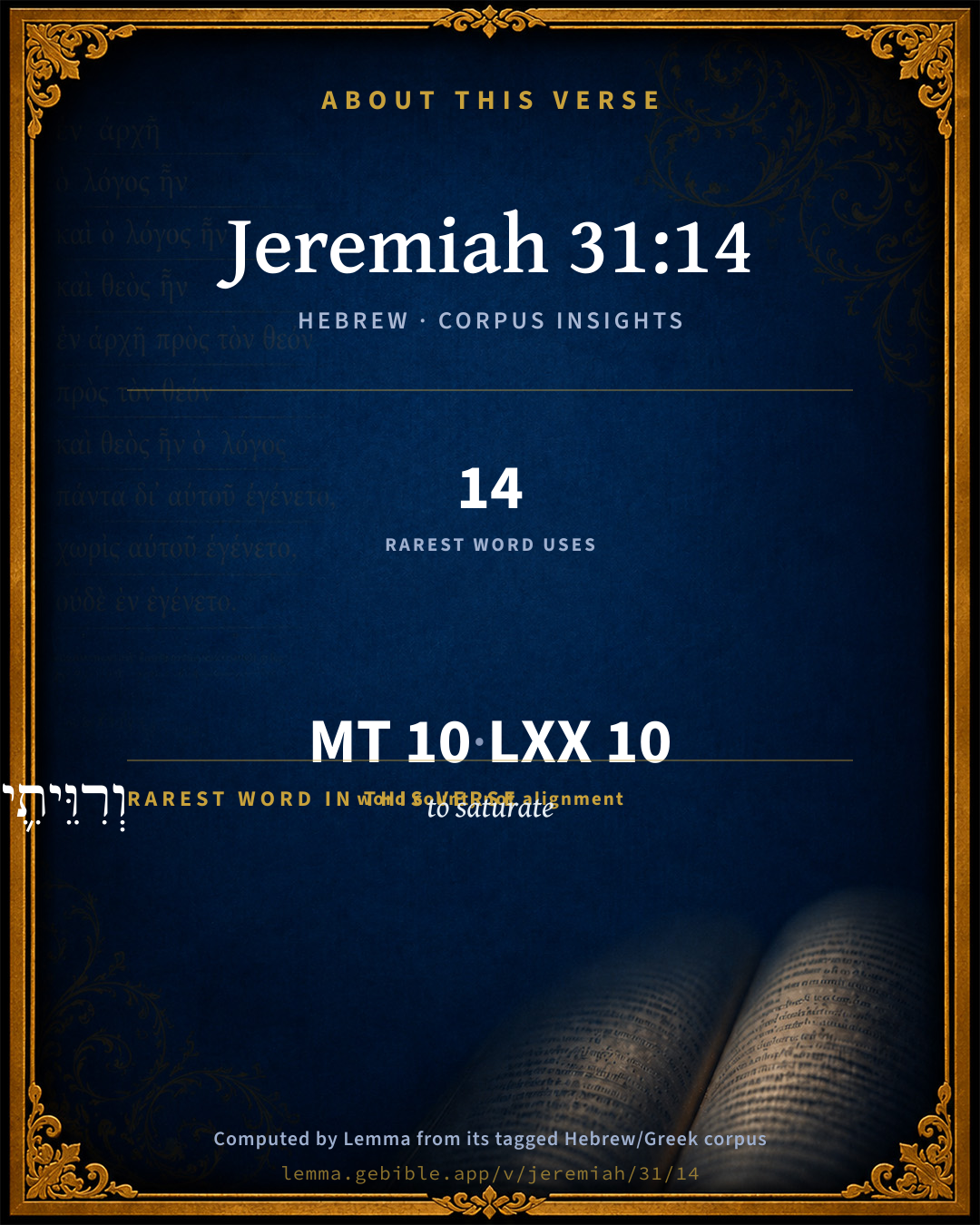
These counts appear in no published source. They are computed here, from the morphology-tagged text and Lemma’s own curated glosses. What Lemma adds →

10
words
10
distinct lemmas
Prophets
section

Notable vocabulary

The rarest word here is וְרִוֵּיתִ֛י to saturate H7301 — appearing just 14 times in the whole Hebrew Bible.

Shared distinctive vocabulary

וְרִוֵּיתִ֛י to saturate H7301 occurs in 14 verses of the Hebrew Bible. Also found in:

Grammatical profile

  • 2 verbs
  • 7 nouns
  • 1 particle

Verb forms

  • וְרִוֵּיתִ֛י Piel · Sequential Perfect
  • יִשְׂבָּ֖עוּ Qal · Imperfect

Hebrew & Septuagint length

In the original languages it is 10 Hebrew tokens and 10 Greek tokens — but the two are counted differently (Hebrew bundles its prefixes and suffixes into one token; the Greek is in lemma form), so that isn’t a like-for-like length.

Cross-references

24

Topical passages linked to Jeremiah 31:14 in the Treasury of Scripture Knowledge — connected by theme and wording, ordered by reader-vote popularity; previews shown in the World English Bible.

  • Jeremiah 31:25 For I have satiated the weary soul, and every sorrowful soul have I replenished.
  • 1 Peter 2:9 But you are a chosen race, a royal priesthood, a holy nation, a people for God's own possession, that you may show forth the excellencies of him who called you out of darkness into his marvelous light:
  • Jeremiah 33:9 [This city] shall be to me for a name of joy, for a praise and for a glory, before all the nations of the earth, which shall hear all the good that I do to them, and shall fear and tremble for all the good and for all the peace that I procure to it.
  • Psalms 107:9 For he satisfies the longing soul. He fills the hungry soul with good.
  • Song of Solomon 5:1 I have come into my garden, my sister, my bride. I have gathered my myrrh with my spice; I have eaten my honeycomb with my honey; I have drunk my wine with my milk. Friends Eat, friends! Drink, yes, drink abundantly, beloved. Beloved
  • Matthew 5:6 Blessed are those who hunger and thirst after righteousness, For they shall be filled.
  • Revelation 5:10 And made them kings and priests to our God, And they reign on earth."
  • Revelation 7:16–17 They will never be hungry, neither thirsty any more; neither will the sun beat on them, nor any heat;
  • 2 Chronicles 6:41 Now therefore arise, Yahweh God, into your resting-place, you, and the ark of your strength: let your priests, Yahweh God, be clothed with salvation, and let your saints rejoice in goodness.
  • Nehemiah 10:39 For the children of Israel and the children of Levi shall bring the heave-offering of the grain, of the new wine, and of the oil, to the chambers, where are the vessels of the sanctuary, and the priests who minister, and the porters, and the singers: and we will not forsake the house of our God.
  • Psalms 36:8 They shall be abundantly satisfied with the abundance of your house. You will make them drink of the river of your pleasures.
  • Psalms 63:5 My soul shall be satisfied as with the richest food. My mouth shall praise you with joyful lips,
  • Psalms 65:4 Blessed is one whom you choose, and cause to come near, That he may live in your courts. We will be filled with the goodness of your house, Your holy temple.
  • Psalms 132:9 Let your priest be clothed with righteousness. Let your saints shout for joy!"
  • Psalms 132:16 Her priests I will also clothe with salvation. Her saints will shout aloud for joy.
  • Isaiah 25:6 In this mountain will Yahweh of Hosts make to all peoples a feast of fat things, a feast of wines on the lees, of fat things full of marrow, of wines on the lees well refined.
  • Isaiah 55:1–3 Ho, everyone who thirsts, come you to the waters, and he who has no money; come you, buy, and eat; yes, come, buy wine and milk without money and without price.
  • Isaiah 61:6 But you shall be named the priests of Yahweh; men shall call you the ministers of our God: you shall eat the wealth of the nations, and in their glory shall you boast yourselves.
  • Isaiah 66:10–14 Rejoice you with Jerusalem, and be glad for her, all you who love her: rejoice for joy with her, all you who mourn over her;
  • Zechariah 9:15–17 Yahweh of Hosts will defend them; And they will destroy and overcome with sling-stones; And they will drink, and roar as through wine; And they will be filled like bowls, Like the corners of the altar.
  • Ephesians 1:3 Blessed be the God and Father of our Lord Jesus Christ, who has blessed us with every spiritual blessing in the heavenly places in Christ;
  • Ephesians 3:19 and to know Christ's love which surpasses knowledge, that you may be filled with all the fullness of God.
  • Deuteronomy 33:8–11 Of Levi he said, Your Thummim and your Urim are with your godly one, Whom you did prove at Massah, With whom you did strive at the waters of Meribah;
  • Psalms 17:15 As for me, I shall see your face in righteousness; I shall be satisfied, when I awake, with seeing your form.

Cross-references courtesy of OpenBible.info (CC BY 4.0).

Hebrew and Greek witnesses Masoretic Hebrew ↔ Greek Septuagint

The same verse in the two great witnesses to the Old Testament, shown verse-for-verse.

These are two independent witnesses, not word-aligned to each other, and the Septuagint is shown in lemma (dictionary) form.

Hebrew Jeremiah 31:14 Masoretic · Westminster Leningrad Codex

וְרִוֵּיתִ֛י נֶ֥פֶשׁ הַכֹּהֲנִ֖ים דָּ֑שֶׁן וְעַמִּ֛י אֶת טוּבִ֥י יִשְׂבָּ֖עוּ נְאֻם יְהוָֽה

I will satiate the soul of the priests with fatness, and my people shall be satisfied with my goodness, says Yahweh.

World English Bible · Public Domain

Greek LXX Structure differs

In the Septuagint, Jeremiah is about an eighth shorter than the Hebrew and arranges its material differently — the Oracles Against the Nations (Hebrew chapters 46–51) appear in the middle of the Greek book, after 25:13. Because the chapter and verse boundaries do not line up, a verse-for-verse comparison with the Hebrew is not shown.

A verse-for-verse comparison isn’t shown here because the chapters and verses don’t line up. Switch to the LXX edition with the MT / LXX toggle above to read the Greek directly.

Hebrew: Westminster Leningrad Codex (CC BY 4.0). Greek: Septuagint (public domain); English from a public-domain English Septuagint. How the Septuagint differs from the Hebrew →

Targum (Aramaic paraphrase)

1

The Targum is the ancient Jewish Aramaic paraphrase of the Hebrew Scriptures — an interpretive translation, not the Hebrew text itself. Onkelos (literal) and Pseudo-Jonathan (expansive) render the Torah, and Jonathan the Prophets. Coverage is partial: where no permissively-licensed English translation exists for a verse, only the Aramaic is shown. This is verse-level text, not a word-by-word alignment to the Hebrew.

  1. Targum Jonathan Prophets (Joshua–Malachi)
    וְאֶשְׂבַּע נְפַשׁ כַּהֲנַיָא תַּפְנוּקִין וְעַמִי בֵּית יִשְׂרָאֵל יַת טוּבִי דִיהָבִית לְהוֹן יִשְׂבְּעוּן אֲמַר יְיָ:

    "And the souls of the priests shall be satisfied with fatness, and my people the house of Israel shall be satisfied with my goodness, saith the Lord.

    Targum Jonathan — Aramaic: “Mikraot Gedolot” (public domain). English: “Sefaria Community Translation” (CC0 1.0 (public-domain dedication)); “London "Chaldee Paraphrase," 1871” (public domain). Text via Sefaria.

Commentary

Notes on Jeremiah 31:14 from classic Christian and Jewish commentators (each source and its license shown beneath its notes). The classic Christian expositions comment on the surrounding passage and are grouped to its opening verse, so a note may address several verses; the Jewish commentaries on the Tanakh (Rashi and others) are per-verse, so they appear only where the commentator wrote on this verse.

Lemma curates 59 commentaries, every one of them public domain or Creative Commons licensed, each selected and text-cleaned for this edition rather than reprinted as found. About our sources →

Trapp's Complete Commentary

John Trapp

Jer 31:14 And I will satiate the soul of the priests with fatness, and my people shall be satisfied with my goodness, saith the LORD.

Ver. 14. And I will satiate the soul of the priests with fatness,] i.e., Provide liberally for my ministers; {Isa 66:21} they and theirs shall be well maintained. Terms taken from the good and fat parts of the sacrifices, which were allotted for the priests.

John Trapp, A Commentary or Exposition upon All the Books of the Old and New Testament (1647–1656) — public domain. Text from a community e-Sword module.

The Biblical Illustrator

Joseph S. Exell

Jer_31:14

My people shall be satisfied with My goodness.

A promise for Gods people

I. Ascertain the right application of the promise. My people. The term is restrictive. Only the people of God. And it is universal: all, everywhere, in every age. Who, then, are they? The phrase denotes covenant relationship. As man is alienated, it implies reconciliation,--acceptance. The covenant by which this is effected is that of mercy in Christ. As children of the covenant, we have received its visible seal,--have been instructed in its obligations and blessings. Repentance and faith required. These produce continued obedience,--and so we become, so we continue to be, the people of God.

II. What is the promise made to them? They shall be satisfied, &c.

1. There is the goodness of God. The phrase sometimes refers to His essential goodness; He is good. But here, to its bestowments;--He doeth good.

(1) The condescending manifestation of pardoning mercy, and adopting love to the conscience.

(2) The various gifts of grace, and blessings of providence, all flowing from paternal love.

(3) The blessings of glory, future, and to be waited for; but brought near by good hope, given by God who hath loved us.

2. With this they are satisfied.

(1) The effect of manifested mercy is true satisfaction--peace, joy, delight. We possess what we feel is our true portion.

(2) And, preserving this feeling,--living as penitent, pardoned believers,--we rejoice in the ordinary gifts of providence; even in chastenings we joy, knowing, their source and object; we rejoice in the overflowing fountain of grace; we joy in the foretastes of glory.

Lessons--

1. See the inestimable value of religion Other gifts vain without this. This of itself all in all.

2. Oh, the unutterable folly of sin! You refuse bliss; choose misery; and for what ? The fountains of living waters,--for broken, even empty cisterns.

3. Seek religion now. Live in full possession of it. (G. Cubitt.)

Gods people satisfied with His goodness

I. My people. Who are now Gods people? All, whether of Jewish origin or of Gentile extraction, who--

1. Have repented of sin, and turned to the Lord with weeping and supplication (Zec_12:10; Jer_31:9; Act_2:38; Act_3:19).

2. Have received Christ, and believed on Him to the salvation of their souls (Joh_1:11-13; Joh_3:18; Joh_3:36).

3. Have been regenerated by the Spirit and the truth of God (Joh_3:5-8; Tit_3:3-7; 1Pe_1:1; 1Pe_1:9; 1Pe_1:23).

4. Have the assurance of their adoption into the family of God (Rom_8:14-17; Gal_4:4-7).

5. Who worship God in spirit and in truth (Joh_4:24; Php_3:3).

6. Who keep His commandments, and are zealous of, and careful to maintain, good works (Joh_14:21; Joh_14:24; Tit_2:14; Tit_3:8; Jam_2:14-26; Rev_22:14).

7. Who have their thoughts and affections set on things above, and who are ever looking for the coming of their Lord (Col_3:1-4; Php_3:20-21; Tit_2:13; 2Pe_3:10-14; Rev_22:20). My people--

II. Shall be satisfied. Satisfaction is the rest of the desiring faculties. To be satisfied is to be filled, contented, and gratified to that degree, that nothing more is, or can be desired. The primary idea of the Hebrew word lies in abundance of drink, although in the common usage of the language this verb is more frequently applied to food than to drink. Thus of one sated with food, Deu_31:20; Rth_2:14; Isa_44:16; Jer_31:14. It is spoken of the Spirit, Ecc_6:3; and metaphorically of the eye, as not satisfied with seeing, Ecc_1:8. Compare Isa_53:2; Psa_17:15.--Geseniuss Heb. Lex. Our spiritual need is often set forth in Scripture by our bodily necessities; and our spiritual supplies are spoken of in similar terms, to the supplies of our temporal wants (Isa_25:6; Isa_55:1-3; Isa_66:10-14; Zec_9:15-17; Mat_5:6). They shall be satisfied; for

1. Their minds shall be filled with knowledge, confidence, and hope, in reference to Divine, Spiritual, and eternal things. They shall be free from perplexity, doubt, and fear. They shall have the full assurance of understanding, to the acknowledgment of the mystery of God, and of the Father, and of Christ (Col_2:2). They shall to God draw near in full assurance of faith, having their hearts sprinkled from an evil conscience, and their bodies washed with pure water (Heb_10:22). And they shew the same diligence unto the full assurance of hope unto the end (Heb_6:11). These three full assurances satisfy the saints.

2. Their souls shall be filled with holiness.

3. Their hearts shall be filled with love (1Jn_4:16-19).

4. Their lives shall be filled with good deeds (Php_1:10-11; Php_2:14-16; Mat_5:13-16). Shah be satisfied--

III. With my goodness, saith the Lord. The goodness of God here means His kindness, benignity, and beneficence, as it does in Psa_25:7; Psa_27:13; Psa_31:19; Psa_145:7, and in many other places.

1. They shall be satisfied with Gods favour. O Naphtali, satisfied with favour, and full of the blessing of the Lord (Deu_33:23). In His favour is life (Psa_30:5). In His favour there is pardon and peace, purity and hope, love and joy, protection and honour (Rom_5:1-5; Psa_4:7-8; Psa_5:12; Psa_32:1; Psa_23:2; Psa_89:15-18; Psa_106:4-5).

2. They shall be satisfied with His goodness in their meditations on God (Psa_63:5; Psa_36:6; Psa_104:34; Psa_119:14-16).

3. They shall be satisfied with Gods goodness in His worship and service (Psa_65:4; Psa_36:7-9; Psa_36:34).

4. They shall be satisfied with Gods goodness in fellowship and communion with Him (1Jn_1:3-4). Fellowship with God and His Son Jesus Christ consists in our being partakers of the Divine nature; in constant intercourse and communion with the Divine being; in community of interest; and in mutual possession. In this blessed fellowship we are satisfied; for we are filled with all the fulness of God, and are blessed with all spiritual blessings in heavenly things in Christ.

5. They shall be satisfied with Gods goodness in heaven for ever and ever (Psa_17:15). Then shall we be satisfied, fully satisfied, eternally satisfied (Rev_7:14-17).

6. The certainty that Gods people shall be satisfied with His goodness. We have no ground for doubt; for God says it, whose word cannot fail. Are we Gods people? If so, we shall be satisfied with His goodness; but if not, we cannot be satisfied. Literature, art, and science cannot satisfy the soul. Wealth, honour, pleasure cannot satisfy the immortal mind. Believe me, nothing can satisfy us but the goodness of God. (H. O. Crofts, D. D.)

The Biblical Illustrator, edited by Joseph S. Exell (c. 1880s–1900s) — public domain. Text from a community e-Sword module.

Tyndale Open Study Notes

Tyndale Open Resources

31:14 The priests and the people would enjoy abundance because the people would pay their tithes rather than robbing God (Mal 3:8-12).

Tyndale Open Study Notes — © Tyndale Open Resources, licensed CC BY-SA 4.0. Text via the HelloAO Bible API.

Geneva Bible (1599)

Geneva Bible translators

Meaning, the spirit of wisdom, knowledge, and zeal.

Geneva Bible (1599) marginal notes — public domain. Text via Bolls.life.

Jamieson, Fausset & Brown

Robert Jamieson, A. R. Fausset & David Brown

my goodness-- (Jer 31:12).

Jamieson, Fausset & Brown — Commentary Critical and Explanatory on the Whole Bible (1871) — public domain (CC PDM 1.0). Text via the HelloAO Bible API.

Adam Clarke's Commentary

Verse 14. And I will satiate the soul of the priests] The worship of God being restored, they shall have their proper share of the victims brought to the temple.

Adam Clarke's Commentary on the Bible (1810–1826) — public domain. Text from a community e-Sword/MySword module.

John Calvin's Commentaries

This verse is connected with the former; for what the Prophet had said generally of the whole people, he now distinctly declares respecting the priests, for they were, as it were, the heart of the people; and by this order God gave a lively representation of his favor. This is the reason why the Scripture, in setting forth God’s blessing to his chosen people, speaks especially of the priests, as it appears from many places. Then the Prophet intimates that God would be bountiful indiscriminately to all the Israelites, but that his peculiar favor would be conspicuous towards the priests, for the condition of the people would not be complete without the priesthood, for the priesthood was, as it were, the soul. They would have lived like the heathens, had not God prescribed how he was to be called upon and worshipped. And having mentioned the priests, he does not confine himself to them, but the favor of God is extended to the whole people. It is not then only of the priests that the Prophet speaks, but he declares that the people would be made blessed through God’s bounty, and yet that his peculiar kindness would be manifested towards the Levitical priests, according to what we read in the Psalms: a special blessing is promised to the priests, accompanied with felicity to the godly; and David, when felicitating himself on having so many of God’s blessings, by which he was distinguished, does indeed mention the provisions of his table and abundance of all other things, yet he immediately adds,

“I will dwell in the house of the Lord.” (Psalm 23:6)

By this conclusion, he intimates, that he esteemed as nothing what profane men desire, except he enjoyed as the first thing the worship of God; for this is the main part of our happiness. For wherefore do we live, except we learn, while we partake of blessings from God’s hand, that he is our Father, and that we are stimulated by his bounty to worship him, and except we surrender ourselves wholly to his word?

We now, then, perceive the Prophet’s object in saying, that the priests would be satiated with fatness

As the word דשן, deshin, fatness, denotes abundance of all things; so satiate intimates the great extent of God’s bounty. Some render it “inebriate,” but improperly; and it would be inappropriate to say, “I will inebriate with fatness.” But רוה rue, means to irrigate and also to satiate: hence the Prophet said, in what we considered yesterday, that the soul of the faithful would be like a watered garden; it is there רוה, rue. So also now God means, that he would be so bountiful towards his people, that nothing would be wanting to the full affluence of all good things. And he again says the same thing with regard to the whole people, My people shall be satisfied with my goodness, saith Jehovah We hence see that nothing is promised to the priests, except in connection with the whole Church. It follows —

John Calvin's Commentaries (1540-1563) — public domain. Text from the Calvin Translation Society English edition (1840s-50s) via the Christian Classics Ethereal Library (ccel.org). Calvin's coverage is partial (roughly two-thirds of the Bible); uncommented books and verses are honest gaps, never fabricated. The 19th-century editor's footnotes and remarks are omitted so the notes are faithfully Calvin's own voice.

The Cambridge Bible for Schools and Colleges

gen. ed. J. J. S. Perowne

14. satiate] lit. water.

the soul of the priests with fatness] The sacrifices shall be so numerous that the priests and their families shall have more than enough for their share. The priest’s portion was the wave-breast and heave-shoulder (Lev_7:31-34). For the soul considered as the seat of desire, cp. Jer_22:28, and in this case of eagerness for food, appetite, Isa_56:11, “greedy dogs,” lit. “strong of soul.”

The Cambridge Bible for Schools and Colleges (gen. ed. J. J. S. Perowne; Cambridge University Press, 1878–1918) — public domain. Text from a community e-Sword module.

John Gill's Exposition

And I will satiate the soul of the priests with fatness,.... Meaning either the ministers of the Gospel, who should not only be liberally provided for as to their maintenance, which is too low a sense; but filled with spiritual good things, with the doctrines of the Gospel, and a comfortable experience of them, that they may be able to feed others with knowledge and understanding; or since, under the Gospel dispensation, there is no such distinct order of men under the name of priests, but all the saints are made kings and priests to God, they may be here meant, as follows:

and my people shall be satisfied with my goodness, saith the Lord; to which they are said to flow; see Gill on Jer 31:12. But, lest it should be thought that there would be no manner of trouble and affliction in those times, two instances, as follow, are given; the one at the beginning, and the other towards the close of them, expressive of distress; one on temporal, the other on spiritual accounts.

John Gill's Exposition of the Whole Bible (1746–1763) — public domain (CC PDM 1.0). Text via the HelloAO Bible API.

Haydock's Catholic Bible Commentary

Fatness. Abundant crops secured them more plentiful tythes[tithes], as long as the people preserved their religion. (Haydock) --- No nation had more priests, or better provided for. (Calmet)

George Leo Haydock (1774–1849), Haydock's Catholic Family Bible and Commentary, 1859 edition — public domain. Excludes Psalms (Douay-Rheims chapter numbering differs from Protestant) and Deuterocanonical books (Catholic canon only).

Matthew Poole's English Annotations

By

priests some understand the ministers of the gospel, whom God here promiseth liberally to provide for; or rather, by giving a success to their ministry, and letting them see the fruit of their labours, make to rejoice: in which metaphorical sense I should rather interpret it, applying it first to the priests of the Jews after the captivity, of whom it is said, Ezr 6:16, that they kept the feast of the dedication of the second temple with joy; and Ezr 6:22, the Lord had made the people joyful. Nor were the people for a short time only satisfied with the Lord’s goodness. In a secondary typical sense it may also signify the spiritual success and rejoicing of good ministers under the gospel, and the spiritual joy of believers. This rejoicing is metaphorically expressed by fatness, with allusion to the rift of the sacrifices under the law. It is a usual thing for God by his prophets to express New Testament duties and privileges by phrases borrowed from the worship of God under the Old Testament. See Isa 66:22,23.

Matthew Poole's English Annotations on the Holy Bible (1683–1685) — public domain. Text from a community e-Sword/MySword module.

Whedon's Commentary on the Bible

Daniel D. Whedon

14. Satiate — Abundantly satisfy — an image of prosperity. The offerings shall be so numerous that the priests shall scarcely consume the portions which fall to them.

Daniel D. Whedon (gen. ed.), Commentary on the Old and New Testaments (1874–1909) — public domain. Text from a community e-Sword module.

The Pulpit Commentary

And I will satiate; literally, water. (same word as in Psa_36:8) The "fatness" means the fat parts of the thank offerings, which were given to the priests. (Lev_7:34) Satisfied. "Satiated" would be a happier rendering. The word is different from that rendered "satiate" just above.

Satisfied.

I THERE IS A SATISFACTION WHICH IS NOT TO BE DESIRED.

1. That of the worldling, which says, "Soul, take thine ease," etc.

2. That of conventionalism. This looks only to the ordinary standard of religious attainment, and so long as it can come up tolerably near to that standard, it desires no more. They are "at ease in Zion," and the "woe" denounced on such is theirs.

3. Of Pharisaism, which thanks God that it is not as other men are.

4. Of the Stoic, that has drilled itself not to feel the sorrows of men.

5. Of the selfish, which, because it swims, cares not who sinks.

II BUT THERE IS A SATISFACTION WHICH IS GREATLY TO BE DESIRED.

1. That of trust, which prevents all murmuring at the dispensations of God, and which says, "I will trust, and not be afraid.

2. That of meekness, which says, "It is the Lord; let him do what seemeth good in his sight.

3. That of belief in God"s promises in Christ. "Being justified by faith, we have peace with God.

4. That of experience the consciousness that God is carrying on his work within us, deepening the hold of that which is good, loosening more and more the power of that which is evil. Consciousness of growth in grace. But none of these, precious as they are, come up to what is meant here. For it tells us that

III THERE IS A SATISFACTION BETTER THAN ALL THESE. It is that of the realization of the promises of God. This, not now, but hereafter. In all the kingdom of nature where God has implanted any hunger, he has made provision for its supply. Is the soul of man to be the solitary exception? The seeds obtain their full development ere they die; but not one single soul that God has created ever does so. We cannot be satisfied with either what we know or attain to here. What satisfaction we have is all based on the conviction that we know not, see not, possess not, now; we shall hereafter. See to it, that we be in the road that leadeth to that realization. "I am the Way," said Jesus. C.

The Pulpit Commentary (1880–1919), ed. H.D.M. Spence-Jones & Joseph S. Exell — public domain. Text from a community e-Sword module.

Rashi

Rabbi Shlomo Yitzchaki (Rashi)

fat Heb. דָשֶן.

Rashi on the Tanakh — English translations: “The Judaica Press complete Tanach with Rashi, translated by A. J. Rosenberg” (CC BY 4.0); “Pentateuch with Rashi's commentary by M. Rosenbaum and A.M. Silbermann, 1929-1934” (public domain); “The Metsudah Tanach series, Lakewood, N.J” (CC BY 4.0); and “The Book of Joshua, Metsudah Publications, 1997” (CC BY 4.0). Text via Sefaria.

Lesson kit

Teaching starters — assembled from the data on this page, not authored interpretation. Every prompt links to the verse data it draws on. Edit before teaching.

Jeremiah, in the Prophets, opens this verse with 10 words (10 distinct Hebrew lemmas). Its most distinctive word is râvâh (“to saturate”). A historical commentator’s framing appears above. Read the whole chapter for the surrounding context.

Discussion questions

  1. How does “to saturate” (râvâh) shape what this verse is saying?
  2. Psalms 36:8 shares the word «to saturate» with this verse. How do the two illuminate each other?
  3. These translations render this verse differently; the difference is in the English rendering, not the original. What questions does that raise?
  4. The verb «וְרִוֵּיתִ֛י» is Piel Sequential Perfect. How does its form color the action?
  5. Reading how Trapp's Complete Commentary and The Biblical Illustrator read this verse, where do the two commentators agree and where do they part?

Things to notice

Reading settings

Reading text

Shown beneath each verse's original-language words.

Old Testament
Old Testament edition

Read the OT as the Masoretic Hebrew (MT) or the Greek Septuagint (LXX).

English shown for the Greek Septuagint (in the Hebrew ↔ Greek comparison).

Comparing translations? Open the Compare panel on any verse page to stack up to four side by side.