
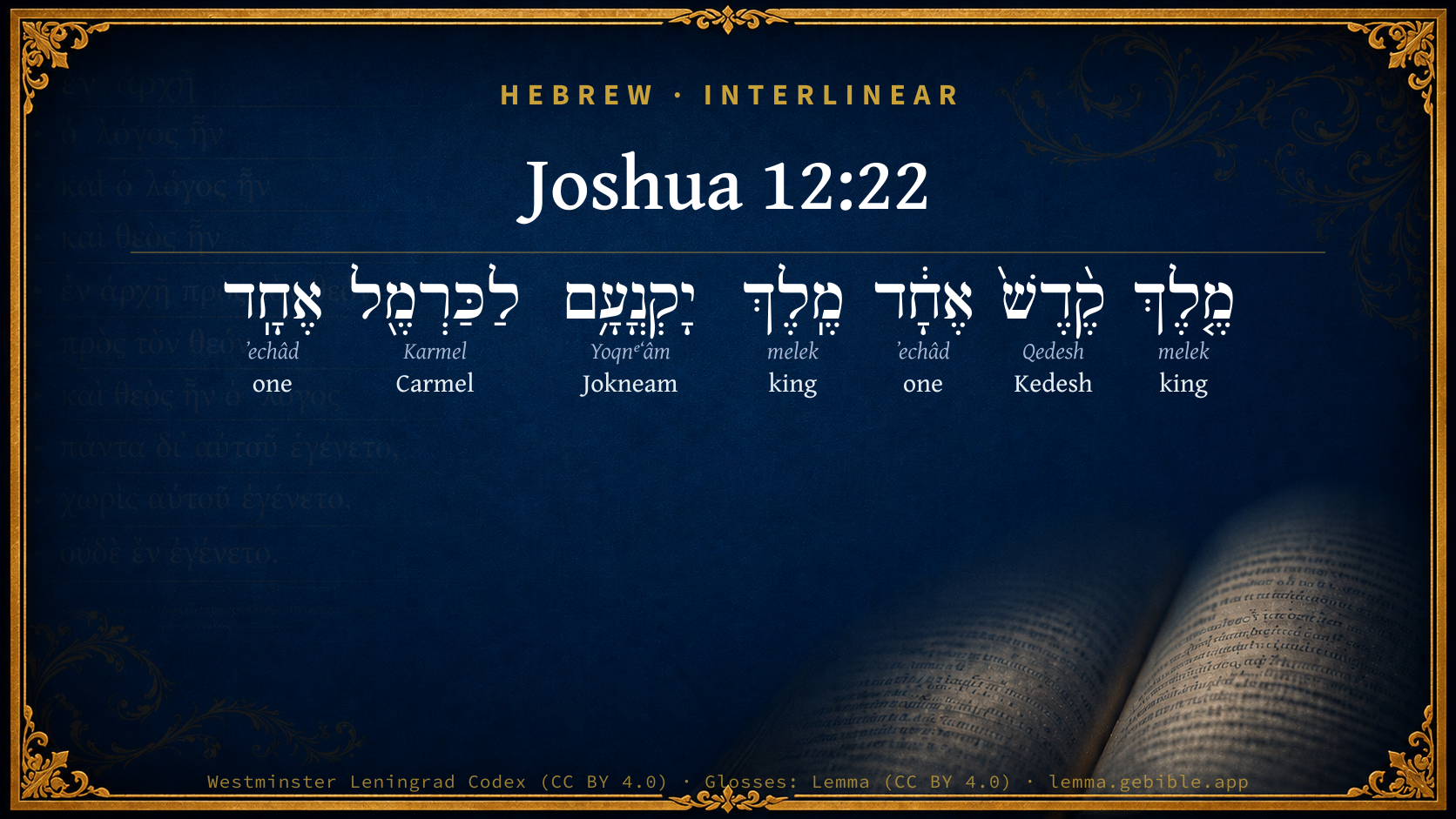
Joshua 12:22

Hebrew (Westminster Leningrad Codex) Joshua 12:22 appears in the Hebrew Old Testament. The text above is from the Westminster Leningrad Codex. Each word links to its Strong’s number, a concise gloss, and parsing drawn from the Open Scriptures Hebrew Bible morphology. Click any word for its full Brown-Driver-Briggs (BDB) entry.
Download image
Cite this verse

Joshua 12:22 (World English Bible). Public Domain. Lemma interlinear Bible study tool, https://lemma.gebible.app/v/joshua/12/22.

Show BibTeX & RIS
BibTeX
RIS
English Translation
the king of Kedesh, one; the king of Jokneam in Carmel, one;
World English Bible · Public Domain
Highlights
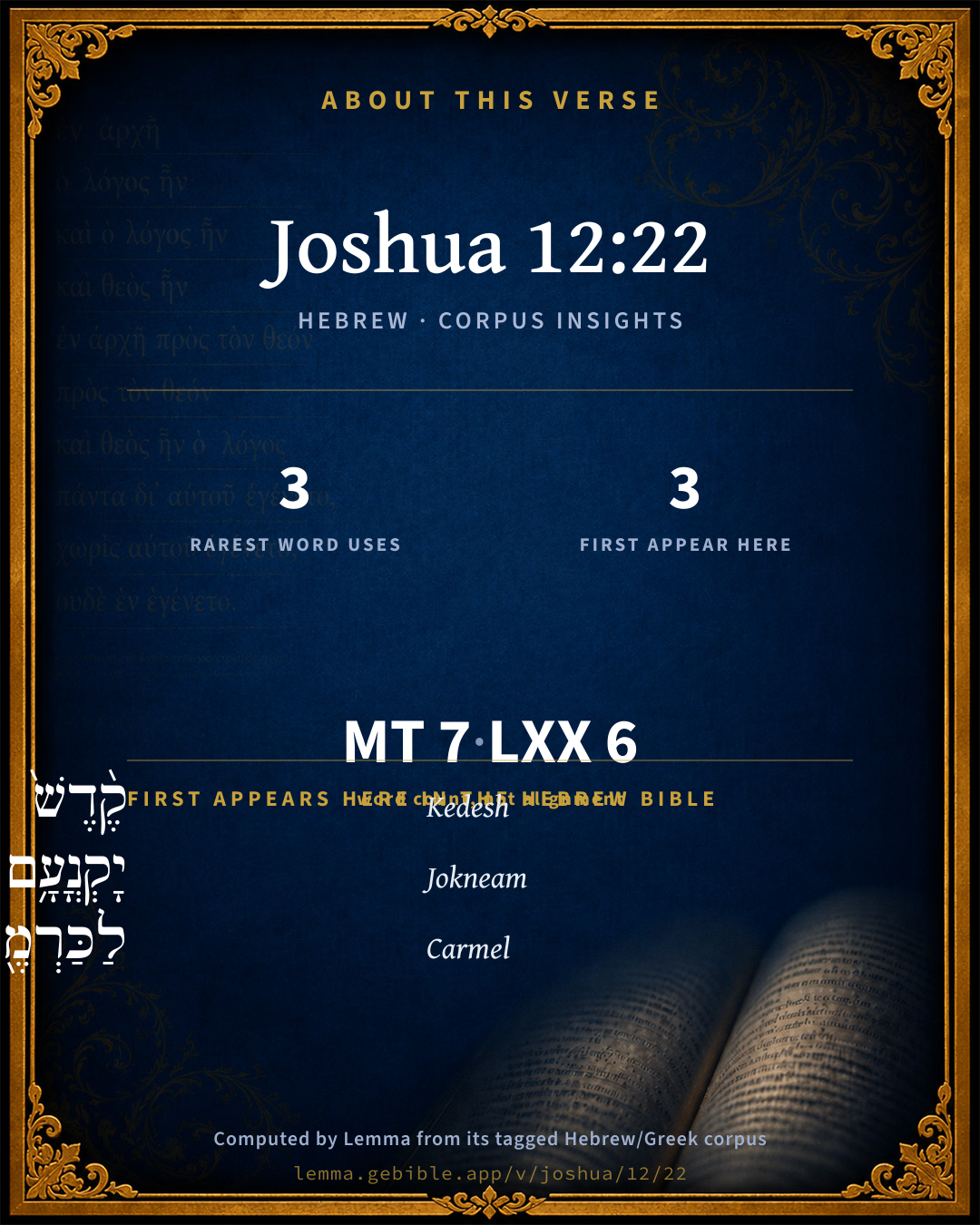
  • 3 first appearances in the Hebrew Bible
Full analysis ↓
Download a study sheet

One document with this verse’s original text, its word-by-word gloss line, the meaning frame, cross-references with their text, attributed commentary, and full source and license credits — printable, and it pastes into notes with its structure intact.

This verse Autodidact and up

Study sheet (.html) Plain text (.txt)

A passage Seminary Student

Up to 50 verses in one chapter. A passage sheet keeps up to 6 commentary sources and 12 cross-references per verse, in the order this page ranks them, and says so on the sheet whenever that leaves anything out. Ask for a single verse and you get the Autodidact verse sheet above.

Everything on this page stays free to read, with no account — the sheet is a download of what is already on screen, not access to it.

Want to remove ads? Support Godless Engineer
Compare translations 3

The same verse in 3 English versions, stacked beneath the original-language interlinear above. Click any original word for its lexicon entry.

Each is an independent rendering of the whole verse — the interlinear is not word-aligned to these translations.

Highlighted words mark where these versions differ — a whole-verse word diff, not a word-by-word alignment.

  • World English Bible Public Domain
    the king of Kedesh, one; the king of Jokneam in Carmel, one;
  • King James Version Public Domain
    The king of Kedesh, one; the king of Jokneam of Carmel, one;
  • unfoldingWord Literal Text CC BY-SA 4.0
    the king of Kedesh, one; the king of Jokneam in Carmel, one;

unfoldingWord Literal Text — © unfoldingWord, licensed CC BY-SA 4.0. Word-aligned USFM3 via Door43 (git.door43.org/unfoldingWord/en_ult).

Versions to compare (up to 4)

3 of 4 selected

Show all 18 translations

Every available English version of this verse, each an independent rendering of the whole verse.

  • World English Bible Public Domain
    the king of Kedesh, one; the king of Jokneam in Carmel, one;
  • Berean Standard Bible Public Domain
    the king of Kedesh, one; the king of Jokneam in Carmel, one;
  • Majority Standard Bible Public Domain
    the king of Kedesh, one; the king of Jokneam in Carmel, one;
  • King James Version Public Domain
    The king of Kedesh, one; the king of Jokneam of Carmel, one;
  • American Standard Version (1901) Public Domain
    the king of Kedesh, one; the king of Jokneam in Carmel, one;
  • Revised Version (1885) Public Domain
    the king of Kedesh, one; the king of Jokneam in Carmel, one;
  • Geneva Bible (1599) Public Domain
    The King of Kedesh, one: the King of Iokneam of Carmel, one:
  • Douay-Rheims (1899) Public Domain
    The king of Cades one, the king of Jachanan of Carmel one,
  • Young's Literal Translation Public Domain
    The king of Kedesh, one; The king of Jokneam of Carmel, one;
  • Literal Standard Version CC BY-SA 4.0
    the king of Kedesh, one; the king of Jokneam of Carmel, one;
  • Unlocked Literal Bible CC BY-SA 4.0
    the king of Kedesh, the king of Jokneam in Carmel,
  • unfoldingWord Literal Text CC BY-SA 4.0
    the king of Kedesh, one; the king of Jokneam in Carmel, one;
  • Darby Bible Public Domain
    the king of Kedesh, one; the king of Jokneam on Carmel, one;
  • World Messianic Bible Public Domain
    the king of Kedesh, one; the king of Jokneam in Carmel, one;
  • Webster's Bible Public Domain
    The king of Kedesh, one; the king of Jokneam of Carmel, one;
  • Free Bible Version CC BY-SA 4.0
    The king of Kedesh. The king of Jokneam in Carmel.
  • Bible in Basic English Public Domain
    The king of Kedesh, one; the king of Jokneam in Carmel, one;
  • JPS Tanakh (1917) Public Domain
    the king of Kedesh, one; the king of Jokneam in Carmel, one;

Literal Standard Version (2020), Covenant Press — licensed CC BY-SA 4.0. Text via the HelloAO Bible API (eBible.org). Unlocked Literal Bible (unfoldingWord) — licensed CC BY-SA 4.0. Text via the HelloAO Bible API (eBible.org). unfoldingWord Literal Text — © unfoldingWord, licensed CC BY-SA 4.0. Word-aligned USFM3 via Door43 (git.door43.org/unfoldingWord/en_ult). Free Bible Version, Dr. Jonathan Gallagher — licensed CC BY-SA 4.0. Text via the HelloAO Bible API (eBible.org).

Word by word

More ways to search: Search by grammar → Find every occurrence → Compare this word →

Practice this passage: Drill this verse → Learn its vocabulary →

About this verse

These counts appear in no published source. They are computed here, from the morphology-tagged text and Lemma’s own curated glosses. What Lemma adds →

7
words
5
distinct lemmas
Historical
section

Notable vocabulary

The rarest word here is יָקְנֳעָ֥ם Jokneam H3362 — appearing just 3 times in the whole Hebrew Bible.

First appearance in Scripture

These words make their first canonical appearance in the Hebrew Bible here:

  • קֶ֨דֶשׁ֙ Kedesh H6943
  • יָקְנֳעָ֥ם Jokneam H3362
  • לַכַּרְמֶ֖ל Carmel H3760

Shared distinctive vocabulary

יָקְנֳעָ֥ם Jokneam H3362 occurs in 3 verses of the Hebrew Bible. Also found in:

Grammatical profile

  • 5 nouns
  • 2 adjectives

Repetition

Words recur within this verse — often emphatic in Hebrew:

  • מֶ֤לֶךְ king H4428 ×2
  • אֶחָ֔ד one H259 ×2

Hebrew & Septuagint length

In English translation the verse runs 12 words from the Hebrew and 10 from the Septuagint (LXX English) — closely comparable.

A rough comparison of the two English renderings, which tokenize alike — not a word-level alignment.

Word counts can differ between the Hebrew and the Greek without any difference in meaning — e.g. the Hebrew direct-object marker אֵת has no separate Greek word, and Greek often adds the article ὁ.

In the original languages it is 7 Hebrew tokens and 6 Greek tokens — but the two are counted differently (Hebrew bundles its prefixes and suffixes into one token; the Greek is in lemma form), so that isn’t a like-for-like length.

Cross-references

8

Topical passages linked to Joshua 12:22 in the Treasury of Scripture Knowledge — connected by theme and wording, ordered by reader-vote popularity; previews shown in the World English Bible.

  • Joshua 19:37 and Kedesh, and Edrei, and En Hazor,
  • Joshua 21:32 Out of the tribe of Naphtali, Kedesh in Galilee with its suburbs, the city of refuge for the manslayer, and Hammothdor with its suburbs, and Kartan with its suburbs; three cities.
  • Joshua 15:23 and Kedesh, and Hazor, and Ithnan,
  • Joshua 15:55 Maon, Carmel, and Ziph, and Jutah,
  • Joshua 19:11 and their border went up westward, even to Maralah, and reached to Dabbesheth; and it reached to the brook that is before Jokneam;
  • Joshua 20:7 They set apart Kedesh in Galilee in the hill-country of Naphtali, and Shechem in the hill-country of Ephraim, and Kiriath Arba (the same is Hebron) in the hill-country of Judah.
  • 1 Samuel 25:2 There was a man in Maon, whose possessions were in Carmel; and the man was very great, and he had three thousand sheep, and a thousand goats: and he was shearing his sheep in Carmel.
  • Isaiah 35:2 It shall blossom abundantly, and rejoice even with joy and singing; the glory of Lebanon shall be given to it, the excellency of Carmel and Sharon: they shall see the glory of Yahweh, the excellency of our God.

Cross-references courtesy of OpenBible.info (CC BY 4.0).

Hebrew and Greek witnesses Masoretic Hebrew ↔ Greek Septuagint

The same verse in the two great witnesses to the Old Testament, shown verse-for-verse.

These are two independent witnesses, not word-aligned to each other, and the Septuagint is shown in lemma (dictionary) form.

Hebrew Joshua 12:22 Masoretic · Westminster Leningrad Codex

מֶ֤לֶךְ קֶ֨דֶשׁ֙ אֶחָ֔ד מֶֽלֶךְ יָקְנֳעָ֥ם לַכַּרְמֶ֖ל אֶחָֽד

the king of Kedesh, one; the king of Jokneam in Carmel, one;

World English Bible · Public Domain

Greek LXX Joshua 12:22 Septuagint · lemma form

βασιλεύς μαγεδων βασιλεύς ιεκοναμ ὁ χερμελ

the king of Maredoth, the king of Jecom of Chermel,

LXX2012 (modern English Septuagint) · Public Domain

Hebrew: Westminster Leningrad Codex (CC BY 4.0). Greek: Septuagint (public domain); English from LXX2012 (modern English Septuagint) (Public Domain). How the Septuagint differs from the Hebrew →

Targum (Aramaic paraphrase)

1

The Targum is the ancient Jewish Aramaic paraphrase of the Hebrew Scriptures — an interpretive translation, not the Hebrew text itself. Onkelos (literal) and Pseudo-Jonathan (expansive) render the Torah, and Jonathan the Prophets. Coverage is partial: where no permissively-licensed English translation exists for a verse, only the Aramaic is shown. This is verse-level text, not a word-by-word alignment to the Hebrew.

  1. Targum Jonathan Prophets (Joshua–Malachi)
    מַלְכָּא דְקֶדֶשׁ חָד מַלְכָּא דְיָקְנְעָם לְכַרְמְלָא חָד:

    (no public-domain English translation for this verse)

    Targum Jonathan — Aramaic: “Mikraot Gedolot” (public domain). English: “Sefaria Community Translation” (CC0 1.0 (public-domain dedication)); “London "Chaldee Paraphrase," 1871” (public domain). Text via Sefaria.

Commentary

Notes on Joshua 12:22 from classic Christian and Jewish commentators (each source and its license shown beneath its notes). The classic Christian expositions comment on the surrounding passage and are grouped to its opening verse, so a note may address several verses; the Jewish commentaries on the Tanakh (Rashi and others) are per-verse, so they appear only where the commentator wrote on this verse.

Lemma curates 59 commentaries, every one of them public domain or Creative Commons licensed, each selected and text-cleaned for this edition rather than reprinted as found. About our sources →

Geneva Bible (1599)

Geneva Bible translators

Or, near unto Carmel.

Geneva Bible (1599) marginal notes — public domain. Text via Bolls.life.

Adam Clarke's Commentary

Verse 22. Kedesh] There was a city of this name in the tribe of Naphtali, Jos 19:37. It was given to the Levites, and was one of the cities of refuge, Jos 20:7.

Jokneam of Carmel] This city is said to have been at the foot of Mount Carmel, near the river Belus, in the tribe of Zebulun, Jos 19:11. It was given to the Levites, Jos 21:34.

Adam Clarke's Commentary on the Bible (1810–1826) — public domain. Text from a community e-Sword/MySword module.

The Cambridge Bible for Schools and Colleges

gen. ed. J. J. S. Perowne

22. Kedesh] in Issachar, allotted to the Gershonite Levites (1Ch_6:72). Sometimes called Kishon or Kishion (Jos_21:28).

Jokneam of Carmel] Or, on Carmel, a city of the tribe of Zebulun, allotted with its suburbs to the Merarite Levites (Jos_21:34). The modern site Tell Kaimon stands just below the eastern termination of Carmel.

Carmel] = “the park,” or “the well-wooded place,” almost always with the definite article. Rightly does it bear its name, being covered below with laurels and olive trees, above with pines and oaks, and full of the most beautiful flowers, “hollyhocks, jasmine, and various flowering creepers.” It is famous for its connection with the history of the two great prophets Elijah and Elisha (1Ki_18:19-20; 1Ki_18:42; 2Ki_2:25; 2Ki_4:25; 2Ki_19:23; Isa_33:9; Isa_35:2).

The Cambridge Bible for Schools and Colleges (gen. ed. J. J. S. Perowne; Cambridge University Press, 1878–1918) — public domain. Text from a community e-Sword module.

John Gill's Exposition

The king of Kedesh, one,.... Which afterwards fell to the tribe of Naphtali, and was one of the cities of refuge, Jos 19:37; it was situated in upper Galilee on Mount Naphtali, four miles from the city of Sephet, and as many from Capernaum, and twenty miles from Tyre (r):

the king of Jokneam of Carmel, one; a city that came to the lot of the tribe of Zebulun, Jos 19:11; and was given to the Levites, Jos 21:34; it was not far from Mount Carmel, from whence it is described.

(r) Adrichom. Theatrum, p. 104.

John Gill's Exposition of the Whole Bible (1746–1763) — public domain (CC PDM 1.0). Text via the HelloAO Bible API.

Haydock's Catholic Bible Commentary

CHAPTER XII.

Jachanan was near Mount Carmel. Sometimes Josue specifies both the city and the canton, where it was situated; at other times he only mentions the latter, as in the following verse.

George Leo Haydock (1774–1849), Haydock's Catholic Family Bible and Commentary, 1859 edition — public domain. Excludes Psalms (Douay-Rheims chapter numbering differs from Protestant) and Deuterocanonical books (Catholic canon only).

Whedon's Commentary on the Bible

Daniel D. Whedon

22. Kedesh — This city is commonly called Kedesh-Naphtali, because it was in the territory of that tribe. It was both a city of refuge (Jos_20:7) and a Levitical city. Jos_21:32. Hence, as the name indicates, it was the holy place of Naphtali, a sanctuary and asylum for all Northern Palestine. Here the tribes assembled, at the call of Barak, to war with Jabin’s hosts. Jdg_4:10. From its exposed position on the northern frontier it was among the first to fall into the hands of the Assyrian invaders. 2Ki_15:29. Its ruins, still bearing the name Kedes, lie on the top and slopes of a round hill in a little plain among the mountains a few miles northwest of Lake Merom.] Jokneam was also a Levitical city in the tribe of Zebulun, (Jos_19:11; Jos_21:34,) and was identified by Robinson with Tell Kaimon, an eminence close to the northern base of Mount Carmel, and on the south bank of the Kishon, a mile from the river. On Carmel, see note on Jos_19:26.

Daniel D. Whedon (gen. ed.), Commentary on the Old and New Testaments (1874–1909) — public domain. Text from a community e-Sword module.

The Pulpit Commentary

Kedesh, i.e. , Kedesh-Napbtali. (see Jos_19:7) Jokneam of Carmel. This city is mentioned as one of the cities of purveyance to Solomon"s court, (1Ki_4:12) with Beth-shean, Taanach, and Megiddo. It has been identified by explorers, from Robinson downwards, with Tell-el-Kaimun, on the southern slopes of Mount Carmel. It is the Cammona, or Cimana, of the Onomasticon, the "Cyamon over against Esdraelon" of RAPC Jdt 7:3. It was a Levitical city, (Jos_21:34) but in the list in 1Ch 6 we miss it in its proper place, and find it taking the place of Kibzaim in Ephraim. But, as the margin of our version remarks in the latter chapter (ver. 68), the names of the cities in the two lists very frequently do not correspond.

The Pulpit Commentary (1880–1919), ed. H.D.M. Spence-Jones & Joseph S. Exell — public domain. Text from a community e-Sword module.

Keil & Delitzsch

C. F. Keil & F. Delitzsch

Kedesh, a Levitical city and city of refuge upon the mountains of Naphtali (Jos 19:37; Jos 20:7; Jos 21:32), the home of Barak (Jdg 4:6), was conquered and depopulated by Tiglath-Pileser (Kg2 15:29), and was also a well-known place after the captivity (1 Macc. 11:61ff.) It is now an insignificant village, still bearing the ancient name, to the north-west of the lake of Huleh, or, according to Van de Velde (Reise. ii. p. 355), nothing but a miserable farmstead upon a Tell at the south-west extremity of a well-cultivated table-land, with a large quantity of antiquities about, viz., hewn stones, relics of columns, sarcophagi, and two ruins of large buildings, with an open and extensive prospect on every side (see also Rob. Bibl. Res. pp. 367ff.). Jokneam, near Carmel, as a Levitical town in the territory of Zebulun (Jos 19:11; Jos 21:34). Van de Velde and Robinson (Bibl. Res. p. 114) suppose that they have found it in Tell Kaimn, on the eastern side of the Wady el Milh, at the north-west end of a chain of hills running towards the south-east; this Tell being 200 feet high, and occupying a very commanding situation, so that it governed the main pass on the western side of Esdraelon towards the southern plain. Kaimn is the Arabic form of the ancient Καμμωνά, Cimana, which Eusebius and Jerome describe in the Onom. as being six Roman miles to the north of Legio, on the road to Ptolemais.

Keil & Delitzsch — Biblical Commentary on the Old Testament (1861–1891) — public domain (CC PDM 1.0). Text via the HelloAO Bible API. (Old Testament only.)

Lesson kit

Teaching starters — assembled from the data on this page, not authored interpretation. Every prompt links to the verse data it draws on. Edit before teaching.

Joshua, in the Historical, opens this verse with 7 words (5 distinct Hebrew lemmas). Its most distinctive word is Yoqnᵉʻâm (“Jokneam”). A historical commentator’s framing appears above. Read the whole chapter for the surrounding context.

Discussion questions

  1. The word Yoqnᵉʻâm carries the sense “Jokneam.” How does it shape the verse?
  2. 3 words make their first appearance in Scripture here. What does this debut establish?
  3. How does Joshua 19:11, which shares the word «Jokneam», read alongside this verse?
  4. What does the repetition of “king” (2× in this one verse) do in this verse?
  5. Compare how Geneva Bible (1599) and Adam Clarke's Commentary read this verse. Where do they agree or differ?

Things to notice

Reading settings

Reading text

Shown beneath each verse's original-language words.

Old Testament
Old Testament edition

Read the OT as the Masoretic Hebrew (MT) or the Greek Septuagint (LXX).

English shown for the Greek Septuagint (in the Hebrew ↔ Greek comparison).

Comparing translations? Open the Compare panel on any verse page to stack up to four side by side.