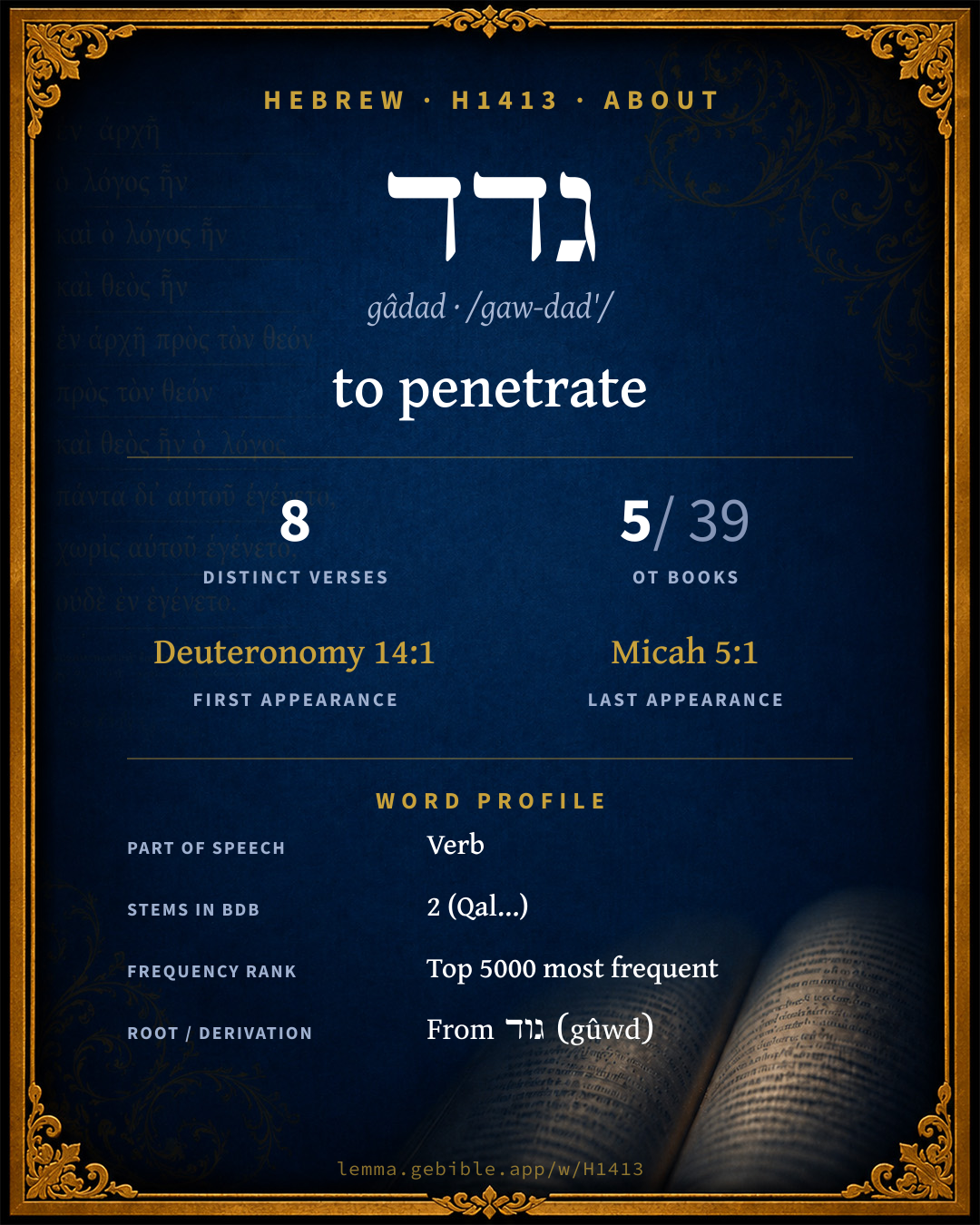
גָּדַד
to penetrate
also: cut, attack, invade fuller range ↓
Full lexicon entry — Brown-Driver-Briggs (BDB)
From Brown-Driver-Briggs (BDB)
Where this word appears
See every Hithpolel verb in the Hebrew Bible →
Grammar key — what these labels mean
Part of speech
- Verb
- An action or state-of-being word.
Stem
- Hithpolel
- The reflexive counterpart of the Polel. Here: ‘cut oneself’
- Qal
- The basic, simple active stem — the plain form of the verb (“he wrote”). Here: ‘they attack’
Form
- Imperfect
- An incomplete, ongoing, or future action (“he will / would write”).
- Sequential Imperfect
- An imperfect with prefixed waw — the standard past-narrative form (waw-consecutive imperfect).
- Participle Active
- A verbal adjective expressing ongoing or characteristic action (“writing / one who writes”).
State
- Absolute
- The independent form of a noun, not bound to a following word.
Person
- 2nd Person
- The one addressed (“you”).
- 3rd Person
- The one spoken about (“he / she / it / they”).
Gender
- Feminine
- Grammatically feminine.
- Masculine
- Grammatically masculine.
Number
- Singular
- One.
- Plural
- More than one (in Hebrew, generally three or more).
Grammatical forms
- Verb, Hithpolel, Imperfect, 2nd Person, Feminine, Singular 2 times (25%)
- Verb, Hithpolel, Sequential Imperfect, 3rd Person, Masculine, Plural 1 time (13%)
- Verb, Hithpoel, Participle Active, Masculine, Plural, Absolute 1 time (13%)
- Verb, Qal, Imperfect, 3rd Person, Masculine, Plural 1 time (13%)
- Verb, Hithpolel, Imperfect, 2nd Person, Masculine, Plural 1 time (13%)
- Verb, Hithpolel, Imperfect, 3rd Person, Masculine, Plural 1 time (13%)
- Verb, Hithpolel, Imperfect, 3rd Person, Masculine, Singular 1 time (13%)
Parsed forms decoded from the imported morphology (morphhb / Westminster Leningrad Codex — WLC text public domain, morphhb tagging CC BY 4.0), counted across 8 parsed occurrences — not distinct verses.
Every verse where H1413 appears — 8 distinct verses across 5 books. Click any verse to open its interlinear word-by-word view. Verse text shown in the World English Bible for context — . Each verse’s Hebrew form is shown with its reference; the English is not keyword-highlighted, since the data carries no word-level English alignment. Use “Compare translations” on any verse to read it across multiple English versions. This concordance covers the Hebrew Bible; Septuagint (Greek Old Testament) occurrences are not indexed here.
Deuteronomy 1 verse
1 Kings 1 verse
Psalms 1 verse
Jeremiah 4 verses
- Jeremiah 5:7 יִתְגֹּדָֽדוּ Hithpolel impf 3mp How can I pardon you? your children have forsaken me, and sworn by them that are no gods: when I had fed them to the full, they committed adultery, and assembled themselves in troops at the prostitutes' houses.
- Jeremiah 16:6 יִתְגֹּדַ֔ד Hithpolel impf 3ms Both great and small shall die in this land; they shall not be buried, neither shall men lament for them, nor cut themselves, nor make themselves bald for them;
- Jeremiah 41:5 וּ/מִתְגֹּֽדְדִ֑ים conj + Hithpoel ptcp.act mp that there came men from Shechem, from Shiloh, and from Samaria, even eighty men, having their beards shaved and their clothes torn, and having cut themselves, with meal-offerings and frankincense in their hand, to bring them to the house of Yahweh.
- Jeremiah 47:5 תִּתְגּוֹדָֽדִי Hithpolel impf 2fs Baldness is come on Gaza; Ashkelon is brought to nothing, the remnant of their valley: how long will you cut yourself?
Micah 1 verse
About this entry
At a glance — auto-summarized from this page’s data, not written by a person. Every figure links to its source below. This summary describes the numbers; it doesn’t interpret them.
At its core, גדד (gâdad) means “to penetrate.” Its uses cluster heavily in Jeremiah (50% of all occurrences). With 8 verses in 5 books, it is an uncommon word in the Hebrew Bible. Scripture first uses it in Deuteronomy 14:1. Beyond its headline sense, its full sense range takes in “cut”, “attack”, and “invade”. Each statement above links to its evidence; the full detail follows below.
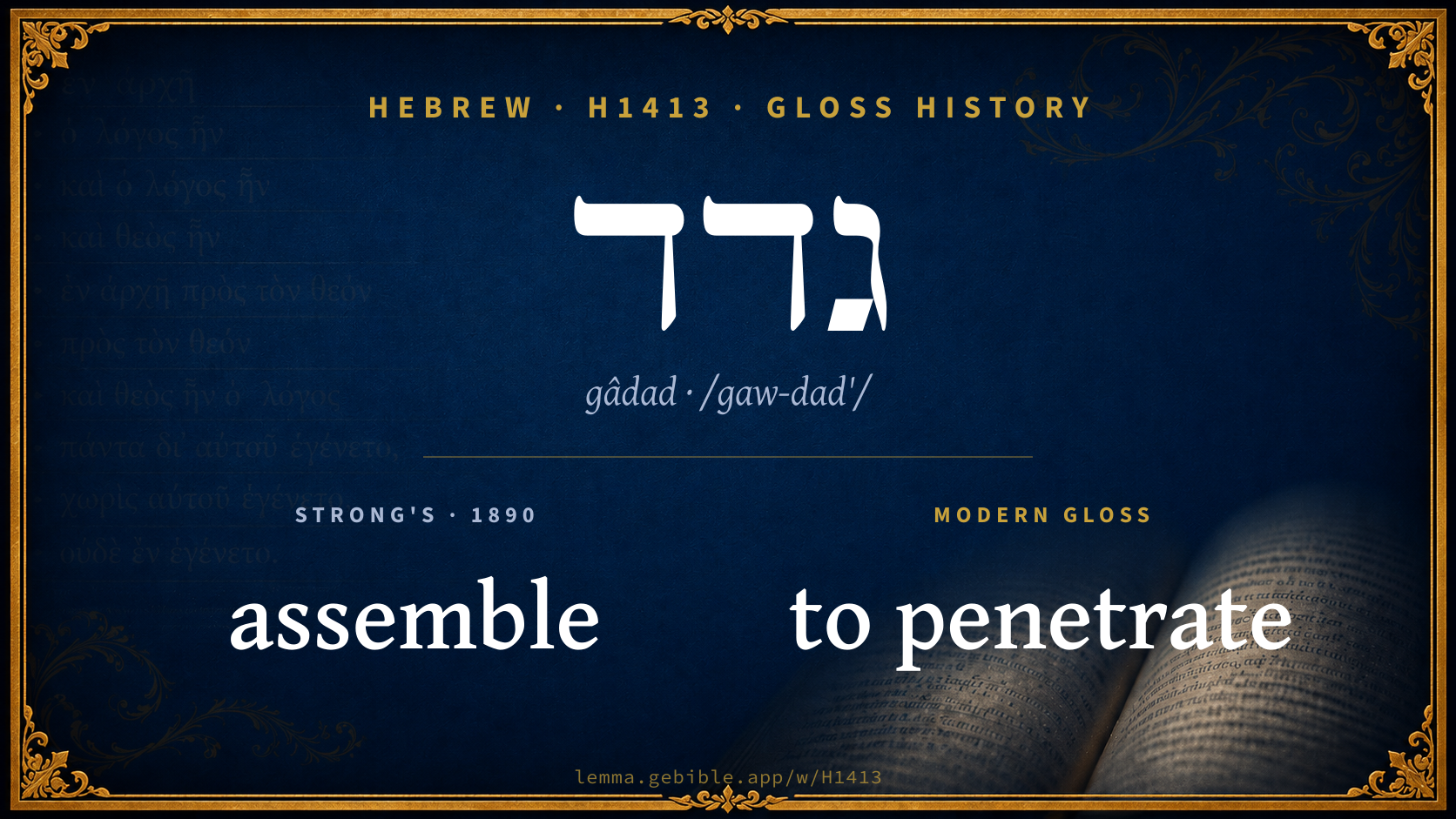
Gloss history
Strong's 1890 vs modern scholarship
About this word
Strong's H1413 catalogs a Hebrew word from the Hebrew Old Testament.
These counts are not copied from any lexicon or concordance. They are computed here, from the morphology-tagged Hebrew Old Testament. What Lemma adds →
- 8
- distinct verses
- The word appears in 8 distinct verses.
- 5 / 39
- OT books
- The word appears in 5 of 39 Old Testament books.
- #2,625
- by frequency
- Top 5000 most frequent Hebrew words (rank 2,625 of 8,640 Hebrew words by occurrence).
View all 8 occurrences in the concordance →
Most concentrated in
- Jeremiah 4 verses 50%
- Deuteronomy 1 verse 13%
- 1 Kings 1 verse 13%
By section of the Old Testament
By traditional corpus
Conventional, traditional groupings — biblical authorship is debated, so this is a traditional corpus grouping, not an authorship claim. Each share is this word’s portion of its verses in that division of the Hebrew canon. Each figure is a share of the word’s 8 distinct verses.
- Prophets (Nevi'im) 6 verses · 75%
- Torah (Pentateuch) 1 verse · 13%
- Writings (Ketuvim) 1 verse · 13%
How translations render this word
Counts come from each version’s own published word-to-Strong’s tagging or interlinear alignment — an approximate guide to how each version renders this word, not a word-level alignment the data otherwise carries. Because each total is that version’s own tagged count, the per-version totals vary from one another and need not match the appearance or distinct-verse counts above. These counts may also differ from a printed concordance because Lemma counts each distinctly tagged rendering and does not collapse phrase taggings into a single head-word total. This is a fixed set of word-tagged versions (KJV, ASV, BSB, ULT) and does not change with the reading translation you choose elsewhere. Each version’s license is shown beside its name below (and on Sources).
- King James Version: Cut 2×
- American Standard Version: Assembled themselves in troops 1×, Cut 1×, Having cut 1×
- Berean Standard Bible: Cut 2×
- unfoldingWord Literal Text: Assembled themselves 1×, Cut himself 1×, Cut yourselves 1×
King James Version Public Domain
Renders H1413 across 8 tagged occurrences — most commonly:
Plus 6 renderings that appear only once — usually multi-word phrases or single function words the recovered tagging swept in, not distinct renderings.
American Standard Version Public Domain
Renders H1413 across 8 tagged occurrences — most commonly:
Berean Standard Bible Public Domain
Renders H1413 across 8 tagged occurrences — most commonly:
Plus 6 renderings that appear only once — usually multi-word phrases or single function words the recovered tagging swept in, not distinct renderings.
unfoldingWord Literal Text CC BY-SA 4.0
Renders H1413 across 8 tagged occurrences — most commonly:
Senses in the full BDB
Hebrew verbs can shift meaning by stem (binyan): Qal is the basic action, Niphal is often passive or reflexive, Piel often intensifies or makes it factitive, and Hiphil is typically causative. The senses below are grouped under the stem BDB assigns to each. This entry also uses one or more reduplicated stems (the Pōlēl/Pilpēl type), which for hollow or geminate roots behave much like Piel — often intensive or iterative.
What do BDB’s symbols mean?
BDB uses these scholarly abbreviations:
| Symbol | Meaning |
|---|---|
| 𝔊 | the Septuagint (the ancient Greek translation, LXX) |
| 𝔙 | the Vulgate (the Latin translation) |
| 𝔖 | the Syriac version (the Peshitta) |
| 𝔗 | the Targum (the Aramaic translation) |
| ψ | the Psalms |
| √ | root (the underlying root or stem) |
| ‖ | parallel passage (a synonymous or contrasted parallel) |
| † | the dagger: every passage where the word occurs is cited |
The 3 senses and sub-senses the full Brown-Driver-Briggs lexicon distinguishes for this word, in lexicon order (not ranked by frequency), with BDB’s own verbatim wording and sub-sense lettering. Shown in Hebrew script with BDB’s own scholarly abbreviations. The condensed entry is in the Lexicon Entry tab. See also the Forms in the corpus table below.
Qal
- they attack (penetrate, make inroads upon) the life of a righteous man
Hithpo
- 1. cut oneself, as religious (heathen) practice
- 2. gather troops, or bands; go in troops or throngs, throng
Senses from the full Brown-Driver-Briggs lexicon (Brown, Driver, Briggs; Oxford 1906 — public domain), digitized via Sefaria, supplemented by the OpenScriptures HebrewLexicon (CC BY 4.0). Full attribution on Sources.
Word origin
[ גָּדַד ] vb. penetrate, cut
— Brown-Driver-Briggs (Oxford 1906, public domain), digitized via Sefaria, supplemented by the OpenScriptures HebrewLexicon (CC BY 4.0). See Sources.
Derived from גוד (gûwd) (H1464) — to attack.
Jastrow Dictionary
A second Hebrew/Aramaic lexicon for comparison, covering Aramaic and post-biblical (Talmudic, Targumic, Midrashic) usage that the biblical-Hebrew BDB does not. Matched by lemma rather than by Strong’s number, so a lemma may carry more than one Jastrow headword (shown separately below), and the entries cover usage well beyond the Bible.
גָּדַד I
- to cut, cut off. Par. II, 2; Bekh. 44ᵃ יָגוֹד let him lop off (the black tops of the horns or hoofs).—[V. גָּדַר.]—Trnsf. (cmp. קצץ) to fix the price. B. Bath. 13ᵃ גּוֹד או אָגוֹד either fix you a price for my share, or I shall do so (and buy your share); דינא דגוד או אגוד the right of settling by god o agod. Ib. אגוד איכא גוד ליכא the offer to buy is applicable in this case (the half-freed slave can offer to buy his other half), but the offer to sell cannot be made (since there is no price for a free man).—Part. pass. גָּדוּד stripped (of branches); trnsf. empty-handed. Gen. R. s. 68, beg. ג׳ שלחו (Yalk. ib. 117 גדודי) Isaac sent Jacob away without anything valuable.
- to cut off, level. Gen. R. s. 71 (play on בא גד, Gen. XXX, 11) בא מי שעתיד לגַדֵּד וכ׳ he has come who is destined to level the fastnesses of the nations (idolatry). Tanḥ. Ki Thissa 13 (play on מגדל גד, Josh. XV, 37) from there the Lord יוצא ומְגַדֵּד וכ׳ will proceed and level &c.; Ex. R. s. 40 ומגיד (corr. acc.). e.g. Genesis 30:11
- to be cut off. Keth. 51ᵃ כל העומד לִיגָּדֵד כְּגָדוּד דמי Ar. (ed. ליגזז, v. גָּזַז).
- to make incisions in one’s own body. Yeb. 13ᵇ, v. גּוּד. Tanḥ. Sh’laḥ. 15; Num. R. s. 17 קבר מת לא תִתְגּוֹדְדוּ when one buried a dead, the law says, Ye shall not &c. (Deut. XIV, 1). V. גְּדִידָה. e.g. Deuteronomy 14:1
- same. Yeb. l. c. א"כ לימא קרא לא תְּגוֹדְדוּ if it were so (that Deut. XIV, 1 meant only to forbid incisions in the body) it ought to read lo t’god’du, ye shall make no incisions. e.g. Deuteronomy 14:1
גְּדַד
- [Dan. IV, 11; 20.] Targ. Deut. XIV, 1 תְגוּדוּן, v. preced. Hithpol.—Bets. 6ᵃ אפי׳ למֵיגַד ליה וכ׳ Ar. a. Ms. M. (ed. למֵיגַז) even to cut a shroud for him (the dead, on the second Holy Day); Sabb. 150ᵇ, v. גְּזַז. e.g. Daniel 4:11
גָּדַד II
- v. גּוּד
גָּדָד
- acrid, v. גַּד I.
A Dictionary of the Targumim, the Talmud Babli and Yerushalmi, and the Midrashic Literature (Marcus Jastrow; London, Luzac, 1903) — Public Domain. Digitized via Sefaria. Digitized via Sefaria. Full attribution on Sources.
Forms in the corpus
The 8 distinct written forms H1413 takes in the Hebrew Bible, most frequent first — each parse links to that stem’s occurrences in the concordance. Hebrew forms include their vowel points and cantillation, so a single lemma takes many written forms.
| Form | Parsing | Example | Uses |
|---|---|---|---|
| וַ/יִּתְגֹּֽדְדוּ֙ | Verb, Hithpolel, Sequential Imperfect, 3rd Person, Masculine, Plural | 1 Kings 18:28 | 1 |
| וּ/מִתְגֹּֽדְדִ֑ים | Verb, Hithpoel, Participle Active, Masculine, Plural, Absolute | Jeremiah 41:5 | 1 |
| יִתְגֹּדַ֔ד | Verb, Hithpolel, Imperfect, 3rd Person, Masculine, Singular | Jeremiah 16:6 | 1 |
| יִתְגֹּדָֽדוּ | Verb, Hithpolel, Imperfect, 3rd Person, Masculine, Plural | Jeremiah 5:7 | 1 |
| יָ֭גוֹדּוּ | Verb, Qal, Imperfect, 3rd Person, Masculine, Plural | Psalms 94:21 | 1 |
| תִתְגֹּֽדְד֗וּ | Verb, Hithpolel, Imperfect, 2nd Person, Masculine, Plural | Deuteronomy 14:1 | 1 |
| תִּתְגֹּדְדִ֣י | Verb, Hithpolel, Imperfect, 2nd Person, Feminine, Singular | Micah 5:1 | 1 |
| תִּתְגּוֹדָֽדִי | Verb, Hithpolel, Imperfect, 2nd Person, Feminine, Singular | Jeremiah 47:5 | 1 |
Same root — word family
Other BDB entries built from the same root as H1413, grouped by Strong’s listed origin. These share a root / origin per the lexicon — not necessarily a shared meaning. Each links to that word’s own entry.
Derives from
Shares the same root
Derived from this word
- גד gad H1407 coriander
- גדד gᵉdad H1414 to cut down
- גדוד gᵉdûwd H1416 troop
- גדוד gᵉdûwd H1417 furrow
- גדודה gᵉdûwdâh H1418 furrow
- גוד gûwd H1464 to attack
Proper names from this root
People and places named from this root — a name, not an additional meaning of the word.
Compare all same-root words → Showing 4 of 12 — not the complete family. 3 of the same-root words are proper names (people or places). They share a root, not necessarily a meaning.
Septuagint verse parallels
This word appears in 7 verses that also exist in the Greek Old Testament (Septuagint), out of the 8 Hebrew verses it occurs in. You can read those verses in Greek by switching the Old Testament edition to the Septuagint.
Read these verses in the Septuagint
This is a verse-level parallel only — the same verses exist in both the Hebrew and Greek Old Testaments. No word-level Hebrew↔Greek correspondence is claimed: the data carries no such alignment, so no Greek word is shown as this Hebrew word’s translation. Coverage is not total — the Septuagint omits the deuterocanon and renumbers the Psalms, so some Hebrew verses have no direct Greek parallel.