
Proverbs 26:11

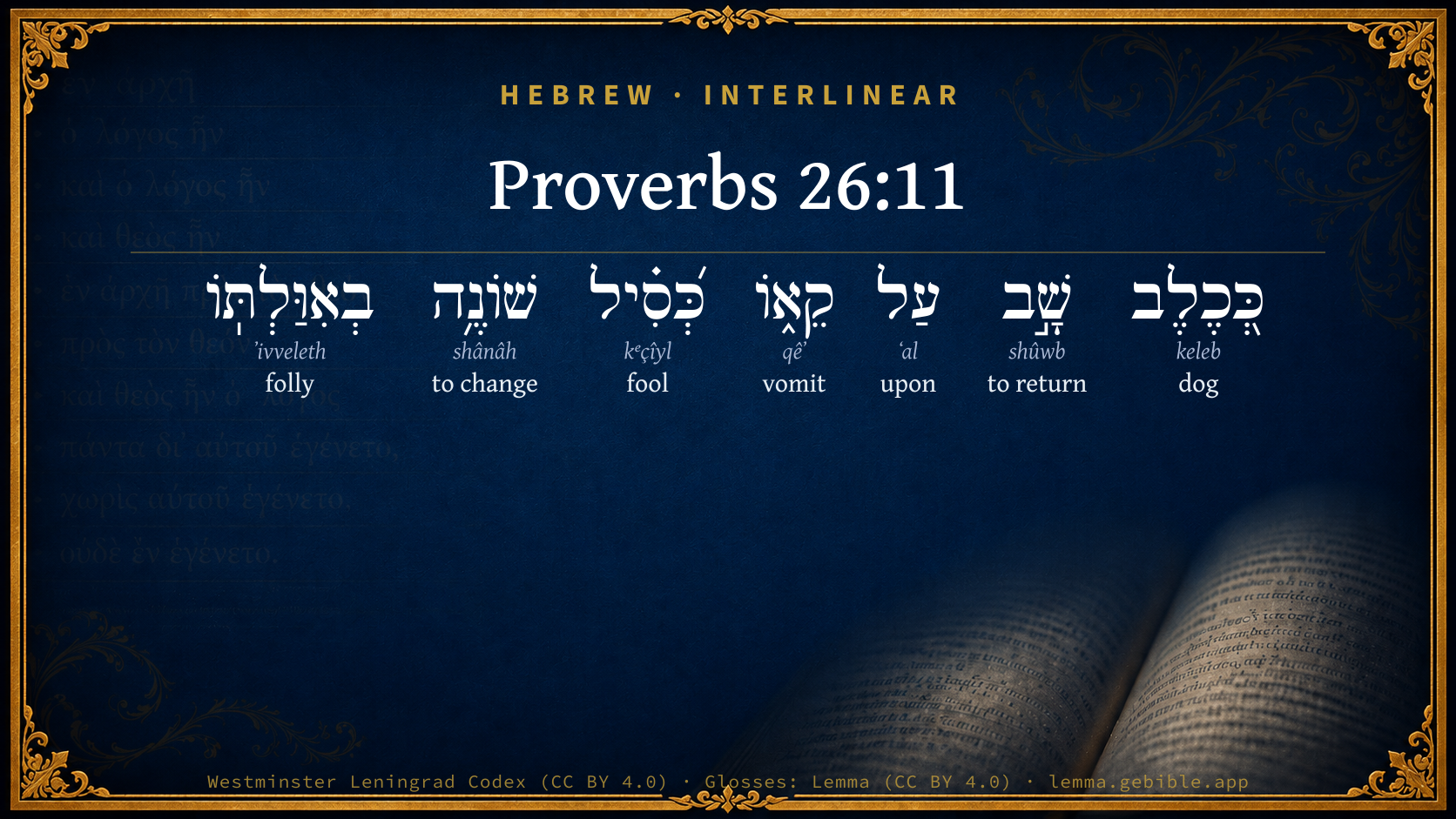
Hebrew (Westminster Leningrad Codex) Proverbs 26:11 appears in the Hebrew Old Testament. The text above is from the Westminster Leningrad Codex. Each word links to its Strong’s number, a concise gloss, and parsing drawn from the Open Scriptures Hebrew Bible morphology. Click any word for its full Brown-Driver-Briggs (BDB) entry.
Download image
Cite this verse

Proverbs 26:11 (World English Bible). Public Domain. Lemma interlinear Bible study tool, https://lemma.gebible.app/v/proverbs/26/11.

Show BibTeX & RIS
BibTeX
RIS
English Translation
As a dog that returns to his vomit, So is a fool who repeats his folly.
World English Bible · Public Domain
Highlights Full analysis ↓
Download a study sheet

One document with this verse’s original text, its word-by-word gloss line, the meaning frame, cross-references with their text, attributed commentary, and full source and license credits — printable, and it pastes into notes with its structure intact.

This verse Autodidact and up

Study sheet (.html) Plain text (.txt)

A passage Seminary Student

Up to 50 verses in one chapter. A passage sheet keeps up to 6 commentary sources and 12 cross-references per verse, in the order this page ranks them, and says so on the sheet whenever that leaves anything out. Ask for a single verse and you get the Autodidact verse sheet above.

Everything on this page stays free to read, with no account — the sheet is a download of what is already on screen, not access to it.

Want to remove ads? Support Godless Engineer
Compare translations 3

The same verse in 3 English versions, stacked beneath the original-language interlinear above. Click any original word for its lexicon entry.

Each is an independent rendering of the whole verse — the interlinear is not word-aligned to these translations.

Highlighted words mark where these versions differ — a whole-verse word diff, not a word-by-word alignment.

  • World English Bible Public Domain
    As a dog that returns to his vomit, So is a fool who repeats his folly.
  • King James Version Public Domain
    As a dog returneth to his vomit, so a fool returneth to his folly.
  • unfoldingWord Literal Text CC BY-SA 4.0
    Like a dog returning to its vomit a stupid who repeats his folly.

unfoldingWord Literal Text — © unfoldingWord, licensed CC BY-SA 4.0. Word-aligned USFM3 via Door43 (git.door43.org/unfoldingWord/en_ult).

Versions to compare (up to 4)

3 of 4 selected

Show all 18 translations

Every available English version of this verse, each an independent rendering of the whole verse.

  • World English Bible Public Domain
    As a dog that returns to his vomit, So is a fool who repeats his folly.
  • Berean Standard Bible Public Domain
    As a dog returns to its vomit, so a fool repeats his folly.
  • Majority Standard Bible Public Domain
    As a dog returns to its vomit, so a fool repeats his folly.
  • King James Version Public Domain
    As a dog returneth to his vomit, so a fool returneth to his folly.
  • American Standard Version (1901) Public Domain
    As a dog that returneth to his vomit, `So is' a fool that repeateth his folly.
  • Revised Version (1885) Public Domain
    As a dog that returneth to his vomit, so is a fool that repeateth his folly.
  • Geneva Bible (1599) Public Domain
    As a dog turneth againe to his owne vomit, so a foole turneth to his foolishnes.
  • Douay-Rheims (1899) Public Domain
    As a dog that returneth to his vomit, so is the fool that repeateth his folly.
  • Young's Literal Translation Public Domain
    As a dog hath returned to its vomit, A fool is repeating his folly.
  • Literal Standard Version CC BY-SA 4.0
    As a dog has returned to its vomit, || A fool is repeating his folly.
  • Unlocked Literal Bible CC BY-SA 4.0
    As a dog returns to his own vomit, so is a fool who repeats his folly.
  • unfoldingWord Literal Text CC BY-SA 4.0
    Like a dog returning to its vomit a stupid who repeats his folly.
  • Darby Bible Public Domain
    As a dog turneth back to its vomit, [so] a fool repeateth his folly.
  • World Messianic Bible Public Domain
    As a dog that returns to his vomit, so is a fool who repeats his folly.
  • Webster's Bible Public Domain
    As a dog returneth to his vomit, so a fool returneth to his folly.
  • Free Bible Version CC BY-SA 4.0
    Stupid people repeat their stupidity like a dog returning to its vomit.
  • Bible in Basic English Public Domain
    Like a dog going back to the food which he has not been able to keep down, is the foolish man doing his foolish acts over again.
  • JPS Tanakh (1917) Public Domain
    As a dog that returneth to his vomit, so is a fool that repeateth his folly.

Literal Standard Version (2020), Covenant Press — licensed CC BY-SA 4.0. Text via the HelloAO Bible API (eBible.org). Unlocked Literal Bible (unfoldingWord) — licensed CC BY-SA 4.0. Text via the HelloAO Bible API (eBible.org). unfoldingWord Literal Text — © unfoldingWord, licensed CC BY-SA 4.0. Word-aligned USFM3 via Door43 (git.door43.org/unfoldingWord/en_ult). Free Bible Version, Dr. Jonathan Gallagher — licensed CC BY-SA 4.0. Text via the HelloAO Bible API (eBible.org).

Word by word

More ways to search: Search by grammar → Find every occurrence → Compare this word →

Practice this passage: Drill this verse → Learn its vocabulary →

About this verse

These counts appear in no published source. They are computed here, from the morphology-tagged text and Lemma’s own curated glosses. What Lemma adds →

7
words
7
distinct lemmas
Wisdom
section

Notable vocabulary

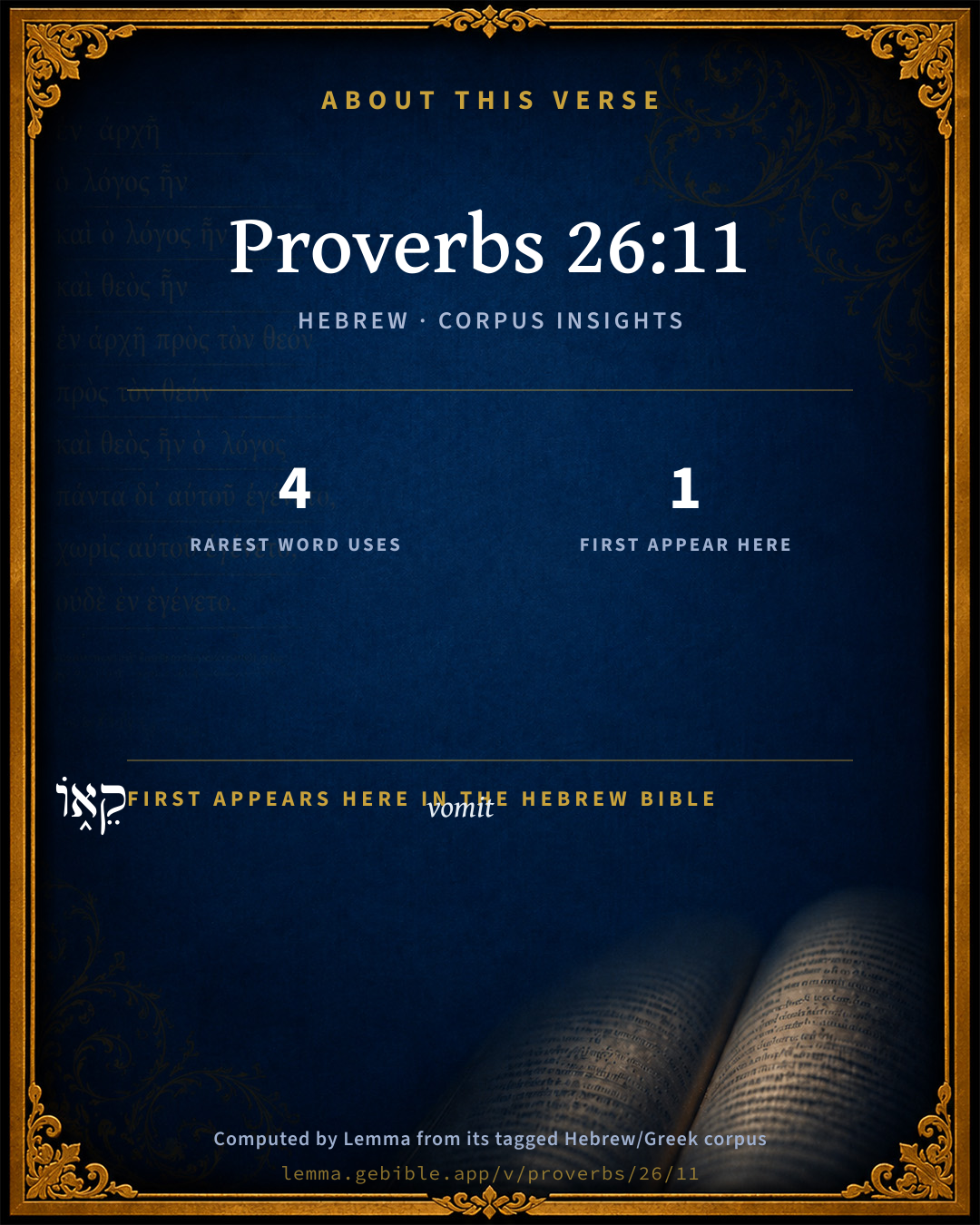
The rarest word here is קֵא֑וֹ vomit H6892 — appearing just 4 times in the whole Hebrew Bible.

First appearance in Scripture

This word makes its first canonical appearance in the Hebrew Bible here:

  • קֵא֑וֹ vomit H6892

Shared distinctive vocabulary

קֵא֑וֹ vomit H6892 occurs in 4 verses of the Hebrew Bible. Also found in:

Grammatical profile

  • 2 verbs
  • 3 nouns
  • 1 adjective
  • 1 preposition

Verb forms

  • שָׁ֣ב Qal · Participle Active
  • שׁוֹנֶ֥ה Qal · Participle Active

Hebrew & Septuagint length

In English translation the verse runs 16 words from the Hebrew and 41 from the Septuagint (LXX English) — the Septuagint runs noticeably longer here. See the side-by-side →

A rough comparison of the two English renderings, which tokenize alike — not a word-level alignment.

Word counts can differ between the Hebrew and the Greek without any difference in meaning — e.g. the Hebrew direct-object marker אֵת has no separate Greek word, and Greek often adds the article ὁ.

Cross-references

3

Topical passages linked to Proverbs 26:11 in the Treasury of Scripture Knowledge — connected by theme and wording, ordered by reader-vote popularity; previews shown in the World English Bible.

  • 2 Peter 2:22 But it has happened to them according to the true proverb, "The dog turns to his own vomit again," and "the sow that had washed to wallowing in the mire."
  • Matthew 12:45 Then he goes, and takes with himself seven other spirits more evil than he is, and they enter in and dwell there. The last state of that man becomes worse than the first. Even so will it be also to this evil generation."
  • Exodus 8:15 But when Pharaoh saw that there was a respite, he hardened his heart, and didn't listen to them, as Yahweh had spoken.

Cross-references courtesy of OpenBible.info (CC BY 4.0).

Hebrew and Greek witnesses Masoretic Hebrew ↔ Greek Septuagint

The same verse in the two great witnesses to the Old Testament, shown verse-for-verse.

Here the Septuagint runs noticeably longer than the Hebrew — LXX2012 (modern English Septuagint) 41 words vs World English Bible 16. A rough length comparison of the two English translations, not a word-level alignment — read both below.

These are two independent witnesses, not word-aligned to each other, and the Septuagint is shown in lemma (dictionary) form.

Hebrew Proverbs 26:11 Masoretic · Westminster Leningrad Codex

כְּ֭כֶלֶב שָׁ֣ב עַל קֵא֑וֹ כְּ֝סִ֗יל שׁוֹנֶ֥ה בְאִוַּלְתּֽוֹ

As a dog that returns to his vomit, So is a fool who repeats his folly.

World English Bible · Public Domain

Greek LXX Proverbs 26:11 Septuagint · lemma form

ὥσπερ κύων ὅταν ἐπιἔρχομαι ἐπί ὁ ἑαυτοῦ ἔμετος καί μισητός γίγνομαι οὕτως ἄφρων ὁ ἑαυτοῦ κακία ἀναστρέφω ἐπί ὁ ἑαυτοῦ ἁμαρτία εἰμί αἰσχύνη ἐπιἄγω ἁμαρτία καί εἰμί αἰσχύνη δόξα καί χάρις

As when a dog goes to his own vomit, and becomes abominable, so is fool who returns in his wickedness to his own sin. [There is a shame that brings sin: and there is a shame that is glory and grace.]

LXX2012 (modern English Septuagint) · Public Domain

On this verse, Keil & Delitzsch discusses the Septuagint’s reading. Read the note in Commentary ↓

Hebrew: Westminster Leningrad Codex (CC BY 4.0). Greek: Septuagint (public domain); English from LXX2012 (modern English Septuagint) (Public Domain). How the Septuagint differs from the Hebrew →

Commentary

Notes on Proverbs 26:11 from classic Christian and Jewish commentators (each source and its license shown beneath its notes). The classic Christian expositions comment on the surrounding passage and are grouped to its opening verse, so a note may address several verses; the Jewish commentaries on the Tanakh (Rashi and others) are per-verse, so they appear only where the commentator wrote on this verse.

Lemma curates 59 commentaries, every one of them public domain or Creative Commons licensed, each selected and text-cleaned for this edition rather than reprinted as found. About our sources →

Trapp's Complete Commentary

John Trapp

Pro 26:11 As a dog returneth to his vomit, [so] a fool returneth to his folly.

Ver. 11. As a dog returneth to his vomit.] A homely comparison, able to make a true Christian ready to lay up all, but good enough for the odious apostate to whom it is applied. Such a one was Judas, Julian, Ecebolius, Baldvinus, Islebius, Agricola, that first Antinomian, - who did many times promise amendment, and yet afterwards fell to his error again; - after that he condemned his error, and recanted it in a public auditory, and printed his revocation; yet when Luther was dead, he relapsed into that error, so hard a thing is it to get poison out when once swallowed down. Harding, Bishop Jewel’s antagonist, was in King Edward’s days a thundering preacher against Popery, wishing he could cry out against it as loud as the bells of Oseney, so that by his preaching many were confirmed in the truth. All which to be so they can testify that heard him and be yet alive, saith Mr Foxe. See an excellent letter of the Lady Jane Grey’s to him while she was prisoner in the Tower, "Acts and Monuments," fol. 1291, wherein she wills him to remember the horrible history of Julian of old, and the lamentable case of Spira a late, &c.

John Trapp, A Commentary or Exposition upon All the Books of the Old and New Testament (1647–1656) — public domain. Text from a community e-Sword module.

The Biblical Illustrator

Joseph S. Exell

Pro_26:11

As a dog returneth to his vomit, so a fool returneth to his folly.

The accustomed course resumed

Dost thou ever raise thy little dam across the streamlet, and think to dry the bed below? Hast thou accomplished thy work, and stood watching awhile thy success? Hast thou seen the water above deepen and widen, and gather strength, and at length, impatient of restraint, push through thy yielding barrier, and resume its accustomed course? But couldst thou have turned the stream into another channel thou hadst triumphed, and the former bed had been left dry. So thou hast attempted, perhaps, to confine thy sinful will by the barrier of good resolutions. Thou hast seemed for awhile to gain thy point, and sin was at a stand. Alas! thou hast found that it but gained force by restraint; ere awhile the inclination has burst through all thy well-formed resolves, and hath rushed more impetuously than ever to the forbidden object. No; the will and affections must be turned into another course--towards God and heaven, and things spiritual; and then shall they cease to flow through the tempting vanities of this evil world. This I say, then, Walk in the Spirit, and ye shall not fulfil the lust of the flesh (Gal_5:16.) (H. G. Salter.)

The Biblical Illustrator, edited by Joseph S. Exell (c. 1880s–1900s) — public domain. Text from a community e-Sword module.

Keil & Delitzsch

C. F. Keil & F. Delitzsch

The series of proverbs regarding fools is continued:

Like a dog which returneth to his vomit,

Is a fool who cometh again with his folly.

שׁב is like שׁונה, particip.; only if the punctuation were כּכּלב, ought "which returneth to his vomit" to be taken as a relative clause (vid., under Psa 38:14). Regarding על as designating the terminus quo with verbs of motions, vid., Khler under Mal. 3:24. On קא = קיא, cf. Pro 23:8. Luther rightly; as a dog devours again his vomit. The lxx translate: ὥσπερ κύων ὅταν ἐπέλθῃ ἐπὶ τὸν ἑαυτοῦ ἔμετον; the reference in Pe2 2:22 : κύων ἐπιστρέψας ἐπὶ τὸ ἴδιον ἐξέραμα, is thus not from the lxx; the Venet. is not connected with this N.T. citation, but with the lxx, if its accordance with it is not merely accidental. To devour again its vomit is common with the dog.

(Note: Vid., Schulze's Die bibl. Sprichwrter der deutschen Sprache, p. 71f.)

Even so, it is the manner of fools to return again in word and in deed to their past folly (vid., regarding שׁנה with ב of the object. Pro 17:9); as an Aram. popular saying has it: the fool always falls back upon his foolish conduct.

(Note: Vid., Wahl's Das Sprichwort der heb.-aram. Literatur, p. 147; Duke's Rabbin. Blumenlese, p. 9.)

He must needs do so, for folly has become to him a second nature; but this "must" ceases when once a divine light shines forth upon him. The lxx has after Pro 26:11 a distich which is literally the same as Sir. 4:21.

Keil & Delitzsch — Biblical Commentary on the Old Testament (1861–1891) — public domain (CC PDM 1.0). Text via the HelloAO Bible API. (Old Testament only.)

Bridges on Proverbs

Charles Bridges

(Pro 26:11 quoted in the NT: 2Pe 2:22 )

And is this the picture of man — "made a little lower than the angels" (Psa 8:5 ) — yea — "made in the likeness of God"? (Gen 1:26 .) Who that saw Adam in his universal dominion, sitting as the monarch of creation; summoning all before him; giving to each his name, and receiving in turn his homage (Gen 2:20 ) — who would have conceived of his children sunk into such brutish degradation? The tempter’s promise was — "Ye shall be as gods." (Gen 3:5 .) The result of this promise was — ’Ye shall be as beasts.’ The vilest comparisons are used to shew man’s loathsomeness in the sight of God. ’Do any feel disgusted at the allusion? Let them remember, that the emblem is far less filthy, than the thing denoted by it; and that the whole race of animals does not afford anything so debasing, as not to be far outdone by the excesses of libertines, drunkards, and gluttons.’†1 We naturally turn away with sickening from this sight. Would that we had the same disgust at the sin, which it so graphically portrays! Would that we might abhor ourselves for that, which God infinitely abhors in us!

The Apostle uses this "true proverb" to describe the awful condition of apostates (2Pe 2:20-22 ) — temporary conviction, unaccompanied with real conversion of heart, and falling away to desperate hardness. Many reasons may produce disgust in the sinner’s mind to his folly. He may loathe, and for a while relinquish it. It has proved so fraught with misery (Pro 13:15 ); its very pleasures so impregnated with poison; that no wonder if he make an occasional, or even a strong effort to be rid of it. But when the sickness has passed away, the sweetness of the forbidden fruit again comes to mind; the heart and affections are again clasped around the world, and, as a dog returneth to his vomit — to the food, which had caused his sickness; so a fool returneth to his folly — to that, which had been his hurt and shame.

Thus greedily did Pharaoh return from his momentary conviction;†2 Ahab from his feigned repentance;†3 Herod from his partial amendment;†4 the drunkard from his brutish insensibility†5 — all to take a more determinate course of sin; to take their final plunge into ruin. Even a superficial knowledge of Christ is no preservative to an unrenewed heart. The "house may be swept" of outward sin, "and garnished" with external holiness; but if it be "empty," if the Divine inhabitant be not heartily welcomed, the former possessor will quickly return, and tenant it as his fixed home with sevenfold destruction. (Mat 12:43-45 .)

Is not sin then justly termed folly? Does not the God of Truth pronounce it to be so now? Will not every fool confess it to be so at the end, when its wages shall be fully paid in "shame and everlasting contempt"? (Dan 12:2 .) Child of God! hearken to thy Father’s voice of "peace." But ponder also his solemn warning "to his people and to his saints — Let them not turn again to folly."†6

Footnotes:

†1 Scott.

†2 1Ki 22:11 . Jer 5:31 . 2Co 11:13-15 . Gal 1:7 . 2Pe 2:17-19 . Jud 1:12-16 .

†3 1Ki 21:27-29 ; 1Ki 22:8, 1Ki 22:37 .

†4 Mar 6:20-27.

†5 Pro 23:35.

†6 Psa 85:8. Compare Joh 5:14 ; also Sir 21:1 .

Charles Bridges, An Exposition of the Book of Proverbs (1846) — public domain. Text from a community e-Sword module.

Tyndale Open Study Notes

Tyndale Open Resources

26:11 Even when foolishness brings terrible consequences, a fool persists in it (17:10; see also 2 Pet 2:22).

Tyndale Open Study Notes — © Tyndale Open Resources, licensed CC BY-SA 4.0. Text via the HelloAO Bible API.

Matthew Henry's Commentary

See here, 1. What an abominable thing sin is, and how hateful sometimes it is made to appear, even to the sinner himself. When his conscience is convinced, or he feels smart from his sin, he is sick of it, and vomits it up; he seems then to detest it and to be willing to part with it. It is in itself, and, first or last, will be to the sinner, more loathsome than the vomit of a dog, Psa 36:2. 2. How apt sinners are to relapse into it notwithstanding. As the dog, after he has gained ease by vomiting that which burdened his stomach, yet goes and licks it up again, so sinners, who have been convinced only and not converted, return to sin again, forgetting how sick it made them. The apostle (Pe2 2:22) applies this proverb to those that have known the way of righteousness but are turned from it; but God will spue them out of his mouth, Rev 3:16.

Matthew Henry's Commentary on the Whole Bible (1708–1710) — public domain (CC PDM 1.0). Text via the HelloAO Bible API.

Jamieson, Fausset & Brown

Robert Jamieson, A. R. Fausset & David Brown

returneth . . . folly--Though disgusting to others, the fool delights in his folly.

Jamieson, Fausset & Brown — Commentary Critical and Explanatory on the Whole Bible (1871) — public domain (CC PDM 1.0). Text via the HelloAO Bible API.

Adam Clarke's Commentary

Verse 11. As a dog returneth to his vomit] 2Pe 2:22.

Adam Clarke's Commentary on the Bible (1810–1826) — public domain. Text from a community e-Sword/MySword module.

Ellicott's Commentary for English Readers

(11) So a fool returneth to his folly.—Though he knows it to be folly, and ruinous to him: but vice has become to him a second nature, and he cannot, even if he would, escape from it. This is especially true of those who have given way to drink or impurity of life.

A Bible Commentary for English Readers, edited by Charles John Ellicott (1878–1897) — public domain. Text from a community e-Sword module.

The Cambridge Bible for Schools and Colleges

gen. ed. J. J. S. Perowne

11. So a fool returneth to] Rather, So is a fool that repeateth, R.V.; iterat, Vulg. The Heb. word is not the same as in the first clause of the verse. Comp. on the proverb 2Pe_2:22.

Pro_26:13-16. Another small group of four proverbs, of which the “sluggard” is the subject.

The Cambridge Bible for Schools and Colleges (gen. ed. J. J. S. Perowne; Cambridge University Press, 1878–1918) — public domain. Text from a community e-Sword module.

John Gill's Exposition

As a dog returneth to his vomit,.... Who being sick with what he has eaten, casts it up again, and afterwards returns unto it and licks it up;

so a fool returneth to his folly, or "repeats" (a) it, time after time, many times, as Ben Melech; or a wicked man turns to his wickedness, who, having had some qualms upon his conscience for sin, for a while forsakes it; but that fit being over, and he forgetting all his former horror and uneasiness, returns to his old course of life: a wicked man is here compared to a dog, as he is elsewhere for his impudence and voraciousness in sinning; and the filthiness of sin is expressed by the vomit of a dog, than which nothing is more nauseous and loathsome; and the apostasy of the sinner, from an external course of righteousness into open profaneness is signified by the return of this creature to it. This is said to be a "true proverb", Pe2 2:22, where it is quoted and applied.

(a) "qui iterat", Tigurine version, Michaelis; "iterans", Montanus, Mercerus, Cocceius, Gejerus; "duplicans", Schultens.

John Gill's Exposition of the Whole Bible (1746–1763) — public domain (CC PDM 1.0). Text via the HelloAO Bible API.

Haydock's Catholic Bible Commentary

Dog. This is the only animal which is known to do so. St. Peter uses this comparison to deter any from renouncing the faith; as the Fathers do, to shew the misery attending a relapse. Septuagint here add, "there is a confusion," &c., taken from Ecclesiasticus iv. 25. (Calmet)

George Leo Haydock (1774–1849), Haydock's Catholic Family Bible and Commentary, 1859 edition — public domain. Excludes Psalms (Douay-Rheims chapter numbering differs from Protestant) and Deuterocanonical books (Catholic canon only).

Matthew Poole's English Annotations

As a dog returneth to his vomit, to lick up that which he had lately vomited, forgetting how burdensome and vexatious it was to him,

so a fool returneth to his folly; such like is the impudence and madness of sinners, who having smarted for their sins, and been forced to forsake them far a time, do afterwards return to the commission of them.

Matthew Poole's English Annotations on the Holy Bible (1683–1685) — public domain. Text from a community e-Sword/MySword module.

Whedon's Commentary on the Bible

Daniel D. Whedon

11. As a dog returneth — Compare 2Pe_2:22.

Returneth to his folly — Repeats it, or turns back unto it. Compare Mat_12:45; Joh_5:14; Heb_6:4-8.

Daniel D. Whedon (gen. ed.), Commentary on the Old and New Testaments (1874–1909) — public domain. Text from a community e-Sword module.

The Pulpit Commentary

As the dog returneth to his vomit, (see 2Pe_2:22, which, however, is not quoted from the Septuagint) so a fool returneth to his folly; or, repeateth his folly. The fool never frees himself from the trammels of his foolishness; his deeds and words always bear the same character to the end. The same truth holds good of the sinner, especially the drunkard and the sensualist. If they feel temporary compunction, and reject their sin by partial repentance, they do not really shake it off wholly; it has become a second nature to them, and they soon relapse into it. Septuagint, "As when a dog goes to his own vomit and becomes hateful, so is a fool who returns in his wickedness to his own sin." The LXX adds a distich which is found in Ecc 4:21, "There is a shame that bringeth sin, and there is a shame that is glory and grace."

The Pulpit Commentary (1880–1919), ed. H.D.M. Spence-Jones & Joseph S. Exell — public domain. Text from a community e-Sword module.

unfoldingWord translationNotes

Door43 World Missions Community

As a dog returns to his own vomit

"As a dog eats its own vomit"

Do you see someone who is wise in his own eyes?

This question is used to lead the reader to think about someone who is wise in his own eyes. The phrase "is wise in his own eyes" means "thinks he is wise," and here it implies that the person is not truly wise. AT: "Consider the person who thinks he is wise but is not." (See: Rhetorical Question and Metaphor)

There is more hope for a fool than for him

"A fool can become wise more easily than he can"

translationWords

fool

hope

unfoldingWord translationNotes — © Distant Shores Media and the Door43 World Missions Community, licensed CC BY-SA 4.0. Source: git.door43.org/Door43/en_tn.

Lesson kit

Teaching starters — assembled from the data on this page, not authored interpretation. Every prompt links to the verse data it draws on. Edit before teaching.

Proverbs, in the Wisdom, opens this verse with 7 words (7 distinct Hebrew lemmas). Its most distinctive word is qêʼ (“vomit”). The Greek Septuagint runs longer here. A historical commentator’s framing appears above. Read the whole chapter for the surrounding context.

Discussion questions

  1. What does “vomit” (qêʼ) contribute to the verse as a whole?
  2. This is the first place “vomit” appears in Scripture (first appears here). What does its debut here establish?
  3. How does Isaiah 19:14, which shares the word «vomit», read alongside this verse?
  4. The Septuagint runs longer here than the Hebrew. What might account for the difference?
  5. The translations on this page render this verse differently — a whole-verse word diff, not a word-by-word alignment. What might account for the different wordings?
  6. «שָׁ֣ב» is a Qal Participle Active verb. How does that grammatical form shape the action described?
  7. Compare how Trapp's Complete Commentary and The Biblical Illustrator read this verse. Where do they agree or differ?

Things to notice

  • 1 word makes its first canonical appearance in Scripture here.
  • These translations choose different wording for 8 words in this verse.
  • 7 distinct Hebrew lemmas span 7 words in this verse.

Reading settings

Reading text

Shown beneath each verse's original-language words.

Old Testament
Old Testament edition

Read the OT as the Masoretic Hebrew (MT) or the Greek Septuagint (LXX).

English shown for the Greek Septuagint (in the Hebrew ↔ Greek comparison).

Comparing translations? Open the Compare panel on any verse page to stack up to four side by side.