
Nahum 3:11

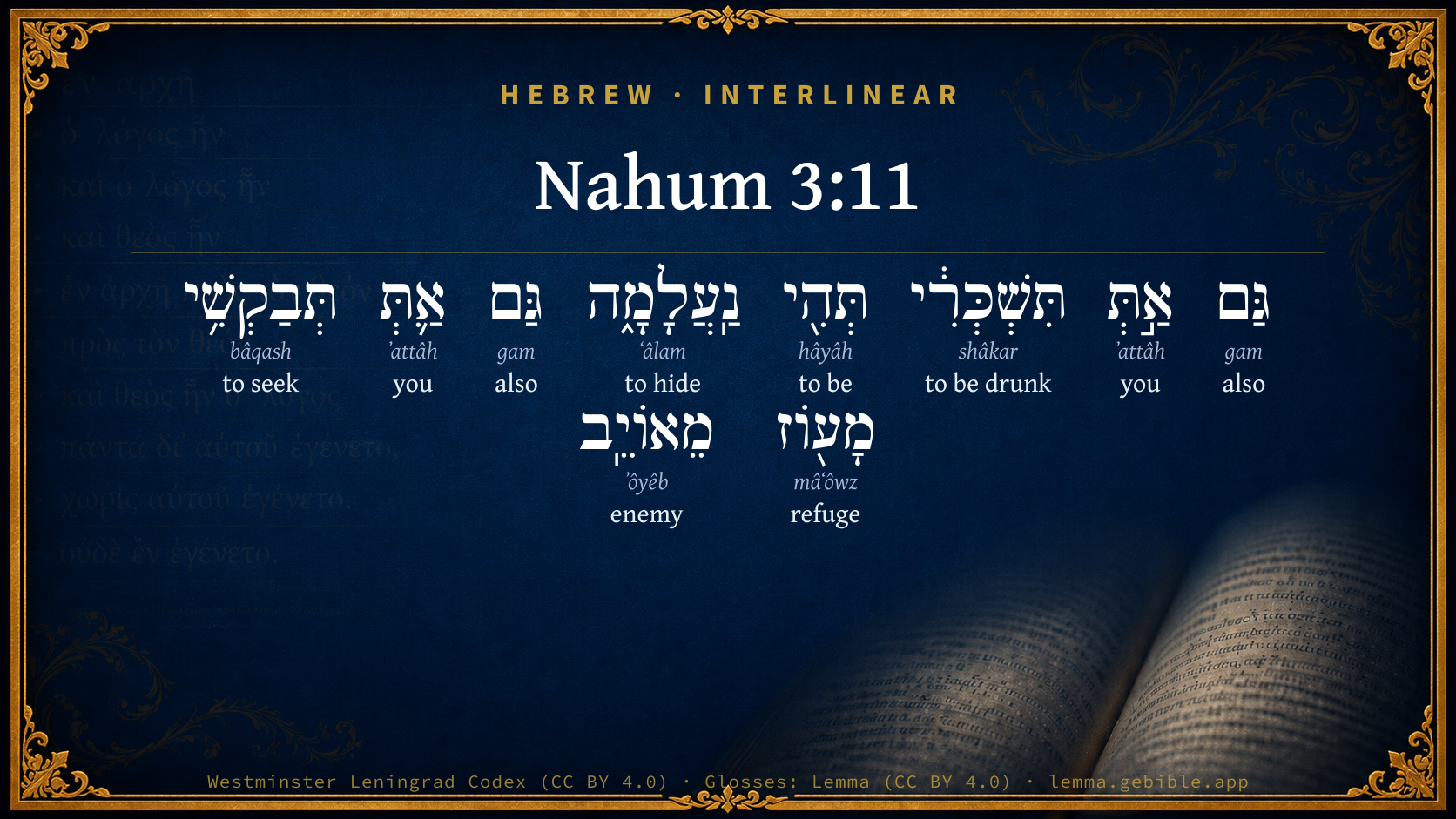
Hebrew (Westminster Leningrad Codex) Nahum 3:11 appears in the Hebrew Old Testament. The text above is from the Westminster Leningrad Codex. Each word links to its Strong’s number, a concise gloss, and parsing drawn from the Open Scriptures Hebrew Bible morphology. Click any word for its full Brown-Driver-Briggs (BDB) entry.
Download image
Cite this verse

Nahum 3:11 (World English Bible). Public Domain. Lemma interlinear Bible study tool, https://lemma.gebible.app/v/nahum/3/11.

Show BibTeX & RIS
BibTeX
RIS
English Translation
You also will be drunken. You will be hidden. You also will seek a stronghold because of the enemy.
World English Bible · Public Domain
Download a study sheet

One document with this verse’s original text, its word-by-word gloss line, the meaning frame, cross-references with their text, attributed commentary, and full source and license credits — printable, and it pastes into notes with its structure intact.

This verse Autodidact and up

Study sheet (.html) Plain text (.txt)

A passage Seminary Student

Up to 50 verses in one chapter. A passage sheet keeps up to 6 commentary sources and 12 cross-references per verse, in the order this page ranks them, and says so on the sheet whenever that leaves anything out. Ask for a single verse and you get the Autodidact verse sheet above.

Everything on this page stays free to read, with no account — the sheet is a download of what is already on screen, not access to it.

Want to remove ads? Support Godless Engineer
Compare translations 3

The same verse in 3 English versions, stacked beneath the original-language interlinear above. Click any original word for its lexicon entry.

Each is an independent rendering of the whole verse — the interlinear is not word-aligned to these translations.

Highlighted words mark where these versions differ — a whole-verse word diff, not a word-by-word alignment.

  • World English Bible Public Domain
    You also will be drunken. You will be hidden. You also will seek a stronghold because of the enemy.
  • King James Version Public Domain
    Thou also shalt be drunken: thou shalt be hid, thou also shalt seek strength because of the enemy.
  • unfoldingWord Literal Text CC BY-SA 4.0
    You also will become drunk; you will be hidden; you also will seek a refuge from your enemy.

unfoldingWord Literal Text — © unfoldingWord, licensed CC BY-SA 4.0. Word-aligned USFM3 via Door43 (git.door43.org/unfoldingWord/en_ult).

Versions to compare (up to 4)

3 of 4 selected

Show all 18 translations

Every available English version of this verse, each an independent rendering of the whole verse.

  • World English Bible Public Domain
    You also will be drunken. You will be hidden. You also will seek a stronghold because of the enemy.
  • Berean Standard Bible Public Domain
    You too will become drunk; you will go into hiding and seek refuge from the enemy.
  • Majority Standard Bible Public Domain
    You too will become drunk; you will go into hiding and seek refuge from the enemy.
  • King James Version Public Domain
    Thou also shalt be drunken: thou shalt be hid, thou also shalt seek strength because of the enemy.
  • American Standard Version (1901) Public Domain
    Thou also shalt be drunken; thou shalt be hid; thou also shalt seek a stronghold because of the enemy.
  • Revised Version (1885) Public Domain
    Thou also shalt be drunken, thou shalt be hid; thou also shalt seek a strong hold because of the enemy.
  • Geneva Bible (1599) Public Domain
    Also thou shalt bee drunken: thou shalt hide thy selfe, and shalt seeke helpe because of the enemie.
  • Douay-Rheims (1899) Public Domain
    Therefore thou also shalt be made drunk, and shalt be despised: and thou shalt seek help from the enemy.
  • Young's Literal Translation Public Domain
    Even thou art drunken, thou art hidden, Even thou dost seek a strong place, because of an enemy.
  • Literal Standard Version CC BY-SA 4.0
    Even you are drunken, you are hidden, || Even you seek a strong place, because of an enemy.
  • Unlocked Literal Bible CC BY-SA 4.0
    You also will become drunk; you will try to hide, and you will also look for a refuge from your enemy.
  • unfoldingWord Literal Text CC BY-SA 4.0
    You also will become drunk; you will be hidden; you also will seek a refuge from your enemy.
  • Darby Bible Public Domain
    Thou also shalt be drunken: thou shalt be hid; thou also shalt seek a refuge from the enemy.
  • World Messianic Bible Public Domain
    You also will be drunken. You will be hidden. You also will seek a stronghold because of the enemy.
  • Webster's Bible Public Domain
    Thou also shalt be drunken: thou shalt be hid, thou also shalt seek strength because of the enemy.
  • Free Bible Version CC BY-SA 4.0
    You too will behave like a drunk. You will hide in fear, trying to find a place safe from the enemy.
  • Bible in Basic English Public Domain
    And you will be overcome with wine, you will become feeble; you will be looking for a safe place from those who are fighting against you.
  • JPS Tanakh (1917) Public Domain
    Thou also shalt be drunken, thou shalt swoon; thou also shalt seek a refuge because of the enemy.

Literal Standard Version (2020), Covenant Press — licensed CC BY-SA 4.0. Text via the HelloAO Bible API (eBible.org). Unlocked Literal Bible (unfoldingWord) — licensed CC BY-SA 4.0. Text via the HelloAO Bible API (eBible.org). unfoldingWord Literal Text — © unfoldingWord, licensed CC BY-SA 4.0. Word-aligned USFM3 via Door43 (git.door43.org/unfoldingWord/en_ult). Free Bible Version, Dr. Jonathan Gallagher — licensed CC BY-SA 4.0. Text via the HelloAO Bible API (eBible.org).

Word by word

More ways to search: Search by grammar → Find every occurrence → Compare this word →

Practice this passage: Drill this verse → Learn its vocabulary →

תִּשְׁכְּרִ֔י
shâkar
H7937
“to be drunk”
Verb, Qal, Imperfect, 2nd Person, Feminine, Singular
Part of Speech
Verb
Stem
Qal
Form
Imperfect
Person
2nd Person
Gender
Feminine
Number
Singular
Full BDB Definition

Origin: a primitive root

TWOT: 2388

to be or become drunk or drunken, be intoxicated - (Qal) to become drunken - (Piel) to make drunken, cause to be drunk - (Hiphil) to cause to be drunk - (Hithpael) to make oneself drunk
  1. גַּם gam H1571 “also” Particle, Accusative
  2. אַ֣תְּ ʼattâh H859 “you” Pronoun, Personal, 2nd Person, Feminine, Singular
  3. תְּהִ֖י hâyâh H1961 “to be” Verb, Qal, Imperfect, 3rd Person, Feminine, Singular
  4. נַֽעֲלָמָ֑ה ʻâlam H5956 “hidden” Verb, Niphal, Participle Passive, Feminine, Singular, Absolute
  5. גַּם gam H1571 “also” Particle, Accusative
  6. אַ֛תְּ ʼattâh H859 “you” Pronoun, Personal, 2nd Person, Feminine, Singular
  7. תְּבַקְשִׁ֥י bâqash H1245 “to seek” Verb, Piel, Imperfect, 2nd Person, Feminine, Singular
  8. מָע֖וֹז mâʻôwz H4581 “refuge” Noun, Common, Masculine, Singular, Absolute
  9. מֵאוֹיֵֽב ʼôyêb H341 “from · enemy” Preposition + Verb, Qal, Participle Active, Masculine, Singular, Absolute

About this verse

These counts appear in no published source. They are computed here, from the morphology-tagged text and Lemma’s own curated glosses. What Lemma adds →

10
words
8
distinct lemmas
Prophets
section

Notable vocabulary

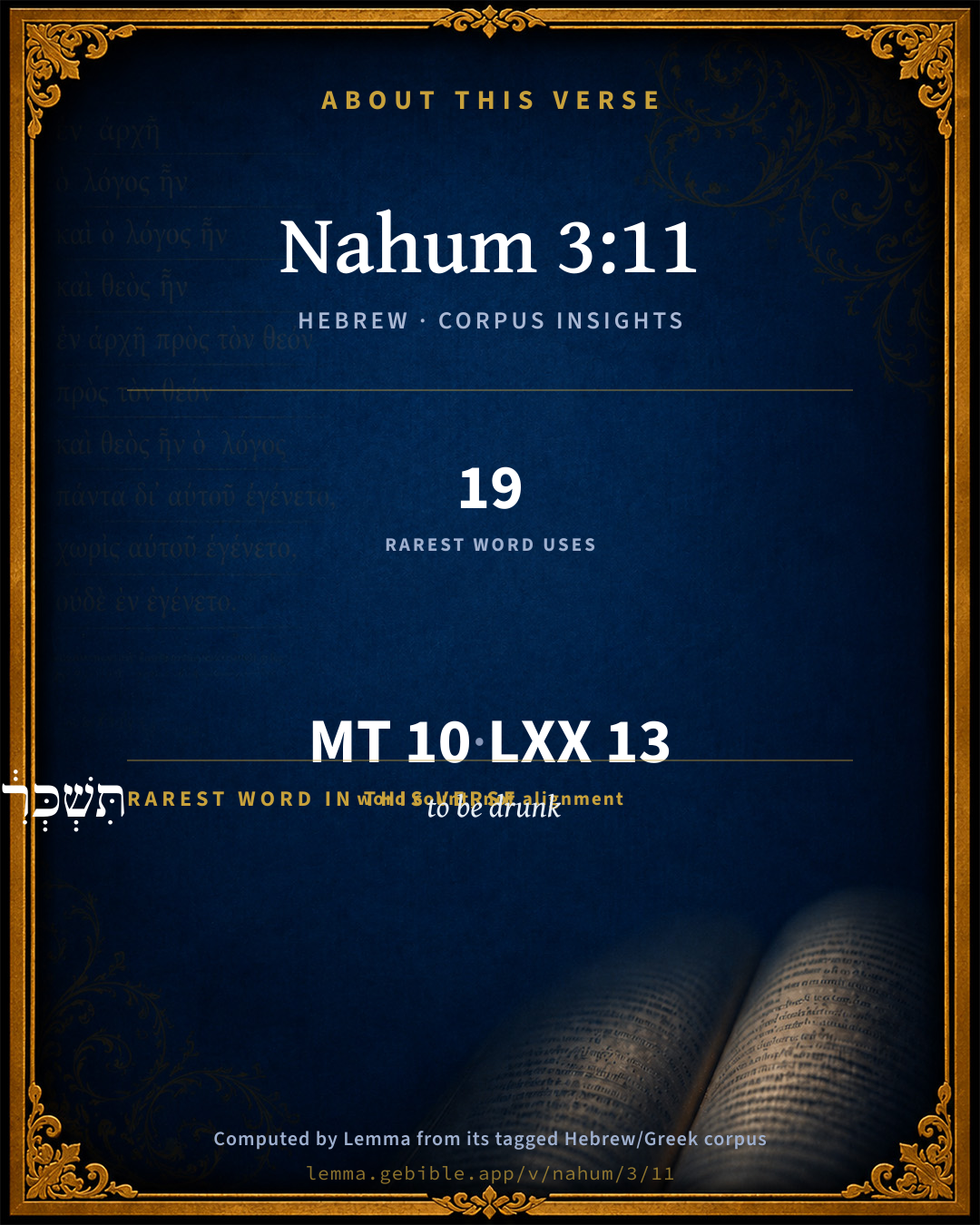
The rarest word here is תִּשְׁכְּרִ֔י to be drunk H7937 — appearing just 19 times in the whole Hebrew Bible.

Shared distinctive vocabulary

תִּשְׁכְּרִ֔י to be drunk H7937 occurs in 19 verses of the Hebrew Bible. Also found in:

Grammatical profile

  • 5 verbs
  • 1 noun
  • 2 pronouns
  • 2 particles

Verb forms

  • תִּשְׁכְּרִ֔י Qal · Imperfect
  • תְּהִ֖י Qal · Imperfect
  • נַֽעֲלָמָ֑ה Niphal · Participle Passive
  • תְּבַקְשִׁ֥י Piel · Imperfect
  • מֵאוֹיֵֽב Qal · Participle Active

Repetition

Words recur within this verse — often emphatic in Hebrew:

  • גַּם also H1571 ×2
  • אַ֣תְּ you H859 ×2

Hebrew & Septuagint length

In English translation the verse runs 19 words from the Hebrew and 20 from the Septuagint (LXX English) — closely comparable.

A rough comparison of the two English renderings, which tokenize alike — not a word-level alignment.

Word counts can differ between the Hebrew and the Greek without any difference in meaning — e.g. the Hebrew direct-object marker אֵת has no separate Greek word, and Greek often adds the article ὁ.

In the original languages it is 10 Hebrew tokens and 13 Greek tokens — but the two are counted differently (Hebrew bundles its prefixes and suffixes into one token; the Greek is in lemma form), so that isn’t a like-for-like length.

Cross-references

19

Topical passages linked to Nahum 3:11 in the Treasury of Scripture Knowledge — connected by theme and wording, ordered by reader-vote popularity; previews shown in the World English Bible.

  • Isaiah 2:10 Enter into the rock, And hide in the dust, From before the terror of Yahweh, And from the glory of his majesty.
  • Isaiah 49:26 I will feed those who oppress you with their own flesh; and they shall be drunken with their own blood, as with sweet wine: and all flesh shall know that I, Yahweh, am your Savior, and your Redeemer, the Mighty One of Jacob.
  • Luke 23:30 Then they will begin to tell the mountains, 'Fall on us!' and tell the hills, 'Cover us.'
  • Psalms 75:8 For in the hand of Yahweh there is a cup, Full of foaming wine mixed with spices. He pours it out. Indeed the wicked of the earth drink and drink it to its very dregs.
  • Isaiah 2:19 Men shall go into the caves of the rocks, And into the holes of the earth, From before the terror of Yahweh, And from the glory of his majesty, When he arises to shake the earth mightily.
  • Jeremiah 4:5 Declare you in Judah, and publish in Jerusalem; and say, Blow you the trumpet in the land: cry aloud and say, Assemble yourselves, and let us go into the fortified cities.
  • Hosea 10:8 The high places also of Aven, the sin of Israel, will be destroyed. The thorn and the thistle will come up on their altars. They will tell the mountains, "Cover us!" and the hills, "Fall on us!"
  • Nahum 1:10 For entangled like thorns, and drunken as with their drink, they are consumed utterly like dry stubble.
  • Revelation 6:15–17 The kings of the earth, the princes, the commanding officers, the rich, the strong, and every slave and free person, hid themselves in the caves and in the rocks of the mountains.
  • 1 Samuel 13:6 When the men of Israel saw that they were in a strait (for the people were distressed), then the people did hide themselves in caves, and in thickets, and in rocks, and in coverts, and in pits.
  • 1 Samuel 14:11 Both of them disclosed themselves to the garrison of the Philistines: and the Philistines said, Behold, the Hebrews come forth out of the holes where they had hid themselves.
  • Isaiah 29:9 Stay you and wonder; take your pleasure and be blind: they are drunken, but not with wine; they stagger, but not with strong drink.
  • Isaiah 63:6 I trod down the peoples in my anger, and made them drunk in my wrath, and I poured out their lifeblood on the earth.
  • Jeremiah 8:14 Why do we sit still? assemble yourselves, and let us enter into the fortified cities, and let us be silent there; for Yahweh our God has put us to silence, and given us water of gall to drink, because we have sinned against Yahweh.
  • Jeremiah 25:15–27 For thus says Yahweh, the God of Israel, to me: take this cup of the wine of wrath at my hand, and cause all the nations, to whom I send you, to drink it.
  • Jeremiah 51:57 I will make drunk her princes and her wise men, her governors and her deputies, and her mighty men; and they shall sleep a perpetual sleep, and not wake up, says the King, whose name is Yahweh of Hosts.
  • Amos 9:3 Though they hide themselves in the top of Carmel, I will search and take them out there; and though they be hid from my sight in the bottom of the sea, there I will command the serpent, and it will bite them.
  • Micah 7:17 They will lick the dust like a serpent. Like crawling things of the earth they shall come trembling out of their dens. They will come with fear to Yahweh our God, And will be afraid because of you.
  • Nahum 2:1 He who dashes in pieces has come up against you. Keep the fortress! Watch the way! Strengthen your loins! Fortify your power mightily!

Cross-references courtesy of OpenBible.info (CC BY 4.0).

Hebrew and Greek witnesses Masoretic Hebrew ↔ Greek Septuagint

The same verse in the two great witnesses to the Old Testament, shown verse-for-verse.

These are two independent witnesses, not word-aligned to each other, and the Septuagint is shown in lemma (dictionary) form.

Hebrew Nahum 3:11 Masoretic · Westminster Leningrad Codex

גַּם אַ֣תְּ תִּשְׁכְּרִ֔י תְּהִ֖י נַֽעֲלָמָ֑ה גַּם אַ֛תְּ תְּבַקְשִׁ֥י מָע֖וֹז מֵאוֹיֵֽב

You also will be drunken. You will be hidden. You also will seek a stronghold because of the enemy.

World English Bible · Public Domain

Greek LXX Nahum 3:11 Septuagint · lemma form

καί σύ μεθύω καί εἰμί ὑπερὁράω καί σύ ζητέω σεαυτοῦ στάσις ἐκ ἐχθρός

And you shall be drunken, and shall be overlooked; and you shall seek for yourself strength because of your enemies.

LXX2012 (modern English Septuagint) · Public Domain

On this verse, John Gill's Exposition discusses the Septuagint’s reading. Read the note in Commentary ↓

Hebrew: Westminster Leningrad Codex (CC BY 4.0). Greek: Septuagint (public domain); English from LXX2012 (modern English Septuagint) (Public Domain). How the Septuagint differs from the Hebrew →

Targum (Aramaic paraphrase)

1

The Targum is the ancient Jewish Aramaic paraphrase of the Hebrew Scriptures — an interpretive translation, not the Hebrew text itself. Onkelos (literal) and Pseudo-Jonathan (expansive) render the Torah, and Jonathan the Prophets. Coverage is partial: where no permissively-licensed English translation exists for a verse, only the Aramaic is shown. This is verse-level text, not a word-by-word alignment to the Hebrew.

  1. Targum Jonathan Prophets (Joshua–Malachi)
    אַף אַתְּ דַמְיָא לְרַוְיָא תְּהֵי מְסַלְעַמָא אַף אַתְּ תַּבְעִין סָעִיד מִבְּעֵיל דְבָבָא:

    (no public-domain English translation for this verse)

    Targum Jonathan — Aramaic: “Mikraot Gedolot” (public domain). English: “Sefaria Community Translation” (CC0 1.0 (public-domain dedication)); “London "Chaldee Paraphrase," 1871” (public domain). Text via Sefaria.

Commentary

Notes on Nahum 3:11 from classic Christian and Jewish commentators (each source and its license shown beneath its notes). The classic Christian expositions comment on the surrounding passage and are grouped to its opening verse, so a note may address several verses; the Jewish commentaries on the Tanakh (Rashi and others) are per-verse, so they appear only where the commentator wrote on this verse.

Lemma curates 59 commentaries, every one of them public domain or Creative Commons licensed, each selected and text-cleaned for this edition rather than reprinted as found. About our sources →

Trapp's Complete Commentary

John Trapp

Nah 3:11 Thou also shalt be drunken: thou shalt be hid, thou also shalt seek strength because of the enemy.

Ver. 11. Thou also shalt be drunken] sc. with the cup of the wine of God’s wrath; Jer 25:27 thou shalt "drink, and be drunken, and spue and fall, and rise no more, because of the sword which I will send among you." This is that κοινος μεθη, dry drunkenness of them that are "drunk, but not with wine," Isa 51:21; of them that remember their affliction and their misery, the wormwood and the gall, Lam 3:19. If the saints sip sometimes of the top of God’s cap, the wicked shall drink deep of it; yea, though it be eternity to the bottom.

Thou shalt be hid] Or, thou shalt lurk, either for fear of the enemy (who wast once above fear, and thine enemies below hope), or for shame of thine undone condition. See Rev 6:16 Luk 23:30 Hos 10:8. Or, thou shalt vanish, and be brought to nothing; as if there never had been any such. Confer Oba 1:16. Nineveh nothing else now, saith one who had been there, but a sepulchre of herself, a little town of small trade, where the patriarch of the Nestorians keeps his seat at the devotion of the Turk.

Thou shalt also seek strength because of the enemy] Or, from the enemy; beg help of them, to whom thou wouldest once have scorned to be beholden; or of them against whom thou hast professed and practised open hostility.

John Trapp, A Commentary or Exposition upon All the Books of the Old and New Testament (1647–1656) — public domain. Text from a community e-Sword module.

Joseph Benson's Commentary

Nah 3:11-13. Thou also shalt be drunken — Thou shalt drink deep of the bitter cup of God’s displeasure. Thou shalt be hid, &c. — Thou shalt not dare to appear in the open field. Thou shalt seek strength because of the enemy — Thou shalt retire into thy strong holds, or fortified places, for fear of the enemy. All thy strong holds shall be like fig-trees — As figs when quite ripe drop off from the trees by the least shaking, so shall thy strong holds fall into the enemies’ hands upon the first assault. The gates of thy land shall be set wide open, &c. — The several passages, by which the enemy may invade thee, shall be open to them, either through fear or treachery, or shall be easily forced. The fire shall devour thy bars — With which the gates were shut and strengthened.

Joseph Benson's Commentary on the Old and New Testaments (1811–1818) — public domain. Text from a community e-Sword module.

Keil & Delitzsch

C. F. Keil & F. Delitzsch

The same, or rather a worse fate than No-amon suffered, is now awaiting Nineveh. Nah 3:11. "Thou also wilt be drunken, shalt be hidden; thou also wilt seek for a refuge from the enemy. Nah 3:12. All thy citadels are fig-trees with early figs; if they are shaken, they fall into the mouth of the eater. Nah 3:13. Behold thy people, women in the midst of thee; the gates of thy land are thrown quite open to thine enemies; fire consumes thy bolts." גּם־אתּ corresponds to גּם־היא in Nah 3:10 : as she, so also thou. "The fate of No-amon is a prophecy of thine own" (Hitzig). תּשׁכּרי, thou wilt be drunken, viz., from the goblet of divine wrath, as at Oba 1:16. תּהי נעלמה might mean, "thou wilt be hiding thyself;" but although this might suit what follows, it does not agree with תּשׁכּרי , since an intoxicated person is not in the habit of hiding himself. Moreover, נעלם always means "hidden," occultus; so that Calvin's interpretation is the correct one: "Thou wilt vanish away as if thou hadst never been; the Hebrews frequently using the expression being hidden for being reduced to nothing." This is favoured by a comparison both with Nah 1:8 and Nah 2:12, and also with the parallel passage in Oba 1:16, "They will drink, and be as if they had not been." This is carried out still further in what follows: "Thou wilt seek refuge from the enemy," i.e., in this connection, seek it in vain, or without finding it; not, "Thou wilt surely demand salvation from the enemy by surrender" (Strauss), for מאויב does not belong to תּבקשׁי, but to מעוז (cf. Isa 25:4). All the fortifications of Nineveh are like fig-trees with early figs (עם in the sense of subordination, as in Sol 4:13), which fall into the mouth of the eater when the trees are shaken. The tertium compar. is the facility with which the castles will be taken and destroyed by the enemy assaulting them (cf. Isa 28:4). We must not extend the comparison so far, however, as to take the figs as representing cowardly warriors, as Hitzig does. Even in Nah 3:13, where the people are compared to women, the point of comparison is not the cowardliness of the warriors, but the weakness and inability to offer any successful resistance into which the nation of the Assyrians, which was at other times so warlike, would be reduced through the force of the divine judgment inflicted upon Nineveh (compare Isa 19:16; Jer 50:37; Jer 51:30). לאיביך belongs to what follows, and is placed first, and pointed with zakeph-katon for the sake of emphasis. The gates of the land are the approaches to it, the passes leading into it, which were no doubt provided with castles. Tuch (p. 35) refers to the mountains on the north, which Pliny calls impassable. The bolts of these gates are the castles, through which the approaches were closed. Jeremiah transfers to Babel what is here said of Nineveh (see Jer 51:30).

Keil & Delitzsch — Biblical Commentary on the Old Testament (1861–1891) — public domain (CC PDM 1.0). Text via the HelloAO Bible API. (Old Testament only.)

Jamieson, Fausset & Brown

Robert Jamieson, A. R. Fausset & David Brown

drunken--made to drink of the cup of Jehovah's wrath (Isa 51:17, Isa 51:21; Jer 25:15).

hid--covered out of sight: a prediction remarkably verified in the state in which the ruins of Nineveh have been found [G. V. SMITH]. But as "hid" precedes "seek strength," &c., it rather refers to Nineveh's state when attacked by her foe: "Thou who now so vauntest thyself, shalt be compelled to seek a hiding-place from the foe" [CALVIN]; or, shalt be neglected and slighted by all [MAURER].

seek strength because of the enemy--Thou too, like Thebes (Nah 3:9), shalt have recourse to other nations for help against thy Medo-Babylonian enemy.

Jamieson, Fausset & Brown — Commentary Critical and Explanatory on the Whole Bible (1871) — public domain (CC PDM 1.0). Text via the HelloAO Bible API.

John Calvin's Commentaries

Nahum, after having adduced the example of Alexandria, now shows that nothing would be able to resist God, so that he should not deal with Nineveh in the same manner; and he declares that this would be the case, Thou also, he says, shalt be inebriated. Well known is this metaphor, which often occurs in Scripture: for the Prophets are wont frequently to call punishment a cup, which God administers. But when God executes a heavy punishment, he is said to inebriate the wicked with his cup. The Prophet says now, that the chastisement of Nineveh would make her like a drunken man, who, being overcome with wine, lies down, as it were, stupefied. Hence by this metaphor he intended to set forth a most severe punishment: Thou then shalt be also inebriated The particle גם, gam, is here emphatical; it was introduced, that the Ninevites might know, that they could not possibly escape the punishment which they deserved; for God continues ever like himself. Thou then shalt be also inebriated This would not be consistent, were not God the judge of the world to the end. There is then a common reason for this proceeding; hence it necessarily follows, — since God punished the Alexandrians, the Assyrians cannot escape his hand, and be exempt from punishment.

He adds, Thou shalt be hidden Some refer this to shame, as though the Prophet had said, — “Thou indeed showest thyself now to be very proud, but calamity will force thee to seek hiding-places, in which to conceal thyself.” But I am more inclined to this meaning, — that Nineveh would vanish away, as though it never had been; for to be hidden is often taken in Hebrew in the sense of being reduced to nothing.

He afterwards says, Thou shalt also seek strength, or supplies, from the enemy. The words מעוז מאויב, meouz meavib, may admit of two meanings, — either that she will humbly solicit her enemies, — or that on account of her enemies she will flee to some foreign aid; for the preposition מ, mem, may be taken in both senses. If we adopt the first meaning, then I think that the Prophet speaks not of the Babylonians, but of the other nations who had been before harassed by the Assyrians. Thou shalt now then humbly pray for the aid of those who have been hitherto thine enemies, — not because they had provoked thee, but because thou hast as an enemy treated them. Now it is an extreme misery, when we are constrained to seek the help of those by whom we are hated, and hated, because we have by wrongs provoked them. But the other sense is more approved, for it is less strained: Thou shalt also seek aids on account of the enemy; that is, as strength to resist will fail thee, thou wilt seek assistance from thy neighbors. It follows —

John Calvin's Commentaries (1540-1563) — public domain. Text from the Calvin Translation Society English edition (1840s-50s) via the Christian Classics Ethereal Library (ccel.org). Calvin's coverage is partial (roughly two-thirds of the Bible); uncommented books and verses are honest gaps, never fabricated. The 19th-century editor's footnotes and remarks are omitted so the notes are faithfully Calvin's own voice.

Ellicott's Commentary for English Readers

(11, 12) Thou also shalt be drunken.—Nineveh also shall be drunken with the cup of God’s wrath (see Hab_2:16), yea, hid from recollection, so that men shall ask, “Where is Nineveh?” (Comp. Nah_2:11.) She, too, shall vainly seek a fortress (Authorised Version, “strength”) to give her shelter, all her own strongholds having fallen as easily as the ripe fruit from the fig-tree.

A Bible Commentary for English Readers, edited by Charles John Ellicott (1878–1897) — public domain. Text from a community e-Sword module.

The Cambridge Bible for Schools and Colleges

gen. ed. J. J. S. Perowne

11. shalt be drunken] Drunkenness is a figure for the stupefaction caused by calamity. Isa_51:17-23, “Awake Jerusalem, which hast drunk at the hand of the Lord the cup of his fury, thou hast drunken of the bowl of the cup of staggering … Hear now this, thou afflicted, and drunken, but not with wine.” Similarly Hab_2:15-16; Jer_25:15 seq. Comp. Jer_25:17-18; Jer_25:27; Eze_23:33; Oba_1:16.

thou shalt be hid] thou shalt faint, or, swoon, lit. be shrouded (in darkness), a usual oriental figure—“a covering came over him,” i.e. he swooned. Comp. the more usual word, Isa_51:20; Amo_8:13; Lam_2:19.

shalt seek strength] seek a place of refuge because of, or, from the enemy.

The destruction of Thebes here alluded to was effected by Assurbanipal about 664–662. The Egyptian king of the day was Urdamanî, who had succeeded Tirhaka. Details are given in the Inscriptions; see Schrader, ii. pp. 149–152; Winckler, Altorient. Untersuch. I. p. 105 (Essay on “The Sargonides and Egypt”). For the bearing of the reference on date of the prophecy, see Introd.

The Cambridge Bible for Schools and Colleges (gen. ed. J. J. S. Perowne; Cambridge University Press, 1878–1918) — public domain. Text from a community e-Sword module.

John Gill's Exposition

Thou also shalt be drunken,.... This is said to Nineveh, whose turn would be next to drink of the cup of the wrath of God, and be inebriated with it, so that they should not know where they were, or what they did; and be as unable to guide and help themselves as a drunken man. So the Targum,

"thou also shalt be like to a drunken man;''

this was literally true of Nineveh when taken; see Nah 1:10,

thou shalt be hid; or, "thou shall be", as if thou wast not; as Nineveh is at this day, "hid" from the sight of men, not to be seen any more. So the Targum,

"thou shall be swallowed up or destroyed.''

The Septuagint, Vulgate Latin, and Arabic versions, render it "despised"; or the meaning is, she should "hide herself" (w); or be lurking about through shame, as drunken, or through fear of her enemies:

thou also shall seek strength because of the enemy; seek to others to help them against the enemy, not being able with their own strength to face them: or, seek strength "of the enemy" (x); beg their lives of him, and their bread; pray for quarter, and desire to be taken under his protection; to so low and mean a state and condition should Nineveh and its inhabitants be reduced, who had given laws to all about them, and had been a terror to them.

(w) "latitans", Junius & Tremellius, Piscator; "abscondes te", Vatablus; "eris abscondita", Burkius. (x) , Sept.; "ab hoste", Montanus, Calvin, Drusius, Grotius, Cocceius.

John Gill's Exposition of the Whole Bible (1746–1763) — public domain (CC PDM 1.0). Text via the HelloAO Bible API.

Albert Barnes' Notes on the Bible

Thou also - As thou hast done, so shall it be done unto thee. The cruelties on No, in the cycle of God’s judgments, draw on the like upon Nineveh who inflicted them. “Thou also shalt be drunken” with the same cup of God’s anger, entering within thee as wine doth, bereaving thee of reason and of counsel through the greatness of thy anguish, and bringing shame on thee , and a stupefaction like death. “Thou shalt be hid, a thing hidden” from the eyes of men, “as though thou hadst never been.” Nahum had foretold her complete desolation: he had asked, where is she? Here he describes an abiding condition; strangely fulfilled, as perhaps never to that extent besides; her palaces, her monuments, her records of her glorious triumphs existed still in their place, but hidden out of sight, as in a tomb, under the hill-like mounds along the Tigris. “Thou also shalt seek strength, or a stronghold from the enemy,” out of thyself, since thine own shall be weakness. Yet in vain, since God, is not such to thee Nah 1:7. “They shall seek, but not find.” “For then shall it be too late to cry for mercy, when it is the time of justice.” “He shall have judgment without mercy, that hath shewed no mercy” Jam 2:13.

Albert Barnes' Notes on the Bible (1834–1885) — public domain. Text from a community e-Sword/MySword module.

Haydock's Catholic Bible Commentary

Drunk, and be chastised by God, Ezechiel xxiii. 32. --- From, to escape.

George Leo Haydock (1774–1849), Haydock's Catholic Family Bible and Commentary, 1859 edition — public domain. Excludes Psalms (Douay-Rheims chapter numbering differs from Protestant) and Deuterocanonical books (Catholic canon only).

Matthew Poole's English Annotations

Thou, O Nineveh,

shalt be drunken; not only taste, but drink deep, yea, be drunk with the bitter cup of God’s displeasure and thine enemies’ rage, Isa 29:9; Oba 1:16.

Thou shalt be hid; either hide thyself, or be so weakened and diminished, that thou shalt no more appear; or else be as contemptible, laid by in some obscure place; fear and shame shall cover thee.

Thou also, O Nineveh, as well as Alexandria,

shalt seek strength, shalt sue for and entreat assistance,

because of the enemy, or from the enemy; i.e. either thus, in thy distress thou shalt seek for strength from such as are really thine enemies, though they make a league with thee; or thus, thou shalt beg protection from thy enemy that hath captivated thee, and rely on the mercy of him against the rage of others.

Matthew Poole's English Annotations on the Holy Bible (1683–1685) — public domain. Text from a community e-Sword/MySword module.

The Pulpit Commentary

Thou also shalt be drunken. Nahum makes the application: The fate of Thebes shall be thine, O Nineveh. Thou shalt drink to the full the cup of God"s wrath. (see note on Oba_1:16; and comp. Jer_25:15, Jer_25:17, Jer_25:27) The metaphor indicates the effect of some overwhelming calamity that makes men reel with terror or stupefies them with amazement. Thou shalt be hid; thou shalt be powerless, or reduced to nothing; Esh uperewramenh , "Thou shalt be despised" (Septuagint); Eris despecta (Vulgate). Nineveh, which was taken and destroyed between B.C. 626 and 608, was so effectually "hidden" that its very site wasdiscovered only in late years, and its monuments have only been partially disinterred after immense labour. Thou also shalt seek strength because of the enemy; or, thou also shalt seek a stronghold from the enemy. As the Egyptians fled for refuge from one place to another (see note on ver. 10), so shall the Assyrians attempt in vain to escape the enemy. History records that they endeavoured to effect a retreat from Nineveh during the siege (see Introduction,

The Pulpit Commentary (1880–1919), ed. H.D.M. Spence-Jones & Joseph S. Exell — public domain. Text from a community e-Sword module.

John Wesley's Explanatory Notes

Thou also - Thou shalt drink deep of the bitter cup of God's displeasure. Hid - Thou shalt hide thyself. O Nineveh, as well as Alexandria. Shalt seek - Shalt sue for, and intreat assistance.

John Wesley, Explanatory Notes Upon the Whole Bible (1754–1765) — public domain. Text via the GEBible commentary corpus.

Rashi

Rabbi Shlomo Yitzchaki (Rashi)

You, too—(Even) according to your greatness, [you] shall become drunk like her with the cup of weakness (Cf. Isa. 51:17), and you shall disappear.

Rashi on the Tanakh — English translations: “The Judaica Press complete Tanach with Rashi, translated by A. J. Rosenberg” (CC BY 4.0); “Pentateuch with Rashi's commentary by M. Rosenbaum and A.M. Silbermann, 1929-1934” (public domain); “The Metsudah Tanach series, Lakewood, N.J” (CC BY 4.0); and “The Book of Joshua, Metsudah Publications, 1997” (CC BY 4.0). Text via Sefaria.

Lesson kit

Teaching starters — assembled from the data on this page, not authored interpretation. Every prompt links to the verse data it draws on. Edit before teaching.

Nahum, in the Prophets, opens this verse with 10 words (8 distinct Hebrew lemmas). Its most distinctive word is shâkar (“to be drunk”). A historical commentator’s framing appears above. Read the whole chapter for the surrounding context.

Discussion questions

  1. What does “to be drunk” (shâkar) contribute to the verse as a whole?
  2. Genesis 9:21 shares the word «to be drunk» with this verse. How do the two illuminate each other?
  3. “also” occurs 2× in this one verse. What is the effect of the repetition?
  4. These translations render this verse differently. What is at stake in choosing one wording over another?
  5. The verb «תִּשְׁכְּרִ֔י» is Qal Imperfect. How does its form color the action?
  6. Reading how Trapp's Complete Commentary and Joseph Benson's Commentary read this verse, where do the two commentators agree and where do they part?

Things to notice

Reading settings

Reading text

Shown beneath each verse's original-language words.

Old Testament
Old Testament edition

Read the OT as the Masoretic Hebrew (MT) or the Greek Septuagint (LXX).

English shown for the Greek Septuagint (in the Hebrew ↔ Greek comparison).

Comparing translations? Open the Compare panel on any verse page to stack up to four side by side.