
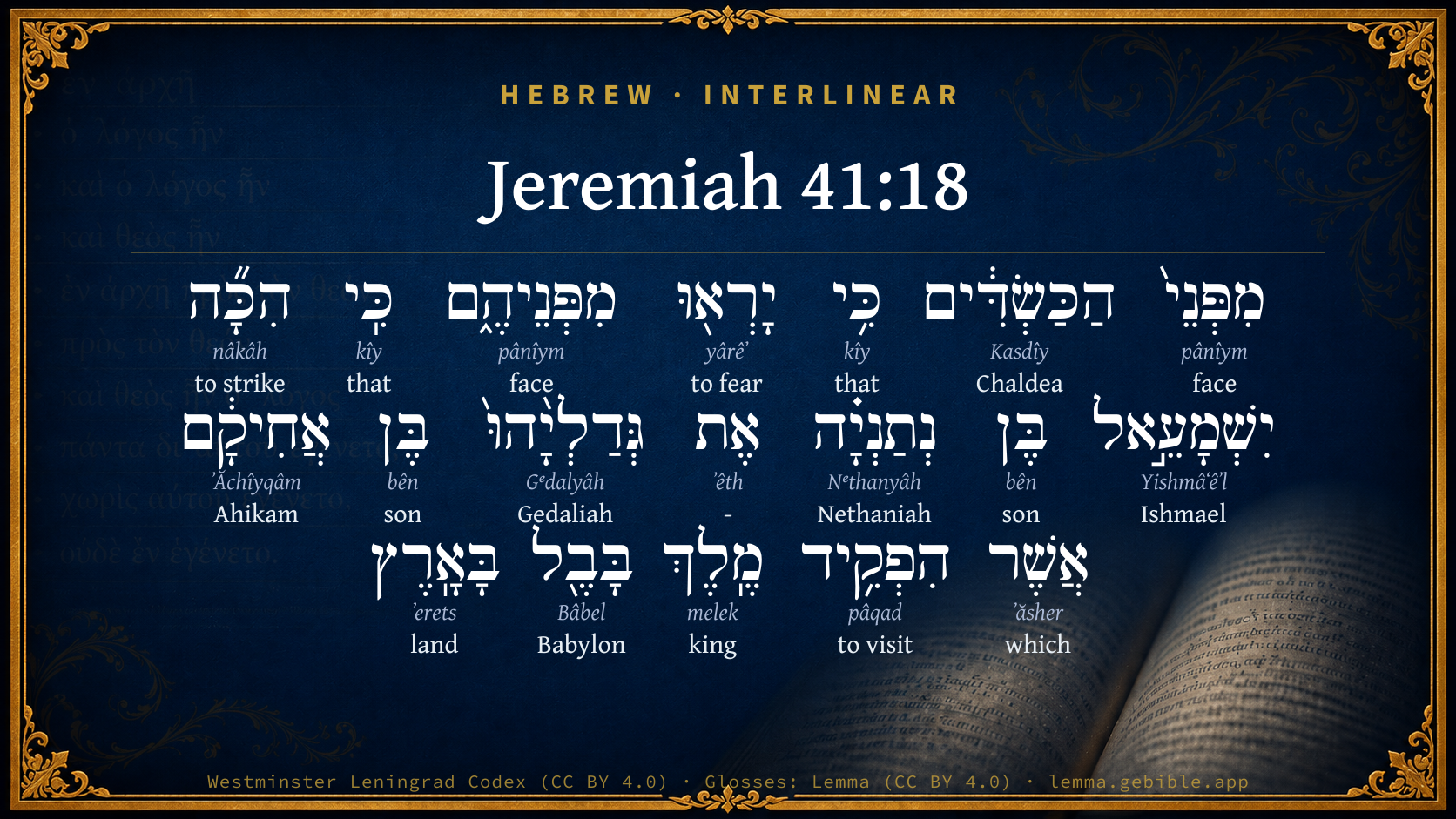
Jeremiah 41:18

Hebrew (Westminster Leningrad Codex) Jeremiah 41:18 appears in the Hebrew Old Testament. The text above is from the Westminster Leningrad Codex. Each word links to its Strong’s number, a concise gloss, and parsing drawn from the Open Scriptures Hebrew Bible morphology. Click any word for its full Brown-Driver-Briggs (BDB) entry.
Download image
Cite this verse

Jeremiah 41:18 (World English Bible). Public Domain. Lemma interlinear Bible study tool, https://lemma.gebible.app/v/jeremiah/41/18.

Show BibTeX & RIS
BibTeX
RIS
English Translation
because of the Chaldeans; for they were afraid of them, because Ishmael the son of Nethaniah had killed Gedaliah the son of Ahikam, whom the king of Babylon made governor over the land.
World English Bible · Public Domain
Download a study sheet

One document with this verse’s original text, its word-by-word gloss line, the meaning frame, cross-references with their text, attributed commentary, and full source and license credits — printable, and it pastes into notes with its structure intact.

This verse Autodidact and up

Study sheet (.html) Plain text (.txt)

A passage Seminary Student

Up to 50 verses in one chapter. A passage sheet keeps up to 6 commentary sources and 12 cross-references per verse, in the order this page ranks them, and says so on the sheet whenever that leaves anything out. Ask for a single verse and you get the Autodidact verse sheet above.

Everything on this page stays free to read, with no account — the sheet is a download of what is already on screen, not access to it.

Want to remove ads? Support Godless Engineer
Compare translations 3

The same verse in 3 English versions, stacked beneath the original-language interlinear above. Click any original word for its lexicon entry.

Each is an independent rendering of the whole verse — the interlinear is not word-aligned to these translations.

Highlighted words mark where these versions differ — a whole-verse word diff, not a word-by-word alignment.

  • World English Bible Public Domain
    because of the Chaldeans; for they were afraid of them, because Ishmael the son of Nethaniah had killed Gedaliah the son of Ahikam, whom the king of Babylon made governor over the land.
  • King James Version Public Domain
    Because of the Chaldeans: for they were afraid of them, because Ishmael the son of Nethaniah had slain Gedaliah the son of Ahikam, whom the king of Babylon made governor in the land.
  • unfoldingWord Literal Text CC BY-SA 4.0
    because of the Chaldeans. They were afraid of them since Ishmael son of Nethaniah had killed Gedaliah son of Ahikam, whom the king of Babylon had put in charge of the land.

unfoldingWord Literal Text — © unfoldingWord, licensed CC BY-SA 4.0. Word-aligned USFM3 via Door43 (git.door43.org/unfoldingWord/en_ult).

Versions to compare (up to 4)

3 of 4 selected

Show all 18 translations

Every available English version of this verse, each an independent rendering of the whole verse.

  • World English Bible Public Domain
    because of the Chaldeans; for they were afraid of them, because Ishmael the son of Nethaniah had killed Gedaliah the son of Ahikam, whom the king of Babylon made governor over the land.
  • Berean Standard Bible Public Domain
    to escape the Chaldeans. For they were afraid of the Chaldeans because Ishmael son of Nethaniah had struck down Gedaliah son of Ahikam, whom the king of Babylon had appointed over the land.
  • Majority Standard Bible Public Domain
    to escape the Chaldeans. For they were afraid of the Chaldeans because Ishmael son of Nethaniah had struck down Gedaliah son of Ahikam, whom the king of Babylon had appointed over the land.
  • King James Version Public Domain
    Because of the Chaldeans: for they were afraid of them, because Ishmael the son of Nethaniah had slain Gedaliah the son of Ahikam, whom the king of Babylon made governor in the land.
  • American Standard Version (1901) Public Domain
    because of the Chaldeans; for they were afraid of them, because Ishmael the son of Nethaniah had slain Gedaliah the son of Ahikam, whom the king of Babylon made governor over the land.
  • Revised Version (1885) Public Domain
    because of the Chaldeans: for they were afraid of them, because Ishmael the son of Nethaniah had slain Gedaliah the son of Ahikam, whom the king of Babylon made governor over the land.
  • Geneva Bible (1599) Public Domain
    Because of the Caldeans: for they feared them, because Ishmael ye sonne of Nethaniah had slaine Gedaliah the sonne of Ahikam, whom the King of Babel made gouernour in the land.
  • Douay-Rheims (1899) Public Domain
    From the face of the Chaldeans: for they were afraid of them, because Ismahel the son of Nathanias had slain Godolias the son of Ahicam, whom the king of Babylon had made governor in the land of Juda.
  • Young's Literal Translation Public Domain
    from the presence of the Chaldeans, for they have been afraid of them, for Ishmael son of Nethaniah had smitten Gedaliah son of Ahikam, whom the king of Babylon had appointed over the land.
  • Literal Standard Version CC BY-SA 4.0
    from the presence of the Chaldeans, for they have been afraid of them, for Ishmael son of Nethaniah had struck Gedaliah son of Ahikam, whom the king of Babylon had appointed over the land.
  • Unlocked Literal Bible CC BY-SA 4.0
    because of the Chaldeans. They were afraid of them since Ishmael son of Nethaniah had killed Gedaliah son of Ahikam, whom the king of Babylon had put in charge of the land.
  • unfoldingWord Literal Text CC BY-SA 4.0
    because of the Chaldeans. They were afraid of them since Ishmael son of Nethaniah had killed Gedaliah son of Ahikam, whom the king of Babylon had put in charge of the land.
  • Darby Bible Public Domain
    because of the Chaldeans; for they feared them, because Ishmael the son of Nethaniah had smitten Gedaliah the son of Ahikam, whom the king of Babylon had appointed over the land.
  • World Messianic Bible Public Domain
    because of the Kasdim; for they were afraid of them, because Ishmael the son of Nethaniah had killed Gedaliah the son of Ahikam, whom the king of Babylon made governor over the land.
  • Webster's Bible Public Domain
    Because of the Chaldeans: for they were afraid of them, because Ishmael the son of Nethaniah had slain Gedaliah the son of Ahikam, whom the king of Babylon made governor in the land.
  • Free Bible Version CC BY-SA 4.0
    to get away from the Babylonians. They were afraid of what the Babylonians would do because Ishmael had assassinated Gedaliah, the governor of the country appointed by the king of Babylon.
  • Bible in Basic English Public Domain
    Because of the Chaldaeans: for they were in fear of them because Ishmael, the son of Nethaniah, had put to death Gedaliah, the son of Ahikam, whom the king of Babylon had made ruler over the land.
  • JPS Tanakh (1917) Public Domain
    because of the Chaldeans; for they were afraid of them, because Ishmael the son of Nethaniah had slain Gedaliah the son of Ahikam, whom the king of Babylon made governor over the land.

Literal Standard Version (2020), Covenant Press — licensed CC BY-SA 4.0. Text via the HelloAO Bible API (eBible.org). Unlocked Literal Bible (unfoldingWord) — licensed CC BY-SA 4.0. Text via the HelloAO Bible API (eBible.org). unfoldingWord Literal Text — © unfoldingWord, licensed CC BY-SA 4.0. Word-aligned USFM3 via Door43 (git.door43.org/unfoldingWord/en_ult). Free Bible Version, Dr. Jonathan Gallagher — licensed CC BY-SA 4.0. Text via the HelloAO Bible API (eBible.org).

Word by word

More ways to search: Search by grammar → Find every occurrence → Compare this word →

Practice this passage: Drill this verse → Learn its vocabulary →

נְתַנְיָ֗ה
Nᵉthanyâh
H5418
“Nethaniah”
Noun, Proper
Part of Speech
Noun
Type
Proper
Full BDB Definition

Origin: from H5414 and H3050

TWOT: None

Nethaniah = "given of Jehovah" - son of Elishama of the royal family of Judah and father of Ishmael who murdered Gedaliah - father of Jehudi - a Levite, one of the 4 sons of Asaph the minstrel - a Levite in the reign of king Jehoshaphat of Judah
  1. מִפְּנֵי֙ pânîym H6440 “from · face(s) of” Preposition + Noun, Common, Both, Plural, Construct
  2. הַכַּשְׂדִּ֔ים Kasdîy H3778 “the · Chaldea” Particle, Definite Article + Noun, Proper
  3. כִּ֥י kîy H3588 “that” Conjunction
  4. יָרְא֖וּ yârêʼ H3372 “to fear” Verb, Qal, Perfect, 3rd Person, Common, Plural
  5. מִפְּנֵיהֶ֑ם pânîym H6440 “from · face(s) · their” Preposition + Noun, Common, Both, Plural, Construct + Suffix, Personal, 3rd Person, Masculine, Plural
  6. כִּֽי kîy H3588 “that” Conjunction
  7. הִכָּ֞ה nâkâh H5221 “to strike” Verb, Hiphil, Perfect, 3rd Person, Masculine, Singular
  8. יִשְׁמָעֵ֣אל Yishmâʻêʼl H3458 “Ishmael” Noun, Proper
  9. בֶּן bên H1121 “son of” Noun, Common, Masculine, Singular, Construct
  10. אֶת ʼêth H853 “-” Particle, Direct Object
  11. גְּדַלְיָ֨הוּ֙ Gᵉdalyâh H1436 “Gedaliah” Noun, Proper
  12. בֶּן bên H1121 “son of” Noun, Common, Masculine, Singular, Construct
  13. אֲחִיקָ֔ם ʼĂchîyqâm H296 “Ahikam” Noun, Proper
  14. אֲשֶׁר ʼăsher H834 “which” Particle, Relative
  15. הִפְקִ֥יד pâqad H6485 “to visit” Verb, Hiphil, Perfect, 3rd Person, Masculine, Singular
  16. מֶֽלֶךְ melek H4428 “king of” Noun, Common, Masculine, Singular, Construct
  17. בָּבֶ֖ל Bâbel H894 “Babylon” Noun, Proper
  18. בָּאָֽרֶץ ʼerets H776 “in/at the · land” Preposition, Determined + Noun, Common, Both, Singular, Absolute

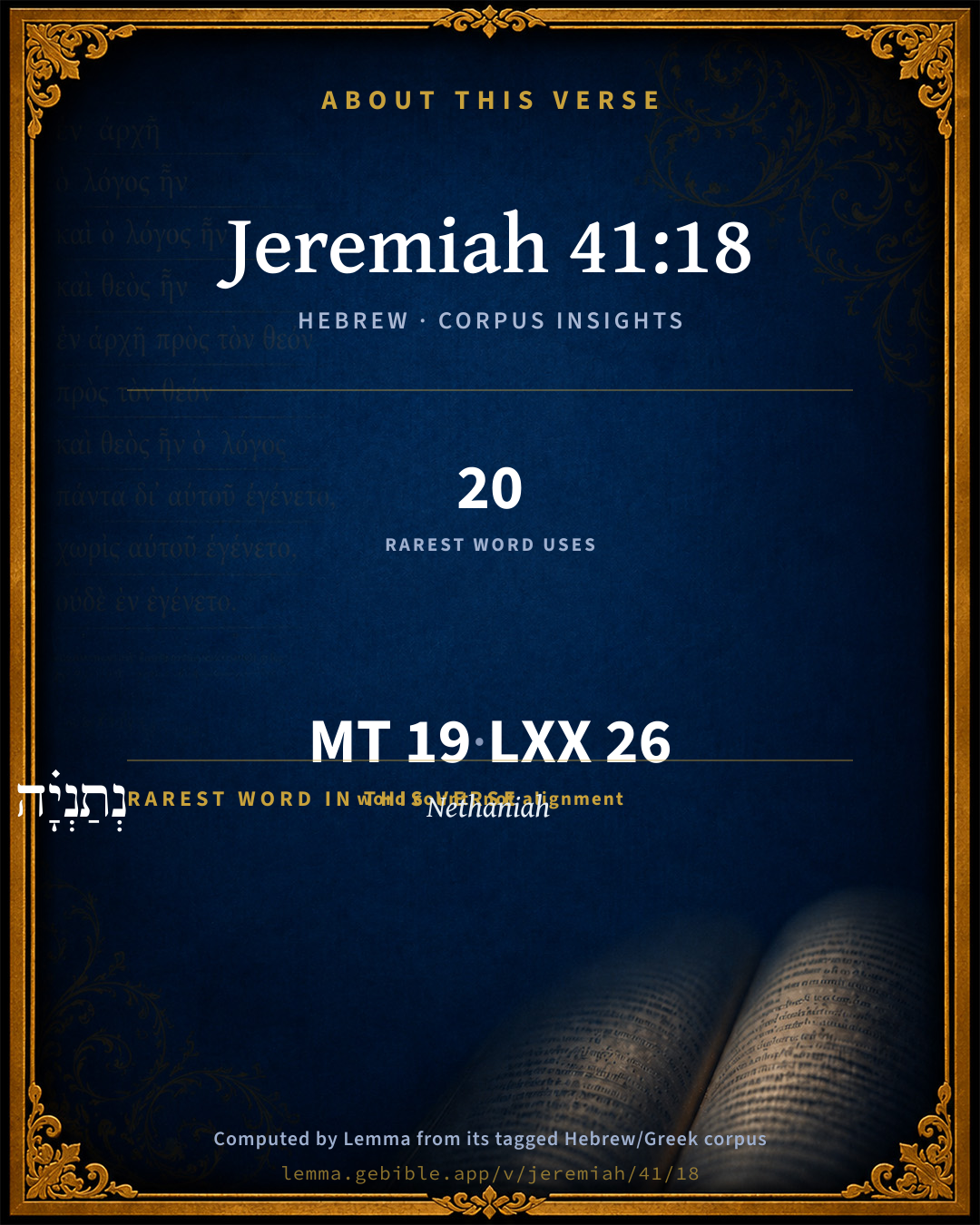
About this verse

These counts appear in no published source. They are computed here, from the morphology-tagged text and Lemma’s own curated glosses. What Lemma adds →

19
words
16
distinct lemmas
Prophets
section

Notable vocabulary

The rarest word here is נְתַנְיָ֗ה Nethaniah H5418 — appearing just 20 times in the whole Hebrew Bible.

Shared distinctive vocabulary

נְתַנְיָ֗ה Nethaniah H5418 occurs in 20 verses of the Hebrew Bible. Also found in:

Grammatical profile

  • 3 verbs
  • 12 nouns
  • 2 conjunctions
  • 2 particles

Verb forms

  • יָרְא֖וּ Qal · Perfect
  • הִכָּ֞ה Hiphil · Perfect
  • הִפְקִ֥יד Hiphil · Perfect

Repetition

Words recur within this verse — often emphatic in Hebrew:

  • מִפְּנֵי֙ face H6440 ×2
  • בֶּן son H1121 ×2
  • כִּ֥י that H3588 ×2

Hebrew & Septuagint length

In the original languages it is 19 Hebrew tokens and 26 Greek tokens — but the two are counted differently (Hebrew bundles its prefixes and suffixes into one token; the Greek is in lemma form), so that isn’t a like-for-like length.

Cross-references

9

Topical passages linked to Jeremiah 41:18 in the Treasury of Scripture Knowledge — connected by theme and wording, ordered by reader-vote popularity; previews shown in the World English Bible.

  • Jeremiah 40:5 Now while he was not yet gone back, Go back then, [said he], to Gedaliah the son of Ahikam, the son of Shaphan, whom the king of Babylon has made governor over the cities of Judah, and dwell with him among the people; or go wherever it seems right to you to go. So the captain of the guard gave him food and a present, and let him go.
  • Jeremiah 42:16 then it shall happen, that the sword, which you fear, shall overtake you there in the land of Egypt; and the famine, about which you are afraid, shall follow hard after you there in Egypt; and there you shall die.
  • Luke 12:4–5 "I tell you, my friends, don't be afraid of those who kill the body, and after that have no more that they can do.
  • Isaiah 51:12–13 I, even I, am he who comforts you: who are you, that you are afraid of man who shall die, and of the son of man who shall be made as grass;
  • Isaiah 57:11 Of whom have you been afraid and in fear, that you lie, and have not remembered me, nor laid it to your heart? Haven't I held my peace even of long time, and you don't fear me?
  • Jeremiah 42:11 Don't be afraid of the king of Babylon, of whom you are afraid; don't be afraid of him, says Yahweh: for I am with you to save you, and to deliver you from his hand.
  • Jeremiah 43:2–3 then spoke Azariah the son of Hoshaiah, and Johanan the son of Kareah, and all the proud men, saying to Jeremiah, You speak falsely: Yahweh our God has not sent you to say, You shall not go into Egypt to sojourn there;
  • 2 Kings 25:25 But it happened in the seventh month, that Ishmael the son of Nethaniah, the son of Elishama, of the royal seed came, and ten men with him, and struck Gedaliah, so that he died, and the Jews and the Chaldeans that were with him at Mizpah.
  • Isaiah 30:16–17 but you said, No, for we will flee on horses; therefore shall you flee: and, We will ride on the swift; therefore shall those who pursue you be swift.

Cross-references courtesy of OpenBible.info (CC BY 4.0).

Hebrew and Greek witnesses Masoretic Hebrew ↔ Greek Septuagint

The same verse in the two great witnesses to the Old Testament, shown verse-for-verse.

These are two independent witnesses, not word-aligned to each other, and the Septuagint is shown in lemma (dictionary) form.

Hebrew Jeremiah 41:18 Masoretic · Westminster Leningrad Codex

מִפְּנֵי֙ הַכַּשְׂדִּ֔ים כִּ֥י יָרְא֖וּ מִפְּנֵיהֶ֑ם כִּֽי הִכָּ֞ה יִשְׁמָעֵ֣אל בֶּן נְתַנְיָ֗ה אֶת גְּדַלְיָ֨הוּ֙ בֶּן אֲחִיקָ֔ם אֲשֶׁר הִפְקִ֥יד מֶֽלֶךְ בָּבֶ֖ל בָּאָֽרֶץ

because of the Chaldeans; for they were afraid of them, because Ishmael the son of Nethaniah had killed Gedaliah the son of Ahikam, whom the king of Babylon made governor over the land.

World English Bible · Public Domain

Greek LXX Structure differs

In the Septuagint, Jeremiah is about an eighth shorter than the Hebrew and arranges its material differently — the Oracles Against the Nations (Hebrew chapters 46–51) appear in the middle of the Greek book, after 25:13. Because the chapter and verse boundaries do not line up, a verse-for-verse comparison with the Hebrew is not shown.

A verse-for-verse comparison isn’t shown here because the chapters and verses don’t line up. Switch to the LXX edition with the MT / LXX toggle above to read the Greek directly.

Hebrew: Westminster Leningrad Codex (CC BY 4.0). Greek: Septuagint (public domain); English from a public-domain English Septuagint. How the Septuagint differs from the Hebrew →

Targum (Aramaic paraphrase)

1

The Targum is the ancient Jewish Aramaic paraphrase of the Hebrew Scriptures — an interpretive translation, not the Hebrew text itself. Onkelos (literal) and Pseudo-Jonathan (expansive) render the Torah, and Jonathan the Prophets. Coverage is partial: where no permissively-licensed English translation exists for a verse, only the Aramaic is shown. This is verse-level text, not a word-by-word alignment to the Hebrew.

  1. Targum Jonathan Prophets (Joshua–Malachi)
    מִן קֳדָם כַּסְדָאֵי אֲרֵי דְחִילוּ מִן קֳדָמֵיהוֹן אֲרֵי קְטַל יִשְׁמָעֵאל בַּר נְתַנְיָה יַת גְדַלְיָה בַּר אֲחִיקַם דְמַנֵי מַלְכָּא דְבָבֶל בְּאַרְעָא:

    (no public-domain English translation for this verse)

    Targum Jonathan — Aramaic: “Mikraot Gedolot” (public domain). English: “Sefaria Community Translation” (CC0 1.0 (public-domain dedication)); “London "Chaldee Paraphrase," 1871” (public domain). Text via Sefaria.

Commentary

Notes on Jeremiah 41:18 from classic Christian and Jewish commentators (each source and its license shown beneath its notes). The classic Christian expositions comment on the surrounding passage and are grouped to its opening verse, so a note may address several verses; the Jewish commentaries on the Tanakh (Rashi and others) are per-verse, so they appear only where the commentator wrote on this verse.

Lemma curates 59 commentaries, every one of them public domain or Creative Commons licensed, each selected and text-cleaned for this edition rather than reprinted as found. About our sources →

Trapp's Complete Commentary

John Trapp

Jer 41:18 Because of the Chaldeans: for they were afraid of them, because Ishmael the son of Nethaniah had slain Gedaliah the son of Ahikam, whom the king of Babylon made governor in the land.

Ver. 18. Because of the Chaldeans, for they were afraid of them.] But they should rather have "sanctified the Lord God in their hearts, and made him their dread." {Isa 8:13} "The fear of man bringeth a snare: but whoso putteth his trust in the Lord shall be safe." {Pro 29:25} {See Trapp on "Pro 29:25"}

Because Ishmael the son of Nethaniah had slain Gedaliah.] And together with him many Chaldeans, whom Johanan and his captains should have cautioned and better guarded; as the king of Babylon would better tell them, they thought, and with it to punish them for their neglect. {a}

{a} Ob incastodiam.

John Trapp, A Commentary or Exposition upon All the Books of the Old and New Testament (1647–1656) — public domain. Text from a community e-Sword module.

Jamieson, Fausset & Brown

Robert Jamieson, A. R. Fausset & David Brown

afraid--lest the Chaldeans should suspect all the Jews of being implicated in Ishmael's treason, as though the Jews sought to have a prince of the house of David (Jer 41:1). Their better way towards gaining God's favor would have been to have laid the blame on the real culprit, and to have cleared themselves. A tortuous policy is the parent of fear. Righteousness inspires with boldness (Psa 53:5; Pro 28:1).

Next: Jeremiah Chapter 42

Jamieson, Fausset & Brown — Commentary Critical and Explanatory on the Whole Bible (1871) — public domain (CC PDM 1.0). Text via the HelloAO Bible API.

John Calvin's Commentaries

He then says, that they were there for a time, but that they looked forward to Egypt, on account, he says, of the Chaldeans, because they feared them, and for this reason, because Ishmael had killed Gedaliah, whom Nebuchadnezzar had set over the land This fear was not without reason; but they might have sent persons to the king of Babylon, and have thrown the blame on the right person, and cleared themselves; and the matter might have been settled. They might then have easily obtained pardon from King Nebuchadnezzar; but as no fear of God prevailed in them, they did not consider what was lawful, and were by a blind impulse led into Egypt. Thus fear was no alleviation to their crime, for there was another remedy at hand, which God would have blessed. But when they disregarded God’s word, and followed what their own feelings dictated to them, they contrived in a very bad way for themselves. But far worse is what follows.

John Calvin's Commentaries (1540-1563) — public domain. Text from the Calvin Translation Society English edition (1840s-50s) via the Christian Classics Ethereal Library (ccel.org). Calvin's coverage is partial (roughly two-thirds of the Bible); uncommented books and verses are honest gaps, never fabricated. The 19th-century editor's footnotes and remarks are omitted so the notes are faithfully Calvin's own voice.

John Gill's Exposition

Because of the Chaldeans,.... Which clause some think should have been joined to Jer 41:17. This is a reason given why they departed from Mizpah, and dwelt at the habitation of Chimham in the way to Egypt; and which is explained in the next words:

for they were afraid of them; at least this they pretended, that the Chaldeans would come upon them, and cut them off, and revenge themselves on them:

because Ishmael the son of Nethaniah had slain Gedaliah the son of Ahikam, whom the king of Babylon made governor in the land; no doubt it was provoking to them to hear that the viceroy or deputy governor of the king of Babylon was slain in this manner; and still more so, as there were many Chaldeans slain with him; but there was no reason to believe that the king of Babylon would carry his resentment against the Jews with Johanan, or take vengeance on them, who had so bravely appeared against the murderers, and had rescued the captives out of their hands: this seems only a pretence for their going into Egypt; for though they were promised safety in Judah by the Prophet Jeremiah, yet they were still for going into Egypt, as the following chapters show.

Next: Jeremiah Chapter 42

John Gill's Exposition of the Whole Bible (1746–1763) — public domain (CC PDM 1.0). Text via the HelloAO Bible API.

Matthew Poole's English Annotations

Here was one slain whom the conqueror Nebuchadnezzar had made governor in the land of Judah, and it was but reasonable for them to think that Nebuchadnezzar would take the affront done to himself, he being constituted governor by him; and though Johanan had nothing to do in that murder, yet he did not know but that the king of Babylon, being ignorant of any parties amongst the Jews, might look upon them, all as guilty who were Jews, and revenge Gedaliah’s blood upon all the remainder of that nation; he therefore chooseth them a habitation for the present, from whence they might in a short time go down into Egypt, which was Johanan’s design, as we shall read in, the next chapter.

Matthew Poole's English Annotations on the Holy Bible (1683–1685) — public domain. Text from a community e-Sword/MySword module.

The Pulpit Commentary

Because of the Chaldeans. They were afraid of being held responsible for the crime of Ishmael. And they had good reason for their alarm, as the Chaldeans would naturally look upon Ishmael as the representative of the Davidic dynasty, and the heir of that dynasty"s claims to the loyalty of the Jews.

The Pulpit Commentary (1880–1919), ed. H.D.M. Spence-Jones & Joseph S. Exell — public domain. Text from a community e-Sword module.

Lesson kit

Teaching starters — assembled from the data on this page, not authored interpretation. Every prompt links to the verse data it draws on. Edit before teaching.

Jeremiah, in the Prophets, opens this verse with 19 words (16 distinct Hebrew lemmas). Its most distinctive word is Nᵉthanyâh (“Nethaniah”). A historical commentator’s framing appears above. Read the whole chapter for the surrounding context.

Discussion questions

  1. What does “Nethaniah” (Nᵉthanyâh) contribute to the verse as a whole?
  2. How does 2 Kings 25:23, which shares the word «Nethaniah», read alongside this verse?
  3. What does the repetition of “face” (2× in this one verse) do in this verse?
  4. These translations render this verse differently. What is at stake in choosing one wording over another?
  5. «יָרְא֖וּ» is a Qal Perfect verb. How does that grammatical form shape the action described?
  6. Compare how Trapp's Complete Commentary and Jamieson, Fausset & Brown read this verse. Where do they agree or differ?

Things to notice

Reading settings

Reading text

Shown beneath each verse's original-language words.

Old Testament
Old Testament edition

Read the OT as the Masoretic Hebrew (MT) or the Greek Septuagint (LXX).

English shown for the Greek Septuagint (in the Hebrew ↔ Greek comparison).

Comparing translations? Open the Compare panel on any verse page to stack up to four side by side.