
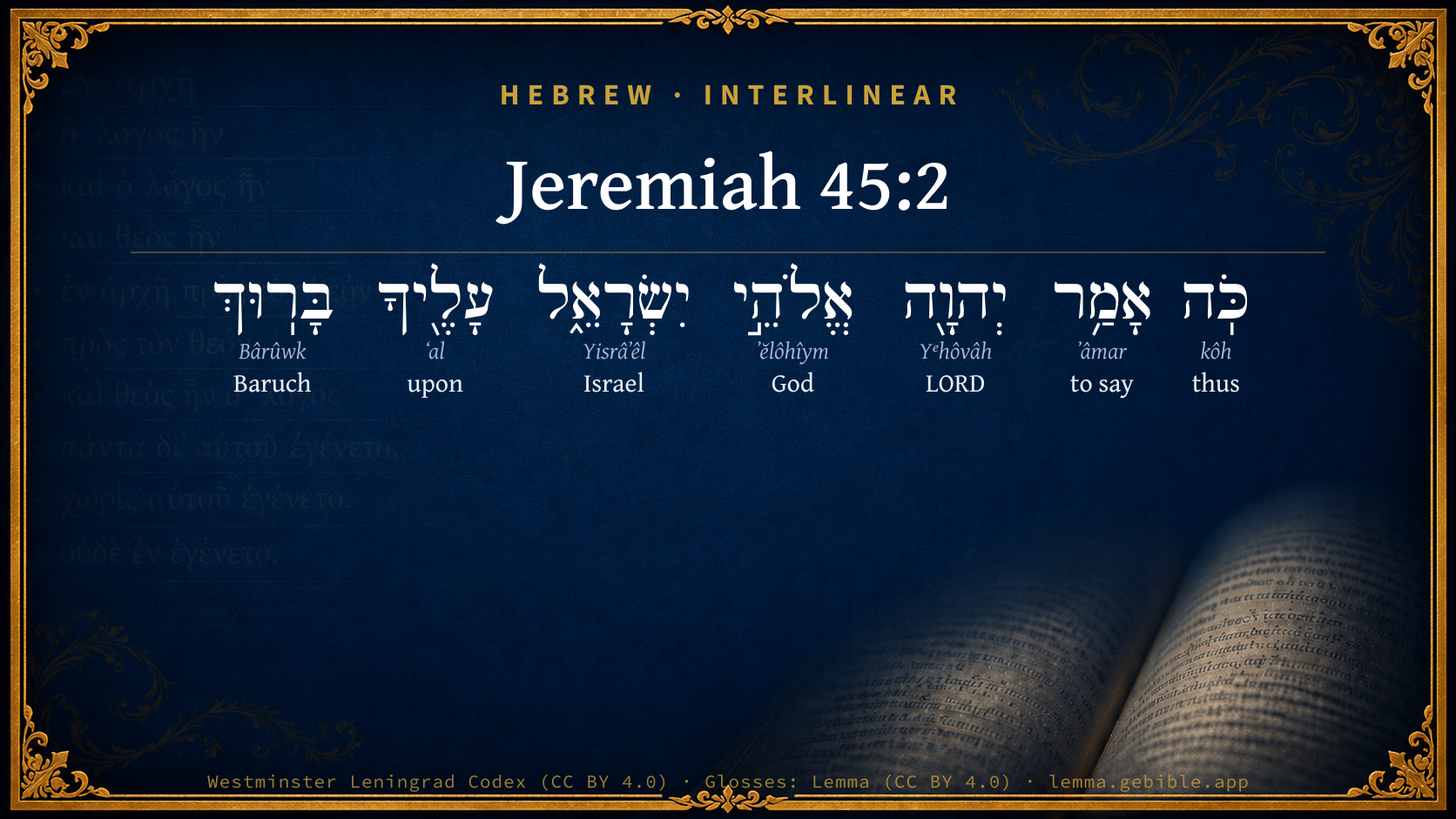
Jeremiah 45:2

Hebrew (Westminster Leningrad Codex) Jeremiah 45:2 appears in the Hebrew Old Testament. The text above is from the Westminster Leningrad Codex. Each word links to its Strong’s number, a concise gloss, and parsing drawn from the Open Scriptures Hebrew Bible morphology. Click any word for its full Brown-Driver-Briggs (BDB) entry.
Download image
Cite this verse

Jeremiah 45:2 (World English Bible). Public Domain. Lemma interlinear Bible study tool, https://lemma.gebible.app/v/jeremiah/45/2.

Show BibTeX & RIS
BibTeX
RIS
English Translation
Thus says Yahweh, the God of Israel, to you, Baruch:
World English Bible · Public Domain
Download a study sheet

One document with this verse’s original text, its word-by-word gloss line, the meaning frame, cross-references with their text, attributed commentary, and full source and license credits — printable, and it pastes into notes with its structure intact.

This verse Autodidact and up

Study sheet (.html) Plain text (.txt)

A passage Seminary Student

Up to 50 verses in one chapter. A passage sheet keeps up to 6 commentary sources and 12 cross-references per verse, in the order this page ranks them, and says so on the sheet whenever that leaves anything out. Ask for a single verse and you get the Autodidact verse sheet above.

Everything on this page stays free to read, with no account — the sheet is a download of what is already on screen, not access to it.

Want to remove ads? Support Godless Engineer
Compare translations 3

The same verse in 3 English versions, stacked beneath the original-language interlinear above. Click any original word for its lexicon entry.

Each is an independent rendering of the whole verse — the interlinear is not word-aligned to these translations.

Highlighted words mark where these versions differ — a whole-verse word diff, not a word-by-word alignment.

  • World English Bible Public Domain
    Thus says Yahweh, the God of Israel, to you, Baruch:
  • King James Version Public Domain
    Thus saith the LORD, the God of Israel, unto thee, O Baruch:
  • unfoldingWord Literal Text CC BY-SA 4.0
    “Yahweh, God of Israel, says this to you, Baruch:

unfoldingWord Literal Text — © unfoldingWord, licensed CC BY-SA 4.0. Word-aligned USFM3 via Door43 (git.door43.org/unfoldingWord/en_ult).

Versions to compare (up to 4)

3 of 4 selected

Show all 18 translations

Every available English version of this verse, each an independent rendering of the whole verse.

  • World English Bible Public Domain
    Thus says Yahweh, the God of Israel, to you, Baruch:
  • Berean Standard Bible Public Domain
    “This is what the LORD, the God of Israel, says to you, Baruch:
  • Majority Standard Bible Public Domain
    “This is what the LORD, the God of Israel, says to you, Baruch:
  • King James Version Public Domain
    Thus saith the LORD, the God of Israel, unto thee, O Baruch:
  • American Standard Version (1901) Public Domain
    Thus saith Jehovah, the God of Israel, unto thee, O Baruch:
  • Revised Version (1885) Public Domain
    Thus saith the LORD, the God of Israel, unto thee, O Baruch:
  • Geneva Bible (1599) Public Domain
    Thus sayeth the Lord God of Israel vnto thee, O Baruch,
  • Douay-Rheims (1899) Public Domain
    Thus saith the Lord the God of Israel to thee, Baruch:
  • Young's Literal Translation Public Domain
    `Thus said Jehovah, God of Israel, concerning thee, O Baruch:
  • Literal Standard Version CC BY-SA 4.0
    “Thus said YHWH, God of Israel, concerning you, O Baruch:
  • Unlocked Literal Bible CC BY-SA 4.0
    “Yahweh, God of Israel, says this to you, Baruch:
  • unfoldingWord Literal Text CC BY-SA 4.0
    “Yahweh, God of Israel, says this to you, Baruch:
  • Darby Bible Public Domain
    Thus sayeth Jehovah, the God of Israel, concerning thee, Baruch:
  • World Messianic Bible Public Domain
    “The LORD, the God of Israel, says to you, Baruch:
  • Webster's Bible Public Domain
    Thus saith the LORD, the God of Israel, to thee, O Baruch;
  • Free Bible Version CC BY-SA 4.0
    This is what the Lord, the God of Israel, says to you, Baruch:
  • Bible in Basic English Public Domain
    This is what the Lord, the God of Israel, has said of you, O Baruch:
  • JPS Tanakh (1917) Public Domain
    'Thus saith the LORD, the God of Israel, concerning thee, O Baruch: Thou didst say:

Literal Standard Version (2020), Covenant Press — licensed CC BY-SA 4.0. Text via the HelloAO Bible API (eBible.org). Unlocked Literal Bible (unfoldingWord) — licensed CC BY-SA 4.0. Text via the HelloAO Bible API (eBible.org). unfoldingWord Literal Text — © unfoldingWord, licensed CC BY-SA 4.0. Word-aligned USFM3 via Door43 (git.door43.org/unfoldingWord/en_ult). Free Bible Version, Dr. Jonathan Gallagher — licensed CC BY-SA 4.0. Text via the HelloAO Bible API (eBible.org).

Word by word

More ways to search: Search by grammar → Find every occurrence → Compare this word →

Practice this passage: Drill this verse → Learn its vocabulary →

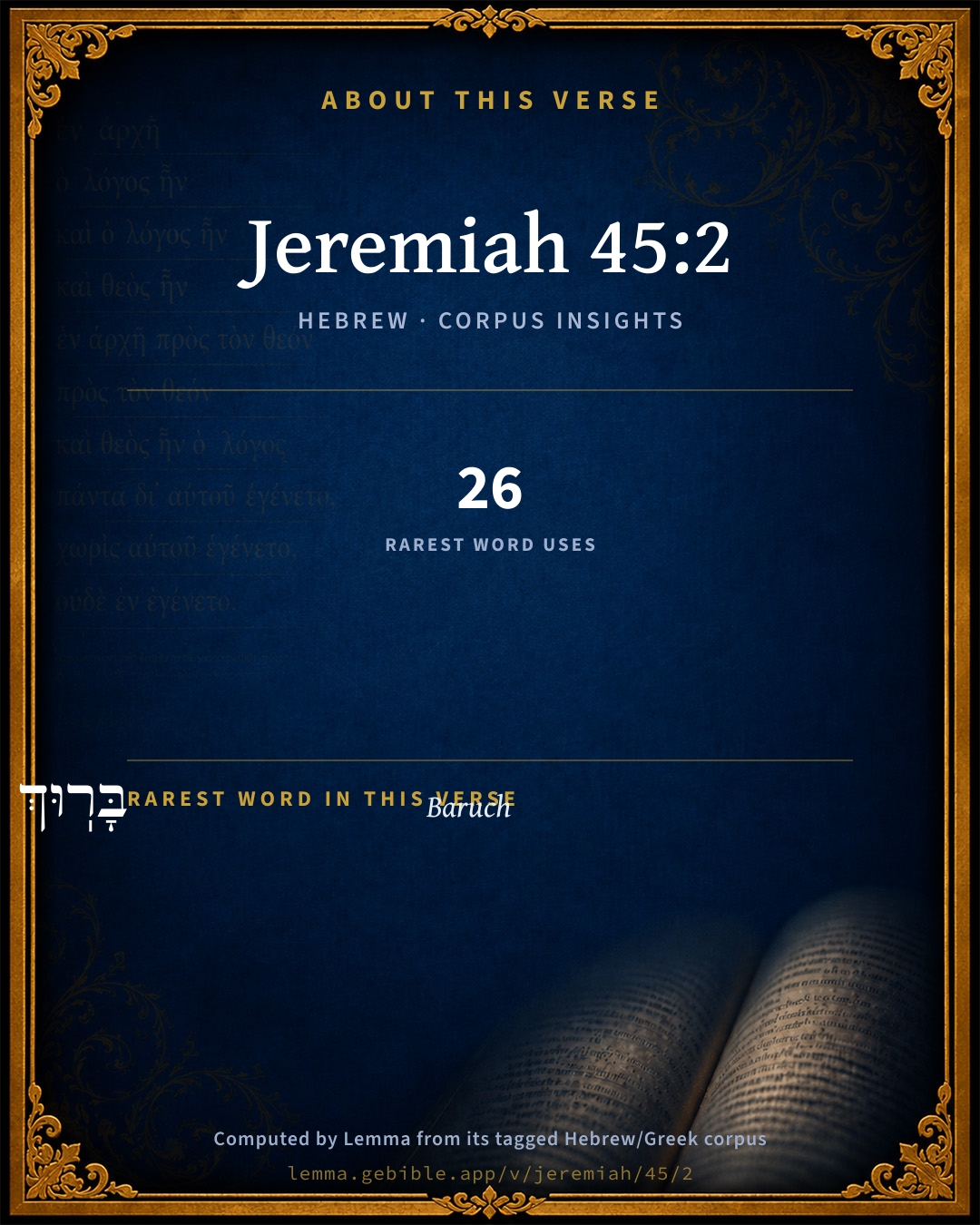
About this verse

These counts appear in no published source. They are computed here, from the morphology-tagged text and Lemma’s own curated glosses. What Lemma adds →

7
words
7
distinct lemmas
Prophets
section

Shared distinctive vocabulary

בָּרֽוּךְ Baruch H1263 occurs in 24 verses of the Hebrew Bible. Also found in:

Grammatical profile

  • 1 verb
  • 4 nouns
  • 1 preposition
  • 1 adverb

Verb forms

  • אָמַ֥ר Qal · Perfect

Cross-references

6

Topical passages linked to Jeremiah 45:2 in the Treasury of Scripture Knowledge — connected by theme and wording, ordered by reader-vote popularity; previews shown in the World English Bible.

  • Isaiah 63:9 In all their affliction he was afflicted, and the angel of his presence saved them: in his love and in his pity he redeemed them; and he bore them, and carried them all the days of old.
  • Mark 16:7 But go, tell his disciples and Peter, 'He goes before you into Galilee. There you will see him, as he said to you.'"
  • 2 Corinthians 1:4 who comforts us in all our affliction, that we may be able to comfort those who are in any affliction, through the comfort with which we ourselves are comforted by God.
  • 2 Corinthians 7:6 Nevertheless, he who comforts the lowly, God, comforted us by the coming of Titus;
  • Hebrews 2:18 For in that he himself has suffered being tempted, he is able to help those who are tempted.
  • Hebrews 4:15 For we don't have a high priest who can't be touched with the feeling of our infirmities, but one who has been in all points tempted like we are, yet without sin.

Cross-references courtesy of OpenBible.info (CC BY 4.0).

Hebrew and Greek witnesses Masoretic Hebrew ↔ Greek Septuagint

The same verse in the two great witnesses to the Old Testament, shown verse-for-verse.

These are two independent witnesses, not word-aligned to each other, and the Septuagint is shown in lemma (dictionary) form.

Hebrew Jeremiah 45:2 Masoretic · Westminster Leningrad Codex

כֹּֽה אָמַ֥ר יְהוָ֖ה אֱלֹהֵ֣י יִשְׂרָאֵ֑ל עָלֶ֖יךָ בָּרֽוּךְ

Thus says Yahweh, the God of Israel, to you, Baruch:

World English Bible · Public Domain

Greek LXX Structure differs

In the Septuagint, Jeremiah is about an eighth shorter than the Hebrew and arranges its material differently — the Oracles Against the Nations (Hebrew chapters 46–51) appear in the middle of the Greek book, after 25:13. Because the chapter and verse boundaries do not line up, a verse-for-verse comparison with the Hebrew is not shown.

A verse-for-verse comparison isn’t shown here because the chapters and verses don’t line up. Switch to the LXX edition with the MT / LXX toggle above to read the Greek directly.

Hebrew: Westminster Leningrad Codex (CC BY 4.0). Greek: Septuagint (public domain); English from a public-domain English Septuagint. How the Septuagint differs from the Hebrew →

Targum (Aramaic paraphrase)

1

The Targum is the ancient Jewish Aramaic paraphrase of the Hebrew Scriptures — an interpretive translation, not the Hebrew text itself. Onkelos (literal) and Pseudo-Jonathan (expansive) render the Torah, and Jonathan the Prophets. Coverage is partial: where no permissively-licensed English translation exists for a verse, only the Aramaic is shown. This is verse-level text, not a word-by-word alignment to the Hebrew.

  1. Targum Jonathan Prophets (Joshua–Malachi)
    כִּדְנַן אֲמַר יְיָ אֱלָהָא דְיִשְׂרָאֵל עֲלָךְ בָּרוּךְ:

    (no public-domain English translation for this verse)

    Targum Jonathan — Aramaic: “Mikraot Gedolot” (public domain). English: “Sefaria Community Translation” (CC0 1.0 (public-domain dedication)); “London "Chaldee Paraphrase," 1871” (public domain). Text via Sefaria.

Commentary

Notes on Jeremiah 45:2 from classic Christian and Jewish commentators (each source and its license shown beneath its notes). The classic Christian expositions comment on the surrounding passage and are grouped to its opening verse, so a note may address several verses; the Jewish commentaries on the Tanakh (Rashi and others) are per-verse, so they appear only where the commentator wrote on this verse.

Lemma curates 59 commentaries, every one of them public domain or Creative Commons licensed, each selected and text-cleaned for this edition rather than reprinted as found. About our sources →

Trapp's Complete Commentary

John Trapp

Jer 45:2 Thus saith the LORD, the God of Israel, unto thee, O Baruch;

Ver. 2. Thus saith the Lord, the God of Israel, unto thee, O Baruch.] Whom he knoweth by name, and for whom he hath in store an ample recompense of reward; for never yet did any one do or suffer aught for God’s sake, that complained of a hard bargain.

John Trapp, A Commentary or Exposition upon All the Books of the Old and New Testament (1647–1656) — public domain. Text from a community e-Sword module.

The Cambridge Bible for Schools and Colleges

gen. ed. J. J. S. Perowne

2. unto] rather, as mg. concerning.

The Cambridge Bible for Schools and Colleges (gen. ed. J. J. S. Perowne; Cambridge University Press, 1878–1918) — public domain. Text from a community e-Sword module.

John Gill's Exposition

Thus saith the Lord, the God of Israel, unto thee, O Baruch. Whom he knew by name, had a great regard for, and honours with this prophecy; and, being an Israelite, both in a literal and spiritual sense, he addresses him as the God of Israel, and as being his covenant God; in whom he should put his trust, and from whom he might expect safety and protection in the worst of times; and to whose sovereign will, in all the dispensations of his providence, he ought to have humbly and patiently submitted.

Thus saith the Lord, the God of Israel, unto thee, O Baruch. Whom he knew by name, had a great regard for, and honours with this prophecy; and, being an Israelite, both in a literal and spiritual sense, he addresses him as the God of Israel, and as being his covenant God; in whom he should put his trust, and from whom he might expect safety and protection in the worst of times; and to whose sovereign will, in all the dispensations of his providence, he ought to have humbly and patiently submitted.

Jeremiah 45:3

jer 45:3

jer 45:3

jer 45:3Thou didst say, woe is me now!.... What will become of me? I am ruined and undone; this he said in his heart, if not with his lips, perhaps both ways; and when the king gave orders for the apprehending of him and the prophet, being provoked at the roll which he had wrote and read, Jer 36:26;

for the Lord hath added grief to my sorrow; caused him grief upon grief, sorrow upon sorrow, an abundance of it; for there was a variety of things which occasioned grief and sorrow; the trouble of his office, as secretary to the prophet; the reproach east upon him by the people for it; the grievous things contained in the prophecies he transcribed, concerning the ruin of his people and nation; the king's displeasure at the roll, and his burning it; to which was added the danger he was exposed unto for writing it; and especially, as he might apprehend, for writing it over again, after it was burnt; to which were annexed new threatenings, and such as personally concerned the king;

I fainted in my sighing; or "with" it; he sighed and groaned at what he saw coming upon his country, and particularly upon himself; it quite overcame his spirits; he sunk and swooned away: or "I laboured in my sighing" (n); amidst his sighs and groans, he prayed to the Lord, and laboured in prayer, that he might be delivered from the evils he feared were coming upon him:

and I find no rest; from his grief, sorrow, and sighing; no cessation of that; no serenity and composure of mind; no answer of prayer from God. The Targum is,

"and I found not prophecy.''

And the Jewish commentators, as Jarchi, Kimchi, Abarbinel, and Abendana, from the ancient Midrashes, interpret this grief of Baruch to be on account of his not having the gift of prophecy bestowed on him, which he expected by being a servant of the prophet (o); and represent him as saying, Joshua ministered to Moses, and the Holy Spirit dwelled upon him; Elisha ministered to Elijah, and the Holy Spirit rested upon him; how different am I from all the disciples of the prophets! "woe is me now!" &c.

(n) "in gemitu meo", V. L. Pagninus, Montanus, Vatanblus, "in suspirio meo", Cocceius, Schmidt. (o) Vid. Maimon. Moreh Nevochim, par. 2. c. 32. p. 286.

John Gill's Exposition of the Whole Bible (1746–1763) — public domain (CC PDM 1.0). Text via the HelloAO Bible API.

Matthew Poole's English Annotations

Jeremiah had in his former discourses revealed the will of God concerning nations, here he revealeth it as to Baruch his secretary or clerk, upon which account some compare him to Paul writing to Philemon as well as to churches.

Matthew Poole's English Annotations on the Holy Bible (1683–1685) — public domain. Text from a community e-Sword/MySword module.

Lesson kit

Teaching starters — assembled from the data on this page, not authored interpretation. Every prompt links to the verse data it draws on. Edit before teaching.

Jeremiah, in the Prophets, opens this verse with 7 words (7 distinct Hebrew lemmas). Its most distinctive word is Bârûwk (“Baruch”). A historical commentator’s framing appears above. Read the whole chapter for the surrounding context.

Discussion questions

  1. The word Bârûwk carries the sense “Baruch.” How does it shape the verse?
  2. Nehemiah 3:20 shares the word «Baruch» with this verse. How do the two illuminate each other?
  3. These translations render this verse differently. What is at stake in choosing one wording over another?
  4. The verb «אָמַ֥ר» is Qal Perfect. How does its form color the action?
  5. Reading how Trapp's Complete Commentary and The Cambridge Bible for Schools and Colleges read this verse, where do the two commentators agree and where do they part?

Things to notice

Reading settings

Reading text

Shown beneath each verse's original-language words.

Old Testament
Old Testament edition

Read the OT as the Masoretic Hebrew (MT) or the Greek Septuagint (LXX).

English shown for the Greek Septuagint (in the Hebrew ↔ Greek comparison).

Comparing translations? Open the Compare panel on any verse page to stack up to four side by side.