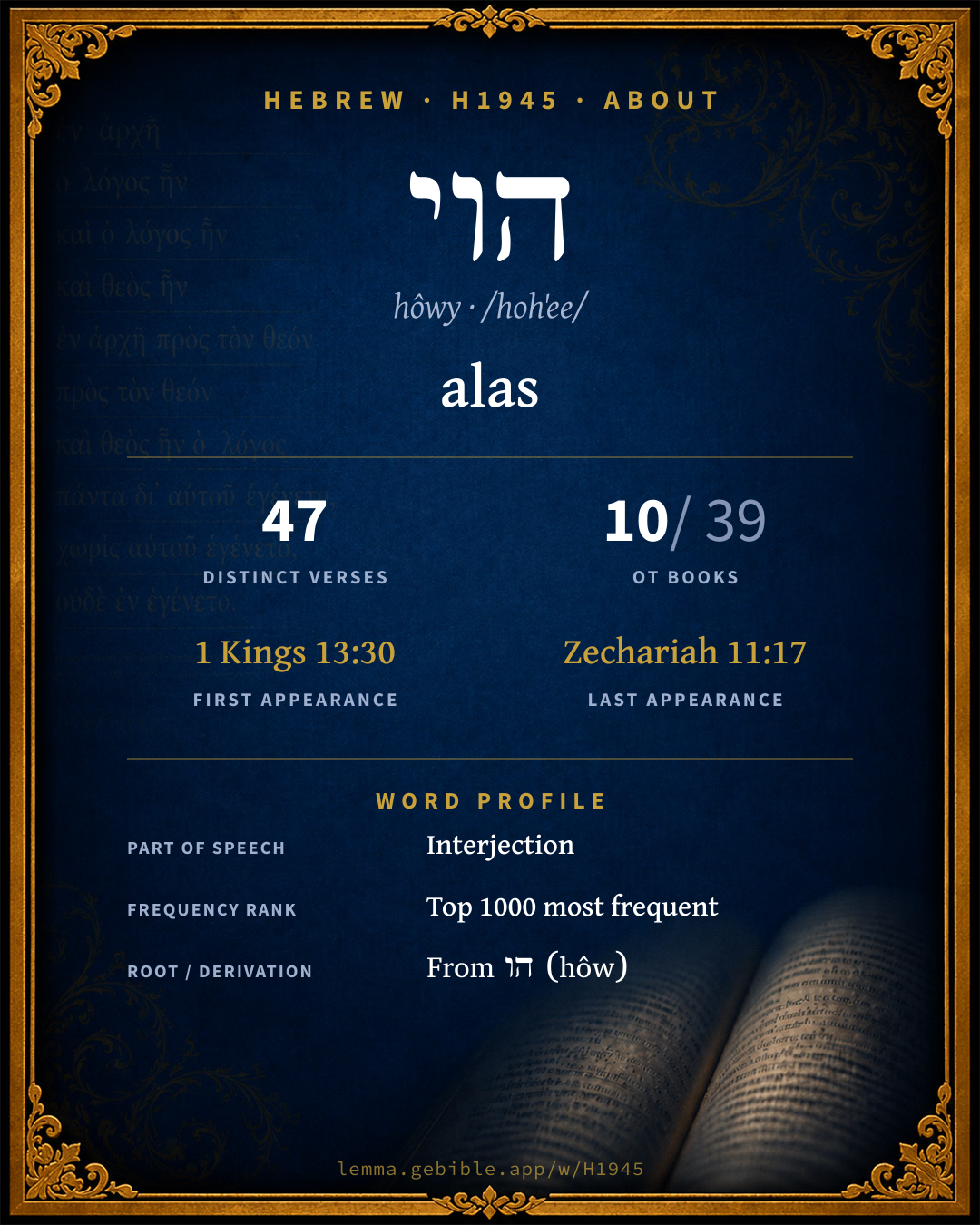
הוֹי
alas
Full lexicon entry — Brown-Driver-Briggs (BDB)
From Brown-Driver-Briggs (BDB)
Where this word appears
Grammar key — what these labels mean
Part of speech
- Particle
- A short function word — article, negation, interrogative, the sign of the direct object, and the like.
Every verse where H1945 appears — 47 distinct verses across 10 books. Click any verse to open its interlinear word-by-word view. Verse text shown in the World English Bible for context — . Each verse’s Hebrew form is shown with its reference; the English is not keyword-highlighted, since the data carries no word-level English alignment. Use “Compare translations” on any verse to read it across multiple English versions. This concordance covers the Hebrew Bible; Septuagint (Greek Old Testament) occurrences are not indexed here.
1 Kings 1 verse
Isaiah 21 verses
- Isaiah 1:4 ה֣וֹי ptcl intj Ah sinful nation, A people loaded with iniquity, A seed of evil-doers, Children who deal corruptly! They have forsaken Yahweh. They have despised the Holy One of Israel. They are estranged and backward.
- Isaiah 1:24 ה֚וֹי ptcl intj Therefore the Lord, Yahweh of Hosts, The Mighty One of Israel, says: "Ah, I will get relief from my adversaries, And avenge myself of my enemies;
- Isaiah 5:8 ה֗וֹי ptcl intj Woe to those who join house to house, Who lay field to field, until there is no room, And you are made to dwell alone in the midst of the land!
- Isaiah 5:11 ה֛וֹי ptcl intj Woe to those who rise up early in the morning, that they may follow strong drink; Who stay late into the night, until wine inflames them!
- Isaiah 5:18 ה֛וֹי ptcl intj Woe to those who draw iniquity with cords of falsehood, And wickedness as with cart rope;
- Isaiah 5:20 ה֣וֹי ptcl intj Woe to those who call evil good, and good evil; Who put darkness for light, And light for darkness; Who put bitter for sweet, And sweet for bitter!
- Isaiah 5:21 ה֖וֹי ptcl intj Woe to those who are wise in their own eyes, And prudent in their own sight!
- Isaiah 5:22 ה֕וֹי ptcl intj Woe to those who are mighty to drink wine, And champions at mixing strong drink;
- Isaiah 10:1 ה֥וֹי ptcl intj Woe to those who decree unrighteous decrees, and to the writers who write perverseness;
- Isaiah 10:5 ה֥וֹי ptcl intj Ho Assyrian, the rod of my anger, the staff in whose hand is my indignation!
- Isaiah 17:12 ה֗וֹי ptcl intj Ah, the uproar of many peoples, who roar like the roaring of the seas; and the rushing of nations, that rush like the rushing of mighty waters!
- Isaiah 18:1 ה֥וֹי ptcl intj Ah, the land of the rustling of wings, which is beyond the rivers of Ethiopia;
- Isaiah 28:1 ה֗וֹי ptcl intj Woe to the crown of pride of the drunkards of Ephraim, and to the fading flower of his glorious beauty, which is on the head of the fat valley of those who are overcome with wine!
- Isaiah 29:1 ה֚וֹי ptcl intj Ho Ariel, Ariel, the city where David encamped! add you year to year; let the feasts come round:
- Isaiah 29:15 ה֛וֹי ptcl intj Woe to those who hide deep their counsel from Yahweh, and whose works are in the dark, and who say, Who sees us? and who knows us?
- Isaiah 30:1 ה֣וֹי ptcl intj Woe to the rebellious children, says Yahweh, who take counsel, but not of me; and who make a league, but not of my Spirit, that they may add sin to sin,
- Isaiah 31:1 ה֣וֹי ptcl intj Woe to those who go down to Egypt for help, and rely on horses, and trust in chariots because they are many, and in horsemen because they are very strong, but they don't look to the Holy One of Israel, neither seek Yahweh!
- Isaiah 33:1 ה֣וֹי ptcl intj Woe to you who destroy, and you weren't destroyed; and deal treacherously, and they didn't deal treacherously with you! When you have ceased to destroy, you shall be destroyed; and when you have made an end of dealing treacherously, they shall deal treacherously with you.
- Isaiah 45:9 ה֗וֹי ptcl intj Woe to him who strives with his Maker--a potsherd among the potsherds of the earth! Shall the clay ask him who fashions it, "What are you making?" or your work, "He has no hands?"
- Isaiah 45:10 ה֛וֹי ptcl intj Woe to him who says to a father, "What have you become the father of?" or to a woman, "With what do you travail?"
- Isaiah 55:1 ה֤וֹי ptcl intj Ho, everyone who thirsts, come you to the waters, and he who has no money; come you, buy, and eat; yes, come, buy wine and milk without money and without price.
Jeremiah 8 verses
- Jeremiah 22:13 ה֣וֹי ptcl intj Woe to him who builds his house by unrighteousness, and his chambers by injustice; who uses his neighbor's service without wages, and doesn't give him his hire;
- Jeremiah 22:18 ה֥וֹי וְ/ה֣וֹי ה֥וֹי וְ/ה֥וֹי ptcl intj conj + ptcl intj ptcl intj conj + ptcl intj Therefore thus says Yahweh concerning Jehoiakim the son of Josiah, king of Judah: they shall not lament for him, [saying], Ah my brother! or, Ah sister! They shall not lament for him, [saying] Ah lord! or, Ah his glory!
- Jeremiah 23:1 ה֣וֹי ptcl intj Woe to the shepherds who destroy and scatter the sheep of my pasture! says Yahweh.
- Jeremiah 30:7 ה֗וֹי ptcl intj Alas! for that day is great, so that none is like it: it is even the time of Jacob's trouble; but he shall be saved out of it.
- Jeremiah 34:5 וְ/ה֥וֹי conj + ptcl intj you shall die in peace; and with the burnings of your fathers, the former kings who were before you, so shall they make a burning for you; and they shall lament you, [saying], Ah Lord! for I have spoken the word, says Yahweh.
- Jeremiah 47:6 ה֗וֹי ptcl intj You sword of Yahweh, how long will it be before you be quiet? put up yourself into your scabbard; rest, and be still.
- Jeremiah 48:1 ה֤וֹי ptcl intj Of Moab. Thus says Yahweh of Hosts, the God of Israel: Woe to Nebo! for it is laid waste; Kiriathaim is disappointed, it is taken; Misgab is put to shame and broken down.
- Jeremiah 50:27 ה֣וֹי ptcl intj Kill all her bulls; let them go down to the slaughter: woe to them! for their day is come, the time of their visitation.
Ezekiel 3 verses
- Ezekiel 13:3 ה֖וֹי ptcl intj Thus says the Lord Yahweh, Woe to the foolish prophets, who follow their own spirit, and have seen nothing!
- Ezekiel 13:18 הוֹי֩ ptcl intj and say, Thus says the Lord Yahweh: Woe to the women who sew pillows on all elbows, and make kerchiefs for the head of [persons of] every stature to hunt souls! Will you hunt the souls of my people, and save souls alive for yourselves?
- Ezekiel 34:2 ה֤וֹי ptcl intj Son of man, prophesy against the shepherds of Israel, prophesy, and tell them, even to the shepherds, Thus says the Lord Yahweh: Woe to the shepherds of Israel who feed themselves! Shouldn't the shepherds feed the sheep?
Amos 2 verses
- Amos 5:18 ה֥וֹי ptcl intj "Woe to you who desire the day of Yahweh! Why do you long for the day of Yahweh? It is darkness, And not light.
- Amos 6:1 ה֚וֹי ptcl intj Woe to those who are at ease in Zion, And to those who are secure on the mountain of Samaria, The notable men of the chief of the nations, To whom the house of Israel come!
Micah 1 verse
Nahum 1 verse
Habakkuk 5 verses
- Habakkuk 2:6 ה֚וֹי ptcl intj Won't all these take up a parable against him, and a taunting proverb against him, and say, 'Woe to him who increases that which is not his, and who enriches himself by extortion! How long?'
- Habakkuk 2:9 ה֗וֹי ptcl intj Woe to him who gets an evil gain for his house, that he may set his nest on high, that he may be delivered from the hand of evil!
- Habakkuk 2:12 ה֛וֹי ptcl intj Woe to him who builds a town with blood, and establishes a city by iniquity!
- Habakkuk 2:15 ה֚וֹי ptcl intj "Woe to him who gives his neighbor drink, pouring your inflaming wine until they are drunk, so that you may gaze at their naked bodies!
- Habakkuk 2:19 ה֣וֹי ptcl intj Woe to him who says to the wood, 'Awake!' or to the mute stone, 'Arise!' Shall this teach? Behold, it is overlaid with gold and silver, and there is no breath at all in the midst of it.
Zephaniah 2 verses
- Zephaniah 2:5 ה֗וֹי ptcl intj Woe to the inhabitants of the sea coast, the nation of the Cherethites! The word of Yahweh is against you, Canaan, the land of the Philistines. I will destroy you, that there will be no inhabitant.
- Zephaniah 3:1 ה֥וֹי ptcl intj Woe to her who is rebellious and polluted, the oppressing city!
Zechariah 3 verses
- Zechariah 2:6 ה֣וֹי ה֗וֹי ptcl intj ptcl intj Come! Come! Flee from the land of the north,' says Yahweh; 'for I have spread you abroad as the four winds of the sky,' says Yahweh.
- Zechariah 2:7 ה֥וֹי ptcl intj 'Come, Zion! Escape, you who dwell with the daughter of Babylon.'
- Zechariah 11:17 ה֣וֹי ptcl intj Woe to the worthless shepherd who leaves the flock! The sword will be on his arm, and on his right eye. His arm will be completely withered, and his right eye will be totally blinded!"
About this entry
At a glance — auto-summarized from this page’s data, not written by a person. Every figure links to its source below. This summary describes the numbers; it doesn’t interpret them.
הוי — transliterated hôwy — is a Hebrew word carrying the sense “alas.” Debuting at 1 Kings 13:30, it then recurs through the corpus. The Hebrew Bible uses it across 47 verses — moderately common. More than a third of its appearances fall in Isaiah. See the sense tree, 47-verse concordance, and the renderings breakdown below.
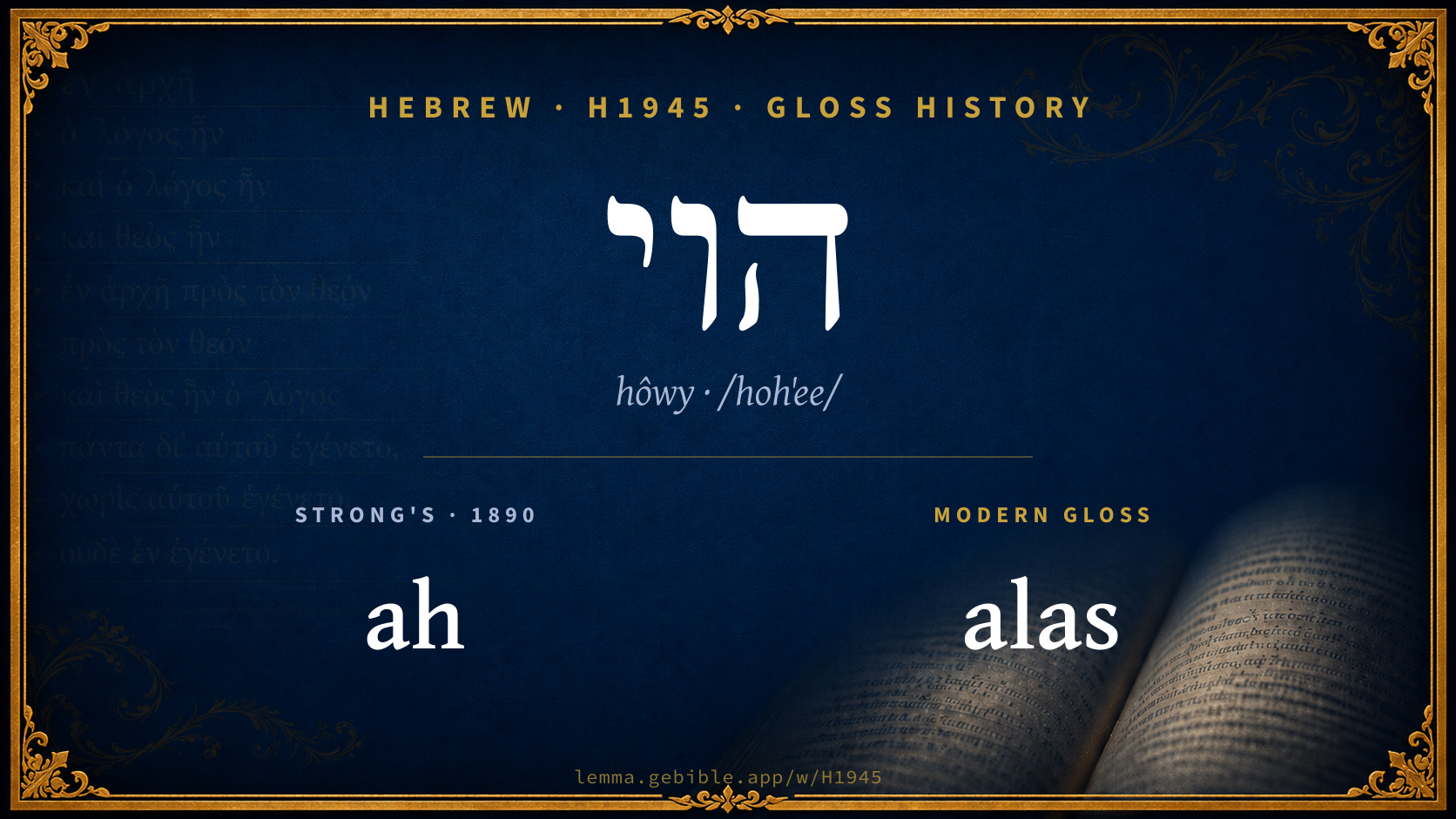
Gloss history
Strong's 1890 vs modern scholarship
About this word
Strong's H1945 catalogs a Hebrew word from the Hebrew Old Testament.
These counts are not copied from any lexicon or concordance. They are computed here, from the morphology-tagged Hebrew Old Testament. What Lemma adds →
- 47
- distinct verses
- The word appears in 47 distinct verses.
- 10 / 39
- OT books
- The word appears in 10 of 39 Old Testament books.
- #723
- by frequency
- Top 1000 most frequent Hebrew words (rank 723 of 8,640 Hebrew words by occurrence).
View all 47 occurrences in the concordance →
By section of the Old Testament
By traditional corpus
Conventional, traditional groupings — biblical authorship is debated, so this is a traditional corpus grouping, not an authorship claim. Each share is this word’s portion of its verses in that division of the Hebrew canon. Each figure is a share of the word’s 47 distinct verses.
- Prophets (Nevi'im) 47 verses · 100%
How translations render this word
Counts come from each version’s own published word-to-Strong’s tagging or interlinear alignment — an approximate guide to how each version renders this word, not a word-level alignment the data otherwise carries. Because each total is that version’s own tagged count, the per-version totals vary from one another and need not match the appearance or distinct-verse counts above. These counts may also differ from a printed concordance because Lemma counts each distinctly tagged rendering and does not collapse phrase taggings into a single head-word total. This is a fixed set of word-tagged versions (KJV, ASV, BSB, ULT) and does not change with the reading translation you choose elsewhere. Each version’s license is shown beside its name below (and on Sources).
- King James Version: Woe 36×, Ho 4×, Ah 2×
- American Standard Version: Woe 32×, Ho 5×, Ah 4×
- Berean Standard Bible: Woe 35×, Alas 8×, Get up 3×
- unfoldingWord Literal Text: Woe 24×, Woe to 20×, And 2×
King James Version Public Domain
Renders H1945 across 52 tagged occurrences — most commonly:
Plus 4 renderings that appear only once — usually multi-word phrases or single function words the recovered tagging swept in, not distinct renderings.
American Standard Version Public Domain
Renders H1945 across 52 tagged occurrences — most commonly:
Plus 7 renderings that appear only once — usually multi-word phrases or single function words the recovered tagging swept in, not distinct renderings.
Berean Standard Bible Public Domain
Renders H1945 across 51 tagged occurrences — most commonly:
Plus 5 renderings that appear only once — usually multi-word phrases or single function words the recovered tagging swept in, not distinct renderings.
unfoldingWord Literal Text CC BY-SA 4.0
Renders H1945 across 52 tagged occurrences — most commonly:
Plus 2 renderings that appear only once — usually multi-word phrases or single function words the recovered tagging swept in, not distinct renderings.
Senses in BDB
The 1 sense BDB distinguishes for this word, in lexicon order (not ranked by frequency or importance). The full entry — with sub-senses — is in the Lexicon Entry tab.
- ah!, alas!, ha!, ho!, O!, woe!
Word origin
interj. (onomatop.; cf. ܗܳܘܳܝ = הוֹ הוֹ Am 5:16 𝔖, = הֵידָד Je 51:14 𝔖; also Mod. Aramaic ú hú, ú hú (in a lament), SoUrmia-Dial. 102.4)—expressing usually dissatisfaction and pain, Ah, Alas, Ha (not distinctly Woe! which is אוֹי): used in lamentations, 1 K 13:30 and they mourned over him (saying) הוֹי אָחִי Ah, my brother! Je 22:18 הוֹי אָחִי וְהוֹי אָחוֹת … הוֹי אָדוֹן וְהוֹי הֹדֹה, 34:5 וְהוֹי אָדוֹן יִסְפְּדוּ לָ֑ךְ (cf. הוֹ־הוֹ Am 5:16): hence Is 1:4 הוֹי גּוֹי חֹטֵא Ah! sinful nation, v 24 Ah! I will ease me of my adversaries; especially preparatory to a declaration of judgment, Is 10:5 הוֹי אַשּׁוּר שֵׁבֶט אַפִּי, 17:12; 28:1, often sq. a ptcp. Ah! those that …, 5:8, 11, 18; 29:15; 31:1; 45:9, 10 Je 22:13 Am 5:18; 6:1 Hb 2:6, 9, 12, 15, 19; Zc 11:17 + (more sympathetic than אוֹי לְ): sq. כִּי Je 30:7, אֶל 48:1, עַל 50:27; Ez 13:3, לְ 13:18. Sometimes hardly more than an exclam. arousing attention Ha! (though perh. with a touch of sympathy or pity) Is 18:1; 55:1 Zc 2:10(×2), 11 Je 47:6.
— Brown-Driver-Briggs (Oxford 1906, public domain), digitized via Sefaria, supplemented by the OpenScriptures HebrewLexicon (CC BY 4.0). See Sources.
Derived from הו (hôw) (H1930) — alas.
Jastrow Dictionary
A second Hebrew/Aramaic lexicon for comparison, covering Aramaic and post-biblical (Talmudic, Targumic, Midrashic) usage that the biblical-Hebrew BDB does not. Matched by lemma rather than by Strong’s number, so a lemma may carry more than one Jastrow headword (shown separately below), and the entries cover usage well beyond the Bible.
הֲוֵי
- , fut. יֶהֱוֵי, יְהֵא, יְהֵי ch.
- 1. same. Targ. Gen. I, 3; a. v. fr.—Koh. R. to IX, 10 הוא הוה גלי he emigrated, v. גְּלֵי. Ib. לא הֲוִינָא גלי did I not emigrate?—Ib. ויהוי מה דהוי (read דיהוי) and come what may. Ber. 3ᵃ (in Hebr. diction) ג׳ משמרות הוי נכ׳ the night consists of three watches. Ib.ᵇ תרי נשפי הוו there are two נשף (twilights); a. v. fr.—Y. Maasr. IV, end, 51ᶜ תְּווּן מפקדין וכ׳ (= תֶּהֱווּן, or read: הֱווּן) give orders to your wives &c., דיהוון מרימין וכ׳ that they (the laborers) should &c.—B. Bath. 73ᵇ, a. fr. הוה אזלינן it happened that we &c.—Kidd. 31ᵇ מרבינתיה הואי (= הֲוָאִית) she was his foster-mother. Ned. 50ᵃ אי הואי לי (Rashi הוי) if I become wealthy. Y. Shek. V, 49ᵇ top אית הוה סבין וכ׳ (Bab. ed. איתהוה, איתחוון, corr. acc.) there used to be old men &c.; Y. Peah VIII, 21ᵇ אית הוו.—Imper. הֱוֵי, v. preced. Ib. זיל הוי בי רב go and stay at college; a. fr.—In Palest. dialect יֵא, יֵיא = יְהֵא. Y. Taan. IV, 68ᶜ top ייא שלמא וכ׳ peace be with the hand &c.; a. fr.—V. יֵבָא, יֵיאבָךְ.
- 2. to dwell upon, discuss, v. infra.
- , הַוֵּא
- 1. to produce. Y. Taan. III, 66ᵈ bot. דהַוִּית וכ׳ (not דהיות) where the ground used to produce &c.; Midr. Till. to Ps. CXXVI דהַוָּה; v. זַוְויֵי.
- 2. (also Peel) with ב or על to dwell upon, to discuss, argue, oppose, cmp. קים. Y. R. Hash. I, 57ᵃ top על דב"ה אינון הַוִּוי they were discussing the question on the basis of Beth-Hillel’s opinion (differing as to the application of B. H.’s principle). Keth. 72ᵇ הוי בה ר׳ פפא R. P. (when that subject was up) raised the question.—Usu. והוינן בה, וה׳ עלה on its being brought up at college we raised the point. Ber. 45ᵇ. Gitt. 4ᵇ; a. fr.—Naz. 16ᵇ וכולה כדה׳ בהאליבא וכ׳ and all this must be understood, in accordance with what we have discussed (ib. 5ᵃ sq.), in the sense of &c.—Kidd. 50ᵇ, a. fr. מאי הַוֵּי עלה what have they decided upon it?, what is the result?—[Nidd. 66ᵃ תהוו … נתהוו, v. תְּהָא.]
הוֹי
- (b. h.) woe!, ah! Ex. R. s. 24, beg. (ref. to Deut. XXXII, 6) כלומר ה׳ (ה)ליי׳ וכ׳ as if saying, Woe, unto &c.—Y. Snh. X, 29ᵇ bot., v. וָהּ; a. fr. e.g. Deuteronomy 32:6
הוי
- (b. h.) to exist; to be, become; to occur, come to pass.—With part. ה׳ מביט he looked; ה׳ אומר he said, freq. used to say. Gen. R. s. 1, beg. אני הָיִיתִי וכ׳ I was the implement &c. Ib. ה׳ הקב"ה מביט וכ׳ the Lord looked into the Law (as often as a thing was to be created). Ab. I, 13 הוא ה׳ אומר the same used to say. Gen. R. s. 2 ה׳ ללמה ולא כלום became a nothing; a. v. fr.—Apocopate forms: אֱהִי, אֱהֵא, תְּהִי, תְּהֵא, יְהִי, יְהֵא; תְּהוּ (= תִּהְיוּ), יְהוּ (= יִהְיוּ). Yoma 66ᵇ אהא בשלום אני נכ׳ (Tosef. ib. IV (III), 14 נִהְיֶה) may I and you be as well; Y. ib. VI, 43ᶜ bot. כן תהו וכ׳ so may ye be well. B. Mets. 35ᵃ תהא במאמינו let this be (speak of a case) when he accepts his opponent’s statement; a. v. fr.—Part. הוֶֹה, הוֶֹוה
- 1. frequent, usual. Sabb. VI, 6 דברו חכמים בה׳ the scholars (in using the words ‘Arabian women’) speak of the ordinary custom (not to the exclusion of other people); a. fr.
- 2. existing, enduring. Pesik. R. s. 11, end הם הווִֹים ודומים [להקב"ה] they shall be existing for themselves (not merely as an attachment) and resembling [the Lord]; ib. אף הם הווים אש וכ׳ they, too, shall endure as a consuming fire.—Cant. R. to II, 13 עניות ירבה ויוקר הווה (read תרבה) poverty shall increase, and prices remain high (different in Snh. 97ᵃ a. Sot. 49ᵇ, v. אָמַר II). Imper. הֱוֵי, הֱוֵא; pl. הֱווּ. Ab. I, 4. Ib. II, 3; a. fr.—הֱוֵי אוֹמֵר, also elliptically הֱוֵי say, i.e. you must admit, this proves, that is meant by saying. Taan. 2ᵃ which is the service of the heart? ה׳ אומר זו תפלה you must admit, it is prayer. Tosef. Nidd. I, 6 ה׳ לא אמרום וכ׳ that is to say, the scholars have spoken &c. Cant. R. to I, 6 ה׳ כרמי שלי וכ׳ this is meant by ‘my vineyard &c.’—Y. Shebu. VII, 38ᶜ top הווי לא צורכה וכ׳ it is evident that it would not have been necessary &c.; a. fr.
- (v. הְוָיָה
- 1. to change one’s legal status, to dispose of. Keth. 40ᵇ (ref. to תהיה Deut. XXII, 19) במְהַוָּה עצמה וכ׳ the text speaks of a woman who can dispose of herself. e.g. Deuteronomy 22:19
- 2. to produce, make. Kidd. 58ᵃ (ref. to והיית, Deut. VII, 26) כל שאתה מְהַיֶּיה הימנה whatever thou makest out of it; Tem. 30ᵇ מְהַיֶּה ממנה; a. e. e.g. Deuteronomy 7:26
A Dictionary of the Targumim, the Talmud Babli and Yerushalmi, and the Midrashic Literature (Marcus Jastrow; London, Luzac, 1903) — Public Domain. Digitized via Sefaria. Digitized via Sefaria. Full attribution on Sources.
Forms in the corpus
The 12 distinct written forms H1945 takes in the Hebrew Bible, most frequent first — each parse links to that state’s occurrences in the concordance. Hebrew forms include their vowel points and cantillation, so a single lemma takes many written forms.
| Form | Parsing | Example | Uses |
|---|---|---|---|
| ה֣וֹי | Particle, Interjection | Habakkuk 2:19 | 11 |
| ה֗וֹי | Particle, Interjection | Habakkuk 2:9 | 9 |
| ה֥וֹי | Particle, Interjection | Amos 5:18 | 9 |
| ה֚וֹי | Particle, Interjection | Amos 6:1 | 5 |
| ה֛וֹי | Particle, Interjection | Habakkuk 2:12 | 5 |
| ה֖וֹי | Particle, Interjection | Ezekiel 13:3 | 3 |
| ה֤וֹי | Particle, Interjection | Ezekiel 34:2 | 3 |
| וְ/ה֥וֹי | Particle, Interjection | Jeremiah 22:18 | 2 |
| ה֕וֹי | Particle, Interjection | Isaiah 5:22 | 1 |
| ה֧וֹי | Particle, Interjection | Micah 2:1 | 1 |
| הוֹי֩ | Particle, Interjection | Ezekiel 13:18 | 1 |
| וְ/ה֣וֹי | Particle, Interjection | Jeremiah 22:18 | 1 |
Septuagint verse parallels
This word appears in 46 verses that also exist in the Greek Old Testament (Septuagint), out of the 47 Hebrew verses it occurs in. You can read those verses in Greek by switching the Old Testament edition to the Septuagint.
Read these verses in the Septuagint
- 1 Kings 13:30
- Isaiah 1:4
- Jeremiah 22:13
- Ezekiel 13:3
- Amos 5:18
- Micah 2:1
- Nahum 3:1
- Habakkuk 2:6
- Zephaniah 2:5
- Zechariah 2:6
This is a verse-level parallel only — the same verses exist in both the Hebrew and Greek Old Testaments. No word-level Hebrew↔Greek correspondence is claimed: the data carries no such alignment, so no Greek word is shown as this Hebrew word’s translation. Coverage is not total — the Septuagint omits the deuterocanon and renumbers the Psalms, so some Hebrew verses have no direct Greek parallel.