

Psalms 145:8

Hebrew (Westminster Leningrad Codex) Psalms 145:8 appears in the Hebrew Old Testament. The text above is from the Westminster Leningrad Codex. Each word links to its Strong’s number, a concise gloss, and parsing drawn from the Open Scriptures Hebrew Bible morphology. Click any word for its full Brown-Driver-Briggs (BDB) entry.
Download image
Cite this verse

Psalms 145:8 (World English Bible). Public Domain. Lemma interlinear Bible study tool, https://lemma.gebible.app/v/psalms/145/8.

Show BibTeX & RIS
BibTeX
RIS
English Translation
Yahweh is gracious, merciful, Slow to anger, and of great loving kindness.
World English Bible · Public Domain
Download a study sheet

One document with this verse’s original text, its word-by-word gloss line, the meaning frame, cross-references with their text, attributed commentary, and full source and license credits — printable, and it pastes into notes with its structure intact.

This verse Autodidact and up

Study sheet (.html) Plain text (.txt)

A passage Seminary Student

Up to 50 verses in one chapter. A passage sheet keeps up to 6 commentary sources and 12 cross-references per verse, in the order this page ranks them, and says so on the sheet whenever that leaves anything out. Ask for a single verse and you get the Autodidact verse sheet above.

Everything on this page stays free to read, with no account — the sheet is a download of what is already on screen, not access to it.

Want to remove ads? Support Godless Engineer
Compare translations 3

The same verse in 3 English versions, stacked beneath the original-language interlinear above. Click any original word for its lexicon entry.

Each is an independent rendering of the whole verse — the interlinear is not word-aligned to these translations.

Highlighted words mark where these versions differ — a whole-verse word diff, not a word-by-word alignment.

  • World English Bible Public Domain
    Yahweh is gracious, merciful, Slow to anger, and of great loving kindness.
  • King James Version Public Domain
    The LORD is gracious, and full of compassion; slow to anger, and of great mercy.
  • unfoldingWord Literal Text CC BY-SA 4.0
    Yahweh gracious and compassionate, long of nostrils and great of covenant faithfulness.

unfoldingWord Literal Text — © unfoldingWord, licensed CC BY-SA 4.0. Word-aligned USFM3 via Door43 (git.door43.org/unfoldingWord/en_ult).

Versions to compare (up to 4)

3 of 4 selected

Show all 18 translations

Every available English version of this verse, each an independent rendering of the whole verse.

  • World English Bible Public Domain
    Yahweh is gracious, merciful, Slow to anger, and of great loving kindness.
  • Berean Standard Bible Public Domain
    The LORD is gracious and compassionate, slow to anger and abounding in loving devotion.
  • Majority Standard Bible Public Domain
    The LORD is gracious and compassionate, slow to anger and abounding in loving devotion.
  • King James Version Public Domain
    The LORD is gracious, and full of compassion; slow to anger, and of great mercy.
  • American Standard Version (1901) Public Domain
    Jehovah is gracious, and merciful; Slow to anger, and of great lovingkindness.
  • Revised Version (1885) Public Domain
    The LORD is gracious, and full of compassion; slow to anger, and of great mercy.
  • Geneva Bible (1599) Public Domain
    The Lord is gracious and merciful, slow to anger, and of great mercie.
  • Douay-Rheims (1899) Public Domain
    Whose mouth hath spoken vanity: and their right hand is the right hand of iniquity.
  • Young's Literal Translation Public Domain
    Gracious and merciful `is' Jehovah, Slow to anger, and great in kindness.
  • Literal Standard Version CC BY-SA 4.0
    YHWH [is] gracious and merciful, || Slow to anger, and great in kindness.
  • Unlocked Literal Bible CC BY-SA 4.0
    Yahweh is gracious and merciful, slow to anger and abounding in covenant faithfulness.
  • unfoldingWord Literal Text CC BY-SA 4.0
    Yahweh gracious and compassionate, long of nostrils and great of covenant faithfulness.
  • Darby Bible Public Domain
    Jehovah is gracious and merciful; slow to anger, and of great loving-kindness.
  • World Messianic Bible Public Domain
    The LORD is gracious, merciful, slow to anger, and of great loving kindness.
  • Webster's Bible Public Domain
    The LORD is gracious, and full of compassion; slow to anger, and of great mercy.
  • Free Bible Version CC BY-SA 4.0
    The Lord is gracious and merciful, not easily angered, and full of trustworthy love.
  • Bible in Basic English Public Domain
    The Lord is full of grace and pity; not quickly angry, but great in mercy.
  • JPS Tanakh (1917) Public Domain
    The LORD is gracious, and full of compassion; slow to anger, and of great mercy.

Literal Standard Version (2020), Covenant Press — licensed CC BY-SA 4.0. Text via the HelloAO Bible API (eBible.org). Unlocked Literal Bible (unfoldingWord) — licensed CC BY-SA 4.0. Text via the HelloAO Bible API (eBible.org). unfoldingWord Literal Text — © unfoldingWord, licensed CC BY-SA 4.0. Word-aligned USFM3 via Door43 (git.door43.org/unfoldingWord/en_ult). Free Bible Version, Dr. Jonathan Gallagher — licensed CC BY-SA 4.0. Text via the HelloAO Bible API (eBible.org).

Word by word

More ways to search: Search by grammar → Find every occurrence → Compare this word →

Practice this passage: Drill this verse → Learn its vocabulary →

About this verse

These counts appear in no published source. They are computed here, from the morphology-tagged text and Lemma’s own curated glosses. What Lemma adds →

7
words
7
distinct lemmas
Wisdom
section

Notable vocabulary

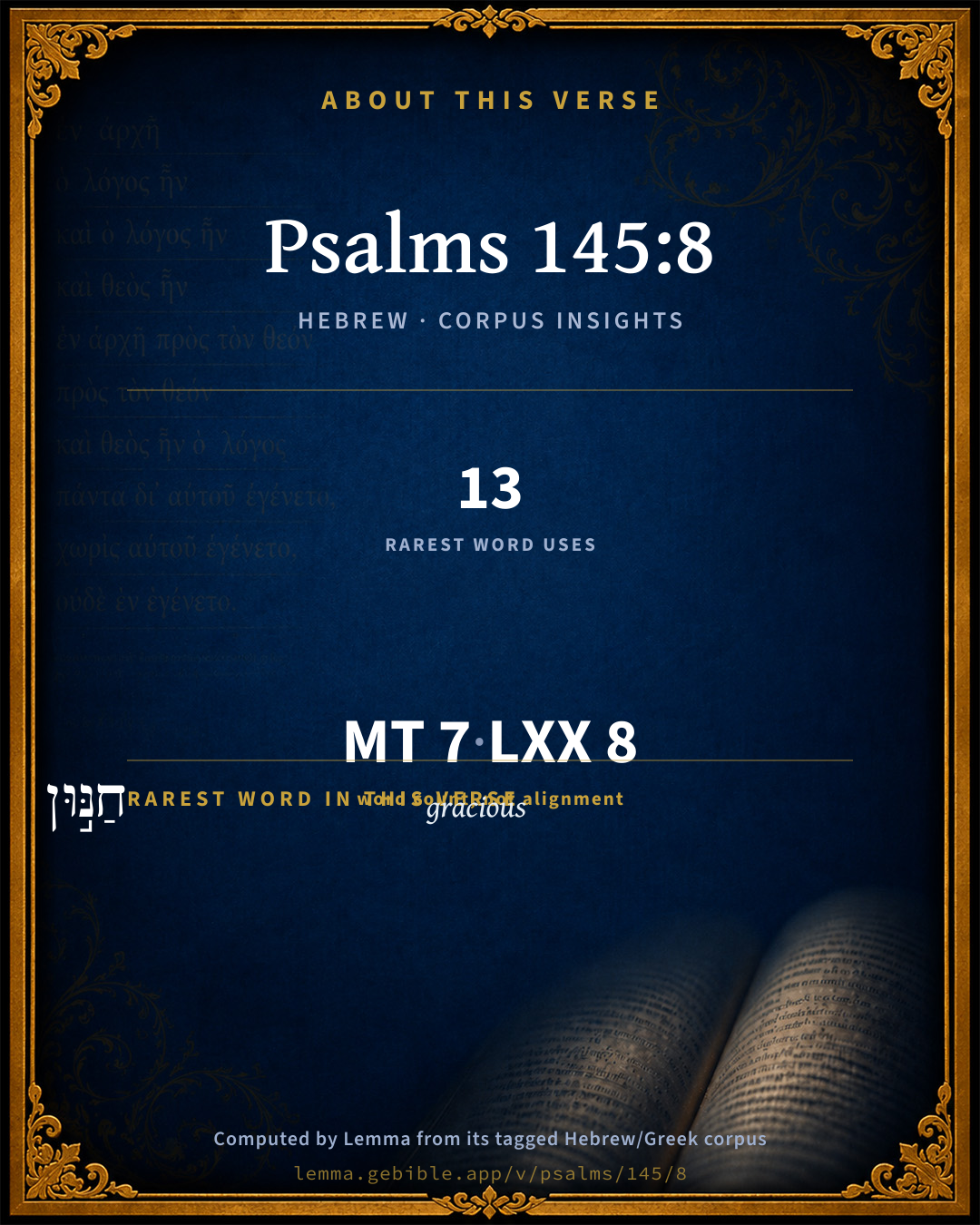
The rarest word here is חַנּ֣וּן gracious H2587 — appearing just 13 times in the whole Hebrew Bible.

Shared distinctive vocabulary

חַנּ֣וּן gracious H2587 occurs in 13 verses of the Hebrew Bible. Also found in:

Grammatical profile

  • 3 nouns
  • 4 adjectives

Hebrew & Septuagint length

In English translation the verse runs 12 words from the Hebrew and 12 from the Septuagint (LXX English) — the same length.

A rough comparison of the two English renderings, which tokenize alike — not a word-level alignment.

Word counts can differ between the Hebrew and the Greek without any difference in meaning — e.g. the Hebrew direct-object marker אֵת has no separate Greek word, and Greek often adds the article ὁ.

In the original languages it is 7 Hebrew tokens and 8 Greek tokens — but the two are counted differently (Hebrew bundles its prefixes and suffixes into one token; the Greek is in lemma form), so that isn’t a like-for-like length.

Cross-references

13

Topical passages linked to Psalms 145:8 in the Treasury of Scripture Knowledge — connected by theme and wording, ordered by reader-vote popularity; previews shown in the World English Bible.

  • Numbers 14:18 Yahweh is slow to anger, and abundant in loving kindness, forgiving iniquity and disobedience; and that will by no means clear [the guilty], visiting the iniquity of the fathers on the children, on the third and on the fourth generation.
  • Psalms 103:8 Yahweh is merciful and gracious, Slow to anger, and abundant in loving kindness.
  • Psalms 86:5 For you, Lord, are good, and ready to forgive; Abundant in loving kindness to all those who call on you.
  • Psalms 100:5 For Yahweh is good. His loving kindness endures forever, His faithfulness to all generations.
  • Psalms 116:5 Gracious is Yahweh, and righteous; Yes, our God is merciful.
  • Psalms 86:15 But you, Lord, are a merciful and gracious God, Slow to anger, and abundant in loving kindness and truth.
  • Micah 7:18–20 Who is a God like you, who pardons iniquity, And passes over the disobedience of the remnant of his heritage? He doesn't retain his anger forever, Because he delights in loving kindness.
  • Romans 5:20–21 The law came in besides, that the trespass might abound; but where sin abounded, grace did abound more exceedingly;
  • Exodus 34:6–7 Yahweh passed by before him, and proclaimed, "Yahweh! Yahweh, a merciful and gracious God, slow to anger, and abundant in loving kindness and truth,
  • Ephesians 2:4 But God, being rich in mercy, for his great love with which he loved us,
  • Jonah 4:2 He prayed to Yahweh, and said, "Please, Yahweh, wasn't this what I said when I was still in my own country? Therefore I hurried to flee to Tarshish, for I knew that you are a gracious God, and merciful, slow to anger, and abundant in loving kindness, and you repent of the evil.
  • Ephesians 1:8 which he made to abound toward us in all wisdom and prudence,
  • Daniel 9:9 To the Lord our God belong mercies and forgiveness; for we have rebelled against him;

Cross-references courtesy of OpenBible.info (CC BY 4.0).

Hebrew and Greek witnesses Masoretic Hebrew ↔ Greek Septuagint

The same verse in the two great witnesses to the Old Testament, shown verse-for-verse.

You’re reading Greek Psalm 144 (Hebrew Psalm 145). The Septuagint counts the superscription, so verse numbers can differ from the Hebrew — chapter-level alignment, not verse-by-verse. Numbering follows Rahlfs.

These are two independent witnesses, not word-aligned to each other, and the Septuagint is shown in lemma (dictionary) form.

Hebrew Psalms 145:8 Masoretic · Westminster Leningrad Codex

חַנּ֣וּן וְרַח֣וּם יְהוָ֑ה אֶ֥רֶךְ אַ֝פַּ֗יִם וּגְדָל חָֽסֶד

Yahweh is gracious, merciful, Slow to anger, and of great loving kindness.

World English Bible · Public Domain

Greek LXX Greek Psalm 144:8 Septuagint · lemma form

οἰκτιρμός καί ἐλεήμων ὁ κύριος μακρόθυμος καί πολυέλεος

The Lord is compassionate, and merciful; long suffering, and abundant in mercy.

LXX2012 (modern English Septuagint) · Public Domain

Hebrew: Westminster Leningrad Codex (CC BY 4.0). Greek: Septuagint (public domain); English from LXX2012 (modern English Septuagint) (Public Domain). How the Septuagint differs from the Hebrew →

Commentary

Notes on Psalms 145:8 from classic Christian and Jewish commentators (each source and its license shown beneath its notes). The classic Christian expositions comment on the surrounding passage and are grouped to its opening verse, so a note may address several verses; the Jewish commentaries on the Tanakh (Rashi and others) are per-verse, so they appear only where the commentator wrote on this verse.

Lemma curates 59 commentaries, every one of them public domain or Creative Commons licensed, each selected and text-cleaned for this edition rather than reprinted as found. About our sources →

Trapp's Complete Commentary

John Trapp

Psa 145:8 The LORD [is] gracious, and full of compassion; slow to anger, and of great mercy.

Ver. 8. The Lord is gracious, &c.] See Psa 86:5; Psa 86:15; Psa 103:8.

Slow to anger, and of great mercy] De quo pene possit ambigi sit ne ad irascendum tardior, an ad parcendum promptior (Bcza).

John Trapp, A Commentary or Exposition upon All the Books of the Old and New Testament (1647–1656) — public domain. Text from a community e-Sword module.

The Biblical Illustrator

Joseph S. Exell

Psa_145:8

Slow to anger, and of great mercy.

Sin a provocation and a misery

I. The provocative power of sin. God is susceptible of provocation.

1. He is not cold intellect.

2. He is not indifferent to moral conduct.

3. His nature revolts at sin.

4. However great His displeasure, He controls it.

II. The misery-producing power of sin. It has turned our Eden into a vale of tears. (David Thomas, D. D.)

The Biblical Illustrator, edited by Joseph S. Exell (c. 1880s–1900s) — public domain. Text from a community e-Sword module.

Joseph Benson's Commentary

Psa 145:8-13. The Lord is gracious, &c. — See notes on Exo 34:6-7; and Num 14:18. The Lord is good to all — Not only to Israel, but to all mankind, whose hearts he fills with food and gladness, as is said Act 14:17; yea, to all his creatures, to beasts as well as men. All thy works praise thee — They give men and angels just occasion to praise thee; for they set forth thy glory, and manifest thy infinite perfections. And thy saints bless thee — Give thanks for thy goodness with grateful hearts. God’s other works praise him, as a beautiful building commends the builder, or a well-drawn picture the painter; but the saints bless him as the children of prudent, tender parents rise up and call them blessed. Of all God’s works, his saints, the first-fruits of his creatures, have most reason to bless him. They shall speak of the glory of thy kingdom — Of which they are loyal subjects, and the blessings and glories of which they make it their business to publish to the world, that mankind may be thereby induced to submit their hearts and lives to so gracious a sceptre as that of the Messiah, and that his dominion may become “as universal in its extent as it is everlasting in its duration.”

Joseph Benson's Commentary on the Old and New Testaments (1811–1818) — public domain. Text from a community e-Sword module.

Keil & Delitzsch

C. F. Keil & F. Delitzsch

This memorable utterance of Jahve concerning Himself the writer of Ps 103, which is of kindred import, also interweaves into his celebration of the revelation of divine love in Psa 145:8. Instead of רב־חסד the expression here, however, is וגדול חסד (Kerמ, as in Nah 1:3, cf. Psa 89:29, with Makkeph וּגדל־). The real will of God tends towards favour, which gladly giving stoops to give (חנּוּן), and towards compassion, which interests itself on behalf of the sinner for his help and comfort (רחוּם). Wrath is only the background of His nature, which He reluctantly and only after long waiting (ארך אפּים) lets loose against those who spurn His great mercy. For His goodness embraces, as Psa 145:9 says, all; His tender mercies are over all His works, they hover over and encompass all His creatures. Therefore, too, all His works praise Him: they are all together loud-speaking witnesses of that sympathetic all-embracing love of His, which excludes no one who does not exclude himself; and His saints, who live in God's love, bless Him (יברכוּכה written as in Kg1 18:44): their mouth overflows with the declaration (יאמרוּ) of the glory of the kingdom of this loving God, and in speaking (ידבּרוּ) of the sovereign power with which He maintains and extends this kingdom. This confession they make their employ, in order that the knowledge of the mighty acts of God and the glorious majesty of His kingdom may at length become the general possession of mankind. When the poet in Psa 145:12 sets forth the purpose of the proclamation, he drops the form of address. God's kingdom is a kingdom of all aeons, and His dominion is manifested without exception and continually in all periods or generations (בּכל־דּור ודר as in Ps 45:18, Est 9:28, a pleonastic strengthening of the expression בּדר ודר, Psa 90:1). It is the eternal circumference of the history of time, but at the same time its eternal substance, which more and more unfolds and achieves itself in the succession of the periods that mark its course. For that all things in heaven and on earth shall be gathered up together (ἀνακεφαλαιώσασθαι, Eph 1:10) in the all-embracing kingdom of God in His Christ, is the goal of all history, and therefore the substance of history which is working itself out. With Psa 145:13 (cf. Dan. 3:33, Dan 4:31, according to Hitzig the primary passages) another paragraph is brought to a close.

Keil & Delitzsch — Biblical Commentary on the Old Testament (1861–1891) — public domain (CC PDM 1.0). Text via the HelloAO Bible API. (Old Testament only.)

J. A. Alexander on Psalms

Joseph Addison Alexander

8. (Psa 145:8) Gracious and compassionate (is) Jehovah, slow to anger and great (in) mercy. Compare Psa 136:14; Psa 103:8; Psa 111:4. Instead of the usual expression much or abundant, we have here great, in allusion to its previous use in Psa 145:3; Psa 145:6.

Joseph Addison Alexander, The Psalms Translated and Explained (1850) — public domain. Text from a community e-Sword module.

Tyndale Open Study Notes

Tyndale Open Resources

145:8-9 God consistently demonstrates his character toward all his creation (see 136:25).

Tyndale Open Study Notes — © Tyndale Open Resources, licensed CC BY-SA 4.0. Text via the HelloAO Bible API.

Geneva Bible (1599)

Geneva Bible translators

He describeth after what sort God showeth himself to all his creatures, though our sins have provoked his vengeance against all: to wit, merciful, not only in pardoning the sins of his elect, but in doing good even to the reprobate, albeit they cannot feel the sweet comfort of the same.

Geneva Bible (1599) marginal notes — public domain. Text via Bolls.life.

Jamieson, Fausset & Brown

Robert Jamieson, A. R. Fausset & David Brown

(Compare Psa 103:8; Psa 111:4).

over all, &c.--rests on all His works.

Jamieson, Fausset & Brown — Commentary Critical and Explanatory on the Whole Bible (1871) — public domain (CC PDM 1.0). Text via the HelloAO Bible API.

Adam Clarke's Commentary

Verse 8. The Lord is gracious] His holy nature is ever disposed to show favour.

Full of compassion] Wherever he sees misery, his eye affects his heart.

Slow to anger] When there is even the greatest provocation.

Of great mercy.] Great in his abundant mercy. These four things give us a wonderful display of the goodness of the Divine nature.

Adam Clarke's Commentary on the Bible (1810–1826) — public domain. Text from a community e-Sword/MySword module.

John Calvin's Commentaries

8. Jehovah is gracious, etc. He opens up the goodness of which he spoke by using several expressions, as that God is inclined to mercy, (for such is the proper meaning of the word חנון, channun,) and that he helps us willingly, as one sympathizing with our miseries. It is to be noticed that David has borrowed the terms which he here applies to God from that celebrated passage in Exodus 34:6; and as the inspired writers drew their doctrine from the fountain of the law, we need not wonder that they set a high value upon the vision which is there recorded, and in which as clear and satisfactory a description of the nature of God is given us as can anywhere be found. David, therefore, in giving us a brief statement of what it was most important we should know in reference to God, makes use of the same terms employed there. Indeed no small part of the grace of God is to be seen in his alluring us to himself by such attractive titles. Were he to bring his power prominently into view before us, we would be cast down by the terror of it rather than encouraged, as the Papists represent him a dreadful God, from whose presence all must fly, whereas the proper view of him is that which invites us to seek after him. Accordingly, the more nearly that a person feels himself drawn to God, the more has he advanced in the knowledge of him. If it be true that God is not only willing to befriend us, but is spoken of as touched with sympathy for our miseries, so as to be all the kinder to us the more that we are miserable, what folly were it not to fly to him without delay? But as we drive God’s goodness away from us by our sins, and block up the way of access, unless his goodness overcome this obstacle, it would be in vain that the Prophets spoke of his grace and mercy. “Si la bonte de Dieu ne surmonte cest empeschement, c’est en vain que les Prophetes traitteroyent de sa grace et misericorde.” — Fr.

“To what end is the day of the Lord for you? the day of the Lord is darkness and not light, affliction and not joy.” (Amos 5:18.)

We see in what severe terms Nahum threatens them at the very beginning of his prophecy. Having referred to the language used in the passage from Moses, he adds immediately, on the other hand, to prevent them being emboldened by it, that God is a rigid and severe, a terrible and an inexorable judge. (Nahum 1:3.) They therefore who have provoked God to anger by their sins, must see to secure his favor by believing.

John Calvin's Commentaries (1540-1563) — public domain. Text from the Calvin Translation Society English edition (1840s-50s) via the Christian Classics Ethereal Library (ccel.org). Calvin's coverage is partial (roughly two-thirds of the Bible); uncommented books and verses are honest gaps, never fabricated. The 19th-century editor's footnotes and remarks are omitted so the notes are faithfully Calvin's own voice.

Ellicott's Commentary for English Readers

(8) Comp. Psa_86:15; Psa_103:8; Psa_111:4.

A Bible Commentary for English Readers, edited by Charles John Ellicott (1878–1897) — public domain. Text from a community e-Sword module.

The Cambridge Bible for Schools and Colleges

gen. ed. J. J. S. Perowne

8. Taken almost verbatim from Exo_34:6, Jehovah’s great revelation of Himself as a God of condescending grace and infinite compassion, Whose Will is love, and Whose wrath is only manifested in the last resort against the hardened and impenitent. Cp. Psa_103:8; Psa_86:15; Joe_2:13; Jon_4:2; Neh_9:17; Neh_9:31.

of great mercy] Lit. great in lovingkindness.

The Cambridge Bible for Schools and Colleges (gen. ed. J. J. S. Perowne; Cambridge University Press, 1878–1918) — public domain. Text from a community e-Sword module.

John Gill's Exposition

The Lord is gracious,.... These are the epithets of our Lord Jesus Christ, and may be truly and with great propriety said of him; he is "gracious", kind, and good, in the instances before mentioned; he is full of grace, and readily distributes it; his words are words of grace; his Gospel, and the doctrines of it, are doctrines of grace; his works are works of grace, all flowing from his wondrous grace and mercy:

and full of compassion: or "merciful" (d), in the most tender manner; hence he came into the world to save sinners, and in his pity redeemed them; and when on earth showed his compassion both to the bodies and souls of men, by healing the one and instructing the other; and particularly had compassion on the ignorant, and them that were out of the way; pitying those that were as sheep without a shepherd, as the blind Jews under their blind guides were; and is very compassionate to his people under all their temptations, afflictions, trials, and exercises; see Heb 2:17;

slow to anger; to the wicked Jews, though often provoked by their calumnies and reproaches, and by their ill behaviour to him in various instances; yet we never read but once of his being angry, and that was through grief at the hardness of their hearts, Mar 3:5; and likewise to his own disciples, who were often froward and perverse, and of bad spirits, very troublesome and afflictive to him, yet he patiently bore with them:

and of great mercy; a merciful High Priest, typified by the mercy seat, where we may find grace and mercy at all times; through whom God is merciful to sinners, and to whose mercy we are to look for eternal life.

(d) "misericors", V. L. Tigurine version, Musculus, Piscator, Cocceius, Michaelis.

John Gill's Exposition of the Whole Bible (1746–1763) — public domain (CC PDM 1.0). Text via the HelloAO Bible API.

Albert Barnes' Notes on the Bible

The Lord is gracious - See Psa 86:5, note; Psa 86:15, note.

And full of compassion - Kind; compassionate; ready to do good. See the notes at Psa 103:8.

Slow to anger - See Psa 103:8, where the same expression occurs.

And of great mercy - Margin, great in mercy. His greatness is shown in his mercy; and the manifestation of that mercy is great: great, as on a large scale; great, as manifested toward great sinners; great, in the sacrifice made that it may be displayed; great, in the completeness with which sin is pardoned - pardoned so as to be remembered no more.

Albert Barnes' Notes on the Bible (1834–1885) — public domain. Text from a community e-Sword/MySword module.

The Treasury of David

Charles H. Spurgeon

Ver. 8. The Lord is gracious. Was it not in some such terms that the Lord revealed himself to Moses? Is not this Jehovah's glory? To all living men his aspect: he is gracious, or full of goodness and generosity. He treats creatures with kindness, his subjects with consideration, and his saints favour. His words and ways, his promises and his gifts, his plans and his poses all manifest his grace, or free favour. There is nothing suspicious, diced, morose, tyrannical, or unapproachable in Jehovah, he is condescending and kind. And full of compassion. To the suffering, the weak, the despondent, he is very pitiful: he feels for them, he feels with them: he this heartily, and in a practical manner. Of this pitifulness he is full, so the compassionates freely, constantly, deeply, divinely, and effectually. In fulness in a sense not known among men, and this fulness is all fragrant sympathy for human misery. If the Lord be full of compassion there is no in him for forgetfulness or harshness, and none should suspect him What an ocean of compassion there must be since the Infinite God is full of Slow to anger. Even those who refuse his grace yet share in long suffering. When men do not repent, but, on the contrary, go from bad to worse, averse to let his wrath flame forth against them. Greatly patient and anxious that the sinner may live, he "lets the lifted thunder drop", and still bears. "Love suffereth long and is kind", and God is love. And of great mercy. This is his attitude towards the guilty. When men at last repent, find pardon awaiting them. Great is their sin, and great is God's mercy, need great help, and they have it though they deserve it not; for he is good to the greatly guilty.

Ver. 8. The Lord is gracious, etc. The proclamation of the Lord to Moses (Ex 34:6) is the fountain head of these epithets. James G. Murphy.

Ver. 8. In God there is no passion, only compassion. Richard Rothe, 1799-1867.

Ver. 8. Of great mercy. Mercy hath misery for its object, and is that attribute towards which the eyes of a fallen world must necessarily be turned. The Psalmist hath, accordingly, introduced her last with great pomp and splendour, seated in her triumphal chariot, and invested with a supremacy over all the works of God. She is above the heavens, and over all the earth, so that the whole creation findeth that refuge under the shadow of her wings of which, by reason of man's transgression, it standeth in need. Samuel Burder.

Ver. 8.

1. Grace to the unworthy.

2. Compassion to the afflicted.

3. Forbearance to the guilty.

4. Mercy to the penitent. G. R.

Psalms 145:9*

Charles H. Spurgeon's The Treasury of David (1869–1885) — public domain. Psalms only. Text from a community e-Sword/MySword module.

The Pulpit Commentary

The Lord is gracious, and full of compassion; slow to anger, and of great mercy. Professor Cheyne compares the epithets in a Babylonian hymn to the sun-god; but a closer parallel is to be found in Exo_34:6, Exo_34:7, "The Lord God is merciful and gracious, long-suffering, and abundant in goodness and truth, keeping mercy for thousands, forgiving iniquity, and transgression, and sin". (see also Psa_86:15)

The slowness of the Divine anger.

"Slow to anger, and of great mercy." In former homilies it has been shown that the term "anger" can only be applied to God with extreme caution and precision. Anger is a part of the possibilities belonging to man as a moral being. He would not be a man if he could not be angry. Anger is the proper response which man makes to a certain class of related circumstances. And as man is made in the image of God, we must think that everything essential to man has its answering essential in God. Then there must be the possibility of anger in God. But man is suffering from the influence of willfulness and sin, continued through long generations. And one of the most decided influences has been a loosening of control over the possibilities of anger, so that a man responds too quickly, and anger degenerates into passion. Such anger must never be associated with God, who must never be thought of as losing self-control under any pressure of outward circumstances. Then he is "slow to anger.

I THE SLOWNESS OF DIVINE ANGER IS MAN"S OPPORTUNITY. The type of man"s anger is Cain, who, in a moment of passion, slew his brother, and gave that brother no opportunity of putting things straight. God waits, and in that waiting-time man gets his opportunity of recovery and repentance. He has the chance of "coming to himself." It may never be thought that God"s slowness is the sign of his indifference. He feels responsively quicker than man does, but action on feeling is subject to judgment, and delayed by compassion. The slowness is mercy. The history of God"s ancient people provides abundant illustrations of the opportunities given by the delaying of Divine anger.

II THE SLOWNESS OF DIVINE ANGER IS MAN"S PERSUASION. There is something in man which instantly convicts him of his wrongdoing, and as instantly fills him with fear of God"s anger. When that anger is held in, the man wonders. If he is a bad man, it leads him to presume. If he is a good man, it becomes to him a persuasion. It reveals to him God"s anxiety about him. He feels to be in God"s thought and patience, and he is moved to recover himself from that wrong state of mind and heart which brought on him the Divine anger. R.T.

The Pulpit Commentary (1880–1919), ed. H.D.M. Spence-Jones & Joseph S. Exell — public domain. Text from a community e-Sword module.

unfoldingWord translationNotes

Door43 World Missions Community

abounding in covenant faithfulness

The psalmist speaks of covenant faithfulness as if it were a physical object of which one could possess a large amount. The abstract noun "faithfulness" can be translated with an adjective. AT: "completely faithful to his covenant" (See: Metaphor and Abstract Nouns)

his tender mercies are over all his works

"people can see him showing mercy in everything he does"

translationWords

grace

mercy

anger

covenant faithfulness

works

unfoldingWord translationNotes — © Distant Shores Media and the Door43 World Missions Community, licensed CC BY-SA 4.0. Source: git.door43.org/Door43/en_tn.

Lesson kit

Teaching starters — assembled from the data on this page, not authored interpretation. Every prompt links to the verse data it draws on. Edit before teaching.

Psalms, in the Wisdom, opens this verse with 7 words (7 distinct Hebrew lemmas). Its most distinctive word is channûwn (“gracious”). A historical commentator’s framing appears above. Read the whole chapter for the surrounding context.

Discussion questions

  1. How does “gracious” (channûwn) shape what this verse is saying?
  2. Exodus 22:27 shares the word «gracious» with this verse. How do the two illuminate each other?
  3. The translations on this page render this verse differently — a whole-verse word diff, not a word-by-word alignment. What might account for the different wordings?
  4. Reading how Trapp's Complete Commentary and The Biblical Illustrator read this verse, where do the two commentators agree and where do they part?

Things to notice

Reading settings

Reading text

Shown beneath each verse's original-language words.

Old Testament
Old Testament edition

Read the OT as the Masoretic Hebrew (MT) or the Greek Septuagint (LXX).

English shown for the Greek Septuagint (in the Hebrew ↔ Greek comparison).

Comparing translations? Open the Compare panel on any verse page to stack up to four side by side.