
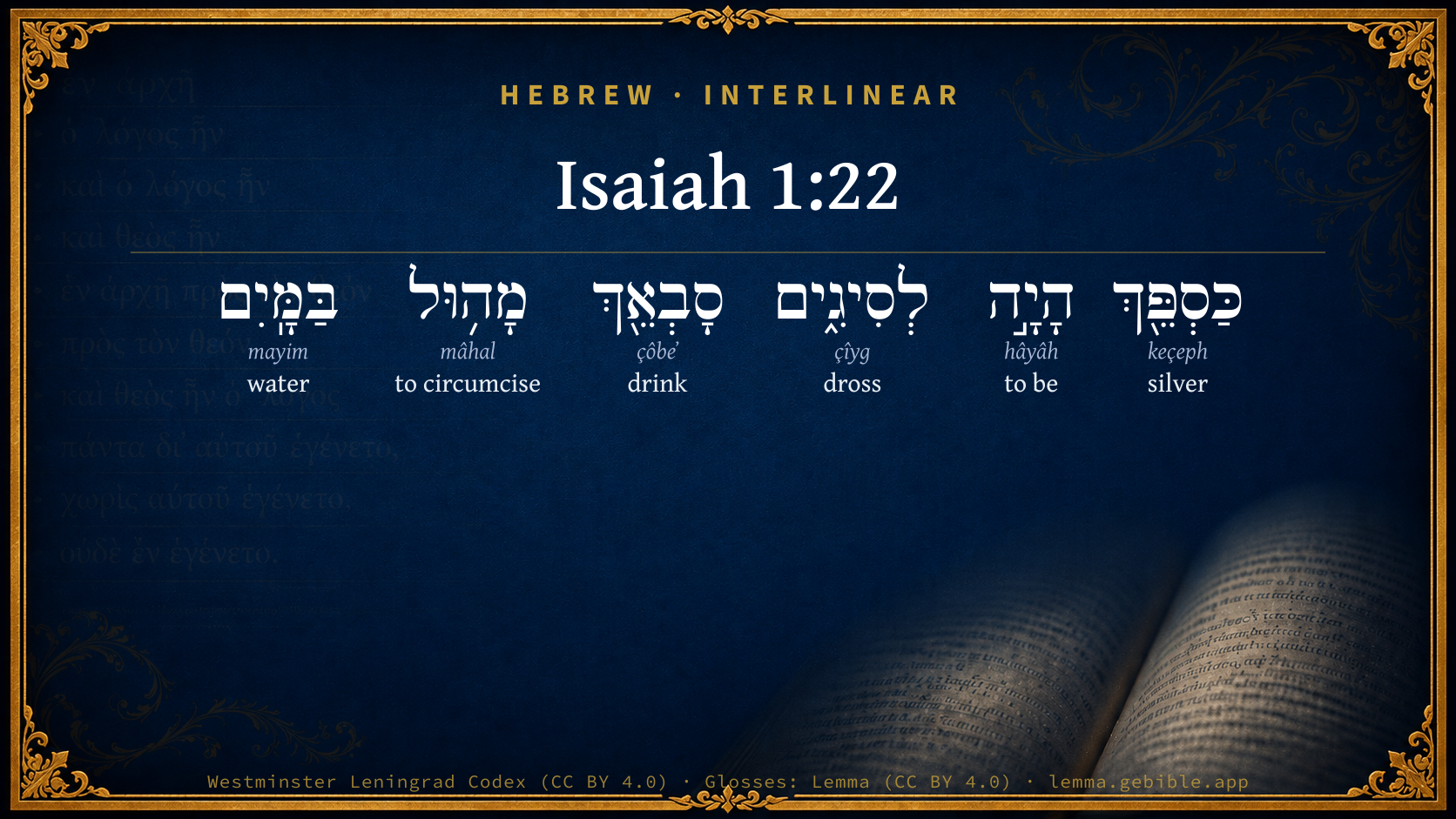
Isaiah 1:22

Hebrew (Westminster Leningrad Codex) Isaiah 1:22 appears in the Hebrew Old Testament. The text above is from the Westminster Leningrad Codex. Each word links to its Strong’s number, a concise gloss, and parsing drawn from the Open Scriptures Hebrew Bible morphology. Click any word for its full Brown-Driver-Briggs (BDB) entry.
Download image
Cite this verse

Isaiah 1:22 (World English Bible). Public Domain. Lemma interlinear Bible study tool, https://lemma.gebible.app/v/isaiah/1/22.

Show BibTeX & RIS
BibTeX
RIS
English Translation
Your silver has become dross, Your wine mixed with water.
World English Bible · Public Domain
Highlights
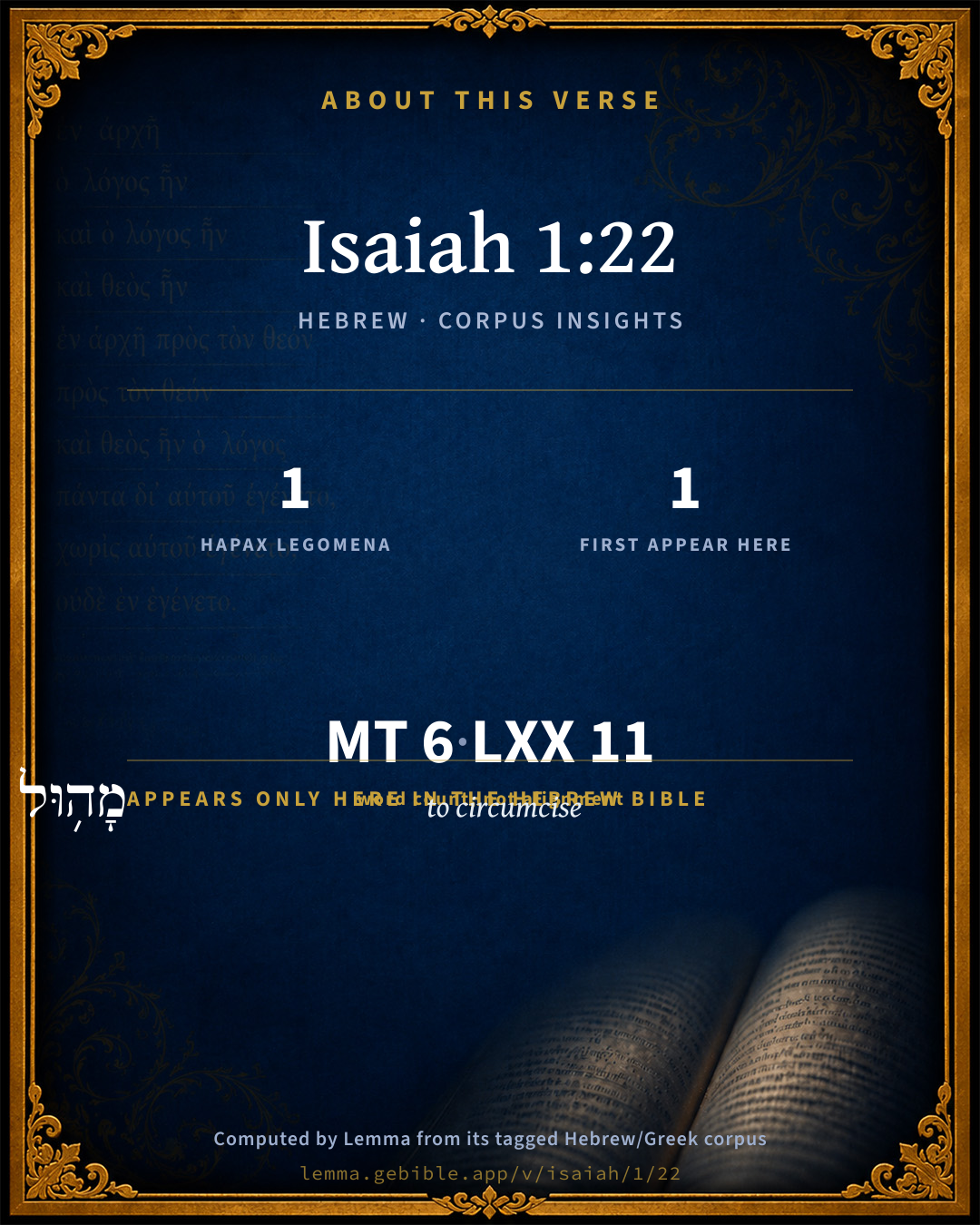
  • 1 hapax legomenon — only here in the Hebrew Bible
  • 1 first appearance in the Hebrew Bible
Full analysis ↓
Download a study sheet

One document with this verse’s original text, its word-by-word gloss line, the meaning frame, cross-references with their text, attributed commentary, and full source and license credits — printable, and it pastes into notes with its structure intact.

This verse Autodidact and up

Study sheet (.html) Plain text (.txt)

A passage Seminary Student

Up to 50 verses in one chapter. A passage sheet keeps up to 6 commentary sources and 12 cross-references per verse, in the order this page ranks them, and says so on the sheet whenever that leaves anything out. Ask for a single verse and you get the Autodidact verse sheet above.

Everything on this page stays free to read, with no account — the sheet is a download of what is already on screen, not access to it.

Want to remove ads? Support Godless Engineer
Compare translations 3

The same verse in 3 English versions, stacked beneath the original-language interlinear above. Click any original word for its lexicon entry.

Each is an independent rendering of the whole verse — the interlinear is not word-aligned to these translations.

Highlighted words mark where these versions differ — a whole-verse word diff, not a word-by-word alignment.

  • World English Bible Public Domain
    Your silver has become dross, Your wine mixed with water.
  • King James Version Public Domain
    Thy silver is become dross, thy wine mixed with water:
  • unfoldingWord Literal Text CC BY-SA 4.0
    Your silver has become dross, your wine, diluted with water.

unfoldingWord Literal Text — © unfoldingWord, licensed CC BY-SA 4.0. Word-aligned USFM3 via Door43 (git.door43.org/unfoldingWord/en_ult).

Versions to compare (up to 4)

3 of 4 selected

Show all 18 translations

Every available English version of this verse, each an independent rendering of the whole verse.

  • World English Bible Public Domain
    Your silver has become dross, Your wine mixed with water.
  • Berean Standard Bible Public Domain
    Your silver has become dross; your fine wine is diluted with water.
  • Majority Standard Bible Public Domain
    Your silver has become dross; your fine wine is diluted with water.
  • King James Version Public Domain
    Thy silver is become dross, thy wine mixed with water:
  • American Standard Version (1901) Public Domain
    Thy silver is become dross, thy wine mixed with water.
  • Revised Version (1885) Public Domain
    Thy silver is become dross, thy wine mixed with water.
  • Geneva Bible (1599) Public Domain
    Thy siluer is become drosse: thy wine is mixt with water.
  • Douay-Rheims (1899) Public Domain
    Thy silver is turned into dress: thy wine is mingled with water.
  • Young's Literal Translation Public Domain
    Thy silver hath become dross, Thy drink polluted with water.
  • Literal Standard Version CC BY-SA 4.0
    Your silver has become dross, || Your drink defiled with water.
  • Unlocked Literal Bible CC BY-SA 4.0
    Your silver has become impure, your wine mixed with water.
  • unfoldingWord Literal Text CC BY-SA 4.0
    Your silver has become dross, your wine, diluted with water.
  • Darby Bible Public Domain
    Thy silver is become dross, thy wine is mixed with water:
  • World Messianic Bible Public Domain
    Your silver has become dross, your wine mixed with water.
  • Webster's Bible Public Domain
    Thy silver is become dross, thy wine mixed with water:
  • Free Bible Version CC BY-SA 4.0
    Your silver has become worthless waste; your wine has been watered down.
  • Bible in Basic English Public Domain
    Your silver is no longer true metal, your wine is mixed with water.
  • JPS Tanakh (1917) Public Domain
    Thy silver is become dross, thy wine mixed with water.

Literal Standard Version (2020), Covenant Press — licensed CC BY-SA 4.0. Text via the HelloAO Bible API (eBible.org). Unlocked Literal Bible (unfoldingWord) — licensed CC BY-SA 4.0. Text via the HelloAO Bible API (eBible.org). unfoldingWord Literal Text — © unfoldingWord, licensed CC BY-SA 4.0. Word-aligned USFM3 via Door43 (git.door43.org/unfoldingWord/en_ult). Free Bible Version, Dr. Jonathan Gallagher — licensed CC BY-SA 4.0. Text via the HelloAO Bible API (eBible.org).

Word by word

More ways to search: Search by grammar → Find every occurrence → Compare this word →

Practice this passage: Drill this verse → Learn its vocabulary →

About this verse

These counts appear in no published source. They are computed here, from the morphology-tagged text and Lemma’s own curated glosses. What Lemma adds →

6
words
6
distinct lemmas
Prophets
section

Notable vocabulary

1 hapax legomenon — a word that appears only here in the entire Hebrew Bible:

  • מָה֥וּל to circumcise H4107

First appearance in Scripture

This word makes its first canonical appearance in the Hebrew Bible here:

  • מָה֥וּל to circumcise H4107

Shared distinctive vocabulary

סָבְאֵ֖ךְ drink H5435 occurs in 4 verses of the Hebrew Bible. Also found in:

Grammatical profile

  • 2 verbs
  • 4 nouns

Verb forms

  • הָיָ֣ה Qal · Perfect
  • מָה֥וּל Qal · Participle Passive

Hebrew & Septuagint length

In English translation the verse runs 10 words from the Hebrew and 12 from the Septuagint (LXX English) — closely comparable.

A rough comparison of the two English renderings, which tokenize alike — not a word-level alignment.

Word counts can differ between the Hebrew and the Greek without any difference in meaning — e.g. the Hebrew direct-object marker אֵת has no separate Greek word, and Greek often adds the article ὁ.

In the original languages it is 6 Hebrew tokens and 11 Greek tokens — but the two are counted differently (Hebrew bundles its prefixes and suffixes into one token; the Greek is in lemma form), so that isn’t a like-for-like length.

Cross-references

6

Topical passages linked to Isaiah 1:22 in the Treasury of Scripture Knowledge — connected by theme and wording, ordered by reader-vote popularity; previews shown in the World English Bible.

  • Jeremiah 6:28–30 They are all grievous rebels, going about with slanders; they are brass and iron: they all of them deal corruptly.
  • Lamentations 4:1–2 How is the gold become dim! [how] is the most pure gold changed! The stones of the sanctuary are poured out at the head of every street.
  • Ezekiel 22:18–22 Son of man, the house of Israel is become dross to me: all of them are brass and tin and iron and lead, in the midst of the furnace; they are the dross of silver.
  • Hosea 4:18 Their drink has become sour. They play the prostitute continually. Her rulers dearly love their shameful way.
  • Hosea 6:4 "Ephraim, what shall I do to you? Judah, what shall I do to you? For your love is like a morning cloud, And like the dew that disappears early.
  • 2 Corinthians 2:17 For we are not as so many, peddling the word of God. But as of sincerity, but as of God, in the sight of God, we speak in Christ.

Cross-references courtesy of OpenBible.info (CC BY 4.0).

Hebrew and Greek witnesses Masoretic Hebrew ↔ Greek Septuagint

The same verse in the two great witnesses to the Old Testament, shown verse-for-verse.

These are two independent witnesses, not word-aligned to each other, and the Septuagint is shown in lemma (dictionary) form.

Hebrew Isaiah 1:22 Masoretic · Westminster Leningrad Codex

כַּסְפֵּ֖ךְ הָיָ֣ה לְסִיגִ֑ים סָבְאֵ֖ךְ מָה֥וּל בַּמָּֽיִם

Your silver has become dross, Your wine mixed with water.

World English Bible · Public Domain

Greek LXX Isaiah 1:22 Septuagint · lemma form

ὁ ἀργύριον σύ ἀδόκιμος ὁ κάπηλος σύ μίσγω ὁ οἶνος ὕδωρ

Your silver is worthless, your wine merchants mix the wine with water.

LXX2012 (modern English Septuagint) · Public Domain

On this verse, J. A. Alexander on Isaiah discusses the Septuagint’s reading. Read the note in Commentary ↓

Hebrew: Westminster Leningrad Codex (CC BY 4.0). Greek: Septuagint (public domain); English from LXX2012 (modern English Septuagint) (Public Domain). How the Septuagint differs from the Hebrew →

Targum (Aramaic paraphrase)

1

The Targum is the ancient Jewish Aramaic paraphrase of the Hebrew Scriptures — an interpretive translation, not the Hebrew text itself. Onkelos (literal) and Pseudo-Jonathan (expansive) render the Torah, and Jonathan the Prophets. Coverage is partial: where no permissively-licensed English translation exists for a verse, only the Aramaic is shown. This is verse-level text, not a word-by-word alignment to the Hebrew.

  1. Targum Jonathan Prophets (Joshua–Malachi)
    כַּסְפֵּךְ הֲוָה לִפְסוּלָא וְחַמְרֵיךְ מְעָרָב בְּמַיָא:

    Thy silver is become dross, thy wine mixed with water.

    Targum Jonathan — Aramaic: “Mikraot Gedolot” (public domain). English: “Sefaria Community Translation” (CC0 1.0 (public-domain dedication)); “London "Chaldee Paraphrase," 1871” (public domain). Text via Sefaria.

Commentary

Notes on Isaiah 1:22 from classic Christian and Jewish commentators (each source and its license shown beneath its notes). The classic Christian expositions comment on the surrounding passage and are grouped to its opening verse, so a note may address several verses; the Jewish commentaries on the Tanakh (Rashi and others) are per-verse, so they appear only where the commentator wrote on this verse.

Lemma curates 59 commentaries, every one of them public domain or Creative Commons licensed, each selected and text-cleaned for this edition rather than reprinted as found. About our sources →

Trapp's Complete Commentary

John Trapp

Isa 1:22 Thy silver is become dross, thy wine mixed with water:

Ver. 22. Thy silver is become dross.] Heb., Drosses, a proverbial kind of speech, deciphering apostasy. It is as if the prophet had said, There is nothing pure in thee, nothing sincere or simple: sed omnia fallacia, omnia fucata, omnia inquinata; but all things are deceitful, degenerate, and corrupt. Dross looketh like silver, and is nothing less. Wine mixed, or marred, with water hath the name of wine, when it is nil nisi vappa. Hypocrites are mere seemers, {Jas 1:26} magicians, {Job 13:16} having a form of knowledge, {Rom 2:20} a form of godliness. {2Ti 3:5} Fair professors they are, and foul sinners. But be not deceived; God is not mocked; he is a faithful metallary, saith a Father, and will easily find out men’s mixtures. It is to be feared that be hath yet a further controversy with this nation for our hateful hypocrisy and apostasy, for where now, alas! is our ancient fervour and forwardness - our heating and whetting one another. Oh, how dull and diluted are we! &c.

John Trapp, A Commentary or Exposition upon All the Books of the Old and New Testament (1647–1656) — public domain. Text from a community e-Sword module.

The Biblical Illustrator

Joseph S. Exell

Isa_1:22-23

Thy silver is become dross, thy wine mixed with water.

Silver

The silver represents the princes and lords, viewed with reference to the nobility of mind associated with their nobility of birth and rank; for silver--sterling silver--is a symbol of all that is noble and pure, and it is the purity of light which shows itself in it, as in the pure white of byssus and of the lily. The princes and lords formerly possessed the virtues which together are in Latin called candor animi,--the virtues of magnanimity, courtesy, impartiality, and freedom from the influence of bribes; now, this silver has become dross, such base metals as are separated or thrown aside. (F. Delitzsch.)

Diluted wine

In a second figure, the leading men of Jerusalem in former days are compared to choice wine, such as drinkers like. This pure, strong, and costly wine is now adulterated with water, or weakened; i.e., through this addition, its strength and flavour are diminished. The present is but the dregs and the shadow of the past. (F. Delitzsch.)

Impaired

The essential idea seems to be that of impairing strength, (J. A. Alexander.)

The possible degeneracy of valuable things

There are many valuable and good things in the world that through varied causes are rendered comparatively useless.

I. THE SILVER OF THY CHARACTER HAS BECOME DROSS BECAUSE OF LITTLE FAILINGS.

II. THE SILVER OF THY SERVICE HAS BECOME DROSS BECAUSE OF UNHOLY MOTIVES.

III. THE SILVER OF THY MONEY HAS BECOME DROSS BECAUSE OF SELFISHNESS.

IV. THE SILVER OF THY TALENTS HAS BECOME DROSS BECAUSE OF INDOLENCE. Silver is bright when kept in use. Talents are valuable when active. (J. S. Exell, M. A.)

Sinful compromise and its results

Thy wine is mixed with water--that sounds like a compromise. Thy wine diluted; it is the corruption of the ideal. Thy princes are rebellions--that is the corruption of government. Everyone loveth gifts and followeth after rewards--that is the corruption of justice. They, judge not the fatherless, neither doth the cause of the widow come unto them--that is the corruption of the tenderest ties of the heart. Do you see where you begin? You begin by mixing wine and water, you begin by illicit compromise, by lowering and corrupting the ideal, and you end in cruelty, you forget God, then the ideal is forgotten, then yourself is forgotten, you forget your neighbour, and the cause of the widow makes no appeal to you. (J. H. Jowett, M. A.)

The Biblical Illustrator, edited by Joseph S. Exell (c. 1880s–1900s) — public domain. Text from a community e-Sword module.

Joseph Benson's Commentary

Isa 1:22-23. Thy silver is become dross — Thou art wofully degenerated from thy former purity. Thy wine mixed with water — If there be any remains of religion and virtue in thee, they are mixed with many and great corruptions. Thy princes are rebellious — Against me, their sovereign Lord; and companions of thieves — Partly by giving them connivance and countenance, and partly by practising the same violence, and cruelty, and injustice that thieves used to do. Every one loveth gifts — That is, bribes given to pervert justice.

Joseph Benson's Commentary on the Old and New Testaments (1811–1818) — public domain. Text from a community e-Sword module.

The Preacher's Complete Homiletical Commentary

Joseph S. Exell (gen. ed.)

THE POSSIBLE DEGENERACY OF VALUABLE THINGS

Isa_1:22. Thy silver is become dross.

There are many valuable and good things in the world that through varied causes are rendered comparatively useless. They once were silver, but now they are dross.

I. The silver of thy character has become dross because of little failings. There have been men known to all of us, of good moral characters, of lofty and heroic soul, but they were betrayed into occasional faults [436] which many condoned, which others magnified, but which they themselves did not correct, until at last their silver became dross. The character depreciated in moral worth. It was no longer current as a thing of beauty. It had lost its value.

[436] You need not break the glasses of a telescope, or coat them over with paint, in order to prevent you from seeing through them. Just breathe upon them, and the dew of your breath will shut out all the stars. So it does not require great crimes to hide the light of God’s countenance. Little faults can do it just as well. Take a shield, and cast a spear upon it, and it will leave in it one great dent. Prick it all over with a million little needle shafts, and they will take the polish from it far more than the piercing of the spear. So it is not so much the great sins which take the freshness from our consciences, as the numberless petty faults which we are all the while committing.—Beecher.

II. The silver of thy service has become dross because of unholy motives. Christian service is a good and precious thing, but how frequently is it rendered useless and vain by pride, by thoughts of self, and by secular motive [439] It is, indeed, as silver when rendered by a pure and loving heart, but alas! it too often becomes dross because of the unhallowed sentiment of the soul. The mite of the widow cast into the treasury was as silver, but the munificent gifts of the Pharisees were as dross. How much of the service rendered to the great God in the pulpit, pew, and school, is but dross! This is a solemn thought.

[439] Our end or motive in acting determines more than anything the quality of our actions. Not that a good end will sanctify a bad action, but a bad end will vitiate every action connected with it. If, for instance, in our religious services we seek the applause of men, we must expect no reward from God; the gratification of our pride and vanity is all the reward that such polluted services can obtain. In the account which is given of Jehu, we find that the very same action which was rewarded on account of its outward conformity with God’s command, was punished on account of the base principle by which he was influenced in performing it. He did well in extirpating the seed of Ahab, and was rewarded for it to the fourth generation: the blood which was shed was imputed to him as murder. Nor is there anything more common than for even religious persons to mistake the path of duty through an inattention to their own spirit. The disciples doubtless thought themselves under the influence of a commendable zeal when they would have called fire from heaven to consume a Samaritan village; as did Peter, also, when he cut off the ear of Malchus. We should therefore be peculiarly cautious with respect to this, lest by the mixture of any selfish motive or base affection we offend Him whom it is our desire and endeavour to please.—Simeon.

III. The silver of thy money has become dross because of selfishness. We cannot estimate the wealth of a man by the money he has in possession, but often far better by the money he gives away. When men keep their riches to themselves, solely for their own use, they cease to be rich—they are laden with coin that is not current; their silver has become dross. Liberality makes money worth its value [442] Generosity preserves wealth from all degenerating influences. How many so-called rich men have more dross than silver in this world.

[442] If we so love our riches that we would eternally possess them, let us not hoard them up in the earth, where we are sure to leave them, carrying nothing with us but the canker of our coin, which shall bear witness against us at the Day of Judgment; but let us send them before us into heaven, delivering them unto the poor, who are God’s factors and receivers; and so having conveyed and made over our goods, as it were by bills of exchange, we shall find the Lord a sure and all-sufficient paymaster, who will give us more than double usance, and yet pay us at the first sight. If we would have our coin continue sweet and good for a great space, let us know that there are for this purpose no garners comparable to poor men’s stomachs, which will preserve our grain for our use unto life eternal. If we would have our clothes preserved from moths, and to last long, the backs of the naked are our safest wardrobes.—Downame, 1644.

IV. The silver of thy talents has become dross because of indolence. Silver is bright when kept in use. Talents are valuable when active. The mind has talents of thought and wisdom. The heart has talents of sympathy and love. The hand has talents of help. The mouth has talents of blessing. Take care that thy silver does not become as dross.—J. S. Exell.

The Preacher's Complete Homiletical Commentary (gen. ed. Joseph S. Exell; Funk & Wagnalls, c. 1892) — public domain (pre-1929). A full-Bible homiletical/sermon-outline anthology covering 65 of 66 books (2 John is absent from the source module). Text from a community e-Sword module.

Geneva Bible (1599)

Geneva Bible translators

Whatsoever was pure in thee before, is now corrupt, though thou have an outward show.

Geneva Bible (1599) marginal notes — public domain. Text via Bolls.life.

Jamieson, Fausset & Brown

Robert Jamieson, A. R. Fausset & David Brown

Thy princes and people are degenerate in "solid worth," equivalent to "silver" (Jer 6:28, Jer 6:30; Eze 22:18-19), and in their use of the living Word, equivalent to "wine" (Sol 7:9).

mixed--literally, "circumcised." So the Arabic, "to murder" wine, equivalent to dilute it.

Jamieson, Fausset & Brown — Commentary Critical and Explanatory on the Whole Bible (1871) — public domain (CC PDM 1.0). Text via the HelloAO Bible API.

Adam Clarke's Commentary

Verse 22. Wine mixed with water] An image used for the adulteration of wines, with more propriety than may at first appear, if what Thevenot says of the people of the Levant of late times were true of them formerly. He says, "They never mingle water with their wine to drink; but drink by itself what water they think proper for abating the strength of the wine." "Lorsque les Persans boivent du vin, ils le prennent tout pur, a la facon des Levantins, qui ne le melent jamais avec de l'eua; mais en beuvant du vin, de temps en temps ils prennent un pot d'eau, et en boivent de grand traits." Voyage, part ii., liv. ii., chap. x. "Ils (les Turcs) n'y meslent jamais d'eau, et se moquent des Chretiens qui en mettent, ce qui leur semble tout a fait ridicule." Ibid. part i., chap. 24. "The Turks never mingle water with their wine, and laugh at the Christians for doing it, which they consider altogether ridiculous."

It is remarkable that whereas the Greeks and Latins by mixed wine always understood wine diluted and lowered with water, the Hebrews on the contrary generally mean by it wine made stronger and more inebriating by the addition of higher and more powerful ingredients, such as honey, spices, defrutum, (or wine inspissated by boiling it down to two-thirds or one-half of the quantity,) myrrh, mandragora, opiates, and other strong drugs. Such were the exhilarating, or rather stupifying, ingredients which Helen mixed in the bowl together with the wine for her guests oppressed with grief to raise their spirits, the composition of which she had learned in Egypt: -

Αυτικ' αρ' εις οινον βαλε φαρμακον, ενθεν επινον,

Νηπενθες τ' αχολον τε, κακων επιληθον ἁπαντων.αντων

HOMER. Odyss. lib. iv., ver. 220.

"Meanwhile, with genial joy to warm the soul,

Bright Helen mix'd a mirth-inspiring bowl;

Temper'd with drugs of sovereign use, to assuage

The boiling bosom of tumultuous rage:

Charm'd with that virtuous draught, the exalted mind

All sense of wo delivers to the wind."

POPE.

Such was the "spiced wine and the juice of pomegranates," mentioned So 8:2. And how much the Eastern people to this day deal in artificial liquors of prodigious strength, the use of wine being forbidden, may be seen in a curious chapter of Kempfer upon that subject. Amoen. Exot. Fasc. iii., Obs. 15.

Thus the drunkard is properly described, Pr 23:30, as one "that seeketh mixed wine," and "is mighty to mingle strong drink," Isa 5:22. And hence the poet took that highly poetical and sublime image of the cup of God's wrath, called by Isaiah, Isa 51:17, the "cup of trembling," causing intoxication and stupefaction, (see Chappelow's note on Hariri, p. 33,) containing, as St. John expresses in Greek the Hebrew idea with the utmost precision, though with a seeming contradiction in terms, κεκερασμενον ακρατον, merum mixtum, pure wine made yet stronger by a mixture of powerful ingredients; Re 14:10. "In the hand of JEHOVAH," saith the psalmist, Ps 75:8, "there is a cup, and the wine is turbid: it is full of a mixed liquor, and he poureth out of it," or rather, "he poureth it out of one vessel into another," to mix it perfectly, according to the reading expressed by the ancient versions, ויגר מזה אל זה vaiyagger mizzeh al zeh, and he pours it from this to that, "verily the dregs thereof," the thickest sediment of the strong ingredients mingled with it, "all the ungodly of the earth shall wring them out, and drink them."

R. D. Kimchi says, "The current coin was adulterated with brass, tin, and other metals, and yet was circulated as good money. The wine also was adulterated with water in the taverns, and sold notwithstanding for pure wine."

Adam Clarke's Commentary on the Bible (1810–1826) — public domain. Text from a community e-Sword/MySword module.

Ellicott's Commentary for English Readers

(22) Thy silver is become dross . . .—The two images describe the degeneracy of the rulers to whose neglect this disorder was due. (See Notes on Jer_6:28-30.) Hypocrisy and adulteration were the order of the day. The coinage of judgment and justice was debased; the wine of spiritual life (Pro_9:5), of enthusiasm and zeal for good, was diluted till it had lost all power to strengthen and refresh. In “the salt that has lost its savour” of Mat_5:13 we have a like symbolism.

A Bible Commentary for English Readers, edited by Charles John Ellicott (1878–1897) — public domain. Text from a community e-Sword module.

The Cambridge Bible for Schools and Colleges

gen. ed. J. J. S. Perowne

22. silver and wine may refer to the great men of the city (Isa_1:23) but more naturally to the “judgment” and “righteousness” of Isa_1:21;—all that was best in her, purity of morals, excellence of character, &c. The word for mixt occurs only here. The phrase is usually illustrated by the Latin “castrare vinum,” the verb being taken as connected with that for “circumcise.”

wine] better: choice drink, found elsewhere only in Hos_4:18.

The Cambridge Bible for Schools and Colleges (gen. ed. J. J. S. Perowne; Cambridge University Press, 1878–1918) — public domain. Text from a community e-Sword module.

John Gill's Exposition

Thy silver is become dross,.... Meaning either that such persons, who had the appearance of goodness, looked like genuine silver, were now become reprobate, and, as the wicked of the earth, like dross, Jer 6:30 or that the word of God, which is as silver purified seven times, was now corrupted with false glosses and human traditions, which were as dross:

thy wine mixed with water (m); the wine of the divine word, which was mixed and blended with the inventions of men, as before; so the roof of the church's mouth, which is no other than the ministry of the word, is compared to the best wine, Sol 7:9.

(m) It being usual to mix water with wine, and drink it, and this being not at all reproachful, but commendable, Gussetius thinks such a version does not express the sense of the words; he therefore thinks that is the same as contracted, which signified "infatuated"; and so the words should be rendered, "thy wine is infatuated into water"; is degenerated, and has lost its spirit and sprightliness, and is become insipid and tasteless. So Jarchi mentions a Midrash, which interprets it by the same word in Ecc 2:2. It is a word only used in this place. Joseph Kimchi says that in the Arabic, language has the signification of mixture, but without giving any instance. Indeed, according to Castel, it is used for the lees of oil.

John Gill's Exposition of the Whole Bible (1746–1763) — public domain (CC PDM 1.0). Text via the HelloAO Bible API.

Albert Barnes' Notes on the Bible

Thy silver - The sentiment in this verse, as it is explained by the following, is, thy princes and people have become corrupt, and polluted. Silver is used here to denote what should have been more valuable - virtuous princes.

Dross - This word - סיג sı̂g - means the scoriae, or baser metal, which is separated from the purer in smelting. It is of little or no value; and the expression means, that the rulers had become debased and corrupt, as if pure silver had been converted wholly to dross.

Thy wine - Wine was regarded as the most pure and valuable drink among the ancients. It is used, therefore, to express that which should have been most valued and esteemed among them - to wit, their rulers.

Mixed with water - Diluted, made weak. According to Gesenius, the word rendered “mixed” - מהוּל mâhûl - is from מהל mâhal, the same as מוּל mûl, to circumcise; and hence, by a figure common with the Arabians, to adulterate, or dilute wine. The word does not occur in this sense elsewhere in the Scriptures, but the connection evidently requires it to be so understood. Wine mixed with water is that which is weakened, diluted, rendered comparatively useless. So with the rulers and judges. They had lest the strength and purity of their integrity, by intermingling those things which tended to weaken and destroy their virtue, pride, the love of gifts, and bribes, etc. Divested of the figure, the passage means, that the rulers had become wholly corrupt.

Albert Barnes' Notes on the Bible (1834–1885) — public domain. Text from a community e-Sword/MySword module.

Haydock's Catholic Bible Commentary

Water. There is no sincerity in commerce. (Calmet) --- Teachers give false interpretations of the law. (St. Jerome) --- Iniquity abounded before the destruction of Jerusalem by the Chaldeans and Romans. (Worthington)

George Leo Haydock (1774–1849), Haydock's Catholic Family Bible and Commentary, 1859 edition — public domain. Excludes Psalms (Douay-Rheims chapter numbering differs from Protestant) and Deuterocanonical books (Catholic canon only).

Matthew Poole's English Annotations

Thou art woefully degenerated from thy former purity. If there be any remainders of religion and justice in thee, they are mixed with many and great corruptions.

Matthew Poole's English Annotations on the Holy Bible (1683–1685) — public domain. Text from a community e-Sword/MySword module.

The Pulpit Commentary

Thy silver is become dross. Primarily, "thy great men have deteriorated." From pure silver, they have become mere dross, the vile refuse of the smelted ore, only fit to be cast away as worthless. But per-Imps there is some further reference to all that was once precious in Jerusalem; there had been a general deterioration all the silver was now a debased metal of no value. Thy wine mixed with water. A parallelism; but (as so often happens) a weakened iteration of the preceding sentiment.

The Pulpit Commentary (1880–1919), ed. H.D.M. Spence-Jones & Joseph S. Exell — public domain. Text from a community e-Sword module.

Keil & Delitzsch

C. F. Keil & F. Delitzsch

The complaint now turns from the city generally to the authorities, and first of all figuratively. "Thy silver has become dross, thy drink mutilated with water." It is upon this passage that the figurative language of Jer 6:27. and Eze 22:18-22 is founded. Silver is here a figurative representation of the princes and lords, with special reference to the nobility of character naturally associated with nobility of birth and rank; for silver - refined silver - is an image of all that is noble and pure, light in all its purity being reflected by it (Bhr, Symbolik, i. 284). The princes and lords had once possessed all the virtues which the Latins called unitedly Candor animi, viz., the virtues of magnanimity, affability, impartiality, and superiority to bribes. This silver had now become l'sigim, dross, or base metal separated (thrown off) from silver in the process of refining (sig, pl. sigim, siggim from sug, recedere, refuse left in smelting, or dross: cf., Pro 25:4; Pro 26:23). A second figure compares the leading men of the older Jerusalem to good wine, such as drinkers like. The word employed here (sobe) must have been used in this sense by the more cultivated classes in Isaiah's time (cf., Nah 1:10). This pure, strong, and costly wine was now adulterated with water (lit. castratum, according to Pliny's expression in the Natural History: compare the Horatian phrase, jugulare Falernum), and therefore its strength and odour were weakened, and its worth was diminished. The present was nothing but the dross and shadow of the past.

Keil & Delitzsch — Biblical Commentary on the Old Testament (1861–1891) — public domain (CC PDM 1.0). Text via the HelloAO Bible API. (Old Testament only.)

J. A. Alexander on Isaiah

Joseph Addison Alexander

The change, which had just been represented under the figure of adultery, is now expressed by that of adulteration, first of silver, then of wine. “Thy silver” (addressing the unfaithful church or city) “is become dross” (alloy, base metal), “thy wine weakened” (literally cut, mutilated) “with water.” The essential idea seems to be that of impairing strength. The Septuagint applies this text in a literal sense to dishonest arts in the sale of wines and the exchange of money. But this interpretation, besides its unworthiness and incongruity, is set aside by the Prophet’s own explanation of his figures, in the next verse.

Joseph Addison Alexander, The Prophecies of Isaiah (1846–1847; New York: Scribner, 1870–1878) — public domain. Text from a community e-Sword module.

Rashi

Rabbi Shlomo Yitzchaki (Rashi)

Your silver has become dross They would make copper coins and plate them with silver, in order to cheat with them.

your wine is diluted with water Your drinks are mixed with water, as is stated in Pesikta (122b). [The word] means ‘mixed,’ although there is no similar word in Scripture to prove it, but the Midrash Aggadah explains (Ecc. 2:2): “Of laughter I said, it makes one mad (מְהוֹלָל)” to mean that it is confused, or mixed up.

Rashi on the Tanakh — English translations: “The Judaica Press complete Tanach with Rashi, translated by A. J. Rosenberg” (CC BY 4.0); “Pentateuch with Rashi's commentary by M. Rosenbaum and A.M. Silbermann, 1929-1934” (public domain); “The Metsudah Tanach series, Lakewood, N.J” (CC BY 4.0); and “The Book of Joshua, Metsudah Publications, 1997” (CC BY 4.0). Text via Sefaria.

Ibn Ezra

Rabbi Abraham ibn Ezra

Thy silver. Metaphor for judges and princes; this verse is, therefore, followed by, Thy princes are rebellious. Thy silver is become dross. The best of the people are like dross.

מהול Mixed. The ה is one of the radical letters. Hapax legomenon.

Ibn Ezra on the Tanakh — English translations: “Sefaria Community Translation” (CC0 1.0 (public-domain dedication)); “Yalkut, Sifsei Chachomim Chumash, Metsudah Publications, 2009” (CC BY 4.0); and “Commentary of Ibn Ezra on Isaiah - trans. by M. Friedlander, 1873” (public domain). Text via Sefaria.

Lesson kit

Teaching starters — assembled from the data on this page, not authored interpretation. Every prompt links to the verse data it draws on. Edit before teaching.

Isaiah, in the Prophets, opens this verse with 6 words (6 distinct Hebrew lemmas). Its most distinctive word is mâhal (“to circumcise”). A historical commentator’s framing appears above. Read the whole chapter for the surrounding context.

Discussion questions

  1. What does “to circumcise” (mâhal) contribute to the verse as a whole?
  2. This verse holds 1 word here found nowhere else in the Hebrew Bible. What might the rare word draw attention to?
  3. The word “to circumcise” first appears here in Scripture. What is being introduced at this debut?
  4. Deuteronomy 21:20 shares the word «drink» with this verse. How do the two illuminate each other?
  5. These translations render this verse differently. What is at stake in choosing one wording over another?
  6. The verb «הָיָ֣ה» is Qal Perfect. How does its form color the action?
  7. Reading how Trapp's Complete Commentary and The Biblical Illustrator read this verse, where do the two commentators agree and where do they part?

Things to notice

Reading settings

Reading text

Shown beneath each verse's original-language words.

Old Testament
Old Testament edition

Read the OT as the Masoretic Hebrew (MT) or the Greek Septuagint (LXX).

English shown for the Greek Septuagint (in the Hebrew ↔ Greek comparison).

Comparing translations? Open the Compare panel on any verse page to stack up to four side by side.