
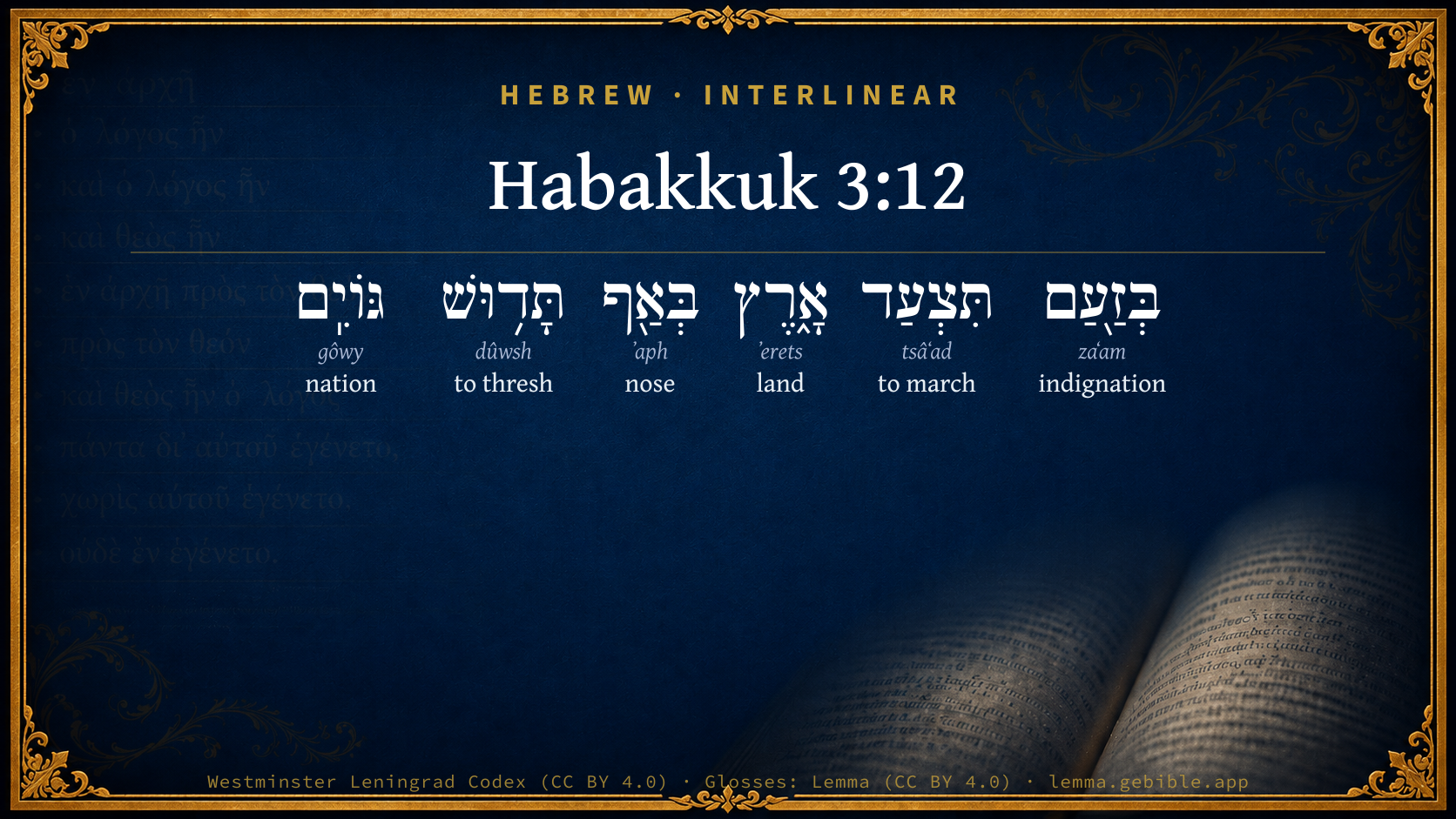
Habakkuk 3:12

Hebrew (Westminster Leningrad Codex) Habakkuk 3:12 appears in the Hebrew Old Testament. The text above is from the Westminster Leningrad Codex. Each word links to its Strong’s number, a concise gloss, and parsing drawn from the Open Scriptures Hebrew Bible morphology. Click any word for its full Brown-Driver-Briggs (BDB) entry.
Download image
Cite this verse

Habakkuk 3:12 (World English Bible). Public Domain. Lemma interlinear Bible study tool, https://lemma.gebible.app/v/habakkuk/3/12.

Show BibTeX & RIS
BibTeX
RIS
English Translation
You marched through the land in wrath. You threshed the nations in anger.
World English Bible · Public Domain
Download a study sheet

One document with this verse’s original text, its word-by-word gloss line, the meaning frame, cross-references with their text, attributed commentary, and full source and license credits — printable, and it pastes into notes with its structure intact.

This verse Autodidact and up

Study sheet (.html) Plain text (.txt)

A passage Seminary Student

Up to 50 verses in one chapter. A passage sheet keeps up to 6 commentary sources and 12 cross-references per verse, in the order this page ranks them, and says so on the sheet whenever that leaves anything out. Ask for a single verse and you get the Autodidact verse sheet above.

Everything on this page stays free to read, with no account — the sheet is a download of what is already on screen, not access to it.

Want to remove ads? Support Godless Engineer
Compare translations 3

The same verse in 3 English versions, stacked beneath the original-language interlinear above. Click any original word for its lexicon entry.

Each is an independent rendering of the whole verse — the interlinear is not word-aligned to these translations.

Highlighted words mark where these versions differ — a whole-verse word diff, not a word-by-word alignment.

  • World English Bible Public Domain
    You marched through the land in wrath. You threshed the nations in anger.
  • King James Version Public Domain
    Thou didst march through the land in indignation, thou didst thresh the heathen in anger.
  • unfoldingWord Literal Text CC BY-SA 4.0
    In indignation you marched through the earth; in anger you threshed the nations.

unfoldingWord Literal Text — © unfoldingWord, licensed CC BY-SA 4.0. Word-aligned USFM3 via Door43 (git.door43.org/unfoldingWord/en_ult).

Versions to compare (up to 4)

3 of 4 selected

Show all 18 translations

Every available English version of this verse, each an independent rendering of the whole verse.

  • World English Bible Public Domain
    You marched through the land in wrath. You threshed the nations in anger.
  • Berean Standard Bible Public Domain
    You marched across the earth with fury; You threshed the nations in wrath.
  • Majority Standard Bible Public Domain
    You marched across the earth with fury; You threshed the nations in wrath.
  • King James Version Public Domain
    Thou didst march through the land in indignation, thou didst thresh the heathen in anger.
  • American Standard Version (1901) Public Domain
    Thou didst march though the land in indignation; Thou didst thresh the nations in anger.
  • Revised Version (1885) Public Domain
    Thou didst march through the land in indignation, thou didst thresh the nations in anger.
  • Geneva Bible (1599) Public Domain
    Thou trodest downe the land in anger, and didest thresh the heathen in displeasure.
  • Douay-Rheims (1899) Public Domain
    In thy anger thou wilt tread the earth under foot: in thy wrath thou wilt astonish the nations.
  • Young's Literal Translation Public Domain
    In indignation Thou dost tread earth, In anger Thou dost thresh nations.
  • Literal Standard Version CC BY-SA 4.0
    In indignation You tread earth, || In anger You thresh nations.
  • Unlocked Literal Bible CC BY-SA 4.0
    You have marched over the earth with indignation. In wrath you have threshed the nations.
  • unfoldingWord Literal Text CC BY-SA 4.0
    In indignation you marched through the earth; in anger you threshed the nations.
  • Darby Bible Public Domain
    Thou didst march through the land in indignation, Thou didst thresh the nations in anger.
  • World Messianic Bible Public Domain
    You marched through the land in wrath. You threshed the nations in anger.
  • Webster's Bible Public Domain
    Thou didst march through the land in indignation, thou didst thresh the heathen in anger.
  • Free Bible Version CC BY-SA 4.0
    Indignant, you marched across the earth, trampling the nations in your anger.
  • Bible in Basic English Public Domain
    You went stepping through the land in wrath, crushing the nations in your passion.
  • JPS Tanakh (1917) Public Domain
    Thou marchest through the earth in indignation, Thou threshest the nations in anger.

Literal Standard Version (2020), Covenant Press — licensed CC BY-SA 4.0. Text via the HelloAO Bible API (eBible.org). Unlocked Literal Bible (unfoldingWord) — licensed CC BY-SA 4.0. Text via the HelloAO Bible API (eBible.org). unfoldingWord Literal Text — © unfoldingWord, licensed CC BY-SA 4.0. Word-aligned USFM3 via Door43 (git.door43.org/unfoldingWord/en_ult). Free Bible Version, Dr. Jonathan Gallagher — licensed CC BY-SA 4.0. Text via the HelloAO Bible API (eBible.org).

Word by word

More ways to search: Search by grammar → Find every occurrence → Compare this word →

Practice this passage: Drill this verse → Learn its vocabulary →

About this verse

These counts appear in no published source. They are computed here, from the morphology-tagged text and Lemma’s own curated glosses. What Lemma adds →

6
words
6
distinct lemmas
Prophets
section

Notable vocabulary

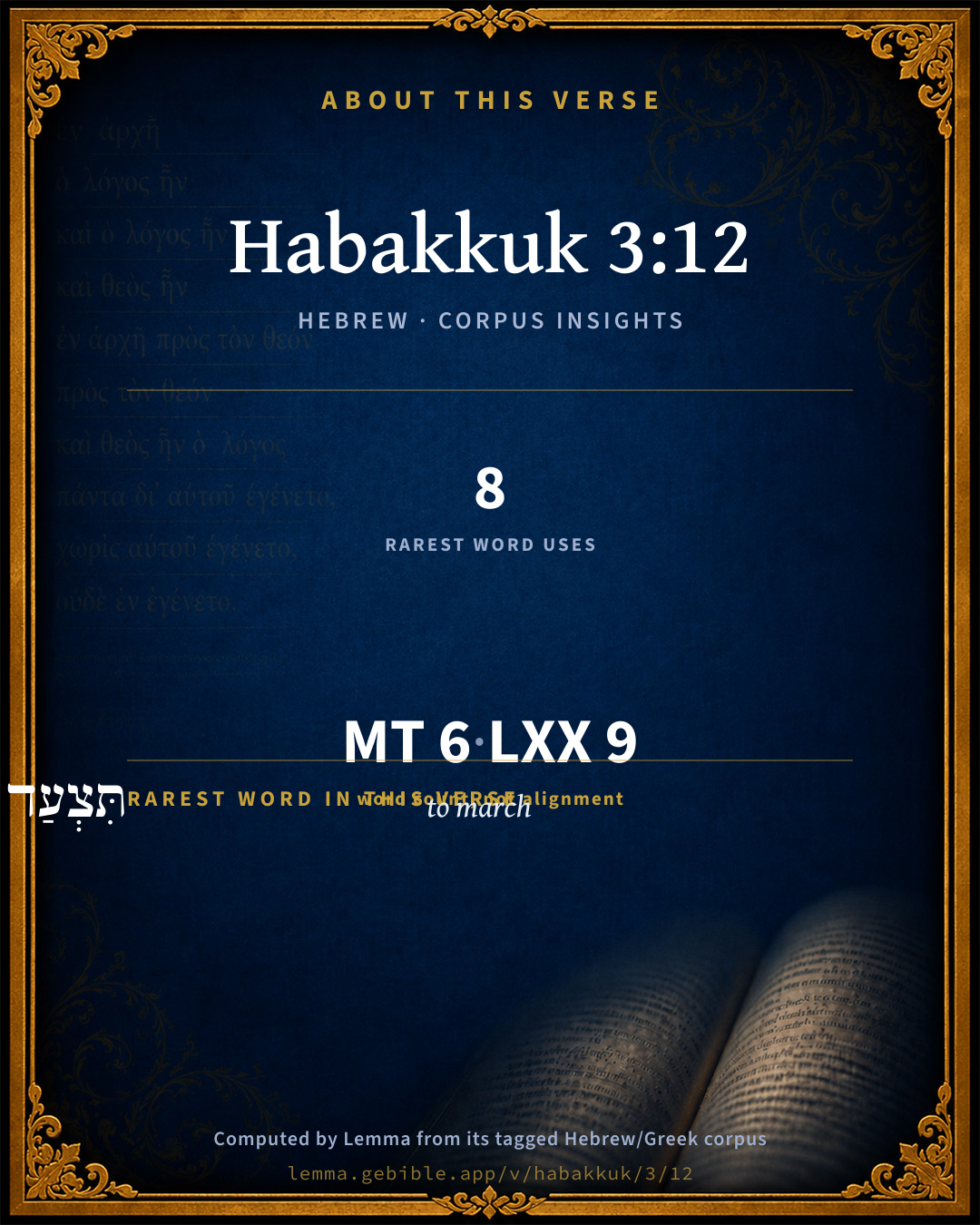
The rarest word here is תִּצְעַד to march H6805 — appearing just 8 times in the whole Hebrew Bible.

Shared distinctive vocabulary

תִּצְעַד to march H6805 occurs in 8 verses of the Hebrew Bible. Also found in:

Grammatical profile

  • 2 verbs
  • 4 nouns

Verb forms

  • תִּצְעַד Qal · Imperfect
  • תָּד֥וּשׁ Qal · Imperfect

Hebrew & Septuagint length

In English translation the verse runs 13 words from the Hebrew and 17 from the Septuagint (LXX English) — closely comparable.

A rough comparison of the two English renderings, which tokenize alike — not a word-level alignment.

Word counts can differ between the Hebrew and the Greek without any difference in meaning — e.g. the Hebrew direct-object marker אֵת has no separate Greek word, and Greek often adds the article ὁ.

In the original languages it is 6 Hebrew tokens and 9 Greek tokens — but the two are counted differently (Hebrew bundles its prefixes and suffixes into one token; the Greek is in lemma form), so that isn’t a like-for-like length.

Cross-references

10

Topical passages linked to Habakkuk 3:12 in the Treasury of Scripture Knowledge — connected by theme and wording, ordered by reader-vote popularity; previews shown in the World English Bible.

  • Jeremiah 51:33 For thus says Yahweh of hosts, the God of Israel: The daughter of Babylon is like a threshing floor at the time when it is trodden; yet a little while, and the time of harvest shall come for her.
  • Micah 4:12–13 But they don't know the thoughts of Yahweh, Neither do they understand his counsel; For he has gathered them like the sheaves to the threshing floor.
  • Numbers 21:23–35 Sihon would not allow Israel to pass through his border: but Sihon gathered all his people together, and went out against Israel into the wilderness, and came to Jahaz; and he fought against Israel.
  • Joshua 6:1–12 Now Jericho was tightly shut up because of the children of Israel: none went out, and none came in.
  • Nehemiah 9:22–24 Moreover you gave them kingdoms and peoples, which you did allot after their portions: so they possessed the land of Sihon, even the land of the king of Heshbon, and the land of Og king of Bashan.
  • Psalms 44:1–3 We have heard with our ears, God; Our fathers have told us, What work you did in their days, In the days of old.
  • Psalms 78:55 He also drove out the nations before them, Allotted them for an inheritance by line, And made the tribes of Israel to dwell in their tents.
  • Isaiah 41:15 Behold, I have made you [to be] a new sharp threshing instrument having teeth; you shall thresh the mountains, and beat them small, and shall make the hills as chaff.
  • Amos 1:3 Thus says Yahweh: "For three transgressions of Damascus, yes, for four, I will not turn away its punishment; Because they have threshed Gilead with threshing instruments of iron;
  • Acts 13:19 When he had destroyed seven nations in the land of Canaan, he gave them their land for an inheritance, for about four hundred fifty years.

Cross-references courtesy of OpenBible.info (CC BY 4.0).

Hebrew and Greek witnesses Masoretic Hebrew ↔ Greek Septuagint

The same verse in the two great witnesses to the Old Testament, shown verse-for-verse.

These are two independent witnesses, not word-aligned to each other, and the Septuagint is shown in lemma (dictionary) form.

Hebrew Habakkuk 3:12 Masoretic · Westminster Leningrad Codex

בְּזַ֖עַם תִּצְעַד אָ֑רֶץ בְּאַ֖ף תָּד֥וּשׁ גּוֹיִֽם

You marched through the land in wrath. You threshed the nations in anger.

World English Bible · Public Domain

Greek LXX Habakkuk 3:12 Septuagint · lemma form

ἐν ἀπειλή ὀλιγόω γῆ καί ἐν θυμός καταἄγω ἔθνος

You will bring low the land with threatening, and in wrath you will break down the nations.

LXX2012 (modern English Septuagint) · Public Domain

On this verse, Whedon's Commentary on the Bible discusses the Septuagint’s reading. Read the note in Commentary ↓

Hebrew: Westminster Leningrad Codex (CC BY 4.0). Greek: Septuagint (public domain); English from LXX2012 (modern English Septuagint) (Public Domain). How the Septuagint differs from the Hebrew →

Targum (Aramaic paraphrase)

1

The Targum is the ancient Jewish Aramaic paraphrase of the Hebrew Scriptures — an interpretive translation, not the Hebrew text itself. Onkelos (literal) and Pseudo-Jonathan (expansive) render the Torah, and Jonathan the Prophets. Coverage is partial: where no permissively-licensed English translation exists for a verse, only the Aramaic is shown. This is verse-level text, not a word-by-word alignment to the Hebrew.

  1. Targum Jonathan Prophets (Joshua–Malachi)
    בְּאַיְתָיוּתָךְ לוּט עַל סָנְאֵי עַמָךְ בְּאִתְגַלְיוּתָךְ לְמִתְּבַר רַשִׁיעֵי אַרְעָא בְרוּגְזָךְ תִּקְטוֹל בְּעַמְמַיָא:

    (no public-domain English translation for this verse)

    Targum Jonathan — Aramaic: “Mikraot Gedolot” (public domain). English: “Sefaria Community Translation” (CC0 1.0 (public-domain dedication)); “London "Chaldee Paraphrase," 1871” (public domain). Text via Sefaria.

Commentary

Notes on Habakkuk 3:12 from classic Christian and Jewish commentators (each source and its license shown beneath its notes). The classic Christian expositions comment on the surrounding passage and are grouped to its opening verse, so a note may address several verses; the Jewish commentaries on the Tanakh (Rashi and others) are per-verse, so they appear only where the commentator wrote on this verse.

Lemma curates 59 commentaries, every one of them public domain or Creative Commons licensed, each selected and text-cleaned for this edition rather than reprinted as found. About our sources →

Trapp's Complete Commentary

John Trapp

Hab 3:12 Thou didst march through the land in indignation, thou didst thresh the heathen in anger.

Ver. 12. Thou didst march through the land in indignation] Heb. Thou didst walk in pomp, as a conqueror, through the land, sc. of Canaan, in contempt of the opposite forces, treading upon the necks of thine enemies, Jos 10:24.

Thou didst thresh the heathen in anger] See Amo 1:3 Mic 4:13. God, by the hands of Joshua, did all this. The most of the old inhabitants were destroyed. Some few fled into Africa, and left written upon a pillar for a monument to posterity, We are Phoenicians, that fled from the face of Joshua, the son of Nave.

John Trapp, A Commentary or Exposition upon All the Books of the Old and New Testament (1647–1656) — public domain. Text from a community e-Sword module.

Whedon's Commentary on the Bible

Daniel D. Whedon

Hab_3:12-15 supply the answer to the question in Hab_3:8. Jehovah showed himself terrible not because he was displeased with the rivers, or the sea, or the mountains, but because his anger was kindled against the nations that oppressed his own people. Against the former he marched for the salvation of the latter.

12. Through the land — Better, through the earth; for Jehovah fought against more than one nation.

Thresh — Literally, tread down (see on Amo_1:3; compare 2Ki_13:7; Job_39:15). He spared no one.

In indignation,… in anger — Because they had wronged his people.

Hab_3:13 declares, at last, why Jehovah went forth.

Thou wentest forth — To war on behalf of his people (Jdg_5:4; Isa_42:13).

For the salvation — To bring deliverance from all enemies. Of thy people,…

with thine anointed — This is a literal reproduction of the original; but the expression “with thine anointed” creates difficulty. Who is this anointed one? It cannot be the expected Messiah, because the verse points to events in the past. R.V. renders “of thine anointed,” which produces a good parallelism and suggests that “thy people” and “thine anointed” are identical. In other passages also the term is applied to the nation, for anyone who has a special commission from Jehovah may be called “the anointed one.” In accordance with this principle the term is applied to Cyrus (Isa_45:1), to the high priest (Lev_4:3; Lev_4:5; Lev_4:16), to the king (1Sa_24:6), to the patriarchs (Psa_105:15), to the godly in the nation (Psa_132:10), and to the people Israel (Psa_84:9; Psa_89:38; Psa_89:51). It must refer to the people, even if the translation of A.V. is retained; he went forth with his people for their salvation.

Thou woundedst the head out of the house of the wicked — This might possibly mean that Jehovah smote the head of the chief of the evildoers, but with this translation the last clause becomes unintelligible; margin R.V.

gives better sense, “Thou didst smite off the head from the house of the wicked man.” To this may be joined the rest of the verse as translated in R.V., “laying bare the foundation even unto the neck.” The last clause indicates that, though the whole is figurative, within the figure “house” is to be understood literally; the “head” is the upper part, the roof, the “neck” is its central portion, the “foundation” the lowest part; the “wicked man” is the enemy of the “anointed one.” The whole is a picture of the utter destruction of this enemy of the people of Jehovah. Who this enemy is taken to be depends upon the interpretation of the poem as a whole. If the poet is describing the divine interference at the time of the Exodus, the enemy is Pharaoh or the Egyptian nation; if the poem contains a summary of all the divine manifestations of the past, he represents all the hostile nations ever encountered by Israel; if it points to the future, which is not likely, he is the Chaldean. The tone of the entire context suggests that the first view is to be preferred (compare Hab_3:15). Laying bare (R.V.) — Used here in the general sense of “destroy” (Mic_1:6; Psa_137:7).

It must be admitted that the whole figure is a strange one; LXX. either read a different text or could not make anything out of the Hebrew; several recent commentators consider the text hopelessly corrupt.

Daniel D. Whedon (gen. ed.), Commentary on the Old and New Testaments (1874–1909) — public domain. Text from a community e-Sword module.

The Preacher's Complete Homiletical Commentary

Joseph S. Exell (gen. ed.)

CRITICAL NOTES.]

Hab_3:12.] Acts of judgment connected with the salvation of Israel. March] Solemn and majestic proceeding (Jdg_5:4; Psa_68:8). Thresh] Tread down the enemy (Mic_4:13).

Hab_3:13.] The end of Divine manifestation. Salvation] Rescue. Anointed] Not any particular king, “but the Davidic King absolutely, including the Messiah, in whom the sovereignty of David is raised to an eternal duration” [Keil]. Head] wounded. Neck] bared; the injury from above and from below; the very foundation destroyed. The necks of princes were trodden under the foot of Israel’s leaders, and the first-born of Egypt cut off.

Hab_3:14.] Warlike nations meet the same fate as royal houses. Staves] The sword of the foe himself, the instrument of destruction to his armies and villages. Some, “that the hostile troops will slay one another in confusion” (cf. 1Sa_14:20; 2Ch_20:23-24). Came] with swiftness and violence, like a storm to destroy me. Scatter] The figure of dispersing chaff (Isa_41:16; Jer_13:24). Rejoicing] i.e. directed to swallow the poor in secret (Psa_10:9).

Hab_3:15. Sea] To destroy these enemies like Pharaoh’s hosts. No obstacle prevented God’s progress.

HOMILETICS

THE ROYAL MARCH.—Hab_3:12-15

To march, is used of the solemn and majestic proceeding of Jehovah before the Hebrews (Jdg_5:4; Psa_68:8 cf. Henderson). The defeat and extermination of the Canaanites and the planting of Israel were the doings of Jehovah.

I. A benevolent march. “Thou wentest forth for the salvation of thy people.” We speak of “the wanderings of Israel,” but they were an appointed, well-ordered march, designed for victory. God, as Commander-in-chief, went with them. With his anointed instruments—Moses, Joshua, and David, types of the Messiah—he delivered them from their enemies. Salvation is the design, and will be the result, of all the doings of God for his people. The Church will never lack leaders, but in each we have a pledge of eternal deliverance by Jesus Christ. “He that is our God is the God of salvation; and unto God the Lord belong the issues from death.”

II. A terrible march. The march was not only in royal dignity, but in judicial power.

1. Terrible in its aspects. “Thou didst walk through the sea with thine horses.” In majesty, power, and splendour, the Exodus was the type of all victories present and future. Waters stand on heap, and the deep becomes a path for his people. “Dividing the water before them, to make himself an everlasting name” (Isa_63:12-13).

2. Terrible in its consequences. The foes, princes, and peoples, were overthrown, exterminated, and supplanted. He slew great kings and famous (Psa_136:17-18). Much more will God display his power to exalt Christ and overthrow his enemies. “The Lord is the saving strength of his anointed.”

III. A triumphant march. No obstacles impeded the march. Mountains shook, waters fled, and the lofty bowed before God’s presence in his Church. 1. Royal houses were destroyed. “Thou woundedst the head out of the house of the wicked.” Each head and prince which sprung from the family was cut off, in cities and villages. The neck, an emblem of dignity and power (Son_4:4); stubbornness and pride (Deu_31:27; Psa_75:5) was laid bare. The head and foundation, high and low, were completely destroyed. “I will cut off from Babylon the name and remnant, and son, and nephew (grandson), saith the Lord.”

2. Warlike nations were defeated. “They came out (were tempestuous) as a whirlwind to scatter me.” Violent, powerful, and insatiable ware the enemies. Pharaoh and Sennacherib came out as a storm, to sweep everything before them, like chaff in the wilderness (Jer_13:24; Jer_18:17; Isa_41:16). “I will pursue, I will overtake, I will divide the spoil; my lust shall be satisfied upon them; I will draw my sword, my hand shall destroy them.” (a) Defeated in their secret purpose. “Their rejoicing was as to devour the poor secretly.” The poor are not a match for the powerful. Hence their pride and confidence of success. But God frustrated their intentions. Their boasting made their fall more disgraceful, and God’s care for his people more glorious. (b) Defeated with their own weapons. He struck through “with his staves.” The destruction was not only upon himself, but upon the multitude of his subjects, and through an act of Divine might by his own weapons. The mischief which he had prepared for others fell upon himself. This has always been the case. With the Midianites and Amalekites (Jdg_7:22); with the Philistines (1Sa_14:16-20); and the inhabitants of Seir (2Ch_20:22-23); in the case of Haman and Daniel those who made the pit fell into it. Heathens declared that there was “no juster law than that artificers of death by their own art should perish.” Fearful will be the future illustrations of this principle (cf. Eze_38:21; Isa_9:20; Zec_14:13).

HOMILETIC HINTS AND SUGGESTIONS

Hab_3:12.

1. God’s anger.

2. The report of God’s anger. “Through the land.” Not the mere land of Canaan, but the whole earth.

3. The fearful consequences of God’s anger. “Thou didst thresh,” a word indicating the ease and power with which this was done, and the complete subjugation of the enemy (Mic_4:13).

Hab_3:13. Head. “He shall destroy at once, from above and below; overthrowing his kingdom from the foundation. From above, his head was crushed in pieces; from below, the house was razed from its very foundations” [Pusey]. The power, pride, and wisdom, the very life of evil to be conquered by God. “He smites his foes on the crown of their pride,” says one. “The seed of the woman crushes the serpent’s head. There is no defence against the Lord, he can in a moment smite with utter destruction the lofty crests of his haughty foes” (cf. Psa_68:21; Psa_110:6).

Hab_3:14.

1. The end in view—“devour the poor.”

2. The method of accomplishing the end—“secretly.”

3. The feeling with which the end is pursued. “Their rejoicing.” The rich boast in wealth, the mighty in power; but the cruel exult in mischief. The ferocity, craft, and activity of the oppressor, and the danger, snares, and helplessness of the oppressed, are described.

“Do not insult calamity;

It is a barbarous grossness to lay on

The weight of scorn, where heavy misery

Too much already weighs men’s fortunes down” [Daniel].

Hab_3:15. A second glance.

1. In time of ease we are satisfied with a cursory glance, a time of trouble promotes a deeper view of God’s works. We seek relief, and find that we never dwell enough on them. Particularly, extraordinary works would be oftener remembered, so much doth the prophet’s practice of looking over again on this act teach us.

2. It is worthy of our second and serious thought—both to honour God and confirm our faith—to consider that God’s people are so dear unto him that he will change the course of nature to save them; that he can make them go safely, like conquerors, through affliction and danger [Hutcheson]. Take the verse as emblematic of God’s ways.

1. Deep as the sea.

2. Swift and orderly, as horses yoked in a chariot.

3. Safe, though threatened by the “heap of great waters” boiling up as in a storm. “The immediate connection, however, shows that what the prophet has in view is not the Red Sea, but the hostile army of the Canaanites, which presented a furious and impenetrable aspect to the Hebrews. Through this army Jehovah is represented as walking with his warriors, as if a general were coolly to march his cavalry through the thickest of a proud and vaunting foe, which he knew would prove utterly powerless in the attack” [Henderson].

ILLUSTRATIONS TO CHAPTER 3

Hab_3:10-15. The whole passage depicts God’s descent to help his people, attended by earthquake, splendour, and power. So tremendous was the shock of God’s assault in arms that the order of nature was changed, and the bottoms of rivers and seas were laid bare. What will not Jehovah’s rebuke do? Vain are the attempts of men to conceal anything from him whose word unbars the deep, and lifts the doors of earth from their hinges! Vain are all hopes of resistance, for a whisper of his voice makes the whole earth quail in abject terror [Spurgeon].

The volcanic phenomena of Palestine open a question of which the data are, in a scientific point of view, too imperfect to be discussed; but there is enough in the history and literature of the people to show that there was an agency of this kind at work. Their traces on the permanent feeling of the nation must be noticed. The writings of the psalmists and prophets abound with indications which escape the eye of a superficial reader. Like the soil of their country, they actually heave and labour with the fiery convulsions which glow beneath their surface [A. P. Stanley].

The Preacher's Complete Homiletical Commentary (gen. ed. Joseph S. Exell; Funk & Wagnalls, c. 1892) — public domain (pre-1929). A full-Bible homiletical/sermon-outline anthology covering 65 of 66 books (2 John is absent from the source module). Text from a community e-Sword module.

Keil & Delitzsch

C. F. Keil & F. Delitzsch

In Hab 3:12 there follows a description of the judgment upon the nations for the rescue of the people of God. Hab 3:12. "In fury Thou walkest through the earth, in wrath Thou stampest down nations. Hab 3:13. Thou goest out to the rescue of Thy people, to the rescue of Thine anointed one; Thou dashest in pieces the head from the house of the wicked one, laying bare the foundation even to the neck. Selah. Hab 3:14. Thou piercest with his spears the head of his hordes, which storm hither to beat me to powder, whose rejoicing is, as it were, to swallow the poor in secret. Hab 3:15. Thou treadest upon the sea: Thy horses, upon the heap of great waters." The Lord, at whose coming in the terrible glory of the majesty of the Judge of the world all nature trembles and appears to fall into its primary chaotic state, marches over the earth, and stamps or tramples down the nations with His feet (compare the kindred figure of the treader of the winepress in Isa 63:1-6). Not all nations, however, but only those that are hostile to Him; for He has come forth to save His people and His anointed one. The perfects in Hab 3:13-15 are prophetic, describing the future in spirit as having already occurred. יצא, referring to the going out of God to fight for His people, as in Jdg 5:4; Sa2 5:24; Isa 42:13, etc. ישׁע, rescue, salvation, is construed the second time with an accusative like an inf. constr. (see Ewald, 239, a). The anointed of God is not the chosen, consecrated nation (Schnur., Ros., Hitzig, Ewald, etc.); for the nation of Israel is never called the anointed one (hammâshı̄ăch) by virtue of its calling to be "a kingdom of priests" (mamlekheth kohănı̄m, Exo 19:6), neither in Psa 28:8 nor in Psa 84:10; Psa 89:39. Even in Psa 105:15 it is not the Israelites who are called by God "my anointed" (meshı̄chai), but the patriarchs, as princes consecrated by God (Gen 23:6). And so here also משׁיחך is the divinely-appointed king of Israel; not, however, this or that historical king - say Josiah, Jehoiakim, or even Jehoiachin - but the Davidic king absolutely, including the Messiah, in whom the sovereignty of David is raised to an eternal duration, "just as by the Chaldaean king here and in Psa 2:1-12 we must understand the Chaldaean kings generally" (Delitzsch), wince the prophecy spreads from the judgment upon the Chaldaeans to the universal judgment upon the nations, and the Chaldaean is merely introduced as the possessor of the imperial power. The Messiah as the Son of David is distinguished from Jehovah, and as such is the object of divine help, just as in Zac 9:9, where He is called נושׁע in this respect, and in the royal Messianic psalms. This help God bestows upon His people and His anointed, by dashing in pieces the head from the house of the wicked one. The râshâ‛ (wicked one) is the Chaldaean, not the nation, however, which is spoken of for the first time in Hab 3:14, but the Chaldaean king, as chief of the imperial power which is hostile to the kingdom of God. But, as the following clause clearly shows, the house is the house in the literal sense, so that the "head," as part of the house, is the gable. A distinction is drawn between this and yeshōd, the foundation, and צוּאר, the neck, i.e., the central part looking from the gable downwards. The destruction takes place both from above and below at once, so that the gable and the foundation are dashed in pieces with one blow, and that even to the neck, i.e., up to the point at which the roof or gable rests upon the walls. עד, inclusive, embracing the part mentioned as the boundary; not exclusive, so as to leave the walls still rising up as ruins. The description is allegorical, the house representing the Chaldaean dynasty, the royal family including the king, but not "including the exalted Chaldaean kingdom in all its prosperity" (Hitzig). ערות, a rare form of the inf. abs., like שׁתות in Isa 22:13 (cf. Ewald, 240, b), from ערה, to make bare, to destroy from the very foundation, the infinitive in the sense of the gerund describing the mode of the action.

The warlike nation meets with the same fate as the royal house (Hab 3:14). The meaning of the first clause of the verse depends upon the explanation to be given to the word perâzâv. There is no foundation for the meaning leaders or judges, which has been claimed for the word perâzı̄m ever since the time of Schroeder and Schnur. In Hebrew usage perâzı̄ signifies the inhabitant of the plain (Deu 3:5; Sa1 6:18), and perâzōth the plains, the open flat land, as distinguished from walled cities (Eze 38:11). Perâzōn has the same meaning in Jdg 5:7 and Jdg 5:11. Consequently Delitzsch derives perâzâv from a segholate noun perez or pērez, in the sense of the population settled upon the open country, the villagers and peasantry, whence the more general signification of a crowd or multitude of people, and here, since the context points to warriors, the meaning hordes, or hostile companies, which agrees with the Targum, Rashi, and Kimchi, who explain the word as signifying warriors or warlike troops. ראשׁ, the head of his hordes, cannot be the leader, partly because of what follows, "who come storming on," which presupposes that not the leader only, but the hordes or warriors, will be destroyed, and partly also because of the preceding verse, in which the destruction of the king is pronounced, and also because the distinction between the king and the leader of the army is at variance with the complex character of the prophetic description. We must take ראשׁ in the literal sense, but collectively, "heads." The prophet was led to the unusual figure of the piercing of the head by the reminiscence of the piercing of Sisera's head by Jael (Jdg 5:26). The suffixes in בּמטּיו and פּרזו refer back to רשׁע. מטּיו, sticks, for lance or spears, after Sa2 18:14. The meaning of the words is this: with the spear of the king God pierces the heads of his warlike troops; and the thought expressed is, that the hostile troops will slay one another in consequence of the confusion, as was the case in the wars described in Sa1 14:20 and Ch2 20:23-24, and as, according to prophecy, the last hostile power of the world is to meet with its ruin when it shall attack the kingdom of God (Eze 38:21; Zac 14:13). יסערוּ להף is to be taken relatively: "which storm hither (sâ‛ar, approach with the swiftness and violence of a storm) to destroy me." The prophet includes himself along with the nation, and uses hēphı̄ts with reference to the figure of the dispersion or powdering of the chaff by a stormy wind (Isa 41:16; Jer 13:24; Jer 18:17). עליצתם forms a substantive clause by itself: "their rejoicing is," for they who rejoice, as if to swallow, i.e., whose rejoicing is directed to this, to swallow the poor in secret. The enemies are compared to highway murderers, who lurk in dark corners for the defenceless traveller, and look forward with rejoicing for the moment when they may be able to murder him. עני forms the antithesis to רשׁע. Inasmuch as "the wicked" denotes the Chaldaean; "the poor" is the nation of Israel, i.e., the congregation of the righteous, who are really the people of God. To devour the poor, i.e., to take violent possession of his life and all that he has (cf. Pro 30:14, and for the fact itself, Psa 10:8-10), is, when applied to a nation, to destroy it (vid., Deu 7:16 and Jer 10:25).

In order that these enemies may be utterly destroyed, God passes through the sea. This thought in Hab 3:15 connects the conclusion of the description of the judicial coming of God with what precedes. The drapery of the thought rests upon the fact of the destruction of Pharaoh and his horsemen in the Red Sea (Exodus 14). The sea, the heap of many waters, is not a figurative expression for the army of the enemy, but is to be taken literally. This is required by דּרכתּ ביּם, since דּרך with ב, to tread upon a place, or enter into it (cf. Mic 5:4; Isa 59:8; Deu 11:24-25), does not suit the figurative interpretation; and it is required still more by the parallel passages, viz., Psa 77:20 (בּיּם דּרכּך), which floated before the prophet's mind, and Zac 10:11. Just as God went through the Red Sea in the olden time to lead Israel through, and to destroy the Egyptian army, so will He in the future go through the sea and do the same, when He goes forth to rescue His people out of the power of the Chaldaean. The prophet does not express the latter indeed, but it is implied in what he says. סוּסיך is an accusative, not instrumenti, however, but of more precise definition: thou, namely, according to thy horses; for "with thy horses," as in Ps. 83:19; Psa 44:3 (אתּה ידך); cf. Ewald, 281, c, and 293, c. The horses are to be taken, as in Hab 3:8, as harnessed to the chariots; and they are mentioned here with reference to the horses and chariots of Pharaoh, which were destroyed by Jehovah in the sea. Chōmer, in the sense of heap, as in Exo 8:10, is not an accusative, but is still dependent upon the ב of the parallel clause. The expression "heap of many waters" serves simply to fill up the picture, as in Psa 77:20.

Keil & Delitzsch — Biblical Commentary on the Old Testament (1861–1891) — public domain (CC PDM 1.0). Text via the HelloAO Bible API. (Old Testament only.)

Jamieson, Fausset & Brown

Robert Jamieson, A. R. Fausset & David Brown

march--implying Jehovah's majestic and irresistible progress before His people (Jdg 5:4; Psa 68:7). Israel would not have dared to attack the nations, unless Jehovah had gone before.

thresh-- (Mic 4:13).

Jamieson, Fausset & Brown — Commentary Critical and Explanatory on the Whole Bible (1871) — public domain (CC PDM 1.0). Text via the HelloAO Bible API.

Adam Clarke's Commentary

Verse 12. Thou didst march through the land] This refers to the conquest of Canaan. God is represented as going at the head of his people as general-in-chief; and leading them on from conquest to conquest-which was the fact.

Thou didst thresh the heathen in anger.] Thou didst tread them down, as the oxen do the sheaves on the threshing-floor.

Adam Clarke's Commentary on the Bible (1810–1826) — public domain. Text from a community e-Sword/MySword module.

John Calvin's Commentaries

The Prophet relates here the entrance of the people into the land of Canaan, that the faithful might know that their fathers would not have obtained so many victories had not God put forth the power and strength of his hand. Hence he says, that God himself had trampled on the land in anger. For how could the Israelites have dared to attack so many nations, who had lately come forth from so miserable a bondage? They had indeed been in the desert for forty years; but they were always trembling and fearful, and we also know that they were weak and feeble. How then was it, that they overcame most powerful kings? that they made war with nations accustomed to war? Doubtless God himself trod down the land in his wrath, and also threshed the nations: as it is said in Psalm 44:5,

“It was not by their own sword that they got the land of Canaan; neither their own power, nor their own hand saved them; but the Lord showed favor to them, and became their Deliverer.”

Justly then does the Prophet ascribe this to God, that he himself walked over the land; for otherwise the Israelites would never have dared to move a foot. Doubtless, they could never have been settled in that land, had not God gone before them. Hence when God did tread on the land in his anger, then it became a quiet habitation to the children of Abraham; warlike nations were then easily and without much trouble conquered by the Israelites, though they were previously very weak.

We now see, that the Prophet sets forth here before the eyes of the people their entrance into the land, that they might know that God did not in vain put to flight so many nations at one time; but that the land of Canaan might be the perpetual inheritance of his chosen people.

The Prophet changes often the tenses of the verbs, inconsistently with the common usage of the Hebrew language; but it must be observed, that he so refers to those histories, as though God were continually carrying on his operations; and as though his presence was to be looked for in adversities, the same as what he had granted formerly to the fathers. Hence the change of tenses does not obscure the sense, but, on the contrary, shows to us the design of the Prophet, and helps us to understand the meaning. It follows at length -

John Calvin's Commentaries (1540-1563) — public domain. Text from the Calvin Translation Society English edition (1840s-50s) via the Christian Classics Ethereal Library (ccel.org). Calvin's coverage is partial (roughly two-thirds of the Bible); uncommented books and verses are honest gaps, never fabricated. The 19th-century editor's footnotes and remarks are omitted so the notes are faithfully Calvin's own voice.

Ellicott's Commentary for English Readers

(12) Thou didst march.—Here the verbs are in the future, and are to be rendered accordingly.

A Bible Commentary for English Readers, edited by Charles John Ellicott (1878–1897) — public domain. Text from a community e-Sword module.

The Cambridge Bible for Schools and Colleges

gen. ed. J. J. S. Perowne

12. Thou didst march] In indignation thou marchest through the earth; thou dost thresh the nations In anger. As in former times “threshing” was performed by treading (Deu_25:4), the sense is: thou treadest down; 2Ki_13:7; Job_39:15, comp. the figures Isa_63:1-6. The term “march” means to take great steps, to stride.

12–15. The Lord is come forth for the salvation of his people

The former verses have described the Theophany in itself and in its effects upon nature; now the outpouring of Jehovah’s indignation on the foes of His people is described.

The Cambridge Bible for Schools and Colleges (gen. ed. J. J. S. Perowne; Cambridge University Press, 1878–1918) — public domain. Text from a community e-Sword module.

John Gill's Exposition

Thou didst march through the land with indignation,.... Not the land of Canaan, fighting against the inhabitants of it, dispossessing them to make room for the Israelites, whatever allusion may be to it; but the antichristian land, the whole Romish jurisdiction, and all the states of it, through which the Lord will march in wrath and fury, when he pours out the vials of it upon them; or this is desired, and prayed for; for it may be rendered, "do thou march through the land" (r), &c.; foreseeing and believing that he would:

thou didst thresh the heathen in anger; or, "do thou thresh" (s), &c.; these are the Papists, called heathens and Gentiles in Scripture, because of the heathenish customs and practices they have introduced into the Christian religion, Psa 10:16 these are the nations that will be gathered together like sheaves of grain on a floor to be threshed; and when Zion the church of Christ, and Christian princes, will be called upon to arise, and thresh them; and the Lord by them will do it, namely, separate his own people from them, which are like wheat, and utterly destroy them, as chaff and stubble, Mic 4:12.

(r) "progredlaris", Van Till. (s) "tritures", Van Till.

John Gill's Exposition of the Whole Bible (1746–1763) — public domain (CC PDM 1.0). Text via the HelloAO Bible API.

Albert Barnes' Notes on the Bible

Thou didst march the earth in indignation - The word “tread” is used of very solemn manifestations of God, (Jdg 5:4; Psa 68:8; of the procession of the ark, 2Sa 6:13. It is denied as to the idols, Jer 10:5.) of His going to give to His own victory over their enemies Not the land only, as of old, but the earth is the scene of His judgments; the earth which was “full of His praise,” which He “meted out” Hab 3:3, Hab 3:6 which contained the nations whom He chastened, the whole earth.

Thou dost thresh the heathen in anger - Not then only, but at all times unto the end, distress of nations and perplexity are among the shoots of the fig tree, which betoken that the everlasting, Luk 21:25-31, “summer is nigh at hand.” Jerusalem, when it had slain the Prince of Life, was given over to desolation and counted like the pagan. It became the synagogue, not the Church; and so in the destruction of Jerusalem (as it is an image of the destruction of the world) was that again fulfilled, “Thou dost march through the earth in indignation, Thou dost thresh the heathen in anger.”

Albert Barnes' Notes on the Bible (1834–1885) — public domain. Text from a community e-Sword/MySword module.

Matthew Poole's English Annotations

Thou, our God,

didst march, as the victorious Conqueror leading still thine armies, the tribes of Israel, through the land of Canaan, to subdue the remainders of thine enemies and theirs, and to give thine Israel possession of the Promised Land.

In indignation against them for their sins.

Thou didst thresh, break to pieces,

the heathen, the nation: devoted to destruction; these were cut in pieces by the sword of Israel.

Matthew Poole's English Annotations on the Holy Bible (1683–1685) — public domain. Text from a community e-Sword/MySword module.

The Pulpit Commentary

Thou didst march through the land in indignation; thou treadest the earth in.fury. The mighty Judge stalks over the earth. (ver. 6; Jud_1:5:4; Psa_68:7) It is a general statement, and not to be confined to the successes of Joshua and the destruction of the Canaanites. Septuagint, jEn ajpeilh ojligwseiv ghn, with the alteration of a letter," Thou wilt bring low the land with threats." Thou didst thresh the heathen (nations ) in anger; Septuagint, ejn qumw kataxeiv ("thou wilt break in pieces") eqnh. Jerome here renders the verb, obstupefacies; but elsewhere, as Isa_28:28; Hos_10:11 Amo_1:3, he uses triturare which gives the best meaning. The kindred figure is found in Mic_4:13; Isa_63:1, etc.

The Pulpit Commentary (1880–1919), ed. H.D.M. Spence-Jones & Joseph S. Exell — public domain. Text from a community e-Sword module.

Rashi

Rabbi Shlomo Yitzchaki (Rashi)

With fury You tread the earth to drive out the seven nation [the heathens of Canaan].

Rashi on the Tanakh — English translations: “The Judaica Press complete Tanach with Rashi, translated by A. J. Rosenberg” (CC BY 4.0); “Pentateuch with Rashi's commentary by M. Rosenbaum and A.M. Silbermann, 1929-1934” (public domain); “The Metsudah Tanach series, Lakewood, N.J” (CC BY 4.0); and “The Book of Joshua, Metsudah Publications, 1997” (CC BY 4.0). Text via Sefaria.

Lesson kit

Teaching starters — assembled from the data on this page, not authored interpretation. Every prompt links to the verse data it draws on. Edit before teaching.

Habakkuk, in the Prophets, opens this verse with 6 words (6 distinct Hebrew lemmas). Its most distinctive word is tsâʻad (“to march”). A historical commentator’s framing appears above. Read the whole chapter for the surrounding context.

Discussion questions

  1. What does “to march” (tsâʻad) contribute to the verse as a whole?
  2. Genesis 49:22 shares the word «to march» with this verse. How do the two illuminate each other?
  3. These translations render this verse differently; the difference is in the English rendering, not the original. What questions does that raise?
  4. The verb «תִּצְעַד» is Qal Imperfect. How does its form color the action?
  5. Reading how Trapp's Complete Commentary and Whedon's Commentary on the Bible read this verse, where do the two commentators agree and where do they part?

Things to notice

Reading settings

Reading text

Shown beneath each verse's original-language words.

Old Testament
Old Testament edition

Read the OT as the Masoretic Hebrew (MT) or the Greek Septuagint (LXX).

English shown for the Greek Septuagint (in the Hebrew ↔ Greek comparison).

Comparing translations? Open the Compare panel on any verse page to stack up to four side by side.