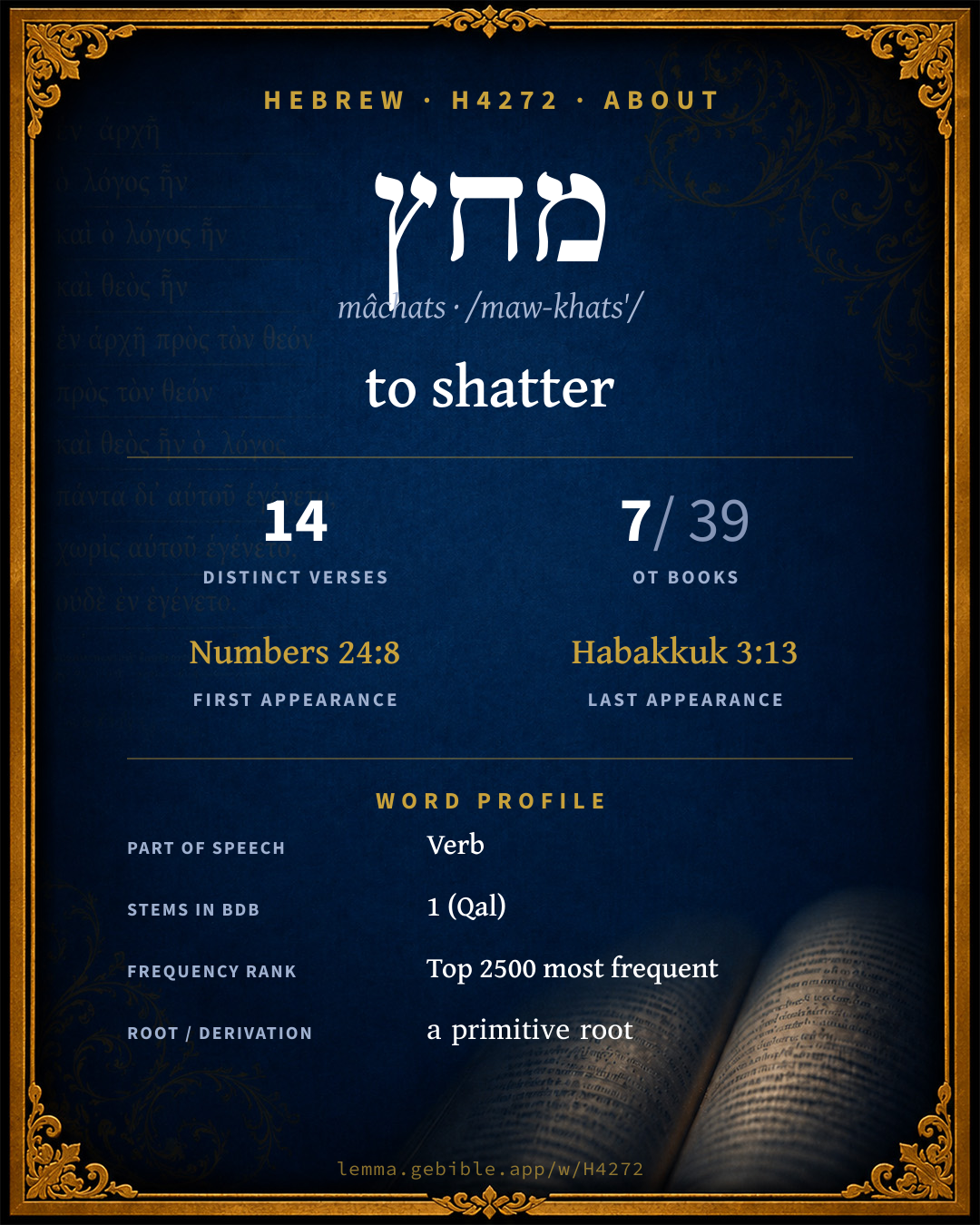
מָחַץ
to shatter
‘to shatter’ is one of 3 main senses fuller range ↓
Full lexicon entry — Brown-Driver-Briggs (BDB)
From Brown-Driver-Briggs (BDB)
Where this word appears
Grammar key — what these labels mean
Part of speech
- Verb
- An action or state-of-being word.
Stem
- Qal
- The basic, simple active stem — the plain form of the verb (“he wrote”).
Form
- Imperfect
- An incomplete, ongoing, or future action (“he will / would write”).
- Perfect
- A completed action or state — Hebrew marks aspect (completeness) more than strict tense (“he wrote”).
- Sequential Perfect
- A perfect with prefixed waw continuing a preceding imperfect or command (waw-consecutive perfect).
- Sequential Imperfect
- An imperfect with prefixed waw — the standard past-narrative form (waw-consecutive imperfect).
- Imperative
- A direct command (“write!”).
Person
- 3rd Person
- The one spoken about (“he / she / it / they”).
- 1st Person
- The speaker (“I / we”).
- 2nd Person
- The one addressed (“you”).
Gender
- Masculine
- Grammatically masculine.
- Feminine
- Grammatically feminine.
- Common
- Either gender — not distinguished for this form.
Number
- Singular
- One.
Grammatical forms 10 distinct
- Verb, Qal, Imperfect, 3rd Person, Masculine, Singular 3 times (21%)
- Verb, Qal, Perfect, 3rd Person, Masculine, Singular 3 times (21%)
- Verb, Qal, Perfect, 3rd Person, Feminine, Singular 1 time (7%)
- Verb, Qal, Sequential Perfect, 3rd Person, Masculine, Singular 1 time (7%)
- Verb, Qal, Sequential Imperfect, 1st Person, Common, Singular 1 time (7%)
- Verb, Qal, Imperfect, 1st Person, Common, Singular 1 time (7%)
- Verb, Qal, Imperfect, 3rd Person, Feminine, Singular 1 time (7%)
- Verb, Qal, Perfect, 1st Person, Common, Singular 1 time (7%)
+2 more forms (2 occurrences)
Parsed forms decoded from the imported morphology (morphhb / Westminster Leningrad Codex — WLC text public domain, morphhb tagging CC BY 4.0), counted across 14 parsed occurrences — not distinct verses.
Every verse where H4272 appears — 14 distinct verses across 7 books. Click any verse to open its interlinear word-by-word view. Verse text shown in the World English Bible for context — . Each verse’s Hebrew form is shown with its reference; the English is not keyword-highlighted, since the data carries no word-level English alignment. Use “Compare translations” on any verse to read it across multiple English versions. This concordance covers the Hebrew Bible; Septuagint (Greek Old Testament) occurrences are not indexed here.
Numbers 2 verses
- Numbers 24:8 יִמְחָֽץ Qal impf 3ms God brings him forth out of Egypt; He has as it were the strength of the wild-ox: He shall eat up the nations his adversaries, Shall break their bones in pieces, Smite [them] through with his arrows.
- Numbers 24:17 וּ/מָחַץ֙ conj + Qal wpf 3ms I see him, but not now; I see him, but not near: There shall come forth a star out of Jacob, A scepter shall rise out of Israel, Shall strike through the corners of Moab, Break down all the sons of tumult.
Deuteronomy 2 verses
- Deuteronomy 32:39 מָחַ֨צְתִּי֙ Qal pf 1cs See now that I, even I, am he, There is no god with me: I kill, and I make alive; I wound, and I heal; There is none who can deliver out of my hand.
- Deuteronomy 33:11 מְחַ֨ץ Qal impv 2ms Bless, Yahweh, his substance, Accept the work of his hands: Smite through the loins of those who rise up against him, Of those who hate him, that they not rise again.
Judges 1 verse
2 Samuel 1 verse
Job 2 verses
Psalms 5 verses
- Psalms 18:38 אֶ֭מְחָצֵ/ם Qal impf 1cs + sfx pers 3mp I will strike them through, so that they will not be able to rise. They shall fall under my feet.
- Psalms 68:21 יִמְחַץ֮ Qal impf 3ms But God will strike through the head of his enemies, The hairy scalp of such a one as still continues in his guiltiness.
- Psalms 68:23 תִּֽמְחַ֥ץ Qal impf 3fs That you may crush them, dipping your foot in blood, That the tongues of your dogs may have their portion from your enemies."
- Psalms 110:5 מָחַ֖ץ Qal pf 3ms The Lord is at your right hand. He will crush kings in the day of his wrath.
- Psalms 110:6 מָ֥חַץ Qal pf 3ms He will judge among the nations. He will heap up dead bodies. He will crush the ruler of the whole earth.
Habakkuk 1 verse
About this entry
At a glance — auto-summarized from this page’s data, not written by a person. Every figure links to its source below. This summary describes the numbers; it doesn’t interpret them.
At its core, מחץ (mâchats) means “to shatter.” Scripture first uses it in Numbers 24:8. It appears 14 verses across 7 books of the Hebrew Bible, among its uncommon vocabulary. The word gravitates to Psalms (36%), then Numbers and Deuteronomy. Not a single-sense word: explore its full sense range. Each statement above links to its evidence; the full detail follows below.
Gloss history
Strong's 1890 vs modern scholarship
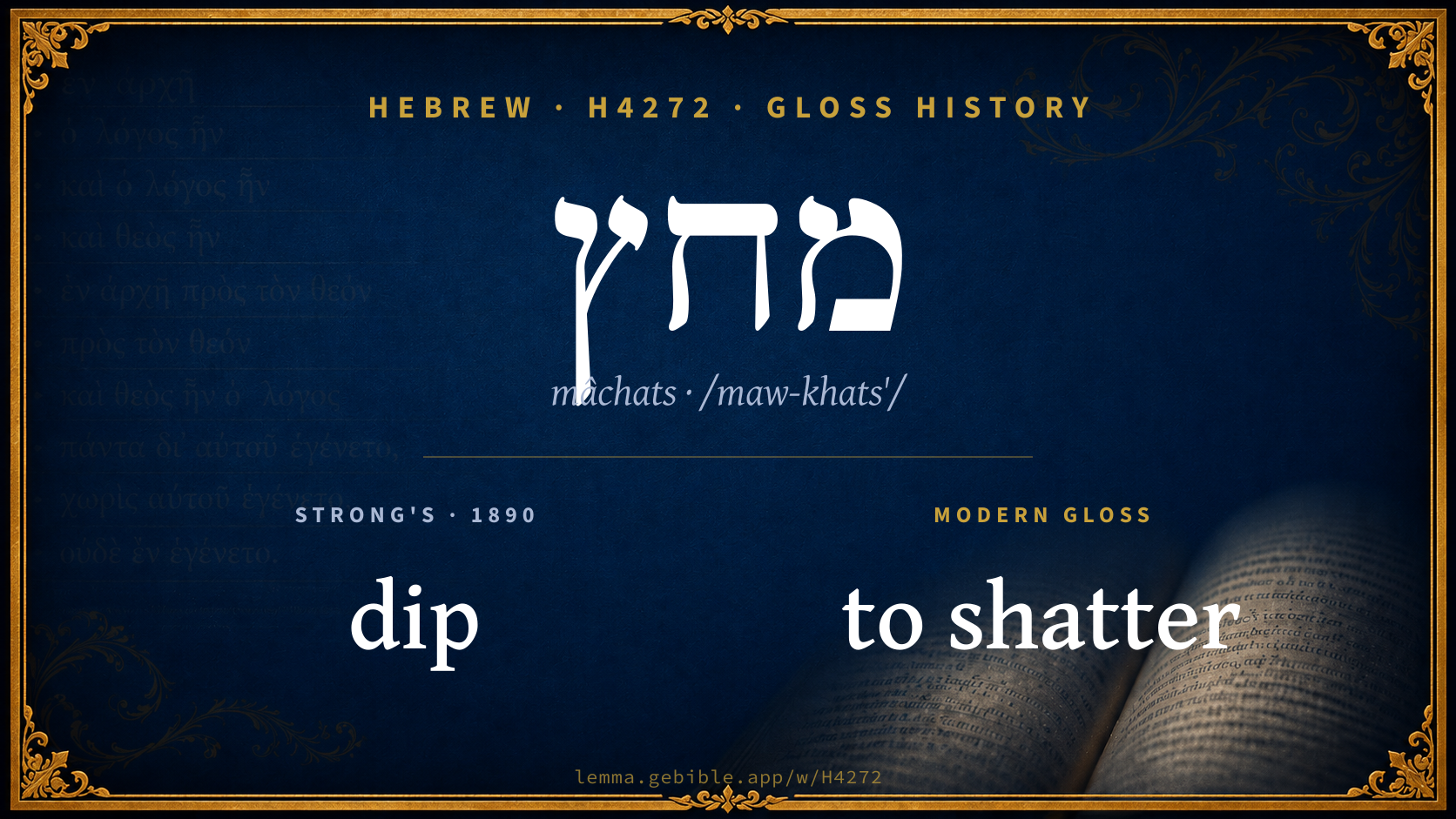
About this word
Strong's H4272 catalogs a Hebrew word from the Hebrew Old Testament.
These counts are not copied from any lexicon or concordance. They are computed here, from the morphology-tagged Hebrew Old Testament. What Lemma adds →
- 14
- distinct verses
- The word appears in 14 distinct verses.
- 7 / 39
- OT books
- The word appears in 7 of 39 Old Testament books.
- #1,910
- by frequency
- Top 2500 most frequent Hebrew words (rank 1,910 of 8,640 Hebrew words by occurrence).
View all 14 occurrences in the concordance →
Most concentrated in
- Psalms 5 verses 36%
- Numbers 2 verses 14%
- Deuteronomy 2 verses 14%
By section of the Old Testament
By traditional corpus
Conventional, traditional groupings — biblical authorship is debated, so this is a traditional corpus grouping, not an authorship claim. Each share is this word’s portion of its verses in that division of the Hebrew canon. Each figure is a share of the word’s 14 distinct verses.
- Writings (Ketuvim) 7 verses · 50%
- Torah (Pentateuch) 4 verses · 29%
- Prophets (Nevi'im) 3 verses · 21%
How translations render this word
Counts come from each version’s own published word-to-Strong’s tagging or interlinear alignment — an approximate guide to how each version renders this word, not a word-level alignment the data otherwise carries. Because each total is that version’s own tagged count, the per-version totals vary from one another and need not match the appearance or distinct-verse counts above. These counts may also differ from a printed concordance because Lemma counts each distinctly tagged rendering and does not collapse phrase taggings into a single head-word total. This is a fixed set of word-tagged versions (KJV, ASV, BSB, ULT) and does not change with the reading translation you choose elsewhere. Each version’s license is shown beside its name below (and on Sources).
- King James Version: He shall wound 1×, He smiteth 1×, He woundeth 1×
- American Standard Version: He smiteth 1×, He will strike 1×, He woundeth 1×
- Berean Standard Bible: He will crush 3×
- unfoldingWord Literal Text: He crushes 2×, He will strike 2×
King James Version Public Domain
Renders H4272 across 14 tagged occurrences — most commonly:
Plus other, less common renderings.
American Standard Version Public Domain
Renders H4272 across 14 tagged occurrences — most commonly:
Plus other, less common renderings.
Berean Standard Bible Public Domain
Renders H4272 across 14 tagged occurrences — most commonly:
Plus 11 renderings that appear only once — usually multi-word phrases or single function words the recovered tagging swept in, not distinct renderings.
unfoldingWord Literal Text CC BY-SA 4.0
Renders H4272 across 14 tagged occurrences — most commonly:
Plus 10 renderings that appear only once — usually multi-word phrases or single function words the recovered tagging swept in, not distinct renderings.
Senses in the full BDB
What do BDB’s symbols mean?
BDB uses these scholarly abbreviations:
| Symbol | Meaning |
|---|---|
| 𝔊 | the Septuagint (the ancient Greek translation, LXX) |
| 𝔙 | the Vulgate (the Latin translation) |
| 𝔖 | the Syriac version (the Peshitta) |
| 𝔗 | the Targum (the Aramaic translation) |
| ψ | the Psalms |
| √ | root (the underlying root or stem) |
| ‖ | parallel passage (a synonymous or contrasted parallel) |
| † | the dagger: every passage where the word occurs is cited |
The 1 sense the full Brown-Driver-Briggs lexicon distinguishes for this word, in lexicon order (not ranked by frequency), with BDB’s own verbatim wording and sub-sense lettering. Shown in Hebrew script with BDB’s own scholarly abbreviations. The condensed entry is in the Lexicon Entry tab. See also the Forms in the corpus table below.
Qal
- Pf. 3 ms. מ׳ Jb 26:12 + 3 times וּמָֽחֲצָה Ju 5:26 etc.; Impf. יִמְחַץ Jb 5:18 ψ 68:22; 1 s. sf. אֶמְחָצֵם ψ 18:39; וָא׳ 2 S 22:39;—smite through, sq. רֹאשׁוֹ, of Jael, Ju 5:26 (‖ הָלַם, מָחַק, חָלַף); of Isr., shattering enemies, חִצָּיו יִמ׳ Nu 24:8 (obj. om.; ‖ עַצְמֹתֵיהֶם יְגָרֵם) cf. v 17 (obj. פַּֽאֲתֵי מוֹאָב); cf. ψ 18:39 = 2 S 22:39; of י׳, smiting through or shattering his foes, ψ 110:5, their heads v 6 68:22 Hb 3:13, loins Dt 33:11; cf. Jb 26:12 obj. רַהַב, q.v.; abs., Dt 32:39 (opp. רָפָא; ‖ cl. אָמִית וַאֲחַיֶּה) cf. Jb 5:18 (opp. רָפָא, ‖ cl. יַכְאִיב וְיֶחְבָּ֑שׁ). For תִּמְחַץ (רגלך בְּדָם) ψ 68:24, read תִּרְחַץ (58:11), Ol Br Che Bae We. e.g. Job 26:12
Senses from the full Brown-Driver-Briggs lexicon (Brown, Driver, Briggs; Oxford 1906 — public domain), digitized via Sefaria, supplemented by the OpenScriptures HebrewLexicon (CC BY 4.0). Full attribution on Sources.
Word origin
vb. smite through, wound severely, shatter (poet.) (Assyrian maḫâṣu, smite, wound, DlHWB 398; Arabic مَخَضَ churn; beat or agitate the milk, etc.; Sab. מחֿץֿ DHMZMG xxx. 1876, 684; xxxvii. 1883, 338; Burgen u. Schlösser (SB. xcvii. 1881), 965 (of stone-cutter’s work), HomChrestom. 127; Ethiopic መሐጸ: );—
— Brown-Driver-Briggs (Oxford 1906, public domain), digitized via Sefaria, supplemented by the OpenScriptures HebrewLexicon (CC BY 4.0). See Sources.
Origin: a primitive root
Jastrow Dictionary
A second Hebrew/Aramaic lexicon for comparison, covering Aramaic and post-biblical (Talmudic, Targumic, Midrashic) usage that the biblical-Hebrew BDB does not. Matched by lemma rather than by Strong’s number, so a lemma may carry more than one Jastrow headword (shown separately below), and the entries cover usage well beyond the Bible.
מָחַץ
- to split, strike. Pirké d’R. El. ch. XXXIV מָחַצְתִּי את ירושלים וכ׳ I struck Jerusalem on the day &c.; Yalk. Deut. 946. Snh. 91ᵇ
מַחַץ
- (חָצַץ, v. Jud. V, 11) [distributor, cmp. בָּזִיךְ,] ladle for filling vessels out of the well, or the wine- or oil-pit. Par. V, 5 שולי המ׳ the sides of a broken ladle. Ab. Zar. 74ᵇ; Y. ib. V, end, 45ᵇ; Tosef. ib. VIII (IX), 1. Toh. X, 7 אם היה זולף מ׳ if he emptied the pit by using a ladle (to pour into the vessels).—Pl. מַחֲצִין. Tosef. Kel. B. Kam. VII, 15.—[Fl. to Levy Talm. Dict. III, 309ᵃ: מָחָץ, fr. מחץ to stir, cmp. Ps. LXVIII, 24.] e.g. Judges 5:11
A Dictionary of the Targumim, the Talmud Babli and Yerushalmi, and the Midrashic Literature (Marcus Jastrow; London, Luzac, 1903) — Public Domain. Digitized via Sefaria. Digitized via Sefaria. Full attribution on Sources.
Forms in the corpus
The 14 distinct written forms H4272 takes in the Hebrew Bible, most frequent first — each parse links to that stem’s occurrences in the concordance. Hebrew forms include their vowel points and cantillation, so a single lemma takes many written forms.
| Form | Parsing | Example | Uses |
|---|---|---|---|
| אֶ֭מְחָצֵ/ם | Verb, Qal, Imperfect, 1st Person, Common, Singular | Psalms 18:38 | 1 |
| וָ/אֶמְחָצֵ֖/ם | Verb, Qal, Sequential Imperfect, 1st Person, Common, Singular | 2 Samuel 22:39 | 1 |
| וּ/מָחֲצָ֥ה | Verb, Qal, Perfect, 3rd Person, Feminine, Singular | Judges 5:26 | 1 |
| וּ/מָחַץ֙ | Verb, Qal, Sequential Perfect, 3rd Person, Masculine, Singular | Numbers 24:17 | 1 |
| יִ֝מְחַ֗ץ | Verb, Qal, Imperfect, 3rd Person, Masculine, Singular | Job 5:18 | 1 |
| יִמְחַץ֮ | Verb, Qal, Imperfect, 3rd Person, Masculine, Singular | Psalms 68:21 | 1 |
| יִמְחָֽץ | Verb, Qal, Imperfect, 3rd Person, Masculine, Singular | Numbers 24:8 | 1 |
| מְחַ֨ץ | Verb, Qal, Imperative, 2nd Person, Masculine, Singular | Deuteronomy 33:11 | 1 |
| מָ֣חַץ | Verb, Qal, Perfect, 3rd Person, Masculine, Singular | Job 26:12 | 1 |
| מָ֥חַץ | Verb, Qal, Perfect, 3rd Person, Masculine, Singular | Psalms 110:6 | 1 |
| מָחַ֖ץ | Verb, Qal, Perfect, 3rd Person, Masculine, Singular | Psalms 110:5 | 1 |
| מָחַ֤צְתָּ | Verb, Qal, Perfect, 2nd Person, Masculine, Singular | Habakkuk 3:13 | 1 |
| מָחַ֨צְתִּי֙ | Verb, Qal, Perfect, 1st Person, Common, Singular | Deuteronomy 32:39 | 1 |
| תִּֽמְחַ֥ץ | Verb, Qal, Imperfect, 3rd Person, Feminine, Singular | Psalms 68:23 | 1 |
Same root — word family
Other BDB entries built from the same root as H4272, grouped by Strong’s listed origin. These share a root / origin per the lexicon — not necessarily a shared meaning. Each links to that word’s own entry.
Derived from this word
Compare all same-root words → They share a root, not necessarily a meaning.
Septuagint verse parallels
This word appears in 13 verses that also exist in the Greek Old Testament (Septuagint), out of the 14 Hebrew verses it occurs in. You can read those verses in Greek by switching the Old Testament edition to the Septuagint.
Read these verses in the Septuagint
This is a verse-level parallel only — the same verses exist in both the Hebrew and Greek Old Testaments. No word-level Hebrew↔Greek correspondence is claimed: the data carries no such alignment, so no Greek word is shown as this Hebrew word’s translation. Coverage is not total — the Septuagint omits the deuterocanon and renumbers the Psalms, so some Hebrew verses have no direct Greek parallel.