
Jude 1:19

Greek (Tischendorf 8th ed.) Jude 1:19 appears in the Greek New Testament. The text above is from the Tischendorf 8th edition. Each word links to its Strong’s number and a concise gloss. Click any word for its full Thayer’s Greek Lexicon entry.
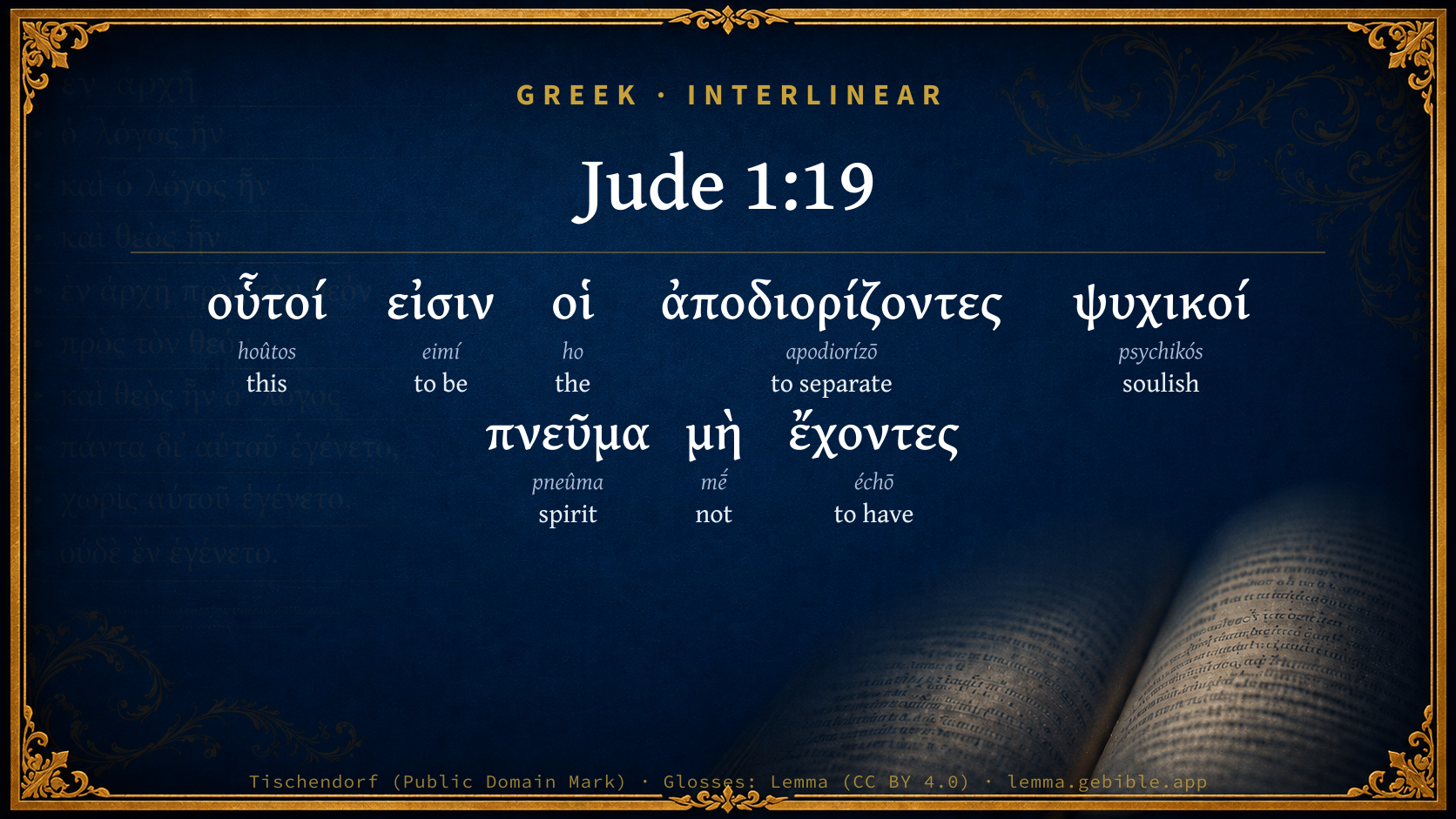
Download image
Cite this verse

Jude 1:19 (World English Bible). Public Domain. Lemma interlinear Bible study tool, https://lemma.gebible.app/v/jude/1/19.

Show BibTeX & RIS
BibTeX
RIS
English Translation
These are they who cause divisions, and are sensual, not having the Spirit.
World English Bible · Public Domain
Highlights
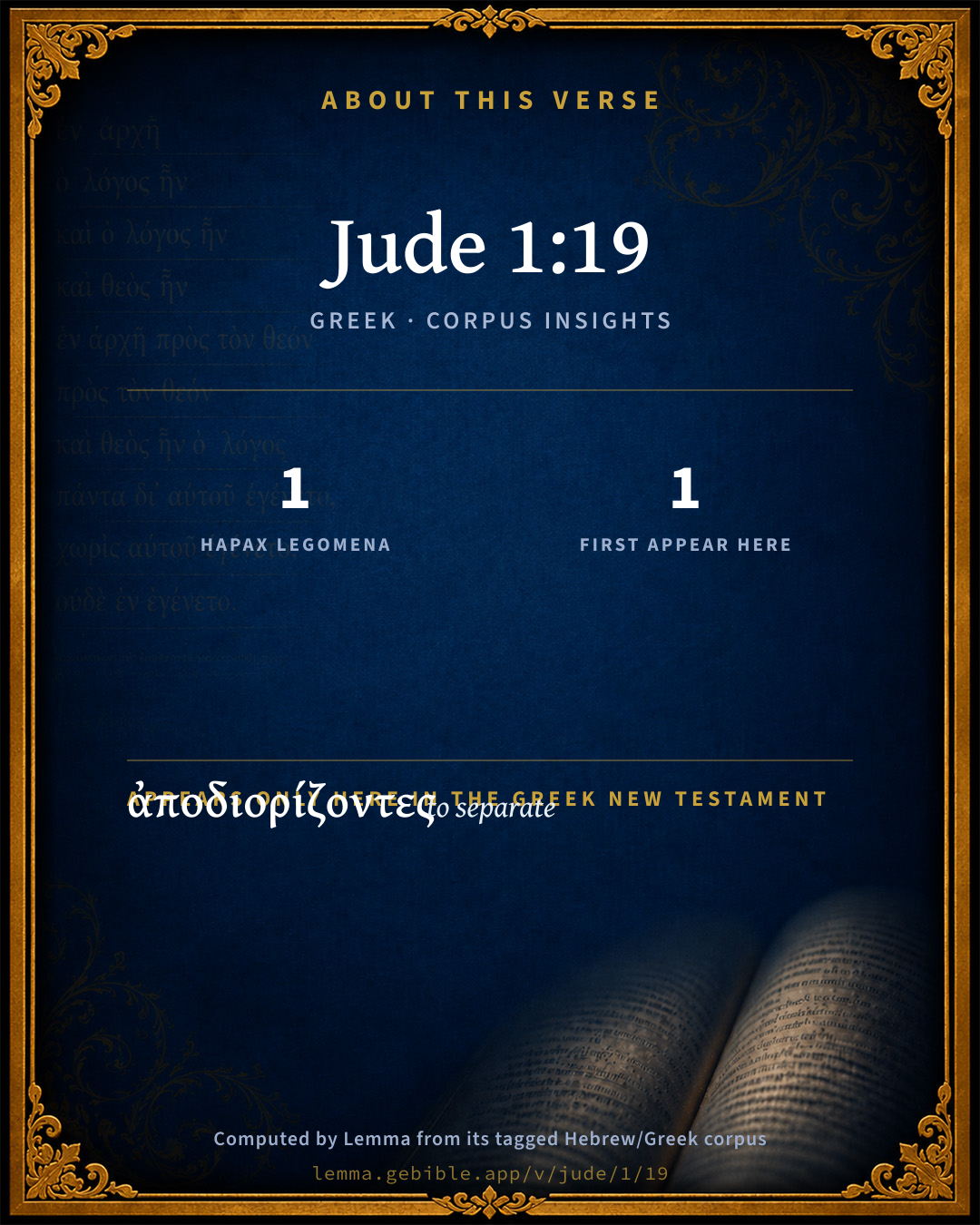
  • 1 hapax legomenon — only here in the Greek New Testament
  • 1 first appearance in the Greek New Testament
Full analysis ↓
Download a study sheet

One document with this verse’s original text, its word-by-word gloss line, the meaning frame, cross-references with their text, attributed commentary, and full source and license credits — printable, and it pastes into notes with its structure intact.

This verse Autodidact and up

Study sheet (.html) Plain text (.txt)

A passage Seminary Student

Up to 50 verses in one chapter. A passage sheet keeps up to 6 commentary sources and 12 cross-references per verse, in the order this page ranks them, and says so on the sheet whenever that leaves anything out. Ask for a single verse and you get the Autodidact verse sheet above.

Everything on this page stays free to read, with no account — the sheet is a download of what is already on screen, not access to it.

Want to remove ads? Support Godless Engineer
Compare translations 3

The same verse in 3 English versions, stacked beneath the original-language interlinear above. Click any original word for its lexicon entry.

Each is an independent rendering of the whole verse — the interlinear is not word-aligned to these translations.

Highlighted words mark where these versions differ — a whole-verse word diff, not a word-by-word alignment.

  • World English Bible Public Domain
    These are they who cause divisions, and are sensual, not having the Spirit.
  • King James Version Public Domain
    These be they who separate themselves, sensual, having not the Spirit.
  • unfoldingWord Literal Text CC BY-SA 4.0
    These are the ones causing divisions, soulish, not having the Spirit.

unfoldingWord Literal Text — © unfoldingWord, licensed CC BY-SA 4.0. Word-aligned USFM3 via Door43 (git.door43.org/unfoldingWord/en_ult).

Versions to compare (up to 4)

3 of 4 selected

Show all 19 translations

Every available English version of this verse, each an independent rendering of the whole verse.

  • World English Bible Public Domain
    These are they who cause divisions, and are sensual, not having the Spirit.
  • Berean Standard Bible Public Domain
    These are the ones who cause divisions, who are worldly and devoid of the Spirit.
  • Majority Standard Bible Public Domain
    These are the ones who cause divisions, who are worldly and devoid of the Spirit.
  • King James Version Public Domain
    These be they who separate themselves, sensual, having not the Spirit.
  • American Standard Version (1901) Public Domain
    These are they who make separations, sensual, having not the Spirit.
  • Revised Version (1885) Public Domain
    These are they who make separations, sensual, having not the Spirit.
  • Geneva Bible (1599) Public Domain
    These are they that separate them selues from other, naturall, hauing not the Spirit.
  • Douay-Rheims (1899) Public Domain
    These are they, who separate themselves, sensual men, having not the Spirit.
  • Young's Literal Translation Public Domain
    these are those setting themselves apart, natural men, the Spirit not having.
  • Literal Standard Version CC BY-SA 4.0
    these are those causing divisions, natural men, not having the Spirit.
  • Unlocked Literal Bible CC BY-SA 4.0
    It is these who cause divisions; they are worldly and they do not have the Spirit.
  • unfoldingWord Literal Text CC BY-SA 4.0
    These are the ones causing divisions, soulish, not having the Spirit.
  • Darby Bible Public Domain
    These are they who set [themselves] apart, natural [men], not having [the] Spirit.
  • World Messianic Bible Public Domain
    These are those who cause divisions and are sensual, not having the Spirit.
  • Webster's Bible Public Domain
    These are they who separate themselves, sensual, having not the Spirit.
  • Free Bible Version CC BY-SA 4.0
    They cause divisions; they are worldly people who don't have the Spirit.
  • Bible in Basic English Public Domain
    These are the men who make divisions, natural men, not having the Spirit.
  • Text-Critical English NT CC BY 4.0
    These people cause divisions; they are worldly and do not have the Spirit.
  • Tyndale New Testament (1534) Public Domain
    These are makers of sectes fleshlie havynge no sprete.

Literal Standard Version (2020), Covenant Press — licensed CC BY-SA 4.0. Text via the HelloAO Bible API (eBible.org). Unlocked Literal Bible (unfoldingWord) — licensed CC BY-SA 4.0. Text via the HelloAO Bible API (eBible.org). unfoldingWord Literal Text — © unfoldingWord, licensed CC BY-SA 4.0. Word-aligned USFM3 via Door43 (git.door43.org/unfoldingWord/en_ult). Free Bible Version, Dr. Jonathan Gallagher — licensed CC BY-SA 4.0. Text via the HelloAO Bible API (eBible.org).

Word by word

More ways to search: Search by grammar → Find every occurrence → Compare this word →

Practice this passage: Drill this verse → Learn its vocabulary →

About this verse

These counts appear in no published source. They are computed here, from the morphology-tagged text and Lemma’s own curated glosses. What Lemma adds →

8
words
8
distinct lemmas
General Epistles
section

Notable vocabulary

1 hapax legomenon — a word that appears only here in the entire Greek New Testament:

  • ἀποδιορίζοντες to separate G592

First appearance in Scripture

This word makes its first canonical appearance in the Greek New Testament here:

  • ἀποδιορίζοντες to separate G592

Shared distinctive vocabulary

ψυχικοί soulish G5591 occurs in 5 verses of the Greek New Testament. Also found in:
Cross-references

11

Topical passages linked to Jude 1:19 in the Treasury of Scripture Knowledge — connected by theme and wording, ordered by reader-vote popularity; previews shown in the World English Bible.

  • 1 Corinthians 2:14 Now the natural man doesn't receive the things of God's Spirit, for they are foolishness to him, and he can't know them, because they are spiritually discerned.
  • Proverbs 18:1 An unfriendly man pursues selfishness, And defies all sound judgment.
  • Romans 8:9 But you are not in the flesh but in the Spirit, if it is so that the Spirit of God dwells in you. But if any man doesn't have the Spirit of Christ, he is not his.
  • James 3:15 This wisdom is not that which comes down from above, but is earthly, sensual, and demonic.
  • Hosea 9:10 I found Israel like grapes in the wilderness. I saw your fathers as the first ripe in the fig tree at its first season; But they came to Baal Peor, and consecrated themselves to the shameful thing, And became abominable like that which they loved.
  • John 3:5–6 Jesus answered, "Most assuredly I tell you, unless one is born of water and spirit, he can't enter into the Kingdom of God!
  • Hebrews 10:25 not forsaking our own assembling together, as the custom of some is, but exhorting one another; and so much the more, as you see the Day approaching.
  • Isaiah 65:5 who say, Stand by yourself, don't come near to me, for I am holier than you. These are a smoke in my nose, a fire that burns all the day.
  • Ezekiel 14:7 For everyone of the house of Israel, or of the strangers who sojourn in Israel, who separates himself from me, and takes his idols into his heart, and puts the stumbling block of his iniquity before his face, and comes to the prophet to inquire for himself of me; I Yahweh will answer him by myself:
  • Hosea 4:14 I will not punish your daughters when they play the prostitute, Nor your brides when they commit adultery; Because the men consort with prostitutes, And they sacrifice with the shrine prostitutes; And the people that does not understand will come to ruin.
  • 1 Corinthians 6:19 Or don't you know that your body is a temple of the Holy Spirit which is in you, which you have from God? You are not your own,

Cross-references courtesy of OpenBible.info (CC BY 4.0).

Commentary

Notes on Jude 1:19 from classic Christian and Jewish commentators (each source and its license shown beneath its notes). The classic Christian expositions comment on the surrounding passage and are grouped to its opening verse, so a note may address several verses; the Jewish commentaries on the Tanakh (Rashi and others) are per-verse, so they appear only where the commentator wrote on this verse.

Lemma curates 59 commentaries, every one of them public domain or Creative Commons licensed, each selected and text-cleaned for this edition rather than reprinted as found. About our sources →

The Biblical Illustrator

Joseph S. Exell

Jud_1:19

These be they who separate themselves.

Separatists

They separate themselves from sound faith by following corrupted speculations. They separate themselves from good works, inasmuch as they quit that faith which is the only genuine source of these works, and go astray after the miserable delusions of licentious indulgences. And in thus abandoning equally the right belief and the right conduct, they virtually separate themselves from the true Church. However they may still wear the name of Christian, they have no communion with Christ. In a word, they are separatists owing to their being sensualists. They love the indulgence of evil passions; and hence they hate the sacred influence that would restrain them. They are attached by habits or carelessness, of folly, or of sordid pursuits, to a life of irreligion; and hence they remain at a distance from the holy power that would out down all such ties, and introduce them to the habits of a new course. The faith of the gospel is too pure for them to adopt; and therefore if they assume the profession of its name, they must hold its principles under some corrupted form. The practice of the gospel is too pure for them to follow; and therefore if they still pretend to a compliance with its requirements, they comply under many abatements; and in fact do it under those mitigations to the strictness of duty, which actually amount to a dereliction of the Christian life. They separate themselves from the faith; because in practice they are sensual. The root of all the evil, however, is their not having the Spirit. (W. Muir, D. D.)

Separation from the Church

1. Separation or dividing ourselves from the fellowship of Gods Church is sinful, or a work of the flesh. The apostle describeth carnal persons, and of them he saith, They separate themselves, and accordingly the apostle reckoneth seditions, heresies, or sect-makings in the Church, among the works of the flesh (Gal_5:20). Cain was the first separatist we read of. He went out from the presence of the Lord (Gen_4:19). God is everywhere: how from His presence? The meaning is, from the Church, where is the presence of His grace.

2. It is little for the honour of Christ that His body is crumbled into small bits and portions. A draft of wine is-best preserved in the hogshead, and Christians in their societies; coals lying together keep in the heat; apostasy began in forsaking the assemblies (Heb_10:23-25; 1Jn_2:19). Partly as to our outward peace and welfare: separation sets others against us, and us against them. Religion, being the highest bond, when it is once violated, the breach is the more irreconcilable. (T. Manton.)

Having not the Spirit.

Sensual men

These two are contrary, flesh and Spirit (Gal_5:17), and they that cherish the one do necessarily banish the other, and as they enlarge the one they straiten the other. The Spirit is a free spirit, and sensual persons are very slaves; the Spirit is a pure spirit, and they are unclean; the Spirit is active, and they are of a dull and stupid nature; the Spirit worketh intellectual and chaste delights, and they are altogether for base pleasures: such a perfect contrariety is there between them.

1. Sensual men have little of the enlightening of the Spirit; their palate is better than their understanding(Eph_5:18). In marshy countries we do not expect a clear air; so sensual persons have seldom any clear thoughts of God: men given to pleasures can taste meats and drinks, but not doctrines.

2. Sensual men have little of the quickenings and efficacy of the Spirit; the more they dissolve and melt away their precious hours and spirits in pleasures, the more do they grow sapless, dead, and careless, and lose all tenderness of conscience and liveliness of affection; they quench the vigour of nature, much more do they quench the Spirit (Eph_4:19).

3. They have little of the comforts of the Spirit. The comforts of the Spirit arise from meditating on the works of God (Psa_104:34), or tasting His love (1Pe_2:3), or contemplating our great hopes (2Co_4:18). Now carnal men can relish none of this; they cannot exercise love, or faith, or hope, that they may delight themselves in God, and have some lively tastes of eternal life. When the soul lieth under the dominion of carnal pleasures, it is incapable of thinking upon God and His works, or relishing inward consolation; love is preoccupied. (T. Manton.)

The Biblical Illustrator, edited by Joseph S. Exell (c. 1880s–1900s) — public domain. Text from a community e-Sword module.

Joseph Benson's Commentary

Jdg 1:19. These be they who separate themselves — Namely, from the communion of the church and from other Christians, under pretence of their greater illumination; sensual — Ψυχικοι, animal; not having the Spirit — Having a natural understanding and natural senses, but not the Spirit of God, either as the Spirit of truth or grace, and therefore addicted to the low gratifications of their animal life; otherwise they would not separate themselves from the Church of Christ. For that it is a sin, and a very heinous one, to separate from it, is out of all question. But then it should be observed, 1st, That by the Church of Christ is meant a body of living Christians, who are a habitation of God through the Spirit, Eph 2:20-21. And, 2d, That by separating is understood renouncing all religious intercourse with them, no longer joining with them in solemn prayer, or the other public offices of religion.

Joseph Benson's Commentary on the Old and New Testaments (1811–1818) — public domain. Text from a community e-Sword module.

The Expositor's Bible

Chapter 37

THE DESCRIPTION CORRESPONDING TO KORAH; MAKING SEPARATIONS-EXHORTATION TO THE FAITHFUL TO BUILD UP THEMSELVES, AND THEN RESCUE OTHERS.

Jud_1:19-23.

FOR the third and last time St. Jude points his finger at the ungodly intruders who are working such mischief in the Church, and gives another triplet of characteristics by which they may be recognized.

"These are they who make separations." This is the first point; like Korah and his company, these men are separatists (οι αποδιοριζοντες) They do not actually make a schism from the Church, for they frequent the love-feasts and profess membership; but they create a faction within it. Even in the public services of the Church they keep aloof from the poorer members of the congregation. At the love-feasts they feed themselves on the good things which they bring with them, instead of handing them over to the ministers to be distributed among all. And in society they care only for persons of rank and wealth, out of whom they hope to gain something. Worst of all, they claim to be specially enlightened members of the Church, having a more comprehensive knowledge of the nature of Christian liberty, while they are turning the fundamental principles of Christian life upside down. Hence, although they are not actual schismatics, who have gone out of the Church and set up a communion of their own, their tendencies are in that direction. They are, in short, much the same kind of people as those against whom St. Paul warns his readers in the Epistle to the Romans: "Now I beseech you, brethren, mark them which are causing the divisions and occasions of stumbling, contrary to the doctrine which ye learned: and turn away from them. For they that are such serve not our Lord Christ, but their own belly; and by their smooth and fair speech they beguile the hearts of the innocent" (Rom_16:17-18). And again in the Epistle to the Philippians: "For many walk of whom I told you often, and now tell you even weeping, that they are the enemies of the cross of Christ, whose end is perdition, whose god is the belly, and whose glory is in their shame, who mind earthly things". {Php_3:18-19} A parallel to nearly every clause in these two descriptions might be found in the account of the libertines given by St. Jude. Indeed, the words in which Bishop Lightfoot sums up St. Pauls description might be adopted verbatim as a summary of the description in our Epistle: "They are described as creating divisions and offenses, as holding plausible language, as professing to be wise beyond others, and yet not innocent in their wisdom." They are "Antinomians, who refuse to conform to the Cross, and live a life of self-indulgence." "The unfettered liberty of which they boast, thus perverted, becomes their deepest degradation" ("Philippians," Notes on 3:18, 19).

Hooker, in his sermons on this passage, although he adopts the translation of Tyndale, continued by Cranmer and the Genevan Version, "These are makers of sects," yet in his exposition follows the corrupt reading which misled the translators of 1611, "These be they who separate themselves" (οι αποδιοριζοντες εαυτους), "themselves" being absent from almost all the ancient MSS. and versions. He Says, "St. Jude, to express the manner of their departure which by apostasy fell away from the faith of Christ, saith, They separated themselves noting thereby that it was not constraint of others which forced them to depart; it was not infirmity and weakness in themselves, it was not fear of persecution to come upon them, whereat their hearts did fail; it was not grief of torments, whereof they had tasted, and were not able any longer to endure them. No, they voluntarily did separate themselves, with a fully settled and altogether determined purpose never to name the Lord Jesus any more, nor to have any fellowship with His saints, but to bend all their counsel and all their strength to raze out their memorial from amongst them" ("Serm.," 5:11). Here there is a double error in the quotation from St. Jude, and therefore considerable error in the exposition of his meaning. St. Jude does not say that these libertines "separated," but that they are "those who are separating," i.e., are habitually making separations or differences. He uses the present participle, not the aorist or perfect. And, as already noticed, he says nothing about separating themselves. So far from implying that they had "a settled and determined purpose never to name the Lord Jesus any more, nor to have any fellowship with His saints," he shows that these men had crept into the Church, and evidently intended to remain there attending the love-feasts and polluting them while they put forward the "freedom wherewith Christ had made them free" as a plea for their own licentiousness; thus "turning the grace of God into lasciviousness," and by their conduct denying the Christ in whom they professed to believe. Thus, though they did not formally leave the Church as heretics, schismatics, or apostates, yet they had the heretical and schismatical temper, and were apostates in their manner of life. As Hooker says elsewhere, "Many things exclude from the kingdom of God, although from the Church they separate not" ("Eccl. Pol.," V 68:6). These men had left the way of salvation to "walk after their own lusts," but they had not separated from the Church, into which they had surreptitiously obtained admission.

"Sensual" (ψυχικος). This word has been already discussed in a previous chapter, in the exposition of the passage where it occurs in the Epistle of St. Jam_3:15. "Sensual" persons are those who live in the world of sense, and are ruled by human feeling and human reason. They stand not very much above the carnal, and with them are opposed to the spiritual. In the triplet, carnalis, animalis, spiritalis, the second term is far more closely allied with the first than the third. It is possible that the libertines, in their travesty of the freedom conferred by the Gospel, made a special claim to be "spiritual" persons, who were above the restraints of the moral law. They may have held that to their exalted natures the things of sense were morally indifferent, and might be indulged in without fear of loss or contamination; while they scoffed at those Christians who were on their guard against such things, and called such Christians psychical or sensuous, because they were careful about the things of sense. St. Jude tells them that it is they who are sensuous, and not spiritual at all.

"Not having the Spirit." The Revisers maintain this rendering, which does not appear in English versions until the influence of Beza and the Genevan Version made itself felt. Calvin seems to adopt it; but Luther certainly does not ("die da keinen Geist haben"). It must be supposed that the arguments in favor of it are very strong, seeing that the alternative translation is not allowed a place in the margin of either Authorized or Revised Version, nor is recommended by the American Committee. Nevertheless, the points in its favor are well worth considering. This alternative translation is, "Having no spirit" (Tyndale, Cranmer), i.e., no spiritual nature. "Not having spirit" is Wiclifs rendering. This agrees very welt with the context. St. Jude has just stigmatized the libertines as "sensuous," or "psychical." Of the three elements in mans nature, body, soul, and spirit, they are ruled by the two lower, while the third, which ought to be supreme, is persistently ignored. They had allowed the spiritual part of their being to become so bemired with self-indulgence and self-sufficiency, to be so much under the dominion of human emotion and reason, that it was utterly inoperative and practically non-existent. Their power of spiritual insight into things heavenly, of laying hold of the invisible world, and of entering into communion with God, was gone. The Holy Spirit was not only absent, but His seat was overturned and destroyed. The facts that "spirit" has neither article nor epithet in the Greek, and that the negative is subjective, and not objective (πνευμα μη εχοντες), are in favor of mans spirit being meant, and this clause being an explanation of what precedes. These men are sensuous because they have lost all spiritual power. It must not, however, be understood that the absence of article and epithet is any barrier to the rendering, "Having not the Spirit." Philippians if. I is proof of that. {comp. Eph_2:22; Col_1:8} Nevertheless, such cases are comparatively rare. The usual expression for the Third Person of the Holy Trinity is either "the Spirit," or "Holy Spirit," or "the Holy Spirit," or "the Spirit of God," or "of the Lord," or "of Jesus Christ," or "of truth," or "of life," etc. Therefore, when we find "spirit" without either article, epithet, or distinguishing genitive, the probabilities are that the spirit of man, and not the Spirit of God, is intended.

It will be observed that the three independent descriptions of the libertines, beginning with the words, "These are," become shorter as they go on. The first is two long verses (Jud_1:12-13); the second is one long verse (Jud_1:16); the third is one very short verse. It is as if the writer were disgusted with the unpalatable subject which necessity had compelled him to take in hand (Jud_1:3), and were hurrying through it to the more pleasing duty of exhorting those faithful Christians for whose sake he has undertaken this, painful task.

"But ye, beloved, building up yourselves on your most holy faith, praying in the Holy Spirit, keep yourselves in the love of God, looking for the mercy of our Lord Jesus Christ unto ετερναλ λιφε." As in ver. 17. {Jud_1:17}, the "But ye, beloved" (υμεις δε) makes an emphatic contrast between those whom St. Jude addresses and the sensuous and unspiritual men of whom he has been speaking. He exhorts his readers to endeavor to keep themselves in favor with God by cultivating faith, prayer, and hope; and in this exhortation the main purpose of the letter, as set forth in Jud_1:3, is fulfilled. The triplet of participles (εποικοδομουντες-προσευχομενοι-προσδεχομενοι) must not be lost sight of although the fact that the main verb (τηρησατε) comes in the middle of them, instead of at the end, somewhat obscures the triple construction.

The expression "building up" (εποικοδομειν) is in the New Testament never used of actual building, but always in the metaphorical sense of believers being united together so as to form a temple. In this temple Christ is sometimes regarded as the foundation, {1Co_3:11} sometimes as that which binds the structure together. {Eph_2:20; Col_2:7} The notion of building up comes from the preposition (επι) one stone being placed upon another, so that upward progress is made. "The faith" here is probably the foundation on which the structure is to rest; but it would be possible to translate "with your most holy faith," instead of "on your most holy faith"; and in that case the dative would, as Col_2:7, express the cement rather than the foundation. In any case "the faith" is not the internal grace or virtue of faith, but, as both the participle and the adjective show, "the faith which was once for all delivered unto the saints" (Jud_1:3). It is "your faith," because it has been thus delivered to you; and it is "most holy," in marked contrast to the vile and shifty doctrines which the libertines profess and uphold.

"Praying in the Holy Ghost." This is the best arrangement of the words, although the Greek allows us to take "in the Holy Ghost" with the previous clause, a rather clumsy division of the words, which is sanctioned by Luther, Beza, and the Rhemish Version: "building yourselves upon our (sic) most holy faith, in the Holy Ghost, praying." The expression "praying in the Holy Ghost" occurs nowhere else; but that is no reason why St. Jude should not have used it here. It means that we are to pray in the power and wisdom of the Spirit. In order that we may pray, and pray aright, He must move our hearts and direct our petitions.

"Keep yourselves in the love of God." Not our love of God is meant, but His love of us. This is rendered probable both by what immediately follows-for "the love of God" should have a meaning similar to that of "the mercy of Jesus Christ"-and also by the opening address, "beloved in God", which St. Jude perhaps has in his mind; for the whole of the verse before us is closely connected with the first verse of the Epistle. Gods love is the region in which all Christians should strive to abide, and it is by faith and prayer that this abode is secured. To be conscious of being beloved by God is one of the greatest protections that the believer can possess.

"Looking for the mercy of our Lord Jesus Christ unto eternal life." That mercy which He will show to all faithful Christians when He returns as Judge at the last day. We may compare "looking for and earnestly desiring the coming of the day of God". {2Pe_3:12} Both in this life and in eternity it is mercy that we need and crave. The Psalms are full of this thought, as a reference to the numerous passages m which the word mercy occurs will reveal: see especially Ps. 130. And in connection with this the concise statement respecting the relations of the Persons of the Blessed Trinity to believers must not be overlooked. By prayer in the power of the Holy Spirit we are kept in the love of the Father through the mercy of the Son. "Unto eternal life." It is not a matter of much moment whether we take these words with "keep yourselves," or with "looking," or with "mercy." The first seems to be the best arrangement, "keep yourselves unto eternal life"; but in any ease, the eternal life is reached through the mercy of the Lord Jesus Christ. With a similar thought the author of the Epistle to the Hebrews {Heb_9:28} writes of Christs Second Advent as an advent "unto salvation" (εις σωτηριαν). The Divine purpose of both Advents is mercy, and not judgment; but seeing that both Advents are met by some who refuse to believe and repent, judgment is inevitable.

"And on some have mercy, who are in doubt; and some save, snatching out of the fire; and on some have mercy with fear." In hardly any other passage, perhaps, does the Revised Version differ in so many particulars from the Authorized. The main changes are the result of changes in the Greek text, which here is in so corrupt a state that the original cannot be restored with certainty. The readings adopted by the Revisers have the advantage of giving us another triple division, which St. Jude is very likely to have made. This triple division is preserved in the Vulgate, and therefore in Wiclif and the Rhemish Version. Our other translators, with Luther and Beza, not finding it in the inferior Greek MSS. which they used, of course do not give it. With one possible exception, the text adopted by the Revisers seems to be the best that can be framed with our present evidence. It is doubtful whether we ought not to substitute "convict" (ελεγχετε) for the first "have mercy" (ελεατε). This reading has very powerful support (AC, the best cursives, Vulgate, Memphitic, Armenian, and Ethiopic), and is adopted by many critics. But it may possibly be an early correction of a still earlier corruption, and not a restoration of the original reading. This is one of those passages about which we must be content to remain in doubt as to what the author actually wrote.

In any case the writer is giving directions as to how to deal with two or three different classes of persons, who are in danger of being seduced by the libertines; and possibly the libertines themselves are included. We will assume that three classes are named. In the first we are confronted with an uncertainty of translation. The participle rendered "who are in doubt" (διακρινομενους) may also mean "while they contend" with you. Which meaning we prefer will depend partly upon the reading which we adopt for the imperative which governs the accusative. "On some have mercy, when they are in doubt," makes very harmonious sense; for earnest doubters, who are unable to make up their minds for or against the truth are to be treated with great tenderness. Again, "And some convict, when they contend with you," makes very harmonious sense; for it is those who are disposed to be contentious that need to be refuted and convinced of their error it is in favor of the latter version of the command that the verbs rendered "convict" and "contend" occur, and in the same sense, in the earlier part of the Epistle (Jud_1:9; Jud_1:15). In either case that which is doubted or contended about is "the faith once for all delivered unto the saints," on which believers are to "build themselves up."

The second class are such as can still be rescued, but by strong measures. No hint, however, is given as to their characteristics; we are merely told that there are some who require to be taken with decision, and perhaps even with violence, out of their perilous surroundings, in order that they may be saved from destruction. We may perhaps think of those who, without being in doubt or inclined to dispute about the faith, are being carried away into licentiousness by intercourse with the libertines. The fire out of which they are to be snatched is not the penal fire of the judgment to come, but the state of perdition in which they are now living. We seem to have here, as in Jud_1:9, a reminiscence of Zec_3:1, where we read, "Is not this a brand plucked out of the fire?" In Amo_4:11 we have the same figure, and the context there agrees with the suggestion just made as to the kind of person indicated by St. Jude: "I have overthrown some among you, as when God overthrew Sodom and Gomorrah, and ye were as a brand plucked out of the burning." There are some who need to be rescued in the way that the angels rescued Lot, with urgency and constraint; {Gen_19:16-17} and it is specially in reference to temptations such as Lot had gone into that such urgency is needed.

The third class is one which must be treated with great circumspection: "and on some have mercy with fear; hating even the garment spotted by the flesh." This does not mean, as Luther supposes, that we must "let them severely alone, and have nothing to do with them," but that in dealing with evil so insidious and so infectious, we must take care that we are not contaminated ourselves. It is quite possible to approach evil with good intentions, and then, through want of proper humility and caution, end in finding it fatally attractive. We must carefully preserve abhorrence for all that is associated with pollution. In the defiled garment {comp. Jam_3:6, where the same word is used} St. Jude appears once more to have Zec_3:1-3 in his mind; but the Greek of the LXX is there quite different (ιματια ρυπαρα, instead of εσπιλωμενον χιτωνα). The garment here mentioned is the chiton, or shirt, which came in contact with the body, and would itself be rendered unclean if the body were unclean. It therefore serves well as a symbol for that which has become perilous through being closely connected with evil. But while the evil and that which had been contaminated by it are to be hated, compassion is to be shown to those who have fallen victims to it. To be shown, not merely felt, as is manifest from the word which St. Jude uses (ελεαν, not οικτειρειν). The passages in which this verb or its more common form (ελεειν) elsewhere occurs in the New Testament prove that it means "to have mercy on, to succor and bring help to," and not merely "to feel pity for" without doing anything to relieve the person pitied. {Mat_9:27; Mat_15:22; Mat_17:15; Mat_18:33; Mat_20:30; Mar_10:47; Luk_16:24; Luk_17:13; Luk_18:38; Php_2:27} It is specially used of Gods showing mercy to those who do not deserve it, {Rom_9:15-16; Rom_9:18; Rom_11:32; 2Co_4:1; 1Ti_1:13; 1Ti_1:16; 1Pe_2:10} and therefore fitly expresses the sympathy which ought to be manifested by the faithful towards the fallen. But in some cases this sympathy must be manifested in fear. It is by acting in the spirit of godly fear that love of the sinner can be combined with hatred of the sin. Without it sympathy with the sinner is too likely to turn into sympathy with the sin. To put it otherwise: All our efforts for the reformation of others must be begun and continued with self-reformation; and therefore St. Jude insists on the necessity for spiritual progress and prayer, before advising as-to the treatment of the fallen. It is while we are earnestly detesting and contending against a particular sin in ourselves that we can most safely and effectually deal with that sin in others.

Finally it must be noted as specially remarkable that St. Jude, after all the strong language which he has used in describing the wickedness of those who are corrupting the Christian community, does not, in this advice as to the different methods which are to be used in dealing with those who are going or have gone astray, recommend denunciation. Not that denunciation is always wrong; in some cases it may be necessary. But denunciation by itself commonly does more harm than good; while other methods, which must be added in order to make denunciation effectual, are quite as efficacious when no denunciation has been employed. It is quite possible to manifest ones abhorrence of "the garment spotted with the flesh," without public or private abuse of those who are the authors of the defilement.

William Robertson Nicoll, ed., The Expositor's Bible (London: Hodder & Stoughton, 1887–1910) — public domain. 65 of 66 books (1 Corinthians is not separately keyed, as that volume carries no machine-parseable verse references); section-level commentary keyed to the opening verse. Introductory and overview sections not keyed to a specific passage are excluded.

Tyndale Open Study Notes

Tyndale Open Resources

1:19-20 Despite the Lord’s presence, the conquest was not completed because of iron chariots and lack of obedience (see Josh 23:12-13; 24:14).

Tyndale Open Study Notes — © Tyndale Open Resources, licensed CC BY-SA 4.0. Text via the HelloAO Bible API.

Bengel's Gnomon

Johann Albrecht Bengel

Jud 1:19. Οὗτοι) these. He shows that the characters of these are such as have been foretold, Jud 1:18.—οἱ ἀποδιορίζοντες) ἑαυτοὺς is understood, though this also is added by some:[9] Isa 45:24, Septuagint, αἰσχυνθήσονται πάντες οἱ ἀφορίζοντες (διορίζοντες is the reading of the Vatican edition) αὐτούς· All that separate themselves shall be ashamed. They separate themselves from God, and from living communion with the Church; yet not from its outward fellowship, Jud 1:12, at the beginning. Comp. Hos 4:14, יפרדו; [Pro 18:1; Isa 66:5; Luk 6:22.—V. g.]—ψυχικοὶ, animal) who are influenced by the animal nature only, without the spirit.—ΠΝΕῦΜΑ ΜῊ ἜΧΟΝΤΕς, not having spirit) Therefore the spirit is not an essential part of man.

[9] A Vulg. and Lucifer omit ἑαυτούς: and so Stephens’ Rec. Text. But B (judging from the silence of collators) C and later Syr. add it: and so Elzev. Rec. Text.—E.

Bengel's Gnomon of the New Testament — English translation (T&T Clark, Edinburgh, 1860) — public domain. Text from a community e-Sword module.

Meyer's Critical & Exegetical Commentary

Heinrich August Wilhelm Meyer

Jud_1:19. Final description of the false teachers, not specially, but according to their general nature.

οὗτοί εἰσιν] parallel with Jud_1:16.

οἱ ἀποδιορίζοντες] the article marks the idea as definite: these are they who, etc.

ἀποδιορίζειν, a word which occurs only in Aristotles Polit. iv. 8. 9, is here very differently explained; with the reading ἑαυτούς it would most naturally be taken as equivalent to separate; thus, who separate themselves from the church, whether internally or externally (Wahl); without ἑαυτούς it is explained either as = to secede (Fronmüller), or = to cause separations and divisions, namely, in the church (Luther: who make factions; de Wette-Brückner, Wiesinger; so also in this commentary). Neither explanation is, however, justified from the use of the word διορίζειν. It is still more arbitrary, with Schott, to explain it: who make a distinction, namely, between the pneumatical (Pneumatikern), as what they consider themselves, and the psychical (Psychikern), as what true Christians regard them; for there is no indication of such a distinction made by them. If we base the explanation on the significance of διορίζειν, the word may be understood as = to make definitions. But in this case what follows must be closely connected with it, by which the mode and manner of their doing so is stated, namely, that they do so as psychical men, who are without the πνεῦμα. Hofmann gives to the verb the meaning: to determine (define) something exactly in detail, and then assumes that the preceding genitive τῶν ἀσεβειῶν depends on οἱ ἀποδιοριζόμενοι, which may well be the case, because a participle standing for a substantive may as well as a substantive govern the genitive. According to this explanation, Jude intends to describe those men as persons who make impieties the object of an exercise of thought exactly defining everything, and so are the philosophers of impieties. This explanation is condemned by the harsh and artificial construction which it requires.[44]

ψυχικοὶ, πνεῦμα μὴ ἔχοντες] πνεῦμα is not mans natural spirit,[45] for Jude could not deny this to his opponents; and to explain μὴ ἔχοντες in the sense: I might say that they have no spirit at all (Fronmüller), is completely arbitrary. It is rather to be understood of the Holy Spirit (de Wette-Brückner, Wiesinger, Hofmann); the want of the article and of an epithet, such as ἁγίου or Θεοῦ, is no objection against this interpretation, since the simple word πνεῦμα is often used in the N. T. as a designation for the objective Holy Spirit. It is erroneous to affirm that by this interpretation the conclusion of the description is too flat, for nothing worse can be said of a man who desires to be esteemed a Christian than that he wants the Holy Spirit. Moreover, only so understood does πνεῦμα μὴ ἔχοντες correspond to the preceding ψυχικοί, to which it is added as an explanation; ψυχικοί they are, inasmuch as their natural spiritual life left to itself is under the unbroken power of the σάρξ; see 1Co_2:14-15; Jam_3:15.

[44] Certainly the dependent genitive may precede the governing substantive; but this union is here rendered impossible by the intervening οὗτοι. A participle also, taken as a substantive, may sometimes govern a genitive; but this is only found with the neuter, and then only rarely. Add to this that οὗτοί εἰσιν here corresponds to the οὗτοί εἰσιν in vv. 16 and 12, and accordingly must stand at the beginning of the sentence.

[45] Schott explains πνεῦμα spiritual life in the distinctive character of its being, that it is self-controlled in personal self-consciousness and self-determination, and so equivalent to free personality of the spirit(!); but this free personality, Schott further observes, is not denied to them in the sense as if they were actually deprived of it, but only that it does not attain permanence and reality in actual performance. This distorted interpretation is contradicted by the fact that Jude simply denies to them πνεῦμα ἔχειν.

REMARK.

Schott attempts to prove that the three verses, 12, 16, and 19, beginning with οὗτοι, refer to the threefold expression contained in Jud_1:11, namely, in this manner: that the Antinomians, in showing themselves to be σπιλάδες in their agapé (Jud_1:12), resembled Cain; that in being γογγυσταὶ μεμψίμοιροι, and out of greed for material gain indulging in mercenary flattery (Jud_1:16), they resembled Balaam; and that in establishing a self-invented ungodly sanctity in opposition to the divinely appointed and divinely effective Christian sanctity (Jud_1:19), they resembled Korah. This juxtaposition, however, is anything but appropriate, resting, on the one hand, on incorrect explanations; and, on the other hand, on the arbitrary selection of separate points. It is incorrect to affirm that the similarity of the Antinomians with Cain consisted in this, that what he did corporally they did spiritually; there is contained in this rather a distinction than a similarity. It is arbitrary to bring forward only the last clause of Jud_1:16, which reproaches the Antinomians with flattery, and which may also be found in Balaam; whereas the other expressions in the verse do not suit in the least degree. And lastly, it is erroneous so to interpret Jud_1:19 that the Antinomians were accused of the setting up of a false sanctity; even were this correct, yet the sanctity claimed by them is of a totally different nature from that to which Korah and his company laid claim.

Meyer — Critical and Exegetical Commentary on the New Testament — English translation by Peter Christie, edited by Frederick Crombie (T&T Clark, 1880) — public domain. Text from a community e-Sword module.

Expositor's Greek Testament

ed. W. Robertson Nicoll

Jud 1:19 . οὗτοί εἰσιν οἱ ἀποδιορίζοντες . “These are they that make invidious distinctions.” See Introduction on the Text. The rare word ἀποδιορίζοντες is used of logical distinctions in Aristotle, Pol. iv. 43, ὥσπερ οὖν εἰ ζῴου προῃρούμεθα λαβεῖν εἴδη , πρῶτον ἂν ἀποδιωρίζομεν ὅπερ ἀναγκαῖον πᾶν ἔχειν ζῷον (“as, if we wished to make a classification of animals, we should have begun by setting aside that which all animals have in common”) and, I believe, in every other passage in which it is known to occur: see Maximus Confessor, ii. p. 103 D, τὸ μὲν φυσικὸν ὥρισεν ἐπʼ αὐτοῦ , τὸ δὲγνωμικὸν ἀποδιώρισε , translated “naturali in eo (Christo) constituta voluntate, arbitrariam dispunxit,” ib. p. 131 C, ὡς ὁ λόγος ἦν αὐτοῦ , μόνον τὸ ἐμπαθές , ἀλλʼ οὐ τὸ φυσικὸν ἀποδιορίσασθαι θέλημα , “quod dixerat hoc solum spectare ut libidinosam, non ut naturalem voluntatem a Salvatore eliminaret,” Severus de Clyst. xxxii., xxv., ὅταν ταῦτα τὰ συμπτώματα ὄψῃ παρόντα , ἀποδιόριζε τὴν ὀργανικὴν νόσον ἐκ τῆς ὁμοιομεροῦς . The simple διορίζω is found in Lev 20:24 , διώρισα ὑμᾶς ἀπὸ τῶν ἐθνῶν “I separated you from the nations,” Job 35:11 ; so ἀφορίζω Mat 25:32 , ἀφορίζει τὰ πρόβατα ἀπὸ τῶν ἐρίφων , Act 19:9 (Paul left the synagogue) καἰ ἀφώρισεν τοὺς μαθητάς , 2Co 6:17 , ἐξέλθατε ἐκ μέσου αὐτῶν καὶ ἀφορίσθητε , Luk 6:22 (of excommunication) ὅταν ἀφορίσωσιν ὑμᾶς , Gal 2:12 (of Peter’s withdrawal from the Gentiles) ὑπέστελλεν καὶ ἀφώριζεν ἐαυτόν .

ψυχικοί . Used of worldly wisdom in Jas 3:15 , where see note, distinguished from πνευματικός in 1Co 2:13-15 ; 1Co 15:44 , cf. the teaching of the Naassenes ( ap. Hippol. p. 164) εἰς τὸν οἶκον θεοῦ οὐκ εἰσελεύσεται ἀκάθαρτος οὐδείς , οὐ ψυχικός , οὐ σαρκικός , ἀλλὰ τηρεῖται πνευματικοῖς .

πνεῦμα μὴ ἔχοντες . The subjective negative may be explained as describing a class (such as have not) rather than as stating a fact in regard to particular persons; but the use of μή is much more widely extended in late than in classical Greek, cf. such phrases as ἐπεὶ μή , ὅτι μή . It is simplest to understand πνεῦμα here of the Holy Spirit, cf. Rom 8:9 , ὑμεῖς οὐκ ἐστὲ ἐν σαρκὶ ἀλλʼ ἐν πνεύματι , εἴπερ πνεῦμα Θεοῦ οἰκεῖ ἐν ὑμῖν , 1Co 2:13 ; 1Co 7:40 , 1Jn 3:24 ; 1Jn 4:13 , and the contrast in Jud 1:20 , ἐν πνεύματι ἁγίῳ προσευχόμενοι . Others, e.g. Plumptre, prefer the explanation that “the false teachers were so absorbed in their lower sensuous nature that they no longer possessed, in any real sense of the word. that element in man’s compound being, which is itself spiritual, and capable therefore of communion with the Divine Spirit”.

The Expositor's Greek Testament, edited by W. Robertson Nicoll (1897–1910) — public domain. Text from a community e-Sword module.

Geneva Bible (1599)

Geneva Bible translators

It is the property of Antichrists to separate themselves from the godly, because they are not governed by the Spirit of God: and contrariwise it is the property of Christians to edify one another through godly prayers both in faith and also in love until the mercy of Christ appears to their full salvation.

Geneva Bible (1599) marginal notes — public domain. Text via Bolls.life.

Jamieson, Fausset & Brown

Robert Jamieson, A. R. Fausset & David Brown

These be they--showing that their characters are such as Peter and Paul had foretold.

separate themselves--from Church communion in its vital, spiritual reality: for outwardly they took part in Church ordinances (Jde 1:12). Some oldest manuscripts omit "themselves": then understand it, "separate," cast out members of the Church by excommunication (Isa 65:5; Isa 66:5; Luk 6:22; Joh 9:34; compare "casteth them out of the Church;" Jo3 1:10). Many, however, understand "themselves," which indeed is read in some of the oldest manuscripts as English Version has it. Arrogant setting up of themselves, as having greater sanctity and a wisdom and peculiar doctrine, distinct from others, is implied.

sensual--literally, "animal-souled": as opposed to the spiritual, or "having the Spirit." It is translated, "the natural man," Co1 2:14. In the threefold division of man's being, body, soul, and spirit, the due state in God's design is, that "the spirit," which is the recipient of the Holy Spirit uniting man to God, should be first, and should rule the soul, which stands intermediate between the body and spirit: but in the animal, or natural man, the spirit is sunk into subserviency to the animal soul, which is earthly in its motives and aims. The "carnal" sink somewhat lower, for in these the flesh, the lowest element and corrupt side of man's bodily nature, reigns paramount.

having not the Spirit--In the animal and natural man the spirit, his higher part, which ought to be the receiver of the Holy Spirit, is not so; and therefore, his spirit not being in its normal state, he is said not to have the spirit (compare Joh 3:5-6). In the completion of redemption the parts of redeemed man shall be placed in their due relation: whereas in the ungodly, the soul severed from the spirit shall have for ever animal life without union to God and heaven--a living death.

Jamieson, Fausset & Brown — Commentary Critical and Explanatory on the Whole Bible (1871) — public domain (CC PDM 1.0). Text via the HelloAO Bible API.

Adam Clarke's Commentary

Verse 19. Who separate themselves] From the true Church, which they leave from an affectation of superior wisdom.

Sensual] ψυχικοι. Animal-living as brute beasts, guided simply by their own lusts and passions, their Bible being the manifold devices and covetousness of their own hearts; for they have not the Spirit-they are not spiritually minded; and have no Holy Ghost, no inspiration from God.

Adam Clarke's Commentary on the Bible (1810–1826) — public domain. Text from a community e-Sword/MySword module.

John Calvin's Commentaries

19. These be they who separate themselves. Some Greek copies have the participle by itself, other copies add ἑαυτοὺς, “themselves;” but the meaning is nearly the same. He means that they separated from the Church, because they would not bear the yoke of discipline, as they who indulge the flesh dislike spiritual life. The word sensual, or animal, stands opposed to spiritual, or to the renovation of grace; and hence it means the vicious or corrupt, such as men are when not regenerated. For in that degenerated nature which we derive from Adam, there is nothing but what is gross and earthly; so that no part of us aspires to God, until we are renewed by his Spirit.

John Calvin's Commentaries (1540-1563) — public domain. Text from the Calvin Translation Society English edition (1840s-50s) via the Christian Classics Ethereal Library (ccel.org). Calvin's coverage is partial (roughly two-thirds of the Bible); uncommented books and verses are honest gaps, never fabricated. The 19th-century editor's footnotes and remarks are omitted so the notes are faithfully Calvin's own voice.

The Cambridge Bible for Schools and Colleges

gen. ed. J. J. S. Perowne

19. These be they who separate themselves] Many of the better MSS. omit the reflexive pronoun. The verb is not found elsewhere in the New Testament, but a simpler form, with the same meaning, occurs in Lev_20:24. It was characteristic of the false teachers and mockers who are spoken of that they drew lines of demarcation, which Christ had not drawn, between themselves and others, or between different classes of believers, those, e.g., who had the higher gnosis, or exercised a wider freedom (2Pe_2:19), and those who were content to walk in “the Apostles’ doctrine and fellowship” (Act_2:42). They lost sight of the unity of the Church of Christ and preferred the position of a sect or party; and, in so doing, united the exclusiveness of the Pharisees with the sensuous unbelief of the Sadducees.

sensual, having not the Spirit] The adjective is the same as that which describes the “natural man” of 1Co_2:14, and implies that the man lives in the full activity of his emotional and perceptive nature, without rising into the region of the reason and conscience which belong to his spiritual being. “Sensual,” or better perhaps, sensuous, is the nearest English equivalent, but, strictly speaking, it expresses the lower aspect of the character represented by the Greek term. The “sensuous” or psychical man is not necessarily “carnal” in the sense usually attached to that term, but the two words are closely connected with, and indeed overlap each other. The words seem specially directed against the boast of many of the Gnostic teachers, who, looking to St Paul’s words in 1Co_2:14, boasted that they alone were “spiritual” in that Apostle’s sense of the term, and that the members of the Church were, as the “natural” or “sensuous,” incapable of knowing the higher mysteries of God (Iren. i. 6. 2–4). St Jude retorts the charge, and says that they, who boast of their illumination, are in very deed destitute of every higher element of the religious life. The word for “Spirit” stands without the article in the Greek, and though this does not necessarily exclude the thought that the Spirit of God is spoken of, it is, perhaps, better to rest in the meaning that the false teachers were so absorbed in their lower, sensuous nature that they no longer possessed, in any real sense of the word, that element in man’s compound being, which is itself spiritual, and capable therefore of communion with the Divine Spirit.

The Cambridge Bible for Schools and Colleges (gen. ed. J. J. S. Perowne; Cambridge University Press, 1878–1918) — public domain. Text from a community e-Sword module.

Albert Barnes' Notes on the Bible

These be they who separate themselves - That is, from their brethren and from the work of benevolence and truth. Compare Rom 16:17; Jdg 5:16, Jdg 5:23.

Sensual - Under the influence of gross passions and appetites.

Having not the spirit - The Holy Spirit, or the spirit of true religion.

Albert Barnes' Notes on the Bible (1834–1885) — public domain. Text from a community e-Sword/MySword module.

Matthew Poole's English Annotations

These be they who separate themselves; viz. from the true doctrine and church of Christ, as being in love with their carnal liberties, and loth to come under the yoke of Christ’s discipline.

Sensual; or carnal, or animal, 1Co 2:14; such as are mere men, and have no higher principle in them than human nature, which, left to itself, and being destitute of the sanctifying Spirit, is generally overpowered by sense, and inclines to fleshly lusts.

Having not the Spirit; the Spirit of God, by which they should be led, and to which they so much pretend; having neither the light, nor grace, nor comfort of the Spirit.

Matthew Poole's English Annotations on the Holy Bible (1683–1685) — public domain. Text from a community e-Sword/MySword module.

Whedon's Commentary on the Bible

Daniel D. Whedon

19. These… separate themselves—First demoralizing and disgracing the Church by bringing the imputation of their own vices upon it, and then distracting and dividing it by a secession, which, however, relieves it. The same sort of seceders as in 1Jn_2:18-19.

Sensual—Same word as is rendered “natural” in 1Co_15:44, and for which we coined the word soulical, as an exact equivalent. The word is plainly antithetical to spirit, as part of the trinality or three-foldness of the human constitution.

Having not the Spirit—These men are merely soulical: spirit having not. They had body and animal soul, but they had lost their highest nature, spirit. This does not literally mean that a part of their human constitution had been annihilated, but nullified; reduced to nullity; just as we severely say that a man is conscienceless when his conscience seems dead.

Daniel D. Whedon (gen. ed.), Commentary on the Old and New Testaments (1874–1909) — public domain. Text from a community e-Sword module.

The Pulpit Commentary

There follows yet another description of the same men, taking up that in verse 16, and generalizing it in harmony with what is suggested by the apostolic prediction. In three bold strokes it gives a representation of them which is at once the sharpest and the broadest of all. This final description, too, at last lays bare the root of their hopeless corruption.

These be they who separate themselves, sensual, having not the Spirit. The pronoun "themselves" cannot be retained in face of the weight of documentary evidence against it. The verb (which is one of very rare occurrence) is held to be capable of more than one sense seceding, causing divisions, creating factions, making definitions or distinctions. The most natural meaning seems to be that adopted by the Revised Version, they who make separations. So Tyndale; Cranmer and the Genevan have "these are makers of sects," and Luther gives "makers of factions." It may be that they caused divisions by setting themselves up as the only enlightened Christians, and, on the ground of that enlightenment, claiming to be superior to the moral laws which bound others. The term translated "sensual" has unfortunately no proper representative in English. It is "psychical," being formed from the noun psyche, which is rendered "life" or "soul." This psyche is intermediate between "body" and "spirit." It is in the first instance simply the bond or principle of the animal life, and in the second instance it is embodied life. Thus it is that in man which he has in common with the brute creation beneath him, But it becomes also more than this, expressing that in man which renders him capable of connection with God. For in the third instance it denotes the seat of feeling, desire, affection, and emotion; the center of the personal life the self in man. The adjective itself occurs in the New Testament only in a few passages of marked importance 1Co_2:14 1Co_15:44, 46 Jam_3:15; and the present verse. Here it designates the men as men who live only for the natural self men who make the sensuous nature, with its appetites and passions, the law of their life; natural or animal men, as the Revised Version gives it in the margin. Wickliffe renders it "beastly;" Tyndale, Cranmer, and the Genevan, "fleshly;" the Rhemish, "sensual." The third clause admits of being rendered either "having not the spirit" (in which the Authorized is supported by Wickliffe, Tyndale, and Cranmer), or "having not the Spirit" (so the Revised Version, following the Genevan and the Rhemish). For it is in many passages difficult to decide whether the word "spirit" means the Holy Spirit of God or man"s own spirit that in him in virtue of which he can have fellowship with the Divine, and on which God specially acts; "that highest and noblest part of man," as Luther puts it, "which qualifies him to lay hold of incomprehensible, invisible things, eternal things; in short... the house where faith and God"s Word are at home." The rendering of the Revised Version is favoured by the occurrence of the term in the following verse. The Spirit of God was not in the lives or the thoughts of these men, and hence they were creators of division, and sensual. Their pretension was that they were the eminently spiritual. But in refusing the Divine Spirit they had sunk to the level of an animal life, immoral in itself, and productive of confusion to the Church.

Application of the prophecy to the seducers of Jude"s day.

Mark the threefold division of the verse.

I THEY WERE SEPARATISTS. "These are they who make separations." Perhaps as "spiritual" persons, who regard things of sense as so indifferent that they may be enjoyed without risk to the soul.

1. Church divisions are usually grounded on separations from the Church"s doctrine. Those who bring in "damnable heresies" "draw away disciples after them". (Act_20:30)

2. Separations may be justified by the Church"s departure from the truth. This is the justification of Protestantism in withdrawing from the Church of Rome in the sixteenth century.

3. Separations, originated by scoffing sensualists,

1. have their origin in unbelief and pride;

2. engender hatred;

3. and end in the destruction of immortal souls.

II THEY WERE SENSUAL. "Sensual.

1. Sensuality, or the idea of an enlarged liberty in sinful enjoyment, is often the motive of separations.

2. Corrupt affections blind the judgment and harden the conscience. Burns says that sensuality "hardens a" within." It turns Christianity into epicurism.

3. Sensuality destroys the soul eternally. "They who sow to the flesh shall of the flesh reap corruption". (Gal_6:8) "If ye live after the flesh, ye shall die,". (Rom_8:13)

III THEY ARE WITHOUT THE HOLY SPIRIT. "Having not the Spirit.

1. Sanctity and sensuality cannot dwell together.

2. Those who want the Spirit are easily carried away into sensual sin. Therefore David prayed, "Take not thy Holy Spirit from me". (Psa_51:11)

3. Saints ought to seek the Spirit of holiness, love, meekness, and truth. "Walk in the Spirit, and ye shall not fulfill the lusts of the flesh". T.C. (Gal_5:16)

The Pulpit Commentary (1880–1919), ed. H.D.M. Spence-Jones & Joseph S. Exell — public domain. Text from a community e-Sword module.

John Wesley's Explanatory Notes

These are they who separate themselves, sensual, not having the Spirit - Having natural senses and understanding only, not the Spirit of God; otherwise they could not separate. For that it is a sin, and a very heinous one, "to separate from the church," is out of all question. But then it should be observed,

1. That by the church is meant a body of living Christians, who are "an habitation of God through the Spirit:"

2. That by separating is understood, renouncing all religious intercourse with them; no longer joining with them in solemn prayer, or the other public offices of religion: and,

3. That we have no more authority from scripture to call even this schism, than to call it murder.

John Wesley, Explanatory Notes Upon the Whole Bible (1754–1765) — public domain. Text via the GEBible commentary corpus.

Godbey's Commentary on the New Testament

William B. Godbey

19. “These are sidetrackers,” i.e., they are used by Satan to get the train off the track of “holiness to the Lord.” The devil’s switch begins so parallel with the main track as not to be discovered by unspiritual yes till you run out on it. Then it gradually diverts from the main trunk, “Holiness to the Lord,” till it turns at right-angles, but ere long gets turned directly back toward hell. You see your preachers and church officials aboard cheerful and happy, so you think all is well till you plunge into the pit. God used three Johns, Bunyan, Knox, and Wesley, to start three holiness revivals, developing into Baptist, Presbyterian, and Methodist churches. Where are they now? Echo answers, Where? If their sainted founders were to rise would they find recognition? “Intellectual, not having the Spirit.” I do not accept the English “sensual.” Doubtless the preachers are sensual, but I prefer “intellectual.” The Greek is “psychikoi,” from psychee, the soul or the mind. From this we have the word psychology, the science of mind. The most literal translation of this word is psychical, which is little used. I prefer intellectual. Again the antithesis with “not having the Spirit,” decidedly favors “intellectual.” True religion is not morality, philanthropy nor churchianity, but spirituality. False religion always gives prominence to intellectualism. These preachers “not having the Spirit,” preach by the power of their intellect and education. Hence their grandiloquent, unspiritual sermons, gathered up to please the people. Jud 1:16.

William B. Godbey, Commentary on the New Testament (1896–1900) — public domain. Text from a community e-Sword module.

The People's New Testament

B. W. Johnson

19. These be they. Already this is being fulfilled. Who separate. Who separate themselves from God and the communion of saints. Sensual. Living an animal rather than a spiritual life.

B. W. Johnson's The People's New Testament with Notes (1889–1891) — public domain. Electronic text from the Christian Classics Ethereal Library (CCEL) ThML edition.

Cambridge Greek Testament for Schools and Colleges

19. ἀποδιορίζοντες, making distinction, saying “stand aside, touch me not: I am holier than thou.” In the Introd. p. xlv I suggest that this again is an allusion to the Assumption of Moses. The false teachers would claim possession of special knowledge in divine things.

ψυχικοί, sensual. 1Co 2:14 a ψυχικὸς ἄνθρωπος does not receive the things of the Spirit of God, 1Co 15:44 σπείρεται σῶμα ψυχικόν, ἐγείρεται σῶμα πνευματικόν. Jas 3:15 speaks of a wisdom which is ἐπίγειος, ψυχική, δαιμονιώδης. There it is definitely the opposite of πνευματικός.

πνεῦμα μὴ ἔχοντες, though doubtless they claimed to possess it in a special degree.

Cambridge Greek Testament for Schools and Colleges (Cambridge University Press, 1896; 21 vols, various authors incl. Carr, Maclear, Plummer, Farrar, Lumby, Moule, M. R. James, Simcox) — public domain. Text from a community e-Sword module.

Alford’s Greek Testament

Henry Alford

19.] Last characteristics of these men. These are they that separate (or “are separating,” viz. from the Church, having no real sympathy with the spirit of the Gospel, The act. verb does not seem to require ἑαυτούς to be supplied: that draw lines of distinction, by walking after their own desires, not in the path of the Church’s obedience, thus separating both themselves from you, and you from themselves), sensual (we have do English word for ψυχικός; and our biblical psychology is, by this defect, entirely at fault. The ψυχή is the centre of the personal being, the “I” of each individual. It is in each man bound to the spirit, man’s higher part. and to the body, man’s lower part; drawn upwards by the one, downwards by the other. He who gives himself up to the lower appetites, is σαρκικός: he who by communion of his πνεῦμα with God’s Spirit is employed in the higher aims of his being, is πνευματικός. He who rests midway, thinking only of self and self’s interests, whether animal or intellectual, is the ψυχικός, the selfish man, the man in whom the spirit is sunk and degraded into subordination to the subordinate ψυχή. In the lack of any adeqaute word, I have retained the “sensual” of the E. V., though the impression which it gives is a wrong one: “selfish” would be as bad, for the ψυχικός may be an amiable and generous man: “animal” would be worse: “intellectual,” worse still. If the word were not so ill-looking in our language, “psychic” would be a great gain), not having the spirit (πνεῦμα, see above, not directly the Holy Spirit of God (the absence of the art. would be no objection to this: see reff. and Rom 8:14, 1Co 2:4, al. fr.), but the higher spiritual life of man’s spirit in communion with the Holy Spirit. These men have not indeed ceased to have πνεῦμα, as a part of their own tripartite nature: but they have ceased to possess it in any worthy sense: it is degraded beneath and under the power of the ψυχή, the personal life, so as to have no real vitality of its own. See Delitzsch, Biblische Psychologie, v. Abschn. § 2, “das neue Geiftesleben:” and Beck, Umriss der biblischen Seelenlehre, p. 35 ff.).

Henry Alford, The Greek Testament (1849–1861) — public domain. Text from a community e-Sword module.

International Critical Commentary

19. οὗτοί εἰσιν οἱ ἀποδιορίζοντες. “These are they that make separations.” Ἁποδιορίζειν is found only here in the New Testament. C and some other authorities add ἑαυτούς, but the insertion is needless. Here again Jude uses the article as in vers. 4, 12, though he omits it when not required, as in ver. 16. He means “these are they of whom you have been told that they make separations,” or “these are they who, as you see, make separations”; if we take the former sense we may find here a reference to the αἰρέσεις of 2Pe 2:1. But in what sense did they separate? They may, as suggested on ver. 12, have kept a distinct Agape. Even this would not imply that they had definitely gone out from the Church. At a later date there were some who celebrated the Agape “without the bishop,” yet did not regard themselves as schismatics, though Ignatius strongly reproves their conduct as unlawful (Smyrn. viii.). Or they may have kept together at a separate part of the table. There was probably some visible sign of exclusiveness. But probably also the division would largely correspond to distinctions of class. The false teachers of whom Jude is speaking attached themselves to the rich (vers. 11, 16). But the rich would be in the main the educated. Thus we may see here a “separation” caused partly by wealth, displaying itself in insolent ostentation at the Agape; partly by social position, rebelling against the authority of officials who were not always men of much worldly consideration; partly by an assumption of intellectual superiority, of “knowledge.” The same dividing influences were working at Corinth, and amongst those to whom St. James wrote, and sprang naturally out of the constitution of the Church, which was strongly democratic on one side, strongly aristocratic on another. In early days, before the Church was wealthy or educated, and before the tradition of her discipline had established itself, a rich Christian, unless he was a very devout man, must have found himself in a very trying position. It was out of this state of things that Gnosticism arose. Gnosticism was the revolt of the well-to-do half-educated bourgeois class.

Here again we may note a resemblance between Jude and the Assumption of Moses, which, after the words already quoted, “et os eorum loquetur ingentia,” proceeds thus, “et super dicent Noli tu me tangere, ne inquines me in loco in quo uersor” (vii. 21; the text, however, is largely conjectural, and is followed by two or three lines which are quite illegible; see Hilgenfeld).

ψυχικοί, πνεῦμα μὴ ἔχοντες. “Sensual, not having the spirit.” Ψυχικός, opposed to πνευματικός, is a Pauline phrase resting on the peculiar Pauline psychology; see 1Co 2:14, 1Co 15:44. The word is found in Jas 3:15, but could not be used by St. Peter, in whose vocabulary ψυχή means the religious soul (See note on 1Pe 1:9, and Introduction, p. 40). Nor is πνεῦμα used by St. Peter as it is here; to him πνεῦμα differs from ψυχή merely as ghost from soul. He speaks of the Holy Ghost as resting on man (1Pe 4:14), but could hardly have spoken of true Christians as “having spirit,” because in his view all men are πνεύματα. St. Jude has here introduced into 2 Peter an alien vocabulary and an alien psychology; see notes on vers. 1, 3.

St. Jude means simply what he says, that these men were psychic, not spiritual. He has been taken to mean that the people against whom he is writing called the catholics “psychic,.” as did the Gnostics and Montanists. Thus his words have been twisted into an argument for the late date of the Epistle. This, however, is quite gratuitous.

International Critical Commentary — older volumes (1896–1929), various authors — public domain. Text from a community e-Sword module.

Vincent's Word Studies in the New Testament

Marvin R. Vincent

Separate themselves [αποδιοριζοντες] . Only here in New Testament. Themselves is unnecessary. Better, as Rev., make separations; i e., cause divisions in the church. The verb is compounded with ajpo, away; dia, though; orov, a boundary line. Of those who draw a line through the church and set off one part from another.

Sensual [ψυχικοι] . See on Mr 12:30. As yuch denotes life in the distinctness of individual existence, "the center of the personal being, the I of each individual," so this adjective derived from it denotes what pertains to man as man, the natural personality as distinguished from the renewed man. So 1Co 2:14; 1Co 14:44. The rendering sensual, here and Jas 3:15, is inferential : sensual because natural and unrenewed. In contrast with this is The spirit. The higher spiritual life. So the adjective pneumatikov, spiritual, is everywhere in the New Testament opposed to yucikov, natural. See 1Co 14:44, 46.

Marvin R. Vincent, Word Studies in the New Testament (1887–1900) — public domain. Text from a community e-Sword/MySword module.

Lesson kit

Teaching starters — assembled from the data on this page, not authored interpretation. Every prompt links to the verse data it draws on. Edit before teaching.

Jude, in the General Epistles, opens this verse with 8 words (8 distinct Greek lemmas). Its most distinctive word is apodiorízō (“to separate”). A historical commentator’s framing appears above. Read the whole chapter for the surrounding context.

Discussion questions

  1. What does “to separate” (apodiorízō) contribute to the verse as a whole?
  2. 1 word here appears nowhere else in the Greek New Testament. Why might the author reach for such rare wording?
  3. This is the first place “to separate” appears in Scripture (first appears here). What does its debut here establish?
  4. How does 1 Corinthians 2:14, which shares the word «soulish», read alongside this verse?
  5. These translations render this verse differently; the difference is in the English rendering, not the original. What questions does that raise?
  6. Compare how The Biblical Illustrator and Joseph Benson's Commentary read this verse. Where do they agree or differ?

Things to notice

  • 1 word in this verse appears nowhere else in the Greek New Testament.
  • 1 word makes its first canonical appearance in Scripture here.
  • These translations choose different wording for 9 words in this verse.
  • 8 distinct Greek lemmas span 8 words in this verse.

Reading settings

Reading text

Shown beneath each verse's original-language words.

Old Testament
Old Testament edition

Read the OT as the Masoretic Hebrew (MT) or the Greek Septuagint (LXX).

English shown for the Greek Septuagint (in the Hebrew ↔ Greek comparison).

Comparing translations? Open the Compare panel on any verse page to stack up to four side by side.