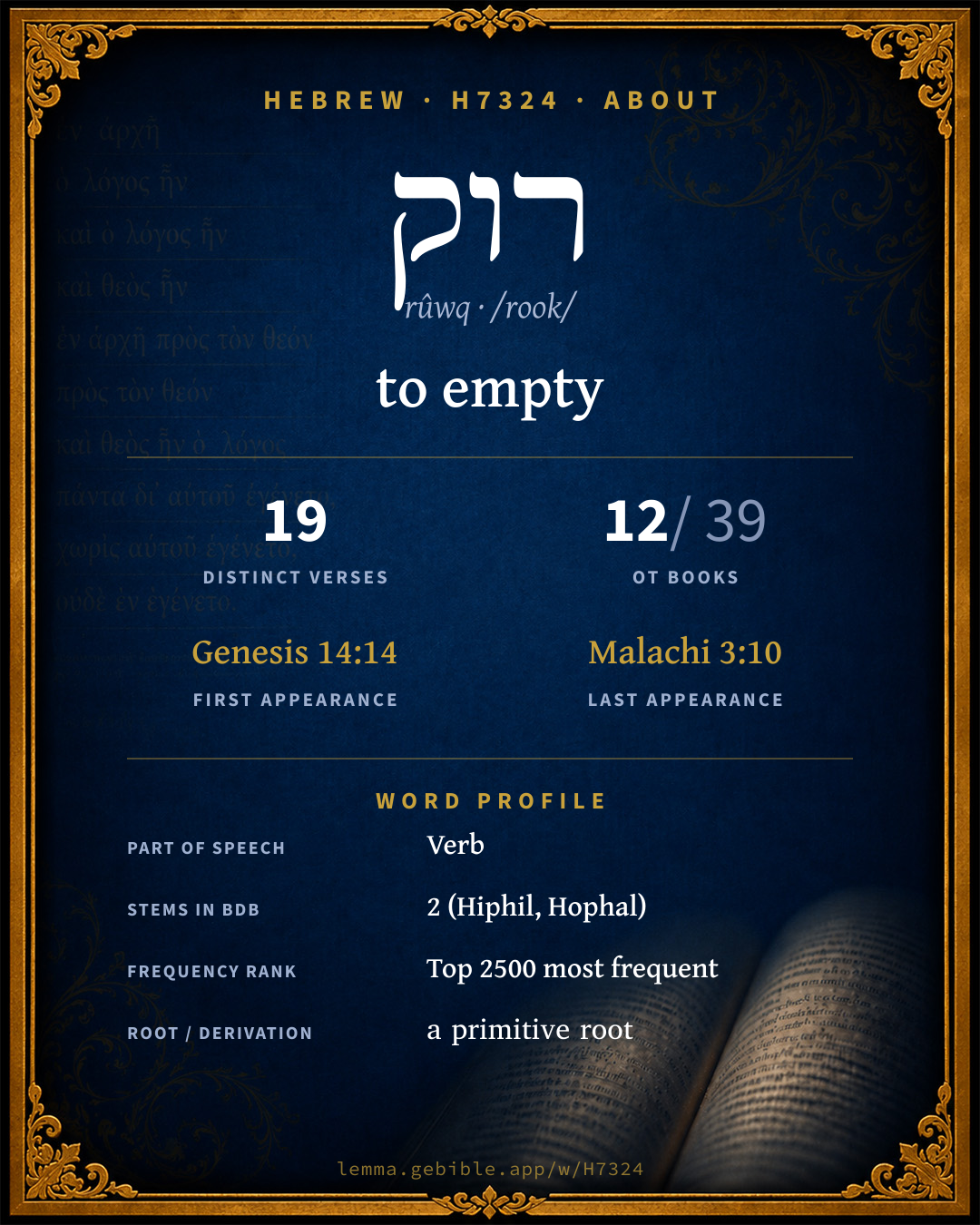
רִיק
to empty
‘to empty’ is one of 2 main senses fuller range ↓
Full lexicon entry — Brown-Driver-Briggs (BDB)
From Brown-Driver-Briggs (BDB)
Where this word appears
See every Hiphil verb in the Hebrew Bible →
Grammar key — what these labels mean
Part of speech
- Verb
- An action or state-of-being word.
Stem
- Hiphil
- The causative active stem (“he caused / brought about”). Here: ‘make empty’
- Hophal
- The passive counterpart of the Hiphil (“he was caused to…”). Here: ‘be emptied out from vessel’
Form
- Imperfect
- An incomplete, ongoing, or future action (“he will / would write”).
- Sequential Perfect
- A perfect with prefixed waw continuing a preceding imperfect or command (waw-consecutive perfect).
- Imperative
- A direct command (“write!”).
- Sequential Imperfect
- An imperfect with prefixed waw — the standard past-narrative form (waw-consecutive imperfect).
- Infinitive Construct
- A bound verbal noun, frequently with prepositions (“to write / in writing”).
- Participle Active
- A verbal adjective expressing ongoing or characteristic action (“writing / one who writes”).
- Perfect
- A completed action or state — Hebrew marks aspect (completeness) more than strict tense (“he wrote”).
State
- Absolute
- The independent form of a noun, not bound to a following word.
Person
- 1st Person
- The speaker (“I / we”).
- 3rd Person
- The one spoken about (“he / she / it / they”).
- 2nd Person
- The one addressed (“you”).
Gender
- Common
- Either gender — not distinguished for this form.
- Masculine
- Grammatically masculine.
- Feminine
- Grammatically feminine.
Number
- Singular
- One.
- Plural
- More than one (in Hebrew, generally three or more).
Grammatical forms 11 distinct
- Verb, Hiphil, Imperfect, 1st Person, Common, Singular 5 times (26%)
- Verb, Hiphil, Sequential Perfect, 1st Person, Common, Singular 2 times (11%)
- Verb, Hiphil, Sequential Perfect, 3rd Person, Common, Plural 2 times (11%)
- Verb, Hiphil, Imperfect, 3rd Person, Masculine, Plural 2 times (11%)
- Verb, Hiphil, Participle Active, Masculine, Plural, Absolute 2 times (11%)
- Verb, Hiphil, Imperative, 2nd Person, Masculine, Singular 1 time (5%)
- Verb, Hiphil, Sequential Imperfect, 3rd Person, Masculine, Singular 1 time (5%)
- Verb, Hiphil, Infinitive Construct 1 time (5%)
+3 more forms (3 occurrences)
Parsed forms decoded from the imported morphology (morphhb / Westminster Leningrad Codex — WLC text public domain, morphhb tagging CC BY 4.0), counted across 19 parsed occurrences — not distinct verses.
Every verse where H7324 appears — 19 distinct verses across 12 books. Click any verse to open its interlinear word-by-word view. Verse text shown in the World English Bible for context — . Each verse’s Hebrew form is shown with its reference; the English is not keyword-highlighted, since the data carries no word-level English alignment. Use “Compare translations” on any verse to read it across multiple English versions. This concordance covers the Hebrew Bible; Septuagint (Greek Old Testament) occurrences are not indexed here.
Genesis 2 verses
- Genesis 14:14 וַ/יָּ֨רֶק conj + Hiphil wimpf 3ms When Abram heard that his relative was taken captive, he led forth his trained men, born in his house, three hundred and eighteen, and pursued as far as Dan.
- Genesis 42:35 מְרִיקִ֣ים Hiphil ptcp.act mp It happened as they emptied their sacks, that behold, every man's bundle of money was in his sack. When they and their father saw their bundles of money, they were afraid.
Exodus 1 verse
Leviticus 1 verse
Psalms 2 verses
Ecclesiastes 1 verse
Song of Solomon 1 verse
Isaiah 1 verse
Jeremiah 2 verses
- Jeremiah 48:11 הוּרַ֤ק Hophal pf 3ms Moab has been at ease from his youth, and he has settled on his lees, and has not been emptied from vessel to vessel, neither has he gone into captivity: therefore his taste remains in him, and his scent is not changed.
- Jeremiah 48:12 יָרִ֔יקוּ Hiphil impf 3mp Therefore, behold, the days come, says Yahweh, that I will send to him those who pour off, and they shall pour him off; and they shall empty his vessels, and break their bottles in pieces.
Ezekiel 5 verses
- Ezekiel 5:2 אָרִ֥יק Hiphil impf 1cs A third part shall you burn in the fire in the midst of the city, when the days of the siege are fulfilled; and you shall take a third part, and strike with the sword round about it; and a third part you shall scatter to the wind, and I will draw out a sword after them.
- Ezekiel 5:12 אָרִ֥יק Hiphil impf 1cs A third part of you shall die with the pestilence, and with famine shall they be consumed in the midst of you; and a third part shall fall by the sword round about you; and a third part I will scatter to all the winds, and will draw out a sword after them.
- Ezekiel 12:14 אָרִ֥יק Hiphil impf 1cs I will scatter toward every wind all who are round about him to help him, and all his bands; and I will draw out the sword after them.
- Ezekiel 28:7 וְ/הֵרִ֤יקוּ conj + Hiphil wpf 3cp therefore, behold, I will bring strangers on you, the terrible of the nations; and they shall draw their swords against the beauty of your wisdom, and they shall defile your brightness.
- Ezekiel 30:11 וְ/הֵרִ֤יקוּ conj + Hiphil wpf 3cp He and his people with him, the terrible of the nations, shall be brought in to destroy the land; and they shall draw their swords against Egypt, and fill the land with the slain.
Habakkuk 1 verse
Zechariah 1 verse
Malachi 1 verse
About this entry
At a glance — auto-summarized from this page’s data, not written by a person. Every figure links to its source below. This summary describes the numbers; it doesn’t interpret them.
At its core, רוק (rûwq) means “to empty.” It first appears in Genesis 14:14. It turns up in 19 verses across 12 books, an uncommon footprint. The word gravitates to Ezekiel (26%), then Genesis and Psalms. As a verb its force shifts by stem, across 2 stems (Hiphil, Hophal, and more). Each statement above links to its evidence; the full detail follows below.
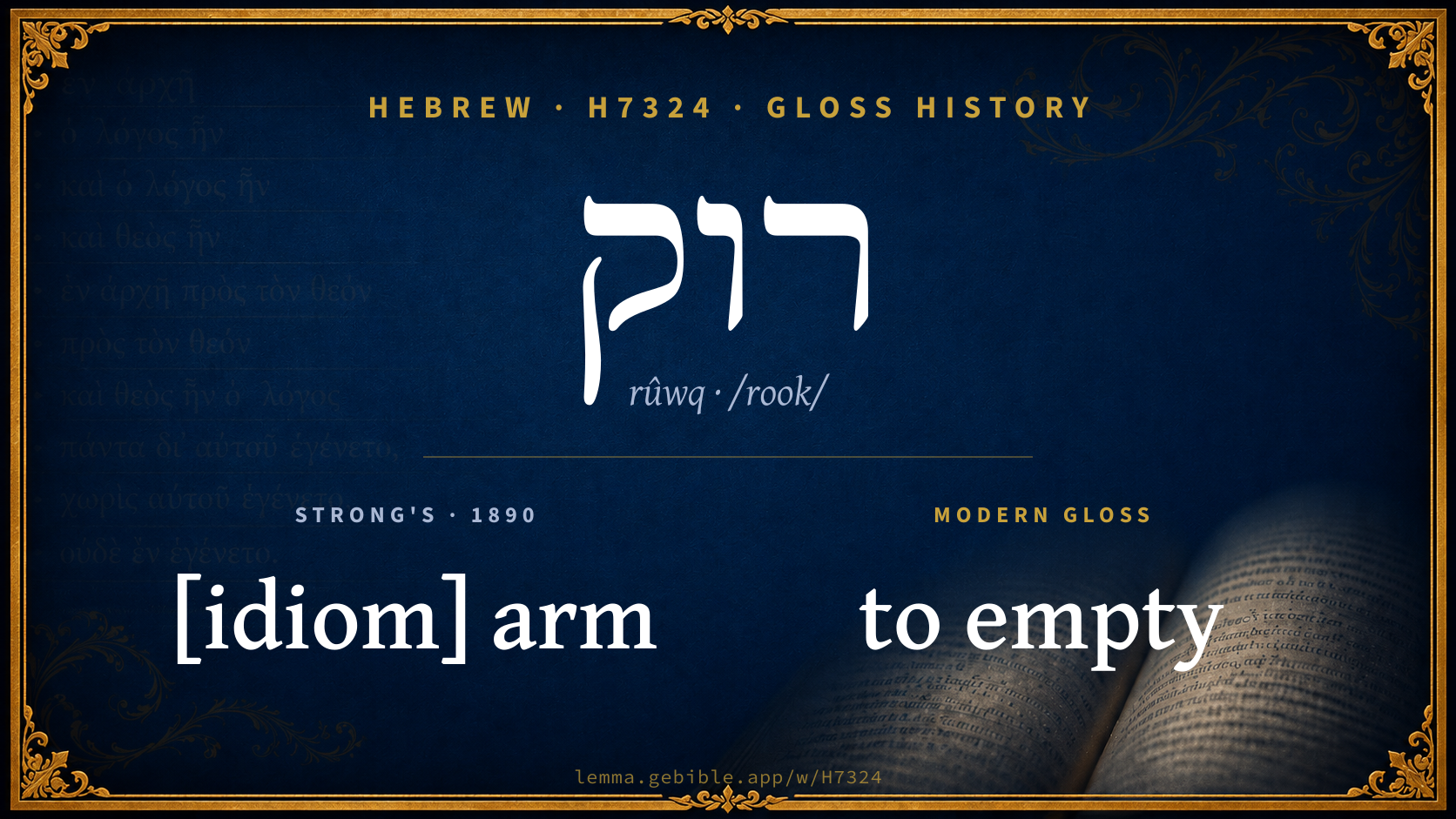
Gloss history
Strong's 1890 vs modern scholarship
About this word
Strong's H7324 catalogs a Hebrew word from the Hebrew Old Testament.
These counts are not copied from any lexicon or concordance. They are computed here, from the morphology-tagged Hebrew Old Testament. What Lemma adds →
- 19
- distinct verses
- The word appears in 19 distinct verses.
- 12 / 39
- OT books
- The word appears in 12 of 39 Old Testament books.
- #1,563
- by frequency
- Top 2500 most frequent Hebrew words (rank 1,563 of 8,640 Hebrew words by occurrence).
View all 19 occurrences in the concordance →
By section of the Old Testament
By traditional corpus
Conventional, traditional groupings — biblical authorship is debated, so this is a traditional corpus grouping, not an authorship claim. Each share is this word’s portion of its verses in that division of the Hebrew canon. Each figure is a share of the word’s 19 distinct verses.
- Prophets (Nevi'im) 11 verses · 58%
- Torah (Pentateuch) 4 verses · 21%
- Writings (Ketuvim) 4 verses · 21%
How translations render this word
Counts come from each version’s own published word-to-Strong’s tagging or interlinear alignment — an approximate guide to how each version renders this word, not a word-level alignment the data otherwise carries. Because each total is that version’s own tagged count, the per-version totals vary from one another and need not match the appearance or distinct-verse counts above. These counts may also differ from a printed concordance because Lemma counts each distinctly tagged rendering and does not collapse phrase taggings into a single head-word total. This is a fixed set of word-tagged versions (KJV, ASV, BSB, ULT) and does not change with the reading translation you choose elsewhere. Each version’s license is shown beside its name below (and on Sources).
BDB lists this Strong’s number as 2 distinct words (homographs). Each count above pools all of them and is not split by sense — see the Senses section below. A low-frequency rendering may belong to a different one of those words, not the primary meaning.
- King James Version†: I will draw out 3×, They shall draw 2×
- American Standard Version†: I will draw out 2×, They shall draw 2×
- Berean Standard Bible†: Empty 2×, I will draw 2×, They will draw 2×
- unfoldingWord Literal Text†: I will draw out 2×
King James Version Public Domain
Renders H7324 across 19† tagged occurrences — most commonly:
Plus 14 renderings that appear only once — usually multi-word phrases or single function words the recovered tagging swept in, not distinct renderings.
American Standard Version Public Domain
Renders H7324 across 19† tagged occurrences — most commonly:
Plus 15 renderings that appear only once — usually multi-word phrases or single function words the recovered tagging swept in, not distinct renderings.
Berean Standard Bible Public Domain
Renders H7324 across 19† tagged occurrences — most commonly:
Plus 13 renderings that appear only once — usually multi-word phrases or single function words the recovered tagging swept in, not distinct renderings.
unfoldingWord Literal Text CC BY-SA 4.0
Renders H7324 across 18† tagged occurrences — most commonly:
Plus 16 renderings that appear only once — usually multi-word phrases or single function words the recovered tagging swept in, not distinct renderings.
Senses in the full BDB
Hebrew verbs can shift meaning by stem (binyan): Qal is the basic action, Niphal is often passive or reflexive, Piel often intensifies or makes it factitive, and Hiphil is typically causative. The senses below are grouped under the stem BDB assigns to each. This entry also uses Hophal (the passive of Hiphil).
What do BDB’s symbols mean?
BDB uses these scholarly abbreviations:
| Symbol | Meaning |
|---|---|
| 𝔊 | the Septuagint (the ancient Greek translation, LXX) |
| 𝔙 | the Vulgate (the Latin translation) |
| 𝔖 | the Syriac version (the Peshitta) |
| 𝔗 | the Targum (the Aramaic translation) |
| ψ | the Psalms |
| √ | root (the underlying root or stem) |
| ‖ | parallel passage (a synonymous or contrasted parallel) |
| † | the dagger: every passage where the word occurs is cited |
The 5 senses and sub-senses the full Brown-Driver-Briggs lexicon distinguishes for this word, in lexicon order (not ranked by frequency), with BDB’s own verbatim wording and sub-sense lettering. Shown in Hebrew script with BDB’s own scholarly abbreviations. The condensed entry is in the Lexicon Entry tab. See also the Forms in the corpus table below.
רוק I
Hiphil
- make empty, empty out (Arabic رَاقَ (ى) pour out, forth, intrans. (of water, blood, etc.); Aramaic רִיק empty, pour, ܪܳܩ in deriv.; Assyrian rêḳu, empty);—Pf. 1 s. הֲרִיקֹ֫תִי Lv 26:33 Mal 3:10; 3 pl. הֵרִיקוּ Ez 28:7; 30:11; Impf. 3 ms. יָרִיק Hb 1:17, וַיָּ֫רֶק Gn 14:14 (but v. infr.); Imv. ms. הָרֵק ψ 35:3; Inf. cstr. הָרִיק Is 32:6; Pt. pl. מְרִיקִים Gn 42:35 Zc 4:12;— e.g. Leviticus 26:33
- 1. empty vessels Gn 42:35 (E) Je 48:12; keep empty, לְהָרִיק נֶפֶשׁ רָעֵב Is 32:6 (i.e. keep hungry). e.g. Genesis 42:35
- 2. pour out or down, rain Mal 3:10 Ec 11:3, oil Zc 4:12. e.g. Malachi 3:10
- 3. empty out (i.e. draw) sword (cf. Assyrian kakkê ittabbaku [pass.], DlHWB 699 b) Ex 15:9 (poem), Lv 26:33 (H), Ez 5:2, 12; 12:14; 28:7; 30:11; prob. also Hb 1:17 (חרבו for חרמוֹ Gie We Now); of lance ψ 35:3; cf. (si vera l.) וירק חניכיו Gn 14:14 (R) led forth, וַיָּ֫דֶק (Aramaic דּוּק Aph. look) i.e. mustered 𝔊 cf. Di al., ויפקד Ball.—In ψ 18:43 𝔊 𝔖 Hup-Now Bae read אֲדִקֵּם; so ‖ 2 S 22:43 MT; but De Dr אֲרִיקֵם (v. דקק). e.g. Exodus 15:9
Hophal
- be emptied out from vessel: Pf. 3 ms. הוּרַק Je 48:11; Impf. 2 ms. תּוּרַק Ct 1:3 (al. 3 fs.; of ointment, in sim.); cf. also Am 6:6, where Oort מוּרְקֵי for מִזְרְקֵי. e.g. Jeremiah 48:11
רוק II [m.] emptiness, vanity
Senses from the full Brown-Driver-Briggs lexicon (Brown, Driver, Briggs; Oxford 1906 — public domain), digitized via Sefaria, supplemented by the OpenScriptures HebrewLexicon (CC BY 4.0). Full attribution on Sources.
Word origin
n.[m.] emptiness, vanity;—chiefly in adv. phr. לְרִיק Is 49:4 Jb 39:16 in vain (of labour without benefit), so לָר׳ Lv 26:16, 20 (H), Is 65:23; and as adv. acc. רִיק Is 30:7 ψ 73:13, prob. also 2:1 (most = empty scheme as רֵיק 2) cf. ψ 4:3 (read prob. רֵיק); בְּדֵי רִיק Je 51:58 = Hb 2:13.—Je 51:34 v. רֵיק 1.
— Brown-Driver-Briggs (Oxford 1906, public domain), digitized via Sefaria, supplemented by the OpenScriptures HebrewLexicon (CC BY 4.0). See Sources.
Origin: a primitive root
Jastrow Dictionary
A second Hebrew/Aramaic lexicon for comparison, covering Aramaic and post-biblical (Talmudic, Targumic, Midrashic) usage that the biblical-Hebrew BDB does not. Matched by lemma rather than by Strong’s number, so a lemma may carry more than one Jastrow headword (shown separately below), and the entries cover usage well beyond the Bible.
רוּק I
- to spit, v. רָקַק, רְקַק.
רוּק II
- [to be bright, clear; cmp. לָבָן,] to be blank, empty.
- to empty, pour from vessel to vessel. Cant. R. to I, 3 (ref. to תורק ib.) כאדם שמֵרִיק מכלי וכ׳ like one emptying (perfumed oil) from one vessel into another. Ned. 32ᵃ (play on וירק, Gen. XIV, 14) הֵרִיקָן מן התורה Var. (v. Tosaf. a. l.) he made them empty of study (took the scholars away from their studies to make them go to war), v. יָרַק; a. e.—[Lev. R. s. 18 ומריקה את הכסף, read: ומריצה, v. רוּץ.] e.g. Genesis 14:14
- to be emptied, be poured from vessel to vessel. Lev. R. s. 3 (ref. to Cant. I, 3, v. supra) כשמן המוּרָק וכ׳ like oil that is poured from vessel to vessel without a sound. e.g. Song of Solomon 1:3
רוּק
- Af. אָרֵיק same, to empty, pour. Targ. Gen. XLII, 35. Ib. XXXV, 14 (h. text ויצק); a. fr.
- to be poured. Targ. Lev. XXI, 10 (Y. ed. Vien. יִתְרוֹק).
רוֹק
- spittle. Yeb. XII, 6 (ref. to Deut. XXV, 9) ר׳ הנראה וכ׳ the spittle must be visible to the judges. Nidd. IX, 6 ר׳ תפל tasteless saliva; expl. ib. 7 כל שלא טעם כלום of a person who has not broken his fast. Y. Sabb. XIV, 14ᵈ top; Bab. Sabb. 108ᵇ; a. fr.—Nidd. 16ᵇ עד שהר׳ בתוך הפה (euphem.) while the semen is yet in the vagina. e.g. Deuteronomy 25:9
רוֹק ²
- c. ch. same. Targ. Job VII, 19 רֻקִּי. Ib. XXX, 10; a. e.—Yeb. 101ᵇ; 106ᵇ צריכי … למיחזי ר׳ וכ׳ the judges must see the spittle as it comes out of the mouth &c., v. preced. Ib. 39ᵇ וירקת … ר׳ דמתחזיא וכ׳ (Rashi דאתחזי) and she spat before him spittle which was visible to the judges on the floor; Y. ib. XII, 13ᵃ top; a. fr.—Sabb. 101ᵃ ר׳ דחמת Ar. (Ms. M. ריקא; ed. זיקא), v. חַמָּת. Ib. 99ᵇ; Nidd. 42ᵃ, v. תְּפֵי I.
רָקַק
- (b. h.) to spit. B. Kam. VIII, 6 ר׳ והגיע בו רוקו if a person spat (at his neighbor), and his spittle touched him. Snh. 101ᵃ וברוֹקֵק בה … על הרקיקה that is when he spits at it (while reciting a Bible verse as a charm for a wound), for the name of God must not be pronounced in connection with spitting. Y. Ber. III, 6ᵈ bot. הרוקק … כרוקק וכ׳ he that spits in the synogogue is considered as if spitting at the pupil of his eye (euphem. for God). Yeb. 105ᵃ שרָקְקָה דם who (in spitting before the yabam) spat blood; Y. ib. XII, end, 13ᵃ רַקָּה (or רָקָה, fr. רוּק). Ḥag. 5ᵃ (ref. to Koh. XII, 14) זה הרָק בפני חבירו וכ׳ this refers to one who spits in his neighbor’s presence and becomes disgusting (v. מָאַס). Tosef. B. Kam. IX, 31, v. טוּשׁ h.; a. fr. e.g. Ecclesiastes 12:14
- same. Yalk. Is. 339 (ref. to Ps. IV, 3) עד מתי … מְרַקְּקִין בו וכ׳ how long will you put to shame the honor of the (ruined) Temple, spitting in it, committing nuisance in it &c.? e.g. Psalms 4:3
- (cmp. רָקָק) to be miry. Mikv. VII, 1 חטיט הנ׳ soft, miry clay (in the bath reservoir); Zeb. 22ᵃ Ms. M. (ed. הנדוק); Succ. 19ᵇ (v. Rabb. D. S. a. l. note 40).
A Dictionary of the Targumim, the Talmud Babli and Yerushalmi, and the Midrashic Literature (Marcus Jastrow; London, Luzac, 1903) — Public Domain. Digitized via Sefaria. Digitized via Sefaria. Full attribution on Sources.
Forms in the corpus
The 14 distinct written forms H7324 takes in the Hebrew Bible, most frequent first — each parse links to that stem’s occurrences in the concordance. Hebrew forms include their vowel points and cantillation, so a single lemma takes many written forms.
Same root — word family
Other BDB entries built from the same root as H7324, grouped by Strong’s listed origin. These share a root / origin per the lexicon — not necessarily a shared meaning. Each links to that word’s own entry.
Derived from this word
Proper names from this root
People and places named from this root — a name, not an additional meaning of the word.
Compare all same-root words → 1 of the same-root words is a proper name (a person or place). They share a root, not necessarily a meaning.
Septuagint verse parallels
This word appears in 18 verses that also exist in the Greek Old Testament (Septuagint), out of the 19 Hebrew verses it occurs in. You can read those verses in Greek by switching the Old Testament edition to the Septuagint.
Read these verses in the Septuagint
- Genesis 14:14
- Exodus 15:9
- Leviticus 26:33
- Psalms 35:3
- Ecclesiastes 11:3
- Song of Solomon 1:3
- Isaiah 32:6
- Jeremiah 48:11
- Ezekiel 5:2
- Habakkuk 1:17
- Zechariah 4:12
- Malachi 3:10
This is a verse-level parallel only — the same verses exist in both the Hebrew and Greek Old Testaments. No word-level Hebrew↔Greek correspondence is claimed: the data carries no such alignment, so no Greek word is shown as this Hebrew word’s translation. Coverage is not total — the Septuagint omits the deuterocanon and renumbers the Psalms, so some Hebrew verses have no direct Greek parallel.