
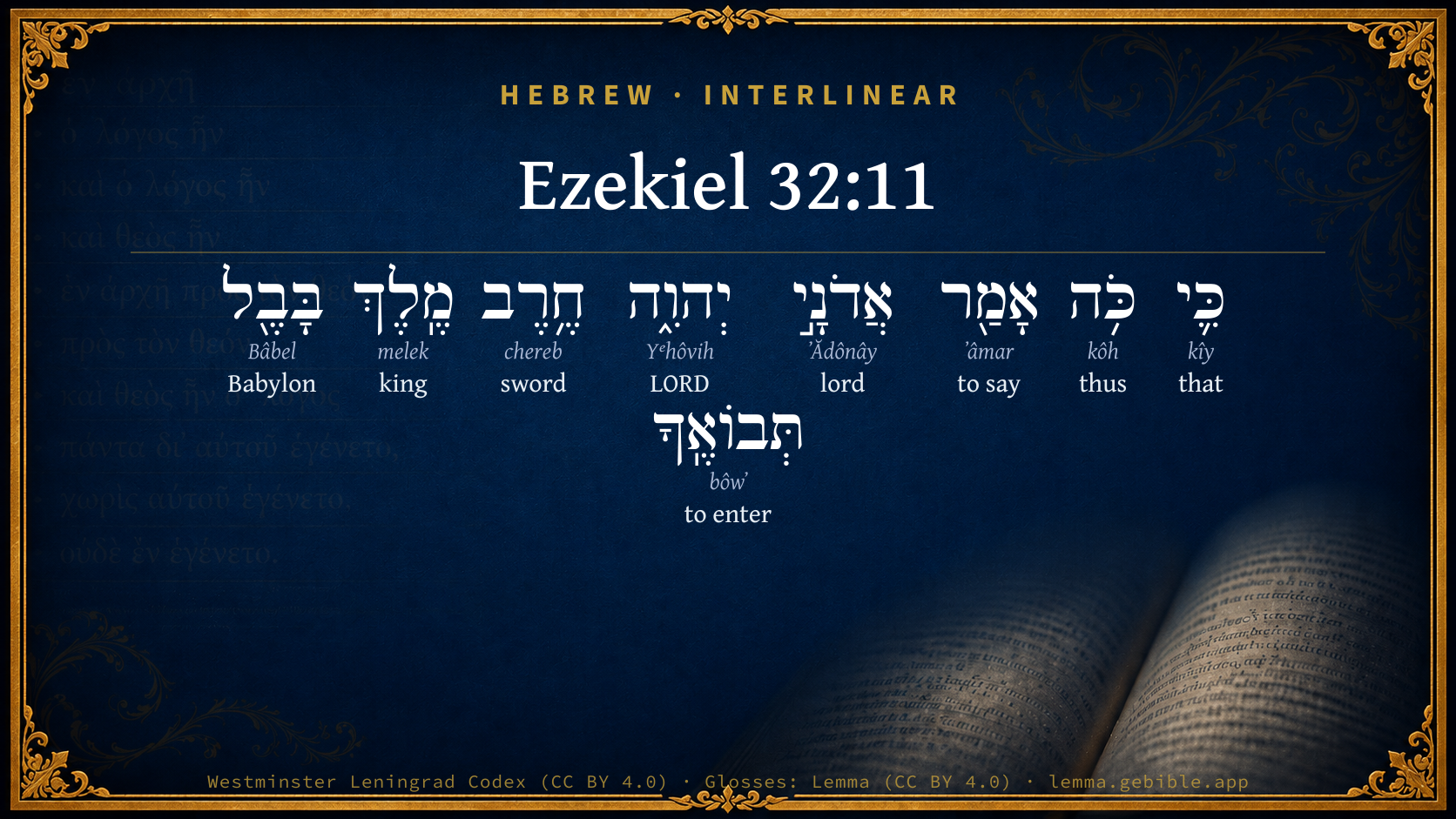
Ezekiel 32:11

Hebrew (Westminster Leningrad Codex) Ezekiel 32:11 appears in the Hebrew Old Testament. The text above is from the Westminster Leningrad Codex. Each word links to its Strong’s number, a concise gloss, and parsing drawn from the Open Scriptures Hebrew Bible morphology. Click any word for its full Brown-Driver-Briggs (BDB) entry.
Download image
Cite this verse

Ezekiel 32:11 (World English Bible). Public Domain. Lemma interlinear Bible study tool, https://lemma.gebible.app/v/ezekiel/32/11.

Show BibTeX & RIS
BibTeX
RIS
English Translation
For thus says the Lord Yahweh: The sword of the king of Babylon shall come on you.
World English Bible · Public Domain
Download a study sheet

One document with this verse’s original text, its word-by-word gloss line, the meaning frame, cross-references with their text, attributed commentary, and full source and license credits — printable, and it pastes into notes with its structure intact.

This verse Autodidact and up

Study sheet (.html) Plain text (.txt)

A passage Seminary Student

Up to 50 verses in one chapter. A passage sheet keeps up to 6 commentary sources and 12 cross-references per verse, in the order this page ranks them, and says so on the sheet whenever that leaves anything out. Ask for a single verse and you get the Autodidact verse sheet above.

Everything on this page stays free to read, with no account — the sheet is a download of what is already on screen, not access to it.

Want to remove ads? Support Godless Engineer
Compare translations 3

The same verse in 3 English versions, stacked beneath the original-language interlinear above. Click any original word for its lexicon entry.

Each is an independent rendering of the whole verse — the interlinear is not word-aligned to these translations.

Highlighted words mark where these versions differ — a whole-verse word diff, not a word-by-word alignment.

  • World English Bible Public Domain
    For thus says the Lord Yahweh: The sword of the king of Babylon shall come on you.
  • King James Version Public Domain
    For thus saith the Lord GOD; The sword of the king of Babylon shall come upon thee.
  • unfoldingWord Literal Text CC BY-SA 4.0
    For the Lord Yahweh says this: The sword of the king of Babylon will come against you.

unfoldingWord Literal Text — © unfoldingWord, licensed CC BY-SA 4.0. Word-aligned USFM3 via Door43 (git.door43.org/unfoldingWord/en_ult).

Versions to compare (up to 4)

3 of 4 selected

Show all 18 translations

Every available English version of this verse, each an independent rendering of the whole verse.

  • World English Bible Public Domain
    For thus says the Lord Yahweh: The sword of the king of Babylon shall come on you.
  • Berean Standard Bible Public Domain
    For this is what the Lord GOD says: ‘The sword of the king of Babylon will come against you!
  • Majority Standard Bible Public Domain
    For this is what the Lord GOD says: ‘The sword of the king of Babylon will come against you!
  • King James Version Public Domain
    For thus saith the Lord GOD; The sword of the king of Babylon shall come upon thee.
  • American Standard Version (1901) Public Domain
    For thus saith the Lord Jehovah: The sword of the king of Babylon shall come upon thee.
  • Revised Version (1885) Public Domain
    For thus saith the Lord GOD: The sword of the king of Babylon shall come upon thee.
  • Geneva Bible (1599) Public Domain
    For thus sayth the Lord God, The sworde of the King of Babel shall come vpon thee.
  • Douay-Rheims (1899) Public Domain
    For thus saith the Lord God: The sword of the king of Babylon shall come upon thee,
  • Young's Literal Translation Public Domain
    For thus said the Lord Jehovah: A sword of the king of Babylon entereth thee,
  • Literal Standard Version CC BY-SA 4.0
    For thus said Lord YHWH: A sword of the king of Babylon enters you,
  • Unlocked Literal Bible CC BY-SA 4.0
    For the Lord Yahweh says this: The sword of the king of Babylon will come against you.
  • unfoldingWord Literal Text CC BY-SA 4.0
    For the Lord Yahweh says this: The sword of the king of Babylon will come against you.
  • Darby Bible Public Domain
    For thus saith the Lord Jehovah: The sword of the king of Babylon shall come upon thee.
  • World Messianic Bible Public Domain
    For the Lord GOD says: “The sword of the king of Babylon will come on you.
  • Webster's Bible Public Domain
    For thus saith the Lord GOD; The sword of the king of Babylon shall come upon thee.
  • Free Bible Version CC BY-SA 4.0
    For this is what the Lord God says: The sword of the king of Babylon will attack you!
  • Bible in Basic English Public Domain
    For this is what the Lord has said: The sword of the king of Babylon will come on you.
  • JPS Tanakh (1917) Public Domain
    For thus saith the Lord GOD: The sword of the king of Babylon shall come upon thee.

Literal Standard Version (2020), Covenant Press — licensed CC BY-SA 4.0. Text via the HelloAO Bible API (eBible.org). Unlocked Literal Bible (unfoldingWord) — licensed CC BY-SA 4.0. Text via the HelloAO Bible API (eBible.org). unfoldingWord Literal Text — © unfoldingWord, licensed CC BY-SA 4.0. Word-aligned USFM3 via Door43 (git.door43.org/unfoldingWord/en_ult). Free Bible Version, Dr. Jonathan Gallagher — licensed CC BY-SA 4.0. Text via the HelloAO Bible API (eBible.org).

Word by word

More ways to search: Search by grammar → Find every occurrence → Compare this word →

Practice this passage: Drill this verse → Learn its vocabulary →

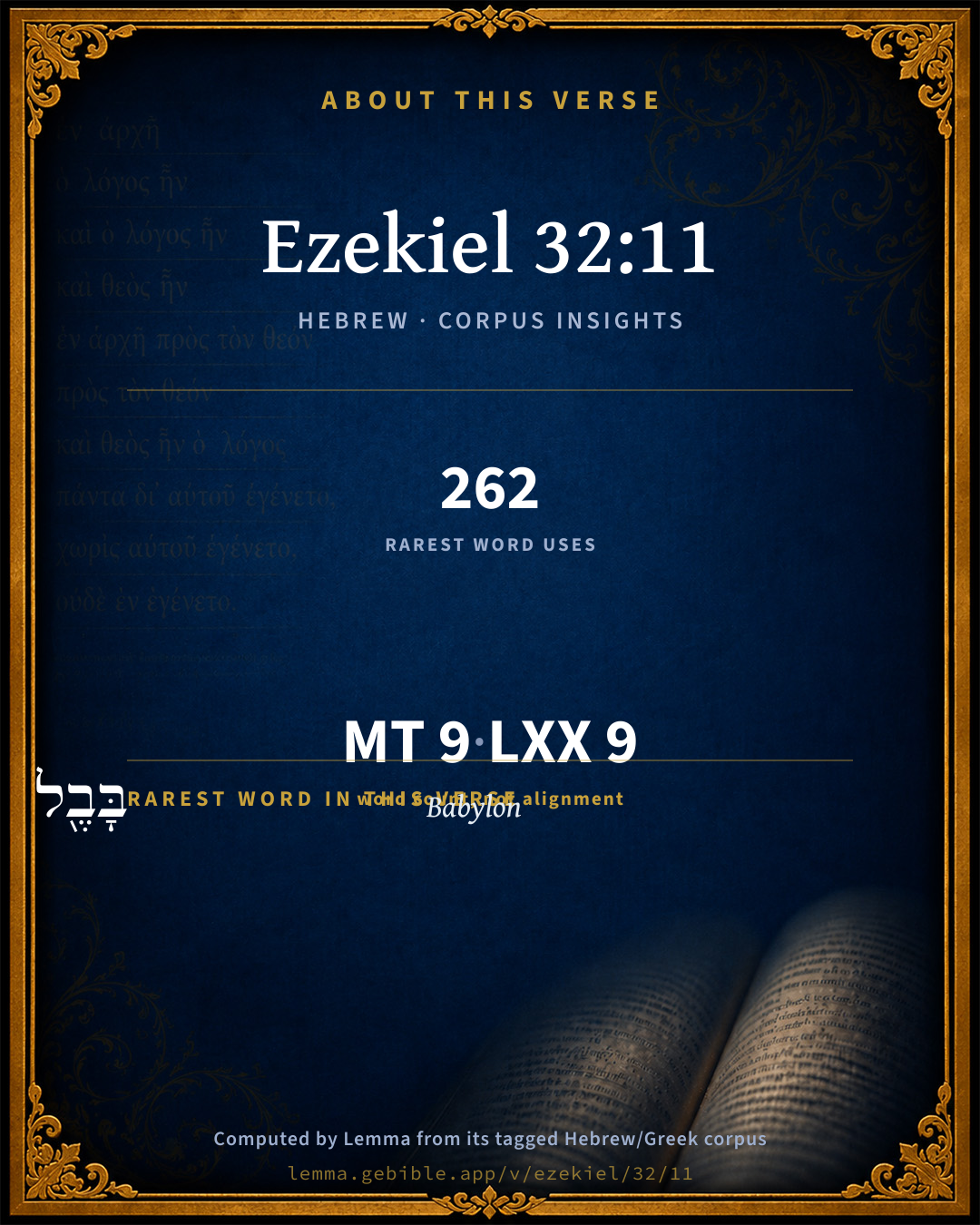
About this verse

These counts appear in no published source. They are computed here, from the morphology-tagged text and Lemma’s own curated glosses. What Lemma adds →

9
words
9
distinct lemmas
Prophets
section

Grammatical profile

  • 2 verbs
  • 5 nouns
  • 1 conjunction
  • 1 adverb

Verb forms

  • אָמַ֖ר Qal · Perfect
  • תְּבוֹאֶֽךָ Qal · Imperfect

Hebrew & Septuagint length

In English translation the verse runs 17 words from the Hebrew and 17 from the Septuagint (LXX English) — the same length.

A rough comparison of the two English renderings, which tokenize alike — not a word-level alignment.

Word counts can differ between the Hebrew and the Greek without any difference in meaning — e.g. the Hebrew direct-object marker אֵת has no separate Greek word, and Greek often adds the article ὁ.

In the original languages it is 9 Hebrew tokens and 9 Greek tokens — but the two are counted differently (Hebrew bundles its prefixes and suffixes into one token; the Greek is in lemma form), so that isn’t a like-for-like length.

Cross-references

6

Topical passages linked to Ezekiel 32:11 in the Treasury of Scripture Knowledge — connected by theme and wording, ordered by reader-vote popularity; previews shown in the World English Bible.

  • Jeremiah 43:10 and tell them, Thus says Yahweh of Hosts, the God of Israel: Behold, I will send and take Nebuchadrezzar the king of Babylon, my servant, and will set his throne on these stones that I have hidden; and he shall spread his royal pavilion over them.
  • Jeremiah 46:13 The word that Yahweh spoke to Jeremiah the prophet, how that Nebuchadrezzar king of Babylon should come and strike the land of Egypt.
  • Jeremiah 46:24–26 The daughter of Egypt shall be disappointed; she shall be delivered into the hand of the people of the north.
  • Ezekiel 26:7 For thus says the Lord Yahweh: Behold, I will bring on Tyre Nebuchadrezzar king of Babylon, king of kings, from the north, with horses, and with chariots, and with horsemen, and a company, and much people.
  • Ezekiel 30:4 A sword shall come on Egypt, and anguish shall be in Ethiopia, when the slain shall fall in Egypt; and they shall take away her multitude, and her foundations shall be broken down.
  • Ezekiel 30:22–25 Therefore thus says the Lord Yahweh: Behold, I am against Pharaoh king of Egypt, and will break his arms, the strong [arm], and that which was broken; and I will cause the sword to fall out of his hand.

Cross-references courtesy of OpenBible.info (CC BY 4.0).

Hebrew and Greek witnesses Masoretic Hebrew ↔ Greek Septuagint

The same verse in the two great witnesses to the Old Testament, shown verse-for-verse.

These are two independent witnesses, not word-aligned to each other, and the Septuagint is shown in lemma (dictionary) form.

Hebrew Ezekiel 32:11 Masoretic · Westminster Leningrad Codex

כִּ֛י כֹּ֥ה אָמַ֖ר אֲדֹנָ֣י יְהוִ֑ה חֶ֥רֶב מֶֽלֶךְ בָּבֶ֖ל תְּבוֹאֶֽךָ

For thus says the Lord Yahweh: The sword of the king of Babylon shall come on you.

World English Bible · Public Domain

Greek LXX Ezekiel 32:11 Septuagint · lemma form

ὅτι ὅδε λέγω κύριος ῥομφαία βασιλεύς βαβυλών ἥκω σύ

For thus says the Lord God; The sword of the king of Babylon shall come upon you,

LXX2012 (modern English Septuagint) · Public Domain

Hebrew: Westminster Leningrad Codex (CC BY 4.0). Greek: Septuagint (public domain); English from LXX2012 (modern English Septuagint) (Public Domain). How the Septuagint differs from the Hebrew →

Targum (Aramaic paraphrase)

1

The Targum is the ancient Jewish Aramaic paraphrase of the Hebrew Scriptures — an interpretive translation, not the Hebrew text itself. Onkelos (literal) and Pseudo-Jonathan (expansive) render the Torah, and Jonathan the Prophets. Coverage is partial: where no permissively-licensed English translation exists for a verse, only the Aramaic is shown. This is verse-level text, not a word-by-word alignment to the Hebrew.

  1. Targum Jonathan Prophets (Joshua–Malachi)
    אֲרֵי כִּדְנַן אֲמַר יְיָ אֱלֹהִים קְטוֹלֵי חַרְבָּא מַלְכָּא דְבָבֶל יֵיתוּן עֲלָךְ:

    (no public-domain English translation for this verse)

    Targum Jonathan — Aramaic: “Mikraot Gedolot” (public domain). English: “Sefaria Community Translation” (CC0 1.0 (public-domain dedication)); “London "Chaldee Paraphrase," 1871” (public domain). Text via Sefaria.

Commentary

Notes on Ezekiel 32:11 from classic Christian and Jewish commentators (each source and its license shown beneath its notes). The classic Christian expositions comment on the surrounding passage and are grouped to its opening verse, so a note may address several verses; the Jewish commentaries on the Tanakh (Rashi and others) are per-verse, so they appear only where the commentator wrote on this verse.

Lemma curates 59 commentaries, every one of them public domain or Creative Commons licensed, each selected and text-cleaned for this edition rather than reprinted as found. About our sources →

Trapp's Complete Commentary

John Trapp

Eze 32:11 For thus saith the Lord GOD; The sword of the king of Babylon shall come upon thee.

Ver. 11. The sword of the King of Babylon.] Here is that delivered plainly which was before parabolically.

John Trapp, A Commentary or Exposition upon All the Books of the Old and New Testament (1647–1656) — public domain. Text from a community e-Sword module.

Tyndale Open Study Notes

Tyndale Open Resources

32:11-12 The human agent of God’s wrath, the sword of the king of Babylon, was coming to shatter the power of Egypt once and for all. This would be an even greater destruction than at the time of the first Passover, when only the firstborn male humans and animals of Egypt died (Exod 12:29).

Tyndale Open Study Notes — © Tyndale Open Resources, licensed CC BY-SA 4.0. Text via the HelloAO Bible API.

The Cambridge Bible for Schools and Colleges

gen. ed. J. J. S. Perowne

11. It is the king of Babylon who shall execute the Lord’s judgment upon Egypt.

The Cambridge Bible for Schools and Colleges (gen. ed. J. J. S. Perowne; Cambridge University Press, 1878–1918) — public domain. Text from a community e-Sword module.

John Gill's Exposition

For thus saith the Lord God, the sword of the king of Babylon shall come upon thee. Upon Pharaoh and his kingdom; having a commission and a direction from the Lord, and which would be the instrument of the destruction before threatened. The Targum is,

"those that slay with the sword of the king of Babylon shall come upon or against thee;''

his army, sword in hand.

John Gill's Exposition of the Whole Bible (1746–1763) — public domain (CC PDM 1.0). Text via the HelloAO Bible API.

Matthew Poole's English Annotations

See Eze 30:24,25.

Upon thee; both king and kingdom of Egypt.

Matthew Poole's English Annotations on the Holy Bible (1683–1685) — public domain. Text from a community e-Sword/MySword module.

Whedon's Commentary on the Bible

Daniel D. Whedon

11-15. It is now plainly stated that Nebuchadnezzar and the terrible Chaldeans shall work this destruction. (Compare Eze_28:7; Eze_29:11; Eze_29:19.) The waters shall now be “clear” (R.V.), and smooth as oil, no longer fouled (R.V., “troubled”) by the struggling crocodile (Eze_32:2), for all life shall be destroyed; then shall the Egyptians know who Jehovah is. (Compare Eze_30:26.)

Daniel D. Whedon (gen. ed.), Commentary on the Old and New Testaments (1874–1909) — public domain. Text from a community e-Sword module.

The Pulpit Commentary

Vers. 11-14. The sword of the King of Babylon, etc. The effects of Nebuchadnezzar"s invasion are now described in language which seems plain enough, but in which we may read between the lines an allusive reference to the previous symbolism. Thus in Ver. 13 we are thrown back upon the thought of the "troubled waters" of Ver. 2. The Nile was no longer to be troubled by the foot of beasts; the streams of justice were no longer to be defiled with a selfish corruption, but were to run smooth and calm, even as the "rivers of oil" which were the symbols of ethical blessedness. (Job_29:6; Deu_32:13) So Ewald and Keil, for once agreeing. The rule of Nebuchadnezzar was to be a righteous rule, in spite of its severity. I am unable, however, to follow these commentators further in seeing in the words a prediction of the Messianic kingdom. The Egyptians were to "know the Lord," as the other nations addressed by Ezekiel were to know him, as a righteous Judge, not as yet as a Deliverer. (Eze_28:26 Eze_29:21 Eze_30:26)

Vers. 11, 12. The sword the implement of Divine judgment.

The sword has been a mighty factor in human history. However peace and harmony may be the ideal state of human society, the chronicles of the past and the observation of the present concur to assure us that there are elements in man"s nature which will surely reveal themselves in hostility and in mutual ill will, in bloodshed, and in violent death. Nation rises against nation. The sword is drawn, and is only sheathed when one combatant is constrained to submit to the superior power of the other.

I THERE IS A SENSE IN WHICH THE SWORD OF THE MIGHTY CONQUEROR IS THE SWORD OF GOD HIMSELF. When the King of Babylon attacked the King of Egypt, there is no doubt he was actuated by motives of hostility, of personal ambition, perhaps of revenge. But for all this, and although he knew it not, he was the minister of God, was doing God"s work, executing God"s purposes. The Almighty can overrule the wrathful passions of men to bring about the objects he desires to compass.

II THE SWORD OF THE CONQUEROR IS THE SYMBOL OF SUPREME POWER. Men talk of submitting matters to the arbitrament of the sword, implying that there is no possibility of going behind and beyond this. In all earthly government physical force is the Ultimate resource; it may not be brought prominently forward, but it lies in the background, to be used when necessary. God"s power controls and rules the nations; he cannot be resisted. "The nations are as nothing before him; they are counted as less than nothing and vanity;" "Let not the rebellious exalt themselves!

III THE CONQUEROR"S SWORD IS THE EMBLEM OF THE EXECUTION OF DIVINE JUSTICE. We speak of the sword of the magistrate, as well as of the sword of the soldier: "He beareth not the sword in vain." There is certainly no allusion in this prophetic passage to judicial functions, if they are understood to be distinct from military operations. Yet in God"s hand the sword is not a weapon of violence, far less of injustice. He never smites vindictively, but always as a righteous Ruler and an impartial Judge. Even in warfare he is exercising a magisterial as well as a military office and power. His sword subdues the rebel, corrects the offender, and establishes the rule of justice, and brings about the purposes of equitable and happy peace. T.

Vers. 11-16. The downfall of one involves the downfall of many.

Every man is linked to society by organic ties. A king especially holds an important and responsible place. He is the key-stone of the arch. "No man liveth unto himself." He lifts others up or drags others down. He goes not to heaven, nor to hell, alone.

I WAR IS THE SCOURGE IN GOD"S HAND. "By the swords of the mighty will I cause thy multitudes to fall." Even the angry passions of men God utilizes for righteous purposes. However reluctant, the devil shall become his servant. Sin shall illustrate the splendors of his grace. His amazing power shall form and mould all things to his will. The cruel sword shall serve to establish the empire of universal peace.

II ONE MAN"S DESTRUCTION INCLUDES TEN THOUSAND OTHERS. Every man is, in greater measure or less, a moral magnet. The fall of a great commercial house brings down to ruin smaller enterprises. The bankruptcy of an employer of labor brings loss to all his servants. If the commander-in-chief falls in battle, the entire army is weakened. If a throne is overturned, all the inhabitants of the land suffer. We are bound each to each by manifold ties, and influence each other"s destiny. A sense of responsibility should lend dignity to all our words and actions.

III HUMAN DESTRUCTION IS MEASURED IN NATURE"S DESOLATION. "I will destroy all the beasts thereof from beside the great waters;" "The country shall be destitute of that whereof it was full." Under man"s care, cattle increase, and the fields become trebly fertile. But if the inhabitants are swept off by the sword, domestic cattle disappear, and wild beasts roam at large. The land, uncultivated, cannot maintain the flecks. Desolation spreads far and wide. Barrenness appears where formerly plenty smiled. The face of nature mourns in sympathy with ruined man.

IV THE KNOWLEDGE OF GOD IS WELL PURCHASED WITH THE LOSS OF ALL THINGS. "When I shall make the land of Egypt desolate, then shall they know that I am the Lord." All knowledge is power, but the knowledge of God is power of the highest kind; it is life. To know God is practical wisdom; it is the only path to safety, elevation, and honor. If the issue of suffering, loss, or defeat in battle be to gain the knowledge of God, then, however great the outlay, the reward is amply satisfying. To know God is the way to obtain likeness to God; and this is the supreme privilege of every man. This is wealth that is abiding, joy that is eternal: honor that never fades.

V SEVERE DISASTER BRINGS INTO VIEW THE UNITY OF THE HUMAN RACE. "The daughters of the nations shall lament her." The prosperity of a man or of a nation often excites envy. But distress awakens compassion. The sight of suffering moves into action the better part of human nature; it awakens the deepest feelings of the soul. In a time of great disaster, men forget their rivalries and hostilities, and, by their deeds, proclaim the oneness of the human family. Such sympathy in suffering has a benign and purifying influence on human nature. The night-dew is a preparation for higher fertility and beauty in the garden, both in nature and in the soul. D.

The Pulpit Commentary (1880–1919), ed. H.D.M. Spence-Jones & Joseph S. Exell — public domain. Text from a community e-Sword module.

unfoldingWord translationNotes

Door43 World Missions Community

General Information:

Yahweh continues to speak to Pharaoh.

The sword of the king of Babylon will come against you

Here "sword" represents an army. AT: "The army of the king of Babylon will attack you" (See: Metonymy)

each warrior a terror of nations

The abstract noun "terror" can be stated as "terrifies" or "afraid." AT: "Each warrior terrifies the nations" or "each one of them makes the nations afraid" (See: Abstract Nouns)

will devastate the pride of Egypt

The abstract noun "pride" can be stated as "proud." AT: "will cause the Egyptians to no longer be proud" (See: Abstract Nouns)

destroy all of its multitudes

Here "all" is probably a generalization that refers to the killing of large numbers of soldiers, and perhaps other people also. AT: "kill a very large number of people who live in Egypt" (See: Hyperbole and Generalization)

translationWords

Lord Yahweh

sword

king

Babylon

terror

nation

devastate

Egypt

unfoldingWord translationNotes — © Distant Shores Media and the Door43 World Missions Community, licensed CC BY-SA 4.0. Source: git.door43.org/Door43/en_tn.

Lesson kit

Teaching starters — assembled from the data on this page, not authored interpretation. Every prompt links to the verse data it draws on. Edit before teaching.

Ezekiel, in the Prophets, opens this verse with 9 words (9 distinct Hebrew lemmas). Its most distinctive word is Bâbel (“Babylon”). A historical commentator’s framing appears above. Read the whole chapter for the surrounding context.

Discussion questions

  1. What does “Babylon” (Bâbel) contribute to the verse as a whole?
  2. Jeremiah 43:10 shares this passage’s theme. How do the two illuminate each other?
  3. These translations render this verse differently; the difference is in the English rendering, not the original. What questions does that raise?
  4. The verb «אָמַ֖ר» is Qal Perfect. How does its form color the action?
  5. Reading how Trapp's Complete Commentary and Tyndale Open Study Notes read this verse, where do the two commentators agree and where do they part?

Things to notice

Reading settings

Reading text

Shown beneath each verse's original-language words.

Old Testament
Old Testament edition

Read the OT as the Masoretic Hebrew (MT) or the Greek Septuagint (LXX).

English shown for the Greek Septuagint (in the Hebrew ↔ Greek comparison).

Comparing translations? Open the Compare panel on any verse page to stack up to four side by side.