Jeremiah 25:22

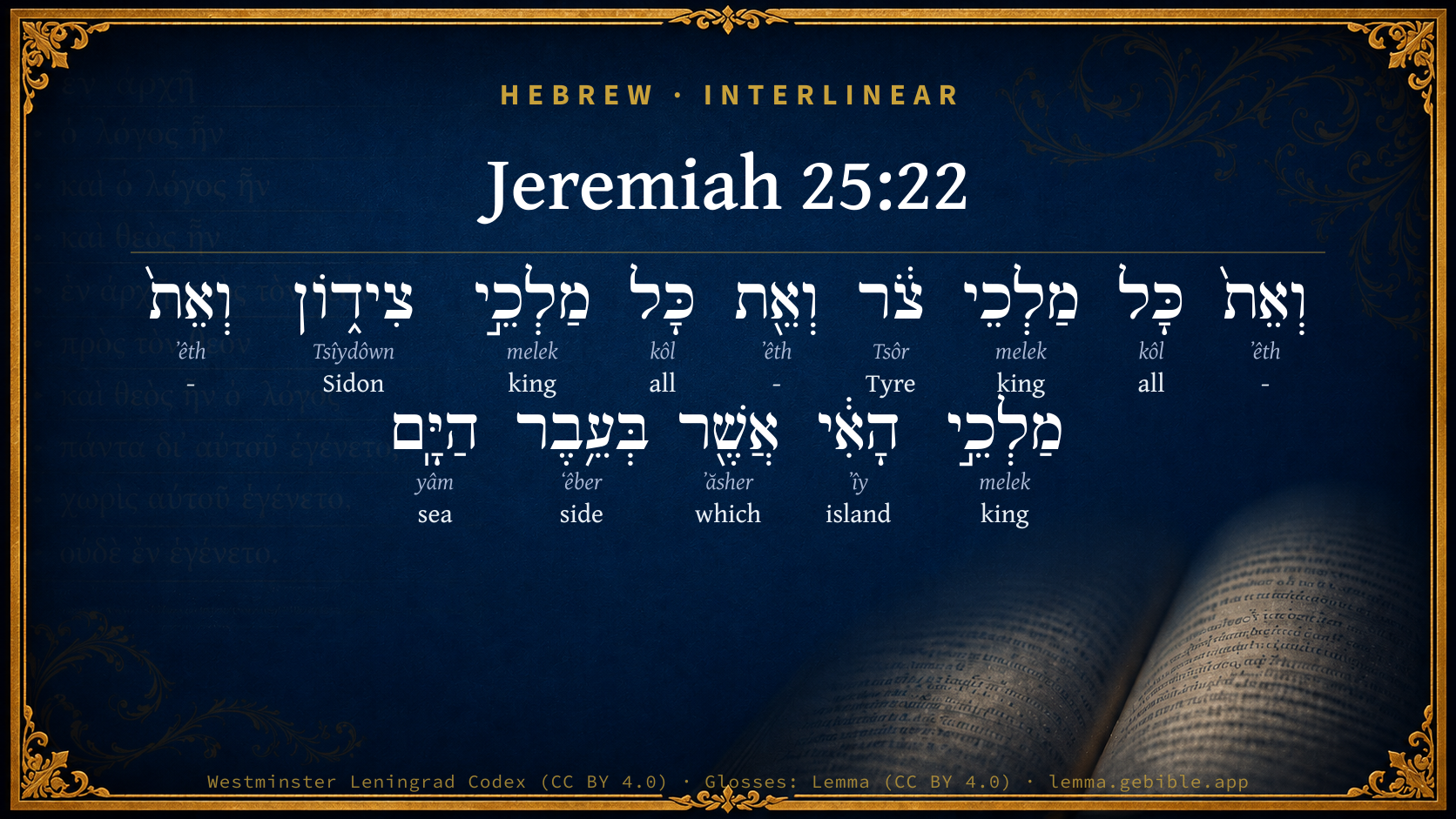
Hebrew (Westminster Leningrad Codex) Jeremiah 25:22 appears in the Hebrew Old Testament. The text above is from the Westminster Leningrad Codex. Each word links to its Strong’s number, a concise gloss, and parsing drawn from the Open Scriptures Hebrew Bible morphology. Click any word for its full Brown-Driver-Briggs (BDB) entry.
Download image
Cite this verse

Jeremiah 25:22 (World English Bible). Public Domain. Lemma interlinear Bible study tool, https://lemma.gebible.app/v/jeremiah/25/22.

Show BibTeX & RIS
BibTeX
RIS
English Translation
and all the kings of Tyre, and all the kings of Sidon, and the kings of the isle which is beyond the sea;
World English Bible · Public Domain
Download a study sheet

One document with this verse’s original text, its word-by-word gloss line, the meaning frame, cross-references with their text, attributed commentary, and full source and license credits — printable, and it pastes into notes with its structure intact.

This verse Autodidact and up

Study sheet (.html) Plain text (.txt)

A passage Seminary Student

Up to 50 verses in one chapter. A passage sheet keeps up to 6 commentary sources and 12 cross-references per verse, in the order this page ranks them, and says so on the sheet whenever that leaves anything out. Ask for a single verse and you get the Autodidact verse sheet above.

Everything on this page stays free to read, with no account — the sheet is a download of what is already on screen, not access to it.

Want to remove ads? Support Godless Engineer
Compare translations 3

The same verse in 3 English versions, stacked beneath the original-language interlinear above. Click any original word for its lexicon entry.

Each is an independent rendering of the whole verse — the interlinear is not word-aligned to these translations.

Highlighted words mark where these versions differ — a whole-verse word diff, not a word-by-word alignment.

  • World English Bible Public Domain
    and all the kings of Tyre, and all the kings of Sidon, and the kings of the isle which is beyond the sea;
  • King James Version Public Domain
    And all the kings of Tyrus, and all the kings of Zidon, and the kings of the isles which are beyond the sea,
  • unfoldingWord Literal Text CC BY-SA 4.0
    and all of the kings of Tyre and all of the kings of Sidon and the kings of the coastland that across the sea;

unfoldingWord Literal Text — © unfoldingWord, licensed CC BY-SA 4.0. Word-aligned USFM3 via Door43 (git.door43.org/unfoldingWord/en_ult).

Versions to compare (up to 4)

3 of 4 selected

Show all 18 translations

Every available English version of this verse, each an independent rendering of the whole verse.

  • World English Bible Public Domain
    and all the kings of Tyre, and all the kings of Sidon, and the kings of the isle which is beyond the sea;
  • Berean Standard Bible Public Domain
    all the kings of Tyre and Sidon; the kings of the coastlands across the sea;
  • Majority Standard Bible Public Domain
    all the kings of Tyre and Sidon; the kings of the coastlands across the sea;
  • King James Version Public Domain
    And all the kings of Tyrus, and all the kings of Zidon, and the kings of the isles which are beyond the sea,
  • American Standard Version (1901) Public Domain
    and all the kings of Tyre, and all the kings of Sidon, and the kings of the isle which is beyond the sea;
  • Revised Version (1885) Public Domain
    and all the kings of Tyre, and all the kings of Zidon, and the kings of the isle which is beyond the sea;
  • Geneva Bible (1599) Public Domain
    And all the Kings of Tyrus, and all the kings of Zidon, and the Kings of the Yles, that are beyonde the Sea,
  • Douay-Rheims (1899) Public Domain
    And all the kings of Tyre, and all the kings of Sidon: and the kings of the land of the islands that are beyond the sea.
  • Young's Literal Translation Public Domain
    And all the kings of Tyre, And all the kings of Zidon, And the kings of the isle that `is' beyond the sea,
  • Literal Standard Version CC BY-SA 4.0
    And all the kings of Tyre, || And all the kings of Sidon, || And the kings of the island that [is] beyond the sea,
  • Unlocked Literal Bible CC BY-SA 4.0
    The kings of Tyre and Sidon, the kings of the coasts on the other side of the sea,
  • unfoldingWord Literal Text CC BY-SA 4.0
    and all of the kings of Tyre and all of the kings of Sidon and the kings of the coastland that across the sea;
  • Darby Bible Public Domain
    and all the kings of Tyre, and all the kings of Zidon, and the kings of the isles that are beyond the sea;
  • World Messianic Bible Public Domain
    and all the kings of Tyre, all the kings of Sidon, and the kings of the isle which is beyond the sea;
  • Webster's Bible Public Domain
    And all the kings of Tyre, and all the kings of Zidon, and the kings of the isles which are beyond the sea,
  • Free Bible Version CC BY-SA 4.0
    to all the kings of Tyre and Sidon; to the kings of the Mediterranean sea coast;
  • Bible in Basic English Public Domain
    And all the kings of Tyre, and all the kings of Zidon, and the kings of the lands across the sea;
  • JPS Tanakh (1917) Public Domain
    and all the kings of Tyre, and all the kings of Zidon, and the kings of the isle which is beyond the sea;

Literal Standard Version (2020), Covenant Press — licensed CC BY-SA 4.0. Text via the HelloAO Bible API (eBible.org). Unlocked Literal Bible (unfoldingWord) — licensed CC BY-SA 4.0. Text via the HelloAO Bible API (eBible.org). unfoldingWord Literal Text — © unfoldingWord, licensed CC BY-SA 4.0. Word-aligned USFM3 via Door43 (git.door43.org/unfoldingWord/en_ult). Free Bible Version, Dr. Jonathan Gallagher — licensed CC BY-SA 4.0. Text via the HelloAO Bible API (eBible.org).

Word by word

More ways to search: Search by grammar → Find every occurrence → Compare this word →

Practice this passage: Drill this verse → Learn its vocabulary →

צִיד֑וֹן
Tsîydôwn
H6721
“Sidon”
Noun, Proper
Part of Speech
Noun
Type
Proper
Full BDB Definition

Origin: from H6679 in the sense of catching fish

TWOT: None

Sidon = "hunting" - ancient Phoenician city, on Mediterranean coast north of Tyre
  1. וְאֵת֙ ʼêth H853 “and · -” Conjunction + Particle, Direct Object
  2. כָּל kôl H3605 “all of” Noun, Common, Masculine, Singular, Construct
  3. מַלְכֵי melek H4428 “kings of” Noun, Common, Masculine, Plural, Construct
  4. צֹ֔ר Tsôr H6865 “Tyre” Noun, Proper
  5. וְאֵ֖ת ʼêth H853 “and · -” Conjunction + Particle, Direct Object
  6. כָּל kôl H3605 “all of” Noun, Common, Masculine, Singular, Construct
  7. מַלְכֵ֣י melek H4428 “kings of” Noun, Common, Masculine, Plural, Construct
  8. וְאֵת֙ ʼêth H853 “and · -” Conjunction + Particle, Direct Object
  9. מַלְכֵ֣י melek H4428 “kings of” Noun, Common, Masculine, Plural, Construct
  10. הָאִ֔י ʼîy H339 “the · island” Particle, Definite Article + Noun, Common, Masculine, Singular, Absolute
  11. אֲשֶׁ֖ר ʼăsher H834 “which” Particle, Relative
  12. בְּעֵ֥בֶר ʻêber H5676 “in/at · side of” Preposition + Noun, Common, Masculine, Singular, Construct
  13. הַיָּֽם yâm H3220 “the · sea” Particle, Definite Article + Noun, Common, Masculine, Singular, Absolute

About this verse

These counts appear in no published source. They are computed here, from the morphology-tagged text and Lemma’s own curated glosses. What Lemma adds →

14
words
9
distinct lemmas
Prophets
section

Notable vocabulary

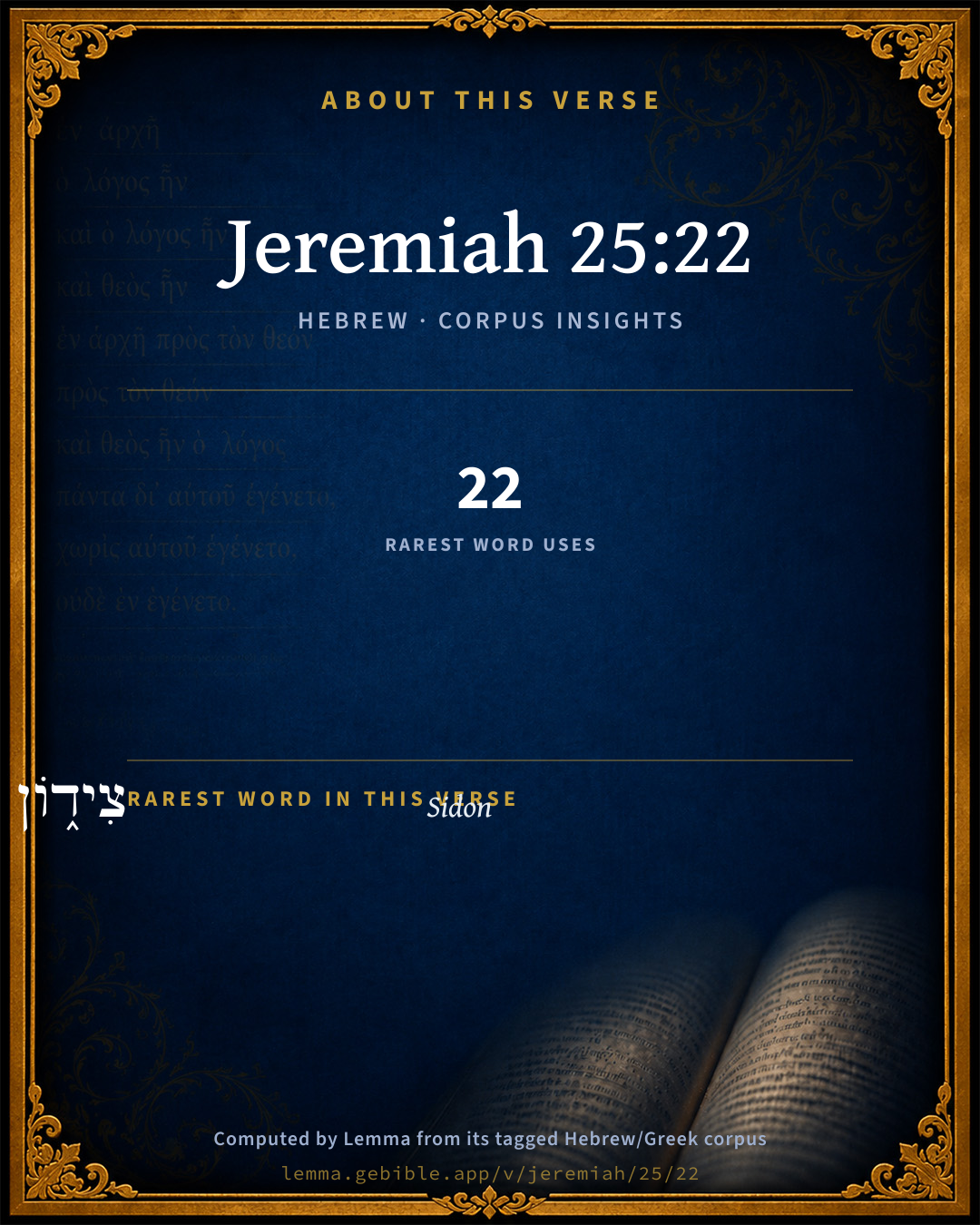
The rarest word here is צִיד֑וֹן Sidon H6721 — appearing just 22 times in the whole Hebrew Bible.

Shared distinctive vocabulary

צִיד֑וֹן Sidon H6721 occurs in 22 verses of the Hebrew Bible. Also found in:

Grammatical profile

  • 10 nouns
  • 4 particles

Repetition

Words recur within this verse — often emphatic in Hebrew:

  • מַלְכֵי king H4428 ×3
  • כָּל all H3605 ×2

Cross-references

12

Topical passages linked to Jeremiah 25:22 in the Treasury of Scripture Knowledge — connected by theme and wording, ordered by reader-vote popularity; previews shown in the World English Bible.

  • Jeremiah 47:4 because of the day that comes to destroy all the Philistines, to cut off from Tyre and Sidon every helper who remains: for Yahweh will destroy the Philistines, the remnant of the isle of Caphtor.
  • Jeremiah 27:3 and send them to the king of Edom, and to the king of Moab, and to the king of the children of Ammon, and to the king of Tyre, and to the king of Sidon, by the hand of the messengers who come to Jerusalem to Zedekiah king of Judah;
  • Jeremiah 31:10 Hear the word of Yahweh, you nations, and declare it in the isles afar off; and say, He who scattered Israel will gather him, and keep him, as shepherd does his flock.
  • Jeremiah 49:23–27 Of Damascus. Hamath is confounded, and Arpad; for they have heard evil news, they are melted away: there is sorrow on the sea; it can't be quiet.
  • Ezekiel 26:1–21 It happened in the eleventh year, in the first [day] of the month, that the word of Yahweh came to me, saying,
  • Ezekiel 28:22–23 and say, Thus says the Lord Yahweh: Behold, I am against you, Sidon; and I will be glorified in the midst of you; and they shall know that I am Yahweh, when I shall have executed judgments in her, and shall be sanctified in her.
  • Ezekiel 29:18 Son of man, Nebuchadrezzar king of Babylon caused his army to serve a great service against Tyre: every head was made bald, and every shoulder was worn; yet had he no wages, nor his army, from Tyre, for the service that he had served against it.
  • Ezekiel 32:30 There are the princes of the north, all of them, and all the Sidonians, who are gone down with the slain; in the terror which they caused by their might they are put to shame; and they lie uncircumcised with those who are slain by the sword, and bear their shame with those who go down to the pit.
  • Joel 3:4–8 "Yes, and what are you to me, Tyre, and Sidon, And all the regions of Philistia? Will you repay me? And if you repay me, I will swiftly and speedily return your repayment on your own head.
  • Amos 1:3–5 Thus says Yahweh: "For three transgressions of Damascus, yes, for four, I will not turn away its punishment; Because they have threshed Gilead with threshing instruments of iron;
  • Amos 1:9–10 Thus says Yahweh: "For three transgressions of Tyre, yes, for four, I will not turn away its punishment; Because they delivered up the whole community to Edom, And didn't remember the brotherly covenant;
  • Zechariah 9:1–4 An oracle. The word of Yahweh is against the land of Hadrach, And will rest upon Damascus; For the eye of man And of all the tribes of Israel is toward Yahweh;

Cross-references courtesy of OpenBible.info (CC BY 4.0).

Hebrew and Greek witnesses Masoretic Hebrew ↔ Greek Septuagint

The same verse in the two great witnesses to the Old Testament, shown verse-for-verse.

These are two independent witnesses, not word-aligned to each other, and the Septuagint is shown in lemma (dictionary) form.

Hebrew Jeremiah 25:22 Masoretic · Westminster Leningrad Codex

וְאֵת֙ כָּל מַלְכֵי צֹ֔ר וְאֵ֖ת כָּל מַלְכֵ֣י צִיד֑וֹן וְאֵת֙ מַלְכֵ֣י הָאִ֔י אֲשֶׁ֖ר בְּעֵ֥בֶר הַיָּֽם

and all the kings of Tyre, and all the kings of Sidon, and the kings of the isle which is beyond the sea;

World English Bible · Public Domain

Greek LXX Structure differs

In the Septuagint, Jeremiah is about an eighth shorter than the Hebrew and arranges its material differently — the Oracles Against the Nations (Hebrew chapters 46–51) appear in the middle of the Greek book, after 25:13. Because the chapter and verse boundaries do not line up, a verse-for-verse comparison with the Hebrew is not shown.

A verse-for-verse comparison isn’t shown here because the chapters and verses don’t line up. Switch to the LXX edition with the MT / LXX toggle above to read the Greek directly.

Hebrew: Westminster Leningrad Codex (CC BY 4.0). Greek: Septuagint (public domain); English from a public-domain English Septuagint. How the Septuagint differs from the Hebrew →

Targum (Aramaic paraphrase)

1

The Targum is the ancient Jewish Aramaic paraphrase of the Hebrew Scriptures — an interpretive translation, not the Hebrew text itself. Onkelos (literal) and Pseudo-Jonathan (expansive) render the Torah, and Jonathan the Prophets. Coverage is partial: where no permissively-licensed English translation exists for a verse, only the Aramaic is shown. This is verse-level text, not a word-by-word alignment to the Hebrew.

  1. Targum Jonathan Prophets (Joshua–Malachi)
    וְיַת כָּל מַלְכֵי צוֹר וְיַת כָּל מַלְכֵי צִידוֹן וְיַת כָּל מַלְכֵי נִיסָא דִי בְעֶבְרָא דְיַמָא:

    (no public-domain English translation for this verse)

    Targum Jonathan — Aramaic: “Mikraot Gedolot” (public domain). English: “Sefaria Community Translation” (CC0 1.0 (public-domain dedication)); “London "Chaldee Paraphrase," 1871” (public domain). Text via Sefaria.

Commentary

Notes on Jeremiah 25:22 from classic Christian and Jewish commentators (each source and its license shown beneath its notes). The classic Christian expositions comment on the surrounding passage and are grouped to its opening verse, so a note may address several verses; the Jewish commentaries on the Tanakh (Rashi and others) are per-verse, so they appear only where the commentator wrote on this verse.

Lemma curates 59 commentaries, every one of them public domain or Creative Commons licensed, each selected and text-cleaned for this edition rather than reprinted as found. About our sources →

Trapp's Complete Commentary

John Trapp

Jer 25:22 And all the kings of Tyrus, and all the kings of Zidon, and the kings of the isles which [are] beyond the sea,

Ver. 22. And all the kings of the isles.] As Cyprus, Rhodes, and the Cyclades, subdued also by the Babylonian, saith Jerome, Rabanus, and Vatablus.

John Trapp, A Commentary or Exposition upon All the Books of the Old and New Testament (1647–1656) — public domain. Text from a community e-Sword module.

Joseph Benson's Commentary

Jer 25:22-24. And all the kings of Tyrus and Zidon — The nobles, or chief men of each city, seem to be meant by kings here, for neither of these cities had more than one king. And the kings of the isles, which are beyond the sea — Cyprus, &c., which Nebuchadnezzar subjected. Or, as the Hebrew, האי בעבר הים, is rendered in the margin, The region by the sea-side. For that אי, rendered isle in the text, does not always signify an island, properly so called, is manifest from many passages. Dedan, and Tema, and Buz — A person called Dedan was descended from Abraham by Keturah, Gen 25:3. Probably he founded the city Dedan; which, however, in process of time, seems to have been annexed to Edom: see Jer 49:8; Eze 25:13. Tema was one of the sons of Ishmael, Gen 25:15, and a city, or district, called after him, was situate near the mountains which separate Arabia from Chaldea. — An. Univ. Hist., vol. 7. p. 230, fol. Buz was the brother of Uz, Gen 22:21, and settled most probably, in his neighbourhood. Elihu, the wisest of Job’s friends, was a Buzite, Job 32:2. And all that are in the utmost corners — Or, all that have the coast insulated, as Blaney translates it: see note on Jer 9:26. These, he supposes, to be the inhabitants of the peninsula of Arabia, especially those situate toward the bottom, or narrow part of it. And all the kings of Arabia — “The whole country to which we give the general name of Arabia seems to have been thrown, in Scripture, into two great divisions, one of which is called properly ערבה, Arabah, the other קדם, Kedem, according to their respective situations; Arabah, signifying the west, as Kedem does the east. Each of these had their subdivisions; the first, comprehending that which geographers have distinguished by the name of Arabia Petræa, and also, perhaps, those parts along the western coast of the Red sea bordering upon Egypt. The other part, called Kedem, comprehended Arabia Felix, and Arabia Deserta; the former of which the Scripture seems to have distinguished by the name of קצוצי פאת, those that have their coast insulated, mentioned in the preceding verse; and the latter in this verse, by the mingled race of those that dwell in the desert, meaning such as inhabited the great desert country, lying between Mesopotamia and Palestine. These may have been so called from the manner of inhabiting the desert promiscuously and in common, without any fixed property or abode, settling, for a time, where they found pasture, and then removing with their flocks to another place; or, from their being made up of people of different descents.” — Blaney.

Joseph Benson's Commentary on the Old and New Testaments (1811–1818) — public domain. Text from a community e-Sword module.

Geneva Bible (1599)

Geneva Bible translators

As Greece, Italy and the rest of those countries.

Geneva Bible (1599) marginal notes — public domain. Text via Bolls.life.

Jamieson, Fausset & Brown

Robert Jamieson, A. R. Fausset & David Brown

all the kings of Tyrus--the petty kings of the various dependencies of Tyre.

isles--a term including all maritime regions (Psa 72:10).

Jamieson, Fausset & Brown — Commentary Critical and Explanatory on the Whole Bible (1871) — public domain (CC PDM 1.0). Text via the HelloAO Bible API.

Adam Clarke's Commentary

Verse 22. Tyrus and - Zidon] The most ancient of all the cities of the Phoenicians.

Kings of the isles which are beyond the sea.] As the Mediterranean Sea is most probably meant, and the Phoenicians had numerous colonies on its coasts, I prefer the marginal reading, the kings of the region by the sea side.

Adam Clarke's Commentary on the Bible (1810–1826) — public domain. Text from a community e-Sword/MySword module.

John Calvin's Commentaries

As to the word Island, the number is to be changed; for the Prophet means not one island, but the countries beyond the sea. Some restrict the reference to Cyprus, Crete, Mitylene, and other islands in the Mediterranean; but it is a common way of speaking in Hebrew, to call all countries beyond the sea islands.

“The kings of the islands shall come.” (Psalm 72:10.)

The Prophet in that passage calls those the kings of the islands who would come in ships to Judea. So also in this place we may understand by the kings of the islands all those who were beyond the sea.

We now see that kings of one age only are not those summoned to God’s tribunal; for why does the Prophet mention all the kings of Tyre and all the kings of Sidon? Was it possible for these two cities to have four or two kings at the same time? But we must bear in mind what I have already stated, — that the children of God were warned, lest they should entertain a too fervid expectation as to the fulfillment of this prophecy. It is then the same as if he had said, “Though God’s vengeance may not come upon the present king of Tyre or of Sidon, it is yet suspended over all kings, and shall be manifested in its time.” Tyre and Sidon, we know, were cities of Phoenicia, and very celebrated; and Tyre had many colonies afar off, among which the principal was Carthage; and the Carthaginians offered honorable presents to it every year, in order to shew that they were its descendants. And Tyre itself was a colony of Sidon, according to historians; but it so prospered, that the daughter as it were swallowed up the mother. But it appears evident that there were kings there in the time of Isaiah and Jeremiah, though in the time of Alexander both cities were republics; for many changes during that period had taken place in them. Now the Prophet says only, that Tyre and Sidon would be involved in the punishment which he denounced on both kings and people. It follows —

John Calvin's Commentaries (1540-1563) — public domain. Text from the Calvin Translation Society English edition (1840s-50s) via the Christian Classics Ethereal Library (ccel.org). Calvin's coverage is partial (roughly two-thirds of the Bible); uncommented books and verses are honest gaps, never fabricated. The 19th-century editor's footnotes and remarks are omitted so the notes are faithfully Calvin's own voice.

Ellicott's Commentary for English Readers

(22) The isles which are beyond the sea.—Better, island. The Hebrew word is in the singular, and is properly, as in the margin, a “region by the sea-side”—a “coast-land,” and thus wider in its extent than our “island.” Here the position in which it occurs tends to identify it either with Cyprus or the coast of Cilicia, or Phœnician colonies generally in the Mediterranean. Cyprus seems the most probable of these.

A Bible Commentary for English Readers, edited by Charles John Ellicott (1878–1897) — public domain. Text from a community e-Sword module.

The Cambridge Bible for Schools and Colleges

gen. ed. J. J. S. Perowne

22. Zidon] the ordinary form of the name in the O.T. Cp. Jer_27:3, Jer_47:4. Sidon, as the Greek form, is that which occurs in the N.T.

isle] mg. coastland, lit. where a mariner betakes himself for refuge or rest; hence used of the colonies planted by Phoenicians on the shores of the Mediterranean.

The Cambridge Bible for Schools and Colleges (gen. ed. J. J. S. Perowne; Cambridge University Press, 1878–1918) — public domain. Text from a community e-Sword module.

John Gill's Exposition

Dedan, and Tema, and Buz,.... These seem to be places in Edom or Idumea, of whose destruction Jeremiah prophesies in Jer 49:7; or rather in Arabia and Mesopotamia. Jerom reckons them among the Ishmaelites and Saracens, The persons from whom they descended are mentioned in Gen 22:21;

and all that are in the utmost corners; that is, either of the above countries, or of the whole earth: or "all that had their hair shorn" (m); or the corners of their beards; which Jerom says is applicable to the Saracens.

(m) "universis qui attonsi sunt in comam", V. L. "barbitonsis", Syr.

John Gill's Exposition of the Whole Bible (1746–1763) — public domain (CC PDM 1.0). Text via the HelloAO Bible API.

Albert Barnes' Notes on the Bible

The isles - Rightly explained in the margin; it probably refers here to Cyprus.

Albert Barnes' Notes on the Bible (1834–1885) — public domain. Text from a community e-Sword/MySword module.

Haydock's Catholic Bible Commentary

Kings. Ithobaal (Josephus, Antiquities x. 11.) had many governors under him. Nabuchodonosor besieged Tyre for 13 years, Ezechiel xxvi., &c. --- Sea, or Gibraltar. See Jos.[Josephus?], sup. v. 22. (Haydock) He had navies on the Mediterranean, Ezechiel xxx. 9.

George Leo Haydock (1774–1849), Haydock's Catholic Family Bible and Commentary, 1859 edition — public domain. Excludes Psalms (Douay-Rheims chapter numbering differs from Protestant) and Deuterocanonical books (Catholic canon only).

Matthew Poole's English Annotations

Tyrus was a strong city upon the borders of the tribe of Asher, Jos 19:29; 2Sa 24:7, a very rich city, and a kingdom, with the king of which (who was Hiram) Solomon in his time traded much, 2Ch 2:3. Isaiah prophesied its ruin, Jer 23:1; so did Ezekiel, Eze 27:28,29; it was destroyed by Nebuchadrezzar, Eze 29:18.

Zidon was nigh to it, therefore we shall ordinarily find Tyre and Zidon joined together in Scripture: both Isaiah and Ezekiel, as well as this prophet, prophesied their ruin. By

the isles beyond the sea, some understand Greece and Italy; others Rhodes, Cyprus, and Crete; but others think Nebuchadnezzar never conquered these, and rather understand those parts of Syria that coasted upon the midland sea.

Matthew Poole's English Annotations on the Holy Bible (1683–1685) — public domain. Text from a community e-Sword/MySword module.

Whedon's Commentary on the Bible

Daniel D. Whedon

22. Kings of Tyrus, etc. The plural is, in Jer_25:18; Jer_19:3; Jer_13:13, used to include the present kings and their successors. Isles, more exactly, as in the margin, region by the sea side, probably including generally the colonies in and upon the Mediterranean.

Daniel D. Whedon (gen. ed.), Commentary on the Old and New Testaments (1874–1909) — public domain. Text from a community e-Sword module.

The Pulpit Commentary

Kings of Tyrus, kings of Zidon. Under the names of the two leading cities, the prophet includes the various dependent Phoenician commonwealths. Hence the plural "kings." The isles. The Hebrew has the singular, "the isle," or rather, "the coast-laud" (more strictly, the region), i.e. perhaps either Tartessus in Spain, or Cyprus (which Esarhaddon describes as "lying in the midst of the sea," and as having two kings, "Records of the Past," 3:108).

The Pulpit Commentary (1880–1919), ed. H.D.M. Spence-Jones & Joseph S. Exell — public domain. Text from a community e-Sword module.

John Wesley's Explanatory Notes

Beyond the sea - Probably those parts of Syria that coasted upon the mid-land sea.

John Wesley, Explanatory Notes Upon the Whole Bible (1754–1765) — public domain. Text via the GEBible commentary corpus.

unfoldingWord translationNotes

Door43 World Missions Community

Connecting Statement:

This passage continues the metaphor of Yahweh's extreme anger as wine that he causes the people of the nations to drink from a cup. (See: Metaphor)

the sea

This is a reference to the Mediterranean Sea.

Dedan, Tema, and Buz

These are the names of places. (See: How to Translate Names)

all the ones who cut the hair on the sides of their heads

This probably refers to people who cut their hair short in order to honor a pagan god. Some modern versions interpret this Hebrew expression as "all the people who live on the edge of the wilderness." See how you translated a similar phrase in Jeremiah 9:26.

they also had to drink it

"they also had to drink the wine from the cup"

translationWords

Tyre

Sidon

unfoldingWord translationNotes — © Distant Shores Media and the Door43 World Missions Community, licensed CC BY-SA 4.0. Source: git.door43.org/Door43/en_tn.

Rashi

Rabbi Shlomo Yitzchaki (Rashi)

and the kings of the isle All these that he counts (ֹשֶמוֹנֶה) until here are neighbors of Eretz Israel.

Rashi on the Tanakh — English translations: “The Judaica Press complete Tanach with Rashi, translated by A. J. Rosenberg” (CC BY 4.0); “Pentateuch with Rashi's commentary by M. Rosenbaum and A.M. Silbermann, 1929-1934” (public domain); “The Metsudah Tanach series, Lakewood, N.J” (CC BY 4.0); and “The Book of Joshua, Metsudah Publications, 1997” (CC BY 4.0). Text via Sefaria.

Lesson kit

Teaching starters — assembled from the data on this page, not authored interpretation. Every prompt links to the verse data it draws on. Edit before teaching.

Jeremiah, in the Prophets, opens this verse with 14 words (9 distinct Hebrew lemmas). Its most distinctive word is Tsîydôwn (“Sidon”). A historical commentator’s framing appears above. Read the whole chapter for the surrounding context.

Discussion questions

  1. What does “Sidon” (Tsîydôwn) contribute to the verse as a whole?
  2. Genesis 10:15 shares the word «Sidon» with this verse. How do the two illuminate each other?
  3. “king” occurs 3× in this one verse. What is the effect of the repetition?
  4. The translations on this page render this verse differently — a whole-verse word diff, not a word-by-word alignment. What might account for the different wordings?
  5. Reading how Trapp's Complete Commentary and Joseph Benson's Commentary read this verse, where do the two commentators agree and where do they part?

Things to notice

Reading settings

Reading text

Shown beneath each verse's original-language words.

Old Testament
Old Testament edition

Read the OT as the Masoretic Hebrew (MT) or the Greek Septuagint (LXX).

English shown for the Greek Septuagint (in the Hebrew ↔ Greek comparison).

Comparing translations? Open the Compare panel on any verse page to stack up to four side by side.