
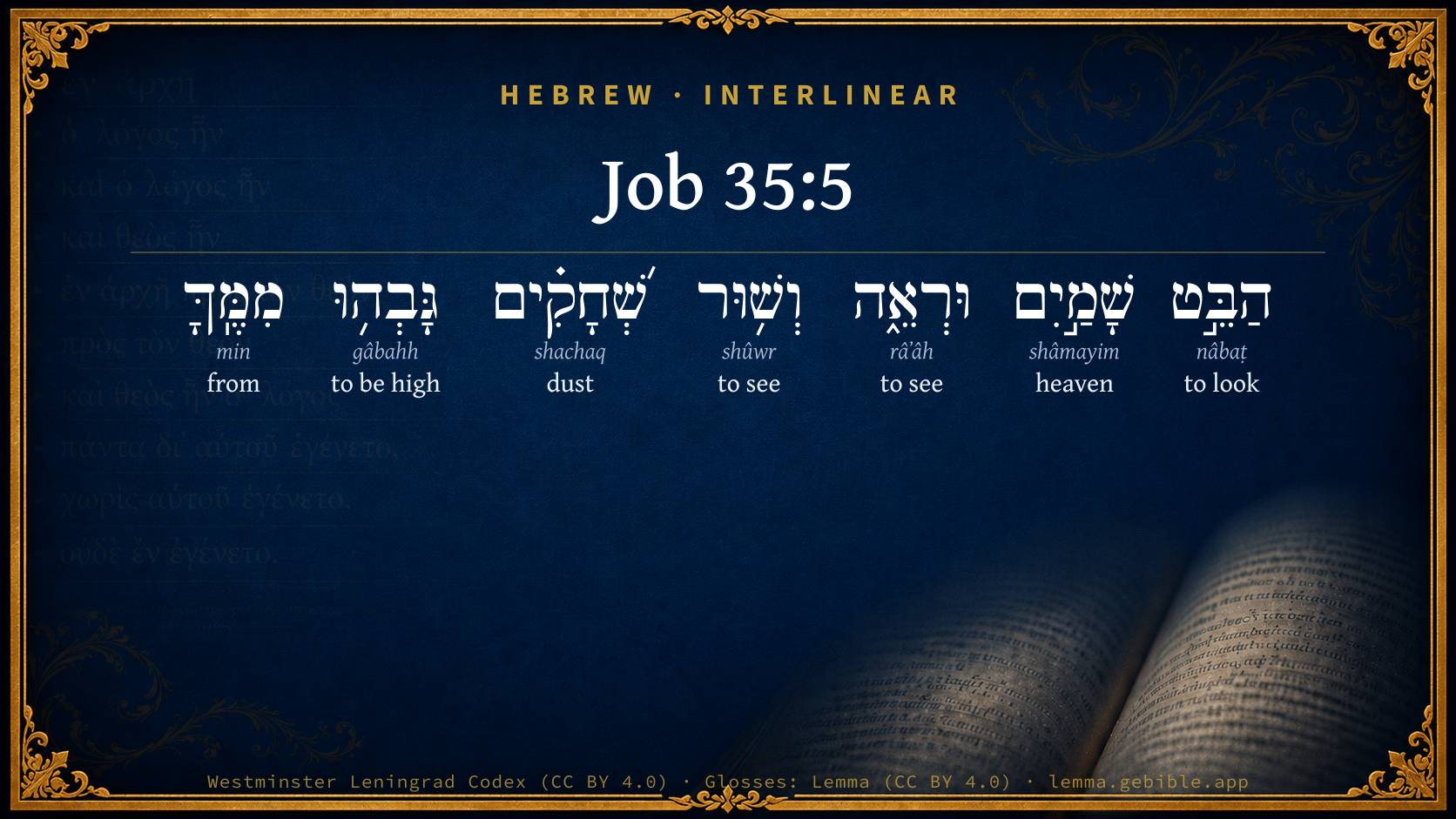
Job 35:5

Hebrew (Westminster Leningrad Codex) Job 35:5 appears in the Hebrew Old Testament. The text above is from the Westminster Leningrad Codex. Each word links to its Strong’s number, a concise gloss, and parsing drawn from the Open Scriptures Hebrew Bible morphology. Click any word for its full Brown-Driver-Briggs (BDB) entry.
Download image
Cite this verse

Job 35:5 (World English Bible). Public Domain. Lemma interlinear Bible study tool, https://lemma.gebible.app/v/job/35/5.

Show BibTeX & RIS
BibTeX
RIS
English Translation
Look to the heavens, and see. See the skies, which are higher than you.
World English Bible · Public Domain
Download a study sheet

One document with this verse’s original text, its word-by-word gloss line, the meaning frame, cross-references with their text, attributed commentary, and full source and license credits — printable, and it pastes into notes with its structure intact.

This verse Autodidact and up

Study sheet (.html) Plain text (.txt)

A passage Seminary Student

Up to 50 verses in one chapter. A passage sheet keeps up to 6 commentary sources and 12 cross-references per verse, in the order this page ranks them, and says so on the sheet whenever that leaves anything out. Ask for a single verse and you get the Autodidact verse sheet above.

Everything on this page stays free to read, with no account — the sheet is a download of what is already on screen, not access to it.

Want to remove ads? Support Godless Engineer
Compare translations 3

The same verse in 3 English versions, stacked beneath the original-language interlinear above. Click any original word for its lexicon entry.

Each is an independent rendering of the whole verse — the interlinear is not word-aligned to these translations.

Highlighted words mark where these versions differ — a whole-verse word diff, not a word-by-word alignment.

  • World English Bible Public Domain
    Look to the heavens, and see. See the skies, which are higher than you.
  • King James Version Public Domain
    Look unto the heavens, and see; and behold the clouds which are higher than thou.
  • unfoldingWord Literal Text CC BY-SA 4.0
    Observe the heavens and see, and look, the clouds soar above you.

unfoldingWord Literal Text — © unfoldingWord, licensed CC BY-SA 4.0. Word-aligned USFM3 via Door43 (git.door43.org/unfoldingWord/en_ult).

Versions to compare (up to 4)

3 of 4 selected

Show all 18 translations

Every available English version of this verse, each an independent rendering of the whole verse.

  • World English Bible Public Domain
    Look to the heavens, and see. See the skies, which are higher than you.
  • Berean Standard Bible Public Domain
    Look to the heavens and see; gaze at the clouds high above you.
  • Majority Standard Bible Public Domain
    Look to the heavens and see; gaze at the clouds high above you.
  • King James Version Public Domain
    Look unto the heavens, and see; and behold the clouds which are higher than thou.
  • American Standard Version (1901) Public Domain
    Look unto the heavens, and see; And behold the skies, which are higher than thou.
  • Revised Version (1885) Public Domain
    Look unto the heavens, and see; and behold the skies, which are higher than thou.
  • Geneva Bible (1599) Public Domain
    Looke vnto the heauen, and see and behold the cloudes which are hyer then thou.
  • Douay-Rheims (1899) Public Domain
    Look up to heaven and see, and behold the sky, that it is higher than thee.
  • Young's Literal Translation Public Domain
    Behold attentively the heavens -- and see, And behold the clouds, They have been higher than thou.
  • Literal Standard Version CC BY-SA 4.0
    Behold attentively the heavens—and see, || And behold the clouds, || They have been higher than you.
  • Unlocked Literal Bible CC BY-SA 4.0
    Look up at the sky, and see it; see the sky, which is higher than you.
  • unfoldingWord Literal Text CC BY-SA 4.0
    Observe the heavens and see, and look, the clouds soar above you.
  • Darby Bible Public Domain
    Look unto the heavens and see; and survey the skies: they are higher than thou.
  • World Messianic Bible Public Domain
    Look to the skies, and see. See the skies, which are higher than you.
  • Webster's Bible Public Domain
    Look to the heavens, and see; and behold the clouds which are higher than thou.
  • Free Bible Version CC BY-SA 4.0
    Just look up at the sky and see. Observe the clouds high above you.
  • Bible in Basic English Public Domain
    Let your eyes be turned to the heavens, and lifted up to see the skies; they are higher than you.
  • JPS Tanakh (1917) Public Domain
    Look unto the heavens, and see; and behold the skies, which are higher than thou.

Literal Standard Version (2020), Covenant Press — licensed CC BY-SA 4.0. Text via the HelloAO Bible API (eBible.org). Unlocked Literal Bible (unfoldingWord) — licensed CC BY-SA 4.0. Text via the HelloAO Bible API (eBible.org). unfoldingWord Literal Text — © unfoldingWord, licensed CC BY-SA 4.0. Word-aligned USFM3 via Door43 (git.door43.org/unfoldingWord/en_ult). Free Bible Version, Dr. Jonathan Gallagher — licensed CC BY-SA 4.0. Text via the HelloAO Bible API (eBible.org).

Word by word

More ways to search: Search by grammar → Find every occurrence → Compare this word →

Practice this passage: Drill this verse → Learn its vocabulary →

About this verse

These counts appear in no published source. They are computed here, from the morphology-tagged text and Lemma’s own curated glosses. What Lemma adds →

7
words
7
distinct lemmas
Wisdom
section

Notable vocabulary

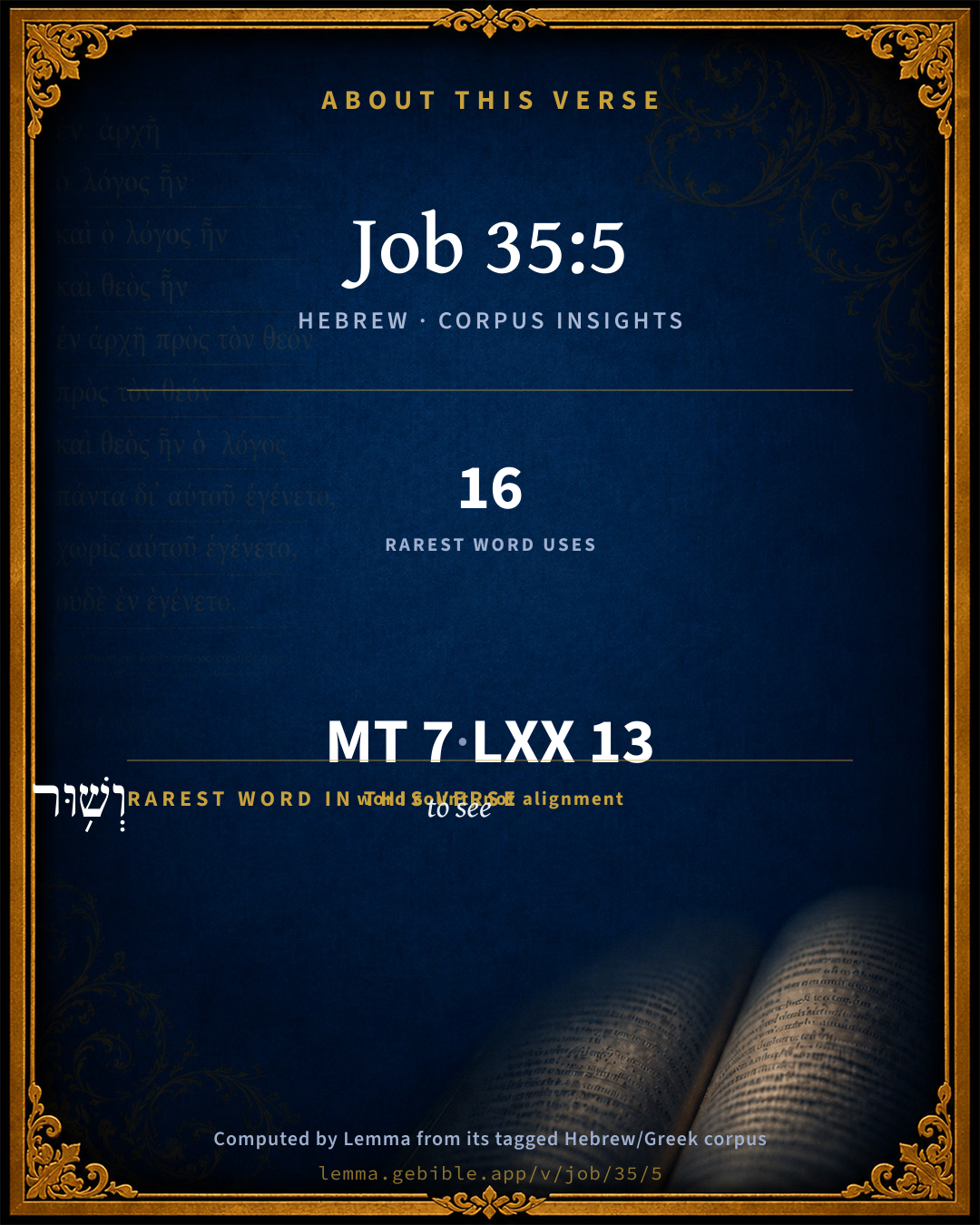
The rarest word here is וְשׁ֥וּר to see H7789 — appearing just 16 times in the whole Hebrew Bible.

Shared distinctive vocabulary

וְשׁ֥וּר to see H7789 occurs in 16 verses of the Hebrew Bible. Also found in:

Grammatical profile

  • 4 verbs
  • 2 nouns
  • 1 preposition

Verb forms

  • הַבֵּ֣ט Hiphil · Imperative
  • וּרְאֵ֑ה Qal · Imperative
  • וְשׁ֥וּר Qal · Imperative
  • גָּבְה֥וּ Qal · Perfect

Hebrew & Septuagint length

In English translation the verse runs 14 words from the Hebrew and 8 from the Septuagint (LXX English) — the Septuagint runs noticeably shorter here. See the side-by-side →

A rough comparison of the two English renderings, which tokenize alike — not a word-level alignment.

Word counts can differ between the Hebrew and the Greek without any difference in meaning — e.g. the Hebrew direct-object marker אֵת has no separate Greek word, and Greek often adds the article ὁ.

In the original languages it is 7 Hebrew tokens and 13 Greek tokens — but the two are counted differently (Hebrew bundles its prefixes and suffixes into one token; the Greek is in lemma form), so that isn’t a like-for-like length.

Cross-references

11

Topical passages linked to Job 35:5 in the Treasury of Scripture Knowledge — connected by theme and wording, ordered by reader-vote popularity; previews shown in the World English Bible.

  • Job 22:12 "Isn't God in the heights of heaven? See the height of the stars, how high they are!
  • Isaiah 55:9 For as the heavens are higher than the earth, so are my ways higher than your ways, and my thoughts than your thoughts.
  • Isaiah 40:22–23 [It is] he who sits above the circle of the earth, and the inhabitants of it are as grasshoppers; who stretches out the heavens as a curtain, and spreads them out as a tent to dwell in;
  • Nahum 1:3 Yahweh is slow to anger, and great in power, and will by no means leave the guilty unpunished. Yahweh has his way in the whirlwind and in the storm, and the clouds are the dust of his feet.
  • Genesis 15:5 Yahweh brought him outside, and said, "Look now toward the sky, and count the stars, if you are able to count them." He said to Abram, "So shall your seed be."
  • 1 Kings 8:27 But will God in very deed dwell on the earth? behold, heaven and the heaven of heavens can't contain you; how much less this house that I have built!
  • Job 25:5–6 Behold, even the moon has no brightness, And the stars are not pure in his sight;
  • Job 36:26–37:5 Behold, God is great, and we don't know him. The number of his years is unsearchable.
  • Job 37:16 Do you know the workings of the clouds, The wondrous works of him who is perfect in knowledge?
  • Job 37:22–23 Out of the north comes golden splendor; With God is awesome majesty.
  • Psalms 8:3–4 When I consider your heavens, the work of your fingers, The moon and the stars, which you have ordained;

Cross-references courtesy of OpenBible.info (CC BY 4.0).

Hebrew and Greek witnesses Masoretic Hebrew ↔ Greek Septuagint

The same verse in the two great witnesses to the Old Testament, shown verse-for-verse.

Here the Septuagint runs noticeably shorter than the Hebrew — LXX2012 (modern English Septuagint) 8 words vs World English Bible 14. A rough length comparison of the two English translations, not a word-level alignment — read both below.

These are two independent witnesses, not word-aligned to each other, and the Septuagint is shown in lemma (dictionary) form.

Hebrew Job 35:5 Masoretic · Westminster Leningrad Codex

הַבֵּ֣ט שָׁמַ֣יִם וּרְאֵ֑ה וְשׁ֥וּר שְׁ֝חָקִ֗ים גָּבְה֥וּ מִמֶּֽךָּ

Look to the heavens, and see. See the skies, which are higher than you.

World English Bible · Public Domain

Greek LXX Job 35:5 Septuagint · lemma form

ἀναβλέπω εἰς ὁ οὐρανός καί ὁράω καταμανθάνω δέ νέφος ὡς ὑψηλός ἀπό σύ

If you have sinned, what will you do?

LXX2012 (modern English Septuagint) · Public Domain

Hebrew: Westminster Leningrad Codex (CC BY 4.0). Greek: Septuagint (public domain); English from LXX2012 (modern English Septuagint) (Public Domain). How the Septuagint differs from the Hebrew →

Commentary

Notes on Job 35:5 from classic Christian and Jewish commentators (each source and its license shown beneath its notes). The classic Christian expositions comment on the surrounding passage and are grouped to its opening verse, so a note may address several verses; the Jewish commentaries on the Tanakh (Rashi and others) are per-verse, so they appear only where the commentator wrote on this verse.

Lemma curates 59 commentaries, every one of them public domain or Creative Commons licensed, each selected and text-cleaned for this edition rather than reprinted as found. About our sources →

Trapp's Complete Commentary

John Trapp

Job 35:5 Look unto the heavens, and see; and behold the clouds [which] are higher than thou.

Ver. 5. Look unto the heavens and see] Yea, look into them, if thou couldst, as did Stephen the proto-martyr, Act 7:56, and as our Saviour Christ, as man, could do (say some) with his bodily eyes; and as a believer by the eye of his faith, through the perspective glass of the promises, may do, doubtless. The further we can look unto heaven (or into it) the better shall we conceive of that infinite distance that is between God in heaven and men on earth. God is far above the highest heavens, therefore higher than any mortal can attain to him, much less contribute anything unto him by his righteousness, or assault him by his wickedness. Herodotus writeth, That the Thracians once were so mad against their god Jupiter, for raining down upon them when ready to join battle with the enemy, that they threw up their darts against heaven, which shortly returned upon their own heads. And of Caligula, the emperor, the story is told, that he thundered and lightened with certain engines he had; and if at any time a thunderbolt fell from heaven, ipse contra iaeiebat lapidem, he on the other side threw up a stone, and used that hemistich {a} in Horner, η μ αναειρ ηεγω σε, Either do thou kill me, or I will kill thee if I can, (Dio in Vit. Calig.). And what less than this upon the matter do those monsters and miscreants among us, who set their mouths against heaven when things go cross with them especially; and their "tongues walk through the earth?" Psa 73:9. As Hacker did, who lifting up his eyes to heaven, and grinning against God, blasphemed him, and threatened him, even when he had the rope about his neck, A. D. 1591. Now, as in the water face answereth to face, so doth the face of a man to a man. And as there were many Marii in one Caesar, so there are many Caligulas and Hackets in the best of us all, if God restrain us not from such horrid outrages. But Elihu would have us here to know, that God is far above our reach, neither can we throw this high and lofty one out of his throne, utcunque fremamus et ferociamus; for how should anything that we silly creatures can do reach to God, when as we cannot reach up to the visible heavens?

And behold the clouds which are higher than thou] Eminent prae te. The clouds are God’s chariot whereon he rideth, and wherein he manifesteth much of his majesty. These Elihu would have Job to contemplate in their height, even superiores nubes, as Tremellius rendereth it, the upper clouds; or, as others, the starry heaven, Heb. The thin of heavens. So Bildad before had called upon him to behold the moon and the stars, Job 25:5. And surely the very sight of heaven over us (to the which all that we are or can can bring no help or hurt at all), should admonish us of our meanness, and make us think most modestly of God, whom we are so infinitely below; and not dare either to complain of him or to boast us before him, &c. For this cause it is that Elihu so presseth Job here with this heap of words, that he may henceforth know and keep his distance; and not so presumptuously call God, as it were, to reckoning, touching expenses and receipts.

{a} The half or section of a line of verse, as divided by the Caesura or the like; also, a line of less than the usual length. spec. Such a half-line or line in Old English verse.

John Trapp, A Commentary or Exposition upon All the Books of the Old and New Testament (1647–1656) — public domain. Text from a community e-Sword module.

Whedon's Commentary on the Bible

Daniel D. Whedon

b. God is self-sufficient in his infinite exaltation, and consequently cannot be benefited or injured by the moral acts of men: the consequences of our actions are confined to ourselves or our fellows. “Good and evil cannot affect God; if they are distinct things, as Job, who is no Pantheist, would admit, they must have distinct effects; and these effects, not reaching God, must be on man, on the man who does good or evil.” — Davidson. Job_35:5-8.

5. Look unto the heavens — The infinite greatness of God is feebly shadowed forth by the heavens, the work of his hands. “Job’s weak and foolish attack on the divine righteousness makes shipwreck of the glory of the divine nature, as manifested in the works of creation.” — Hengstenberg. Higher than the heavens, God is too high to gain by the virtue of man or to lose by his vice.

Daniel D. Whedon (gen. ed.), Commentary on the Old and New Testaments (1874–1909) — public domain. Text from a community e-Sword module.

Geneva Bible (1599)

Geneva Bible translators

If thou canst not control the clouds, wilt thou presume to instruct God?

Geneva Bible (1599) marginal notes — public domain. Text via Bolls.life.

Jamieson, Fausset & Brown

Robert Jamieson, A. R. Fausset & David Brown

Elihu like Eliphaz (Job 22:2-3, Job 22:12) shows that God is too exalted in nature to be susceptible of benefit or hurt from the righteousness or sin of men respectively; it is themselves that they benefit by righteousness, or hurt by sin.

behold the clouds, which are higher than thou--spoken with irony. Not only are they higher than thou, but thou canst not even reach them clearly with the eye. Yet these are not as high as God's seat. God is therefore too exalted to be dependent on man. Therefore He has no inducement to injustice in His dealings with man. When He afflicts, it must be from a different motive; namely, the good of the sufferer.

Jamieson, Fausset & Brown — Commentary Critical and Explanatory on the Whole Bible (1871) — public domain (CC PDM 1.0). Text via the HelloAO Bible API.

Adam Clarke's Commentary

Verse 5. Look unto the heavens] These heavens, and their host, God has created: the bare sight of them is sufficient to show thee that God is infinitely beyond thee in wisdom and excellence.

Behold the clouds] שחקים shechakim, the ethers, (Vulgate, aethera,) from שחק shachak, to contend, fight together: the agitated or conflicting air and light; the strong agitation of these producing both light and heat. Look upon these, consider them deeply, and see and acknowledge the perfections of the Maker.

Adam Clarke's Commentary on the Bible (1810–1826) — public domain. Text from a community e-Sword/MySword module.

The Cambridge Bible for Schools and Colleges

gen. ed. J. J. S. Perowne

5–8. The reply of Elihu to Job’s complaint. A glance at heaven, the infinitely exalted abode of God, must tell us that our conduct whether good or bad cannot affect Him. Our righteousness confers no profit on Him, neither does our wickedness entail any loss. It is men themselves that their conduct affects. It is in human life that the influence of righteousness or evil-doing is seen. And being so eternally unlike they cannot have the same effect.

Elihu does not contemplate any one going so far as to maintain that godliness and unrighteousness do not differ in themselves. Job assumes and most strongly asserts their difference. He even rises to the sublime height of resolving to adhere to righteousness though God and men should shew their indifference to it (ch. Job_17:9). And what he complains of is that God is indifferent to it, and that in His government the righteous is treated as the wicked. This is the point which Elihu touches.

The Cambridge Bible for Schools and Colleges (gen. ed. J. J. S. Perowne; Cambridge University Press, 1878–1918) — public domain. Text from a community e-Sword module.

John Gill's Exposition

If thou be righteous, what givest thou him?.... All righteousness is of God that any creatures have. What the angels in heaven have, or Adam had in a state of innocence; or what believers in Christ have in and from him; his righteousness imputed to them is of God; the grace of righteousness, or holiness, imparted to them and implanted in them, is from him; and it is under the influence of his Spirit, and by his grace and strength, they do works of righteousness externally; and therefore can give nothing to him of their own, nor does he need any, being God all sufficient; even the goodness of his Son does not extend to him, but to the saints, Psa 16:2; much less any goodness of theirs: their best works of righteousness are due to him, and not gifts; and though they may contribute to his manifestative glory, both in them that do them and in others that see them, they can add nothing to the essential glory of God;

or what receiveth he of thine hand? He can receive nothing but what he has given, or what he has a prior right to and is his due, and so cannot be laid under any obligation to man by what he does; nor can man merit anything at his hand, not even the least temporal mercy, and much less spiritual ones and everlasting life: and what notice God is pleased to take of the good works of men, in away of reward, is not of debt, but of grace, and entirely owing to his goodness; and does not arise from any intrinsic worth in them, or from any advantage to him by them.

John Gill's Exposition of the Whole Bible (1746–1763) — public domain (CC PDM 1.0). Text via the HelloAO Bible API.

Albert Barnes' Notes on the Bible

Look unto the heavens, and see - This is the commencement of the reply which Elihu makes to the sentiment which he had understood Job to advance, and which Eliphaz had proposed formerly to examine. The general object of the reply is, to show that God is so great that he cannot be affected with human conduct, and that he has no interest in treating people otherwise than according to character. He is so exalted that their conduct cannot reach and affect his happiness. It ought to be “presumed,” therefore, since there is no motive to the contrary, that the dealings of God with people would be impartial, and that there “would” be an advantage in serving him - not because people could lay him under “obligation,” but because it was right and proper that such advantage should accrue to them. To impress this view on the mind, Elihu directs Job and his friends to look to the heavens - so lofty, grand, and sublime; to reflect how much higher they are than man; and to remember that the great Creator is “above” all those heavens, and “thus” to see that he is so far cxalted that he is not dependent on man; that he cannot be affected by the righteousness or wickedness of his creatures; that his happiness is not dependent on them, and consequently that it is to bc presumed that he would act impartially, and treat all people as they deserved. There “would” be, therefore, an advantage in serving God.

And behold the clouds - Also far above us, and seeming to float in the heavens. The sentiment here is, that one view of the astonishing display of wisdom and power above us must extinguish every feeling that he will be influenced in his dealings as people are in theirs, or that he can gain or suffer anything by the good or bad behavior of his creatures.

Albert Barnes' Notes on the Bible (1834–1885) — public domain. Text from a community e-Sword/MySword module.

Haydock's Catholic Bible Commentary

Thee. Thy sin cannot hurt, nor thy virtue add any thing to God. He is not therefore actuated by resentment, or jealousy, but by justice. (Calmet) --- He revenges the injury done by the sinner to himself, ver. 8. (St. Augustine, Confessions iii. 8.) --- The inference is therefore wrong, (Calmet) that God will not regard the sins or punishment of men, because he thence derives no profit, ver. 3. (Haydock) --- The strong sentences of Eliu agree not (or are ill-applied) to the blessed Job. (St. Gregory xxvi. 7.) (Worthington)

George Leo Haydock (1774–1849), Haydock's Catholic Family Bible and Commentary, 1859 edition — public domain. Excludes Psalms (Douay-Rheims chapter numbering differs from Protestant) and Deuterocanonical books (Catholic canon only).

Matthew Poole's English Annotations

How much more is God, who is far above all heavens, higher than thou! And therefore God is out of the reach of all profit or loss by thy actions. If thy goodness do not profit thee, it is certain it doth not profit him; and therefore doth not lay any obligation upon him to indulge or recompense thee for it, save only so far as he hath graciously obliged himself; and therefore thou canst not accuse him of injustice for afflicting thee, nor pretend that thou hast deserved better usage from him. And this infinite distance between God and thee should cause thee to think and speak more modestly and reverently of that glorious majesty.

Matthew Poole's English Annotations on the Holy Bible (1683–1685) — public domain. Text from a community e-Sword/MySword module.

The Pulpit Commentary

Look unto the heavens, and see; and behold the clouds which are higher than thou; i.e. "look to the material sky and heavens, so far above thee and so unapproachable, and judge from them how far the God who made them is above thy puny, feeble self how incapable he is of being touched by any of thy doings.

Vers. 5-8. God"s independence of man.

I GOD IS NOT DEPENDENT ON MAN"S CONDUCT. We must agree in the main with what Elihu here states. God is serf-sufficient, and he owns all things. "The cattle upon a thousand hills are his." If he were hungry he would not need to tell us. Our most active service is not necessary to God, our most virulent malignity cannot really touch him. He dwells in the fulness and serenity of his own perfection.

II GOD CANNOT BE BRIBED BY MAN"S GIFTS. The huge mistake of heathen worship is that it consists for the most part in attempts to buy off the anger and secure the favour of the gods by means of gifts and sacrifices. We meet with the same heathenish idea in all religious exercises that aim at being really profitable to God, not for his own sake, but to purchase his favour.

III GOD IS UNDER NO INDUCEMENT TO BE UNJUST TO MAN. Between man and man injustice is common, because one man is much affected by the conduct of another. But if man can neither profit nor injure God, God can have no motive for dealing in any unequal way with man.

IV GOD VOLUNTARILY CONCERNS HIMSELF WITH OUR CONDUCT BECAUSE HE LOVES us. Elihu"s description of God is one-sided. True in regard to the nature of things, it is false as it concerns the action and sympathy of God. Elihu"s God is too much like an Epicurean divinity. The love which is most characteristic of the Divine character, as it is revealed in the Bible, is here quite ignored. God may not be dependent on us. Yet his love leads him to be deeply concerned in what we do, and to entrust his designs to us as his servants. At the same time, seeing that love is his leading motive, there can be no need for us to try to bribe God, even if it were possible for us to do so; and we may be sure that, so far from dealing with harsh injustice, God will only desire our good.

V GOD ACCEPTS MAN"S TREATMENT OF HIS BROTHER-MAN AS THOUGH THIS AFFECTED HIMSELF. Christ has taught us that what is done to one of the least of his brethren is done to our Lord himself. (Mat_25:40) God"s love for his children makes him regard any injury done to them as though it were an injury to his own person. The Father feels in the sufferings of his children. Thus we may benefit or injure God by benefiting or injuring our fellow-men. At the same time, this only results from the position which God voluntarily assumes towards us.

VI MAN IS DEPENDENT ON GOD, AND HIS CONDUCT SHOULD BE A RESPONSE TO GOD"S. Religion does not begin with our worship of God. Its commencement is earlier, in God"s goodness to man. All true worship springs from gratitude. Thus, while we cannot be useful or hurtful to God, excepting in so far as his love and sympathy permit us, we are urged to consider how completely our lives are in his hands, and how essential it is for us to live so that we may enjoy his continued favour. W.F.A.

The Pulpit Commentary (1880–1919), ed. H.D.M. Spence-Jones & Joseph S. Exell — public domain. Text from a community e-Sword module.

John Wesley's Explanatory Notes

Clouds, &c. - They are far above us, and God is far above them. How much then is he out of the reach either of our sins or our services?

John Wesley, Explanatory Notes Upon the Whole Bible (1754–1765) — public domain. Text via the GEBible commentary corpus.

Keil & Delitzsch

C. F. Keil & F. Delitzsch

5 Look towards heaven and see,

And behold the ethereal heights: they are high above thee.

6 If thou sinnest, what dost thou effect with Him?

And if thy transgressions are many, what doest thou to Him?

7 If thou art righteous, what dost thou give Him,

Or what doth He take from thy hand?

8 To man like thee thy godlessness availeth,

And to thee, a son of man, thy righteousness.

Towards heaven he is to direct his gaze, to obtain from the height of heaven a notion of the exaltation of God who dwells above the heavens. The combination הבּיט וראה is like Psa 80:15 and freq. שׁחקים (שׁחק, Arab. sḥq, to rub in pieces, make thin, therefore the opposite of עבים) are the thin transparent strata of the atmosphere above the hanging clouds. מן after גּבהּ denotes the height that is on the opposite side to the beholder. From the exaltation of God it is then further inferred that it is impossible to exercise any human influence upon Him, by which He might suffer. The pointing wavers here between תּפעל (the common fut. form) and תּפעל(as a contraction of תּפעל after the form אזעם, Num 23:8). Human wrong or right doing neither diminishes nor increases His blessedness; injury or advantage is only on the side of man, from whom it proceeds. Others, whom his conduct affect, are not included in Job 35:8 : righteous or ungodly doing, Elihu means to say, as such and with its consequences, belongs solely to the doer himself, the man "like thee" (לאישׁ with Munach, כּמוך with Munach), the son of man, i.e., man, capable of evil as of good, and who always, after deciding in favour of the latter or the former, determines his fortune or misfortune, in distinction from God, who ever remains unchangeably the same in His perfect righteousness. What Elihu here says we have already heard from Eliphaz, Job 22:2., and Job even expresses himself similarly in Job 7:20; but to Elihu's mind it all becomes for Job new and powerful motives to quiet submission, for what objection should Job raise in justification of his complaints concerning his affliction against such sentiments as these, that goodness bears its reward and evil its punishment in itself, and that God's reward of goodness is not a work of indebtedness, nor His punishment of evil a work of necessity? Before such truth he must really hold his peace.

Keil & Delitzsch — Biblical Commentary on the Old Testament (1861–1891) — public domain (CC PDM 1.0). Text via the HelloAO Bible API. (Old Testament only.)

Rashi

Rabbi Shlomo Yitzchaki (Rashi)

Gaze at the heavens And since He is high and you are low, and He has no benefit from your wickedness and righteousness, why do you boast to Him about your righteousness?

Rashi on the Tanakh — English translations: “The Judaica Press complete Tanach with Rashi, translated by A. J. Rosenberg” (CC BY 4.0); “Pentateuch with Rashi's commentary by M. Rosenbaum and A.M. Silbermann, 1929-1934” (public domain); “The Metsudah Tanach series, Lakewood, N.J” (CC BY 4.0); and “The Book of Joshua, Metsudah Publications, 1997” (CC BY 4.0). Text via Sefaria.

Lesson kit

Teaching starters — assembled from the data on this page, not authored interpretation. Every prompt links to the verse data it draws on. Edit before teaching.

Job, in the Wisdom, opens this verse with 7 words (7 distinct Hebrew lemmas). Its most distinctive word is shûwr (“to see”). The Greek Septuagint runs shorter here. A historical commentator’s framing appears above. Read the whole chapter for the surrounding context.

Discussion questions

  1. The word shûwr carries the sense “to see.” How does it shape the verse?
  2. Numbers 23:9 shares the word «to see» with this verse. How do the two illuminate each other?
  3. Compared with the Hebrew, the Septuagint runs shorter here. What questions does that raise?
  4. These translations render this verse differently; the difference is in the English rendering, not the original. What questions does that raise?
  5. The verb «הַבֵּ֣ט» is Hiphil Imperative. How does its form color the action?
  6. Reading how Trapp's Complete Commentary and Whedon's Commentary on the Bible read this verse, where do the two commentators agree and where do they part?

Things to notice

Reading settings

Reading text

Shown beneath each verse's original-language words.

Old Testament
Old Testament edition

Read the OT as the Masoretic Hebrew (MT) or the Greek Septuagint (LXX).

English shown for the Greek Septuagint (in the Hebrew ↔ Greek comparison).

Comparing translations? Open the Compare panel on any verse page to stack up to four side by side.