
Proverbs 18:12

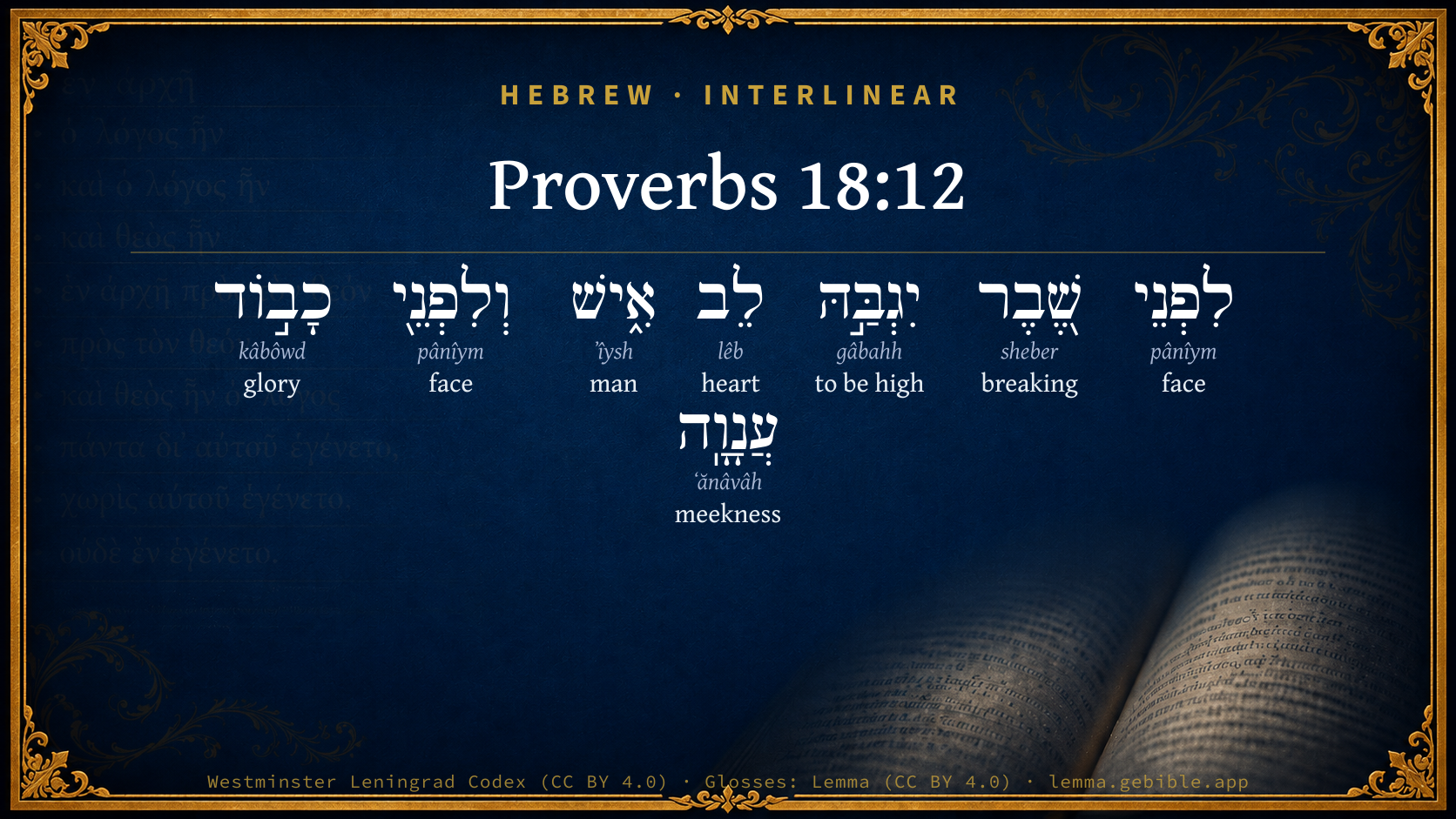
Hebrew (Westminster Leningrad Codex) Proverbs 18:12 appears in the Hebrew Old Testament. The text above is from the Westminster Leningrad Codex. Each word links to its Strong’s number, a concise gloss, and parsing drawn from the Open Scriptures Hebrew Bible morphology. Click any word for its full Brown-Driver-Briggs (BDB) entry.
Download image
Cite this verse

Proverbs 18:12 (World English Bible). Public Domain. Lemma interlinear Bible study tool, https://lemma.gebible.app/v/proverbs/18/12.

Show BibTeX & RIS
BibTeX
RIS
English Translation
Before destruction the heart of man is proud, But before honor is humility.
World English Bible · Public Domain
Download a study sheet

One document with this verse’s original text, its word-by-word gloss line, the meaning frame, cross-references with their text, attributed commentary, and full source and license credits — printable, and it pastes into notes with its structure intact.

This verse Autodidact and up

Study sheet (.html) Plain text (.txt)

A passage Seminary Student

Up to 50 verses in one chapter. A passage sheet keeps up to 6 commentary sources and 12 cross-references per verse, in the order this page ranks them, and says so on the sheet whenever that leaves anything out. Ask for a single verse and you get the Autodidact verse sheet above.

Everything on this page stays free to read, with no account — the sheet is a download of what is already on screen, not access to it.

Want to remove ads? Support Godless Engineer
Compare translations 3

The same verse in 3 English versions, stacked beneath the original-language interlinear above. Click any original word for its lexicon entry.

Each is an independent rendering of the whole verse — the interlinear is not word-aligned to these translations.

Highlighted words mark where these versions differ — a whole-verse word diff, not a word-by-word alignment.

  • World English Bible Public Domain
    Before destruction the heart of man is proud, But before honor is humility.
  • King James Version Public Domain
    Before destruction the heart of man is haughty, and before honour is humility.
  • unfoldingWord Literal Text CC BY-SA 4.0
    To the face of breaking, the heart of a man is exalted, but to the face of honor—humility.

unfoldingWord Literal Text — © unfoldingWord, licensed CC BY-SA 4.0. Word-aligned USFM3 via Door43 (git.door43.org/unfoldingWord/en_ult).

Versions to compare (up to 4)

3 of 4 selected

Show all 18 translations

Every available English version of this verse, each an independent rendering of the whole verse.

  • World English Bible Public Domain
    Before destruction the heart of man is proud, But before honor is humility.
  • Berean Standard Bible Public Domain
    Before his downfall a man’s heart is proud, but humility comes before honor.
  • Majority Standard Bible Public Domain
    Before his downfall a man’s heart is proud, but humility comes before honor.
  • King James Version Public Domain
    Before destruction the heart of man is haughty, and before honour is humility.
  • American Standard Version (1901) Public Domain
    Before destruction the heart of man is haughty; And before honor `goeth' humility.
  • Revised Version (1885) Public Domain
    Before destruction the heart of man is haughty, and before honour goeth humility.
  • Geneva Bible (1599) Public Domain
    Before destruction the heart of a man is hautie, and before glory goeth lowlines.
  • Douay-Rheims (1899) Public Domain
    Before destruction, the heart of a man is exalted: and before he be glorified, it is humbled.
  • Young's Literal Translation Public Domain
    Before destruction the heart of man is high, And before honour `is' humility.
  • Literal Standard Version CC BY-SA 4.0
    The heart of man is high before destruction, || And humility [is] before honor.
  • Unlocked Literal Bible CC BY-SA 4.0
    Before his downfall a person's heart is proud, but humility comes before honor.
  • unfoldingWord Literal Text CC BY-SA 4.0
    To the face of breaking, the heart of a man is exalted, but to the face of honor—humility.
  • Darby Bible Public Domain
    Before destruction the heart of man is haughty; and before honour [goeth] humility.
  • World Messianic Bible Public Domain
    Before destruction the heart of man is proud, but before honor is humility.
  • Webster's Bible Public Domain
    Before destruction the heart of man is haughty, and before honor is humility.
  • Free Bible Version CC BY-SA 4.0
    Pride leads to destruction; humility goes before honor.
  • Bible in Basic English Public Domain
    Before destruction the heart of man is full of pride, and before honour goes a gentle spirit.
  • JPS Tanakh (1917) Public Domain
    Before destruction the heart of a man is haughty, and before honour goeth humility.

Literal Standard Version (2020), Covenant Press — licensed CC BY-SA 4.0. Text via the HelloAO Bible API (eBible.org). Unlocked Literal Bible (unfoldingWord) — licensed CC BY-SA 4.0. Text via the HelloAO Bible API (eBible.org). unfoldingWord Literal Text — © unfoldingWord, licensed CC BY-SA 4.0. Word-aligned USFM3 via Door43 (git.door43.org/unfoldingWord/en_ult). Free Bible Version, Dr. Jonathan Gallagher — licensed CC BY-SA 4.0. Text via the HelloAO Bible API (eBible.org).

Word by word

More ways to search: Search by grammar → Find every occurrence → Compare this word →

Practice this passage: Drill this verse → Learn its vocabulary →

About this verse

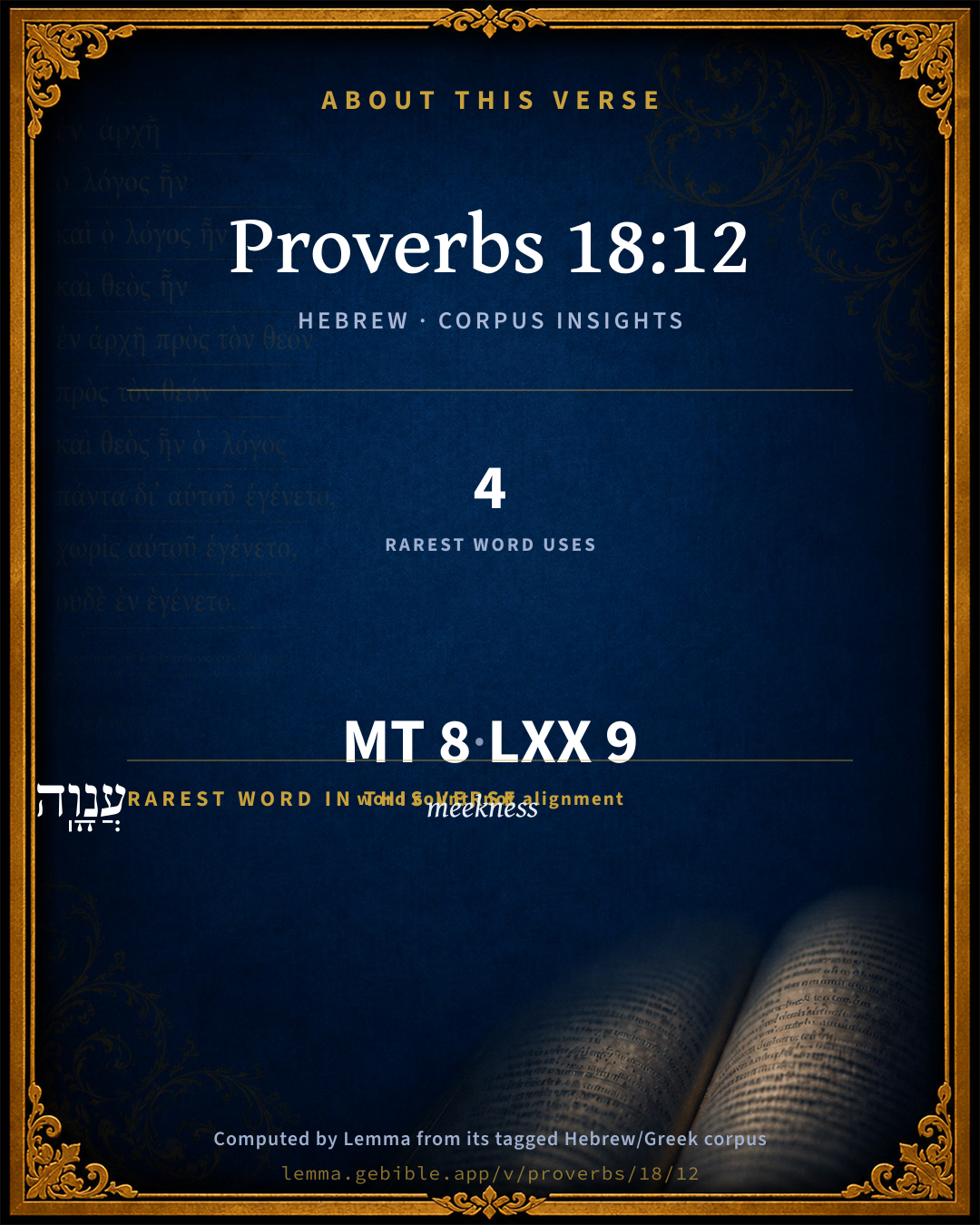
These counts appear in no published source. They are computed here, from the morphology-tagged text and Lemma’s own curated glosses. What Lemma adds →

8
words
7
distinct lemmas
Wisdom
section

Notable vocabulary

The rarest word here is עֲנָוָֽה meekness H6038 — appearing just 4 times in the whole Hebrew Bible.

Shared distinctive vocabulary

עֲנָוָֽה meekness H6038 occurs in 4 verses of the Hebrew Bible. Also found in:

Grammatical profile

  • 1 verb
  • 7 nouns

Verb forms

  • יִגְבַּ֣הּ Qal · Imperfect

Repetition

A word recurs within this verse — often emphatic in Hebrew:

  • לִפְנֵי face H6440 ×2

Hebrew & Septuagint length

In English translation the verse runs 13 words from the Hebrew and 13 from the Septuagint (LXX English) — the same length.

A rough comparison of the two English renderings, which tokenize alike — not a word-level alignment.

Word counts can differ between the Hebrew and the Greek without any difference in meaning — e.g. the Hebrew direct-object marker אֵת has no separate Greek word, and Greek often adds the article ὁ.

In the original languages it is 8 Hebrew tokens and 9 Greek tokens — but the two are counted differently (Hebrew bundles its prefixes and suffixes into one token; the Greek is in lemma form), so that isn’t a like-for-like length.

Cross-references

15

Topical passages linked to Proverbs 18:12 in the Treasury of Scripture Knowledge — connected by theme and wording, ordered by reader-vote popularity; previews shown in the World English Bible.

  • Proverbs 15:33 The fear of Yahweh teaches wisdom. Before honor is humility.
  • 1 Peter 5:5 Likewise, you younger ones, be subject to the elder. Yes, all of you gird yourselves with humility, to subject yourselves to one another; for "God resists the proud, but gives grace to the humble."
  • Proverbs 11:2 When pride comes, then comes shame, But with humility comes wisdom.
  • Proverbs 16:18 Pride goes before destruction, And a haughty spirit before a fall.
  • Ezekiel 28:2 Son of man, tell the prince of Tyre, Thus says the Lord Yahweh: Because your heart is lifted up, and you have said, I am a god, I sit in the seat of God, in the midst of the seas; yet you are man, and not God, though you did set your heart as the heart of God;-
  • Proverbs 29:23 A man's pride brings him low, But one of lowly spirit gains honor.
  • Luke 14:11 For everyone who exalts himself will be humbled, and whoever humbles himself will be exalted."
  • Ezekiel 28:9 Will you yet say before him who kills you, I am God? but you are man, and not God, in the hand of him who wounds you.
  • Daniel 9:20 While I was speaking, and praying, and confessing my sin and the sin of my people Israel, and presenting my supplication before Yahweh my God for the holy mountain of my God;
  • Daniel 9:23 At the beginning of your petitions the commandment went forth, and I am come to tell you; for you are greatly beloved: therefore consider the matter, and understand the vision.
  • Acts 12:21–23 On an appointed day, Herod dressed himself in royal clothing, sat on the throne, and gave a speech to them.
  • Job 42:6–17 Therefore I abhor myself, And repent in dust and ashes."
  • Isaiah 6:5–13 Then I said, "Woe is me! For I am undone, because I am a man of unclean lips, and I dwell in the midst of a people of unclean lips: for my eyes have seen the King, Yahweh of Hosts!"
  • Ezekiel 16:49–50 Behold, this was the iniquity of your sister Sodom: pride, fullness of bread, and prosperous ease was in her and in her daughters; neither did she strengthen the hand of the poor and needy.
  • Daniel 5:23–24 but have lifted up yourself against the Lord of heaven; and they have brought the vessels of his house before you, and you and your lords, your wives and your concubines, have drunk wine from them; and you have praised the gods of silver and gold, of brass, iron, wood, and stone, which don't see, nor hear, nor know; and the God in whose hand your breath is, and whose are all your ways, you have not glorified.

Cross-references courtesy of OpenBible.info (CC BY 4.0).

Hebrew and Greek witnesses Masoretic Hebrew ↔ Greek Septuagint

The same verse in the two great witnesses to the Old Testament, shown verse-for-verse.

These are two independent witnesses, not word-aligned to each other, and the Septuagint is shown in lemma (dictionary) form.

Hebrew Proverbs 18:12 Masoretic · Westminster Leningrad Codex

לִפְנֵי שֶׁ֭בֶר יִגְבַּ֣הּ לֵב אִ֑ישׁ וְלִפְנֵ֖י כָב֣וֹד עֲנָוָֽה

Before destruction the heart of man is proud, But before honor is humility.

World English Bible · Public Domain

Greek LXX Proverbs 18:12 Septuagint · lemma form

πρό συντριβή ὑψόω καρδία ἀνήρ καί πρό δόξα ταπεινόω

Before ruin a man's heart is exalted, and before honor it is humble.

LXX2012 (modern English Septuagint) · Public Domain

On this verse, Keil & Delitzsch discusses the Septuagint’s reading. Read the note in Commentary ↓

Hebrew: Westminster Leningrad Codex (CC BY 4.0). Greek: Septuagint (public domain); English from LXX2012 (modern English Septuagint) (Public Domain). How the Septuagint differs from the Hebrew →

Commentary

Notes on Proverbs 18:12 from classic Christian and Jewish commentators (each source and its license shown beneath its notes). The classic Christian expositions comment on the surrounding passage and are grouped to its opening verse, so a note may address several verses; the Jewish commentaries on the Tanakh (Rashi and others) are per-verse, so they appear only where the commentator wrote on this verse.

Lemma curates 59 commentaries, every one of them public domain or Creative Commons licensed, each selected and text-cleaned for this edition rather than reprinted as found. About our sources →

Trapp's Complete Commentary

John Trapp

Pro 18:12 Before destruction the heart of man is haughty, and before honour [is] humility.

Ver. 12. Before destruction the heart of a man is haughty.] Creature confidence and high mindedness are the Dives’s richman’s diseases, and go therefore yoked together, as here; so in 1Ti 6:17 - "Charge the rich that they be not high minded, nor trust to uncertain riches." Magna cognatio ut rei sic nominis divitiis, et vitiis; Wealth and wickedness are of near alliance, and are not far from destruction, or ‘breaking to shivers,’ as the word signifies. So bladder like is the soul, that, filled with earthly vanities, though but wind, it grows great and swells in pride; but pricked with the least pin of divine justice, it shrinks and shrivels to nothing. {Pro 16:18; Pro 15:33; Pro 12:2} {See Trapp on "Pro 16:18"} {See Trapp on "Pro 15:33"} {See Trapp on "Pro 12:2"}

John Trapp, A Commentary or Exposition upon All the Books of the Old and New Testament (1647–1656) — public domain. Text from a community e-Sword module.

The Biblical Illustrator

Joseph S. Exell

Pro_18:12

Before destruction the heart of man is haughty, and before honour is humility.

Honour and humility

I. Explain the nature of genuine humility.

1. It does not consist in a mean and servile state of mind, in anything that is unworthy of the man or the Christian. Humility dignifies human nature; a spirit of servility degrades it. Some persons are naturally timid and faint-hearted. But this is mere human weakness.

2. It does not consist in indulging a low and dejected frame of mind, or in being pensive and sad on all occasions. Distance and reserve are so far from being the fruit of genuine humility, that they often proceed from pride and self-conceit.

3. There is what the Scriptures call a voluntary humility unrequired and unapproved. An apparently humble demeanour may consist with a haughty and aspiring spirit.

4. Genuine humility consists chiefly in the state of our hearts towards God. Here reason bows to faith, and interest to obligation.

5. Humility consists in thinking of ourselves as we ought to think, and conducting ourselves accordingly.

6. Our humility will appear in the sentiments we entertain of others, of the behaviour we manifest towards them.

II. The honour with which Christian humility is accompanied.

1. It is the forerunner of just and worthy commendation. God exalts the low tree, and brings down the high.

2. Humility is a preparative for honour. A meek and quiet spirit is itself an ornament. It prepares the way for further honours.

3. Eternal honours shall be the gracious reward of true and genuine humility. God shall save the humble person. (B. Beddome, M. A.)

Humility

The text contains a most certain truth; and yet it is in its proper and most extensive sense a truth we owe to revelation. The natural man is not fond of believing in the necessity of humility. He contends for the dignity of his nature, he asserts the sufficiency of his own powers. Unaided man has been able to discover a considerable number of important truths in the theory of morals. With the polished nations of antiquity morals formed a part of the science of government. They examined into morals, and erected systems of morals, not with a view to ascertain and lay down the duties of the man, but of the citizen. The Christian cannot expect much assistance from this quarter. As they do not rest on the right foundation, or aim at the right end, the ancient ethics are miserably defective, and often grievously false. In no part are they more delusive than in the estimate they teach men to make of themselves. H we turn our eyes upon the world around us, we shall readily find instances of the connection between pride and ruin. Pride leads men to make an offensive assumption of superiority. We know the infatuating nature of pride. It may be illustrated by the career of the first Napoleon. It is not less certain that before honour is humility. Nothing more frequently leads men to situations of respect and eminence than modesty and diffidence. Every man of merit is so conscious of his deficiencies, he judges himself so severely, he adopts such an elevated standard of excellence, that he ever thinks hardly of himself. Thinking people know this, and give their verdict accordingly. And it is the thinking part of society that allot to a man his reputation. And humility has an effect upon the man himself, in whom it prevails. The sense of the smallness of his attainments will drive him to make large attainments. And thus, as the cause is before the effect, so before honour is humility. Now apply the text to the spiritual life. Both in what regards faith, and in what regards practice, pride inevitably leads to ruin. No one is likely to attain truth on spiritual subjects who approaches them in a spirit of pride. The man who depends on his intelligence, who examines the objects of faith in a self-sufficient spirit, is quite sure to fall into infidelity or error. If the man whose heart is haughty does get to entertain orthodox opinions of religious truth, his opinions cannot profit him: the truth must enter his heart as a living principle before it can be of personal benefit to him. The very first effect which it has on the heart is to bring down the reign of pride. Whenever pride reigns in a heart, there the kingdom of God is not set up. When a sinner passes from a state of impenitence to a state of grace, the whole process will be attended by humility. And there is no growth in grace, there is no safety, without humility. The more we know of ourselves the more cause we shall find for humility. Humility is our security. When he distrusts himself, and thinks meanly of himself, the Christian is in the state most favourable for his advancement in faith and holiness. (J. G. Dowling, M. A.)

Pride and humility

When destruction walks through the land, it casts its shadow; it is in the shape of pride. When honour visits a mans house, it casts its shadow before it; it is in the fashion of humility.

I. The vice of pride.

1. Describe pride. It is a groundless thing; a brainless thing; the maddest thing; a protean thing, ever changing its shapes.

2. The seat of pride. The true throne of pride is the heart of man.

3. The consequence of pride--destruction.

II. The grace of humility. A good man may have honour in this life. But God forbids our making that honour a cloak for pride,

1. What is humility? To think rightly of ourselves. Humility is to make a right estimate of ourselves. It is no humility for a man to think less of himself than he ought.

2. What is the seat or throne of humility? It is the heart. I hate, of all things, the humility that lives in the face. Cringing men that bow before everybody are truly proud men; humble men think of themselves so little, they do not think it worth while to stoop to serve themselves.

3. What comes of humility? Before honour is humility. Humility is the herald which ushers in the great King. He who has humility will have honour afterwards. Apply this spiritually. (C. H. Spurgeon.)

The Biblical Illustrator, edited by Joseph S. Exell (c. 1880s–1900s) — public domain. Text from a community e-Sword module.

Keil & Delitzsch

C. F. Keil & F. Delitzsch

We place together Pro 18:12-19, in which the figure of a secure fortress returns:

Pro 18:12

This proverb is connected with the preceding of the rich man who trusts in his mammon.

Before destruction the heat of man is haughty;

And humility goeth before honour.

Line first is a variation of Pro 16:18, and line second is similar to Pro 15:33.

Pro 18:13

13 If one giveth an answer before he heareth,

It is to him as folly and shame.

The part. stands here differently from what it does at Pro 13:18, where it is subj., and at Pro 17:14, where it is pred. of a simple sentence; it is also here, along with what appertains to it in accordance with the Semitic idiom, subj. to 13b (one who answers ... is one to whom this...); but, in accordance with our idiom, it becomes a hypothetical antecedent. For "to answer" one also uses השׁיב without addition; but the original full expression is השׁיב דּבר, reddere verbum, referre dictum (cf. ענה דּבר, Jer 44:20, absol. in the cogn., Pro 15:28); דבר one may not understand of the word to which, but of the word with which, the reply is made. היא לו comprehends the meaning: it avails to him (ducitur ei), as well as it reaches to him (est ei). In Agricola's Fnfhundert Sprchen this proverb is given thus: Wer antwortet ehe er hret, der zaiget an sein torhait und wirdt ze schanden [he who answers before he hears shows his folly, and it is to him a shame]. But that would require the word to be יבושׁ, pudefiet; (היא לו) כּלמּה means that it becomes to him a ground of merited disgrace. "כּלמּה, properly wounding, i.e., shame (like atteinte son honneur), from כּלם (cogn. הלם), to strike, hit, wound" (Fl.). Sirach (11:8) warns against such rash talking, as well as against the rudeness of interrupting others.

Pro 18:14

14 The spirit of a man beareth his sickness;

But a broken spirit, who can bear it?

The breath of the Creator imparting life to man is spoken of as spiritus spirans, רוּח (רוּח חיּים), and as spiritus spiratus, נפשׁ (נפשׁ חיּה); the spirit (animus) is the primary, and the soul (anima) the secondary principle of life; the double gender of רוח is accounted for thus: when it is thought of as the primary, and thus in a certain degree (vid., Psychol. p. 103ff.) the manly principle, it is mas. (Gen 6:3; Psa 51:12, etc.). Here the change of gender is in the highest degree characteristic, and אישׁ also is intentionally used (cf. Sa1 26:15) instead of אדם, 16a: the courageous spirit of a man which sustains or endures (כּלכּל R. כל, comprehendere, prehendere; Luther, "who knows how to contain himself in his sufferings;" cf. Psa 51:12, "may the free Spirit hold me") the sickness [Siechthum] (we understand here "siech" in the old meaning = sick) with self-control, is generis masculini; while, on the contrary, the רוּח נכאה (as Pro 15:13; Pro 17:22), brought down from its manliness and superiority to disheartened passivity, is genere feminino (cf. Psa 51:12 with Pro 18:19). Fleischer compares the Arab. proverb, thbât âlnfs bâlghdhâ thbât alrwh balghnâ, the soul has firmness by nourishment, the spirit by music.

(Note: In the Arab. language, influenced by philosophy, rwh, the anima vitalis, and nfs, the anima rationalis, are inverted; vid., Baudissin's Translationis antiquae Arab. libri Jobi quae supersunt (1870), p. 34.)

The question מי ישּׂאנּה is like Mar 9:50 : if the salt becomes tasteless, wherewith shall one season it? There is no seasoning for the spice that has become insipid. And for the spirit which is destined to bear the life and fortune of the person, if it is cast down by sufferings, there is no one to lift it up and sustain it. But is not God the Most High the lifter up and the bearer of the human spirit that has been crushed and broken? The answer is, that the manly spirit, 14a, is represented as strong in God; the discouraged, 14b, as not drawing from God the strength and support he ought to do. But passages such as Isa 66:2 do not bring it near that we think of the רוח נכאה as alienated from God. The spirit is נשׂא, the bearer of the personal and natural life with its functions, activities, and experiences. If the spirit is borne down to powerless and helpless passivity, then within the sphere of the human personality there is no other sustaining power that can supply its place.

Pro 18:15

15 The heart of a man of understanding gaineth knowledge,

And the ear of the wise seeketh after knowledge.

נבון may be also interpreted as an adj., but we translate it here as at Pro 14:33, because thus it corresponds with the parallelism; cf. לב צדּיק, Pro 15:28, and לב חכם, Pro 16:23, where the adject. interpretation is excluded. The gaining of wisdom is, after Pro 17:16, referred to the heart: a heart vigorous in embracing and receiving it is above all necessary, and just such an one possesses the נבון, which knows how to value the worth and usefulness of such knowledge. The wise, who are already in possession of such knowledge, are yet at the same time constantly striving to increase this knowledge: their ear seeks knowledge, eagerly asking where it is to be found, and attentively listening when the opportunity is given of מצא, obtaining it.

Pro 18:16

16 The gift of a man maketh room for him,

And bringeth him before the great.

That מתּן may signify intellectual endowments, Hitzig supposes, but without any proof for such an opinion. Intellectual ability as the means of advancement is otherwise designated, Pro 22:29. But Hitzig is right in this, that one mistakes the meaning of the proverb if he interprets מתן in the sense of שׂחד (vid., at Pro 17:8): mtn is an indifferent idea, and the proverb means that a man makes free space, a free path for himself, by a gift, i.e., by this, that he shows himself to be agreeable, pleasing where it avails, not niggardly but liberal. As a proverb expresses it:

Mit dem Hut in der Hand

Kommt man durchs ganze Land

[with hat in hand one goes through the whole land], so it is said here that such liberality brings before the great, i.e., not: furnishes with introductions to them; but helps to a place of honour near the great, i.e., those in a lofty position (cf. לפני, Pro 22:29; עם, Psa 113:8). It is an important part of practical wisdom, that by right liberality, i.e., by liberal giving where duty demands it, and prudence commends it, one does not lose but gains, does not descend but rises; it helps a man over the difficulties of limited, narrow circumstances, gains for him affection, and helps him up from step to step. The ā of מתּן is, in a singular way (cf. מתּנה, מתּנת), treated as unchangeable.

Pro 18:17

17 He that is first in his controversy is right;

But there cometh another and searcheth him thoroughly -

an exhortation to be cautious in a lawsuit, and not to justify without more ado him who first brings forward his cause, and supports it by reasons, since, if the second party afterwards search into the reasons of the first, they show themselves untenable. הראשׁון בּריבו are to be taken together; the words are equivalent to אשׁר יבא בריבו בראשׁונה: qui prior cum causa sua venit, i.e., eam ad judicem defert (Fl.). הראשׁון may, however, also of itself alone be qui prior venit; and בריבו will be taken with צדיק: justus qui prior venit in causa sua (esse videtur). The accentuation rightly leaves the relation undecided. Instead of יבא (יבא) the Kerı̂ has וּבא, as it elsewhere, at one time, changes the fut. into the perf. with ו (e.g., Pro 20:4; Jer 6:21); and, at another time, the perf. with ו into the fut. (e.g., Psa 10:10; Isa 5:29). But here, where the perf. consec. is not so admissible, as Pro 6:11; Pro 20:4, the fut. ought to remain unchanged. רעהוּ is the other part, synon. with בעל דין חברו, Sanhedrin 7b, where the אזהרה לבית־דין (admonition for the court of justice) is derived from Deu 1:16, to hear the accused at the same time with the accuser, that nothing of the latter may be adopted beforehand. This proverb is just such an audiatur et altera pars. The status controversiae is only brought fairly into the light by the hearing of the altera pars: then comes the other and examines him (the first) to the very bottom. חקר, elsewhere with the accus. of the thing, e.g., ריב ,., thoroughly to search into a strife, Job 29:16, is here, as at Job 28:11, connected with the accus. of the person: to examine or lay bare any one thoroughly; here, so that the misrepresentations of the state of the matter might come out to view along with the reasons assigned by the accuser.

Pro 18:18

18 The lot allayeth contentions,

And separateth between the mighty,

i.e., erects a partition wall between them - those contending (הפריד בּין, as at Kg2 2:11, cf. Arab. frḳ byn); עצוּמים are not opponents who maintain their cause with weighty arguments (עצּמות, Isa 41:21), qui argumentis pollent (vid., Rashi), for then must the truth appear in the pro et contra; but mighty opponents, who, if the lot did not afford a seasonable means of reconciliation, would make good their demands by blows and by the sword (Fl.). Here it is the lot which, as the judgment of God, brings about peace, instead of the ultima ratio of physical force. The proverb refers to the lot what the Epistle to the Heb; Heb 6:16, refers to the oath, vid., at Pro 16:33. Regarding מדינים and its altered forms, vid., p. 145.

Pro 18:19

19 A brother toward whom it has been acted perfidiously resists more than a strong tower;

And contentions are like the bar of a palace.

Luther rightly regarded the word נושׁע, according to which the lxx, Vulg., and Syr. translated frater qui adjuvatur a fratre, as an incorrect reading; one would rather expect אח מושׁיע, "a brother who stands by," as Luther earlier translated; and besides, נושׁע does not properly mean adjuvari, but salvari. His translation -

Ein verletzt Bruder helt herter denn eine feste Stad,

Und Zanck helt herter, denn rigel am Palast

[a brother wounded resisteth more than a strong city, and strife resisteth more than bolts in the palace], is one of his most happy renderings. מקּרית־עז in itself only means ὑπὲρ πόλιν ὀχυράν (Venet.); the noun-adjective (cf. Isa 10:10) to be supplied is to be understood to עז: עז הוּא or קשׁה הוא (Kimchi). The Niph. נפשׁע occurs only here. If one reads נפשׁע, then it means one who is treated falsely = נפשׁע בּו, like the frequently occurring קמי, my rising up ones = קמים עלי, those that rise up against me; but Codd. (Also Baer's Cod. jaman.) and old editions have נפשׁע, which, as we have above translated, gives an impersonal attributive clause; the former: frater perfidiose tractatus (Fl.: mala fide offensus); the latter: perfide actum est, scil. בּו in eum = in quem perfide actum. אח is, after Pro 17:17, a friend in the highest sense of the word; פשׁע means to break off, to break free, with ב or על of him on whom the action terminates. That the פּשׁע is to be thought of as אח of the אח נפשׁע is obvious; the translation, "brothers who break with one another" (Gesen.), is incorrect: אח is not collective, and still less is נפשׁע a reciprocum. The relation of אח is the same as that of אלּוּף, Pro 16:28. The Targum (improving the Peshito) translates אחא דמת עוי מן אחוי, which does not mean: a brother who renounces (Hitzig), but who is treated wickedly on the part of, his brother. That is correct; on the contrary, Ewald's "a brother resists more than..." proceeds from a meaning of פשׁע which it has not; and Bertheau gives, with Schultens, an untenable

(Note: Among the whole Heb. synon. for sinning, there exists no reflexive Niph.; and also the Arab. fsḳ has no ethical signification. נסכּל only, in the sense of fool, is found.)

reflexive meaning to the Niph. (which as denom. might mean "covered with crime," Venet. πλημμεληθείς), and, moreover, one that is too weak, for he translates, "a brother is more obstinate then...." Hitzig corrects אחז פּשׁע, to shut up sin = to hold it fettered; but that is not correct Heb. It ought to be עצר, כּבשׁ, or רדות. In 19a the force of the substantival clause lies in the מן (more than, i.e., harder = more difficult to be gained), and in 19b in the כּ; cf. Mic 7:4, where they are interchanged. The parallelism is synonymous: strifes and lawsuits between those who had been friends form as insurmountable a hindrance to their reconciliation, are as difficult to be raised, as the great bars at the gate of a castle (Fl.). The point of comparison is not only the weight of the cross-beam (from ברח, crosswise, across, to go across the field), but also the shutting up of the access. Strife forms a partition wall between such as once stood near each other, and so much thicker the closer they once stood.

With Pro 18:19, the series of proverbs which began with that of the flatterer closes. The catchword אח, which occurred at its commencement, 9b, is repeated at its close, and serves also as a landmark of the group following Pro 18:20-24. The proverb of the breach of friendship and of contentions is followed by one of the reaction of the use of the tongue on the man himself.

Keil & Delitzsch — Biblical Commentary on the Old Testament (1861–1891) — public domain (CC PDM 1.0). Text via the HelloAO Bible API. (Old Testament only.)

Tyndale Open Study Notes

Tyndale Open Resources

18:12 Haughtiness cultivates pride. It leads to failure because it does not allow for change in the face of criticism. Humility learns from others and leads to the honor of success.

Tyndale Open Study Notes — © Tyndale Open Resources, licensed CC BY-SA 4.0. Text via the HelloAO Bible API.

Matthew Henry's Commentary

Note, 1. Pride is the presage of ruin, and ruin will at last be the punishment of pride; for before destruction men are commonly so infatuated by the just judgment of God that they are more haughty than ever, that their ruin may be the sorer and the more surprising. Of, if that do not always hold, yet after the heart has been lifted up with pride, a fall comes, Pro 16:18. 2. Humility is the presage of honour and prepares men for it, and honour shall at length be the reward of humility, as he had said before, Pro 15:33. That has need to be often said which men are so loth to believe.

Matthew Henry's Commentary on the Whole Bible (1708–1710) — public domain (CC PDM 1.0). Text via the HelloAO Bible API.

Jamieson, Fausset & Brown

Robert Jamieson, A. R. Fausset & David Brown

(Compare Pro 15:33; Pro 16:18).

Jamieson, Fausset & Brown — Commentary Critical and Explanatory on the Whole Bible (1871) — public domain (CC PDM 1.0). Text via the HelloAO Bible API.

Adam Clarke's Commentary

Verse 12. Before destruction] See on Prov 11:2; Prov 16:18.

Adam Clarke's Commentary on the Bible (1810–1826) — public domain. Text from a community e-Sword/MySword module.

The Cambridge Bible for Schools and Colleges

gen. ed. J. J. S. Perowne

12. Comp. Pro_16:18; Pro_15:33.

The Cambridge Bible for Schools and Colleges (gen. ed. J. J. S. Perowne; Cambridge University Press, 1878–1918) — public domain. Text from a community e-Sword module.

John Gill's Exposition

Before destruction the heart of man is haughty,.... Lifted up with his riches. Rich men are apt to be highminded, and therefore are to be charged and cautioned against it; they are apt to look above their poor neighbours, and with contempt upon them; and very often this haughtiness of theirs is a presage of their ruin and destruction: and those haughty airs are put on from the pride of their hearts, when a "breach" is near, as the word (u) signifies, or when they are ready to break; however, their haughty spirits are, sooner or later, humbled by one distressing providence or another; see Pro 16:18;

and before honour is humility; See Gill on Pro 15:33.

(u) "ante confractionem", Junius & Tremellius, Piscator, Cocceius, Schultens.

John Gill's Exposition of the Whole Bible (1746–1763) — public domain (CC PDM 1.0). Text via the HelloAO Bible API.

Albert Barnes' Notes on the Bible

Before - In the sense of priority of time.

Albert Barnes' Notes on the Bible (1834–1885) — public domain. Text from a community e-Sword/MySword module.

Matthew Poole's English Annotations

Before destruction the heart of man is haughty; pride is a cause and presage of ruin, as is noted, Pro 16:18. Is; or, goeth. This clause we had Pro 15:33.

Matthew Poole's English Annotations on the Holy Bible (1683–1685) — public domain. Text from a community e-Sword/MySword module.

Whedon's Commentary on the Bible

Daniel D. Whedon

12. Compare Pro_15:33; Pro_16:18. They are the same in substance.

Daniel D. Whedon (gen. ed.), Commentary on the Old and New Testaments (1874–1909) — public domain. Text from a community e-Sword module.

The Pulpit Commentary

Comp. Pro_16:18 Pro_15:33; where the maxims are found in almost the same words.

See homily on Pro_16:18. C.

The Pulpit Commentary (1880–1919), ed. H.D.M. Spence-Jones & Joseph S. Exell — public domain. Text from a community e-Sword module.

Bridges on Proverbs

Charles Bridges

We have had both these Proverbs separately. (Pro 16:18 ; Pro 15:33 .) Surely this repetition, like our Lord’s often-repeated parallel,†1 was intended to deepen our sense of their importance. It is hard to persuade a man that he is proud. Every one protests against this sin. Yet who does not cherish the viper in his own bosom? Man so little understands, that dependence upon his God constitutes the creature’s happiness, and that the principle of independence is madness, and its end — destruction. (Gen 3:5-6 .) The haughty walk on the brink of a fearful precipice; only a miracle preserves them from instant ruin. The security of the child of God is, when he lies prostrate in the dust. If he soar high, the danger is imminent, though he be on the verge of heaven. (2Co 12:1-7 .)

The danger of a young Christian lies in an over-forward profession. The glow of the first love, the awakened sensibility to the condition of his perishing fellow-sinners; ignorance of the subtle working of inbred vanity, the mistaken zeal of injudicious friends — all tends to foster self-pleasing. Oh! let him know, that before honour is humility. In the low valley of Humiliation special manifestations are realized.†2 Enlarged gifts, and apparently extending usefulness, without growing more deeply into the humility of Christ, will be the decline, not the advancing of grace. That undoubtedly is the most humbled spirit, that has most of the spirit of Christ. The rule of entry into his school — the first step of admission to his kingdom is — "Learn of me, for I am meek and lowly in heart." (Mat 11:29 .)

The spring of this humility is true self-knowledge. Whatever may be seen of a man externally to his advantage, let him keep his eye looking within; and the real sight of himself must lay him low. When he compares his secret follies with his external decency — what appears to his fellow-creatures with what he knows of himself — he can but cry out — "Behold I am vile! I abhor myself!" (Job 40:4 .) The seat of this precious grace is not in words, meltings, or tears, but in the heart. No longer will he delude himself with a false conceit of what he has not, or with a vain conceit of what he has. The recollection — "Who maketh thee to differ?" (1Co 4:7 ) is ever present, to press him down under the weight of infinite obligations. Its fruit is lowliness of mind, meekness of temper, thankfulness in receiving reproof, forgetfulness of injury, readiness to be lightly regarded. No true greatness can there be without this deep-toned humility. This is he "whom the King delighteth to honour." "Blessed are the poor in spirit; for theirs is the kingdom of heaven. He raiseth up the poor out of the dust, that he may set him with princes, even with the princess of his people." (Mat 5:3 . Psa 113:7-8 .)

Footnotes:

†1 Mat 23:12. Luk 14:11 ; Luk 18:14 . See Hor. Od. i. 34.

†2 Job 42:5-6. Isa 6:5-7 . Dan 9:20-23 .

Charles Bridges, An Exposition of the Book of Proverbs (1846) — public domain. Text from a community e-Sword module.

Kretzmann's Popular Commentary

Paul E. Kretzmann

v. 12. Before destruction the heart of man is haughty, pride going before the fall, and before honor is humility, preceding it like a herald showing the way. cf Pro 16:18; Pro 15:33.

Paul E. Kretzmann, Popular Commentary of the Bible (1921–1924) — public domain. Text from a community e-Sword module.

Lesson kit

Teaching starters — assembled from the data on this page, not authored interpretation. Every prompt links to the verse data it draws on. Edit before teaching.

Proverbs, in the Wisdom, opens this verse with 8 words (7 distinct Hebrew lemmas). Its most distinctive word is ʻănâvâh (“meekness”). A historical commentator’s framing appears above. Read the whole chapter for the surrounding context.

Discussion questions

  1. The word ʻănâvâh carries the sense “meekness.” How does it shape the verse?
  2. How does Proverbs 15:33, which shares the word «meekness», read alongside this verse?
  3. What does the repetition of “face” (2× in this one verse) do in this verse?
  4. These translations render this verse differently. What is at stake in choosing one wording over another?
  5. «יִגְבַּ֣הּ» is a Qal Imperfect verb. How does that grammatical form shape the action described?
  6. Compare how Trapp's Complete Commentary and The Biblical Illustrator read this verse. Where do they agree or differ?

Things to notice

Reading settings

Reading text

Shown beneath each verse's original-language words.

Old Testament
Old Testament edition

Read the OT as the Masoretic Hebrew (MT) or the Greek Septuagint (LXX).

English shown for the Greek Septuagint (in the Hebrew ↔ Greek comparison).

Comparing translations? Open the Compare panel on any verse page to stack up to four side by side.