
Proverbs 16:5

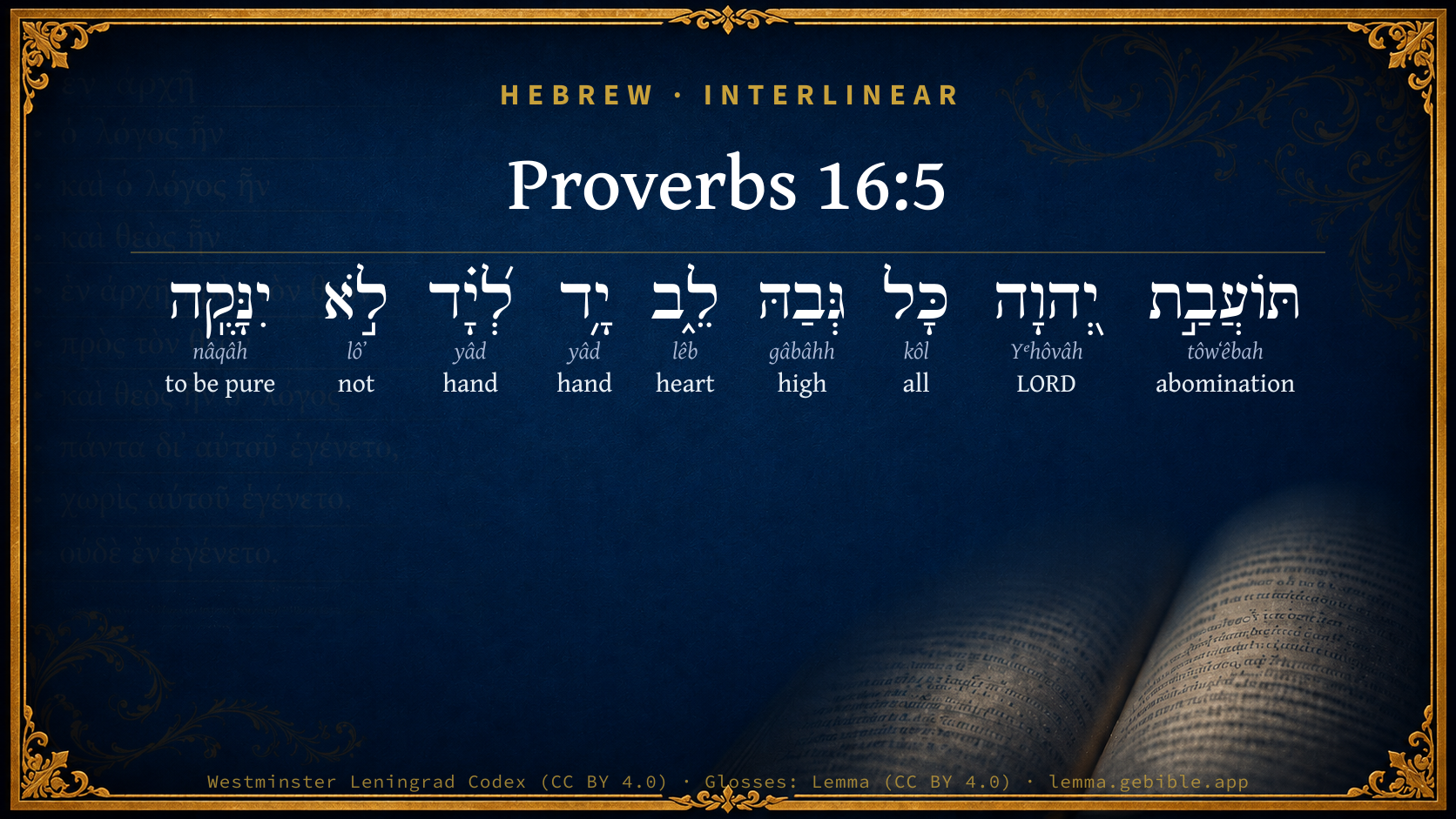
Hebrew (Westminster Leningrad Codex) Proverbs 16:5 appears in the Hebrew Old Testament. The text above is from the Westminster Leningrad Codex. Each word links to its Strong’s number, a concise gloss, and parsing drawn from the Open Scriptures Hebrew Bible morphology. Click any word for its full Brown-Driver-Briggs (BDB) entry.
Download image
Cite this verse

Proverbs 16:5 (World English Bible). Public Domain. Lemma interlinear Bible study tool, https://lemma.gebible.app/v/proverbs/16/5.

Show BibTeX & RIS
BibTeX
RIS
English Translation
Everyone who is proud in heart is an abomination to Yahweh: They shall assuredly not be unpunished.
World English Bible · Public Domain
Download a study sheet

One document with this verse’s original text, its word-by-word gloss line, the meaning frame, cross-references with their text, attributed commentary, and full source and license credits — printable, and it pastes into notes with its structure intact.

This verse Autodidact and up

Study sheet (.html) Plain text (.txt)

A passage Seminary Student

Up to 50 verses in one chapter. A passage sheet keeps up to 6 commentary sources and 12 cross-references per verse, in the order this page ranks them, and says so on the sheet whenever that leaves anything out. Ask for a single verse and you get the Autodidact verse sheet above.

Everything on this page stays free to read, with no account — the sheet is a download of what is already on screen, not access to it.

Want to remove ads? Support Godless Engineer
Compare translations 3

The same verse in 3 English versions, stacked beneath the original-language interlinear above. Click any original word for its lexicon entry.

Each is an independent rendering of the whole verse — the interlinear is not word-aligned to these translations.

Highlighted words mark where these versions differ — a whole-verse word diff, not a word-by-word alignment.

  • World English Bible Public Domain
    Everyone who is proud in heart is an abomination to Yahweh: They shall assuredly not be unpunished.
  • King James Version Public Domain
    Every one that is proud in heart is an abomination to the LORD: though hand join in hand, he shall not be unpunished.
  • unfoldingWord Literal Text CC BY-SA 4.0
    An abomination to Yahweh each one high of heart, hand to hand he will not remain blameless.

unfoldingWord Literal Text — © unfoldingWord, licensed CC BY-SA 4.0. Word-aligned USFM3 via Door43 (git.door43.org/unfoldingWord/en_ult).

Versions to compare (up to 4)

3 of 4 selected

Show all 18 translations

Every available English version of this verse, each an independent rendering of the whole verse.

  • World English Bible Public Domain
    Everyone who is proud in heart is an abomination to Yahweh: They shall assuredly not be unpunished.
  • Berean Standard Bible Public Domain
    Everyone who is proud in heart is detestable to the LORD; be assured that he will not go unpunished.
  • Majority Standard Bible Public Domain
    Everyone who is proud in heart is detestable to the LORD; be assured that he will not go unpunished.
  • King James Version Public Domain
    Every one that is proud in heart is an abomination to the LORD: though hand join in hand, he shall not be unpunished.
  • American Standard Version (1901) Public Domain
    Every one that is proud in heart is an abomination to Jehovah: `Though' hand `join' in hand, he shall not be unpunished.
  • Revised Version (1885) Public Domain
    Every one that is proud in heart is an abomination to the LORD: though hand join in hand, he shall not be unpunished.
  • Geneva Bible (1599) Public Domain
    All that are proude in heart, are an abomination to the Lord: though hand ioyne in hand, he shall not be vnpunished.
  • Douay-Rheims (1899) Public Domain
    Every proud man is an abomination to the Lord: though hand should be joined to hand, he is not innocent. The beginning of a good way is to do justice; and this is more acceptable with God, than to offer sacrifices.
  • Young's Literal Translation Public Domain
    An abomination to Jehovah `is' every proud one of heart, Hand to hand he is not acquitted.
  • Literal Standard Version CC BY-SA 4.0
    Every proud one of heart [is] an abomination to YHWH, || Hand to hand—he is not acquitted.
  • Unlocked Literal Bible CC BY-SA 4.0
    Yahweh hates everyone who has an arrogant heart, but be sure of this, they will not go unpunished.
  • unfoldingWord Literal Text CC BY-SA 4.0
    An abomination to Yahweh each one high of heart, hand to hand he will not remain blameless.
  • Darby Bible Public Domain
    Every proud heart is an abomination to Jehovah: hand for hand, he shall not be held innocent.
  • World Messianic Bible Public Domain
    Everyone who is proud in heart is an abomination to the LORD; they shall certainly not be unpunished.
  • Webster's Bible Public Domain
    Every one that is proud in heart is an abomination to the LORD: though hand join in hand, he shall not be unpunished.
  • Free Bible Version CC BY-SA 4.0
    The Lord hates the arrogant. You can be certain of this: the wicked won't go unpunished.
  • Bible in Basic English Public Domain
    Everyone who has pride in his heart is disgusting to the Lord: he will certainly not go free from punishment.
  • JPS Tanakh (1917) Public Domain
    Every one that is proud in heart is an abomination to the LORD; my hand upon it! he shall not be unpunished.

Literal Standard Version (2020), Covenant Press — licensed CC BY-SA 4.0. Text via the HelloAO Bible API (eBible.org). Unlocked Literal Bible (unfoldingWord) — licensed CC BY-SA 4.0. Text via the HelloAO Bible API (eBible.org). unfoldingWord Literal Text — © unfoldingWord, licensed CC BY-SA 4.0. Word-aligned USFM3 via Door43 (git.door43.org/unfoldingWord/en_ult). Free Bible Version, Dr. Jonathan Gallagher — licensed CC BY-SA 4.0. Text via the HelloAO Bible API (eBible.org).

Word by word

More ways to search: Search by grammar → Find every occurrence → Compare this word →

Practice this passage: Drill this verse → Learn its vocabulary →

About this verse

These counts appear in no published source. They are computed here, from the morphology-tagged text and Lemma’s own curated glosses. What Lemma adds →

9
words
8
distinct lemmas
Wisdom
section

Notable vocabulary

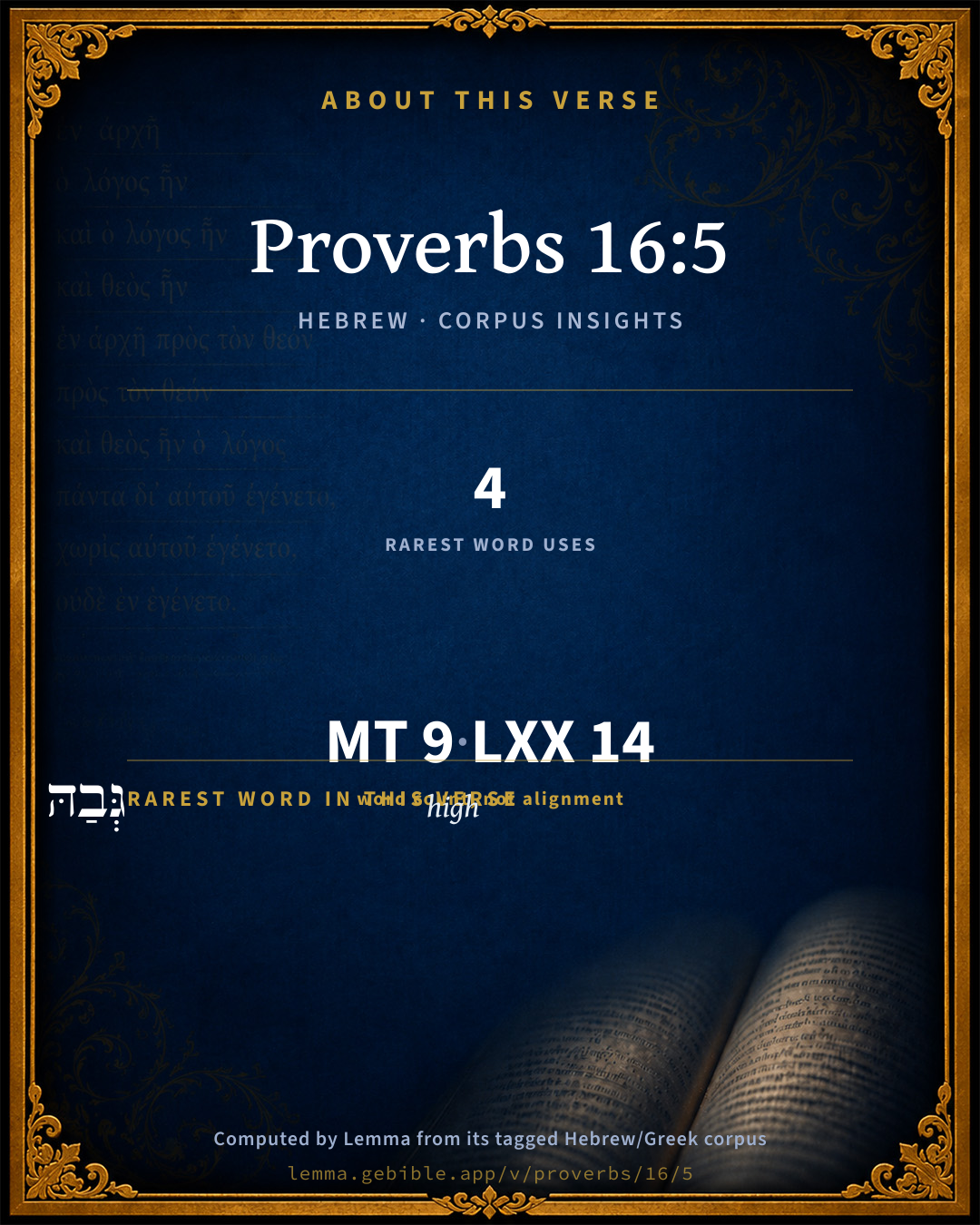
The rarest word here is גְּבַהּ high H1362 — appearing just 4 times in the whole Hebrew Bible.

Shared distinctive vocabulary

גְּבַהּ high H1362 occurs in 4 verses of the Hebrew Bible. Also found in:

Grammatical profile

  • 1 verb
  • 6 nouns
  • 1 adjective
  • 1 particle

Verb forms

  • יִנָּקֶֽה Niphal · Imperfect

Repetition

A word recurs within this verse — often emphatic in Hebrew:

  • יָ֥ד hand H3027 ×2

Hebrew & Septuagint length

In English translation the verse runs 17 words from the Hebrew and 85 from the Septuagint (LXX English) — the Septuagint runs noticeably longer here. See the side-by-side →

A rough comparison of the two English renderings, which tokenize alike — not a word-level alignment.

Word counts can differ between the Hebrew and the Greek without any difference in meaning — e.g. the Hebrew direct-object marker אֵת has no separate Greek word, and Greek often adds the article ὁ.

In the original languages it is 9 Hebrew tokens and 14 Greek tokens — but the two are counted differently (Hebrew bundles its prefixes and suffixes into one token; the Greek is in lemma form), so that isn’t a like-for-like length.

Cross-references

8

Topical passages linked to Proverbs 16:5 in the Treasury of Scripture Knowledge — connected by theme and wording, ordered by reader-vote popularity; previews shown in the World English Bible.

  • Proverbs 6:16–17 There are six things which Yahweh hates; Yes, seven which are an abomination to him:
  • Proverbs 8:13 The fear of Yahweh is to hate evil. I hate pride, arrogance, the evil way, and the perverse mouth.
  • Proverbs 11:21 Most assuredly, the evil man will not be unpunished, But the seed of the righteous will be delivered.
  • Romans 2:8–9 but to those who are self-seeking, and don't obey the truth, but obey unrighteousness, will be wrath and indignation,
  • James 4:6 But he gives more grace. Therefore it says, "God resists the proud, but gives grace to the humble."
  • Job 40:12 Look on everyone who is proud, and humble him. Crush the wicked in their place.
  • Isaiah 3:11 Woe to the wicked! Disaster is upon them; For the deeds of his hands will be paid back to him.
  • Exodus 20:7 "You shall not take the name of Yahweh your God in vain, for Yahweh will not hold him guiltless who takes his name in vain.

Cross-references courtesy of OpenBible.info (CC BY 4.0).

Hebrew and Greek witnesses Masoretic Hebrew ↔ Greek Septuagint

The same verse in the two great witnesses to the Old Testament, shown verse-for-verse.

Here the Septuagint runs noticeably longer than the Hebrew — LXX2012 (modern English Septuagint) 85 words vs World English Bible 17. A rough length comparison of the two English translations, not a word-level alignment — read both below.

These are two independent witnesses, not word-aligned to each other, and the Septuagint is shown in lemma (dictionary) form.

Hebrew Proverbs 16:5 Masoretic · Westminster Leningrad Codex

תּוֹעֲבַ֣ת יְ֭הוָה כָּל גְּבַהּ לֵ֑ב יָ֥ד לְ֝יָ֗ד לֹ֣א יִנָּקֶֽה

Everyone who is proud in heart is an abomination to Yahweh: They shall assuredly not be unpunished.

World English Bible · Public Domain

Greek LXX Proverbs 16:5 Septuagint · lemma form

πᾶς ὁ ἔργον ὁ κύριος μετά δικαιοσύνη φυλάσσω δέ ὁ ἀσεβής εἰς ἡμέρα κακός

Every one that is proud in heart is unclean before God, and he that unjustly strikes hands with hand shall not be held guiltless. The beginning of a good way is to do justly; and it is more acceptable with God than to offer sacrifices. He that seeks the Lord shall find knowledge with righteousness: and they that rightly seek him shall find peace. All of the works of the Lord are done with righteousness; and the ungodly man is kept for the evil day.

LXX2012 (modern English Septuagint) · Public Domain

On this verse, Haydock's Catholic Bible Commentary discusses the Septuagint’s reading. Read the note in Commentary ↓

Hebrew: Westminster Leningrad Codex (CC BY 4.0). Greek: Septuagint (public domain); English from LXX2012 (modern English Septuagint) (Public Domain). How the Septuagint differs from the Hebrew →

Commentary

Notes on Proverbs 16:5 from classic Christian and Jewish commentators (each source and its license shown beneath its notes). The classic Christian expositions comment on the surrounding passage and are grouped to its opening verse, so a note may address several verses; the Jewish commentaries on the Tanakh (Rashi and others) are per-verse, so they appear only where the commentator wrote on this verse.

Lemma curates 59 commentaries, every one of them public domain or Creative Commons licensed, each selected and text-cleaned for this edition rather than reprinted as found. About our sources →

Trapp's Complete Commentary

John Trapp

Pro 16:5 Every one [that is] proud in heart [is] an abomination to the LORD: [though] hand [join] in hand, he shall not be unpunished.

Ver. 5. Every one that is proud in heart, &c.] That lifts up himself against God and his righteous decree; daring to reprehend what they do not comprehend about the doctrine of reprobation, as those chatters, Rom 9:20. These, while, like proud and yet brittle clay, they will be knocking their sides against the solid and eternal decrees of God - called mountains of brass {Zec 6:1} - break themselves in pieces. So likewise do such as "stumble at the word, being disobedient, whereunto also they were appointed." {1Pe 2:8} How much better were it for them to take the prophet’s counsel, "Hear, and give ear, be not proud, for the Lord hath spoken it. Give glory to the Lord your God" - let him be justified and every mouth stopped, subscribe to his most perfect justice, though it were in your own utter destruction - "before your feet stumble upon the dark mountains." {Jer 13:15-16} That was a proud and atheistic speech of Louis XI, Si salvabor, salvabor; si veto damnabor damnabor: If I shall be saved, I shall be saved; and if I shall be damned, I shall be damned; and there is all the care that I shall take. Not unlike to this was that wretched resolution of one Ruffus, of whom it is reported that he painted God on the one side of his shield, and the devil on the other, with this mad motto, Si tu me nolis, iste rogitat: If thou wilt not have me, here is one who will!

Though hand join in hand.] {See Trapp on "Pro 11:21"} Some make "hand in hand" to be no more than ‘out of hand,’ ‘immediately’ or ‘with ease’; for nothing is sooner or with more ease done than to fold one hand in another. God "shall spread forth his hands in the midst of them, as he that swimmeth spreadeth forth his hands to swim, and he shall bring down their pride together with the spoil of their hands." {Isa 25:11} The motion in swimming is easy, not strong; for strong strokes in the water would rather sink than support. God with greatest facility can subdue his stoutest adversary when once it comes to handy gripes; when once his hand joins to the proud man’s hand - so some sense this text - so that they do manus conserere, then shall it appear that "it is a fearful thing to fall into the hands of the living God." {Heb 10:31}

John Trapp, A Commentary or Exposition upon All the Books of the Old and New Testament (1647–1656) — public domain. Text from a community e-Sword module.

The Biblical Illustrator

Joseph S. Exell

Pro_16:5

Every one that is proud in heart is an abomination to the Lord.

On pride

In the maladies which assault the human body, a marked distinction prevails as to the relative extensiveness of their influence. A kindred analogy discriminates the distempers of the mind. Pride claims the denomination of an universal passion. Age, or sex, or situation exempts not from its control. Body and mind, virtues and vices, it presses into its service. Men are proud in health, proud in the chamber of disease; proud in public, proud in retirement; proud of their frugality, proud of their profusion; proud of their sobriety, proud of their intemperance; proud of their pride, proud of their humility.

I. Some of its modes of operation.

1. National pride. Different regions are separated by appropriate marks of moral discrimination. One will be described as courageous; one as interested; one as fickle, one as circumspect. But you will hear each characterised as proud. Pride sometimes wears the features of emulation; sometimes of ambition; sometimes of resentment; sometimes of policy. How generally in the senate and in the private circles, no less than on the parade and in the camp, is national pride, under various forms, addressed, applauded, pushed forward additional excesses!

2. Pride in the walks of private life. The man who is intoxicated by pride of birth; the pride of authority. The exercise of power affords to pride the most solid gratification. The pride of wealth. What solicitude is devoted to the establishment of a name for opulence! Besides the pride of accumulation and possession, there is the pride of displaying riches. The pride of genius, intellect, and talents. Under how many different shapes is it exhibited! Sometimes in disdain of industry, as indicative of dulness; sometimes in the love of singularity and paradox; sometimes in proneness to stigmatise received opinions as vulgar prejudices, or in sceptical repugnance to acquiesce in any truth not completely circumscribed within the span of human comprehension. Sometimes it betrays itself by overweening ideas which the individual ill disguises of the extent of his own powers, and by his unbounded estimation of their importance; sometimes by open scorn of ordinary men, and of the sobriety of common sense; sometimes by unwarranted daringness of enterprise, and presumptuous confidence of success; sometimes it is displayed in impatience of contradiction, in oracular sententiousness, in a dictatorial delivery of opinion. The pride of literary and professional attainments. The pride of fashion. Above all, the man of spiritual pride.

II. The irreconcilable contrariety between pride and religious principle. The corner-stone of Christian virtue is humility. The most powerful obstacle to the conversion of the Jews was pride. The primary source of modern unbelief is pride. Pride, which refuses to do homage to the wisdom of revelation, and bow the neck to the yoke of the gospel. The cold and careless scorner resists the influence of the gospel far more effectually than the open sinner.

III. Gods special judgments against pride. He chastises nations by bringing upon them national calamities. In Scripture we find it is this sin that has drawn down the most severe judgments on individuals, such as Nebuchadnezzar, Uzziah, Hezekiah, Ahithophel, Herod (see also the Laodiceans). Is not pride convicted as in every shape utterly un-Christian, as the primary cause of the fall of man, as in all ages the foundation of most heinous sins, of the most tremendous judgments? Then leave pride to the proud. Be not ye corrupted to call evil good, and darkness light. Pride is ever setting itself up against heaven. When it looks to God, it is with a desire of being freed from dependence on Him. When it considers men, it undervalues His gifts to others; and prompts us to act, with respect to His gifts to ourselves, as though they were inherent in us, or were our due. Scrutinise your own bosom that you may discover whether it is under the influence of pride. (Thos. Gisborne, M.A.)

The Biblical Illustrator, edited by Joseph S. Exell (c. 1880s–1900s) — public domain. Text from a community e-Sword module.

The Preacher's Complete Homiletical Commentary

Joseph S. Exell (gen. ed.)

CRITICAL NOTES.—

Pro_16:5. Though hand join in hand, literally “hand to hand,” as in chap. Pro_11:21. This phrase is variously understood. Stuart renders it “Should hand be added to hand,” i.e., although a haughty man should employ all his powers of resistance, “he shall not go unpunished.” Delitzsch and Zöckler render it “assuredly,” as in chap. Pro_11:21. See also the comments on the verse.

MAIN HOMILETICS OF Pro_16:5

HEART-PRIDE

I. That which may be hidden from all others is ever manifest to One Being. There is coin in the world that is not money nor money’s worth, although it often passes through the hands of many before its worthlessness is detected. But there are eyes which could tell at once that it was not genuine, and hands which if it came into their possession would soon reduce it to its true level among the baser metals. So there is in the world a feigned humility, which has so much the appearance of the genuine article that no earthly creature suspects that it is the covering of a heart big with pride. But when God judges whether a man is proud or humble He looks through the words and actions at the heart. “Everyone that is proud in heart,” etc.

II. God abhors pride.

1. It is entirely contrary to His own nature. God is entirely without pride. His condescension is one of His most remarkable attributes. God manifest in flesh abased Himself beyond the possibility of any finite creature. “Being in the form of God He made Himself of no reputation, and took upon Him the form of a servant, and was made in the likeness of men: and being found in fashion as a man He humbled Himself, and became obedient unto death, even the death of the cross” (Php_3:7-8). We always find that in proportion as men are holy and god-like they are destitute of pride. The proudest men are always those who have least to be proud of. Therefore pride can have no place in the character of the holy and ever-blessed God.

2. It is opposed to the possessor’s well-being. God not only abhors pride because He is Himself supremely good, but He holds it in abomination because He desires men’s good. Whatever is opposed to God’s nature must be opposed to man’s interest. He who desires the salvation of all His creatures hates pride because it holds men tied and bound in fetters which hinder their approach to Him; because it makes men akin to the fallen angels. (On this subject see also on chapters Pro_11:1; Pro_13:10, page 305, etc.)

III. Union is no guarantee against punishment. “Though hand join in hand, he shall not be unpunished.” When that which is an abomination to God is the foundation of a confederation, it must be overthrown by the power of the stronger arm. And it contains within itself an element of overthrow. A house may have an appearance of compactness which may lead a casual onlooker to think it is destined to stand for many a century. But its foundation is in the sand, and its fall is only the work of time, even if storms and tempests never beat upon its walls. So there may be an appearance of strength where pride is the basis of union, but it can be only an appearance. Pride is a dividing force and not a binding one, and all confederations against God being based upon it, they rest only upon a foundation of sand. (See also on chap. Pro_11:21.)

OUTLINES AND SUGGESTIVE COMMENTS

(1.) If God has made everthing for His purpose (Pro_16:4), how foolish the man who arrogantly forgets Him!

(2.) If God has besought us to work under His plans (Pro_16:3), how wicked the man who proudly mutinies. If God works even in kings (chap. Pro_21:1), how absurd the man who would work away from Him. How can it work well? “Hand to hand,” i.e., in close quarters (chap. Pro_11:21), as we shall come all of us at the last, how can the workers outside of the Almighty possibly “go unpunished?”—Miller.

How many sins are in this sinful world, and yet, as Solomon saith of the good wife (Pro_31:29), “Many daughters have done virtuously, but thou surmountest them all.” So I may say of pride, many sins have done wickedly, but thou surmountest them all; for the wrathful man, the prodigal man, the lascivious man, the surfeiting man, the slothful man, is rather an enemy to himself than to God; the envious man, the covetous man, the deceitful man, the ungrateful man, is rather an enemy to men than to God; but the proud man sets himself against God, because he doth against His laws, he maketh himself equal with God, because he doth all without God, and craves no help of Him; he exalteth himself above God, because he will have his own will, though it be contrary to God’s will. As the humble man saith, “Not unto us, Lord, not unto us, but to Thy name give the glory” (Psa_115:1); so the proud man saith, “Not unto Him, not unto Him, but unto us give glory.”.… Therefore God is specially said to resist the proud, because the proud resist Him. Here is heaven against earth, the Creator against the creature, the Father against the Son, the Prince against the subject—who is like to win the field?.… It had been too heavy for them, if he had said the Lord doth not care for them; for God’s care preserveth us, and our own care doth but trouble us; but to say that the Lord doth resist them, is as if Michael should denounce war with the dragon till he hath cast him into the pit.—Henry Smith, 1590.

Some make “hand in hand” to be no more than “out of hand,” “immediately,” or “with ease,” for nothing is sooner or with more ease done than to fold one hand in another. God “shall spread forth His hands in the midst of them, as he that swimmeth spreadeth forth his hands to swim, and He shall bring down their pride together with the spoil of their hands” (Isa_25:11). The motion in swimming is easy, not strong; for strong strokes in the water would rather sink than support. God, with greatest facility, can subdue His stoutest adversary when once it comes to handy-gripes—when once his hands join to the proud man’s hand—so some sense this text—so that they do manus conserere, then shall it appear that it is a fearful thing to fall into the hands of the Living God (Heb_10:31).—Trapp.

From hand to hand expresses the consecutive connection of causes through which the Lord works; though the proud escape one occasion of His punishment, yet he is reserved for another.—Mercer.

The Preacher's Complete Homiletical Commentary (gen. ed. Joseph S. Exell; Funk & Wagnalls, c. 1892) — public domain (pre-1929). A full-Bible homiletical/sermon-outline anthology covering 65 of 66 books (2 John is absent from the source module). Text from a community e-Sword module.

Bridges on Proverbs

Charles Bridges

(Pro 16:5 quoted in the NT: Luk 16:15 (Note, this is at advice of one internet commentator who writes as follows: "In Luk 16:15 Jesus asserts that ’what is exalted among humans is an abomination [bdelygrna] in the sight of God.’ This alludes to Pro 16:5 in the Hebrew, where the wise man claims: ’Every one who is arrogant is an abomination [tw’bh] to the LORD.’" Other expositors/commentators who made this connection were not available. Any able scholars who can provide input on this, please email e_proverbs@yahoo.com).)

The hatefulness of a proud look has been mentioned. (Pro 6:17 .) But the Searcher of hearts marks pride in heart under a humble look. (Mat 6:16 .) Men see no abomination in this spirit. It brings no disgrace. Nay, it is often thought to be high-minded. But it keeps back the heart from God. It lifts up the heart against him. It contends for the supremacy with him. (Eze 28:2 .) When it thus strikes at God, what wonder that God strikes at it (1Pe 5:5 ), as an abomination to him?

How unseemly moreover is this sin! A creature so utterly dependent, so fearfully guilty, yet proud in heart! A true child of a fallen parent, who, in dreaming to be as God, made himself like the devil. (Gen 3:5 .) Many are the forms of this hateful spirit. Some are proud of their beauty; some of their talents; some of their rank; some of their goodness - all forgetting, that they "have nothing which they have not received" (1Co 4:7 ); all unconscious, that they are an abomination to the LORD.

Perhaps, however, this declaration applies more distinctly to proud combinations against God - hand joining in hand.†1 What is all this force, but the worm "striving with his Maker"?†2 "Who is the LORD?" - was the boast of haughty Pharaoh. Let him and his people go to the Red Sea, and learn.†3 Hand joining in hand shall not be held innocent - shall not be unpunished. The Babel combination was blasted with confusion.†4 The "associations" against the holy child Jesus were "broken in pieces."†5 The infidel conspiracies of Voltaire and his school have been overthrown. And thus in our own day, with all Social and Chartist banding together for wickedness, only manifest more gloriously - "There is no wisdom, nor understanding, nor counsel against the LORD." (Pro 21:30 .)

Footnotes:

†1 Pro 11:21. Psa 59:3, Psa 59:12-13 .

†2 Isa 45:9.

†3 Exo 5:2; Exo 14:26-30 .

†4 Gen 11:1-9.

†5 Isa 8:9. Psa 2:1-5 .

Charles Bridges, An Exposition of the Book of Proverbs (1846) — public domain. Text from a community e-Sword module.

Tyndale Open Study Notes

Tyndale Open Resources

16:5 God detests the proud, who refuse to commit their ways to the Lord (16:3) and mistakenly believe that they can accomplish their plans on their own (16:1).

Tyndale Open Study Notes — © Tyndale Open Resources, licensed CC BY-SA 4.0. Text via the HelloAO Bible API.

Matthew Henry's Commentary

Note, 1. The pride of sinners sets God against them. He that, being high in estate is proud in heart, whose spirit is elevated with his condition, so that he becomes insolent in his conduct towards God and man, let him know that though he admires himself, and others caress him, yet he is an abomination to the Lord. The great God despises him; the holy God detest him. 2. The power of sinners cannot secure them against God, though they strengthen themselves with body hands. Though they may strengthen one another with their confederacies and combinations, joining forces against God, they shall not escape his righteous judgment. Woe unto him that strives with his Maker, Pro 11:21; Isa 45:9.

Matthew Henry's Commentary on the Whole Bible (1708–1710) — public domain (CC PDM 1.0). Text via the HelloAO Bible API.

Jamieson, Fausset & Brown

Robert Jamieson, A. R. Fausset & David Brown

(Compare Pro 3:32).

Jamieson, Fausset & Brown — Commentary Critical and Explanatory on the Whole Bible (1871) — public domain (CC PDM 1.0). Text via the HelloAO Bible API.

Adam Clarke's Commentary

Verse 5. Though hand join in hand, he shall not be unpunished.] The day of wrath shall come on the wicked, whatever means he may take to avoid it. See Pr 11:21.

Adam Clarke's Commentary on the Bible (1810–1826) — public domain. Text from a community e-Sword/MySword module.

Ellicott's Commentary for English Readers

(5) Though hand join in hand.—See Note on Pro_11:21.

A Bible Commentary for English Readers, edited by Charles John Ellicott (1878–1897) — public domain. Text from a community e-Sword module.

The Cambridge Bible for Schools and Colleges

gen. ed. J. J. S. Perowne

5. Though hand join in hand] See Pro_11:21, note.

The Cambridge Bible for Schools and Colleges (gen. ed. J. J. S. Perowne; Cambridge University Press, 1878–1918) — public domain. Text from a community e-Sword module.

John Gill's Exposition

Every one that is proud in heart is an abomination to the Lord,.... Though he may dissemble his pride, and not discover it in his looks, by his words and gestures; yet the Lord sees and knows the heart, the naughtiness of it, and the pride that is in it: and only a proud look, but a proud heart, is abominable to him: everyone that is so arrogant as to arraign the decrees of God, and quarrel with him about them, to whom the apostle says, "Nay, but, O man", O proud vain man, "who art thou, that repliest against God?" Rom 9:19; every proud Pharisee, that trusts in himself that he is righteous, and despises others, that justifies himself before men, is an abomination in the sight of God, Luk 18:9; particularly antichrist, who has not only a proud look, a look more stout than his fellows, but a proud heart; exalts himself above all that is called God; and not only speaks big words against the most High, but has it in his heart to change times and laws; and proudly imagines he shall always continue in his grandeur and prosperity, Dan 7:25;

though hand join in hand, he shall not be unpunished; though he endeavours with both hands, with all his might and main, to secure himself and prevent his ruin, he shall not be able to do it; though he enters into confederacy with, and calls in the kings of the earth to his assistance, it will be of no avail, both he and they shall be destroyed; or out of hand, immediately, his destruction will come upon him, Rev 16:14; See Gill on Pro 11:21; The Targum is,

"from evil he shall not be cleared;''

and the Syriac version,

"he that stretcheth out his hand against his neighbour shall not be cleared from evil.''

John Gill's Exposition of the Whole Bible (1746–1763) — public domain (CC PDM 1.0). Text via the HelloAO Bible API.

Albert Barnes' Notes on the Bible

See the marginal reference note.

Albert Barnes' Notes on the Bible (1834–1885) — public domain. Text from a community e-Sword/MySword module.

Haydock's Catholic Bible Commentary

Hand. And he seems to be very quiet, chap. xi. 21. Septuagint, "but he who putteth his hand in hands unjustly, to make a contract, is," &c. --- The, &c., is taken from the Roman Septuagint and occurs before, chap. xv. 27.

George Leo Haydock (1774–1849), Haydock's Catholic Family Bible and Commentary, 1859 edition — public domain. Excludes Psalms (Douay-Rheims chapter numbering differs from Protestant) and Deuterocanonical books (Catholic canon only).

Matthew Poole's English Annotations

That is proud in heart, though he dissemble it in his outward carriage and countenance, as Psa 10:4. In whose heart pride rules.

Though hand join in hand; though they have many friends and assistants. See the same phrase Pro 11:21.

Matthew Poole's English Annotations on the Holy Bible (1683–1685) — public domain. Text from a community e-Sword/MySword module.

Whedon's Commentary on the Bible

Daniel D. Whedon

5. Proud in heart — Of a haughty, insolent mind, disposed to treat the poor and weak contemptuously and oppressively.

Though hand join in hand — Though he use both his own hands and all others at his command — all his power and influence.

He (the proud in heart) shall not be unpunished — Shall not be acquitted. Comp. on first clause Pro_6:17; Pro_8:13; Pro_15:9; Pro_25:26; on second clause Pro_11:21.

Daniel D. Whedon (gen. ed.), Commentary on the Old and New Testaments (1874–1909) — public domain. Text from a community e-Sword module.

The Pulpit Commentary

For the first member, see Pro_6:17 Pro_8:13. Says the maxim Alazoneiav ou tiv ekfeugei dikhn. "Pride hath its certain punishment.

We read in the Talmud, "Of every proud man God says, He and I cannot live in the world together." A mediaeval jingle runs"Hoc retine verbum, frangit Deus omne superbum.

Septuagint, "Impure in the sight of God is every high-hearted man (uqhlokardiov )." The second member is found in Pro_11:21, and must be taken as a form of adjuration. Septuagint, "Putting hands on hand unjustly, he shall not be innocent;" i.e. one who acts violently and unjustly shall be held guilty which seems a trite truism. Many commentators interpret the clause as if it meant that the cooperation and combination of sinners in evil practices will not save them from retribution. But hand clasping hand in token of completing a bargain or alliance is scarcely an early Oriental custom. There is an analogous saying in Greek which implies mutual assistance Ceiptei daktulov te daktulon. "Hand washes hand, and finger finger.

The LXX has here two distiches, the first of which occurs in the Vulgate, but the second is not found there. Neither appears in our present Hebrew text. "The beginning of the good way is to do what is just; this is more acceptable to God than to sacrifice sacrifices. He who seeketh the Lord shall find knowledge with righteousness; and they who seek him rightly alkali find peace."

The Pulpit Commentary (1880–1919), ed. H.D.M. Spence-Jones & Joseph S. Exell — public domain. Text from a community e-Sword module.

Keil & Delitzsch

C. F. Keil & F. Delitzsch

Here follow three proverbs of divine punishment, expiatio [Vershnung] and reconciliatio [Vershnung].

5 An abomination of Jahve is every one who is haughty;

The hand for it [assuredly] he remains not unpunished.

Proverbs thus commencing we already had at Pro 15:9, Pro 15:26. גּבהּ is a metaplastic connecting form of גּבהּ; on the contrary, גּבהּ, Sa1 16:7; Psa 103:11, means being high, as גּבהּ, height; the form underlying גּבהּ is not גּבהּ (as Gesen. and Olshausen write it), but גּבהּ. In 5b, Pro 11:21 is repeated. The translators are perplexed in their rendering of יד ליד. Fleischer: ab aetate in aetatem non (i.e., nullo unquam tempore futuro) impunis erit.

Keil & Delitzsch — Biblical Commentary on the Old Testament (1861–1891) — public domain (CC PDM 1.0). Text via the HelloAO Bible API. (Old Testament only.)

Kretzmann's Popular Commentary

Paul E. Kretzmann

v. 5. Every one that is proud in heart is an abomination to the Lord, He loathes such as exalt themselves; though hand join in hand, that is, most assuredly, he shall not be unpunished.

Paul E. Kretzmann, Popular Commentary of the Bible (1921–1924) — public domain. Text from a community e-Sword module.

unfoldingWord translationNotes

Door43 World Missions Community

everyone who has an arrogant heart

Here the word "heart" represents the person. AT: "everyone who is arrogant" (See: Synecdoche)

they will not go unpunished

The two negatives in this phrase strongly emphasize the positive. This can be stated in active form. AT: "Yahweh will certainly punish them" (See: Litotes and Active or Passive)

By covenant faithfulness and trustworthiness iniquity is atoned for

The abstract nouns "faithfulness" and "trustworthiness" can be stated as "faithful" and "trustworthy." This can be stated in active form. Possible meanings are 1) AT: "Because Yahweh is faithful to his covenant and trustworthy he forgives people's sins" or 2) AT: "Yahweh will forgive the sins of those who are faithful to the covenant and trustworthy" (See: Abstract Nouns and Active or Passive)

people turn away from evil

The writer speaks of people no longer doing evil things as if they were turning away from evil. AT: "people stop doing evil things" (See: Metaphor)

translationWords

Yahweh

arrogant

heart

covenant faithfulness

trust

iniquity

atonement

fear

evil

unfoldingWord translationNotes — © Distant Shores Media and the Door43 World Missions Community, licensed CC BY-SA 4.0. Source: git.door43.org/Door43/en_tn.

Rashi

Rabbi Shlomo Yitzchaki (Rashi)

hand to hand he will not go unpunished From hand to hand the punishment for his haughtiness will come to him.

Rashi on the Tanakh — English translations: “The Judaica Press complete Tanach with Rashi, translated by A. J. Rosenberg” (CC BY 4.0); “Pentateuch with Rashi's commentary by M. Rosenbaum and A.M. Silbermann, 1929-1934” (public domain); “The Metsudah Tanach series, Lakewood, N.J” (CC BY 4.0); and “The Book of Joshua, Metsudah Publications, 1997” (CC BY 4.0). Text via Sefaria.

Lesson kit

Teaching starters — assembled from the data on this page, not authored interpretation. Every prompt links to the verse data it draws on. Edit before teaching.

Proverbs, in the Wisdom, opens this verse with 9 words (8 distinct Hebrew lemmas). Its most distinctive word is gâbâhh (“high”). The Greek Septuagint runs longer here. A historical commentator’s framing appears above. Read the whole chapter for the surrounding context.

Discussion questions

  1. What does “high” (gâbâhh) contribute to the verse as a whole?
  2. How does Psalms 101:5, which shares the word «high», read alongside this verse?
  3. What does the repetition of “hand” (2× in this one verse) do in this verse?
  4. The Septuagint runs longer here than the Hebrew. What might account for the difference?
  5. These translations render this verse differently; the difference is in the English rendering, not the original. What questions does that raise?
  6. «יִנָּקֶֽה» is a Niphal Imperfect verb. How does that grammatical form shape the action described?
  7. Compare how Trapp's Complete Commentary and The Biblical Illustrator read this verse. Where do they agree or differ?

Things to notice

Reading settings

Reading text

Shown beneath each verse's original-language words.

Old Testament
Old Testament edition

Read the OT as the Masoretic Hebrew (MT) or the Greek Septuagint (LXX).

English shown for the Greek Septuagint (in the Hebrew ↔ Greek comparison).

Comparing translations? Open the Compare panel on any verse page to stack up to four side by side.