Colossians 2:9

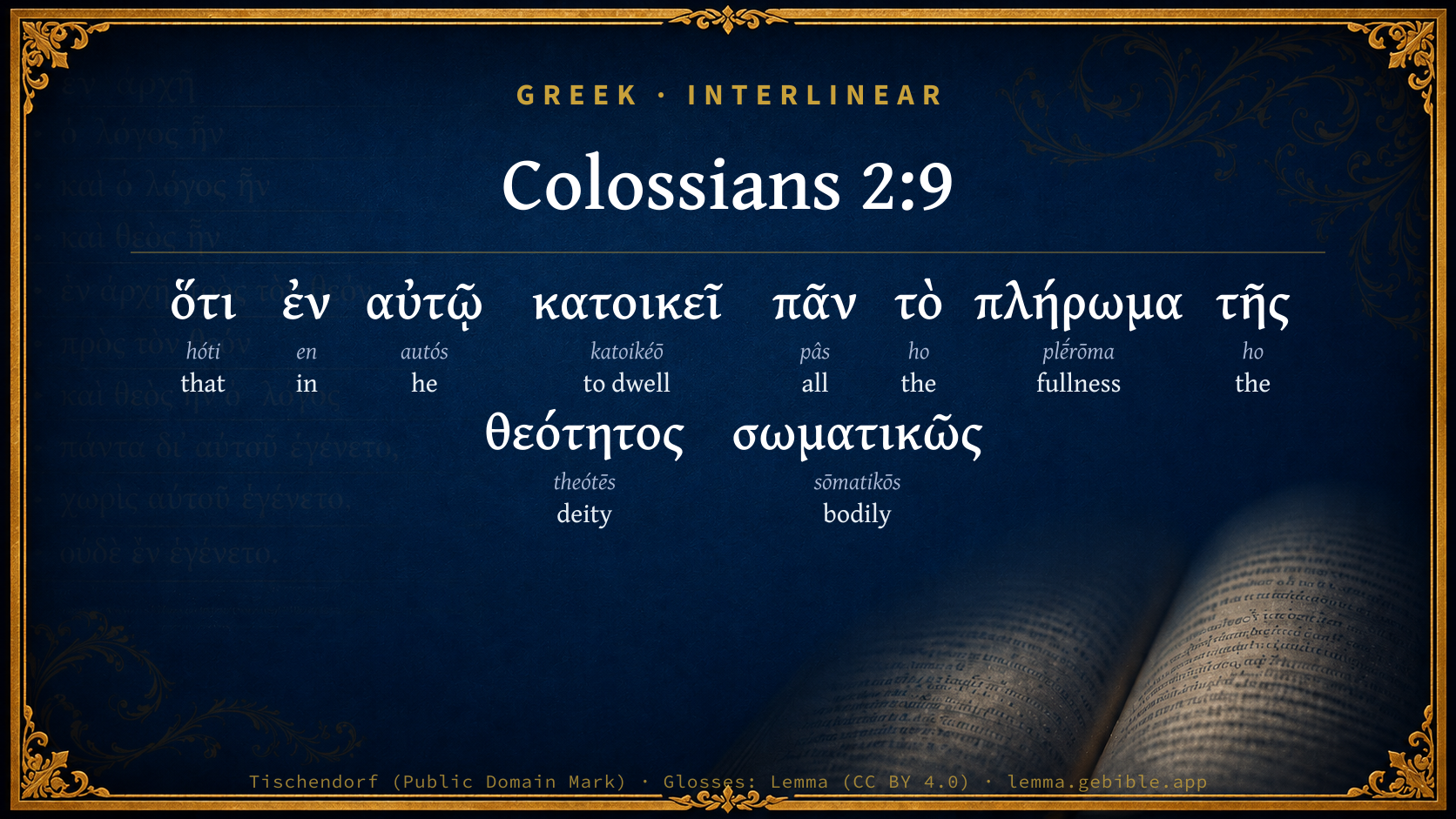
Greek (Tischendorf 8th ed.) Colossians 2:9 appears in the Greek New Testament. The text above is from the Tischendorf 8th edition. Each word links to its Strong’s number and a concise gloss. Click any word for its full Thayer’s Greek Lexicon entry.
Download image
Cite this verse

Colossians 2:9 (World English Bible). Public Domain. Lemma interlinear Bible study tool, https://lemma.gebible.app/v/colossians/2/9.

Show BibTeX & RIS
BibTeX
RIS
English Translation
For in him all the fullness of the Godhead dwells bodily,
World English Bible · Public Domain
Highlights
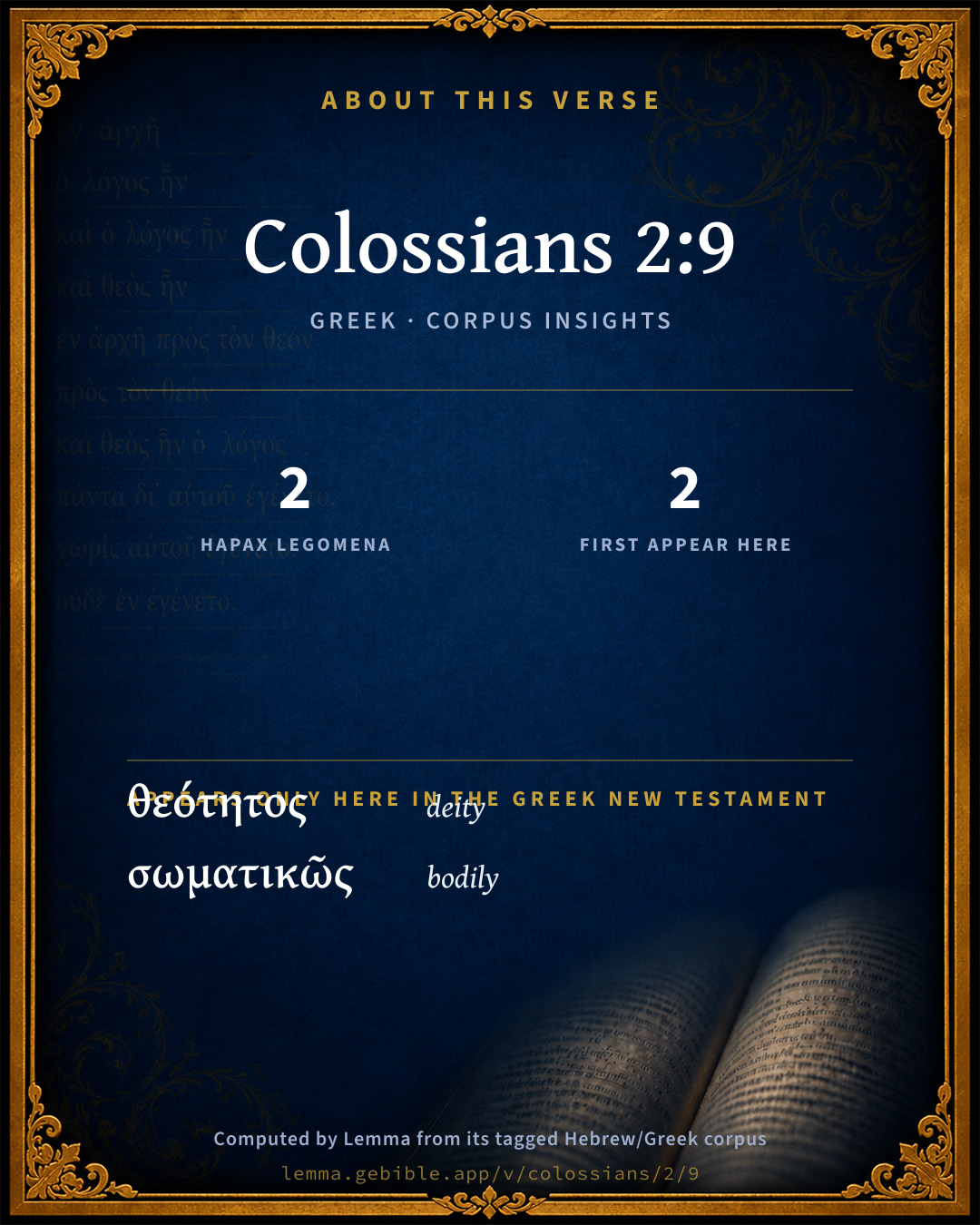
  • 2 hapax legomena — only here in the Greek New Testament
  • 2 first appearances in the Greek New Testament
Full analysis ↓
Download a study sheet

One document with this verse’s original text, its word-by-word gloss line, the meaning frame, cross-references with their text, attributed commentary, and full source and license credits — printable, and it pastes into notes with its structure intact.

This verse Autodidact and up

Study sheet (.html) Plain text (.txt)

A passage Seminary Student

Up to 50 verses in one chapter. A passage sheet keeps up to 6 commentary sources and 12 cross-references per verse, in the order this page ranks them, and says so on the sheet whenever that leaves anything out. Ask for a single verse and you get the Autodidact verse sheet above.

Everything on this page stays free to read, with no account — the sheet is a download of what is already on screen, not access to it.

Want to remove ads? Support Godless Engineer
Compare translations 3

The same verse in 3 English versions, stacked beneath the original-language interlinear above. Click any original word for its lexicon entry.

Each is an independent rendering of the whole verse — the interlinear is not word-aligned to these translations.

Highlighted words mark where these versions differ — a whole-verse word diff, not a word-by-word alignment.

  • World English Bible Public Domain
    For in him all the fullness of the Godhead dwells bodily,
  • King James Version Public Domain
    For in him dwelleth all the fulness of the Godhead bodily.
  • unfoldingWord Literal Text CC BY-SA 4.0
    For in him all the fullness of deity dwells in bodily form,

unfoldingWord Literal Text — © unfoldingWord, licensed CC BY-SA 4.0. Word-aligned USFM3 via Door43 (git.door43.org/unfoldingWord/en_ult).

Versions to compare (up to 4)

3 of 4 selected

Show all 19 translations

Every available English version of this verse, each an independent rendering of the whole verse.

  • World English Bible Public Domain
    For in him all the fullness of the Godhead dwells bodily,
  • Berean Standard Bible Public Domain
    For in Christ all the fullness of the Deity dwells in bodily form.
  • Majority Standard Bible Public Domain
    For in Christ all the fullness of the Deity dwells in bodily form.
  • King James Version Public Domain
    For in him dwelleth all the fulness of the Godhead bodily.
  • American Standard Version (1901) Public Domain
    for in him dwelleth all the fulness of the Godhead bodily,
  • Revised Version (1885) Public Domain
    for in him dwelleth all the fulness of the Godhead bodily,
  • Geneva Bible (1599) Public Domain
    For in him dwelleth all the fulnesse of the Godhead bodily.
  • Douay-Rheims (1899) Public Domain
    For in him dwelleth all the fulness of the Godhead corporeally;
  • Young's Literal Translation Public Domain
    because in him doth tabernacle all the fulness of the Godhead bodily,
  • Literal Standard Version CC BY-SA 4.0
    because in Him dwells all the fullness of the Godhead bodily,
  • Unlocked Literal Bible CC BY-SA 4.0
    For in him all the fullness of God lives in bodily form.
  • unfoldingWord Literal Text CC BY-SA 4.0
    For in him all the fullness of deity dwells in bodily form,
  • Darby Bible Public Domain
    For in him dwells all the fulness of the Godhead bodily;
  • World Messianic Bible Public Domain
    For in him all the fullness of the Deity dwells bodily,
  • Webster's Bible Public Domain
    For in him dwelleth all the fullness of the Godhead bodily.
  • Free Bible Version CC BY-SA 4.0
    For the fullness of God's divine nature lives in Christ in bodily form,
  • Bible in Basic English Public Domain
    For in him all the wealth of God's being has a living form,
  • Text-Critical English NT CC BY 4.0
    For all the fullness of God's nature dwells bodily in Christ,
  • Tyndale New Testament (1534) Public Domain
    For in him dwelleth all the fulnes of the godheed bodyly

Literal Standard Version (2020), Covenant Press — licensed CC BY-SA 4.0. Text via the HelloAO Bible API (eBible.org). Unlocked Literal Bible (unfoldingWord) — licensed CC BY-SA 4.0. Text via the HelloAO Bible API (eBible.org). unfoldingWord Literal Text — © unfoldingWord, licensed CC BY-SA 4.0. Word-aligned USFM3 via Door43 (git.door43.org/unfoldingWord/en_ult). Free Bible Version, Dr. Jonathan Gallagher — licensed CC BY-SA 4.0. Text via the HelloAO Bible API (eBible.org).

Word by word

More ways to search: Search by grammar → Find every occurrence → Compare this word →

Practice this passage: Drill this verse → Learn its vocabulary →

About this verse

These counts appear in no published source. They are computed here, from the morphology-tagged text and Lemma’s own curated glosses. What Lemma adds →

10
words
9
distinct lemmas
Pauline Epistles
section

Notable vocabulary

2 hapax legomena — words that appear only here in the entire Greek New Testament:

  • θεότητος deity G2320
  • σωματικῶς bodily G4985

First appearance in Scripture

These words make their first canonical appearance in the Greek New Testament here:

  • θεότητος deity G2320
  • σωματικῶς bodily G4985

Shared distinctive vocabulary

πλήρωμα fullness G4138 occurs in 17 verses of the Greek New Testament. Also found in:

Repetition

A word recurs within this verse:

Cross-references

17

Topical passages linked to Colossians 2:9 in the Treasury of Scripture Knowledge — connected by theme and wording, ordered by reader-vote popularity; previews shown in the World English Bible.

  • Colossians 1:19 For all the fullness was pleased to dwell in him;
  • John 1:14 The Word became flesh, and lived among us. We saw his glory, such glory as of the one and only Son of the Father, full of grace and truth.
  • John 10:30 I and the Father are one."
  • 1 Timothy 3:16 Without controversy, the mystery of godliness is great: God was revealed in the flesh, Justified in the spirit, Seen by angels, Preached among the nations, Believed on in the world, And received up in glory.
  • John 14:9–10 Jesus said to him, "Have I been with you such a long time, and do you not know me, Philip? He who has seen me has seen the Father. How do you say, 'Show us the Father?'
  • John 10:38 But if I do them, though you don't believe me, believe the works; that you may know and believe that the Father is in me, and I in the Father."
  • 1 John 5:20 We know that the Son of God has come, and has given us an understanding, that we know him who is true, and we are in him who is true, in his Son Jesus Christ. This is the true God, and eternal life.
  • John 14:20 In that day you will know that I am in my Father, and you in me, and I in you.
  • Titus 2:13 looking for the blessed hope and appearing of the glory of our great God and Savior, Jesus Christ;
  • Isaiah 7:14 Therefore the Lord himself will give you a sign. Behold, the virgin will conceive, and bear a son, and shall call his name Immanuel.
  • John 17:21 that they may all be one; even as you, Father, are in me, and I in you, that they also may be one in us; that the world may believe that you sent me.
  • Colossians 2:2–3 that their hearts may be comforted, they being knit together in love, and gaining all riches of the full assurance of understanding, that they may know the mystery of God, both of the Father and of Christ,
  • Matthew 1:23 "Behold, the virgin shall be with child, And shall bring forth a son. They shall call his name Immanuel;" Which is, being interpreted, "God with us."
  • Luke 3:22 and the Holy Spirit descended in a bodily form as a dove on him; and a voice came out of the sky, saying "You are my beloved Son. In you I am well pleased."
  • 2 Corinthians 5:19 namely, that God was in Christ reconciling the world to himself, not reckoning to them their trespasses, and having committed to us the word of reconciliation.
  • 1 John 5:7 For there are three who testify:
  • John 2:21 But he spoke of the temple of his body.

Cross-references courtesy of OpenBible.info (CC BY 4.0).

Commentary

Notes on Colossians 2:9 from classic Christian and Jewish commentators (each source and its license shown beneath its notes). The classic Christian expositions comment on the surrounding passage and are grouped to its opening verse, so a note may address several verses; the Jewish commentaries on the Tanakh (Rashi and others) are per-verse, so they appear only where the commentator wrote on this verse.

Lemma curates 59 commentaries, every one of them public domain or Creative Commons licensed, each selected and text-cleaned for this edition rather than reprinted as found. About our sources →

The Biblical Illustrator

Joseph S. Exell

Col_2:9

In Him dwelleth all the fulness of the Godhead bodily.

I. The house, or place of residence--in Him. In the man Christ Jesus, or in that human nature in which He carried on the business of our salvation; as despicable and abject as it was in the eyes of men, yet it was the temple and seat of the Godhead.

II. The inhabitant--the fulness of the Godhead; not a portion of God only, or His gifts and graces (as we are made partakers of the Divine nature, 1Pe_1:4.), but the whole Godhead.

III. The manner--bodily. The word may relate--

1. To the shadows and figures of the law, and so it signifieth essentially, substantially. God dwelt in the tabernacle, temple, or ark of the covenant, συμβολικῶϚ, because of the figures of His presence. In Christ, σωματικῶϚ, as His human nature was the true tabernacle or temple in which He resideth. Christ calls His human nature a temple (Joh_2:19), or else--

2. With respect to the intimacy and closeness of the union. So σωματικῶϚ, may be rendered personally; for body is often put for a person. The two natures were so united in Him, that He is one Christ. (T. Manton, D. D.)

The fulness of Christ

Ships have been wrecked by mistaking one light for another. Men in lifes voyage often make the same terrible blunder. Signals of danger, however, are set up by God to save us from so tragic an end. False teachers were proclaiming fantastic doctrines, but of such death-luring lights the apostle bids the Colossians beware. We need the same warning. Error confronts us in magazines, newspapers, and pulpits. Paul would have us know that all doctrine is false which does not radiate from Christ. Note--

I. Mans condition is a necessitous one.

1. He has Divinely implanted longings for whose satisfaction he has to go out of himself. He has

(1) Social cravings. He was not designed for loneliness but for companionship.

(2) Mental cravings, which sometimes show themselves in the form of curiosity; but the more cultured a man becomes, his mental longings assume a higher form. The journeys taken, libraries collected, the efforts made to ransack past and present witness to these.

(3) Moral and spiritual cravings. What efforts he has made to know God and be at peace with Him.

2. These longings distinguish man from the animal creation, and witness to the grandeur of His soul.

3. Their existence implies that there is somewhere that by which they may be satisfied.

II. Mans necessitous condition is completely met by the Divine fulness. This fulness is--

1. The plenitude of the Godhead. Who can describe this? It is a fathomless ocean and a limitless sky. All we can say is that it is a fulness out of which all our need may be supplied. But we may know of boundless wealth, and yet remain destitute because not able or permitted to approach it. Is this so here? No. As the beams flow from the suns fulness within the reach and for the use of every tree and hedgerow, so the Divine fulness has come down to us all,

2. In the person of Christ, not typically but really.

(1) He meets our social cravings. He has become one with us in sharing our common life, with its sorrows and joys. No one need now be lonely, since here is One who has everything for which we yearn.

(2) He meets our mental cravings. He is the Truth, the Light of the world, the Wisdom of God.

(3) He meets our moral cravings in His revelation of the Father, and in His atonement for sin. Why, then, go to philosophy or sacraments which can only disappoint.

3. Present and unchanging. The Colossian heretics held a temporary fulness; Paul affirms the Divine fulness dwells in Him now and for ever. Earthly things filter away with pitiless haste, but He is the same to-day, etc. Then while we should avoid going elsewhere we should flee to Him at once. His willingness is equal to His ability to distribute. (E. H. Palmer.)

The fulness of God dwelling in Christ

I. The import of the text.

1. All the fulness of the Godhead. The original signifies that by which a thing is filled, completed, or made perfect. The earth is the Lords and the fulness thereof, i.e., all it contains. So the text means all the natural and moral attributes, everything which renders the Divine nature complete. It cannot mean anything less, for if one perfection were taken away there would be something wanting to, and therefore destructive of the fulness of the Godhead.

2. All this fulness dwells in Christ. The word is not that used in Joh_1:14, to dwell in a tabernacle--a temporary residence, but one which signifies to live in a house, a permanent habitation. So then all the fulness of the Godhead dwells in Christ abidingly.

3. Bodily means real and substantial as against shadowy and figurative. The Mosaic law was a shadow, Christ was the body.

II. This import corresponds with other scriptures.

1. We are taught in many places that the Father and the Spirit dwelt in Christ. Our Lord often declared that the Father dwelt in Him, and added He that hath seen Me hath seen the Father. He is also represented as having the Spirit without measure. Now the whole Godhead is included in Father, Son, and Spirit. Wherever these dwell there is the Divine fulness. They dwell in Christ.

2. Christ is represented as possessing all the perfections of Deity--omnipotence in creation and Providence; omniscience in His knowledge of the Father, and of the heart of man; omnipresence in being with His disciples alway. In fact, He is all in all, and therefore has the fulness of the Godhead bodily.

III. Inferences. If all the fulness of the Godhead is in Christ, then--

1. In Him alone can God be found. Men have forsaken God; but they must find Him again or be lost for ever. It is His will that men should seek after Him if haply they may find Him. Now if we wish to find any one we must go to His residence. So since the whole Godhead resides in Jesus as in a permanent habitation, we must repair to Him to find God. I am the Way, the Truth, etc. No man knoweth the Father but the Son, etc. Men may seek Him in the works of creation, in providence, in His Word; but they will never find Him till they come to Christ, for even the Scriptures can only make us wise unto salvation through Him. But if we come to Him, God who commanded the light to shine out of darkness will give us the knowledge of His glory in the face of Jesus Christ.

2. No man can obtain a portion of that fulness except by applying to Christ. Did all the light of the universe dwell in the sun; none could obtain light except from the sun. Were all the water that exists collected into one reservoir none could obtain water but by applying to that reservoir. Now, unless we obtain some of this fulness, we must pine in eternal want. The mercy which pardons sin, the light which illumines the mind, the grace which purifies the heart, the strength which resists and overcomes, the consolation which supports, bright hope and everlasting joy flow from this, and no man can partake of them without partaking of it. Infinitely better to be destitute of everything else than to want this. For it the Saviour invites us to apply to Him.

3. The necessity and worth of faith in Him. Look first at Him and see in Him an inexhaustible fulness of blessing; look next at mankind wanting everything and therefore wretched. Now what is wanted is a channel of communication through which this fulness may flow, so as to be filled with it. Such a channel is faith. Hence John says of believers, and of those only, Of His fulness we have received. (E. Payson, D. D.)

The Biblical Illustrator, edited by Joseph S. Exell (c. 1880s–1900s) — public domain. Text from a community e-Sword module.

Joseph Benson's Commentary

Col 2:9-10. For in him dwelleth — Inhabiteth, κατοικει, continually abideth; all the fulness of the Godhead — Believers may be filled with all the fulness of God, Eph 3:19; but in Christ dwelleth all the fulness of the Godhead, the most full Godhead, Col 1:19; bodily — Really, substantially. The very substance of God, if one might so speak, dwells in Christ in the most full sense. “It is plain,” says Dr. Doddridge, “that the Godhead is an anglicism equivalent to Deity. Compare Act 17:29. And I cannot think that these wonderful words are intended merely to signify that God hath lodged in the hands of Christ a fulness of gifts, to be conferred upon men, as if the passage were merely parallel to Joh 1:16-17, as Mr. Pierce explains it; while Socinus sinks it yet lower, as if it only referred to his complete knowledge of the divine will. I assuredly believe, that as it contains an evident allusion to the Shechinah, in which God dwelt, so it ultimately refers to the adorable mystery of the union of the divine and human natures in the person of the glorious Emmanuel, which makes him such an object of our hope and confidence, as the most exalted creature, with the most glorious endowments, could never of himself be.” And ye are complete in him — You have in and from him every thing necessary to your salvation, all the wisdom and knowledge, the righteousness and strength, the holiness, support, and comfort that you stand in need of, to enable you to glorify God on earth, and to prepare you for being glorified with him in heaven. But the original expression, εν αυτω πεπληρωμενοι, is literally, ye are filled by him. See on Joh 1:16. Christ is filled with God, and ye are filled with, or by, Christ. The fulness of Christ overflows his church, Psa 133:3. He is originally full, but our fulness is derived from him. Who is the head of all principality and power — Of angels as well as men. Not from angels, therefore, but from their Head, are we to ask whatever we stand in need of. The supremacy of Christ over all created beings, is asserted in many other passages of Scripture. See the margin. A doctrine this which affords the greatest consolation to the people of God, as it assures them that nothing befalls them without his permission, and that all things shall work together for their good.

Joseph Benson's Commentary on the Old and New Testaments (1811–1818) — public domain. Text from a community e-Sword module.

Whedon's Commentary on the Bible

Daniel D. Whedon

2. Transcended by Christ, Col_2:9-10.

9. In him—And in none else, now in heaven as well as when he was on earth, dwelleth really, permanently, and never henceforth to be separated from his humanity, the fulness of the Godhead, the totality of the attributes and perfections of the divine nature. The word translated Godhead means nothing less than the divine nature and essence. Bodily, not as a charism, as in Col_1:19, but corporeally, manifested in his glorious body. Angels have no such glory of person or authority as teachers. Nor was that indwelling Godhead reduced to the dimensions of a human soul, so as to be the human soul of Jesus. It was the fulness of the Godhead.

Daniel D. Whedon (gen. ed.), Commentary on the Old and New Testaments (1874–1909) — public domain. Text from a community e-Sword module.

The Preacher's Complete Homiletical Commentary

Joseph S. Exell (gen. ed.)

CRITICAL AND EXPLANATORY NOTES

Col_2:9. In Him dwelleth all the fulness of the Godhead bodily.—There is no minimising the significance of this statement. It is either true or it is the wildest raving of blasphemy. “Dwelleth”—has its settled abode. A change of prefix would give us the word in Luk_24:18. “Dost thou alone sojourn?” etc. Dualism separates God from matter as far as possible; the Incarnation unites Him for ever with it. “Great is the mystery.” “Godhead.” Though twice before in our A.V. (Act_17:29; Rom_1:23), the word here differs from both.

Col_2:10. And ye are complete in Him.—These minor powers of whom you have heard are all subordinate to Him in whom directly you have all you need. There is no need to go viâ Philip and Andrew, Mary or Michael, when “we would see Jesus.”

MAIN HOMILETICS OF THE PARAGRAPH.—Col_2:9-10

The Divine Fulness of Christ a Pledge of the Believer’s Perfection.

Christianity is the true philosophy. Here are its profoundest depths, its loftiest themes, its most substantial discoveries. The philosophy that is not after Christ is vain and misleading. It was a false conception of the Colossian heresy that the divine energy was dispersed among several spiritual agencies. The apostle boldly declares that in Christ dwells the whole πλήρωμα, the entire fulness of the Deity, and that it is in vain to seek for spiritual life in communion with inferior creatures.

I. The divine fulness of Christ.—

1. In Christ is the fulness of the Deity. “For in Him dwelleth all the fulness of the Godhead” (Col_2:9). A small text, but a great subject. These words contain the sublimest truth in the narrowest compass. Fulness is a term used to signify all that anything contains. Hence we read of the fulness of the earth, the fulness of the sea, and that the Church is Christ’s body, the fulness of Him that filleth all in all. In Christ inhere all the perfections, attributes, and qualities that essentially constitute the divine nature—power, wisdom, eternity, self-existence, omnipresence, truth, love, holiness. The deities of the heathen never pretended to possess more than a few divine attributes, some portion of divinity. But Christ contains in Himself the totality of divine powers and excellencies.

2. The fulness of the Deity in Christ is present and permanent.—“Dwelleth.” The present tense is used. It is not as a transient gleam or as a brilliant display to serve a temporary purpose, but as an ever-present and unchanging reality. Mystery of mysteries! the body that hungered and thirsted, that bled and died, that rose and ascended on high, is still the temple of illimitable Deity! The manifestations of God through angels and prophets were brief and partial. The Shekinah, or visible glory, that hovered over the ark of the covenant was a symbol only of a present deity, and disappeared as mysteriously as it came. But in Christ the transcendent fulness of the Godhead finds its permanent home, never to depart, never to vanish.

3. The fulness of the Deity in Christ has a visible embodiment.—“Bodily.” In the person of Christ every moral perfection of the Godhead was enshrined, and brought within the range of human vision. He presented and proved the fact of the divine existence. He embodied and declared the divine spirituality. He delineated the divine disposition and character in the days of His flesh. Gleams of the divine nature occasionally broke forth. “We beheld His glory, the glory as of the only begotten Son of God.” And now, from that subtle, glorified human form of our exalted Mediator, the splendour of the Deity rays forth, filling the universe with light and glory and joy. In Christ the Godhead is revealed, not as a changing, shadowy phantasm, but as a positive, substantial reality.

II. The supreme authority of Christ.—“Which is the Head of all principality and power” (Col_2:10).

1. Angels are the principalities and powers of the universe.—They are called spirits to express their nature, and angels to designate their office as messengers sent by God. They are called sons of God, to indicate their lofty relationship; cherubim, because of their composite nature, and because they are placed under the presence of Jehovah, whose moving throne they appear to draw; seraphim, because of their burning ardour in executing the commands of God; stars of the morning, to set forth their brightness; a flaming fire, because of the fierceness and celerity with which they carry out the vengeance of Heaven; and they are called principalities and powers on account of their exalted rank and superior endowments.

2. Among the principalities and powers of the universe Christ has supreme authority.—He is the Head of all angelic hierarchies. He called them into being. He endows them with vast intelligence. He designates their rank. He controls their beneficent ministries. He fills the circle of their bliss. To worship angels, or to seek their mediation in the affairs of the soul, is not only gross idolatry, but an insufferable insult to the fulness of the Deity in Christ.

III. The believer’s fulness in Christ.—“And ye are complete in Him” (Col_2:10).

1. In Christ is the inspiration of the believer’s life.—The soul finds its true life by believing on the Son of God. “He that hath the Son hath life.” In ourselves we are like empty vessels; but in Christ we are filled up to the brim. As there is an original and divine fullness of the Godhead in Christ, so there is a derived fulness communicated to us. Every advance in Christian experience, every aspiration after a more exalted spiritual tone, every yearning of the soul after clearer light, every struggle for victory over self and sin, is prompted and accelerated by the impetuous inflow of the divine life.

2. In Christ is the perfect ideal of the believer’s character.—Christ has exalted human nature. He took not on Him the nature of angels, but the seed of Abraham. He has shown what human nature can become, and what it can do. In Him we have the illustrious pattern after which our souls are to be fashioned and rounded off into a full-orbed completeness. “Christ is the mirror that glasses God’s image before us, and the spirit is the plastic force within that transfers and photographs that image; and so, beholding as in a glass the glory of the Lord, we are changed into the same image from glory to glory, even as by the Spirit of the Lord.”

3. In Christ is the interminable bliss of the believer’s future.—The present life is a training for the future. The more it is in harmony with the will of Christ the happier will it be. Every attempt, amid the multiform relations of life, to do our duty in a Christly spirit, is bringing us into closer sympathy with Christ, and preparing us for a joyous life with Him hereafter. The apostle expressed the condition of the highest conceivable bliss to the believer in the words, “And so shall we ever be with the Lord.”

Lessons.—

1. Christ is essentially divine.

2. There is an ineffable fulness of salvation in Christ.

3. All secondary mediators between God and man are superfluous.

4. The soul is complete in Christ only as it believes in Him.

GERM NOTES ON THE VERSES

Col_2:9-10. A Presentation of Two Great Truths.

I. That all Christianity centres in Christ.

II. That union to Christ makes the soul independent of others.—Dykes.

Col_2:9. The Fulness of Christ.

I. Christ is full of the power of God.

II. The love of God.

III. The grace of God.

IV. The faithfulness of God.

V. The purpose of God to punish sin.—Preacher’s Magazine.

Col_2:10. The Completing of the Soul.

I. We are made complete in Christ by inspirations.

II. We have ideas and ideals in Christ.

III. We are set in a various scheme of relations that we may have a training in virtues equally various and be perfected in them and by means of them—Bushnell.

The Believer Complete in Christ.

I. Complete in Him with respect to the work which He hath already performed.—

1. His obedience and atonement were precisely what God Himself had prescribed.

2. That He obeyed and atoned, we have the perfect evidence of observation and testimony. He Himself declared, “I have finished the work which Thou gavest Me to do.” “It is finished.” To this the Father and the Spirit have expressly borne testimony: by signs and wonders; His resurrection; His ascension; the descent of the Spirit; conversions; the glorification of His people.

3. Into His righteousness thus perfect the believer is admitted.

II. Complete in Him with respect to the work which He is now performing.—

1. interceding in heaven.

2. Ruling on earth, and thus giving grace and affording protection.

III. Complete in Him with respect to the work which He is hereafter to perform.—

1. As the Resurrection.

2. As the Judges 3. As the Glorifier.

4. As the Consummation and Communicator of eternal blessedness.—Stewart.

The Preacher's Complete Homiletical Commentary (gen. ed. Joseph S. Exell; Funk & Wagnalls, c. 1892) — public domain (pre-1929). A full-Bible homiletical/sermon-outline anthology covering 65 of 66 books (2 John is absent from the source module). Text from a community e-Sword module.

Bengel's Gnomon

Johann Albrecht Bengel

Col 2:9. Ὃτι) for, since. The reason is hereby given, why those alone should be attended to, who teach according to Christ.—ἐν αὐτῷ, in Him) Joh 14:10.—κατοικεῖ, dwells) ch. Col 1:19, note.—πᾶν τὸ πλήρωμα τῆς θεότητος, all the fulness of the Godhead) Believers are filled with [rather into, εἰς τὸ πλήρωμα, so as to enter into a living participation of] all the fulness of God; Eph 3:19. But all the fulness of the Godhead, i.e. the Godhead in its greatest fulness, dwells in Christ; not merely the Divine attributes, but the Divine nature itself; ch. Col 1:19. The abstract word is most significant.[7]—σωματικῶς, bodily) God is the head of Christ, 1Co 11:3, and Christ is the head of all, Col 2:10; and Christ is related to God, as His body, the Church, is to Christ; but Christ could not with propriety be called the body of God. Therefore the language is varied. The Godhead itself, as it were the very entire substance (essence) of the Godhead, dwells in Christ, in a manner most immediate (vividly present) and most real. The type was God’s glory dwelling in the temple of Solomon. Σῶμα, the body, does not always denote the body properly so called; Col 2:11; Col 2:17

[7] “Of the Godhead,” in its essence not merely θειότητος, of the godlike character.—ED.

Bengel's Gnomon of the New Testament — English translation (T&T Clark, Edinburgh, 1860) — public domain. Text from a community e-Sword module.

Meyer's Critical & Exegetical Commentary

Heinrich August Wilhelm Meyer

Col_2:9. Since indeed in Him dwells, etc. This is not a peg upon which the interpolator hangs his own thoughts (Holtzmann). On the contrary, Paul assigns a reason for the οὐ κατὰ Χριστόν just said, with a view more effectually to deter them from the false teachers. The force of the reason assigned lies in the fact that, if the case stand so with Christ, as is stated in Col_2:9 ff., by every other regulative principle of doctrine that which is indicated in the words κατὰ Χριστόν is excluded and negatived. Others make the reason assigned refer to the warning: βλέπετε κ.τ.λ., so that ὅτι adduces the reason why they ought to permit this warning to be addressed to them (Hofmann, comp. Huther and Bleek); but, in opposition to this view, it may be urged that the ἐν αὐτῷ placed emphatically first (in Him and in no other) points back to the immediately preceding οὐ κατὰ Χριστόν (comp. Chrysostom and Calvin); there is therefore nothing to show that the reference of ὅτι ought to be carried further back (to βλέπετε). In Christ the whole fulness of Godheadwhat a contrast to the human παράδοσις and the στοιχεῖα of the world!

κατοικεῖ] The present, for it is the exalted Christ, in the state of His heavenly δόξα, that is in view. Comp. Col_1:15. In Him the entire πλήρωμα has its κατοικητήριον (Eph_2:22), so that He is the personal bearer of it, the personal seat of its essential presence.

πᾶν τὸ πλήρωμα (comp. on Col_1:19) is here more precisely defined by the vocabulum abstractum significantissimum (Bengel) τῆς θεότητος, which specifies what dwells in Christ in its entire fulness, i.e. not, it may be, partially, but in its complete entirety. On the genitive, comp. Rom_11:25; Rom_15:29. It is not the genitive auctoris (Nösselt: universa comprehensio eorum, quae Deus per Christum vellet in homines transferre); the very abstract θεότητ. should have been a sufficient warning against this view, as well as against the interpretation: id quod inest θεότητι (Bähr). ἡ θεότης, the Godhead (Lucian, Icarom. 9; Plut. Mor. p. 415 C), the abstract from ὁ Θεός, is to be distinguished from ἡ θειότης, the abstract from θεῖος (Rom_1:20; Wis_18:19; Lucian, de calumn. 17). The former is Deitas, the being God, i.e. the divine essence, Godhead; the latter is divinitas, i.e. the divine quality, godlikeness. See on Rom_1:20. Accordingly, the essence of God, undivided and in its whole fulness, dwells in Christ in His exalted state, so that He is the essential and adequate image of God (Col_1:15), which He could not be if He were not possessor of the divine essence. The distinction between what is here said about Christ and what is said about Him in Col_1:19 is, that the πλήρωμα is here meant metaphysically, of the divina essentia, but in the former passage charismatically, of the divina gratia, and that κατοικεῖν is conceived here as in present permanence, but in the former passage historically (namely, of Christs historical, earthly appearance). See on Col_1:19. The erroneous attempts that have been made to explain away the literal meaning thus definitely and deliberately expressed by Paul, are similar to those in Col_1:19. One of these, in particular, is the mis-explanation referring it to the church as the God-filled organ of divine self-revelation (Heinrichs, Baumgarten-Crusius, Schenkel) which has its dwelling-place in Christ.[92] Already Theodoret (comp. τινές in Chrysostom), indeed, quotes the explanation that Christ signifies the church in which the πλήρωμα dwells, but on account of σωματικῶς hesitates to agree to it, and rather accedes to the common view, thereby deviating from his interpretation of Col_1:19. Theophylact is substantially right (comp. Chrysostom and Oecumenius): εἰ τί ἐστιν ὁ Θεὸς λόγος, ἐν αὐτῷ οἰκεῖ, so that the fulness of the Godhead in the ontological, and not in the simply mystical or morally religious sense (de Wette) is meant.

But how does it dwell in Christ? σωματικῶς, in bodily fashion, i.e. in such a way that through this indwelling in Christ it is in a bodily form of appearance, clothed with a body. Comp. also Hofmann in loc., and Schriftbew. II. 1, p. 29; Weiss, Bibl. Theol. p. 428, ed. 2. It is not in Christ (ἀσωμάτως), as before the Incarnation it was in the λόγος (Θεὸς ἦν ὁ λόγος, Joh_1:1), but (comp. also Gess, Pers. Chr. p. 260 ff.) it is in His glorified body (Php_3:21), so that the ἐν μορφῇ Θεοῦ and ἰσα Θεῷ εἶναι, which already existed in the λόγος ἄσαρκος (Php_2:6), now in Christs estate of exaltationwhich succeeded the state of humiliation, whereby the μορφὴ Θεοῦ was affectedhave a bodily frame, are in bodily personality.[93] Of course the θεότης does not thereby itself come into the ranks of the σωματικαὶ οὐσίαι (Plat. Locr. p. 96 A), but is in the exalted Christ after a real fashion σωματικῷ εἴδει (Luk_3:22), and therefore Christ Himself is the visible divine-human image of the invisible God (Col_1:15). In this glory, as Possessor of the Godhead dwelling in Him bodily, He will also appear at the Parousiaan appearance, therefore, which will manifest itself visibly (1Jn_3:2) as the actual ἐπιφάνεια τῆς δόξης τοῦ μεγάλου Θεοῦ (Tit_2:13). The reference of the whole statement, however, to the exalted Christ is placed beyond question by the use of the present κατοικεῖ, which asserts the presently existing relation, without requiring a νῦν along with it (in opposition to Huther). The renderings: essentialiter, οὐσιωδῶς (Cyril, Theophylact, Calvin, Beza, and others, including Usteri, Steiger, Olshausen, Huther, Bisping), in which case some thought of a contrast to the divine ἐνέργεια in the prophets (see Theophylact), and: realiter (Augustine, Erasmus, Vatablus, Cornelius a Lapide, Grotius, Schoettgen, Wolf, Nösselt, Bleek, and others), in which was found the opposite of τυπικῶς (Col_2:17), are linguistically inappropriate; for σωματικός never means anything else than corporeus. Comp. on the adverb, Plut. Mor. p. 424 D. The less justifiable is the hypothesis of Rich. Schmidt (Paul. Christol. p. 191), that in the term σωματικῶς the contrast of Col_2:17 was already present to the apostles mind. Those who adopt the erroneous explanation of πλήρωμα as referring to the church, assign to σωματικῶς the meaning: so that the church stands related to Him as His body (Baumgarten-Crusius and Schenkel), which issues in the absurdity that the body of Christ is held to dwell in Christ, whereas conversely Christ could not but dwell in His body. It is true that the church is related to Christ as His body, not, however, in so far as it dwells in Him (and, according to the context, this must have been the case here, if the explanation in question be adopted), but either in so far as He dwells in it, or in so far as He is its Head, which latter thought is quite foreign to the connection of the passage; for even in Col_2:10 Christ is not called the Head of the church. It is, morever, to be observed, that the adverb is placed emphatically at the end. The special reason, however, on account of which the κατοικεῖν κ.τ.λ. is thus prominently set forth as bodily, cannot, indeed, be directly shown to have been supplied by the circumstances of the Colossians, but is nevertheless to be recognised in an apologetic interest of opposition to the false teachers, who by their doctrines concerning the angels (comp. Col_2:10 : ἀρχῆς κ. ἐξουσ.) must have broken up, in a spiritualistic sense, the πλήρωμα τῆς θεότητος.

[92] Thus, indeed, the fulness of the Godhead has been removed from Christ, but there has only been gained instead of it the unbiblical idea that the church dwells in Christ. The church has its support in Christ as the corner-stone (Eph_2:20-21), but it does not dwell in Him. On the contrary, Christ dwells in the church, which is His body, and the πλήρωμα filled by Him (see on Eph_1:23), namely, in virtue of the Spirit dwelling in the church (see on Eph_2:22), which is the Spirit of Christ (Rom_8:9; Gal_4:6; Php_1:19).

[93] It is now only worth remarking historically, but is almost incredible, how the Socinians have twisted our verse. Its sense in their view is: quod in doctrina ipsius tota Dei voluntas integre et reapse est patefacta, Catech. Racov. 194, p. 398, ed. Oeder. Calovius gives a refutation in detail.

Meyer — Critical and Exegetical Commentary on the New Testament — English translation by Peter Christie, edited by Frederick Crombie (T&T Clark, 1880) — public domain. Text from a community e-Sword module.

Expositor's Greek Testament

ed. W. Robertson Nicoll

Col 2:9 . ὅτι is connected by Bleek and Meyer with οὐ κατὰ χ ., but it is much more probable that it should be connected with the whole warning introduced by βλέπετε . The false teachers represented the fulness of the Godhead as distributed among the angels, and thus led their victims captive. Paul’s warning against the false doctrine thus rests on the fact that it was in Christ that the whole fulness dwelt. ἐν αὐτῷ is emphatic, in Him and in Him alone. κατοικεῖ : “permanently dwells”. The reference is to the Exalted State, not only on account of the present, but of the context and Paul’s Christology generally. πᾶν τὸ πλήρωμα τῆς θεότητος : “all the fulness of the Godhead”. πᾶν is emphatic, the whole fulness dwells in Christ, therefore it is vain to seek it wholly or partially outside of Him. πλ . τ . θ . is not to be taken (as by Ol.) to mean the perfection of Divinity, i.e. , ideal holiness. Nor can it mean the Church, for which Eph 1:23 gives no support, nor yet the universe, either of which must have been very differently expressed. The addition of θεότητος defines πλ . as the fulness of Deity. The word is to be distinguished from θειότης as Deity, the being God, from Divinity, the being Divine or Godlike. The passage thus asserts the real Deity of Christ. σωματικῶς . This word is very variously interpreted. The reference is usually taken to be to the glorified body of Christ, or (as by Lightf.) to the Incarnation, and the word is translated “in bodily fashion”. Apart from the question whether the word naturally expresses this, there is the difficulty caused by the contrast implied in its emphatic position. This contrast is sometimes thought to be to the pre-incarnate state, but this has no relevance here. A contrast to the angels might be in point, but they were closely connected with bodies, so the contrast in this respect did not exist. But neither is Soden’s view that while the angels have bodies what is expressed in them is only θειότης (Rom 1:20 ) not πλ . τ . θεότητος , a tenable explanation, since this is just read into the words, not elicited from them; nor could such a distinction have occurred to the readers. This interpretation of σωμ ., then, as expressing the indwelling of the fulness in a body, although said by Abbott to be “the only one tenable,” is encumbered with grave difficulties, and has been rejected by several commentators. Many have taken it to mean “really” (recently Bleek, Kl [12] , Everling, Cremer). This is supported by the contrast of σῶμα with σκιά in Col 2:17 , the indwelling is real and not shadowy or typical. But σωματικῶς could hardly express this shade of meaning unless the antithesis was expressed. Oltramare translates “personally, in His person”. But he quotes no instances of the adverb, but only of σῶμα . And Haupt’s criticism is just, that this sense might suggest that in God Himself it dwelt impersonally. After an elaborate examination of the various views, Haupt puts forward the explanation that σωματ . relates to τ . πλ . τ . θ ., and is to be translated “in the form of a body”. The meaning he takes to be that the fulness exists in Christ as a body, that is as a complete and organic whole. This suits the context and the general argument better than the reference to Christ’s own body. In contrast to the distribution of the fulness among the angels, or to the view that it dwelt only partially in Him, Paul insists that all the fulness dwells in Him, and not fragmentarily but as an organic whole. This view, like Oltramare’s, is supported only by references to the use of σῶμα . This is not a fatal objectiön, and its harmony with the context makes it the most probable interpretation.

[12] Klöpper.

The Expositor's Greek Testament, edited by W. Robertson Nicoll (1897–1910) — public domain. Text from a community e-Sword module.

Geneva Bible (1599)

Geneva Bible translators

By these words, is showed a distinction of the natures.

The knitting together of God and man, is substantial and essential.

These words set down most perfect Godhead to be in Christ.

A reason: Because only Christ God and man, is most perfect, and passeth far above all things, so that whosoever hath him, may require nothing more.

This word (Dwelleth) noteth out unto us the joining together of those natures, so that of God and Man, is one Christ.

Geneva Bible (1599) marginal notes — public domain. Text via Bolls.life.

Jamieson, Fausset & Brown

Robert Jamieson, A. R. Fausset & David Brown

For--"Because." Their "philosophy" (Col 2:8) is not "after Christ," as all true philosophy is, everything which comes not from, and tends not to, Him, being a delusion; "For in Him (alone) dwelleth" as in a temple, &c.

the fulness-- (Col 1:19; Joh 14:10).

of the Godhead--The Greek (theotes) means the ESSENCE and NATURE of the Godhead, not merely the divine perfections and attributes of Divinity (Greek, "theiotes"). He, as man, was not merely God-like, but in the fullest sense, God.

bodily--not merely as before His incarnation, but now "bodily in Him" as the incarnate word (Joh 1:14, Joh 1:18). Believers, by union with Him, partake of His fulness of the divine nature (Joh 1:16; Pe2 1:4; see on Eph 3:19).

Jamieson, Fausset & Brown — Commentary Critical and Explanatory on the Whole Bible (1871) — public domain (CC PDM 1.0). Text via the HelloAO Bible API.

Adam Clarke's Commentary

Verse 9. For in him dwelleth all the fulness] This is opposed to the vain or empty doctrine of the Gentile and Jewish philosophers: there is a fulness in Christ suited to the empty, destitute state of the human soul, but in the philosophy of the Jews and Gentiles nothing like this was found; nor indeed in the more refined and correct philosophy of the present day. No substitute has ever been found for the grace of the Lord Jesus, and those who have sought for one have disquieted themselves in vain.

By the Godhead or Deity, Θεοτης, we are to understand the state or being of the Divine nature; and by the fulness of that Deity, the infinite attributes essential to such a nature.

Bodily.] Συματικως signifies truly, really; in opposition to typically, figuratively. There was a symbol of the Divine presence in the Hebrew tabernacle, and in the Jewish temple; but in the body of CHRIST the Deity, with all its plenitude of attributes, dwelt really and substantially: for so the word σωματικως means; and so it was understood by the ancient Greek fathers, as is fully shown by SUICER, in his Thesaurus, under the word.

"The fulness of the Godhead dwelt in Christ 'bodily,' as opposed to the Jewish tabernacle, or temple; truly and really, in opposition to types and figures; not only effectively, as God dwells in good men, but substantially or personally, by the strictest union, as the soul dwells in the body; so that God and man are one Christ." See Parkhurst.

Adam Clarke's Commentary on the Bible (1810–1826) — public domain. Text from a community e-Sword/MySword module.

John Calvin's Commentaries

9. For in him dwelleth. Here we have the reason why those elements of the world, which are taught by men, do not accord with Christ — because they are additions for supplying a deficiency, as they speak. Now in Christ there is a perfection, to which nothing can be added. Hence everything that mankind of themselves mix up, is at variance with Christ’s nature, because it charges him with imperfection. This argument of itself will suffice for setting aside all the contrivances of Papists. For to what purpose do they tend, but to perfect what was commenced by Christ? Now this outrage upon Christ is not by any means to be endured. They allege, it is true, that they add nothing to Christ, inasmuch as the things that they have appended to the gospel are, as it were, a part of Christianity, but they do not effect an escape by a cavil of this kind. For Paul does not speak of an imaginary Christ, but of a Christ preached, who has revealed himself by express doctrine.

Further, when he says that the fullness of the Godhead dwells in Christ, he means simply, that God is wholly found in him, so that he who is not contented with Christ alone, desires something better and more excellent than God. The sum is this, that God has manifested himself to us fully and perfectly in Christ.

Interpreters explain in different ways the adverb bodily. For my part, I have no doubt that it is employed — not in a strict sense — as meaning substantially. For he places this manifestation of God, which we have in Christ, to all others that have ever been made. For God has often manifested himself to men, but it has been only in part. In Christ, on the other hand, he communicates himself to us wholly. He has also manifested himself to us otherwise, but it is in figures, or by power and grace. In Christ, on the other hand, he has appeared to us essentially. Thus the statement of John holds good:

He that hath the Son, hath the Father also. (1 John 2 23.)

For those who possess Christ have God truly present, and enjoy Him wholly.

John Calvin's Commentaries (1540-1563) — public domain. Text from the Calvin Translation Society English edition (1840s-50s) via the Christian Classics Ethereal Library (ccel.org). Calvin's coverage is partial (roughly two-thirds of the Bible); uncommented books and verses are honest gaps, never fabricated. The 19th-century editor's footnotes and remarks are omitted so the notes are faithfully Calvin's own voice.

Ellicott's Commentary for English Readers

(9) In him dwelleth all the fulness of the Godhead bodily.—Here almost every word is emphatic. First, “All the fulness of the Godhead”—not a mere emanation from the Supreme Being. Next, “dwells” and remains for ever—not descending on Him for a time and leaving Him again. Lastly, “bodily,” i.e., as incarnate in His humanity. The whole is an extension and enforcement of Col_1:19, “God was pleased that in Him all the fulness should dwell.” The horror of all that was material, as having in it the seed of evil, induced denial either of the reality of our Lord’s body, or of its inseparable connection with the Godhead in Him. Hence the emphasis here; as also we find (somewhat later) in St. John, “The Word was made flesh” (Joh_1:14); “The spirit which confesseth not that Jesus Christ is come in the flesh . . . is the spirit of antichrist” (1Jn_4:3).

On the meaning of “fullness” (plerorna), see Col_1:10; Eph_1:3; Eph_3:19; Eph_4:13. Here it is only necessary to add, that, as in the later Gnosticism, so probably in its earlier forms, the word was used for the infinite nature of the Supreme Deity, out of which all the emanations (afterwards called Æons) received in various degrees of imperfection, according to their capacity. Probably for that reason St. Paul uses it so emphatically here. In the same spirit, St. John declares (Joh_1:16), “Out of His (Christ’s) fulness have all we received.” It is not finite, but infinitely perfect; hence we all can draw from it, yet leave it unimpaired.

A Bible Commentary for English Readers, edited by Charles John Ellicott (1878–1897) — public domain. Text from a community e-Sword module.

The Cambridge Bible for Schools and Colleges

gen. ed. J. J. S. Perowne

9. For] He is about to shew that “Christ” is the antithesis of this false gospel in two respects; (a) His glorious Person is all in all as the substance of the true Gospel; (b) His code of resulting observance appears not in an ascetic rule but in a life of liberty and purity in union with the Risen Lord Himself.

in him dwelleth &c.] See above on Col_1:19.

the Godhead] The Greek word (theotês) stands here alone in the N.T. It is as strong as possible; Deity, not only Divinity, which is a word much more elastic and inclusive.—The Latin Versions have divinitas here; and the word deitas was coined later, on purpose to express the true force of theotês. See Lightfoot, who quotes Trench’s Synonyms.

bodily] “ ‘Bodily-wise,’ ‘corporeally’; with a bodily manifestation” (Lightfoot).—From all eternity the Divine Plenitude had “dwelt” in the Son of the Father. But in the Incarnation of the Son this indwelling dwelling had been, “for us men and our salvation,” conditioned by the fact of the Lord’s true human Body. In that Body, and through it, was manifested His union with us, and was wrought out His work for us in life and death. From Him now exalted, not only as the Son but as the Son Incarnate, Slain, and Risen, radiates to all His members the Holy Ghost (Rev_5:6). So, for us, the Divine Plenitude dwells in Him “bodily-wise”; not circumscribed by His holy human Body, which “is in heaven and not here” (see the last Rubric of the Communion Office), but eternally conditioned, as to our fruition of It, by the fact of His Incarnation.

The Cambridge Bible for Schools and Colleges (gen. ed. J. J. S. Perowne; Cambridge University Press, 1878–1918) — public domain. Text from a community e-Sword module.

John Gill's Exposition

For in him dwelleth all the fulness of the Godhead bodily. This is to be understood, not of the doctrine, or Gospel of Christ, as being a perfect revelation of the will of God; but of Christ, and particularly of his human nature, as consisting of a true body and a reasonable soul, in which the Godhead dwells in a most eminent manner: God indeed is everywhere by his powerful presence, was in the tabernacle and temple in a very singular manner, and dwells in the saints in a way of special grace; but resides in the human nature of Christ, in the highest and most exalted manner; that is to deity what the human body is to an human soul, it is the house in which it dwells: so Philo the Jew (t) calls the "Logos" the house of God, who is the soul of the universe; and elsewhere says (u), that God himself has filled the divine Logos wholly with incorporeal powers. The Godhead dwells in Christ as in a tabernacle, in allusion to the tabernacle of Moses, which looked mean without side, but glorious within; where God granted his presence, and accepted the sacrifices of his people; the human nature of Christ is the true antitypical tabernacle, which God pitched, and not man; and sometimes is called a temple, in allusion to Solomon's; and which is filled with the train of the divine perfections, signified by fulness here: for not the fulness of grace, or a communicative fulness, is here meant; nor the relative fulness, the church; but the fulness of the divine nature, of all the perfections of deity, such as eternity, immensity, omnipresence, omnipotence, omniscience, immutability, necessary and self existence, and every other; for if anyone perfection was wanting, the fulness, much less all the fulness of the Godhead, would not be in him. The act of inhabitation denotes the union of the two natures in Christ, and expresses the distinction of them; and is to be understood of the Godhead, as subsisting in the person of the Son of God, and not as subsisting in the person of the Father, or of the Spirit; and shows the permanency of this union, it is a perpetual abiding one; and this fulness is not dependent on the Father's pleasure; it is not said of this as of another fulness, Col 1:19; that it pleased the Father that it should dwell in him: the manner in which it dwells, is "bodily"; not by power, as in the universe; nor by grace, as in the saints; nor by any glorious emanations of it, as in heaven; nor by gifts, as in the prophets and eminent men of God; nor by signs symbols, and shadows, as in the tabernacle and temple; but essentially and personally, or by personal union of the divine nature, as subsisting in the Son of God to an human body, chosen and prepared for that purpose, together with a reasonable human soul; which is the great mystery of godliness, the glory of the Christian religion, and what qualified Christ for, and recommends him to us as a Saviour; and is a reason why, as these words are, that the Gospel should be abode by, continued in, and that with thankfulness: nor should any regard be had to vain and deceitful philosophy, to the traditions of men, or rudiments of the world: Christ only is to be looked to, attended, and followed, who has all fulness in him,

(t) De migr. Abraham, p. 389. (u) De Sommiis, p. 574.

John Gill's Exposition of the Whole Bible (1746–1763) — public domain (CC PDM 1.0). Text via the HelloAO Bible API.

Trapp's Complete Commentary

John Trapp

9 For in him dwelleth all the fulness of the Godhead bodily.

Ver. 9. All the fulness of the Godhead bodily] That is, essentially, not in clouds and ceremonies, as once between the cherubims, which the Jews called Shechinah; whereunto the apostle here alludeth.

John Trapp, A Commentary or Exposition upon All the Books of the Old and New Testament (1647–1656) — public domain. Text from a community e-Sword module.

Albert Barnes' Notes on the Bible

For in him dwelleth - That is, this was the great and central doctrine that was to be maintained about Christ, that all the fulness of the Godhead dwelt in him. Every system which denied this was a denial of the doctrine which they had been taught; and against every thing that would go to undermine this; they were especially to be on their guard. Almost all heresy has been begun by some form of the denial of the great central truth of the incarnation of the Son of God.

All the fulness - Notes, Col 1:19.

Of the Godhead - Of the Divinity, the divine nature - θεότης theotēs. The word is one that properly denotes the divine nature and perfections. Robinson, Lexicon. It occurs nowhere else in the New Testament.

Bodily - σωματικῶς sōmatikōs. This word also is found nowhere else in the New Testament, though the adjective bodily - σωματικὸς sōmatikos - occurs twice; Luk 3:22, “in a bodily shape;” and 1Ti 4:8, “for bodily exercise profiteth little.” The word means, “having a bodily appearance, instead of existing or appearing in a spiritual form;” and the fair sense of the phrase is, that the fullness of the divine nature became incarnate, and was indwelling in the body of the Redeemer. It does not meet the case to say, as Crellius does, that the “whole divine will was in him,” for the word θεότη theotē - “godhead” - does not mean the will of God; and it is as certainly true that the inspired prophets were under the control of the divine will, as that the Saviour was. Nor can it mean, as Socinus supposes, that the fulness of divine knowledge dwelt in him, for this is not the proper meaning of the word (θεότης theotēs) “godhead;” nor can it mean, for the same reason, that a fullness of divine gifts was intrusted to him. The language is such as would be obviously employed on the supposition that God became incarnate, and appeared in human form; and there is no other idea which it so naturally expresses, nor is there any other which it can be made to express without a forced construction. The meaning is, that it was not anyone attribute of the Deity that became incarnate in the Saviour; that he was not merely endowed with the knowledge, or the power, or the wisdom of God; but that the whole Deity thus became incarnate, and appeared in human form; compare Joh 14:9; Joh 1:18. No language could, therefore, more clearly demonstrate the divinity of Christ. Of what mere man - of what angel, could it be used?

Albert Barnes' Notes on the Bible (1834–1885) — public domain. Text from a community e-Sword/MySword module.

Haydock's Catholic Bible Commentary

For in him (in Christ) dwelleth all the fulness of the Godhead (of the divinity) corporally.[3] That is, in the person of Christ, the Son of God, really and substantially united to our human nature. Not inhabiting, as in a temple as the Nestorian heretics pretended, nor as by his grace in men’s souls, but so as to be personally or hypostatically united to the soul and body of Christ. (Witham)

===============================

[BIBLIOGRAPHY]

In ipso inhabitat omnis plenitudo divinitatis corporaliter, Greek: katoikei pan to pleroma tes theotetos somatikos. See St. John Chrysostom, Greek: log. st. p. 118.

George Leo Haydock (1774–1849), Haydock's Catholic Family Bible and Commentary, 1859 edition — public domain. Excludes Psalms (Douay-Rheims chapter numbering differs from Protestant) and Deuterocanonical books (Catholic canon only).

Matthew Poole's English Annotations

For; the causal particle induceth this as an argument to enforce the caution immediately foregoing, against those who did seek to draw from Christ by philosophy, as well as urging the ceremonial law; else the apostle’s reasoning were not cogent unless against both.

In him; it is evident that the Lord Jesus Christ himself, whom he had described and but just now named, is the subject, the person of whom he speaks, and in whom is seated, and unto whom he attributes, what followeth, Col 1:19; Joh 1:4; 1Ti 4:16. He doth not say, in his doctrine, whatever Socinians cavil, as if they would render the apostle absurd, and not to agree with himself in what he asserts of Christ’s person before (as hath been showed) and after in the context. It is plain this relative him, respects not only Col 2:8, but Col 2:11, &c. in whom the believing Colossians are said to be complete as their Head, both in the former chapter, and soon after in this. Would it not be absurd to say, Christ’s doctrine is the head of angels? We are crucified in the doctrine of Christ? Buried and quickened together with his doctrine? The hand-writing of ordinances was nailed to the cross of doctrine? Is a doctrine the head of principalities and powers? Can a doctrine be buried in baptism? &c. To silence all the earth, that they should not restrain it to Christ’s doctrine only, what he asserts of his person, Paul, after Christ had been several years in heaven, put it in the present tense,

dwelleth, not dwelt, {as 2Ti 1:5} in regard of the person eternally the same, Heb 13:8; for his argument had not been cogent, to contain Christians in the faith of Christ, and their duty to him, to have alleged, in the doctrine of Christ now in heaven hath dwelt all the fulness of the Godhead bodily (could propriety of speech have allowed it); but from the other respect, because in their very flesh (the body of Christ, now an inhabitant of the heavens) the very Godhead, in the whole fulness thereof, personally, from the moment of his incarnation, doth yet dwell. What will not the faithful perform and work out with their utmost faith, that they may never suffer themselves to be rent from spiritual and mystical union with him, in whom they understand that even they themselves shall be also divinely filled, Col 2:10, i.e. in their measure be made partakers of the Divine nature, 2Pe 1:4.

Dwelleth imports more than a transient stay for a few minutes, or a little while, even abiding in him constantly and for ever, as dwelling most usually notes, 2Co 6:16. That which doth thus perpetually abide in his person, as denominated after the human nature, is all the fulness of the Godhead, viz. that rich and incomprehensible abundance of perfections, whereof the supreme and adorable nature is full; so that indeed there is not at all any perfection or excellency in the Divine nature but is found abiding in him. And after no common or ordinary way, but by a hypostatical or personal union of the Godhead with the manhood in Christ; which is not by way of mixture, confusion, conversion, or any other mutation; but

bodily, to exclude that inhabitation which is only by extrinsical denomination. It being an adverb, doth denote the manner as well as the subject; wherefore when he speaks of the temple of his body, Joh 2:21, that doth not fully reach the apostle’s meaning here: but it must be expounded personally, since in the Greek that which signifies with us a body, and so our English word body, is put for a person, Rom 12:1; 2Co 5:10; Rev 18:13; somebody or nobody, i.e. some person or no person. There is a presence of the Godhead general, by essence and power; particular, in the prophets and apostles working miracles: gracious, in all sanctified ones; glorious, in heaven, in light which no man can approach unto, 1Ti 6:16; relative, in the church visible and ordinances, typically under the law, and symbolically in the sacraments: but all these dwellings, or being present in the creature, fall short of that in the text, viz. bodily, connoting the personal habitation of the Deity in, and union of it with, the humanity of Christ, so close, and strait, and intimate, that the Godhead inhabiting and the manhood inhabited make but one and the same person, even as the reasonable soul and body in man make but one man. The way of the presence of the Deity with the humanity of Christ is above all those manners of the presence of God with angels and men. The Godhead dwells in him personally, in them in regard of assistance and energy: Godhead notes the truth of it; Christ was not only partaker of the Divine nature, 2Pe 1:4, but the very Godhead dwells in him: it is not only the Divinity (as the Socinians, following the Vulgar Latin in this, would have it) but the Deity, the very nature and essence of God. Now it is observable, though in God himself Divinity and Deity be indeed the same, Rom 1:20, and may differ only from the manner of our conception and contemplation; yet here, when the enemies to Christ’s Deity might by their cavilling make more use of the word Divinity, (as when the soul of man is said to be a divine thing), to insinuate as if it here noted only the Divine will exclusive to the other attributes, (which exclusion the term all doth significantly prevent), the apostle puts in Deity or Godhead. Then lest Christ might (as by the Arians) be deemed a secondary God, or (as some since) a made god, inferior to the Father, he saith the fulness of the Godhead, which speaks him perfect God, coequal with the Father: further, connoting a numerical sameness of essence between the Godhead of the Father and the Son, all the fulness of the Godhead dwelleth in him. There is not one fulness of the Father and another of the Son, but one and the same singular Godhead in both, Joh 10:30. The fulness of the manhood in Adam and Eve were not numerically the same, but the Godhead of the Father and the Son is: yet is not the manhood of Christ co-extended and commensurate with the Godhead (as some Lutherans conceit); but where the manhood is, or Christ as man is, or hath his existence, there the fulness of the Godhead dwells bodily: so that this fulness is extended as the manhood only in which it is, and not as far as the Deity in which this derivative fulness is not as in its seat, though it be all originally from it, but inherently or subjectively in Christ.

Matthew Poole's English Annotations on the Holy Bible (1683–1685) — public domain. Text from a community e-Sword/MySword module.

The Pulpit Commentary

Because in him dwelleth all the fulness (or, completeness) of the Godhead bodily (Col_1:19; Php_2:6-8; Rom_1:3, 4 9:5; Joh_1:1, Joh_1:14) In Col_1:18-20 we viewed a series of events; here we have an abiding fact. The whole plenitude of our Lord"s Divine-human person and powers, as the complete Christ, was definitively constituted when, in the exercise of his kingly prerogative, "he sat down on the right hand of the Majesty on high." "From henceforth" that fulness evermore resides in him (comp. note,. (Col_1:19) The undivided pleroma ofthv (Col_1:19) now reveals its twofold nature: it is "the fulness of the Godhead," and yet "dwells corporeally in him." "Godhead" (qeo) is the abstract of "God" (qeov), not of the adjective "Divine" (qeiov: the Vulgate therefore, wrongly, divinitatis: comp. (Rom_1:20; Act_17:29 RAPC Wis 18:9) and denotes,"not Divine excellences, but the Divine nature" (Bengel); see Trench"s "Synonyms." Schenkel and others, guided by a conjecture of Theodoret, have found here the Church, supporting their view by a very doubtful interpretation of Eph_1:23. Still more groundless is the identification of this pleroma with the created world. The apostle unmistakably affirms that the Divine nature, in its entirety, belongs to the Church"s Christ. The literal sense of "bodily" (maintained by Meyer, Alford, Ellicott, Lightfoot, Hofmann, after Chrysostom and Athanasius) has been avoided by those who render it "wholly" (Jerome); "essentially, substantially" (Cyril, Theophylact, Calvin, Klopper), as opposed to "relatively" or "partially;" "truly" (Augustine, Erasmus, Bengel, Bleek), as opposed to "figuretively" (ver. 17). The adverb swmatikwv (always literal in classical usage, along with its adjective) occurs only here in the New Testament; the adjective "bodily" in 1Ti_4:8; Luk_3:22. "The body of his flesh" in Col_1:22 affords a truer parallel than the language of ver. 17, where swma, bears an exceptional sense (see note). Elsewhere St. Paul balances in similar fashion expressions relating to the twofold nature of Christ (see parallels). The assertion that "all the fulness of Deity" dwells in Christ negatives the Alexandrine "philosophy," with its cloud of mediating angel powers and spiritual emanations; the assertion that it dwells in him bodily equally condemns that contempt for the body and the material world which was the chief practical tenet of the same school. (comp. notes on Col_1:22 Col_2:23)

Vers. 9, 10.

Christ the Fulness of the Godhead, and our relationship to him.

in him dwelleth all the fulness of the Godhead bodily; and in him ye are made full, who is the Head of all principality and power." The apostle is here condemning one of the false principles that underlay the teaching of the Gnostics the substitution of angelic mediators for Christ.

I CHRIST"S TRUE DEITY AND TRUE HUMANITY.

1. He is no mere emanation from the supreme God, but "all the fulness of the Godhead. All the infinite perfections of the essential being of God are in him. The Gnostics taught that the fulness of the Godhead was distributed among many spiritual agencies. The apostle teaches that it is in Christ as the eternal Word. "The Word was with God, and was God.

2. This fulness "dwells" in him now and forver. It is a blessedly abiding fact. It is a permanent indwelling.

3. It dwells "bodily; that is, with a bodily manifestation. The false teachers, imagining that matter was essentially evil, could not brook the thought of the Divine Redeemer linking himself forver with a human body, and they, after Docetic theory, either denied the reality of his body or its inseparable connection with him forver. But "the Word was made flesh", (Joh_1:14) and "The spirit which confesseth not that Jesus Christ is come in the flesh,.., is the spirit of antichrist". (1Jn_4:3)

II OUR RELATIONSHIP TO THE FULNESS OF CHRIST. "And in him ye are made full, who is the Head of all principality and power.

1. Christian life is union with Christ.

(1) We can obtain nothing from Christ till we are in Christ. (1Jn_5:20) "In him we have life", (1Jn_5:11) as in him we are chosen. (Eph_1:4)

(2) We cannot, therefore, look for life from subordinate mediators.

2. Christian life is the enjoyment of his fulness.

(1) Therefore nothing is to be looked for from angelic mediators. "Out of his fulness have we all received, and grace for grace". (Joh_1:16) His fulness is not finite, hut infinite. There can never, therefore, be lack of supply.

(2) It ought to be our prayer to receive more largely of this fulness. The apostle prayed for the Ephesians that they might be "filled up to all the fulness of God," and "grow unto the measure of the stature of the fulness of Christ". (Eph_3:19 Eph_4:13)

(3) To share in this fulness is no privilege of an esoteric few, but is that of all who are united to Christ by faith.

III THE EXPLANATION OF THIS RELATIONSHIP OF CHRIST"S FULNESS TO OUR FULNESS. "Who is the Head of all principality and power." He is more than Sovereign over the powers. He is the Source of their life and activity. This headship over angels is asserted elsewhere. (Heb_1:1-14) Angels are not, therefore, mediators for man, displacing "the one Mediator between God and men, the Man Christ Jesus". (1Ti_2:5) They are but fellow servants under the same Head. (Rev_22:8, Rev_22:9) Therefore we do not seek our fulness in them, but in our Head. T.C.

The full divinity of Christ.

The Gnostic error which St. Paul seems to be opposing was twofold. It denied that all the fulness of the Godhead resided in Christ, teaching that, while the highest effluence of that fulness was in him, other effluences which completed it were distributed through the angels, in descending gradations of being. At the same time, in its abhorrence of matter, it refused to believe that so much divinity as it allowed to Christ could dwell in a human earthly body, and, accordingly, it favoured the absurd idea that what men saw of Christ was a phantom appearance, not a real man. In reply to this twofold error, St. Paul teaches that all the fulness of the Godhead is in Christ, and that this dwells in him bodily.

I CHRIST IS FULLY DIVINE. The fulness of the Godhead is in Christ. Wherein this fulness consists is an infinite mystery. We must be omniscient to measure and sound its contents. But we see glimpses of parts of it, rays of divinity breaking out here and there. And all that we see is in Christ. There is no known characteristic of divinity which is not ascribed to Christ in the New Testament, from creation (Col_1:16) to judgment (Act_10:42) and the final restitution of all things. (Eph_1:10)

1. In this fact is the essential difference between the divinity of Christ andGod"s dwelling in the temple of the heart of good men. In men he dwells partially. They can hold but a small part of God"s nature, and they do not give up the whole of their hearts for that. Christ is wholly filled with the whole of God.

2. This fact helps us to escape from the idea of two or three separate gods.It is the one infinite God who works in creation, and rules in heaven, and pleads with our spirits, and dwells fully in Christ. Christ is perfectly Divine, because the one God dwells perfectly in him. Thus when we worship God and Christ we are not worshipping two beings, but the one God in Christ. Therefore, also, all that we see and know of Christ is so much revelation of God. To be in sympathy with Christ is to be reconciled to God.

II GOD IS INCARNATE IN CHRIST. The fulness of the Godhead dwells in Christ in a bodily way. "The Word was made flesh." Some have thought to make this fact seem impossible by absurd representations, which go on the assumption that an infinite God cannot enter a finite being without ceasing to be infinite. How he can do so we cannot understand. This is not a subject that admits of being rationalized. But dogmatic objectors may be reminded that it is their teaching which sets a limit to the infinite by proclaiming its inability to enter fully a finite being. Does not the infinity of God involve, not the distribution of innumerable parts through all space, but presence of him wholly in every region of the universe? Why, then, cannot he manifest his presence in a peculiar way in one being? Moreover, if God, who is always infinite, can dwell in man at all, that fact is a mystery which seems to foreshadow the greater mystery of his full dwelling in Christ. The humanity of Christ is real and pure and perfect humanity, and God who dwells in him is still perfect God. This is very different from the metamorphosis of a God into a man that is described in heathen mythologies. It is to be practically learnt from this Christian mystery

(1) that God is now very near to us in a brother man;

(2) that we can be raised to God and become one with Christ and God through Christ"s oneness with us and God. W.F.A. (Joh_17:23)

The Pulpit Commentary (1880–1919), ed. H.D.M. Spence-Jones & Joseph S. Exell — public domain. Text from a community e-Sword module.

John Wesley's Explanatory Notes

For in him dwelleth - Inhabiteth, continually abideth, all the fulness of the Godhead. Believers are "filled with all the fulness of God," Eph. iii, 19. But in Christ dwelleth all the fulness of the Godhead; the most full Godhead; not only divine powers, but divine nature, Colossians i, 19. Bodily - Personally, really, substantially. The very substance of God, if one might so speak, dwells in Christ in the most full sense.

John Wesley, Explanatory Notes Upon the Whole Bible (1754–1765) — public domain. Text via the GEBible commentary corpus.

Kretzmann's Popular Commentary

Paul E. Kretzmann

Christ’s Work for His Church, Resulting in Sanctification.

The glory of Christ in His work of salvation:

v. 9. For in Him dwelleth all the fullness of the Godhead bodily.

v. 10. And ye are complete in Him, which is the Head of all principality and power;

v. 11. in whom also ye are circumcised with the circumcision made without hands, in putting off the body of the sins of the flesh by the circumcision of Christ;

v. 12. buried with Him in Baptism, wherein also ye are risen with Him through the faith of the operation of God, who hath raised Him from the dead.

v. 13. And you, being dead in your sins and the uncircumcision of your flesh, hath he quickened together with Him, having forgiven you all trespasses;

v. 14. blotting out the handwriting of ordinances that was against us, which was contrary to us, and took it out of the way, nailing it to is cross;

v. 15. and having spoiled principalities and powers, He made a show of them openly, triumphing over them in it.

The apostle here brings his reasons for admonishing the Christians to lead such lives as are conformable to the high character of their calling. In the first place, they have part in the fullness of His Godhead: Because in Him dwells the entire fullness of the Godhead bodily. Here is a plain and unmistakable asseveration of the deity of Jesus Christ. Paul does not merely state that He is divine, that He has some attributes of God, but he says that the deity, the essential majesty of the Godhead, dwells in Him bodily, according to His body. The fullness of the Godhead assumed human nature in the person, in the body, of Jesus Christ. When the Son of Mary was born at Bethlehem, the eternal Word, the Son of God from eternity, became man; when the Prophet of Nazareth died on the cross, God Himself died, for in His body the fullness of the divine Godhead lived; the fullness of the essential deity had been communicated to Him in such a manner that it partook of all the functions of the human body. Since the same Christ has ascended to the right hand of the majesty of God, it is our Brother, our flesh and blood, in whom the fullness of the eternal Godhead dwells bodily.

In this fullness the believers take part: And it is in Him that you are made full, who is the Head of all principality and power. In Christ the believers reach their full life, in fellowship with Him through faith they are filled with all the fullness of God, Eph 3:19. They have life, divine, abundant, active, fruitful life, in Him, Joh 10:11. In Him they come behind in no gift, 1Co 1:7. This fact ought to have all the greater influence upon the believers since this Christ who lives in them with His gracious power is the Head of all principality and power. The entire universe, including the domain of all the angels, both good and bad, is subject to Him. Therefore we also, to whom this fullness has been imparted, fear no power on the earth or under the earth, since we have Christ on our side, since we are united with Him by the bonds of the most perfect union.

The Christians, furthermore, have in Christ regeneration and a new life through Baptism: In whom you also were circumcised with a circumcision not performed with hands, in the stripping off of the body of the flesh, in the circumcision of Christ. The apostle here, in addressing a congregation which consisted chiefly of Gentile Christians, compares the sacrament by which they were received into the Church with that by which the Jews of old were made members of the outward people of God. This sacrament is not, indeed, like the circumcision which was performed with hands, in a slight operation upon the body, but it is a sacrament in which the body of the flesh is put off, in which the old, sinful nature of man is laid aside like a filthy garment, never to be donned again. A circumcision of Christ the sacrament is called by which the believers of the New Testament are joined to the Church of Christ. All believers in Christ are in full possession of all the promises which were given to Abraham to apply to all nations. Through this sacrament of admission all believers have become a peculiar people, a people consecrated to the Lord.

The apostle now says expressly what he has reference to: Buried with Him in Baptism, in whom you also were raised up through the faith of the operation of God, who raised Him from the dead. The circumcision of Christ, the stripping off of the sinful nature in man, is Baptism. That is the visible means by which the Lord works regeneration in our hearts. The old Adam in us was mortally wounded when the Lord received us as His own in Baptism. So the figure is consistently carried out: We were buried with Christ by Baptism into death, Rom 6:4, because in Baptism we became partakers of all the spiritual gifts which He earned for us by His entire life, death, and resurrection. Buried with Christ and dead to sin, we now, through the effective working of the word in Baptism, become partakers also of Christ’s resurrection: We are raised with Him. The blessings of His redemption are transmitted to us through faith. Not, indeed, as if even this faith were our own meritorious work, for it is a faith of the operation of God. When we were dead in trespasses and sins, He quickened us together with Christ, Eph 2:1-6. He wrought faith in our hearts through the Sacrament of Baptism. It was a proof of the same divine power by which God raised up Jesus from the dead. Note: The casual comparison between circumcision and Baptism in this passage affords a very strong argument in favor of infant baptism; for the rite of circumcision, as practiced by the Jews, had to take place on the eighth day, and Baptism is spoken of as being parallel to circumcision.

The third great benefit of our union with Christ is this, that we now have the assurance that all sin and guilt is forgiven: And you being dead through trespasses and the uncircumcision of your flesh, He has made you alive with Him, having forgiven us all trespasses. The apostle here presents the work of regeneration much as in Eph 2:1-6: When the Colossians were dead through, by reason of, their sins, when they were lying in spiritual death and were subject to eternal damnation. That this was a lasting condition of the Gentiles, Paul indicates by speaking of the uncircumcision of their flesh. He is speaking of a spiritual condition, Deu 10:16; Jer 4:4, of the sensuous, sinful nature of natural men, of their inherited state of disobedience and enmity toward God. While they were in that condition of spiritual death, while they had no longing for spiritual life, when all their thoughts were at variance with God’s holy Word and will, then it was that God quickened them, made them alive with Christ, made them partakers of the resurrection and of the life of Christ. Paul here skillfully changes his address from the second to the first person, thus softening the harshness of the passage and including himself as a recipient of this blessing. This great gift, this wonderful blessing of being awakened to spiritual life, was transmitted to us by the fact that God forgave us our trespasses; He graciously canceled the debt which was charged against us.

This miracle the apostle proceeds to describe in greater detail: Having blotted out the handwriting in ordinances that was against us, which was directly opposed to us, and He has taken it out of the way by affixing it to the cross. Without Christ the Law was before us like a bond or note of hand, made by us as the debtors in writing, always held before us as a debt which must be discharged. We were under obligation to keep the Law of God, its unfulfilled decrees were a continual accusation against us. No matter which way we turned for relief, there was the Law before our eyes, an insatiable creditor. But then Christ came and paid the entire debt of all mankind, He paid the guilt of all their sins, He secured a complete redemption for them all. Therefore the handwriting is blotted out, the note is canceled, its constant menace has been removed from between God and us. And here Paul, in his eagerness to impress the fact of this great truth upon his readers, uses the strongest possible figure: God has affixed the handwriting of our guilt to the cross. When Christ was crucified, laden, as He was, with the guilt of mankind, God thereby nailed the Law to His cross. Thus it shared in His death, thus it was abrogated, thus it was canceled. See 2Co 5:21; Gal 3:13. Thus there is no more guilt to condemn us, the Law no longer has power over us: Christ’s death has brought us eternal life.

In Him, therefore, we also may triumph over all the powers that oppose us: Having spoiled principalities and powers, He made a show of them with boldness, triumphing over them in it. God, being in Christ for the purpose of reconciling the world to Himself, while He was at the same time the great Ruler and Judge of the universe, made the principalities and powers the object of spoil and booty, He divested those spirits that were opposed to Him, the angels of darkness, of their authority and power. The evil spirits are now no longer able to accuse and condemn the Christians; one little word can fell them. In proof of the fact that the principalities of darkness had been fully conquered, God made a show of them openly, frankly, freely. It was done with that easy confidence and certainty which marks a complete, permanent victory. By virtue of this fact every Christian can point the finger of derision at the mighty spirit of evil, so long as he adheres to the Word, which makes him certain of the great victory. Yea, God has made a triumph of Satan and his host in the cross. Like a mighty general that has fully vanquished a dangerous opponent and is leading him along bound in fetters, so God made the Cross, otherwise the symbol of shame and sorrow, the sign of victory and final triumph over all His enemies. This entire victory, with all its blessings, is ours through the gift of God, by faith. We are victors over the kingdom of darkness, we can triumph over all our enemies, even here in time, and hereafter in one glorious hymn of triumph in all eternity.

Paul E. Kretzmann, Popular Commentary of the Bible (1921–1924) — public domain. Text from a community e-Sword module.

Burkitt's Expository Notes on the New Testament

William Burkitt

Here St. Paul gives a reason of the foregoing caution against philosophy; for in him, that is, in Christ, dwelleth all the fulness of the Godhead bodily; As if he had said, "Let no man impose upon you by a lame and imperfect philosophy, there is no need of that, for now there is introduced an absolute and complete doctrine, namely, that of our Lord Jesus Christ, which has the fulness of all divine wisdom in it, and the fulness of the Godhead dwelling bodily in himself, that is personally and substantially."

Where note, That the apostle says not, that the Godhead is assistant to Christ, but, that it resideth or dwelleth in him; as the Deity dwelt in the the ark symbolically, so it dwelt in Christ bodily.

Note farther, That Christ is not here said to be filled with the fulness of God, as the church is said to be, Eph 1:23 in regard of the gifts and graces which she had received from him; but the whole fulness of the Godhead is here said to reside in him, which can argue him to be no less than really and truly God, his complete essence dwelleth in him. Well might the apostle therefore add, Ye are complete in him Col 2:10, wanting no requisite to salvation; ye need not go to the philosophers for knowledge, for in Christ you have complete wisdom; he is above all Pagan philosophers and Jewish Rabbies; nay, he is the Head of all principalities and powers; that is, above the highest angel in heaven.

Here observe, That it was the opinion of the Paganish, as it is now of the Popish part of mankind, that Almighty God was too high to be immediately approached, and therefore they applied themselves to angels as mediators betwixt God and them; but the apostle acquaints them, that the angel-mediatorship is vain, since Christ is also their Head and Lord.

William Burkitt's Expository Notes on the New Testament (1700–1703) — public domain. Text from a community e-Sword module.

The People's New Testament

B. W. Johnson

9–12. For in him dwelleth all the fulness, etc. You must not be drawn from Christ. He is all in all. In him is the divine fullness (all divine power). In him as revealed was God in bodily form. Compare John 1:14.

B. W. Johnson's The People's New Testament with Notes (1889–1891) — public domain. Electronic text from the Christian Classics Ethereal Library (CCEL) ThML edition.

Cambridge Greek Testament for Schools and Colleges

9. ὅτι. The reason for the warning of Col 2:8.

Hence the emphatic ἐν αὐτῷ. The fact has been already stated in Col 1:19, which however is here defined by the addition of τ. θεότητος, and the important word σωματικῶς.

ἐν αὐτῷ, Col 2:6.

κατοικεῖ, see Col 1:19. Observe (1) the compound; the permanence of the indwelling is emphasized; (2) the tense; this indwelling was not only during His historic life on earth, but even now.

πᾶν τὸ πλήρωμα, see Col 1:19. Nothing less than all the fulness would meet the case. If any were omitted an excuse would arise for the new and, as was supposed, supplementary teaching.

τῆς θεότητος, “of the Godhead” or “of deity.”

Here only in the Greek Bible, as κυαθότης, τραπεζότης (both coined by Plato) = the abstract quality of a cup, and of a table, so θεότης = the abstract quality of God, that which makes God what He is and without which He would cease to be God. A similar word is θειότης (Rom 1:20†), which, as starting not from the thought of a person, but from the adjective θεῖος, divine, appears at first sight to be wider, but is in reality weaker, and describes the attributes rather than (as θεότης) the essential nature. Hence in Rom 1:20 St Paul says that men can perceive God’s θειότητα from nature, not His θεότητα, which indeed, as he implies here, can only be known through Christ. Similarly he uses τὸ θεῖον when speaking to the Athenians on the Areopagus (Act 17:29). Had St Paul used θειότης in our passage he would have seemed to the Colossians to include all lower forms of divinity, and to exclude the highest and, as we know, the only real form—Deity.

The Vulg. reads divinitas here as in Rom 1:20, probably being unaltered in this particular by Jerome, and due to a time before the Latin Christians, dissatisfied with divinitas, had coined deitas “nam et hoc verbo uti jam nostros non piget, ut de Graeco expressius transferant id quod illi θεότητα appellant,” Aug. De Civ. Dei, VII. 1. See Trench, Synon. § ii.

σωματικῶς, “bodily,” i.e. in Christ as incarnate, both during His historical life on earth and in His present glorified state in heaven (Php 3:21).

To St Paul the doctrine of the Incarnation, perfect in manhood (σωματικῶς) and perfect in Godhead (πᾶν τὸ πλήρωμα τῆς θεότητος), is a sine quâ non in all true teaching, and makes τὴν παράδοσιν τῶν ἀνθρώπων superfluous.

For St Paul’s insistence on the reality of the Incarnation cf. Col 1:22, ἐν τῷ σώματι τῆς σαρκὸς αὐτοῦ.

“St Paul’s language is carefully guarded. He does not say ἐν σώματι, for the Godhead cannot be confined to any limits of space [ἵνα μὴ νομίσῃς αὐτὸν συγκεκλεῖσθαι, ὡς ἐν σώματι, Chrys.]; nor σωματοειδῶς, for this might suggest the unreality of Christ’s human body; but σωματικῶς, ‘in bodily wise,’ ‘with a bodily manifestation’ ” (Lightfoot).

Other meanings have been suggested for σωματικῶς, e.g. “personally” (Oltramare); “really” as contrasted with “figuratively,” cf. Col 2:17 (apparently Bengel, and compare Augustine, Ep. 149, § 25, Migne, II. 641); “in one organic whole” as contrasted with the thought of the false teachers that the deity dwelt in angelic beings as well as in Christ (apparently Meyer-Haupt); or, again, “in the Church” (“others” in Chrys., cf. Col 1:24), but even if these suggestions can be defended by usage (even the last seems to require some express reference in its immediate context, contrast Col 1:18; Col 1:24), there is no necessity here to forsake the more obvious interpretation.

Cambridge Greek Testament for Schools and Colleges (Cambridge University Press, 1896; 21 vols, various authors incl. Carr, Maclear, Plummer, Farrar, Lumby, Moule, M. R. James, Simcox) — public domain. Text from a community e-Sword module.

Alford’s Greek Testament

Henry Alford

9.] (supply, ‘as all true philosophy ought to be’) because in Him (emphatic: in Him alone) dwelleth (now, in His exaltation) all the fulness (cf. on ch. 1:19, and see below) of the Godhead (Deity: the essential being of God: ‘das Gott sein,’ as Meyer. θεότης, the abstract of θεός, must not be confounded with θειότης the abstract of θεῖος, divine, which occurs in Rom 1:20, where see Fritzsche’s note. θεότης does not occur in the classics, but is found in Lucian, Icaromenippus, c. 9: τὸν μέν τινα πρῶτον θεὸν ἐπεκάλουν, τοῖς δὲ τὰ δεὺτερα κ. τὰ τρίτα ἔνεμον τῆς θεότητος. ‘The fulness of the Godhead’ here spoken of must be taken, as indeed the context shews, metaphysically, and not as ‘all fulness’ in ch. 1:19, where the historical Christ, as manifested in redemption, was in question; see this well set forth in Mey.’s note. There, the lower side, so to speak, of that fulness, was set forth—the side which is presented to us here, is the higher side. Some strangely take πλήρωμα here to mean the Church—so Heinr. in Mey.: “Ab eo collecta est omnis ex omnibus sine discrimine gentibus ecclesia, eo tauquam οἴκῳ, tanquam σώματι, continetur gubernaturque.” Others again hold Christ here to mean the Church, in whom [or which] the πλήρωμα dwells: so τινές in Thdrt. and Chrys.) bodily (i.e. manifested corporeally, in His present glorified Body—cf. on οἰκεῖ above, and Php 3:21. Before His incarnation, it dwelt in Him, as the λόγος ἄσαρκος, but not σωματικῶς, as now that He is the λόγος ἔνσαρκος. This is the obvious, and I am persuaded only tenable interpretation. And so Calov., Est., De W., Mey., Eadie, al. Others have been 1) ‘really,’ as distinguished from τυπικῶς: so,—resting for the most part on ver. 17, where the reference is quite different,—Aug., Corn.-a-lap., Grot., Schöttg., Wolf, Nösselt, Rev_2) ‘essentially,’ οὐσιωδῶς, as contrasted with the energic dwelling of God in the prophets: the objection to which is that the word cannot have this meaning: so Cyr., Thl., Calv., Beza, Usteri, p. 324, Olsh., al.), and ye are (already—there is an emphasis in the prefixing of ἐστε) in Him (in your union with Him,—‘Christo cum sitis semel insiti,’ Erasm. in Mey.) filled up (with all divine gifts—so that you need not any supplementary sources of grace such as your teachers are directing you to,—reff.: τῆς γὰρ ἀπʼ αὐτοῦ χάριτος ἀπελαύσατε, as Thdrt.: cf. Joh 1:16, ἐκ τοῦ πληρώματος αὐτοῦ ἡμεῖς πάντες ἑλάβομεν: not, as Chrys., Thl., De W., ‘with the fulness of the Godhead,’ which is not true, and would require ἧς ἐστε καὶ ὑμεῖς ἐν αὐτ. πεπλ.

Nor must ἐστε be taken as imperative, against the whole context, which is assertive, no less than usage—‘verbum ἐστέ nunquam in N. T. sensu imperandi adhibitum invenio, v. c. ἐστὲ οἰκτίρμονες, sed potius γίνεσθε, cf. 1Co 10:32; 1Co 11:1; 1Co 15:58: et Eph 4:32; Eph 5:1, Eph 5:7, Eph 5:17, &c. Itaque si Paulus imperare hoc loco quicquam voluisset, scripturus potius erat κ. γίνεσθε ἐν αὐτῷ πεπληρ.’ Wolf. What follows, shews them that He their perfection, is not to be mixed up with other dignities, as objects of adoration, for He is the Head of all such)—who (or, which: but the neuter seems to have been written to agree with πλήρωμα) is the Head of every government and power:

Henry Alford, The Greek Testament (1849–1861) — public domain. Text from a community e-Sword module.

International Critical Commentary

9. ὅτι ἐν αὐτῷ κατοικεῖ πᾶν τὸ πλήρωμα. See 1:19; and on πλήρωμα, Lightfoot’s dissertation, Colossians, p. 323 ff.

τῆς θεότητος, “of the Godhead,” i.e. of the Divine nature. θεότης, the abstract of θεός, must not be confounded with θειότης, which is used with propriety in Rom 1:20, and which means, not the essence, but the quality of divinity. θεότης is found in Lucian, Icarom. ix., τὸν μέν τινα πρῶτον Θεὸν ἐπεκάλουν, τοῖς δὲ τὰ δεύτερα καὶ τὰ τρίτα ἔνεμον τῆς θεότητος; and in Plutarch, Mor. p. 415 C, ἐκ δὲ δαιμόνων ὀλίγαι μὲν ἔτι χρόνῳ πολλῷ διʼ ἀρετῆς καθαρθεῖσαι παντάπασι θεότητος μετέσχον. The δαίμονες were always θεῖοι, but a few became in course of time θεοί. The same author, Mor. p. 857 A, says, πᾶσιν Αἰγυπτίοις θειότητα πολλὴν καὶ δικαιοσύνην μαρτυρήσας, i.e. a Divine faculty. The Versions generally, including the Vulgate, fail to mark the distinction, doubtless for want of a word to express θεότης. The word deitas was a later coinage (not quite according to Latin analogy). Trench quotes from Augustine, De Civ. Dei, vii. § 1, “Hanc divinitatem, vel, ut sic dixerim deitatem: nam et hoc verbo uti jam nostros non piget, ut de Graeco expressius transferant id quod illi θεότητα appellant.”

σωματικῶς, “bodilywise, corporeally.” Not ἀσωμάτως as in the λόγος before the Incarnation, but in His glorified body σῶμα τῆς δόξης αὐτοῦ, Php 3:21. Chrysostom draws attention to the accuracy of the expression, μὴ νομίσῃς Θεὸν συγκεκλεῖσθαι, ὡς ἐν σώματι.

This interpretation, which is that adopted by most modern commentators, is the only one tenable, but many others have been suggested. Theophylact and Oecumenius took the word to mean “essentially,” οὐσιωδῶς, i.e. not merely as an influence, as in the saints or as in the prophets. So Calvin, Beza, and, more recently, Olshausen and Usteri. But the word cannot have this meaning.

Augustine (Epist. 149) understands it to mean “really” not “typically,” “vere non umbratice,” not “umbratiliter,” as in the temple made with hands; and so many moderns (including Bengel and Bleek), comparing ver. 17, where σῶμα is contrasted with σκιά. But there the idea is that of a body which cast a shadow, and the passage does not justify our rendering the adverb “really.”

Others, again, understanding πλήρωμα of the Church, take σωματικῶς to mean, “so that the Church is related to Him as His body” (Baumgarten-Crusius, al.), thus making the body of Christ dwell in Christ, instead of Christ in the body.

International Critical Commentary — older volumes (1896–1929), various authors — public domain. Text from a community e-Sword module.

Vincent's Word Studies in the New Testament

Marvin R. Vincent

Fullness. See on ch. Col 1:19.

Godhead [θεοτητος] . Only here in the New Testament. See on Rom 1:20, where qeiothv divinity or godhood is used. Appropriate there, because God personally would not be known from His revelation in nature, but only His attributes - His majesty and glory. Here Paul is speaking of the essential and personal deity as belonging to Christ. So Bengel : "Not the divine attributes, but the divine nature."

Bodily [σωματικως] . In bodily fashion or bodily - wise. The verse contains two distinct assertions : 1. That the fullness of the Godhead eternally dwells in Christ. The present tense katoikei dwelleth, is used like ejstin is (the image), ch. 1 15, to denote an eternal and essential characteristic of Christ 's being. The indwelling of the divine fullness in Him is characteristic of Him as Christ, from all ages and to all ages. Hence the fullness of the Godhead dwelt in Him before His incarnation, when He was "in the form of God" (Phi 2:6). The Word in the beginning, was with God and was God (Joh 1:1). It dwelt in Him during His incarnation. It was the Word that became flesh and dwelt among us, full of grace and truth, and His glory which was beheld was the glory as of the Only begotten of the Father (Joh 1:14; compare 1Jo 1:1 - 3). The fullness of the Godhead dwells in His glorified humanity in heaven.

Col 2:2The fullness of the Godhead dwells in Him in a bodily way, clothed the body. This means that it dwells in Him as one having a human body. This could not be true of His preincarnate state, when He was "in the form of God," for the human body was taken on by Him in the fullness of time, when "He became in the likeness of men" (Phi 2:7), when the Word became flesh. The fullness of the Godhead dwelt in His person from His birth to His ascension. He carried His human body with Him into heaven, and in His glorified body now and ever dwells the fullness of the Godhead.

" O, for a sight, a blissful sight Of our Almighty Father 's throne ! There sits the Savior crowned with light, Clothed in a body like our own.

"Adoring saints around Him stand, And thrones and powers before Him fall; The God shines gracious through the man, And sheds sweet glories on them all."

WATTS

"What a contrast to the human tradition and the rudiments of the world" (Meyer). What a contrast to the spiritual agencies conceived as intermediate between God and men, in each of which the divine fullness was abridged and the divine glory shaded, in proportion to the remoteness from God in successive emanation.

Marvin R. Vincent, Word Studies in the New Testament (1887–1900) — public domain. Text from a community e-Sword/MySword module.

Lightfoot's Colossians and Philemon

J. B. Lightfoot

οὐ κατὰ Χριστόν] ‘not after Christ’. This expression is wide in itself, and should be interpreted so as to supply the negative to both the preceding clauses; ‘Christ is neither the author nor the substance of their teaching: not the author, for they listen to human traditions (κατὰ τὴν παράδοσιν τῶν ἀνθρώπων); not the substance, for they replace Him by formal ordinances (κατὰ τὰ στοιχεῖα τοῦ κόσμου) and by angelic mediators‘.

9 sq. In explaining the true doctrine which is ‘after Christ’, St Paul condemns the two false principles, which lay at the root of this heretical teaching; (1) The theological error of substituting inferior and created beings angelic mediators for the divine Head Himself (vv. 9, 10); and (2) The practical error of insisting upon ritual and ascetic observances, as the foundation of their moral teaching (vv. 11–14). Their theological speculations and their ethical code alike were at fault. On the intimate connexion between these two errors, as springing out of a common root, the Gnostic dualism of these false teachers, see the introduction, pp. 33 sq., 79, 87, 180 sq.

ὅτι κ.τ.λ.] The Apostle justifies the foregoing charge that this doctrine was not κατὰ Χριστόν; ‘In Christ dwells the whole pleroma, the entire fulness of the Godhead, whereas they represent it to you as dispersed among several spiritual agencies. Christ is the one fountain-head of all spiritual life, whereas they teach you to seek it in communion with inferior creatures.’ The same truths have been stated before (i. 14 sq.) more generally and they are now restated with direct and immediate reference to the heretical teaching.

κατοικεῖ] ‘has its fixed abode’. On the force of this compound in relation to the false teaching, see the note on i. 19.

πᾶν τὸ πλήρωμα] ‘all the plenitude’, ‘the totality of the divine powers and attributes’. On this theological term see i. 19, and the detached note at the end of the epistle.

τῆς θεότητος] ‘of the Godhead’. ‘Non modo divinæ virtutes, sed ipsa divina natura’, writes Bengel. For the difference between θέοτης ‘deitas’, the essence, and θειότης ‘divinitas’, the quality, see Trench N. T. Syn. § ii. p. 6. The different force of the two words may be seen by a comparison of two passages in Plutarch, Mor. p. 857 A πᾶσιν Αἰγυπτίοις θειότητα πολλὴν καὶ δικαιοσύνην μαρτυρήσας (where it means a divine inspiration or faculty, and where no one would have used θεότητα), and Mor. 415 C ἐκ δὲ ἡρώων εἰς δαίμονας αἱ βελτίονες ψυχαὶ τὴν μεταβολὴν λαμβάνουσιν, ἐκ δὲ δαιμόνων ὀλίγαι μὲν ἔτι χρόνῳ πολλῷ δι’ ἀρετῆς καθαρθεῖσαι παντάπασι θεότητος μετέσχον (where θειότητος would be quite out of place, because all δαίμονες without exception were θεῖοι, though they only became θεοί in rare instances and after long probation and discipline). In the New Testament the one word occurs here alone, the other in Rom. i. 20 alone. So also τὸ θεῖον, a very favourite expression in Greek philosophy, is found once only, in Acts xvii. 29, where it is used with singular propriety; for the Apostle is there meeting the heathen philosophers on their own ground and arguing with them in their own language. Elsewhere he instinctively avoids a term which tends to obscure the idea of a personal God. In the Latin versions, owing to the poverty of the language, both θέοτης and θείοτης are translated by the same term divinitas; but this was felt to be inadequate, and the word deitas was coined at a later date to represent θέοτης: August. de Civ. Dei vii. § 1, VII. p. 162 (quoted in Trench) ‘Hanc divinitatem vel, ut sic dixerim, deitatem: nam et hoc verbo uti jam nostros non piget, ut de Græco expressius transferant id quod illi θεότητα appellant etc.’

σωματικῶς] ‘bodily-wise’, ‘corporeally’, i.e. ‘assuming a bodily form, becoming incarnate’. This is an addition to the previous statement in i. 19 ἐν αυτῷ εὐδόκησεν πᾶν τὸ πλήρωμα κατοικῆσαι. The indwelling of the pleroma refers to the Eternal Word, and not to the Incarnate Christ; but σωματικῶς is added to show that the Word, in whom the pleroma thus had its abode from all eternity, crowned His work by the Incarnation. Thus while the main statement κατοικεῖ πᾶν τὸ πλήρωμα τῆς θεότητος of St Paul corresponds to the opening sentence ὁ λόγος ἦν πρὸς τὸν Θὲον καὶ Θεὸς ἦν ὁ λόγος of St John, the subsidiary adverb σωματικῶς of St Paul has its counterpart in the additional statement καὶ ὁ λόγος σὰρξ ἐγένετο of St John. All other meanings which have been assigned to σωματικῶς here, as ‘wholly’ (Hieron. in Is. xi. 1 sq., IV. p. 156, ‘nequaquam per partes, ut in ceteris sanctis’), or ‘really’ (Aug. Epist. cxlix, II. p. 513 ‘Ideo corporaliter dixit, quia illi umbratiliter seducebant’), or ‘essentially’ (Hilar. de Trin. viii. 54, II. p. 252 ‘Dei ex Deo significat veritatem etc.’, Cyril. Alex. in Theodoret. Op. V. p. 34 τουτέστιν, οὐ σχετικῶς, Isid. Pelus. Ep. iv. 166 ἀντὶ τοῦ οὐσιωδῶς), are unsupported by usage. Nor again can the body be understood of anything else but Christ’s human body; as for instance of the created World (Theod. Mops. in Rab. Op. VI. p. 522) or of the Church (Anon. in Chrysost. ad loc.). According to these two last interpretations τὸ πλήρομα τῆς θεότητος is taken to mean the Universe (‘universam naturam repletam ab eo’) and the Church (τὴν ἐκκλησίαν πεπληρωμένην ὑπὸ τῆς θεότητος αὐτοῦ, see Ephes. i. 23) respectively, because either of these may be said to reside in Him, as the source of its life, and to stand to Him in the relation of the body to the head (σωματικῶς). But these forced interpretations have nothing to recommend them.

St Paul’s language is carefully guarded. He does not say ἐν σώματι, for the Godhead cannot be confined to any limits of space; nor σωματοειδῶς, for this might suggest the unreality of Christ’s human body; but σωματικῶς, ‘in bodily wise’, ‘with a bodily manifestation’. The relation of σωματικῶς to the clause which it qualifies will depend on the circumstances of the case: comp. e.g. Plut. Mor. p. 424 E λέιπεται τοίνυν τὸ μέσον οὐ τοπικῶς ἀλλὰ σωματικῶς λέγεσθαι, i.e. ‘ratione corporis habita’, Athan. Exp. Fid. 4 (I. p. 81) ἑκάτερα τοίνυν τὰ περὶ τὸ κτίσμα ῥητὰ σωματικῶς εἰς τὸν Ἰησοῦν γέγραπται, i.e. ‘secundum corpus’, Ptolem. in Epiphan. Hær. xxxiii. 5 κατὰ μὲν τὸ φαινόμενον καὶ σωματικῶς ἐκτελεῖσθαι ἀνῃρέθη.

J. B. Lightfoot, St Paul's Epistles to the Colossians and Philemon: a revised text with introductions, notes and dissertations (London: Macmillan, 1875) — public domain. Electronic text from Project Gutenberg (ebook #50857). Covers Colossians and Philemon only (the verse-by-verse notes; introductions and dissertations are omitted); Lightfoot's companion Galatians and Philippians volumes are not included, as the available public-domain scans carry garbled Greek that cannot be faithfully reproduced.

Lesson kit

Teaching starters — assembled from the data on this page, not authored interpretation. Every prompt links to the verse data it draws on. Edit before teaching.

Colossians, in the Pauline Epistles, opens this verse with 10 words (9 distinct Greek lemmas). Its most distinctive word is theótēs (“deity”). A historical commentator’s framing appears above. Read the whole chapter for the surrounding context.

Discussion questions

  1. What does “deity” (theótēs) contribute to the verse as a whole?
  2. 2 words here appear nowhere else in the Greek New Testament. Why might the author reach for such rare wording?
  3. 2 words make their first appearance in Scripture here. What does this debut establish?
  4. How does Matthew 9:16, which shares the word «fullness», read alongside this verse?
  5. What does the repetition of “the” (2× in this one verse) do in this verse?
  6. The translations on this page render this verse differently — a whole-verse word diff, not a word-by-word alignment. What might account for the different wordings?
  7. Compare how The Biblical Illustrator and Joseph Benson's Commentary read this verse. Where do they agree or differ?

Things to notice

  • 2 words in this verse appear nowhere else in the Greek New Testament.
  • 2 words make their first canonical appearance in Scripture here.
  • These translations choose different wording for 7 words in this verse.
  • “the” occurs 2× in this single verse.
  • 9 distinct Greek lemmas span 10 words in this verse.

Reading settings

Reading text

Shown beneath each verse's original-language words.

Old Testament
Old Testament edition

Read the OT as the Masoretic Hebrew (MT) or the Greek Septuagint (LXX).

English shown for the Greek Septuagint (in the Hebrew ↔ Greek comparison).

Comparing translations? Open the Compare panel on any verse page to stack up to four side by side.