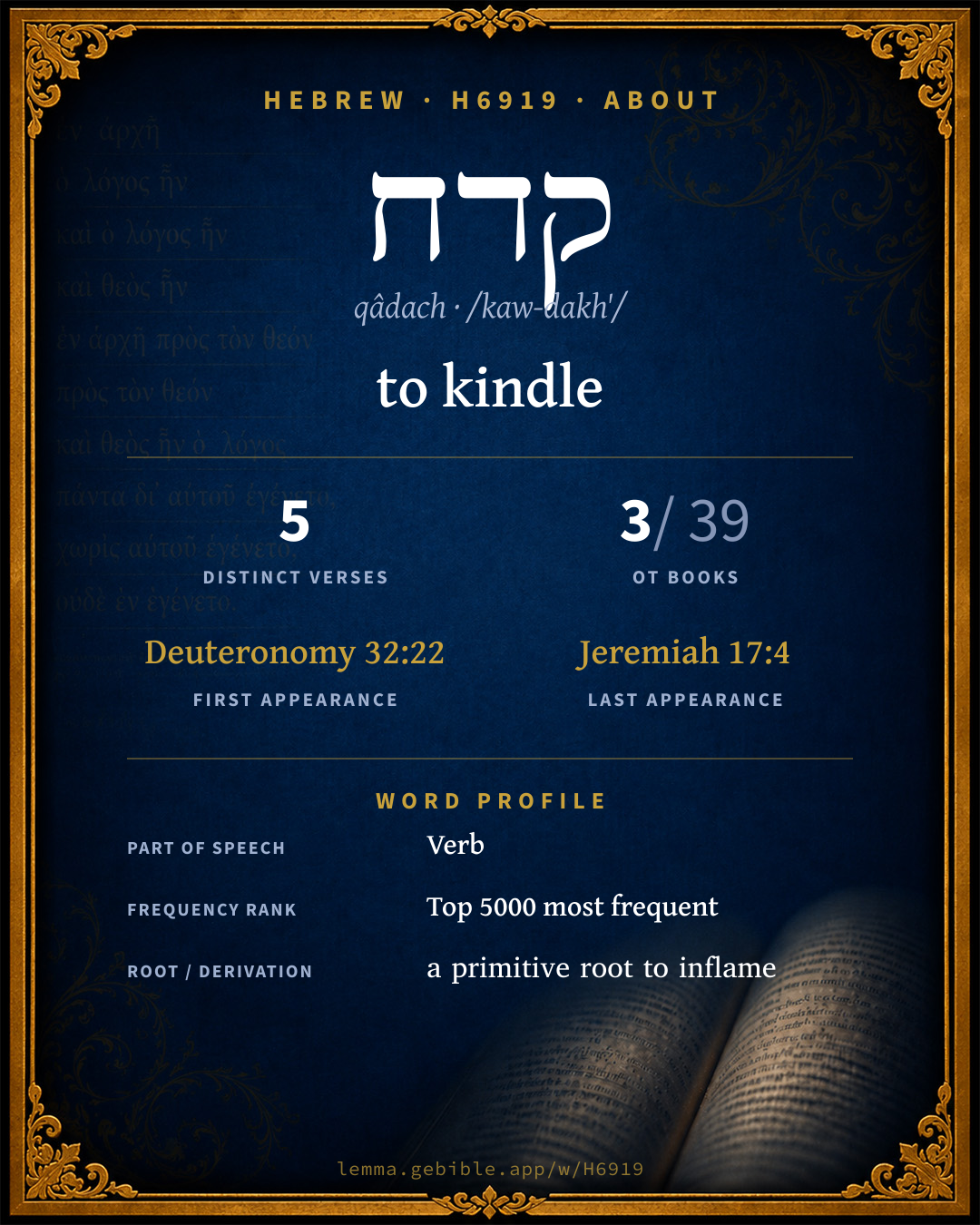
קָדַח
to kindle
‘to kindle’ is one of 3 main senses fuller range ↓
Full lexicon entry — Brown-Driver-Briggs (BDB)
From Brown-Driver-Briggs (BDB)
Where this word appears
Grammar key — what these labels mean
Part of speech
- Verb
- An action or state-of-being word.
Stem
- Qal
- The basic, simple active stem — the plain form of the verb (“he wrote”).
Form
- Perfect
- A completed action or state — Hebrew marks aspect (completeness) more than strict tense (“he wrote”).
- Infinitive Construct
- A bound verbal noun, frequently with prepositions (“to write / in writing”).
- Participle Active
- A verbal adjective expressing ongoing or characteristic action (“writing / one who writes”).
State
- Construct
- A noun bound to a following noun in a possessive / “of” relationship (the construct chain).
Person
- 3rd Person
- The one spoken about (“he / she / it / they”).
- 2nd Person
- The one addressed (“you”).
Gender
- Feminine
- Grammatically feminine.
- Masculine
- Grammatically masculine.
Number
- Singular
- One.
- Plural
- More than one (in Hebrew, generally three or more).
Grammatical forms
- Verb, Qal, Perfect, 3rd Person, Feminine, Singular 2 times (40%)
- Verb, Qal, Infinitive Construct 1 time (20%)
- Verb, Qal, Perfect, 2nd Person, Masculine, Plural 1 time (20%)
- Verb, Qal, Participle Active, Masculine, Plural, Construct 1 time (20%)
Parsed forms decoded from the imported morphology (morphhb / Westminster Leningrad Codex — WLC text public domain, morphhb tagging CC BY 4.0), counted across 5 parsed occurrences — not distinct verses.
Every verse where H6919 appears — 5 distinct verses across 3 books. Click any verse to open its interlinear word-by-word view. Verse text shown in the World English Bible for context — . Each verse’s Hebrew form is shown with its reference; the English is not keyword-highlighted, since the data carries no word-level English alignment. Use “Compare translations” on any verse to read it across multiple English versions. This concordance covers the Hebrew Bible; Septuagint (Greek Old Testament) occurrences are not indexed here.
Deuteronomy 1 verse
Isaiah 2 verses
- Isaiah 50:11 קֹ֥דְחֵי Qal ptcp.act mp cs Behold, all you who kindle a fire, who gird yourselves about with firebrands; walk you in the flame of your fire, and among the brands that you have kindled. This shall you have of my hand; you shall lie down in sorrow.
- Isaiah 64:2 כִּ/קְדֹ֧חַ prep + Qal inf.cs as when fire kindles the brushwood, [and] the fire causes the waters to boil; to make your name known to your adversaries, that the nations may tremble at your presence!
Jeremiah 2 verses
- Jeremiah 15:14 קָדְחָ֥ה Qal pf 3fs I will make [them] to pass with your enemies into a land which you don't know; for a fire is kindled in my anger, which shall burn on you.
- Jeremiah 17:4 קְדַחְתֶּ֥ם Qal pf 2mp You, even of yourself, shall discontinue from your heritage that I gave you; and I will cause you to serve your enemies in the land which you don't know: for you have kindled a fire in my anger which shall burn forever.
About this entry
At a glance — auto-summarized from this page’s data, not written by a person. Every figure links to its source below. This summary describes the numbers; it doesn’t interpret them.
The Hebrew verb קדח centers on the idea of “to kindle.” A scarce word — 5 verses in all of the Hebrew Bible. Isaiah dominates its distribution — 2 of 5 verses. Debuting at Deuteronomy 32:22, it then recurs through the corpus. BDB distinguishes 3 senses for it. For the data behind this summary, explore the sense tree and the renderings breakdown below.
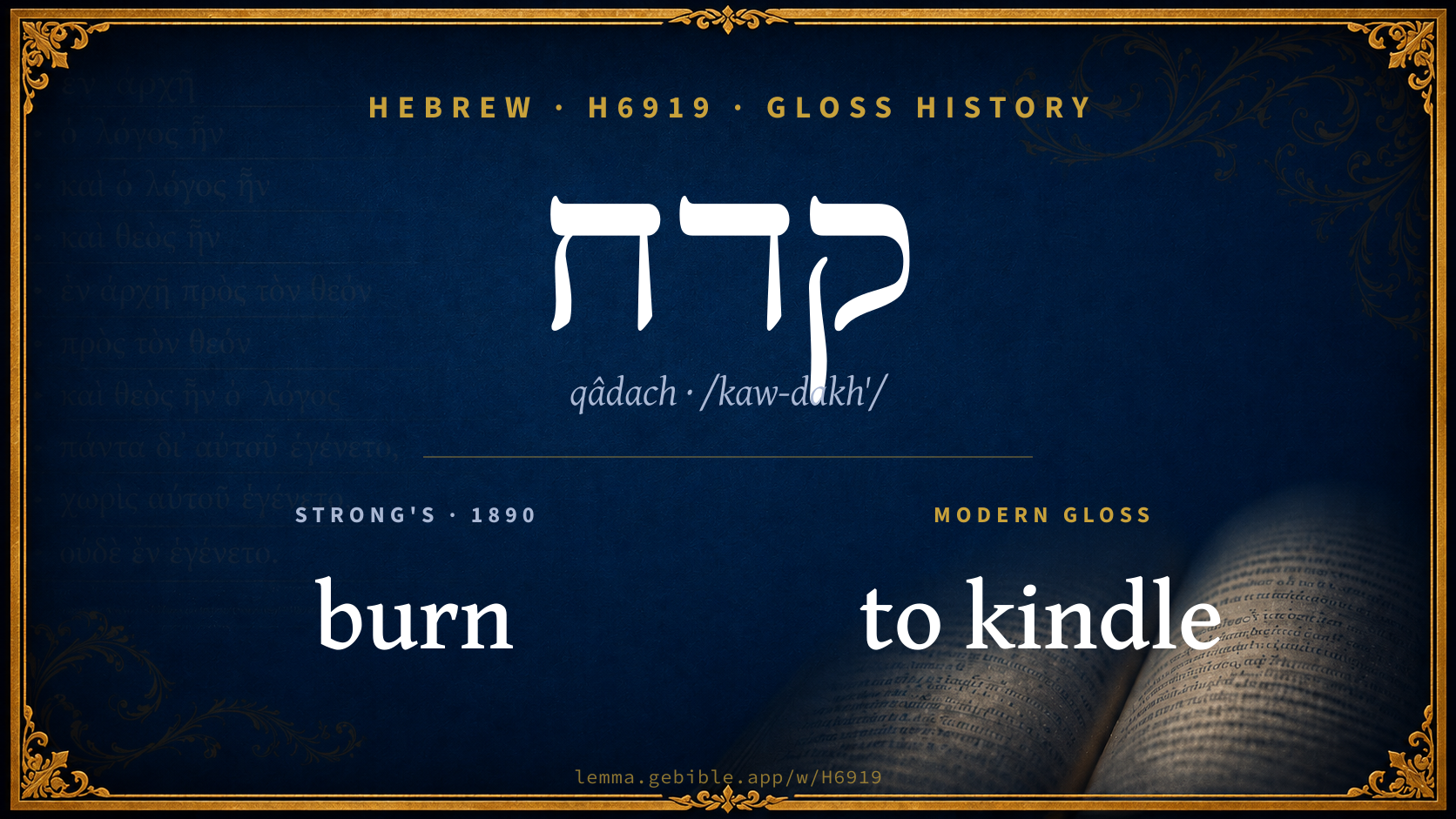
Gloss history
Strong's 1890 vs modern scholarship
About this word
Strong's H6919 catalogs a Hebrew word from the Hebrew Old Testament.
These counts are not copied from any lexicon or concordance. They are computed here, from the morphology-tagged Hebrew Old Testament. What Lemma adds →
- 5
- distinct verses
- The word appears in 5 distinct verses.
- 3 / 39
- OT books
- The word appears in 3 of 39 Old Testament books.
- #3,337
- by frequency
- Top 5000 most frequent Hebrew words (rank 3,337 of 8,640 Hebrew words by occurrence).
View all 5 occurrences in the concordance →
Most concentrated in
- Isaiah 2 verses 40%
- Jeremiah 2 verses 40%
- Deuteronomy 1 verse 20%
By section of the Old Testament
By traditional corpus
Conventional, traditional groupings — biblical authorship is debated, so this is a traditional corpus grouping, not an authorship claim. Each share is this word’s portion of its verses in that division of the Hebrew canon. Each figure is a share of the word’s 5 distinct verses.
- Prophets (Nevi'im) 4 verses · 80%
- Torah (Pentateuch) 1 verse · 20%
How translations render this word
Counts come from each version’s own published word-to-Strong’s tagging or interlinear alignment — an approximate guide to how each version renders this word, not a word-level alignment the data otherwise carries. Because each total is that version’s own tagged count, the per-version totals vary from one another and need not match the appearance or distinct-verse counts above. These counts may also differ from a printed concordance because Lemma counts each distinctly tagged rendering and does not collapse phrase taggings into a single head-word total. This is a fixed set of word-tagged versions (KJV, ASV, BSB, ULT) and does not change with the reading translation you choose elsewhere. Each version’s license is shown beside its name below (and on Sources).
- King James Version: Is kindled 2×
- American Standard Version: Behold 1×, Fire is kindled 1×, Is kindled 1×
- Berean Standard Bible: Has been kindled 1×, Kindles 1×, Will kindle 1×
- unfoldingWord Literal Text: As 1×, Flares 1×, Is kindled 1×
King James Version Public Domain
Renders H6919 across 5 tagged occurrences — most commonly:
Plus 3 renderings that appear only once — usually multi-word phrases or single function words the recovered tagging swept in, not distinct renderings.
American Standard Version Public Domain
Renders H6919 across 5 tagged occurrences — most commonly:
Berean Standard Bible Public Domain
Renders H6919 across 4 tagged occurrences — most commonly:
Not rendered by a distinct English word in 1 further occurrence.
unfoldingWord Literal Text CC BY-SA 4.0
Renders H6919 across 6 tagged occurrences — most commonly:
Senses in BDB
The 3 senses BDB distinguishes for this word, in lexicon order (not ranked by frequency or importance). The full entry — with sub-senses — is in the Lexicon Entry tab.
- to kindle, be kindled
(Qal)
- to kindle
- to be kindled
Word origin
[ קָדַח ] vb. be kindled, kindle
— Brown-Driver-Briggs (Oxford 1906, public domain), digitized via Sefaria, supplemented by the OpenScriptures HebrewLexicon (CC BY 4.0). See Sources.
Origin: a primitive root to inflame
Jastrow Dictionary
A second Hebrew/Aramaic lexicon for comparison, covering Aramaic and post-biblical (Talmudic, Targumic, Midrashic) usage that the biblical-Hebrew BDB does not. Matched by lemma rather than by Strong’s number, so a lemma may carry more than one Jastrow headword (shown separately below), and the entries cover usage well beyond the Bible.
קָדַח
- 1. to bore, perforate, penetrate. Sabb. XII, 1 הקוֹדֵחַ וכ׳ he who bores a hole ever so small. Tosef. ib. XI (XII), 3 עד שיִקְדַּח את כולו until he bores as far as is needed for his purpose; Y. Pes. VI, 33ᵇ top. Lev. R. s. 4 נטל … והתחיל קוֹדֵחַ תחתיו one of the passengers of the ship took a borer and began to bore under the place assigned to him; לא תחתי אני קודח have I no right to bore in my place? Ab. Zar. 58ᵃ, v. מֵינֶקֶת; a. fr.—[Tosef. B. Bath. V, 4 קודח ed. Zuck., read: קוֹנֵחַ.]
- 2. (b. h.; to burn, rise in a column and spread sparks; [b. h. also to enkindle]. Y. B. Kam. VI, 5ᶜ top (ref. to Mish. B. Kam. VI, 4) בקוֹדַחַת … אבל במקטפת וכ׳ the Mishnah speaks of a fire which (unexpectedly) blazes up and spreads, but in the case of a creeping fire all agree &c.; Bab. B. Kam. 61ᵃ בקודחת Ar. (ed. בקולחת).
- 1. to cut out, make an opening. Y. R. Hash. II, 58ᵃ bot. ה׳ לו … ככברה the Lord made for him an opening (in the clouds) of the size of a K’barah (v. כְּבָרָה), and the moon became visible within it.
- 2. to cause burning, to spoil a dish, a dye &c. B. Kam. IX, 4 (100ᵇ) הִקְדִּיחָתוֹ יורה (Bab. ed. הִקְדִּיחוֹ), v. יוֹרֶה II. Y. ib. IX, 6ᵈ bot. שהִקְדִּיחוּ סממנין when the dyes burned the material, אבל הִקְדִּיחָה יורה וכ׳ but if the boiler burned &c. Erub. 53ᵇ הִקְדִּיחָתָן במלח she spoiled them (the beans) by oversalting. Gitt. IX, 10 אפי׳ הקדיחה תבשילו if she spoiled a dish for him (he may divorce her). Bets. 29ᵃ כדי שלא יַקְדִּיחַ תבשילו so as not to spoil his dish (by spicing it too much or too little); Ar. שלא יַקְדִּיחוּ וכ׳ that they (the spices) may not burn &c. Tosef. B. Kam. X, 9 המוליך … והִקְדִּיחוֹ if one gives meat to a cook, and he spoils it; a. fr.—Trnsf. ה׳ תבשילו to misapply learning, disgrace one’s education; to degenerate. Ber. 17ᵇ לא יהא … שמַקְדִּיחַ ת׳ ברבים that we may not have a son or a pupil that disgraces his education in public; Snh. 103ᵃ
- 3. to have fever. Sifra B’ḥuck. Par. 2, ch. IV נוח לו ואינו מקדיח he is comfortable and has no fever; Yalk. Lev. 673.—[Tosef. Maasr. I, 2 משיקדיחו ed. Zuck., v. קָרַח.]
קְדַח
- 1. to bore, perforate. Targ. Job XL, 25 (ed. Wil. תַּקְדַח Af.).—Cant. R. to I, 10 למִקְדַּח, v. חֲרַז.
- 2. [to break through,] to grow forth, sprout. Ber. 56ᵃ חזן … דקַדְחָא וכ׳ I saw (in my dream) a pomegranate sprouting through the mouth of a wine jar. B. Bath. 28ᵇ דקַדְחָה ואכלה וכ׳ Ms. M. (Ar. דקדח, ed. דקדיח) it (clover or grass) grew forth, and he made use of it, and as it grew again (the next day), he made use of it &c. Ḥull. 110ᵃ קדְחֵי, v. חִילְפָא III. Snh. 109ᵇ (Sodomitic justice) הבה … עד דקדחא (Ms. M. דקדחה) give him the ass (whose ear he had cut off), until its ear is grown again; a. e.
- 3. to be inflamed. Ab. Zar. 28ᵇ דקדחה לה עינא her eye was inflamed. Ḥag. 5ᵃ קדחה her knee was burned.
- to dig out, make a path for. [Targ. Job l. c., v. supra.]—M. Kat. 4ᵇ לאַקְדּוּחֵי נהר וכ׳ to clean the canal of B. (in the festive week).
קֶדַח
- (preced.) inflammation, blister. Neg. VI, 8; VIII, 5; Sifra Thazr., Neg., ch. I קרח (corr. acc.); a. fr., v. מָרַד II.
A Dictionary of the Targumim, the Talmud Babli and Yerushalmi, and the Midrashic Literature (Marcus Jastrow; London, Luzac, 1903) — Public Domain. Digitized via Sefaria. Digitized via Sefaria. Full attribution on Sources.
Forms in the corpus
The 5 distinct written forms H6919 takes in the Hebrew Bible, most frequent first — each parse links to that stem’s occurrences in the concordance. Hebrew forms include their vowel points and cantillation, so a single lemma takes many written forms.
| Form | Parsing | Example | Uses |
|---|---|---|---|
| כִּ/קְדֹ֧חַ | Verb, Qal, Infinitive Construct | Isaiah 64:2 | 1 |
| קְדַחְתֶּ֥ם | Verb, Qal, Perfect, 2nd Person, Masculine, Plural | Jeremiah 17:4 | 1 |
| קָדְחָ֣ה | Verb, Qal, Perfect, 3rd Person, Feminine, Singular | Deuteronomy 32:22 | 1 |
| קָדְחָ֥ה | Verb, Qal, Perfect, 3rd Person, Feminine, Singular | Jeremiah 15:14 | 1 |
| קֹ֥דְחֵי | Verb, Qal, Participle Active, Masculine, Plural, Construct | Isaiah 50:11 | 1 |
Same root — word family
Other BDB entries built from the same root as H6919, grouped by Strong’s listed origin. These share a root / origin per the lexicon — not necessarily a shared meaning. Each links to that word’s own entry.
Derived from this word
Compare all same-root words → They share a root, not necessarily a meaning.
Septuagint verse parallels
This word appears in 4 verses that also exist in the Greek Old Testament (Septuagint), out of the 5 Hebrew verses it occurs in. You can read those verses in Greek by switching the Old Testament edition to the Septuagint.
Read these verses in the Septuagint
This is a verse-level parallel only — the same verses exist in both the Hebrew and Greek Old Testaments. No word-level Hebrew↔Greek correspondence is claimed: the data carries no such alignment, so no Greek word is shown as this Hebrew word’s translation. Coverage is not total — the Septuagint omits the deuterocanon and renumbers the Psalms, so some Hebrew verses have no direct Greek parallel.