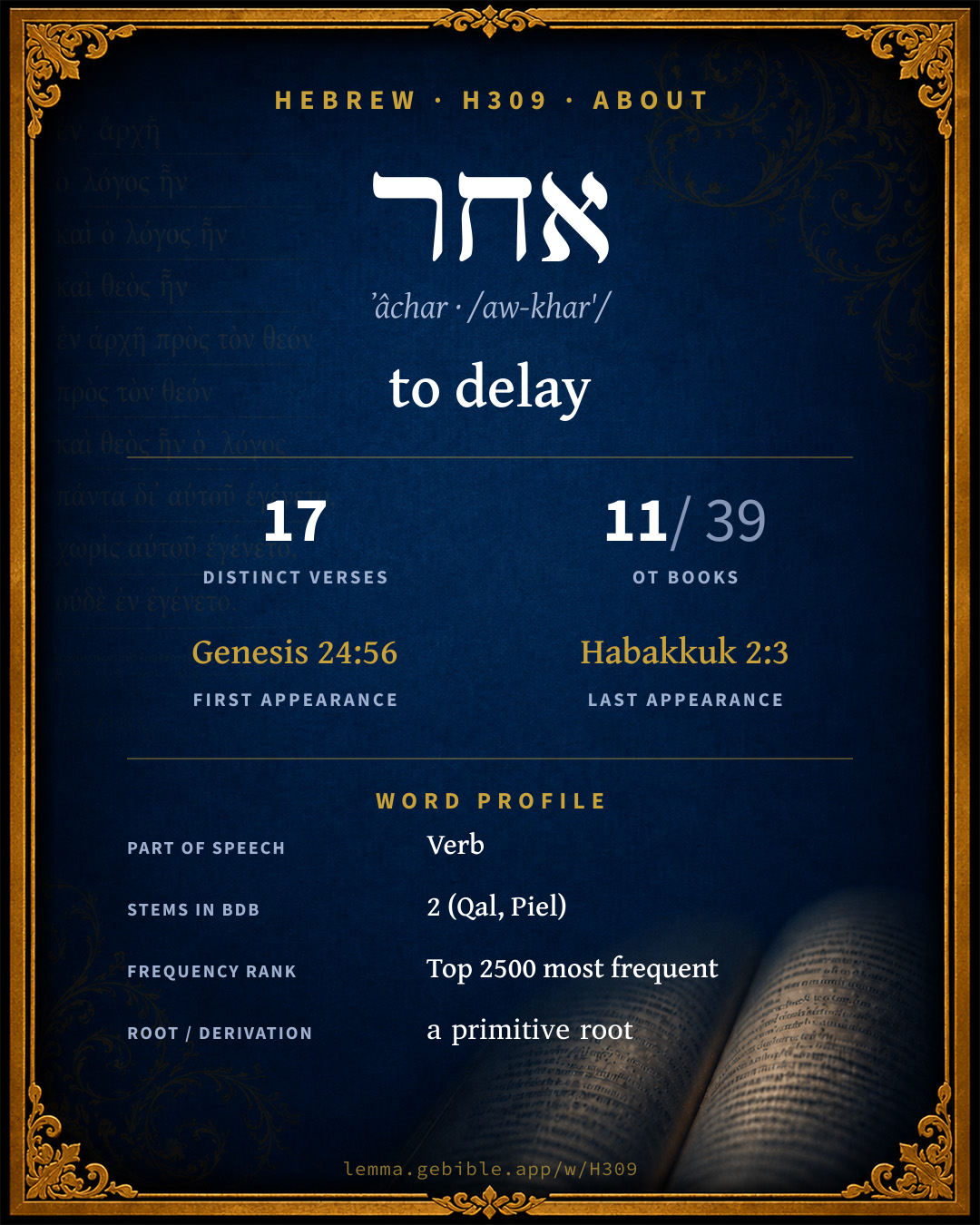
אָחַר
to delay
also: hesitate, tarry, defer, remain behind fuller range ↓
Full lexicon entry — Brown-Driver-Briggs (BDB)
From Brown-Driver-Briggs (BDB)
Where this word appears
See every Piel verb in the Hebrew Bible →
Grammar key — what these labels mean
Part of speech
- Verb
- An action or state-of-being word.
Stem
- Piel
- An intensive or resultative active stem. Here: ‘intensive’
- Hiphil
- The causative active stem (“he caused / brought about”).
- Qal
- The basic, simple active stem — the plain form of the verb (“he wrote”). Here: ‘once only Gn 32’
Form
- Jussive
- A third- or second-person volitional form expressing wish or command (“let him write”).
- Imperfect
- An incomplete, ongoing, or future action (“he will / would write”).
- Participle Active
- A verbal adjective expressing ongoing or characteristic action (“writing / one who writes”).
- Sequential Imperfect
- An imperfect with prefixed waw — the standard past-narrative form (waw-consecutive imperfect).
- Perfect
- A completed action or state — Hebrew marks aspect (completeness) more than strict tense (“he wrote”).
State
- Construct
- A noun bound to a following noun in a possessive / “of” relationship (the construct chain).
- Absolute
- The independent form of a noun, not bound to a following word.
Person
- 2nd Person
- The one addressed (“you”).
- 3rd Person
- The one spoken about (“he / she / it / they”).
- 1st Person
- The speaker (“I / we”).
Gender
- Masculine
- Grammatically masculine.
- Common
- Either gender — not distinguished for this form.
- Feminine
- Grammatically feminine.
Number
- Singular
- One.
- Plural
- More than one (in Hebrew, generally three or more).
Grammatical forms 11 distinct
- Verb, Piel, Jussive, 2nd Person, Masculine, Singular 4 times (24%)
- Verb, Piel, Imperfect, 2nd Person, Masculine, Singular 2 times (12%)
- Verb, Piel, Imperfect, 3rd Person, Masculine, Singular 2 times (12%)
- Verb, Piel, Participle Active, Masculine, Plural, Construct 2 times (12%)
- Verb, Hiphil, Sequential Imperfect, 3rd Person, Masculine, Singular 1 time (6%)
- Verb, Qal, Sequential Imperfect, 1st Person, Common, Singular 1 time (6%)
- Verb, Piel, Participle Active, Masculine, Plural, Absolute 1 time (6%)
- Verb, Piel, Imperfect, 3rd Person, Feminine, Singular 1 time (6%)
+3 more forms (3 occurrences)
Parsed forms decoded from the imported morphology (morphhb / Westminster Leningrad Codex — WLC text public domain, morphhb tagging CC BY 4.0), counted across 17 parsed occurrences — not distinct verses.
Every verse where H309 appears — 17 distinct verses across 11 books. Click any verse to open its interlinear word-by-word view. Verse text shown in the World English Bible for context — . Each verse’s Hebrew form is shown with its reference; the English is not keyword-highlighted, since the data carries no word-level English alignment. Use “Compare translations” on any verse to read it across multiple English versions. This concordance covers the Hebrew Bible; Septuagint (Greek Old Testament) occurrences are not indexed here.
Genesis 3 verses
- Genesis 24:56 תְּאַחֲר֣וּ Piel juss 2mp He said to them, "Don't hinder me, seeing Yahweh has prospered my way. Send me away that I may go to my master."
- Genesis 32:4 וָ/אֵחַ֖ר conj + Qal wimpf 1cs He commanded them, saying, "This is what you shall tell my lord, Esau: 'This is what your servant, Jacob, says. I have lived as a foreigner with Laban, and stayed until now.
- Genesis 34:19 אֵחַ֤ר Piel pf 3ms The young man didn't wait to do this thing, because he had delight in Jacob's daughter, and he was honored above all the house of his father.
Exodus 1 verse
Deuteronomy 2 verses
- Deuteronomy 7:10 יְאַחֵר֙ Piel impf 3ms and repays those who hate him to their face, to destroy them: he will not be slack to him who hates him, he will repay him to his face.
- Deuteronomy 23:21 תְאַחֵ֖ר Piel impf 2ms When you shall vow a vow to Yahweh your God, you shall not be slack to pay it: for Yahweh your God will surely require it of you; and it would be sin in you.
Judges 1 verse
2 Samuel 1 verse
Psalms 3 verses
- Psalms 40:17 תְּאַחַֽר Piel juss 2ms But I am poor and needy; May the Lord think about me. You are my help and my deliverer. Don't delay, my God.
- Psalms 70:5 תְּאַחַֽר Piel juss 2ms But I am poor and needy. Come to me quickly, God. You are my help and my deliverer. Yahweh, don't delay.
- Psalms 127:2 מְאַֽחֲרֵי Piel ptcp.act mp cs It is vain for you to rise up early, To stay up late, Eating the bread of toil; For he gives sleep to his loved ones.
Proverbs 1 verse
Ecclesiastes 1 verse
Isaiah 2 verses
- Isaiah 5:11 מְאַחֲרֵ֣י Piel ptcp.act mp cs Woe to those who rise up early in the morning, that they may follow strong drink; Who stay late into the night, until wine inflames them!
- Isaiah 46:13 תְאַחֵ֑ר Piel impf 3fs I bring near my righteousness, it shall not be far off, and my salvation shall not wait; and I will place salvation in Zion for Israel my glory.
Daniel 1 verse
Habakkuk 1 verse
About this entry
At a glance — auto-summarized from this page’s data, not written by a person. Every figure links to its source below. This summary describes the numbers; it doesn’t interpret them.
The Hebrew verb אחר centers on the idea of “to delay.” First canonically at Genesis 24:56, it enters the text early. The Hebrew Bible uses it across 17 verses — uncommon. Different stems carry different senses — BDB groups them under 2 stems, among them Qal and Piel. Related forms include אחר, אחר and אחרון. For the data behind this summary, explore the sense tree and the renderings breakdown below.
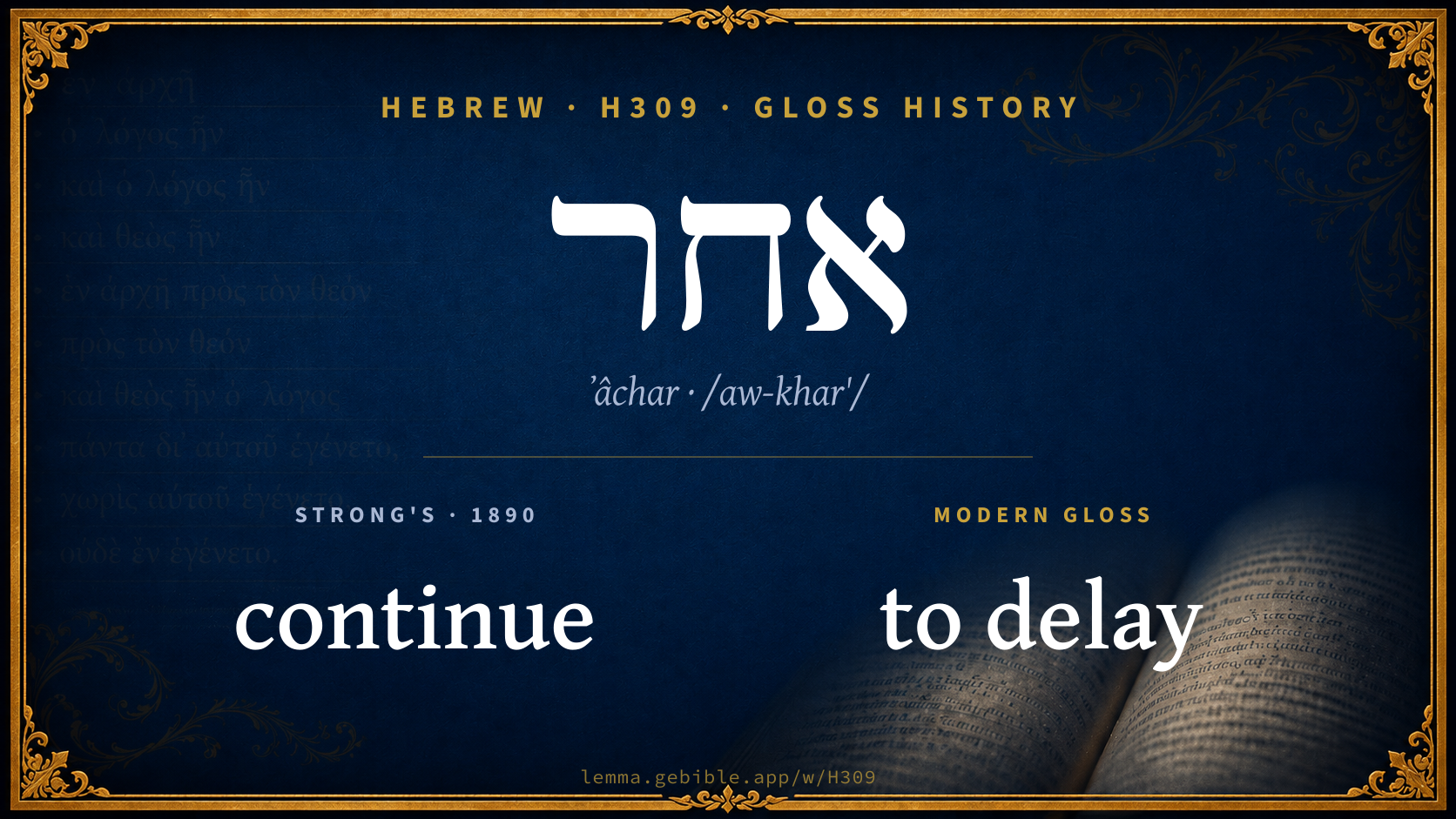
Gloss history
Strong's 1890 vs modern scholarship
About this word
Strong's H309 catalogs a Hebrew word from the Hebrew Old Testament.
These counts are not copied from any lexicon or concordance. They are computed here, from the morphology-tagged Hebrew Old Testament. What Lemma adds →
- 17
- distinct verses
- The word appears in 17 distinct verses.
- 11 / 39
- OT books
- The word appears in 11 of 39 Old Testament books.
- #1,671
- by frequency
- Top 2500 most frequent Hebrew words (rank 1,671 of 8,640 Hebrew words by occurrence).
View all 17 occurrences in the concordance →
Most concentrated in
- Genesis 3 verses 18%
- Psalms 3 verses 18%
- Deuteronomy 2 verses 12%
By section of the Old Testament
By traditional corpus
Conventional, traditional groupings — biblical authorship is debated, so this is a traditional corpus grouping, not an authorship claim. Each share is this word’s portion of its verses in that division of the Hebrew canon. Each figure is a share of the word’s 17 distinct verses.
- Torah (Pentateuch) 6 verses · 35%
- Writings (Ketuvim) 6 verses · 35%
- Prophets (Nevi'im) 5 verses · 29%
How translations render this word
Counts come from each version’s own published word-to-Strong’s tagging or interlinear alignment — an approximate guide to how each version renders this word, not a word-level alignment the data otherwise carries. Because each total is that version’s own tagged count, the per-version totals vary from one another and need not match the appearance or distinct-verse counts above. These counts may also differ from a printed concordance because Lemma counts each distinctly tagged rendering and does not collapse phrase taggings into a single head-word total. This is a fixed set of word-tagged versions (KJV, ASV, BSB, ULT) and does not change with the reading translation you choose elsewhere. Each version’s license is shown beside its name below (and on Sources).
- King James Version: Defer 2×, Make no tarrying 2×
- American Standard Version: Defer 2×, Make no tarrying 2×, Them 2×
- Berean Standard Bible: Delay 5×, Hesitate 2×, Linger 2×
- unfoldingWord Literal Text: Delay 8×, Do 4×, Linger 2×
King James Version Public Domain
Renders H309 across 17 tagged occurrences — most commonly:
Plus 13 renderings that appear only once — usually multi-word phrases or single function words the recovered tagging swept in, not distinct renderings.
American Standard Version Public Domain
Renders H309 across 17 tagged occurrences — most commonly:
Plus 11 renderings that appear only once — usually multi-word phrases or single function words the recovered tagging swept in, not distinct renderings.
Berean Standard Bible Public Domain
Renders H309 across 17 tagged occurrences — most commonly:
Plus 8 renderings that appear only once — usually multi-word phrases or single function words the recovered tagging swept in, not distinct renderings.
unfoldingWord Literal Text CC BY-SA 4.0
Renders H309 across 27 tagged occurrences — most commonly:
Plus 9 renderings that appear only once — usually multi-word phrases or single function words the recovered tagging swept in, not distinct renderings.
Senses in the full BDB
Hebrew verbs can shift meaning by stem (binyan): Qal is the basic action, Niphal is often passive or reflexive, Piel often intensifies or makes it factitive, and Hiphil is typically causative. The senses below are grouped under the stem BDB assigns to each.
What do BDB’s symbols mean?
BDB uses these scholarly abbreviations:
| Symbol | Meaning |
|---|---|
| 𝔊 | the Septuagint (the ancient Greek translation, LXX) |
| 𝔙 | the Vulgate (the Latin translation) |
| 𝔖 | the Syriac version (the Peshitta) |
| 𝔗 | the Targum (the Aramaic translation) |
| ψ | the Psalms |
| √ | root (the underlying root or stem) |
| ‖ | parallel passage (a synonymous or contrasted parallel) |
| † | the dagger: every passage where the word occurs is cited |
The 4 senses and sub-senses the full Brown-Driver-Briggs lexicon distinguishes for this word, in lexicon order (not ranked by frequency), with BDB’s own verbatim wording and sub-sense lettering. Shown in Hebrew script with BDB’s own scholarly abbreviations. The condensed entry is in the Lexicon Entry tab. See also the Forms in the corpus table below.
Qal
- once only Gn 32:5 וָאֵחַר (contr. from וָאֶאֱחַר cf. אֵהָ֑ב Pr 8:17) and I have tarried until now. e.g. Genesis 32:5
Piel
- Pf. אֵחַר Gn 34:19; אֶחֱרוּ Ju 5:28; Impf. יְאַחֵר, תְּאַחֵר, (3 times תְּאַחַ֑ר) etc. Gn 24:56 + 9 times; Pt. (־רֵי) מְאַחֲרִים 3 times e.g. Genesis 34:19
- 1. intensive, delay, tarry, abs. Ju 5:28 (‖ בּשֵׁשׁ לָבוֹא) Is 46:13 and my salvation לֹא תְאַחֵר Hb 2:3 ψ 40:18 = 70:6 Dn 9:19; with ל & inf. Gn 34:19.—Pr 23:30 מְאַחֲרִים עַל־הַיָּיִ֑ן those tarrying over the wine, Is 5:11 מְאַחֲרֵי בַנֶּשֶׁף, ψ 127:2 מְאַחֲרֵי שֶׁבֶת (‖ מַשְׁכִּימֵי קוּם). e.g. Judges 5:28
- 2. causat. of Qal, cause one to delay, hinder Gn 24:56; keep back (= bring late) Ex 22:28; with ל & inf. delay to … Dt 23:22 quoted Ec 5:3: ellipt. Dt 7:10 he delayeth (it, the recompense) not to his enemy.—2 S 20:5 Qr וַיּ֫וֹחֶר is taken by Ol§ 241 c as Qal (cf. וַתּ֫חֶז v 9 from אָחַז), by Sta§ 498 c KöI. 397 Ges§ 68 2 Rem as Hiph. (lit. shewed, exhibited delay): on the Kt (? וַיֵּיחַר) v. DrSm. e.g. Genesis 24:56
Senses from the full Brown-Driver-Briggs lexicon (Brown, Driver, Briggs; Oxford 1906 — public domain), digitized via Sefaria, supplemented by the OpenScriptures HebrewLexicon (CC BY 4.0). Full attribution on Sources.
Word origin
vb. to remain behind, delay, tarry (Arabic أَخَّرَ to put off, also to remain behind; Aramaic Pa. אְחַר, Aph. ܐܰܘܚܰܕ, Shaph. ܫܰܘܚܰܪ, Sab. אחֿר OsianderZMG 1865, 197; אחֿחֿר DHMEpigr. Denkm. 34).
— Brown-Driver-Briggs (Oxford 1906, public domain), digitized via Sefaria, supplemented by the OpenScriptures HebrewLexicon (CC BY 4.0). See Sources.
Origin: a primitive root
Jastrow Dictionary
A second Hebrew/Aramaic lexicon for comparison, covering Aramaic and post-biblical (Talmudic, Targumic, Midrashic) usage that the biblical-Hebrew BDB does not. Matched by lemma rather than by Strong’s number, so a lemma may carry more than one Jastrow headword (shown separately below), and the entries cover usage well beyond the Bible.
אָחַר
- 1. to be behind, v. Pi.
- 2. (euphem.) to cover (of camels). B. Bath. 93ᵃ; Shebu. 34ᵃ; Snh. 37ᵇ (Ms. M. B. Bath. l. c. יהיר). Tosef. B. Kam. III, 6 אוֹחֵיר.
- to tarry, hesitate; to set behind. Pes. IX, 9 אם אֵחַרְתִּי if I should be late. Y. Yoma III, 40ᶜ top א׳ בו מעשה the text orders a later action after it. Y. Ned. X, 42ᵃ; 42ᵇ א׳ בעמידה he tarried in standing, i.e. was the last to sit down. Gen. R. s. 81, beg. א׳ אדם את נדרו if one procrastinates the fulfillment of his vow; a. fr.
- to be postponed, be done late, be placed later. Y. Yoma III, 40ᶜ top בכלל מְאוּחָר היה would belong to things to be done later. Ib. יוּאֲחַר וכ׳ let it be done later than &c.—אין מוקדם ומאוחר בתורה there is no ‘earlier’ or ‘later’ (no chronological order) in the events or laws of the Scripture. Pes. 6ᵇ; a. e.; Y. Sot. VIII, 22ᵈ מוּאֲחַר.—Shebi. X, 5, a. fr. מאוחר (a document) postdated, opp. מוקדם antedated. B. Mets. V, 10 רבית מְאוּחֶרֶת postpaid interests.
אֲחַר
- 1. to be behind.
- 2. *to cover. Targ. Jer. V, 8 (of steeds, h. text מוזנים; some ed. ד for. ר).
- take ye a later meal (on Sabbaths).
- same. Targ. II Sam. XX, 5; a. fr.—[Targ. Prov. XXIII, 30 מַוְחֲרִין, מְוַוחֲרִין Part. Af. or Pa. of יחר = מוֹחר׳, מאחר׳.]
- , contr. אִתְחַר to be delayed. Targ. Y. I Deut. I, 2; cmp. however ib. v. 6, v. אֲרַח.
אַחַר
- v. foreg.), pl. constr. אַחֲרֵי after, behind. Gen. R. s. 44 wherever the Bible uses the preposition aḥaré סמוך, it means in connection with, אחר מופלג while aḥar means without connection (later on). Yoma 6ᵃ אחר א׳ after ‘after’, i.e. some time after the act, opp. חד אחר one ‘after’, immediately, v. אֶוְתִּיוֹס.—לְאַחֲרָיו, לְאַחֲרֶיהָ, מֵאַחֲרָיו, מֵאַחֲרֶיהָ after it, as concluding, opp. לפניה, לפניו introductory (prayer).—Ber. I, 4 אחת לא׳ one benediction after the Sh’ma. Ib. III, 4 לאחריו (prayer) after meal; a. fr.—כִּלְאַחַר יד as if doing a thing with the back of the hand, i.e. in a manner different from the usual way of doing it. Sabb. 153ᵇ; a. fr.—מֵאַחַר
- 1. (conj. followed by ש־ or ד־) after, since, whereas, because. Ḥull. 29ᵃ מא׳ ששנינו after it has once been stated in the Mishnah … why was it necessary (?) &c. Ib.ᵇ ומאחר דאפי׳ וכ׳ and since it is not even rabbinically unfit, why &c.; a. fr.
- 2. a legal term, meaḥar, the presumption of the truth of one’s statement, because he might have pleaded more profitably, if he had been inclined to lie. Y. Shebu. VI, 36ᵈ bot. אין אומרים בממון מא׳ מאחר וכ׳ in money matters we do not apply the principle of meaḥer, so as to say that because he might have said ‘thou hast not lent me anything’, he may say, ‘thou didst lend me, but I paid half of it’ (and his plea must be accepted without an oath); v. מִיגּוֹ s. v. גּוֹ.—אַחֲרֶיךָ thy successor. Y. Kil. IX, 32ᶜ top יהודה בני א׳ וכ׳ my son Judah shall succeed thee, none else (is worthy). Keth. 95ᵇ my property I bequeath to thee ואַחֲרַיִיךְ לפ׳ and after thee it shall go over to …—אַחַר כָּךְ (abbrev. אח"כ) afterwards, subsequently. Pes. X, 2; a. v. fr.
אַחֵר
- v. foreg. a. [back of,] another, the other, stranger. דבר א׳ (abbr. ד"א)
- 1. another thing, another explanation. Snh. IV, 5; a. v. fr. in Midr.
- 2. euphem. for idolatry, swine &c., v. דָּבָר.
- 3. Aḥer, [apostate,] byname of Elisha ben Abuyah. Ḥag. 14ᵇ; a. e.—Pl. אֲחֵרִים others; 1) freq. in Mishn. for anonymous authorities differing in opinion, א׳ אומרים, v. Hor. 13ᵇ אסיקו לר׳ מאיר א׳ R. Meïr is quoted under the word aḥerim.—2) freq. for strangers, gentiles. Snh. 52ᵇ אשת א׳ the wife of a non-Israelite. B. Mets. 111ᵇ; a. fr.—Fem. אֲחֶרֶת. Yoma I, 1 אשה א׳ a second (additional) wife; a. fr.—Snh. 104ᵃ זאת ועוד א׳ this and something besides (shall happen).
A Dictionary of the Targumim, the Talmud Babli and Yerushalmi, and the Midrashic Literature (Marcus Jastrow; London, Luzac, 1903) — Public Domain. Digitized via Sefaria. Digitized via Sefaria. Full attribution on Sources.
Forms in the corpus
The 15 distinct written forms H309 takes in the Hebrew Bible, most frequent first — each parse links to that stem’s occurrences in the concordance. Hebrew forms include their vowel points and cantillation, so a single lemma takes many written forms.
Same root — word family
Other BDB entries built from the same root as H309, grouped by Strong’s listed origin. These share a root / origin per the lexicon — not necessarily a shared meaning. Each links to that word’s own entry.
Derived from this word
Compare all same-root words → Showing 4 of 5 — not the complete family. They share a root, not necessarily a meaning.
Septuagint verse parallels
This word appears in 16 verses that also exist in the Greek Old Testament (Septuagint), out of the 17 Hebrew verses it occurs in. You can read those verses in Greek by switching the Old Testament edition to the Septuagint.
Read these verses in the Septuagint
- Genesis 24:56
- Exodus 22:29
- Deuteronomy 7:10
- Judges 5:28
- 2 Samuel 20:5
- Psalms 70:5
- Proverbs 23:30
- Ecclesiastes 5:4
- Isaiah 5:11
- Daniel 9:19
- Habakkuk 2:3
This is a verse-level parallel only — the same verses exist in both the Hebrew and Greek Old Testaments. No word-level Hebrew↔Greek correspondence is claimed: the data carries no such alignment, so no Greek word is shown as this Hebrew word’s translation. Coverage is not total — the Septuagint omits the deuterocanon and renumbers the Psalms, so some Hebrew verses have no direct Greek parallel.