
Jeremiah 25:29

Hebrew (Westminster Leningrad Codex) Jeremiah 25:29 appears in the Hebrew Old Testament. The text above is from the Westminster Leningrad Codex. Each word links to its Strong’s number, a concise gloss, and parsing drawn from the Open Scriptures Hebrew Bible morphology. Click any word for its full Brown-Driver-Briggs (BDB) entry.
Download image
Cite this verse

Jeremiah 25:29 (World English Bible). Public Domain. Lemma interlinear Bible study tool, https://lemma.gebible.app/v/jeremiah/25/29.

Show BibTeX & RIS
BibTeX
RIS
English Translation
For, behold, I begin to work evil at the city which is called by my name; and should you be utterly unpunished? You shall not be unpunished; for I will call for a sword on all the inhabitants of the earth, says Yahweh of Hosts.
World English Bible · Public Domain
Download a study sheet

One document with this verse’s original text, its word-by-word gloss line, the meaning frame, cross-references with their text, attributed commentary, and full source and license credits — printable, and it pastes into notes with its structure intact.

This verse Autodidact and up

Study sheet (.html) Plain text (.txt)

A passage Seminary Student

Up to 50 verses in one chapter. A passage sheet keeps up to 6 commentary sources and 12 cross-references per verse, in the order this page ranks them, and says so on the sheet whenever that leaves anything out. Ask for a single verse and you get the Autodidact verse sheet above.

Everything on this page stays free to read, with no account — the sheet is a download of what is already on screen, not access to it.

Want to remove ads? Support Godless Engineer
Compare translations 3

The same verse in 3 English versions, stacked beneath the original-language interlinear above. Click any original word for its lexicon entry.

Each is an independent rendering of the whole verse — the interlinear is not word-aligned to these translations.

Highlighted words mark where these versions differ — a whole-verse word diff, not a word-by-word alignment.

  • World English Bible Public Domain
    For, behold, I begin to work evil at the city which is called by my name; and should you be utterly unpunished? You shall not be unpunished; for I will call for a sword on all the inhabitants of the earth, says Yahweh of Hosts.
  • King James Version Public Domain
    For, lo, I begin to bring evil on the city which is called by my name, and should ye be utterly unpunished? Ye shall not be unpunished: for I will call for a sword upon all the inhabitants of the earth, saith the LORD of hosts.
  • unfoldingWord Literal Text CC BY-SA 4.0
    For behold, in the city over which my name is called I am beginning to bring harm, and you, being acquitted will you be acquitted? You will not be acquitted, for a sword I am calling against all of the dwellers of the earth”—the declaration of Yahweh of Armies.

unfoldingWord Literal Text — © unfoldingWord, licensed CC BY-SA 4.0. Word-aligned USFM3 via Door43 (git.door43.org/unfoldingWord/en_ult).

Versions to compare (up to 4)

3 of 4 selected

Show all 18 translations

Every available English version of this verse, each an independent rendering of the whole verse.

  • World English Bible Public Domain
    For, behold, I begin to work evil at the city which is called by my name; and should you be utterly unpunished? You shall not be unpunished; for I will call for a sword on all the inhabitants of the earth, says Yahweh of Hosts.
  • Berean Standard Bible Public Domain
    For behold, I am beginning to bring disaster on the city that bears My Name, so how could you possibly go unpunished? You will not go unpunished, for I am calling down a sword upon all the inhabitants of the earth, declares the LORD of Hosts.’
  • Majority Standard Bible Public Domain
    For behold, I am beginning to bring disaster on the city that bears My Name, so how could you possibly go unpunished? You will not go unpunished, for I am calling down a sword upon all the inhabitants of the earth, declares the LORD of Hosts.’
  • King James Version Public Domain
    For, lo, I begin to bring evil on the city which is called by my name, and should ye be utterly unpunished? Ye shall not be unpunished: for I will call for a sword upon all the inhabitants of the earth, saith the LORD of hosts.
  • American Standard Version (1901) Public Domain
    For, lo, I begin to work evil at the city which is called by my name; and should ye be utterly unpunished? Ye shall not be unpunished; for I will call for a sword upon all the inhabitants of the earth, saith Jehovah of hosts.
  • Revised Version (1885) Public Domain
    For, lo, I begin to work evil at the city which is called by my name, and should ye be utterly unpunished? Ye shall not be unpunished: for I will call for a sword upon all the inhabitants of the earth, saith the LORD of hosts.
  • Geneva Bible (1599) Public Domain
    For loe, I beginne to plague the citie, where my Name is called vpon, and shoulde you goe free? Ye shall not goe quite: for I will call for a sword vpon al the inhabitants of the earth, saith the Lord of hostes.
  • Douay-Rheims (1899) Public Domain
    For behold I begin to bring evil on the city wherein my name is called upon: and shall you be as innocent and escape free? you shall not escape free: for I will call for the sword upon all the inhabitants of the earth, saith the Lord of hosts.
  • Young's Literal Translation Public Domain
    For lo, in the city over which My name is called, I am beginning to do evil, And ye -- ye are entirely acquitted! Ye are not acquitted, for a sword I am proclaiming, For all inhabitants of the land, An affirmation of Jehovah of Hosts.
  • Literal Standard Version CC BY-SA 4.0
    For behold, in the city over which My Name is called, || I am beginning to bring ruin, || And are you entirely acquitted? You are not acquitted, for I am proclaiming a sword, || For all inhabitants of the land,” || A declaration of YHWH of Hosts.
  • Unlocked Literal Bible CC BY-SA 4.0
    For see, I am about to bring disaster on the city that is called by my name, and should you yourselves be free from punishment? You will not be free, for I am calling a sword against all the inhabitants of the land!—this is the declaration of Yahweh of hosts.'
  • unfoldingWord Literal Text CC BY-SA 4.0
    For behold, in the city over which my name is called I am beginning to bring harm, and you, being acquitted will you be acquitted? You will not be acquitted, for a sword I am calling against all of the dwellers of the earth”—the declaration of Yahweh of Armies.
  • Darby Bible Public Domain
    For behold, I begin to bring evil on the city that is called by my name, and should ye be altogether unpunished? Ye shall not be unpunished; for I call for a sword upon all the inhabitants of the earth, saith Jehovah of hosts.
  • World Messianic Bible Public Domain
    For, behold, I begin to work evil at the city which is called by my name; and should you be utterly unpunished? You will not be unpunished; for I will call for a sword on all the inhabitants of the earth, says the LORD of Hosts.”’
  • Webster's Bible Public Domain
    For lo, I begin to bring evil on the city which is called by my name, and should ye be utterly unpunished? Ye shall not be unpunished: for I will call for a sword upon all the inhabitants of the earth, saith the LORD of hosts.
  • Free Bible Version CC BY-SA 4.0
    Can't you see that I'm about to bring disaster down on my own city, so do you really think you wouldn't be punished as well? You won't go unpunished, for I am bringing war to everyone on earth, declares the Lord Almighty.
  • Bible in Basic English Public Domain
    For see, I am starting to send evil on the town which is named by my name, and are you to be without any punishment? You will not be without punishment: for I will send a sword on all people living on the earth, says the Lord of armies.
  • JPS Tanakh (1917) Public Domain
    For, lo, I begin to bring evil on the city whereupon My name is called, and should ye be utterly unpunished? Ye shall not be unpunished; for I will call for a sword upon all the inhabitants of the earth, saith the LORD of hosts.

Literal Standard Version (2020), Covenant Press — licensed CC BY-SA 4.0. Text via the HelloAO Bible API (eBible.org). Unlocked Literal Bible (unfoldingWord) — licensed CC BY-SA 4.0. Text via the HelloAO Bible API (eBible.org). unfoldingWord Literal Text — © unfoldingWord, licensed CC BY-SA 4.0. Word-aligned USFM3 via Door43 (git.door43.org/unfoldingWord/en_ult). Free Bible Version, Dr. Jonathan Gallagher — licensed CC BY-SA 4.0. Text via the HelloAO Bible API (eBible.org).

Word by word

More ways to search: Search by grammar → Find every occurrence → Compare this word →

Practice this passage: Drill this verse → Learn its vocabulary →

הִנָּקֵ֣ה
nâqâh
H5352
“to be pure”
Verb, Niphal, Infinitive Absolute
Part of Speech
Verb
Stem
Niphal
Form
Infinitive Absolute
Full BDB Definition

Origin: a primitive root

TWOT: 1412

to be empty, be clear, be pure, be free, be innocent, be desolate, be cut off - (Qal) to be empty, be clean, be pure - (Niphal) - to be cleaned out, be purged out - to be clean, be free from guilt, be innocent - to be free, be exempt from punishment - to be free, be exempt from obligation - (Piel) - to hold innocent, acquit - to leave unpunished
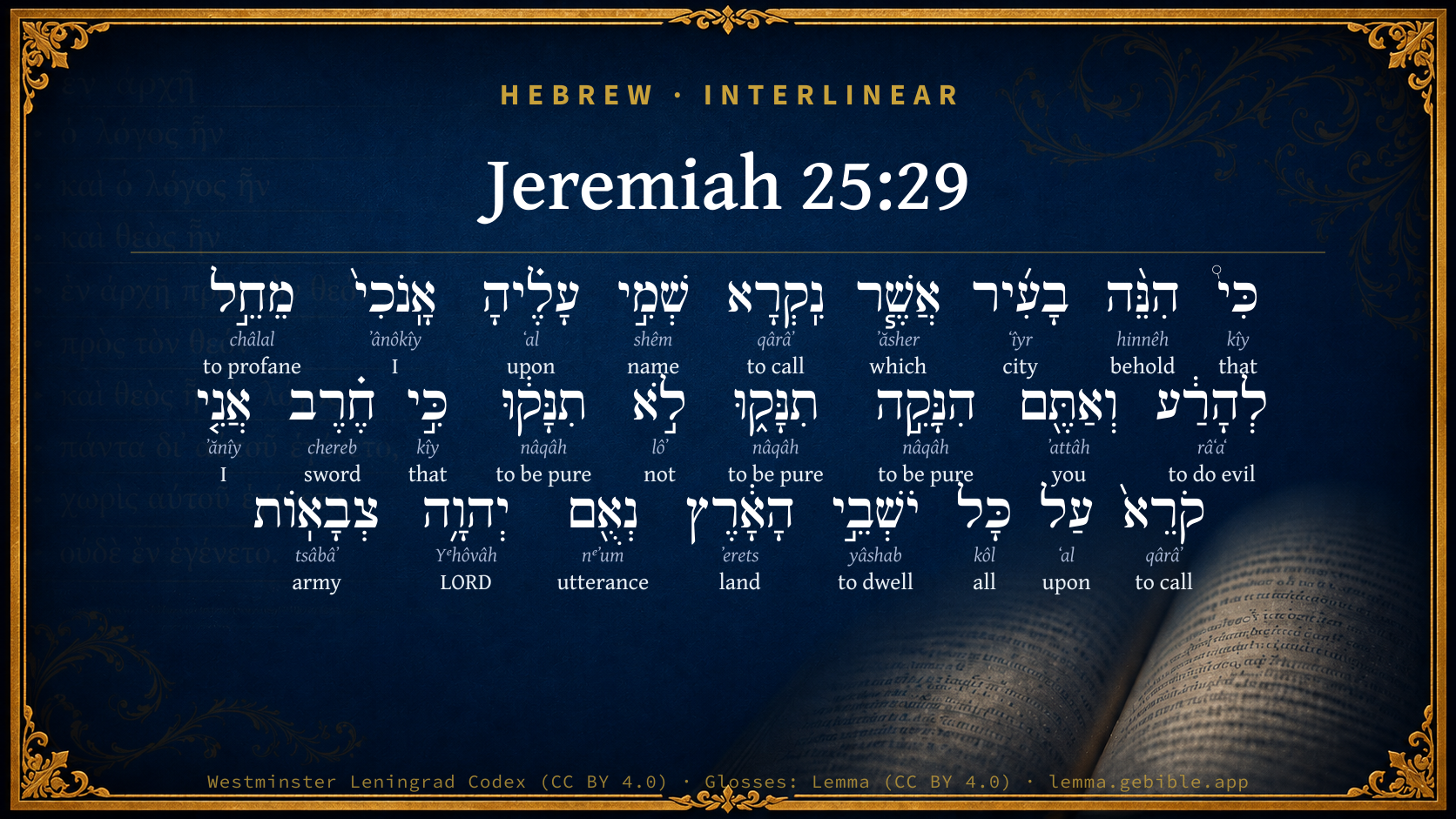
  1. כִּי֩ kîy H3588 “that” Conjunction
  2. הִנֵּ֨ה hinnêh H2009 “behold” Particle, Demonstrative
  3. בָעִ֜יר ʻîyr H5892 “in/at the · city” Preposition, Determined + Noun, Common, Feminine, Singular, Absolute
  4. אֲשֶׁ֧ר ʼăsher H834 “which” Particle, Relative
  5. נִֽקְרָא qârâʼ H7121 “to call” Verb, Niphal, Perfect, 3rd Person, Masculine, Singular
  6. שְׁמִ֣י shêm H8034 “name · my” Noun, Common, Masculine, Singular, Construct + Suffix, Personal, 1st Person, Common, Singular
  7. עָלֶ֗יהָ ʻal H5921 “upon · her” Preposition + Suffix, Personal, 3rd Person, Feminine, Singular
  8. אָֽנֹכִי֙ ʼânôkîy H595 “I” Pronoun, Personal, 1st Person, Common, Singular
  9. מֵחֵ֣ל châlal H2490 “profaning” Verb, Hiphil, Participle Active, Masculine, Singular, Absolute
  10. לְהָרַ֔ע râʻaʻ H7489 “to do evil” Preposition + Verb, Hiphil, Infinitive Construct
  11. וְאַתֶּ֖ם ʼattâh H859 “and · you” Conjunction + Pronoun, Personal, 2nd Person, Masculine, Plural
  12. תִנָּק֑וּ nâqâh H5352 “to be pure” Verb, Niphal, Imperfect, 2nd Person, Masculine, Plural
  13. לֹ֣א lôʼ H3808 “not” Particle, Negative
  14. תִנָּק֔וּ nâqâh H5352 “to be pure” Verb, Niphal, Imperfect, 2nd Person, Masculine, Plural
  15. כִּ֣י kîy H3588 “that” Conjunction
  16. חֶ֗רֶב chereb H2719 “sword” Noun, Common, Feminine, Singular, Absolute
  17. אֲנִ֤י ʼănîy H589 “I” Pronoun, Personal, 1st Person, Common, Singular
  18. קֹרֵא֙ qârâʼ H7121 “calling” Verb, Qal, Participle Active, Masculine, Singular, Absolute
  19. עַל ʻal H5921 “upon” Preposition
  20. כָּל kôl H3605 “all of” Noun, Common, Masculine, Singular, Construct
  21. יֹשְׁבֵ֣י yâshab H3427 “dwelling” Verb, Qal, Participle Active, Masculine, Plural, Construct
  22. הָאָ֔רֶץ ʼerets H776 “the · land” Particle, Definite Article + Noun, Common, Both, Singular, Absolute
  23. נְאֻ֖ם nᵉʼum H5002 “utterance of” Noun, Common, Masculine, Singular, Construct
  24. יְהוָ֥ה Yᵉhôvâh H3068 “LORD” Noun, Proper
  25. צְבָאֽוֹת tsâbâʼ H6635 “armies” Noun, Common, Both, Plural, Absolute

About this verse

These counts appear in no published source. They are computed here, from the morphology-tagged text and Lemma’s own curated glosses. What Lemma adds →

26
words
21
distinct lemmas
Prophets
section

Shared distinctive vocabulary

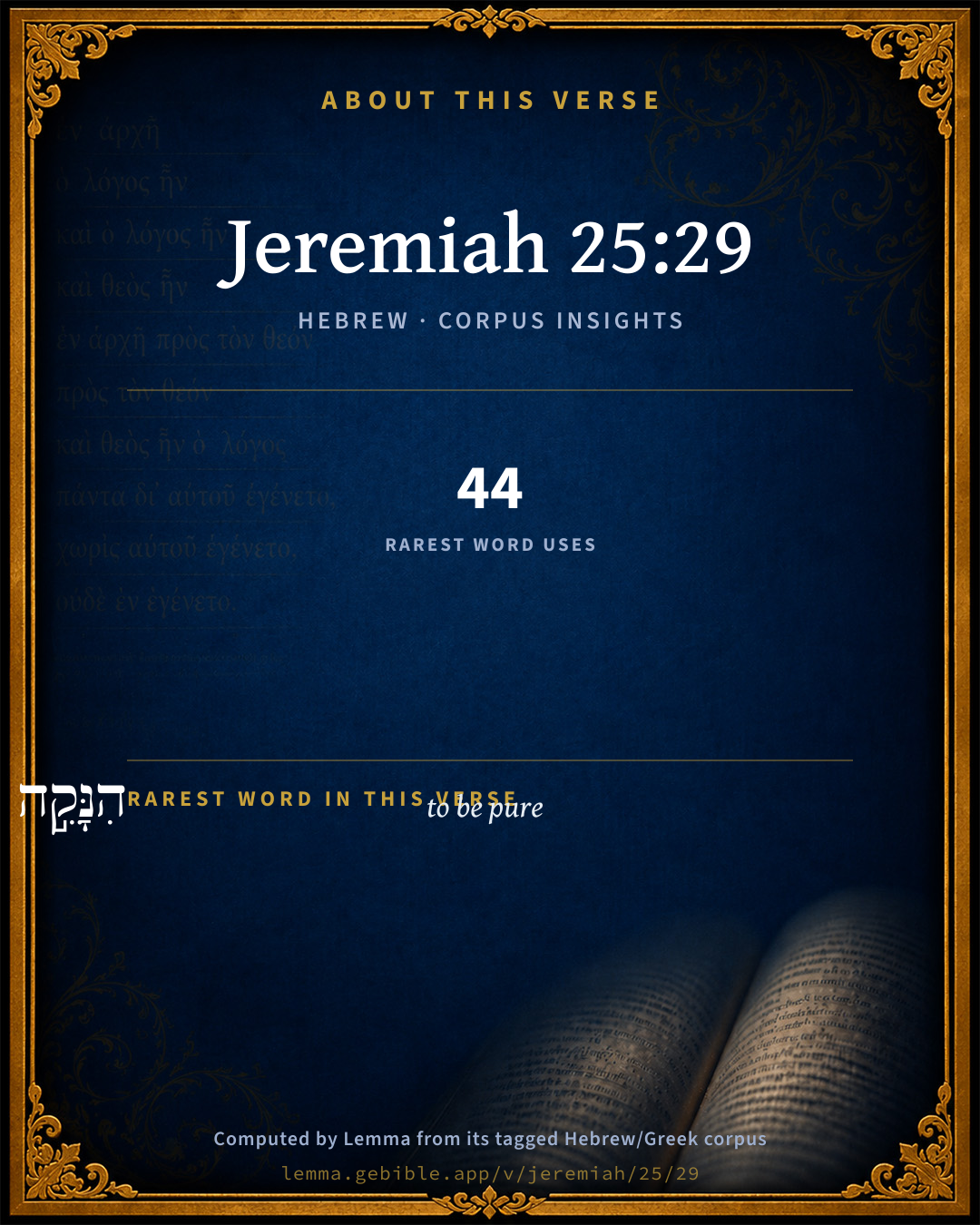
הִנָּקֵ֣ה to be pure H5352 occurs in 33 verses of the Hebrew Bible. Also found in:

Grammatical profile

  • 8 verbs
  • 8 nouns
  • 3 pronouns
  • 2 prepositions
  • 2 conjunctions
  • 3 particles

Verb forms

  • נִֽקְרָא Niphal · Perfect
  • מֵחֵ֣ל Hiphil · Participle Active
  • לְהָרַ֔ע Hiphil · Infinitive Construct
  • הִנָּקֵ֣ה Niphal · Infinitive Absolute
  • תִנָּק֑וּ Niphal · Imperfect
  • תִנָּק֔וּ Niphal · Imperfect
  • קֹרֵא֙ Qal · Participle Active
  • יֹשְׁבֵ֣י Qal · Participle Active

Repetition

Words recur within this verse — often emphatic in Hebrew:

  • הִנָּקֵ֣ה to be pure H5352 ×3
  • נִֽקְרָא to call H7121 ×2
  • עָלֶ֗יהָ upon H5921 ×2
  • כִּי֩ that H3588 ×2

Cross-references

18

Topical passages linked to Jeremiah 25:29 in the Treasury of Scripture Knowledge — connected by theme and wording, ordered by reader-vote popularity; previews shown in the World English Bible.

  • Proverbs 11:31 Behold, the righteous shall be repaid in the earth; How much more the wicked and the sinner!
  • Ezekiel 38:21 I will call for a sword against him to all my mountains, says the Lord Yahweh: every man's sword shall be against his brother.
  • 1 Peter 4:17 For the time has come for judgment to begin at the house of God. If it begins first with us, what will happen to those who don't obey the Gospel of God?
  • 1 Kings 8:43 hear in heaven, your dwelling-place, and do according to all that the foreigner calls to you for; that all the peoples of the earth may know your name, to fear you, as does your people Israel, and that they may know that this house which I have built is called by my name.
  • Jeremiah 49:12 For thus says Yahweh: Behold, they to whom it didn't pertain to drink of the cup shall assuredly drink; and are you he who shall altogether go unpunished? you shall not go unpunished, but you shall surely drink.
  • Ezekiel 9:6 kill utterly the old man, the young man and the virgin, and little children and women; but don't come near any man on whom is the mark: and begin at my sanctuary. Then they began at the old men that were before the house.
  • Obadiah 1:16 For as you have drunk on my holy mountain, so will all the nations drink continually. Yes, they will drink, swallow down, and will be as though they had not been.
  • Proverbs 11:21 Most assuredly, the evil man will not be unpunished, But the seed of the righteous will be delivered.
  • Proverbs 17:5 Whoever mocks the poor reproaches his Maker. He who is glad at calamity shall not be unpunished.
  • Isaiah 10:12 Therefore it shall happen that, when the Lord has performed his whole work on Mount Zion and on Jerusalem, I will punish the fruit of the stout heart of the king of Assyria, and the glory of his high looks.
  • Jeremiah 13:13 Then shall you tell them, Thus says Yahweh, Behold, I will fill all the inhabitants of this land, even the kings who sit on David's throne, and the priests, and the prophets, and all the inhabitants of Jerusalem, with drunkenness.
  • Jeremiah 30:11 For I am with you, says Yahweh, to save you: for I will make a full end of all the nations where I have scattered you, but I will not make a full end of you; but I will correct you in measure, and will in no way leave you unpunished.
  • Jeremiah 46:28 Don't be afraid you, O Jacob my servant, says Yahweh; for I am with you: for I will make a full end of all the nations where I have driven you; but I will not make a full end of you, but I will correct you in measure, and will in no way leave you unpunished.
  • Ezekiel 14:17 Or if I bring a sword on that land, and say, Sword, go through the land; so that I cut off from it man and animal;
  • Ezekiel 14:21 For thus says the Lord Yahweh: How much more when I send my four sore judgments on Jerusalem, the sword, and the famine, and the evil animals, and the pestilence, to cut off from it man and animal!
  • Daniel 9:18–19 My God, turn your ear, and hear; open your eyes, and see our desolations, and the city which is called by your name: for we do not present our petitions before you for our righteousness, but for your great mercies' sake.
  • Zechariah 13:7 "Awake, sword, against my shepherd, And against the man who is close to me," says Yahweh of Hosts. Strike the shepherd, and the sheep will be scattered; And I will turn my hand against the little ones.
  • Luke 23:31 For if they do these things in the green tree, what will be done in the dry?"

Cross-references courtesy of OpenBible.info (CC BY 4.0).

Hebrew and Greek witnesses Masoretic Hebrew ↔ Greek Septuagint

The same verse in the two great witnesses to the Old Testament, shown verse-for-verse.

These are two independent witnesses, not word-aligned to each other, and the Septuagint is shown in lemma (dictionary) form.

Hebrew Jeremiah 25:29 Masoretic · Westminster Leningrad Codex

כִּי֩ הִנֵּ֨ה בָעִ֜יר אֲשֶׁ֧ר נִֽקְרָא שְׁמִ֣י עָלֶ֗יהָ אָֽנֹכִי֙ מֵחֵ֣ל לְהָרַ֔ע וְאַתֶּ֖ם הִנָּקֵ֣ה תִנָּק֑וּ לֹ֣א תִנָּק֔וּ כִּ֣י חֶ֗רֶב אֲנִ֤י קֹרֵא֙ עַל כָּל יֹשְׁבֵ֣י הָאָ֔רֶץ נְאֻ֖ם יְהוָ֥ה צְבָאֽוֹת

For, behold, I begin to work evil at the city which is called by my name; and should you be utterly unpunished? You shall not be unpunished; for I will call for a sword on all the inhabitants of the earth, says Yahweh of Hosts.

World English Bible · Public Domain

Greek LXX Structure differs

In the Septuagint, Jeremiah is about an eighth shorter than the Hebrew and arranges its material differently — the Oracles Against the Nations (Hebrew chapters 46–51) appear in the middle of the Greek book, after 25:13. Because the chapter and verse boundaries do not line up, a verse-for-verse comparison with the Hebrew is not shown.

A verse-for-verse comparison isn’t shown here because the chapters and verses don’t line up. Switch to the LXX edition with the MT / LXX toggle above to read the Greek directly.

Hebrew: Westminster Leningrad Codex (CC BY 4.0). Greek: Septuagint (public domain); English from a public-domain English Septuagint. How the Septuagint differs from the Hebrew →

Targum (Aramaic paraphrase)

1

The Targum is the ancient Jewish Aramaic paraphrase of the Hebrew Scriptures — an interpretive translation, not the Hebrew text itself. Onkelos (literal) and Pseudo-Jonathan (expansive) render the Torah, and Jonathan the Prophets. Coverage is partial: where no permissively-licensed English translation exists for a verse, only the Aramaic is shown. This is verse-level text, not a word-by-word alignment to the Hebrew.

  1. Targum Jonathan Prophets (Joshua–Malachi)
    אֲרֵי הָא בְקַרְתָּא דְאִתְקְרֵי שְׁמִי עֲלָהּ אֲנָא מַשְׁרֵי לְאַבְאָשָׁא וְאַתּוּן מְדַמָן דְמִזְכָּא תִזְכּוּן לָא תִזְכּוּן אֲרֵי דְקַטְלִין בְּחַרְבָּא אֲנָא מַכְלֵי עַל כָּל יַתְבֵי אַרְעָא אֲמַר יְיָ צְבָאוֹת:

    (no public-domain English translation for this verse)

    Targum Jonathan — Aramaic: “Mikraot Gedolot” (public domain). English: “Sefaria Community Translation” (CC0 1.0 (public-domain dedication)); “London "Chaldee Paraphrase," 1871” (public domain). Text via Sefaria.

Commentary

Notes on Jeremiah 25:29 from classic Christian and Jewish commentators (each source and its license shown beneath its notes). The classic Christian expositions comment on the surrounding passage and are grouped to its opening verse, so a note may address several verses; the Jewish commentaries on the Tanakh (Rashi and others) are per-verse, so they appear only where the commentator wrote on this verse.

Lemma curates 59 commentaries, every one of them public domain or Creative Commons licensed, each selected and text-cleaned for this edition rather than reprinted as found. About our sources →

Trapp's Complete Commentary

John Trapp

Jer 25:29 For, lo, I begin to bring evil on the city which is called by my name, and should ye be utterly unpunished? Ye shall not be unpunished: for I will call for a sword upon all the inhabitants of the earth, saith the LORD of hosts.

Ver. 29. The city that is called by my name.] Periphrasis Hierosolymae argumentosa.

And should ye be utterly unpunished?] See on Jer 25:18.

Ye shall not be unpunished.] But suffer as surely and as sorely.

John Trapp, A Commentary or Exposition upon All the Books of the Old and New Testament (1647–1656) — public domain. Text from a community e-Sword module.

Geneva Bible (1599)

Geneva Bible translators

That is, Jerusalem, read verse 12.

Geneva Bible (1599) marginal notes — public domain. Text via Bolls.life.

Jamieson, Fausset & Brown

Robert Jamieson, A. R. Fausset & David Brown

If I spared not Mine elect people on account of sin, much less will I spare you (Eze 9:6; Oba 1:16; Luk 23:31; Pe1 4:17).

be unpunished--"be treated as innocent."

Jamieson, Fausset & Brown — Commentary Critical and Explanatory on the Whole Bible (1871) — public domain (CC PDM 1.0). Text via the HelloAO Bible API.

Adam Clarke's Commentary

Verse 29. The city which is called by my name] Jerusalem, which should be first given up to the destruction.

Adam Clarke's Commentary on the Bible (1810–1826) — public domain. Text from a community e-Sword/MySword module.

John Calvin's Commentaries

A proof is added by comparing the less and the greater; for the Prophet reasons thus, — “If God spares not the city in which he has chosen a temple for himself, and designed his name to be invoked, how can he spare aliens to whom he has never made any promise, as he regarded them as strangers? If then the green tree is consumed, how can the dry remain safe?” This is the import of the passage. The Apostle uses the same argument in other words; for after having said that judgment would begin at God’s house, he immediately shews how dreadful that vengeance of God was to be which awaited his open enemies! (1 Peter 4:17.)

We may hence gather a useful doctrine. Since God not only declares that he will be indiscriminately the avenger of wickedness, but also summons in the first place his Church which he has chosen before his tribunal, its condition may seem to be worse than that of alien nations. Hence the minds of the godly, when they view things in this light, might be much depressed. It seems a singular favor of God, that he unites us to himself; but yet this honor seems only to lead to punishment: for God connives at the wickedness of heathens, and seems to bury them in oblivion; but as soon as we fall into sin, we perceive signs of his wrath. It would then be better to be at a distance from him, and that he should not be so solicitous in his care for us. Thus the faithful view the unbelieving as in a better state than themselves. But this doctrine mitigates all the sharpness of that grief, which might otherwise occasion great bitterness. For when it is represented to us, that God begins at his Church, that he may more heavily punish the unbelieving after having long endured them, and that they may thus be far more grievously dealt with than the faithful, as the dry tree is much sooner consumed than the green, — when therefore this is set before us, we have doubtless a ground for comfort, and that not small nor common.

We hence see why Jeremiah added this, — that how much soever the nations would resist God, they would yet be constrained, willing or unwilling, to yield, as God was more powerful than they; and for this reason, that since God would not spare his chosen people, the heathens could by no means escape unpunished, and not find him to be the judge of the world. Let then this truth be remembered by us, whenever our flesh leads us to complain or to be impatient; for it is better for us that God should begin with us, as at length the wicked shall in their turn be destroyed, and that we should endure temporal evils, that God may at length raise us up to the enjoyment of his paternal favor. And for this reason Paul also says, that it is a demonstration of the just judgment of God when the faithful are exposed to many evils. (2 Thessalonians 1:4, 5.): For, when God chastises his own children, of whose obedience he yet approves, do we not see as in a glass what is yet concealed? even the dreadful punishment that awaits all the unbelieving. God, then, represents to us at this day the destruction of his enemies by the paternal chastisements with which he visits us; and they are a certain proof or a lively exhibition of that judgment which the unbelieving fear not, but thoughtlessly deride.

Now, he says, Behold I begin to bring evil, etc. The verb הרע, ero, means properly to do evil; and it would be a strange thing to say that God does evil, were it not that common usage explains the meaning. They who are in any measure acquainted with Scripture know that calamities are called evils, that is, according to the perceptions of men. The Lord then is said to bring evil on men, not because he injures them or deals unjustly and cruelly with them, but because what is adverse to men’s minds is thought to be by them, and is called evil. Then he says, I begin to do evil in the city on which my name is called God’s name is called on a people, when he promises to be their guardian and defender, and his name is said to be called upon men, when they betake themselves to his guardianship and protection.

But we must notice the real meaning, — that God’s name is called on a people, when they are deemed to be under his guardianship and keeping; as God’s name is called on the children of Abraham, because he had promised to be their God; and they boasted that they were his peculiar people, even on account of their adoption. So God’s name was called on Jerusalem, because there was the Temple and the altar; and as God called it his rest or habitation, his name was there well known, according to what we say in French, Se reclamer, il se reclame d’un tel, that is, such an one claims this or that as his patron, so that he shelters himself under his protection. So also the Jews formerly called on God’s name, when they said that they had been chosen to be his people: nay, this may also be applied to men; for the name of Jacob, Isaac, and Abraham was called on the twelve tribes, even for this reason, — because they regarded, when seeking to rely on God’s covenant, their own origin, for they had descended from the holy fathers, with whom God had made his covenant, and to whom he had promised that he would be ever their God. All the Israelites called on Abraham, not, that they offered him worship, but that, as they were his offspring, they might feel justly assured that the gratuitous covenant by which God had adopted them to himself, had been transmitted to them. But this calling may be also taken in another sense, even because they daily appeased God by sacrifices and prayers: when they committed their safety to God, there was a sacrifice always added, and reconciliation was also promised. Then to be called upon or invoked, נקרא, nukora, may be taken in this sense, even that they knew that God was reconciled to them, when they from the heart repented. Since then God’s name was called upon in that city, how was it possible that the Gentiles should escape that judgment to which the holy city was of be exposed?

But the former view seems to me the best; and there is no doubt but that God speaks here to the free adoption by which he had chosen that people for himself: hence was the invocation or the glorying of which he now speaks.

But as it was difficult to make the Jews to believe what the Prophet had said, he dwells on the subject, and repeats what was before sufficiently clear. He not only says, Shall ye be treated as innocent? but he mentions the word twice, Shall ye by being treated as innocent be treated as innocent? And thus he rebuked the perverse contumacy by which the heathens were filled, while looking on their wealth, their number, and other things, and at the same time disregarding all that the prophets proclaimed at Jerusalem, as though it was nothing to them. The question is in itself emphatical, “Can ye by any means be treated as innocent?” The verb נקה, nuke, means to be innocent, but it is applied to punishment; as the word עון, on, which means iniquity, is used to designate punishment. So he is said not to be innocent who cannot exempt himself from God’s judgment, nor be free from it.

He confirms this sentence when he says, For a sword am I calling for on all the inhabitants of the earth, saith Jehovah of hosts This confirmation is by no means superfluous, for the insolence of the nations had increased through the forbearance of God, for they had for a long time, yea, for many ages, been in a quiet state, and had indulged themselves in their pleasures, and slept as it were in their own dregs, according to what is said elsewhere. The Prophet then says now, that God was calling for a sword on all the inhabitants of the earth. For he had often and in various ways chastised his own people, while the Gentiles were not in any danger and free from troubles. (Jeremiah 48:11.) But he says now that he was calling for a sword to destroy all those whom he seemed to have forgiven.

But God is said to have called for men as well as for a sword; for Nebuchadnezzar is said to have fought under the banner of God; he is said to have been like a hired soldier. But God now speaks of the sword, that we might know that it is in his power to excite and to quell wars whenever it pleases him, and that thus the sword, though wielded by the hand of man, is not yet called forth by the will of man, but by the hidden power of God. It follows, —

John Calvin's Commentaries (1540-1563) — public domain. Text from the Calvin Translation Society English edition (1840s-50s) via the Christian Classics Ethereal Library (ccel.org). Calvin's coverage is partial (roughly two-thirds of the Bible); uncommented books and verses are honest gaps, never fabricated. The 19th-century editor's footnotes and remarks are omitted so the notes are faithfully Calvin's own voice.

Ellicott's Commentary for English Readers

(29) I begin to bring evil . . .?—The thought is the same as that of 1Pe_4:17, “If judgment shall begin at the house of God . . .?” If this were His chastisement of those who were His chosen people, it followed à fortiori that those who were less favoured and had less claims should not escape. For them, as for Judah, the one wise and safe course was to accept their punishment and submit. (Comp. Jer_49:12.)

A Bible Commentary for English Readers, edited by Charles John Ellicott (1878–1897) — public domain. Text from a community e-Sword module.

The Cambridge Bible for Schools and Colleges

gen. ed. J. J. S. Perowne

29. called by my name] See on Jer_7:10.

The Cambridge Bible for Schools and Colleges (gen. ed. J. J. S. Perowne; Cambridge University Press, 1878–1918) — public domain. Text from a community e-Sword module.

John Gill's Exposition

Therefore prophesy thou against them all these words, and say unto them,.... What follows, as well as declare all that is before spoken concerning the cup of fury all nations must drink of:

the Lord shall roar from on high: from, heaven, like a lion, in violent claps of thunder; or in such dreadful dispensations of his providence, as will be very amazing and terrifying:

and utter his voice from his holy habitation; from heaven, as before; and though it will be terrible, yet quite consistent with his holiness and justice:

he shall mightily roar upon his habitation; the temple at Jerusalem, where he had his residence; but now should be deserted by him, and feel the effects of his wrath in the destruction and desolation of it: or rather, since the address is made to the nations of the world, and not to the Jews, it may be rendered, "in" or "out of his habitation" (q); and so designs heaven, as before; and all these expressions are intended to show both the certainty and terribleness of the dispensation;

he shall give a shout, as they that tread the grapes, against all the inhabitants of the earth; or, "answer a shout" (r); give the onset for battle against the inhabitants of the earth, as the general of an army; which is accompanied with a shout, like that which is made by workmen treading in the wine press, to encourage one another to go on the more cheerfully in their work.

(q) "in habitaculo suo", Junius & Tremellius; "vel ex habitaculo", Gataker, Schmidt. (r) "heded respondebit", Schmidt; "celeusma respondebit", Gataker.

John Gill's Exposition of the Whole Bible (1746–1763) — public domain (CC PDM 1.0). Text via the HelloAO Bible API.

Haydock's Catholic Bible Commentary

City. Jerusalem first fell a prey.

George Leo Haydock (1774–1849), Haydock's Catholic Family Bible and Commentary, 1859 edition — public domain. Excludes Psalms (Douay-Rheims chapter numbering differs from Protestant) and Deuterocanonical books (Catholic canon only).

Matthew Poole's English Annotations

By the city called by his name, or upon which his name was called, he means Jerusalem, elsewhere called the holy city. The apostle, 1Pe 4:17, speaketh much to this purpose, The time is come that judgment must begin at the house of God; and if it first begin at us, what shall the end be of them that obey not the gospel of God? If God spareth not the green tree, how shall he spare those that are dry and withered? Atheists and lewd and profane persons have little reason to promise themselves an escape from God’s righteous judgment, when they see God not sparing those that make the highest profession of him, and stand in some relation to him.

For I will call for a sword upon all the inhabitants of the earth; it is in vain for you to promise yourselves an escape, for God is about to punish all your neighhours.

Matthew Poole's English Annotations on the Holy Bible (1683–1685) — public domain. Text from a community e-Sword/MySword module.

The Pulpit Commentary

I will call for a sword. It is probably that awful sword referred to in ver. 16 (see note).

The ineffectual palladium of a great name.

Jerusalem was called by God"s name; yet Jerusalem was not to be spared in the general outpouring of the wine-cup of fury. The Jews were vainly trusting in their name. We are all inclined to think too much of mere names. Certainly there is something in a name; it may command respect, influence, etc. Yet this applies only in regard to human considerations; it can have no weight with God. Even with men it is less potent than its possessors would fain believe. The influence of it is slowly won, easily lost, and only recovered with the utmost difficulty, if at all.

I A NAME MAY BE GREAT BECAUSE IT REPRESENTS CONNECTION WITH THE GREAT. It may indicate relationship to a family, a clan, a nation. We are proud of the name of Englishmen. St. Paul, professing himself a Roman, was able to claim the rights of Roman citizenship. (Act_22:25) But the name is here useful only in so far as the privilege it implies extends. St. Paul had a right not to be scourged, but none to save him from being beheaded by the order of the emperor. We may claim undue privileges because we bear the name of Christian, because we were born in Christendom, are citizens of a Christian state, are members of a Christian Church. These associations count for nothing before God. We shall "all appear before the judgment-seat of Christ, that every one may receive the things done in his body". (2Co_5:10) It will be vain then to say, "Lord, Lord, have we not prophesied in thy Name," etc.? If Christ must answer, "I never knew you: depart from me, ye that work iniquity". (Mat_7:23, Mat_7:24)

II A NAME MAY BE GREAT BECAUSE IT REPRESENTS HIGH RANK, Social distinctions cannot be ignored while they exist, and in them the favored necessarily enjoy many amenities that are denied to the commonalty. But they are snares when they tempt their owners to expect peculiar privileges with Heaven. In spiritual matters we approach God, not as rich or poor, not as prince or beggar, but as man. Rank goes for nothing there; character is everything. This applies to ecclesiastical rank. They who hold high office in the Church are tempted to expect exceptional judgment. They will be judged, not as officials, not as popes, bishops, priests, but as men, and will find that their holy office will be no sanctuary when the awful sword of Divine judgment is unsheathed.

III A NAME MAY BE GREAT BECAUSE IT REPRESENTS A GOOD REPUTATION. If the reputation is justly earned, the name is a real honor. "A good name," says the wise man, "is rather to be chosen than great riches". (Pro_22:1) Shakespeare"s Cassio exclaims, Reputation, reputation, reputation!" Oh, I have lost my reputation! I have lost the immortal part of myself, and what remains is bestial." Yet, if reputation is "got without merit," it is a poor refuge to flee to from before the all-seeing God. Even when it is solid and honest it stands only as a record of the past, and a presumption in our favor when our conduct is equivocal. But it does not mitigate the guilt of subsequent offences. We are judged by our conduct, not by our fame. It is vain to have a name to live if we are dead; the name will not galvanize us back into life.

IV A NAME MAY BE GREAT BECAUSE IT REPRESENTS A GREAT PROFESSION. Men assume big names and flourish them before the world in pretended evidence of their own excellence, and the world, being too blind and too indolent to make very searching inquiries, commonly takes men much at their own reckoning. The advantage of such a deception can only be superficial and transitory. The foolish boast will soon be exploded. Before God it matters little what a man calls himself. The one question is as to what he is.

Judgment beginning at the house of God.

I THE ORDER OF GOD"S JUDGMENT.

1. It begins with his own people.

2. Reasons for this are:

(1) The harmony of the Divine rule in the earth. The Church is his own house. It ought, therefore, to be in perfect order first. His authority ought to be recognized among those whom he calls his own. He will therefore deal with them first, and then with better grace address the impenitent and unbelieving world.

(2) The purity of Gods character. He cannot endure wrong cannot look upon sin. Yet he is to dwell in the Church, in individual believers. It is necessary, therefore, that they be made pure as he is pure. Their discipline must be immediate if they are to become vessels prepared unto honor.

(3) The justice of God. Immediately the sin of the child is worse than that of the stranger, because it is done in the midst of light and privilege. Sharp and immediate chastisement is the only way in which he can show his sense of the wrong done. (Amo_3:2)

(4) The mercy of God. If it begins with the children of God, it is that they may the sooner be saved. He embitters the breast of the world to wean them (Leighton). It is because he loves he rebukes and chastens. But the grief of sin begins first in the breast of God and in the person of his Son. It is of the nature of Divine love to suffer for the sinful, even to die, that he may be made a child of grace.

II THE EXTENT OF IT. "All the inhabitants of the earth." Thus early nay, from the first sin onwards does he begin the judgment of the whole earth. The sin of one is but a symptom of the universal depravity of all. The oneness of the world in its fall and the evolution of its sin, is constantly declared in Scripture.

1. This is demanded by the justice of God. "Should ye be utterly unpunished?" It would be manifestly unfair that the child of God alone should suffer for that which is primarily a sin of all mankind.

2. It is founded upon the solidarity of the race. There is a universal kinship in sins. "In Adam (they) all die". (1Co_15:22)

III THE MEASURE OF IT. "A sword" (cf. ver. 33). This signifies destruction, death. That which opposes itself to him will be utterly destroyed. He begins his judgment upon his own, but it passes from them and rests forever upon his enemies. The picture painted by Jeremiah (vers, 30-38) is but one of many similar ones in the Bible. The utter holiness of God cannot endure the sinfulness of men; it must consume it and all that identify themselves with it. In the New Testament the horizon widens, and the spiritual world participates with the living upon earth in the sentence of the Judge. The first duty, therefore, of every awakened sinner is to flee from the "wrath to come." Whilst he remains unconverted he is a "child of wrath." Punishment has a different significance to him from what it would have if he were "in Christ." It is the same principle of solidarity which condemned us that now avails for our salvation. "For as in Adam all die, even so in Christ shall all be made alive". M. (1Co_15:22)

The Pulpit Commentary (1880–1919), ed. H.D.M. Spence-Jones & Joseph S. Exell — public domain. Text from a community e-Sword module.

Scofield Reference Notes

C. I. Scofield

all the inhabitants

The scope of this great prophecy cannot be limited to the invasion of Nebuchadnezzar. If Jehovah does not spare His own city, should the Gentile nations imagine that there is no judgment for them? The prophecy leaps to the very end of this age. (See "Day of the Lord," Isa 2:10-22; Rev 19:11-21 "Armageddon,"; Rev 16:14; Rev 19:11-21.

I will call (See Scofield "Isa 2:12").

The Scofield Reference Bible (1917 edition), notes by C. I. Scofield — public domain. Text from a community e-Sword module.

Rashi

Rabbi Shlomo Yitzchaki (Rashi)

commence מֵחֵל.

Rashi on the Tanakh — English translations: “The Judaica Press complete Tanach with Rashi, translated by A. J. Rosenberg” (CC BY 4.0); “Pentateuch with Rashi's commentary by M. Rosenbaum and A.M. Silbermann, 1929-1934” (public domain); “The Metsudah Tanach series, Lakewood, N.J” (CC BY 4.0); and “The Book of Joshua, Metsudah Publications, 1997” (CC BY 4.0). Text via Sefaria.

Lesson kit

Teaching starters — assembled from the data on this page, not authored interpretation. Every prompt links to the verse data it draws on. Edit before teaching.

Jeremiah, in the Prophets, opens this verse with 26 words (21 distinct Hebrew lemmas). Its most distinctive word is nâqâh (“to be pure”). A historical commentator’s framing appears above. Read the whole chapter for the surrounding context.

Discussion questions

  1. What does “to be pure” (nâqâh) contribute to the verse as a whole?
  2. How does Genesis 24:8, which shares the word «to be pure», read alongside this verse?
  3. What does the repetition of “to be pure” (3× in this one verse) do in this verse?
  4. These translations render this verse differently; the difference is in the English rendering, not the original. What questions does that raise?
  5. «נִֽקְרָא» is a Niphal Perfect verb. How does that grammatical form shape the action described?
  6. Compare how Trapp's Complete Commentary and Geneva Bible (1599) read this verse. Where do they agree or differ?

Things to notice

Reading settings

Reading text

Shown beneath each verse's original-language words.

Old Testament
Old Testament edition

Read the OT as the Masoretic Hebrew (MT) or the Greek Septuagint (LXX).

English shown for the Greek Septuagint (in the Hebrew ↔ Greek comparison).

Comparing translations? Open the Compare panel on any verse page to stack up to four side by side.