
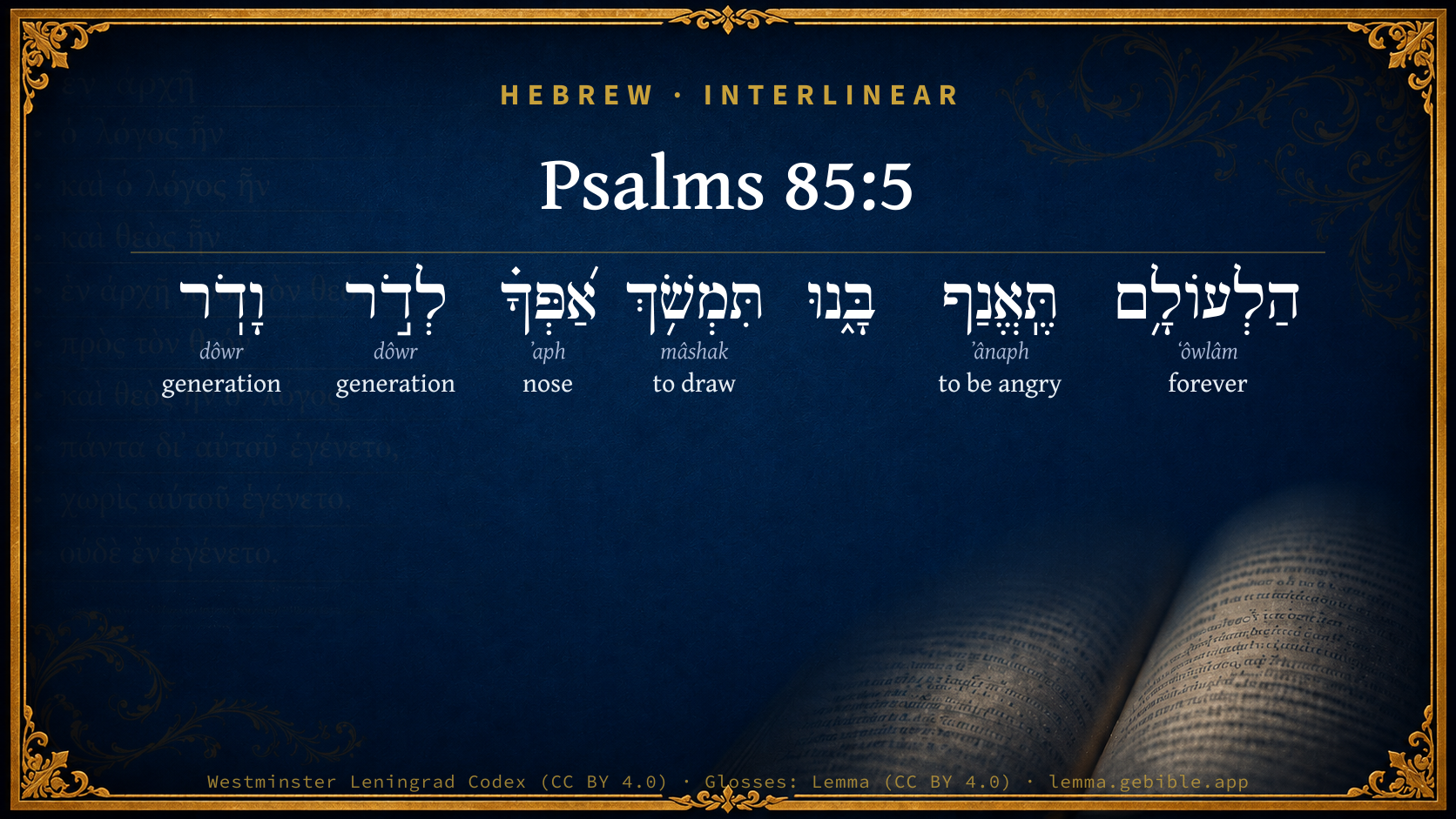
Psalms 85:5

Hebrew (Westminster Leningrad Codex) Psalms 85:5 appears in the Hebrew Old Testament. The text above is from the Westminster Leningrad Codex. Each word links to its Strong’s number, a concise gloss, and parsing drawn from the Open Scriptures Hebrew Bible morphology. Click any word for its full Brown-Driver-Briggs (BDB) entry.
Download image
Cite this verse

Psalms 85:5 (World English Bible). Public Domain. Lemma interlinear Bible study tool, https://lemma.gebible.app/v/psalms/85/5.

Show BibTeX & RIS
BibTeX
RIS
English Translation
Will you be angry with us forever? Will you draw out your anger to all generations?
World English Bible · Public Domain
Download a study sheet

One document with this verse’s original text, its word-by-word gloss line, the meaning frame, cross-references with their text, attributed commentary, and full source and license credits — printable, and it pastes into notes with its structure intact.

This verse Autodidact and up

Study sheet (.html) Plain text (.txt)

A passage Seminary Student

Up to 50 verses in one chapter. A passage sheet keeps up to 6 commentary sources and 12 cross-references per verse, in the order this page ranks them, and says so on the sheet whenever that leaves anything out. Ask for a single verse and you get the Autodidact verse sheet above.

Everything on this page stays free to read, with no account — the sheet is a download of what is already on screen, not access to it.

Want to remove ads? Support Godless Engineer
Compare translations 3

The same verse in 3 English versions, stacked beneath the original-language interlinear above. Click any original word for its lexicon entry.

Each is an independent rendering of the whole verse — the interlinear is not word-aligned to these translations.

Highlighted words mark where these versions differ — a whole-verse word diff, not a word-by-word alignment.

  • World English Bible Public Domain
    Will you be angry with us forever? Will you draw out your anger to all generations?
  • King James Version Public Domain
    Wilt thou be angry with us for ever? wilt thou draw out thine anger to all generations?
  • unfoldingWord Literal Text CC BY-SA 4.0
    Will you be angry with us forever? Will you prolong your nose to generation and generation?

unfoldingWord Literal Text — © unfoldingWord, licensed CC BY-SA 4.0. Word-aligned USFM3 via Door43 (git.door43.org/unfoldingWord/en_ult).

Versions to compare (up to 4)

3 of 4 selected

Show all 18 translations

Every available English version of this verse, each an independent rendering of the whole verse.

  • World English Bible Public Domain
    Will you be angry with us forever? Will you draw out your anger to all generations?
  • Berean Standard Bible Public Domain
    Will You be angry with us forever? Will You draw out Your anger to all generations?
  • Majority Standard Bible Public Domain
    Will You be angry with us forever? Will You draw out Your anger to all generations?
  • King James Version Public Domain
    Wilt thou be angry with us for ever? wilt thou draw out thine anger to all generations?
  • American Standard Version (1901) Public Domain
    Wilt thou be angry with us for ever? Wilt thou draw out thine anger to all generations?
  • Revised Version (1885) Public Domain
    Wilt thou be angry with us for ever? wilt thou draw out thine anger to all generations?
  • Geneva Bible (1599) Public Domain
    Wilt thou be angry with vs for euer? and wilt thou prolong thy wrath from one generation to another?
  • Douay-Rheims (1899) Public Domain
    Convert us, O God our saviour: and turn off thy anger from us.
  • Young's Literal Translation Public Domain
    To the age art Thou angry against us? Dost Thou draw out Thine anger To generation and generation?
  • Literal Standard Version CC BY-SA 4.0
    Are You angry against us for all time? Do You draw out Your anger || To generation and generation?
  • Unlocked Literal Bible CC BY-SA 4.0
    Will you be angry with us forever? Will you remain angry throughout future generations?
  • unfoldingWord Literal Text CC BY-SA 4.0
    Will you be angry with us forever? Will you prolong your nose to generation and generation?
  • Darby Bible Public Domain
    Wilt thou be angry with us for ever? wilt thou draw out thine anger from generation to generation?
  • World Messianic Bible Public Domain
    Will you be angry with us forever? Will you draw out your anger to all generations?
  • Webster's Bible Public Domain
    \\85:4\\Turn us, O God of our salvation, and cause thy anger towards us to cease.
  • Free Bible Version CC BY-SA 4.0
    Are you going to be furious with us forever? Will you stay angry with us for all future generations?
  • Bible in Basic English Public Domain
    Will you go on being angry with us for ever? will you keep your wrath against us through all the long generations?
  • JPS Tanakh (1917) Public Domain
    (85-6) Wilt Thou be angry with us for ever? Wilt Thou draw out Thine anger to all generations?

Literal Standard Version (2020), Covenant Press — licensed CC BY-SA 4.0. Text via the HelloAO Bible API (eBible.org). Unlocked Literal Bible (unfoldingWord) — licensed CC BY-SA 4.0. Text via the HelloAO Bible API (eBible.org). unfoldingWord Literal Text — © unfoldingWord, licensed CC BY-SA 4.0. Word-aligned USFM3 via Door43 (git.door43.org/unfoldingWord/en_ult). Free Bible Version, Dr. Jonathan Gallagher — licensed CC BY-SA 4.0. Text via the HelloAO Bible API (eBible.org).

Word by word

More ways to search: Search by grammar → Find every occurrence → Compare this word →

Practice this passage: Drill this verse → Learn its vocabulary →

About this verse

These counts appear in no published source. They are computed here, from the morphology-tagged text and Lemma’s own curated glosses. What Lemma adds →

7
words
5
distinct lemmas
Wisdom
section

Notable vocabulary

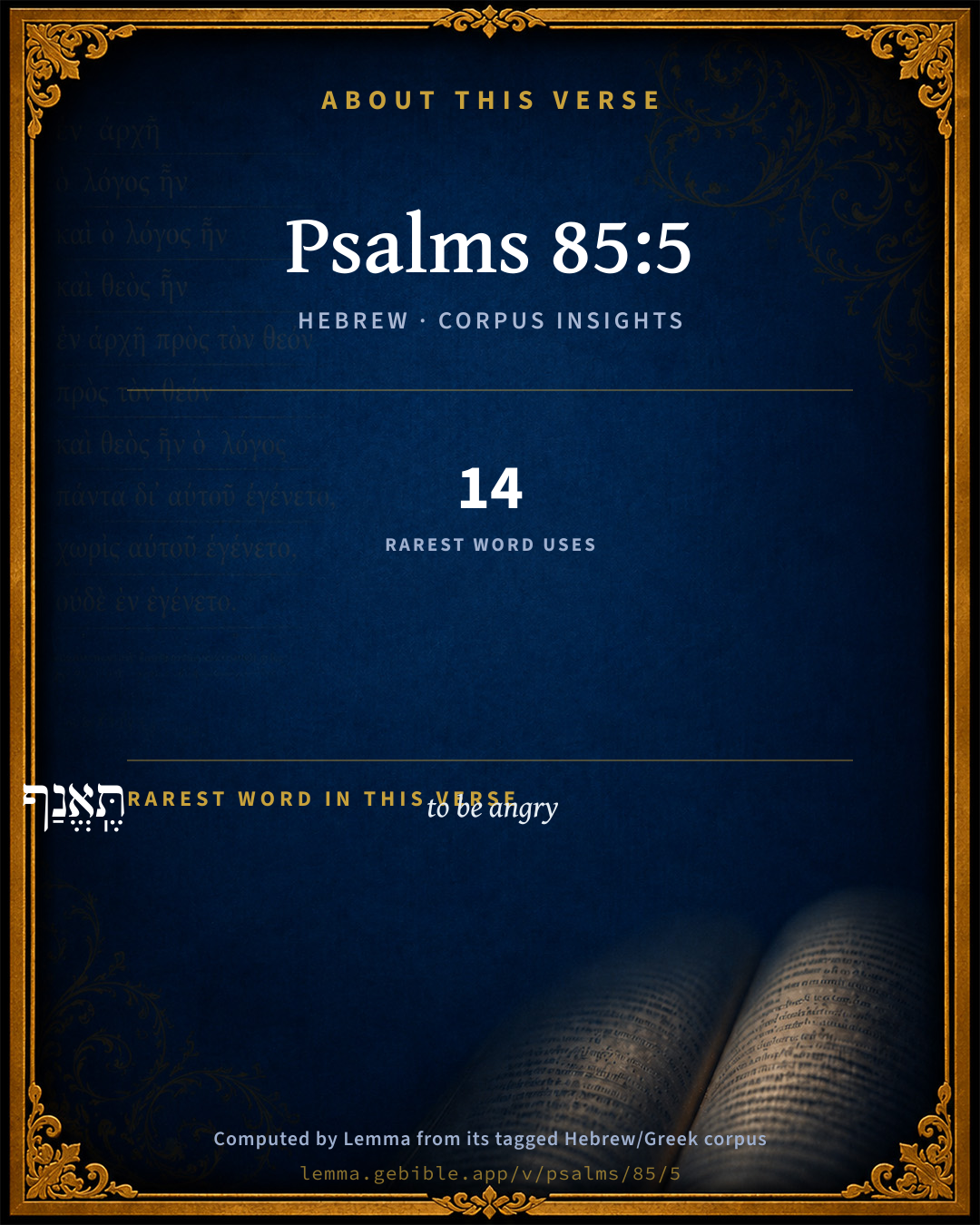
The rarest word here is תֶּֽאֱנַף to be angry H599 — appearing just 14 times in the whole Hebrew Bible.

Shared distinctive vocabulary

תֶּֽאֱנַף to be angry H599 occurs in 14 verses of the Hebrew Bible. Also found in:

Grammatical profile

  • 2 verbs
  • 4 nouns
  • 1 preposition

Verb forms

  • תֶּֽאֱנַף Qal · Imperfect
  • תִּמְשֹׁ֥ךְ Qal · Imperfect

Repetition

A word recurs within this verse — often emphatic in Hebrew:

  • לְדֹ֣ר generation H1755 ×2

Hebrew & Septuagint length

In English translation the verse runs 16 words from the Hebrew and 18 from the Septuagint (LXX English) — closely comparable.

A rough comparison of the two English renderings, which tokenize alike — not a word-level alignment.

Word counts can differ between the Hebrew and the Greek without any difference in meaning — e.g. the Hebrew direct-object marker אֵת has no separate Greek word, and Greek often adds the article ὁ.

Cross-references

9

Topical passages linked to Psalms 85:5 in the Treasury of Scripture Knowledge — connected by theme and wording, ordered by reader-vote popularity; previews shown in the World English Bible.

  • Psalms 79:5 How long, Yahweh? Will you be angry forever? Will your jealousy burn like fire?
  • Psalms 80:4 Yahweh God of hosts, How long will you be angry against the prayer of your people?
  • Psalms 74:1 God, why have you rejected us forever? Why does your anger smolder against the sheep of your pasture?
  • Psalms 77:9 Has God forgotten to be gracious? Has he, in anger, withheld his compassion?" Selah.
  • Psalms 89:46 How long, Yahweh? Will you hide yourself forever? Will your wrath burn like fire?
  • Isaiah 64:9–12 Don't be angry very sore, Yahweh, neither remember iniquity forever: see, look, we beg you, we are all your people.
  • Micah 7:18 Who is a God like you, who pardons iniquity, And passes over the disobedience of the remnant of his heritage? He doesn't retain his anger forever, Because he delights in loving kindness.
  • Luke 21:24 They will fall by the edge of the sword, and will be led captive into all the nations. Jerusalem will be trampled down by the Gentiles, until the times of the Gentiles are fulfilled.
  • Revelation 18:21–23 A mighty angel took up a stone like a great millstone and cast it into the sea, saying, "Thus with violence will Babylon, the great city, be thrown down, and will be found no more at all.

Cross-references courtesy of OpenBible.info (CC BY 4.0).

Hebrew and Greek witnesses Masoretic Hebrew ↔ Greek Septuagint

The same verse in the two great witnesses to the Old Testament, shown verse-for-verse.

You’re reading Greek Psalm 84 (Hebrew Psalm 85). The Septuagint counts the superscription, so verse numbers can differ from the Hebrew — chapter-level alignment, not verse-by-verse. Numbering follows Rahlfs.

These are two independent witnesses, not word-aligned to each other, and the Septuagint is shown in lemma (dictionary) form.

Hebrew Psalms 85:5 Masoretic · Westminster Leningrad Codex

הַלְעוֹלָ֥ם תֶּֽאֱנַף בָּ֑נוּ תִּמְשֹׁ֥ךְ אַ֝פְּךָ֗ לְדֹ֣ר וָדֹֽר

Will you be angry with us forever? Will you draw out your anger to all generations?

World English Bible · Public Domain

Greek LXX Greek Psalm 84:5 Septuagint · lemma form

ἐπιστρέφω ἐγώ ὁ θεός ὁ σωτήριον ἐγώ καί ἀποστρέφω ὁ θυμός σύ ἀπό ἐγώ

Wouldest you be angry with us for ever? or will you continue your wrath from generation to generation?

LXX2012 (modern English Septuagint) · Public Domain

Hebrew: Westminster Leningrad Codex (CC BY 4.0). Greek: Septuagint (public domain); English from LXX2012 (modern English Septuagint) (Public Domain). How the Septuagint differs from the Hebrew →

Commentary

Notes on Psalms 85:5 from classic Christian and Jewish commentators (each source and its license shown beneath its notes). The classic Christian expositions comment on the surrounding passage and are grouped to its opening verse, so a note may address several verses; the Jewish commentaries on the Tanakh (Rashi and others) are per-verse, so they appear only where the commentator wrote on this verse.

Lemma curates 59 commentaries, every one of them public domain or Creative Commons licensed, each selected and text-cleaned for this edition rather than reprinted as found. About our sources →

Trapp's Complete Commentary

John Trapp

Psa 85:5 Wilt thou be angry with us for ever? wilt thou draw out thine anger to all generations?

Ver. 5. Wilt thou be angry with us for ever?] Dilato Christo tuo vel tuo adventu? Such expostulations mixed with faith are Vis Deo grata, as saith Tertullian, such as God is well pleased with.

John Trapp, A Commentary or Exposition upon All the Books of the Old and New Testament (1647–1656) — public domain. Text from a community e-Sword module.

J. A. Alexander on Psalms

Joseph Addison Alexander

6. (Psa 85:5) For ever wilt thou be angry at us? Wilt thou draw out thine anger to generation and generation! The first Hebrew word strictly means to ages or eternities. The verb to draw out, protract, continue, is used in a favourable sense, Psa 36:10. The idea here expressed is the opposite of that in Psa 30:5.

Joseph Addison Alexander, The Psalms Translated and Explained (1850) — public domain. Text from a community e-Sword module.

Geneva Bible (1599)

Geneva Bible translators

As in times past they had felt God’s mercies, so now being oppressed by the long continuance of evils, they pray unto God that according to his nature he would be merciful unto them.

Geneva Bible (1599) marginal notes — public domain. Text via Bolls.life.

Adam Clarke's Commentary

Verse 5. Wilt thou draw out thine anger] We have already suffered much and long; our fathers have suffered, and we have succeeded to their distresses. Draw not out thy anger against us from generation to generation.

Adam Clarke's Commentary on the Bible (1810–1826) — public domain. Text from a community e-Sword/MySword module.

John Calvin's Commentaries

5 Wilt thou be wroth against us for ever? Here the godly bewail the long continuance of their afflictions, and derive an argument in prayer from the nature of God, as it is described in the law, —

“The Lord, The Lord God, merciful and gracious, long-suffering, and abundant in goodness and truth, keeping mercy for thousands, forgiving iniquity, and transgression, and sin,” (Exodus 34:6, 7,)

— a truth which has also been brought under our notice in Psalm 30:5, “For his anger endureth but a moment; in his favor is life: weeping may endure for a night, but joy cometh in the morning.” It thus becomes us, when we engage in prayer, to meditate upon the Divine promises that we may be furnished with suitable expressions. It may seem, at first view, that these devout Jews find fault with God, as if he exhibited his character to them in a light very different from that in which he was wont to exhibit it; but the object they had in view undoubtedly was to obtain, in the struggle they were resolutely maintaining against temptation, hope of relief from the contemplation of the nature of God; as if they laid it down as a fixed principle, that it is impossible for Him to be angry for ever. We may observe, by the way, that it is evident, from their praying in this manner, that they were weighed down with such an oppressive load of calamities, as to be almost unable any longer to endure them. Let us therefore learn, that although God may not immediately grant us manifest tokens of his returning favor, yet we must not cease to persevere in earnest prayer. If it is objected, that then God has promised in vain that his anger would be of short duration, I answer, that if we entertain suitable views of our own sins, his anger will assuredly appear to be always of short continuance; and if we call to remembrance the everlasting course of his mercy, we will confess that his anger endures but for a moment. As our corrupt nature is ever relapsing into the wanton indulgence of its native propensities, manifold corrections are indispensably necessary to subdue it thoroughly.

John Calvin's Commentaries (1540-1563) — public domain. Text from the Calvin Translation Society English edition (1840s-50s) via the Christian Classics Ethereal Library (ccel.org). Calvin's coverage is partial (roughly two-thirds of the Bible); uncommented books and verses are honest gaps, never fabricated. The 19th-century editor's footnotes and remarks are omitted so the notes are faithfully Calvin's own voice.

The Cambridge Bible for Schools and Colleges

gen. ed. J. J. S. Perowne

5. For the pleading question cp. Psa_77:7 ff.

wilt thou draw out &c.] I.e. protract, prolong, continue thine anger to one generation after another (Psa_77:8).

The Cambridge Bible for Schools and Colleges (gen. ed. J. J. S. Perowne; Cambridge University Press, 1878–1918) — public domain. Text from a community e-Sword module.

John Gill's Exposition

Wilt thou be angry with us for ever?.... God is angry with the wicked every day, their life being a continued series of sin, without repentance for it, or confession of it; and he will be so for ever, of which they will have a constant sense and feeling; and is the worm that never dies, and the fire that is inextinguishable; but he does not retain his anger for ever with his own people; though he is displeased with them, and chastises them for their sins, his anger endures but for a moment; he is pacified towards them and turns away his anger from them, by discovering his pardoning love, and withdrawing his afflicting hand:

wilt thou draw out thine anger to all generations? out of his heart, where it is supposed to be conceived; and out of his treasury, where it is thought to be laid up: this has been drawn out to a great length of time upon the Jewish nation; it has been upon them for almost twenty centuries, or ages, and still remains, and will until the fulness of the Gentiles is brought in; but it will not be drawn out to "all" ages or generations; for they shall return to the Lord, and seek him; and he will come to them, and turn away iniquity from them, and so all Israel shall be saved.

John Gill's Exposition of the Whole Bible (1746–1763) — public domain (CC PDM 1.0). Text via the HelloAO Bible API.

Albert Barnes' Notes on the Bible

Wilt thou be angry with us for ever? - Thine anger is so long continued that it seems as if it would never cease.

Wilt thou draw out thine anger - Wilt thou protract or prolong it? The idea is that of a determined purpose, in retaining his anger, as if his wrath would cease of necessity unless there were such a direct exercise of will.

To all generations - literally, “from generation to generation.” That is, - so that not merely the generation which has sinned, and which has brought down these tokens of displeasure, shall suffer, but the next, and the next, and the next, forever. The plea is that the judgment might terminate, and not reach coming generations.

Albert Barnes' Notes on the Bible (1834–1885) — public domain. Text from a community e-Sword/MySword module.

The Treasury of David

Charles H. Spurgeon

Ver. 5. Wilt thou be angry with us for ever? See how the psalmist makes bold to plead. We are in time as yet and not in eternity, and does not time come to an end, and therefore thy wrath! Wilt thou be angry always as if it were eternity? Is there no boundary to thine indignation? Will thy wrath never have done? And if for ever angry, yet wilt thou be angry

with us, thy favoured people, the seed of Abraham, thy friend? That our enemies should be always wroth is natural, but wilt thou, our God, be always incensed against us? Every word is an argument. Men is distress never waste words.

Wilt thou draw out thine anger to all generations? Shall sons suffer for their father's faults, and punishment become an entailed inheritance? O merciful God, hast thou a mind to spin out thine anger, and make it as long as the ages? Cease thou, as thou hast ceased aforetime, and let grace reign as it has done in days of yore. When we are under spiritual desertion we may beg in the like manner that the days of tribulation may be shortened, lest our spirit should utterly fail beneath the trial.

None.

None.

Psalms 85:6*

Charles H. Spurgeon's The Treasury of David (1869–1885) — public domain. Psalms only. Text from a community e-Sword/MySword module.

Whedon's Commentary on the Bible

Daniel D. Whedon

5. Wilt thou be angry with us for ever—The obstacles to the return of the exiled Israelites appeared insurmountable. So the joy of the passage of the Red Sea was soon damped by the discouragements of Marah and Rephidim. Exo_15:23; Exo_17:1. It was over twenty years after the edict of liberation by Cyrus before the temple was built, and nearly one hundred years before Jerusalem was much populated and the city walls restored.

See on Psalms 87. Thus human selfishness and unbelief retard the work of God! On “forever,” see note on Psa_33:11

Daniel D. Whedon (gen. ed.), Commentary on the Old and New Testaments (1874–1909) — public domain. Text from a community e-Sword module.

The Pulpit Commentary

Wilt thou be angry with us forever? This is equivalent to "Wilt thou still go on punishing us?" Wilt thou draw out thine anger to all generations? or, "from generation to generation?" This suits well the first period after the return from the Captivity, when the depressed condition of Israel continued for several generations.

The Pulpit Commentary (1880–1919), ed. H.D.M. Spence-Jones & Joseph S. Exell — public domain. Text from a community e-Sword module.

Rashi

Rabbi Shlomo Yitzchaki (Rashi)

Return us You return and bring us back.

Rashi on the Tanakh — English translations: “The Judaica Press complete Tanach with Rashi, translated by A. J. Rosenberg” (CC BY 4.0); “Pentateuch with Rashi's commentary by M. Rosenbaum and A.M. Silbermann, 1929-1934” (public domain); “The Metsudah Tanach series, Lakewood, N.J” (CC BY 4.0); and “The Book of Joshua, Metsudah Publications, 1997” (CC BY 4.0). Text via Sefaria.

Lesson kit

Teaching starters — assembled from the data on this page, not authored interpretation. Every prompt links to the verse data it draws on. Edit before teaching.

Psalms, in the Wisdom, opens this verse with 7 words (5 distinct Hebrew lemmas). Its most distinctive word is ʼânaph (“to be angry”). A historical commentator’s framing appears above. Read the whole chapter for the surrounding context.

Discussion questions

  1. What does “to be angry” (ʼânaph) contribute to the verse as a whole?
  2. Deuteronomy 1:37 shares the word «to be angry» with this verse. How do the two illuminate each other?
  3. “generation” occurs 2× in this one verse. What is the effect of the repetition?
  4. These translations render this verse differently. What is at stake in choosing one wording over another?
  5. The verb «תֶּֽאֱנַף» is Qal Imperfect. How does its form color the action?
  6. Reading how Trapp's Complete Commentary and J. A. Alexander on Psalms read this verse, where do the two commentators agree and where do they part?

Things to notice

  • These translations choose different wording for 13 words in this verse.
  • “generation” occurs 2× in this single verse.
  • 5 distinct Hebrew lemmas span 7 words in this verse.

Reading settings

Reading text

Shown beneath each verse's original-language words.

Old Testament
Old Testament edition

Read the OT as the Masoretic Hebrew (MT) or the Greek Septuagint (LXX).

English shown for the Greek Septuagint (in the Hebrew ↔ Greek comparison).

Comparing translations? Open the Compare panel on any verse page to stack up to four side by side.