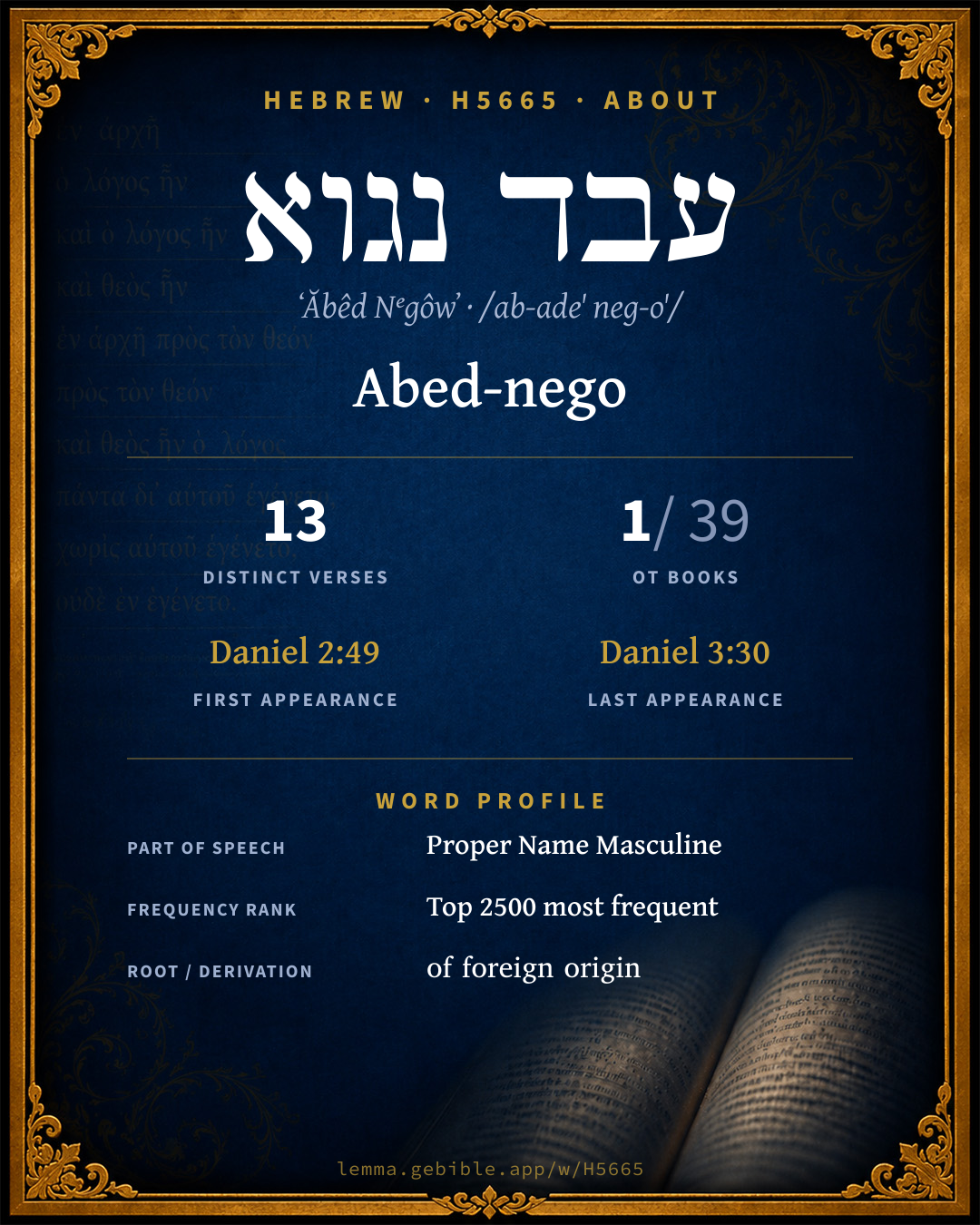
עֲבֵד נְגוֹ
Abed-nego
BDB lists 2 entries for ‘Abed-nego’ fuller range ↓
Full lexicon entry — Brown-Driver-Briggs (BDB)
From Brown-Driver-Briggs (BDB)
Where this word appears
Grammar key — what these labels mean
Part of speech
- Noun
- A naming word — a person, place, thing, or idea.
Noun type
- Proper
- A name of a specific person, place, or people (e.g. Abraham, Zion, Israel).
Every verse where H5665 appears — 13 distinct verses across 1 book. Click any verse to open its interlinear word-by-word view. Verse text shown in the World English Bible for context — . Each verse’s Hebrew form is shown with its reference; the English is not keyword-highlighted, since the data carries no word-level English alignment. Use “Compare translations” on any verse to read it across multiple English versions. This concordance covers the Hebrew Bible; Septuagint (Greek Old Testament) occurrences are not indexed here.
Daniel 13 verses
- Daniel 2:49 וַ/עֲבֵ֣ד נְג֑וֹ conj + n Proper n Proper Daniel requested of the king, and he appointed Shadrach, Meshach, and Abednego, over the affairs of the province of Babylon: but Daniel was in the gate of the king.
- Daniel 3:12 וַ/עֲבֵ֣ד נְג֑וֹ conj + n Proper n Proper There are certain Jews whom you have appointed over the affairs of the province of Babylon: Shadrach, Meshach, and Abednego; these men, O king, have not regarded you: they don't serve your gods, nor worship the golden image which you have set up.
- Daniel 3:13 וַ/עֲבֵ֣ד נְג֑וֹ conj + n Proper n Proper Then Nebuchadnezzar in [his] rage and fury commanded to bring Shadrach, Meshach, and Abednego. Then they brought these men before the king.
- Daniel 3:14 וַ/עֲבֵ֣ד נְג֑וֹ conj + n Proper n Proper Nebuchadnezzar answered them, Is it on purpose, Shadrach, Meshach, and Abednego, that you don't serve my god, nor worship the golden image which I have set up?
- Daniel 3:16 וַ/עֲבֵ֣ד נְג֔וֹ conj + n Proper n Proper Shadrach, Meshach, and Abednego answered the king, Nebuchadnezzar, we have no need to answer you in this matter.
- Daniel 3:19 וַ/עֲבֵ֣ד נְג֑וֹ conj + n Proper n Proper Then was Nebuchadnezzar full of fury, and the form of his visage was changed against Shadrach, Meshach, and Abednego: [therefore] he spoke, and commanded that they should heat the furnace seven times more than it was wont to be heated.
- Daniel 3:20 וַ/עֲבֵ֣ד נְג֑וֹ conj + n Proper n Proper He commanded certain mighty men who were in his army to bind Shadrach, Meshach, and Abednego, [and] to cast them into the burning fiery furnace.
- Daniel 3:22 וַ/עֲבֵ֣ד נְג֔וֹ conj + n Proper n Proper Therefore because the king's commandment was urgent, and the furnace exceeding hot, the flame of the fire killed those men who took up Shadrach, Meshach, and Abednego.
- Daniel 3:23 וַ/עֲבֵ֣ד נְג֑וֹ conj + n Proper n Proper These three men, Shadrach, Meshach, and Abednego, fell down bound into the midst of the burning fiery furnace.
- Daniel 3:26 וַ/עֲבֵד נְג֛וֹ וַ/עֲבֵ֥ד נְג֖וֹ conj + n Proper n Proper conj + n Proper n Proper Then Nebuchadnezzar came near to the mouth of the burning fiery furnace: he spoke and said, Shadrach, Meshach, and Abednego, you servants of the Most High God, come forth, and come here. Then Shadrach, Meshach, and Abednego came forth out of the midst of the fire.
- Daniel 3:28 וַ/עֲבֵ֣ד נְג֔וֹ conj + n Proper n Proper Nebuchadnezzar spoke and said, Blessed be the God of Shadrach, Meshach, and Abednego, who has sent his angel, and delivered his servants who trusted in him, and have changed the king's word, and have yielded their bodies, that they might not serve nor worship any god, except their own God.
- Daniel 3:29 וַ/עֲבֵ֣ד נְג֔וֹא conj + n Proper n Proper Therefore I make a decree, that every people, nation, and language, which speak anything evil against the God of Shadrach, Meshach, and Abednego, shall be cut in pieces, and their houses shall be made a dunghill; because there is no other god who is able to deliver after this sort.
- Daniel 3:30 וַ/עֲבֵ֥ד נְג֖וֹ conj + n Proper n Proper Then the king promoted Shadrach, Meshach, and Abednego in the province of Babylon.
About this entry
At a glance — auto-summarized from this page’s data, not written by a person. Every figure links to its source below. This summary describes the numbers; it doesn’t interpret them.
At its core, עבד נגוא (ʻĂbêd Nᵉgôwʼ) means “Abed-nego.” Its uses cluster heavily in Daniel (100% of all occurrences). Spanning 13 verses in 1 book, it ranks among the uncommon words of the Hebrew Bible. It first appears in Daniel 2:49. Each statement above links to its evidence; the full detail follows below.
Gloss history
Strong's 1890 vs modern scholarship
About this word
Strong's H5665 catalogs a Hebrew word from the Hebrew Old Testament.
These counts are not copied from any lexicon or concordance. They are computed here, from the morphology-tagged Hebrew Old Testament. What Lemma adds →
- 13
- distinct verses
- The word appears in 13 distinct verses.
- 1 / 39
- OT books
- The word appears in 1 of 39 Old Testament books.
- #1,190
- by frequency
- Top 2500 most frequent Hebrew words (rank 1,190 of 8,640 Hebrew words by occurrence).
View all 13 occurrences in the concordance →
Most concentrated in
- Daniel 13 verses 100%
By section of the Old Testament
By traditional corpus
Conventional, traditional groupings — biblical authorship is debated, so this is a traditional corpus grouping, not an authorship claim. Each share is this word’s portion of its verses in that division of the Hebrew canon. Each figure is a share of the word’s 13 distinct verses.
- Writings (Ketuvim) 13 verses · 100%
How translations render this word
Counts come from each version’s own published word-to-Strong’s tagging or interlinear alignment — an approximate guide to how each version renders this word, not a word-level alignment the data otherwise carries. Because each total is that version’s own tagged count, the per-version totals vary from one another and need not match the appearance or distinct-verse counts above. These counts may also differ from a printed concordance because Lemma counts each distinctly tagged rendering and does not collapse phrase taggings into a single head-word total. This is a fixed set of word-tagged versions (KJV, ASV, BSB, ULT) and does not change with the reading translation you choose elsewhere. Each version’s license is shown beside its name below (and on Sources).
- King James Version: Abednego 14×
- American Standard Version: Abed-nego 14×
- Berean Standard Bible: Abednego 14×
- unfoldingWord Literal Text: Abednego 28×
King James Version Public Domain
Renders H5665 across 14 tagged occurrences — most commonly:
American Standard Version Public Domain
Renders H5665 across 14 tagged occurrences — most commonly:
Berean Standard Bible Public Domain
Renders H5665 across 14 tagged occurrences — most commonly:
unfoldingWord Literal Text CC BY-SA 4.0
Renders H5665 across 28 tagged occurrences — most commonly:
Senses in BDB
The 2 senses BDB distinguishes for this word, in lexicon order (not ranked by frequency or importance). The full entry — with sub-senses — is in the Lexicon Entry tab.
- Abed-nego = "servant of Nebo"
- the godly friend of Daniel who Nebuchadnezzar renamed Abednego…
Word origin
עֲבֵד נְגוֹ n.pr.m. comrade of Daniel
— Brown-Driver-Briggs (Oxford 1906, public domain), digitized via Sefaria, supplemented by the OpenScriptures HebrewLexicon (CC BY 4.0). See Sources.
Origin: of foreign origin
Jastrow Dictionary
A second Hebrew/Aramaic lexicon for comparison, covering Aramaic and post-biblical (Talmudic, Targumic, Midrashic) usage that the biblical-Hebrew BDB does not. Matched by lemma rather than by Strong’s number, so a lemma may carry more than one Jastrow headword (shown separately below), and the entries cover usage well beyond the Bible.
עֲבַד I
- (corresp. to h. עָשָׂה)
- 1. to do, labor; to make; to act. Targ. Gen. I, 7. Ib. XXXI, 26; a. v. fr.—Ber. 60ᵇ לעולם … כל דעביד רחמנא לטב Ms. M. (ed. לטב עביד; v. Rabb. D. S. a. l. note 3) man should train himself always to say, Whatever the Merciful One does, is for good; Yalk. Job 893 כל … לטב עביד. Tem. 4ᵇ אי עביד מהני, v. הֲנִי. Yeb. 37ᵃ מי עָבוּד רבנן תקנתא וכ׳ (not עביד) have the Rabbis adopted special measures for priests &c.? Ib. עַבְדִּינָן כרבנן we act (decide) in accordance with the opinion of the Rabbis. Keth. 60ᵇ לא עַבְדֵי נשי דחנקן וכ׳ women will not do such a thing as strangling their children. Kidd. 50ᵃ לא ע׳ אינש דמשוי וכ׳ a man will not declare himself a wrongdoer; a. v. fr.
- 2. to do, fare, prosper. Lev. R. s. 5, end מה את עָבֵיד how art thou?; ומה ארעא עֲבִידָא and how does the field fare?; מה תורין עַבְדִין how are the oxen? Ib. ע׳ לב טב he assumes cheerfulness. Gen. R. s. 13 כל שיחתן … עַבְדַּת ארעא all the talk of people turns on the land (material prosperity): ‘the land is doing well’ (crops promise to be good); ‘the land is not doing well’; a. fr.
- 3. to spend time. Y. Shebi. VIII, 38ᵇ top עביד טמיר במערתא וכ׳ he remained hidden in a cave &c.; ib. IX, 38ᵈ. Y. Shek. V, 48ᵈ top עַבְדַת טמירא וכ׳ she (the ass) remained hidden with them &c.; Gen. R. s. 60 עבדת גבון; a. fr.—Part. pass. עָבִיד; f. עֲבִידָא made, liable to, likely, used to. Y. Peah III, 17ᵈ bot. היך ע׳ how did it happen (i.e. in what case would it make a practical difference for the slave)? R. Hash. 22ᵇ, a. e. מילתא דע׳ לאיגלויי, v. גְּלֵי. Shebu. 46ᵃ, v. גְּזַם; a. fr.
- 1. to make, produce. Targ. O. Ex. XXXII, 10 אַעַבֵּיד ed. Berl. (oth. אַעֲבֵיד; Y. אֶעְבַּד). Ib. XXX, 37; a. fr.—Lev. R. s. 28, end, v. infra.
- 2. to cause to prosper. Gen. R. s. 13 כל תפלתן … מרי תַעֲבִיד ארעא יכ׳ all the prayers of men turn on the earth (mundane affairs): Lord, make the land (crop) thrive, make the land prosper; a. e.
- 3. to work through. Part. pass. מְעַבַּד, מְעַבְּדָא. B. Mets. 116ᵇ טינא דמע׳ thoroughly kneaded clay.
- to be done; to be made, become. Targ. Gen. XXIX, 26. Targ. Koh. VIII, 4. Targ. Ps. LXII, 4; a. fr.—Lam. R. to II, 2 בעית לאִיעַבְדָּא וכ׳ (not לאיבדא, לעיבדא) dost thou want to be made a senator? Lev. R. s. 28, end מאן דעַבֵּיד … אתע׳ וכ׳ he who made the comes …, is now to become a bather &c.; Esth. R. to VI, 10 האי גברא מְעַבֵּיד … עביד בלן (corr. acc.); a. fr. [Zeb. 75ᵇ דאיעבד, read: דאיערוב, v. עֲרַב I.]—V. דִּיעֲבַד.
עָבַד
- (b. h.) [to work]
- 1. to serve, work for. Gitt. IV, 5 עוֹבֵד את רבו וכ׳ works one day for his master, and one for himself; a. fr. Esp. to do priestly service. Ḥull. 24ᵇ אחיו הכהנים … לַעֲבוֹד וכ׳ his brother priests allow him not to serve, until he is twenty years of age.
- 2. to prepare; to till the ground; to dress (hides). Gen. R. s. 22 קין עובד אדמה Cain the tiller of the ground. Y. Ab. Zar. II, 41ᵇ bot. גוי עוֹבְדָן; Tosef. ib. IV (V), 10 עוֹבְדוֹ, v. דָּבַב I; (Bab. ib. 33ᵃ עיבדן). Y. Sabb. I, 4ᵇ top נתן כלים … ומצאו עובד בו וכ׳ if one gave a gentile garments to wash, and found him working at them on the Sabbath; a. fr.—Part. pass. עָבוּד, pl. עֲבוּדִין dressed, v. infra.
- 3. (v. עֲבוֹדָה) to use esp. for idolatrous purposes; to worship. Tem. VI, 1, v. infra. Ab. Zar. III, 7 (defining אשרה) כל שעוֹבְדִין אותה a tree which is itself worshipped (not one at which idolatrous rites are performed). Ib. הואיל … הן עובדין since they worship merely the image (under the tree). Snh. VII, 6 העובד ע"ז אחד העובד וכ׳ he who worships an idol, whether he goes through the regular forms of that particular worship (v. ib. 60ᵇ), or sacrifices &c. Ab. Zar. III, 5 העכומ"ז העובדין וכ׳ as to idolaters that worship mountains and hills (as deities), they (the territories) may be used, but what is on them is forbidden. Ib. 45ᵇ אילן … ולבסוף עֲבָדוֹ if one planted a tree and afterwards made it a subject of worship. Ib. 46ᵃ ועוֹבְדֵיהֶן בסייף and those (Jews) who worship them are put to death by the sword; Tosef. ib. VI (VII), 8. Sabb. 56ᵇ אילמלי לא … ולא עָבְדוּ ישראל ע"א had David not listened to evil gossip (against Mephibosheth), … Israel would not have worshipped idols (under Jeroboam). Ib. 105ᵇ עד שיאמר לו עֲבוֹד ע"ז until he (the tempter) finally tells him, worship idols; Tosef. B. Kam. IX, 31. Ḥull. 13ᵇ נכרים שבח"ל לאו עוֹבְדֵי ע"א הן gentiles outside of Palestine must not be considered as idolaters; a. v. fr.
- 1. to be prepared, dressed. Tosef. B. Kam. l. c. עורות שאינן נֶעֱבָדִין ed. Zuck. (oth. ed. עֲבוּדִין) undressed hides; a. e.
- 2. to be used, esp. for illicit purposes; to be worshipped. Tem. l. c. המוקצה והנ׳ the animal designated for idolatrous purposes and the one used; expl. כל שעובדין אותו whatever they may use it for ((e.g. yoking the ox, shearing the sheep for the benefit of idolatrous temples). Ib. 28ᵃ נעבדה בהן עבירה an illicit act has been done with them (by coupling them); ib. לא נֵתְעַבְּדָה בה עבירה no sinful act has been done with it (by which to unfit it for the altar). Ab. Zar. 46ᵇ יש נ׳ במחובר אצל גבוה does the law forbidding the use in divine worship of objects which have been used for idolatrous purposes include things fixed in the ground? Ib. יש שינוי בנ׳ does change of form restore to legitimate use objects otherwise forbidden on account of their use in connection with idolatry? a. fr.
- same, v. supra.
- to enslave, oppress. Yalk. Ex. 162 הֶעֱבִידוֹ בכל וכ׳ he (Esau) oppressed him with all sorts of troubles.
- to prepare, esp. to dress hides. Sabb. VII, 2 (among the labors forbidden on the Sabbath) והמְעַבֵּד את עורו dressing the hide of the deer (to fit it for parchment). Ib. 75ᵇ חייב משום מעבד is guilty of a Sabbath offence coming under the category of tanning. Gitt. 54ᵇ גוילין … לא עִיבַּדְתִּין לשמן I did not prepare the parchment sheets with the proper intention; a. fr.
עֶבֶד
- preced. wds.) slave, servant. Kidd. 20ᵃ הקונה ע׳ עברי וכ׳ he who buys a Hebrew slave, has, so to say, bought a master over himself. Sabb. 89ᵃ כלום יש ע׳ שנותן וכ׳ dare a servant salute his master (first)? Snh. 58ᵇ (ref. to Prov. XII, 11) אם … כע׳ לאדמה וכ׳ if a man makes himself a slave to the soil, he will be satisfied with bread &c. Kidd. I, 3 ע׳ כנעני נקנה וכ׳ a Canaanite (gentile) slave is acquired by money, by deed &c. Ib. III, 13 ממזר … הולד ע׳ if a bastard marries a slave, the child is a slave; הרי זה ע׳ ממזר the child is a bastard slave (subject to the disabilities of both). Shebu. 47ᵇ ע׳ מלך כמלך a king’s officer is like a king (the inferior person is raised by association with a superior); a. v. fr.—Pl. עֲבָדִים. Kidd. 22ᵇ (ref. to Lev. XXV, 55) כי לי … ולא ע׳ לע׳ ‘the children of Israel are my servants’, but they must not make themselves servants of servants (of human beings). Ab. I, 3 אל תהיו כע׳ וכ׳ be not like the servants that wait upon their master for the sake of getting their fare (reward), v. פְּרָס; a. fr. e.g. Proverbs 12:11
עֲבַד
- 1. same. Targ. Gen. IX, 25 (O. ed. Berl. עַבַד; ed. Vien. עֶבֶד). Ib. 26; a. fr.—Gen. R. s. 86 ע׳ זבין … ע׳ לתרויהון a slave (Potiphar) buys, the son of a handmaid (the Ishmaelite) sells, and the free man (Joseph) is the slave of both; Koh. R. to X, 7. Gitt. 13ᵃ, a. e. ע׳ בהפקרא וכ׳, v. הֶפְקֵרָא; a. fr.—[Y. Ber. IV, 7ᶜ נפק ע׳, read: עוּבְדָּא.]—Pl. עַבְדִּין, עַבְדַּיָּא, עַבְדֵּי. Targ. Gen. XXIV, 25. Targ. Is. LIV, 17. Targ. Prov. XII, 9; a. fr.—B. Kam. 97ᵃ הוה תקיף ע׳ דאינשי וכ׳ used to seize slaves of men against whom he had a claim &c. Kidd. 70ᵃ רגיל דקרי אינשי ע׳ he is in the habit of calling people slaves; a. fr.
- 2. worshipper. Ned. 62ᵇ ע׳ דנורא fire-worshipper (Geber); a. e.
A Dictionary of the Targumim, the Talmud Babli and Yerushalmi, and the Midrashic Literature (Marcus Jastrow; London, Luzac, 1903) — Public Domain. Digitized via Sefaria. Digitized via Sefaria. Full attribution on Sources.
Forms in the corpus
The 8 distinct written forms H5665 takes in the Hebrew Bible, most frequent first — each parse links to that state’s occurrences in the concordance. Hebrew forms include their vowel points and cantillation, so a single lemma takes many written forms.
| Form | Parsing | Example | Uses |
|---|---|---|---|
| וַ/עֲבֵ֣ד | Noun, Proper | Daniel 2:49 | 11 |
| נְג֑וֹ | Noun, Proper | Daniel 2:49 | 7 |
| נְג֔וֹ | Noun, Proper | Daniel 3:16 | 3 |
| וַ/עֲבֵ֥ד | Noun, Proper | Daniel 3:26 | 2 |
| נְג֖וֹ | Noun, Proper | Daniel 3:26 | 2 |
| וַ/עֲבֵד | Noun, Proper | Daniel 3:26 | 1 |
| נְג֔וֹא | Noun, Proper | Daniel 3:29 | 1 |
| נְג֛וֹ | Noun, Proper | Daniel 3:26 | 1 |
Same root — word family
Other BDB entries built from the same root as H5665, grouped by Strong’s listed origin. These share a root / origin per the lexicon — not necessarily a shared meaning. Each links to that word’s own entry.
Proper names from this root
People and places named from this root — a name, not an additional meaning of the word.
Compare all same-root words → 1 of the same-root words is a proper name (a person or place). They share a root, not necessarily a meaning.
Bible dictionary
Public-domain dictionary articles matched to this entry by name (Abed-nego). A biblical name can be shared by more than one person or place, so an article may treat several.
Easton's Bible Dictionary · M. G. Easton, 1897
Servant of Nego=Nebo, the Chaldee name given to Azariah, one of Daniel's three companions (Dan. 2:49). With Shadrach and Meshach, he was delivered from the burning fiery furnace (3:12-30).
Smith's Bible Dictionary · William Smith, 1863
(i.e. servant of Nego, perhaps the same as Nebo), the Chaldean name given to Azariah, one of the three friends of Daniel, miraculously save from the fiery furnace. Dan. 3. (B.C. about 600.)
Hitchcock's Bible Names Dictionary · Roswell D. Hitchcock, 1869
servant of light; shining
Classic public-domain reference works; full attribution on Sources.
Septuagint verse parallels
This word appears in 13 verses that also exist in the Greek Old Testament (Septuagint), out of the 13 Hebrew verses it occurs in. You can read those verses in Greek by switching the Old Testament edition to the Septuagint.
Read these verses in the Septuagint
This is a verse-level parallel only — the same verses exist in both the Hebrew and Greek Old Testaments. No word-level Hebrew↔Greek correspondence is claimed: the data carries no such alignment, so no Greek word is shown as this Hebrew word’s translation. Coverage is not total — the Septuagint omits the deuterocanon and renumbers the Psalms, so some Hebrew verses have no direct Greek parallel.