Colossians 2:22

Greek (Tischendorf 8th ed.) Colossians 2:22 appears in the Greek New Testament. The text above is from the Tischendorf 8th edition. Each word links to its Strong’s number and a concise gloss. Click any word for its full Thayer’s Greek Lexicon entry.
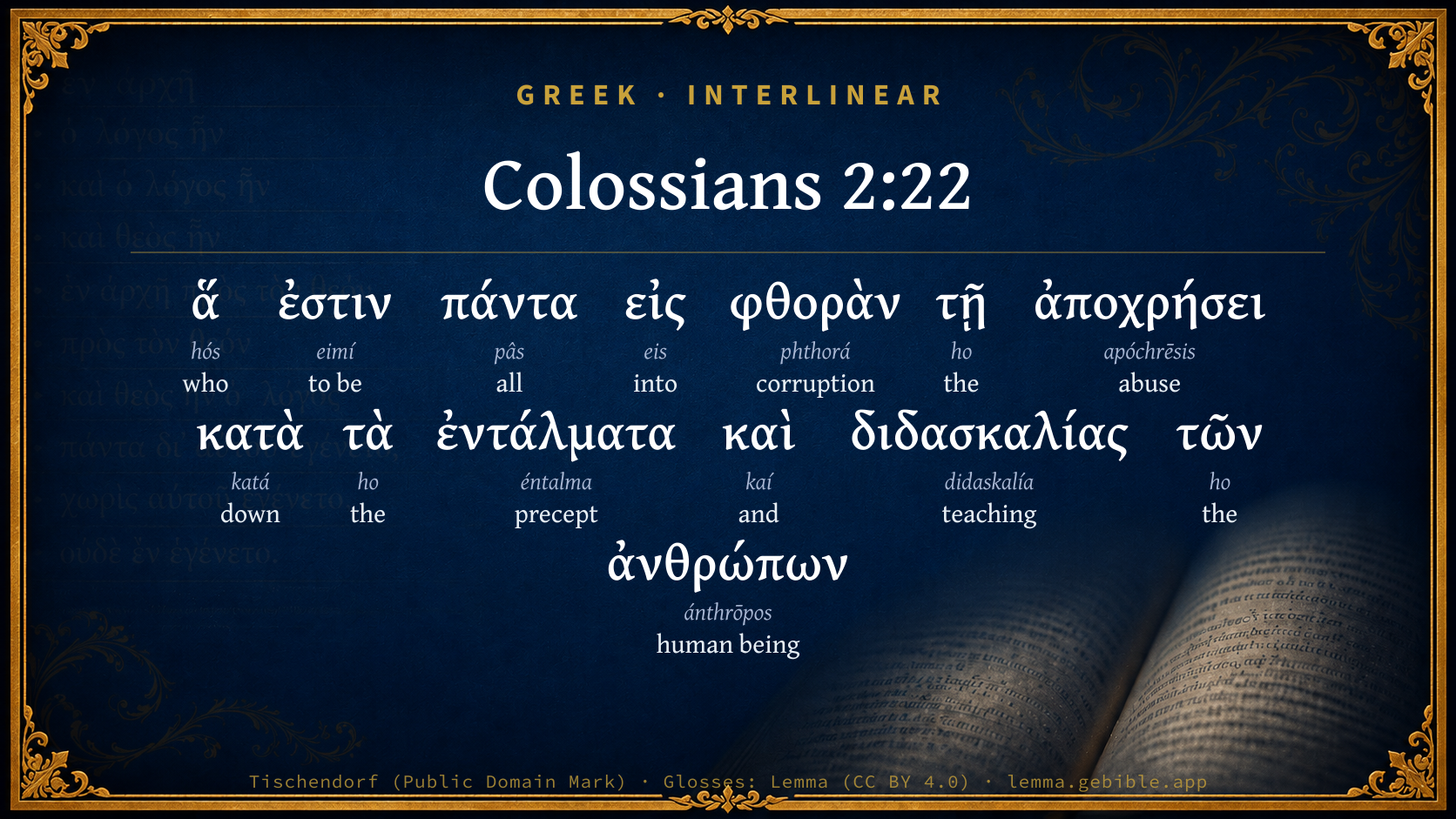
Download image
Cite this verse

Colossians 2:22 (World English Bible). Public Domain. Lemma interlinear Bible study tool, https://lemma.gebible.app/v/colossians/2/22.

Show BibTeX & RIS
BibTeX
RIS
English Translation
(all of which perish with use), according to the precepts and doctrines of men?
World English Bible · Public Domain
Highlights
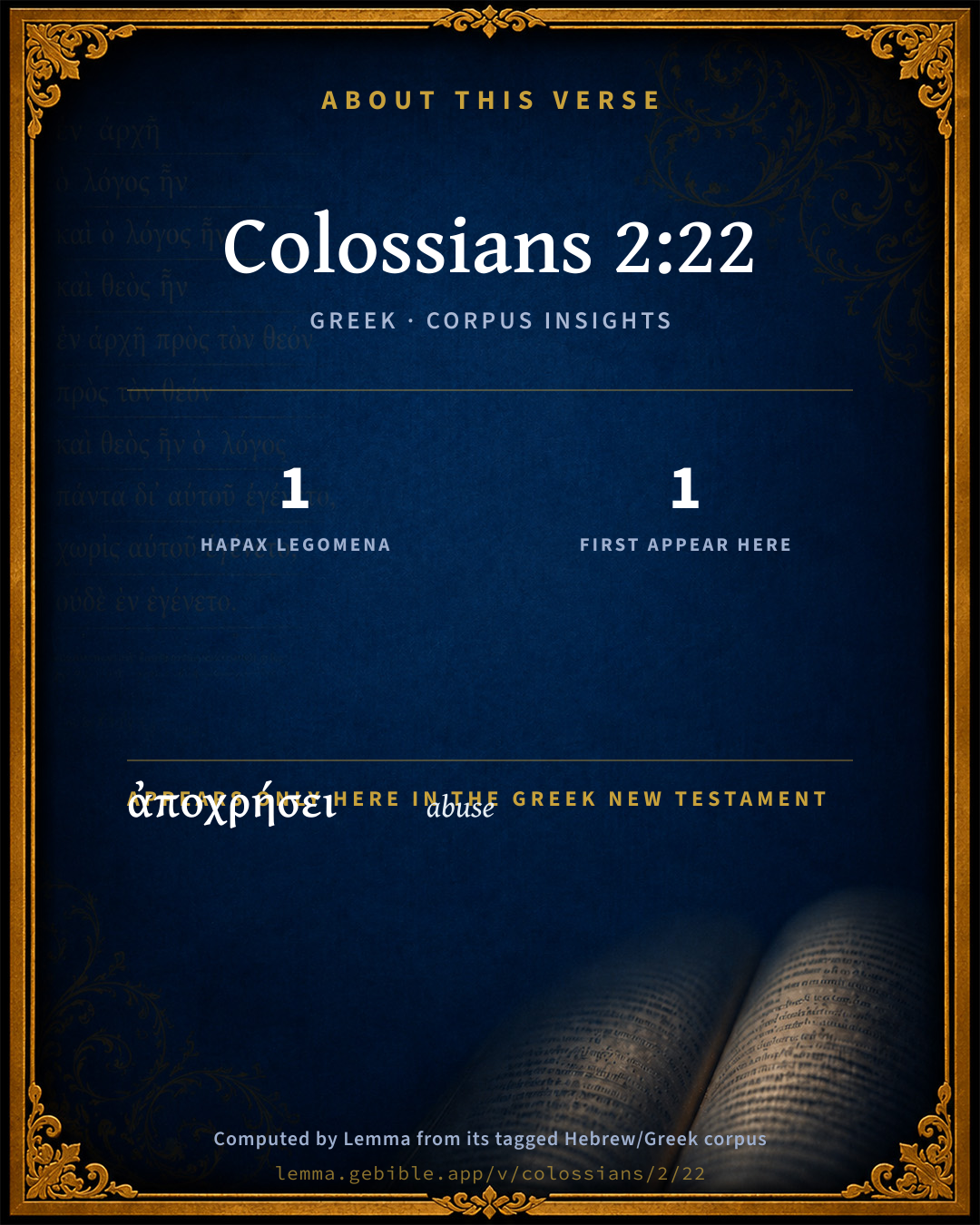
  • 1 hapax legomenon — only here in the Greek New Testament
  • 1 first appearance in the Greek New Testament
Full analysis ↓
Download a study sheet

One document with this verse’s original text, its word-by-word gloss line, the meaning frame, cross-references with their text, attributed commentary, and full source and license credits — printable, and it pastes into notes with its structure intact.

This verse Autodidact and up

Study sheet (.html) Plain text (.txt)

A passage Seminary Student

Up to 50 verses in one chapter. A passage sheet keeps up to 6 commentary sources and 12 cross-references per verse, in the order this page ranks them, and says so on the sheet whenever that leaves anything out. Ask for a single verse and you get the Autodidact verse sheet above.

Everything on this page stays free to read, with no account — the sheet is a download of what is already on screen, not access to it.

Want to remove ads? Support Godless Engineer
Compare translations 3

The same verse in 3 English versions, stacked beneath the original-language interlinear above. Click any original word for its lexicon entry.

Each is an independent rendering of the whole verse — the interlinear is not word-aligned to these translations.

Highlighted words mark where these versions differ — a whole-verse word diff, not a word-by-word alignment.

  • World English Bible Public Domain
    (all of which perish with use), according to the precepts and doctrines of men?
  • King James Version Public Domain
    Which all are to perish with the using;) after the commandments and doctrines of men?
  • unfoldingWord Literal Text CC BY-SA 4.0
    which are all for destruction with the use, according to the commands and teachings of men;

unfoldingWord Literal Text — © unfoldingWord, licensed CC BY-SA 4.0. Word-aligned USFM3 via Door43 (git.door43.org/unfoldingWord/en_ult).

Versions to compare (up to 4)

3 of 4 selected

Show all 19 translations

Every available English version of this verse, each an independent rendering of the whole verse.

  • World English Bible Public Domain
    (all of which perish with use), according to the precepts and doctrines of men?
  • Berean Standard Bible Public Domain
    These will all perish with use, because they are based on human commands and teachings.
  • Majority Standard Bible Public Domain
    These will all perish with use, because they are based on human commands and teachings.
  • King James Version Public Domain
    Which all are to perish with the using;) after the commandments and doctrines of men?
  • American Standard Version (1901) Public Domain
    (all which things are to perish with the using), after the precepts and doctrines of men?
  • Revised Version (1885) Public Domain
    (all which things are to perish with the using), after the precepts and doctrines of men?
  • Geneva Bible (1599) Public Domain
    Which al perish with the vsing, and are after the commandements and doctrines of men.
  • Douay-Rheims (1899) Public Domain
    Which all are unto destruction by the very use, according to the precepts and doctrines of men.
  • Young's Literal Translation Public Domain
    which are all for destruction with the using, after the commands and teachings of men,
  • Literal Standard Version CC BY-SA 4.0
    which are all for destruction with the using, after the commands and teachings of men,
  • Unlocked Literal Bible CC BY-SA 4.0
    All these things will perish with use, according to the instructions and teachings of men.
  • unfoldingWord Literal Text CC BY-SA 4.0
    which are all for destruction with the use, according to the commands and teachings of men;
  • Darby Bible Public Domain
    (things which are all for destruction in the using [of them]:) according to the injunctions and teachings of men,
  • World Messianic Bible Public Domain
    (all of which perish with use), according to the precepts and doctrines of men?
  • Webster's Bible Public Domain
    Which all are to perish with the using;) according to the commandments and doctrines of men?
  • Free Bible Version CC BY-SA 4.0
    These commands refer to things that don't last since they're used up, and they're based on man-made requirements and teachings.
  • Bible in Basic English Public Domain
    (Rules which are all to come to an end with their use) after the orders and teaching of men?
  • Text-Critical English NT CC BY 4.0
    Such regulations are based on the commandments and doctrines of men, and apply to things that will all decay with use.
  • Tyndale New Testament (1534) Public Domain
    which all perysshe with the vsinge of the and are after the commaundmentes and doctrins of men

Literal Standard Version (2020), Covenant Press — licensed CC BY-SA 4.0. Text via the HelloAO Bible API (eBible.org). Unlocked Literal Bible (unfoldingWord) — licensed CC BY-SA 4.0. Text via the HelloAO Bible API (eBible.org). unfoldingWord Literal Text — © unfoldingWord, licensed CC BY-SA 4.0. Word-aligned USFM3 via Door43 (git.door43.org/unfoldingWord/en_ult). Free Bible Version, Dr. Jonathan Gallagher — licensed CC BY-SA 4.0. Text via the HelloAO Bible API (eBible.org).

Word by word

More ways to search: Search by grammar → Find every occurrence → Compare this word →

Practice this passage: Drill this verse → Learn its vocabulary →

About this verse

These counts appear in no published source. They are computed here, from the morphology-tagged text and Lemma’s own curated glosses. What Lemma adds →

14
words
12
distinct lemmas
Pauline Epistles
section

Notable vocabulary

1 hapax legomenon — a word that appears only here in the entire Greek New Testament:

  • ἀποχρήσει abuse G671

First appearance in Scripture

This word makes its first canonical appearance in the Greek New Testament here:

  • ἀποχρήσει abuse G671

Shared distinctive vocabulary

ἐντάλματα precept G1778 occurs in 3 verses of the Greek New Testament. Also found in:

Repetition

A word recurs within this verse:

Cross-references

10

Topical passages linked to Colossians 2:22 in the Treasury of Scripture Knowledge — connected by theme and wording, ordered by reader-vote popularity; previews shown in the World English Bible.

  • Isaiah 29:13 The Lord said, Because this people draw near [to me], and with their mouth and with their lips to honor me, but have removed their heart far from me, and their fear of me is a commandment of men which has been taught [them];
  • Titus 1:14 not paying attention to Jewish fables and commandments of men who turn away from the truth.
  • Mark 7:18–19 He said to them, "Are you thus without understanding also? Don't you perceive that whatever goes into the man from outside can't defile him,
  • 1 Corinthians 6:13 "Foods for the belly, and the belly for foods," but God will bring to nothing both it and them. But the body is not for sexual immorality, but for the Lord; and the Lord for the body.
  • Mark 7:7–13 But in vain do they worship me, Teaching as doctrines the commandments of men.'
  • Matthew 15:3–9 He answered them, "Why do you also disobey the commandment of God because of your tradition?
  • John 6:27 Don't work for the food which perishes, but for the food which remains to eternal life, which the Son of Man will give to you. For God the Father has sealed him."
  • Isaiah 29:18 In that day shall the deaf hear the words of the book, and the eyes of the blind shall see out of obscurity and out of darkness.
  • Daniel 11:37 Neither shall he regard the gods of his fathers, nor the desire of women, nor regard any god; for he shall magnify himself above all.
  • Revelation 17:18 The woman whom you saw is the great city, which reigns over the kings of the earth."

Cross-references courtesy of OpenBible.info (CC BY 4.0).

Commentary

Notes on Colossians 2:22 from classic Christian and Jewish commentators (each source and its license shown beneath its notes). The classic Christian expositions comment on the surrounding passage and are grouped to its opening verse, so a note may address several verses; the Jewish commentaries on the Tanakh (Rashi and others) are per-verse, so they appear only where the commentator wrote on this verse.

Lemma curates 59 commentaries, every one of them public domain or Creative Commons licensed, each selected and text-cleaned for this edition rather than reprinted as found. About our sources →

Bengel's Gnomon

Johann Albrecht Bengel

Col 2:22. Ἅ ἐστι, which are) Those things, namely, which are touched, tasted, etc.—εἰς φθορὰν, [are to end in destruction] to perish) and which therefore do not defile; 1Co 6:13; the middle of Mat 15:17.—τῇ ἀποχρήσει) in the using up (entire consumption), not strictly so called [not the abuse], but so far as it denotes the use, which is natural, civil, external, truly indifferent, and removed from superstitious fear and severity (rigour).—κατἁ, according to) as the commandments of men are wont to be.—τὰ ἐντάλματα καὶ διδασκαλίας, the commandments and doctrines) Mat 15:9, note.

Bengel's Gnomon of the New Testament — English translation (T&T Clark, Edinburgh, 1860) — public domain. Text from a community e-Sword module.

Meyer's Critical & Exegetical Commentary

Heinrich August Wilhelm Meyer

Col_2:22. We are not to put in a parenthesis μὴ ἅψῃ … ἀποχρήσει (Erasmus Schmid, Heinrichs, and others), but merely ἅ ἐστιν … ἀποχρ. (Griesbach, Lachmann, Scholz, Ewald); for the construction proceeds uninterruptedly to θίγῃς, is then only broken by the judgment ἅ ἐστι π. εἰς φθ. τ. ἀποχρ., and thereafter runs on with κατὰ τὰ ἐντάλμ. κ.τ.λ.

ἅ ἐστι … ἀποχρ. is an inserted[131] judgment of the apostle anent that which the false teachers interdicted by μὴ ἅψῃ κ.τ.λ.: which all are destined to destruction[132] through the using,from which it is to be rendered palpably apparent, how preposterous it is to make such things a condition of eternal bliss by urging abstinence from them. We have here a similar line of argument to that in Mat_15:17. Comp. 1Co_6:13. Hence φθορά is meant to denote the perishing which takes place through the natural dissolution (digestion) of the meats and drinks; and with this conception quite accords the purposely-chosen compound τῇ ἀποχρήσει, which, like abusus, indicates the using up, the consuming (Plut. Mor. p. 267 E; Davis, ad Cic. N. D. iv. 60). So it is unanimously explained by Chrysostom, Theodoret (εἰς κόπρον γὰρ ἅπαντα μεταβάλλεται), Oecumenius (φθορᾷ γὰρ, φησιν, ὑπόκειται ἐν τῷ ἀφεδρῶνι), Theophylact, Erasmus, Luther, Beza, Calvin, Wolf, Grotius, Michaelis, and many others, including Bähr, Steiger, Olshausen, Ewald, Bleek, Hofmann. But, according to others, who likewise regard ἅ … ἀποχρ. as a parenthetical judgment, the ἅ is to be referred to the prohibitions, ἀποχρ. to the use, i.e. the following of them, and φθορά (comp. Gal_6:8) to the destruction of the persons who follow them: all which δόγματα by their use tend to (eternal) destruction. So Ambrosiaster, Augustine, Cornelius a Lapide, Calixtus, Heumann, Junker. Erroneously; because ἀπόχρησις never means merely use, and even the simple χρῆσις, in the sense of τήρησις, would be an unsuitable designation; in fact, the entire addition, by the use, would be utterly superfluous. On account of ἀποχρ., the expedient must also be rejected, on linguistic grounds, that ἅ … ἀποχρ. are still words of the false teachers, which Paul repeats with irony: omnia haec (vetita) usu suo perniciem afferunt, Heinrichs, comp. Schenkel. By others, who, like Tischendorf, have deleted the marks of parenthesis, the whole down to ἀνθρώπων is taken together: all this, which the false teachers forbid, tends through the using to (moral, de Wette) destruction, si sc. ex doctorum Judaicorum praeceptis et doctrinis hac de re judicium feratur,[133] Kypke; so also Vatablus, Storr, Flatt, Böhmer, de Wette, Baumgarten-Crusius (Huther is undecided between this explanation and ours). But in opposition to this it may be urged, that the compound ἀποχρήσει would be entirely without a motive, since not the consumption, but the use at all would be soul-destroying according to the maxims of those people. Our view alone supplies a motive for the use of ἀποχρήσει, and that through the point of its connection with εἰς φθοράν, in which case, however, the object affected by ἈΠΟΧΡ. and ΕἸς ΦΘΟΡ. must be the same (the things forbidden). De Wettes objections are irrelevant, since the thought of the parenthesis ἅ … ἀποχρ. is expressed not strangely, but with Pauline ingenuity, the words ΚΑΤᾺ ΤᾺ ἘΝΤΆΛΜ. Κ.Τ.Λ. annexed to ΔΟΓΜΑΤΊΖΕΣΘΕ are by no means superfluous (see below), nor does this annexation require us to begin the parenthesis with ΜῊ ἍΨῌ and thereby to include heterogeneous elements together; for ΜῊ ἍΨῌ Κ.Τ.Λ. still belongs closely to ΔΟΓΜΑΤ., of which it is the contents, and ΚΑΤᾺ ΤᾺ ἘΝΤΆΛΜ. Κ.Τ.Λ. is then annexed, after the brief incidentally inserted remark, to ΔΟΓΜΑΤ. and its contents (μὴ ἅψῃ κ.τ.λ.).

ΚΑΤᾺ ΤᾺ ἘΝΤΆΛΜΑΤΑ Κ.Τ.Λ.] The article before ἘΝΤΆΛΜ., and extending also to ΔΙΔΑΣΚΑΛ., is generic. The μὴ ἅψῃ κ.τ.λ. was decreed by the false teachers conformably to the commandments and doctrines of men, not in consequence of what God had commanded and taught. This element, annexed to δογματίζ., is by no means superfluous (in opposition to de Wette), since, in fact, ΔΌΓΜΑ in itself is a command generally, and may be one based upon divine authority; it rather serves to bring out with perfect clearness the conflicting relation, in which that δογματίζεσθαι stands to the ἈΠΕΘΆΝΕΤΕ ΣῪΝ ΧΡΙΣΤῷ Κ.Τ.Λ. For what the false teachers decreed was not the prohibitions of meats contained in the law of Moses as such, and these alone (although they too would have been incompatible with the ἈΠΕΘΆΝΕΤΕ ΣῪΝ Χ. Κ.Τ.Λ.), but such as consisted in the human (Essene) definitions, expansions, and amplifications of the former (ΚΑΤᾺ ΤῊΝ ΠΑΡΆΔΟΣΙΝ ΤῶΝ ἈΝΘΡΏΠΩΝ, Col_2:8). It was in this, and not in the mere setting up again of the Mosaic law abolished through Christ (Chrysostom and many others), that the ΔΟΓΜΑΤΊΖΕΣΘΑΙ was regulated by human standard, without the divine authority and warrant. Moreover, διδασκ. is not synonymous with ἐντάλμ., but has a wider sense (in Mat_15:9 and Mar_6:7, the narrower idea comes after as a more precise definition), so that the two together specify the preceptive and generally (καί) the doctrinal standard. Comp. Isa_29:13.

[131] For it is only an incidental observation in opposition to the above δογματίζεσθαι; the main ground of opposition to the latter lies in εἰ ἀπεθάν. σὺν Χ.

[132] ἐστὶν εἰς φθοράν, it serves for destruction, i.e. it serves for the purpose of being destroyed. See generally Winer, p. 173 [E. T. 229]; Buttmann, Neut. Gr. p. 131 [E. T. 150 f.]. Comp. Wis_4:18; Sir_34:10; Jdt_5:21; Jdt_5:24; Jdt_8:22.

[133] Similarly Dalmer, who, however, takes τῇ ἀποχρ. in the sense of abuse, joining it immediately to κατὰ τὰς διδασκ. κ.τ.λ. But while ἀποχρῆσθαι (Dem. 215. 8; Herodian, v. 1. 13) is found in the sense of abuse (καταχρῆσις, παραχρῆσις), ἀποχρῆσις is not, though it was so taken by Erasmus Schmid, Schoettgen, Zachariae, as also by Grimm in his Lexicon.

Meyer — Critical and Exegetical Commentary on the New Testament — English translation by Peter Christie, edited by Frederick Crombie (T&T Clark, 1880) — public domain. Text from a community e-Sword module.

Expositor's Greek Testament

ed. W. Robertson Nicoll

Col 2:22 . ἅ ἐστιν πάντα εἰς φθορὰν τῇ ἀποχρήσει . Augustine and Calvin took ἅ as meaning the ordinances referred to in Col 2:20 , and explained the words as Paul’s refutation, “all which ordinances lead in their use to spiritual destruction”. But ἀποχ . means much more than use, it means abuse or using up; and ἅ refers more naturally to the prohibited things than to the prohibitions; while the sense would be complete if τῇ ἀποχ . were omitted. A much more attractive interpretation is that of De Wette (followed by Grimm, Ol. and others). He regards the words as a continuation of the injunctions of the false teachers, “all which things tend to spiritual destruction in the abuse”. The sense will then be that certain meats and drinks are forbidden, because the abuse of them leads to spiritual destruction. Lightfoot says “this interpretation, however, has nothing to recommend it”. This is perhaps too strong, for on the usual view κατὰ … ἀνθρώπων comes in awkwardly, as its place is at the end of the prohibitions. But it must be rejected. The translation is a little strained, and it would have been much simpler to say “the use of these things is destructive”. It is therefore best to adhere to the common view, and translate “all which things are to perish with the using”. The meaning is, then, that with consumption the forbidden meats and drinks were destined to perish. This interpretation has the advantage of being forcible, for it throws one side of Paul’s refutation into a terse parenthesis. His argument is, these meats and drinks, on which the false teachers lay such stress, are of no such importance, for in the nature of things they perish in their very use. If we can annihilate them they cannot rule us. The words should be included in brackets. κατὰ τὰ ἐντὰλματα καὶ διδασκαλίας τῶν ἀνθρώπων : to be taken with δογματίζεσθε . This states the other side of Paul’s refutation. The precepts are not only concerned with things destined to perish, they have their source in human commandments. Lightfoot aptly points out the striking parallel between these words of Paul and those of Christ on defilement (Mar 7 ). Both argue from the perishableness of meats, both treat these things as indifferent in themselves, and both quote Isaiah. Even though these precepts are partially found in the O.T., they are rightly called precepts of men, partly because they went beyond what it enjoined, partly because their object is different.

The Expositor's Greek Testament, edited by W. Robertson Nicoll (1897–1910) — public domain. Text from a community e-Sword module.

Geneva Bible (1599)

Geneva Bible translators

The third argument: Because God is not the author of these traditions, and therefore they do not bind the conscience.

Another argument: The spiritual and inward kingdom of God cannot consist in these outward things, and such as perish with the using.

Geneva Bible (1599) marginal notes — public domain. Text via Bolls.life.

Jamieson, Fausset & Brown

Robert Jamieson, A. R. Fausset & David Brown

Which--things, namely, the three things handled, touched, and tasted.

are to perish--literally, "are constituted (by their very nature) for perishing (or 'destruction by corruption') in (or 'with') their using up (consumption)." Therefore they cannot really and lastingly defile a man (Mat 15:17; Co1 6:13).

after--according to. Referring to Col 2:20-21. All these "ordinances" are according to human, not divine, injunction.

doctrines--Greek, teachings." ALFORD translates, "(doctrinal) systems."

Jamieson, Fausset & Brown — Commentary Critical and Explanatory on the Whole Bible (1871) — public domain (CC PDM 1.0). Text via the HelloAO Bible API.

Adam Clarke's Commentary

Verse 22. Which all are to perish with the using] These are not matters of eternal moment; the different kinds of meats were made for the body, and go with it into corruption: in like manner, all the rites and ceremonies of the Jewish religion now perish, having accomplished the end of their institution; namely, to lead us to Christ, that we might be justified by faith.

After the commandments and doctrines of men?] These words should follow the 20th verse, Col 2:20 of which they form a part; and it appears from them that the apostle is here speaking of the traditions of the elders, and the load of cumbrous ceremonies which they added to the significant rites prescribed by Moses.

Adam Clarke's Commentary on the Bible (1810–1826) — public domain. Text from a community e-Sword/MySword module.

John Calvin's Commentaries

22. All which things tend to corruption. He sets aside, by a twofold argument, the enactments of which he has made mention — because they make religion consist in things outward and frail, which have no connection with the spiritual kingdom of God; and secondly, because they are from men, not from God. He combats the first argument, also, in Romans 14:17, when he says,

The kingdom of God is not in meat and drink;

likewise in 1 Corinthians. 6 13,

Meat for the belly, and the belly for meats: God will destroy both.

Christ also himself says,

Whatever entereth into the mouth defileth not the man, because it goes down into the belly, and is cast forth. (Matthew 15:11.)

The sum is this — that the worship of God, true piety, and the holiness of Christians, do not consist in drink, and food, and clothing, which are things that are transient and liable to corruption, and perish by abuse. For abuse is properly applicable to those things which are corrupted by the use of them. Hence enactments are of no value in reference to those things which tend to excite scruples of conscience. But in Popery you would scarcely find any other holiness, than what consists in little observances of corruptible things.

A second refutation is added — that they originated with men, and have not God as their Author; and by this thunderbolt he prostrates and swallows up all traditions of men. For why? This is Paul’s reasoning: “Those who bring consciences into bondage do injury to Christ, and make void his death. For whatever is of human invention does not bind conscience.”

John Calvin's Commentaries (1540-1563) — public domain. Text from the Calvin Translation Society English edition (1840s-50s) via the Christian Classics Ethereal Library (ccel.org). Calvin's coverage is partial (roughly two-thirds of the Bible); uncommented books and verses are honest gaps, never fabricated. The 19th-century editor's footnotes and remarks are omitted so the notes are faithfully Calvin's own voice.

Ellicott's Commentary for English Readers

(22) Which all are to perish with the using.—It has been doubted whether these words (which are literally, all which things go to corruption, or destruction, in the using) are the continuation of the ascetic ordinance, or the comment of the Apostle. But the last word—which signifies, not only “using,” but “using up”—seems to decide for the latter alternative. The things are things which go to destruction and are used up. What permanent effect can they leave behind? See 1Co_8:8 (whether the words of St. Paul, or the words of the Corinthians, accepted as true by him), “Meat commendeth us not to God: for neither, if we eat, are we the better; neither, if we eat not, are we the worse.” It is but an echo of our Lord’s own teaching as to that which goeth into the mouth (Mat_15:16-17; Mar_13:18-19).

After the commandments . . .—See Col_2:8, and Note there. There seems to be an allusion to Isa_29:13, quoted by our Lord (Mat_15:7-8; Mar_7:6-7) in relation to these ceremonial observances.

A Bible Commentary for English Readers, edited by Charles John Ellicott (1878–1897) — public domain. Text from a community e-Sword module.

The Cambridge Bible for Schools and Colleges

gen. ed. J. J. S. Perowne

22. which all are to perish with the using;)] Lit., which are all for corruption in the consumption. I.e., the things which are thus forbidden as soul-tainting are things merely material, not moral, and this is evidenced by their merely material destiny—physical dissolution in the course of natural use. Cp. Mat_15:17.—This clause should be bracketed apart, as in R.V.

Observe St Paul’s instructive opposite use, in an opposite connexion, of the same consideration, 1Co_6:13. There an assertor of a distorted “liberty” is met by the thought that alike “meats” and “belly” are to cease to exist with the present order of things; then why for their sake violate real claims of purity?

after the commandments, &c.] The thought returns to the prohibitive formulas; these are not utterances of God’s will, but “according to,” of the kind of, on the scale of, merely human rule and principle. Obviously, so far as any of them were Mosaic, St Paul would fully recognize their Divine authority in their own period and for their own purpose. But the period was over, the purpose was fulfilled in Christ. To impose them now was to put God’s edict to man’s arbitrary use.

“Of men:”—cp. Mat_15:9; Mar_7:7; and see Isa_29:13, the passage quoted by our Lord, and doubtless here in St Paul’s mind. The LXX. there agrees almost verbatim with the words here, more so than with the quotations in the Gospels.

The Cambridge Bible for Schools and Colleges (gen. ed. J. J. S. Perowne; Cambridge University Press, 1878–1918) — public domain. Text from a community e-Sword module.

John Gill's Exposition

Which all are to perish with the using,.... Meaning either the ordinances concerning touching, tasting, and handling, which bring destruction and death on them that use them, and comply with them, in order to obtain righteousness and life; for instead of enjoying salvation through them, they were the cause of damnation to them. Or rather the meats not to be touched, tasted, or handled; these are in their own nature perishing things, and perish by being used; they are only of service to the body, and can be of none to the soul; the using of them cannot defile the man, nor an abstinence from them sanctify him, or commend him to God; they only relate to this present life, and will cease with it, and can have no manner of influence on the spiritual and eternal concerns of men: and besides, the ordinances concerning them are not of God, but are

after the commandments and doctrines of men; for so even the ceremonial law, being now abolished, though originally of God, yet the imposition of it, as necessary to salvation, was a commandment and doctrine of man's; and particularly the traditions of the elders, and the various rules and decrees, which the doctors among the Jews obliged men to regard, were human inventions and devices: and this is another reason the apostle makes use of to dissuade from any regard unto them; for whatever is of man, and not of God, in religious worship, ought to be rejected.

John Gill's Exposition of the Whole Bible (1746–1763) — public domain (CC PDM 1.0). Text via the HelloAO Bible API.

Trapp's Complete Commentary

John Trapp

22 Which all are to perish with the using;) after the commandments and doctrines of men?

Ver. 22. Which all are to perish] The very daily perishing of food and raiment are types of thy perishing also, saith a divine.

John Trapp, A Commentary or Exposition upon All the Books of the Old and New Testament (1647–1656) — public domain. Text from a community e-Sword module.

Albert Barnes' Notes on the Bible

Which all are to perish with the using - This is commonly marked as a part of the parenthesis, or the quotation; and there is considerable difficulty in ascertaining its true meaning. It seems most probable that these are the words of the apostle himself, thrown in in the rapidity of composition, and that they are not to be connected with the phrase “touch not,” etc. If so, the idea is, that it cannot be of so much consequence as the Jewish teachers supposed, to mark distinctly the difference between meats and drinks. They were all to perish with the use of them. Nothing was permanent about them. It could really then be of no great importance what was eaten, or what was drunk, provided it was not in itself injurious. These ordinances had a value among the Hebrews when it was designed to keep them as a distinct people; but they had no value in themselves, so as to make them binding on all mankind. To suppose this, was the common error of the Jews; and hence, the apostle so frequently labored to show that the Jewish rites had no permanent value; see the Rom 14:1-6 notes; 1Co 8:1-13, note; compare the notes at Mat 15:17-18. According to this interpretation, Col 2:21 should be regarded as expressing the common maxim of the Jewish teachers, and the clause before us as the words of the apostle, and should be marked as a parenthesis. So it is marked in Hahn’s Ed. of the New Testament.

After the commandments and doctrines of men - Many of the ordinances on which the Jews insisted were those which were handed down by tradition. They depended on human authority only, and of course, should not bind the conscience. Others take the words here to mean, “All which things tend to the corruption of religion (Doddridge), or are cause of destruction or condemnation (Robinson, Lexicon), by the use of these things, according to the commandments and doctrines of these men.”

Albert Barnes' Notes on the Bible (1834–1885) — public domain. Text from a community e-Sword/MySword module.

Matthew Poole's English Annotations

Which all are to perish with the using: he adds his reasons why, under the Christian institution, acceptable worshipping of God doth not consist in such observances, both because meats, drinks, garments, &c. are designed unto the benefit of man, for the preserving of his temporal life, and are consumed in their use. They cannot, in or by themselves, either make a man holy or render him unclean, Mat 15:11; Mar 7:19; Rom 14:17; 1Co 6:13; 1Ti 4:3; they all come to corruption, or are consumed in doing us service, they cannot otherwise be of use; which may evince that all the benefit we receive from them doth only respect this mortal life, it not being imaginable that what perisheth in our use should be of any force to the life of our soul, which is immortal and incorruptible. And therefore to urge the reviving of antiquated ordinances, or bringing in such like new ones, is to corrupt or consume the creatures without any spiritual advantage, whereupon such impositions must needs be destructive; and because of the apostle’s stronger argument, they are not after Christ, but after the precepts and decrees of men, compare Col 2:8, which is our Lord aud Master’s argument against the inovations of the Pharisees, Mat 15:9, agreeing with the prophet, Isa 29:13. To bring in additionals of uncommanded worship, or rites and ways of it, is forbidden of God, Deu 12:32; Joh 14:26; 16:13; Rev 22:18; who (according to the purport of the second commandment) must be worshipped in a manner peculiar to him and appointed by him; and theretbre worship not appointed, i.e. not commanded, is forbidden by, him, who will accept of no homage from Christians in the business of religion, unless it be taught by him, and not by men only.

Matthew Poole's English Annotations on the Holy Bible (1683–1685) — public domain. Text from a community e-Sword/MySword module.

Whedon's Commentary on the Bible

Daniel D. Whedon

22. Which all… perish—The things thus forbidden, were made to be eaten and to perish with the consumption of them. This verse, thus far, with the preceding one, should be read as a parenthesis.

Commandments—Connects with Col_2:20, and is a part of the question. These ascetic impositions sought to enslave their consciences by commands and systems of men, and were not made obligatory by God.

Daniel D. Whedon (gen. ed.), Commentary on the Old and New Testaments (1874–1909) — public domain. Text from a community e-Sword module.

The Pulpit Commentary

Ver. 22 a is the apostle"s comment on these rules, in the form of a continuation of their terms. Do not touchthings which are an intended to perish (literally, for corruption) in their consumption (Mat_15:17; Mar_7:19; 1Co_6:13 1Co_8:8; 1Ti_4:3-5) which, being destroyed as they are used, therefore do not enter into the soul"s life, and are of themselves morally indifferent; so the Greek Fathers, and most modern interpreters. This is the position which Christ himself takes in regard to Jewish distinctions of meats. (Mar_7:14-23, R.V) We note the same style of sarcastic comment on the language of the false teachers as that exhibited in ver. 18. Augustine, Calvin, and some ethers render, "which (decrees) tend to (spiritual) destruction in their use;" but ajpocrhsiv never means simply "use," and the antecedent "decrees" is awkwardly supplied. More plausibly, De Wette and some modems interpret, "things which tend to (spiritual) destruction in their abuse," putting the words in the mouth of the false teacher, as though he said, "Abstain from everything the use of which may be fatal to the soul." But this ascribes to the errorist an argument which fails short of his principles (see note on "hard treatment of the body," ver. 23); and to which, specious as it is, and in harmony with the apostle"s own teaching, (1Co_6:12 1Co_9:26, 1Co_9:27) he makes no reply. According to the commandments and teachings of men (Isa_29:13, LXX; Mar_7:7; ver. 8; 1Co_1:20 1Co_2:5, 1Co_2:13) the only passage in this Epistle which distinctly alludes to the language of the Old Testament. But the words are, we may suppose, primarily a reminiscence of the language of Christ, who uses them in connection with his announcement of the abolition of the sacred distinctions of meats. (comp. Mar_7:1-23) This clause points out the method after which, and direction in which, the new teachers were leading their disciples, on the line of a man-made instead of a God given religion. "Commandments" (or, "injunctions") include the prescriptions of ver. 21 and all others like them; "teachings" embrace the general principles and doctrines on which these rules were based. So this expression, following "rudiments of the world (ver. 20), leads us back by a rapid generalization from the particulars specified in ver. 21 to the general starting point given in ver. 8 (see note), and prepares us for the brief and energetic summary of the whole Colossian error which we find in

The Pulpit Commentary (1880–1919), ed. H.D.M. Spence-Jones & Joseph S. Exell — public domain. Text from a community e-Sword module.

John Wesley's Explanatory Notes

Perish in the using - Have no farther use, no influence on the mind.

John Wesley, Explanatory Notes Upon the Whole Bible (1754–1765) — public domain. Text via the GEBible commentary corpus.

The People's New Testament

B. W. Johnson

22. Which all are to perish. The prohibition applies to “things all of which perishing in the using;” i. e., to food and drink. After the commandments. These ordinances, whether Jewish traditions, or those of ascetics, are dependent upon the commands and teachings of men.

B. W. Johnson's The People's New Testament with Notes (1889–1891) — public domain. Electronic text from the Christian Classics Ethereal Library (CCEL) ThML edition.

Cambridge Greek Testament for Schools and Colleges

22. ἅ ἐστιν πάντα εἰς φθορὰν τῇ ἀποχρήσει. A parenthesis giving St Paul’s judgment on the things that they are bid avoid. The false teachers say these must not be even touched and yet in their very use they perish!

ἅ. The antecedent is readily supplied in the objects of the preceding prohibitions.

ἐστιν … εἰς, of destination, Act 8:20; cf. Rom 11:9.

εἰς φθορὰν. Physical dissolution, the present mark on all created things; Rom 8:21.

τῇ ἀποχρήσει, “by their using up.”

Here only in the Greek Bible. “The unusual word was chosen for its expressiveness: the χρῆσις here was an ἀπόχρησις; the things could not be used without rendering them unfit for further use” (Lightfoot). The dative is of the cause or occasion.

κατὰ τὰ ἐντάλματα καὶ διδασκαλίας τῶν ἀνθρώπων. To be joined with Col 2:21, and its preceding question. In this way τῶν ἀνθρώπων (article probably generic, merely human beings) becomes the most emphatic part of the clause. Ye died with Christ and receive orders from men! Observe that ἐντάλματα κ. διδασκαλίας are under the one article, καὶ διδασκαλίας being, apparently, an enlargement and explanation of ἐντάλματα. Of the two words, ἐντάλματα (a) lays more stress on the authority commanding, and (b) refers more to positive rules; while διδασκαλίας suggests instruction and reasons.

It is of even greater interest to notice that the relation of this verse to our Lord’s words in Mat 15:9-20 (|| Mar 7:7-23) can hardly be accidental, but suggests knowledge on the part of St Paul of the incident and sayings recorded in the Gospel narrative. For (1) both there and here it is a question of insistence on dietary laws (perhaps the washings in Mar 7:3-5 also include the thought of μηδὲ θίγῃς); (2) The destruction of foods by the natural processes of their consumption furnishes the same argument as to their unimportance; (3) This is connected with the same blame for being led by the precepts of men based on Isa 29:13.

Observe that in both the Gospel narrative and St Paul use is made of the LXX. rather than the Hebrew form of the words, but that in St Paul the LXX. is less modified than in the Gospel narrative (see Swete on Mark, l.c.).

Cambridge Greek Testament for Schools and Colleges (Cambridge University Press, 1896; 21 vols, various authors incl. Carr, Maclear, Plummer, Farrar, Lumby, Moule, M. R. James, Simcox) — public domain. Text from a community e-Sword module.

International Critical Commentary

22. (ἅ ἐστι πάντα εἰς φθορὰν τῇ ἀποχρήσει.) The clause is parenthetical. “Which things (the objects which it is forbidden to touch) are all (destined) for corruption in their consumption.” For εἶναι εἰς compare Act 8:20, εἴη εἰς ἀπωλείαν: 2Pe 2:12, γεγεννημένα … εἰς ἅλωσιν καὶ φθοράν. φθορά has its proper sense of decomposition, referring to the physical dissolution of such things in their natural use; ἀπόχρησις meaning “using up,” “consumption.” The thought is that these things which are merely material, as is shown by their dissolution in the ordinary course of nature, have in themselves no moral or spiritual effect. The argument is strikingly similar to that in Mat 15:17, εἰς ἀφεδρῶνα ἐκβάλλεται: so much so, indeed, that we might suppose that the apostle had this discourse in his mind. Compare also 1Co 6:12, where the same consideration is differently applied; and ib. 8:8, where the principle is expressed, “Meat will not commend us to God; neither, if we eat not, are we the worse; nor if we eat, are we the better.” This is the view taken by the Greek commentators as well as by most moderns. Theodoret says: οὐ σκοπεῖτε ὡς μόνιμον τούτων οὐδέν· εἰς κόπρον γὰρ ἅπαντα μεταβάλλεται: and Oecumenius: φθορᾷ γάρ, φησίν, ὑπόκειται ἐν τῷ ἀφεδρῶνι.

Other interpretations are as follow:—

First, the antecedent of ἅ is taken to be the precepts referred to: “which δόγματα all by their use tend to (everlasting) destruction.” So Ambrose, Augustine, Corn. a Lapide, al. For this sense of φθορά, see Gal 6:8. But ἀπόχρησις never means simply “use,” but “using up,” “consumption”; nor, indeed, would the simple χρῆσις be suitable in the sense of “observance,” τήρησις. Moreover, the addition τῇ ἀποχρήσει would, on this view, be quite superfluous.

Secondly, it is held by some that these words are those of the false teachers, repeated in irony by St. Paul: “omnia haec (vetita) usu suo perniciem afferunt.” Or, again—

Thirdly, the words, similarly interpreted, are connected with the following: κατὰ τὰ ἐντάλματα, κ.τ.λ. “Which things tend to destruction”; “scil. si ex doctorum Judaicorum praeceptis et doctrinis hac de re judicium feratur.” So Kypke, De Wette, and others.

Against both these interpretations the objection from the meaning of ἀπόχρησις holds good, for it was not the “using up” of these things, but their simple use, that these teachers condemned.

κατὰ τὰ ἐντάλματα καὶ διδασκαλίας τῶν ἀνθρώπων. To be connected with vv. 20, 21. The article covers both nouns, which belong to the same category, and is generic. These δόγματα were of human invention, not founded on the Divine commands and teaching. διδασκαλίας is a term of wider application than ἐντάλματα, “precepts and in general teachings.” The expression is taken from Isa 29:13, μάτην δὲ σέβονταί με, διδάσκοντες ἐντάλματα ἀνθρώπων καὶ διδασκαλίας. Compare Mat 15:9; Mar 7:7

International Critical Commentary — older volumes (1896–1929), various authors — public domain. Text from a community e-Sword module.

Lightfoot's Colossians and Philemon

J. B. Lightfoot

ἅψῃ] The difference between ἅπτεσθαι and θιγγάνειν is not great, and in some passages where they occur together, it is hard to distinguish them: e.g. Exod. xix. 12 προσέχετε ἑαυτοῖς τοῦ ἀναβῆναι εἰς τὸ ὄρος καὶ θιγεῖν τι αὐτοῦ· πᾶς ὁ ἁψάμενος τοῦ ὄρους θανάτῳ τελευτήσει, Eur. Bacch. 617 οὔτ’ ἔθιγεν οὔθ’ ἣψαθ’ ἡμῶν, Arist. de Gen. et Corr. i. 8 (p. 326) διὰ τί οὐ γίγνεται ἁψάμενα ἕν, ὥσπερ ὕδωρ ὕδατος ὅταν θίγη |; Dion Chrys. Or. xxxiv. (II. p. 50) οἱ δ’ ἐκ παρέργου προσίασιν ἁπτόμενοι μόνον τοῦ πράγματος, ὥσπερ οἱ σπονδῆς θιγγάνοντες, Themist. Paraphr. Arist. 95 τὴν δὲ ἁφὴν αὐτῶν ἅπτεσθαι τῶν αἰσθητῶν ἀναγκαῖον · καὶ γὰρ τοὔνομα αὐτῆς ἐκ τοῦ ἅπτεσθαι καὶ θιγγάνειν . But ἅπτεσθαι is the stronger word of the two. This arises from the fact that it frequently suggests, though it does not necessarily involve, the idea of a voluntary or conscious effort, ‘to take hold of’–a suggestion which is entirely wanting to the colourless word θιγγάνειν; comp. Themist. Paraphr. Arist. 94 ἡ τῶν ζώων ἁφὴ κρίσις ἐστὶ καὶ ἀντίληψις τοῦ θιγγάνοντος . Hence in Xen. Cyrop. i. 3. 5 ὅτι σε, φάναι, ὁρῶ, ὅταν μὲν τοῦ ἄρτου ἅψῃ, εἰς οὐδὲν τὴν χεῖρα ἀποψώμενον, ὅταν δὲ τούτων τινὸς θίγῃς , εὐθὺς ἀποκαθαίρει τὴν χεῖρα εἰς τὰ χειρόμακτρα κ.τ.λ. Thus the words chosen in the Latin Versions, tangere for ἅπτεσθαι and attaminare or contrectare for θιγεῖν, are unfortunate, and ought to be transposed. Our English Version, probably influenced by the Latin, has erred in the same direction, translating ἅπτεσθαι by ‘touch’ and θιγεῖν by ‘handle’. Here again they must be transposed. ‘Handle’ is too strong a word for either; though in default of a better it may stand for ἅπτεσθαι, which it more nearly represents. Thus the two words ἅψῃ and θίγῃς being separate in meaning, γεύσῃ may well interpose; and the three together will form a descending series, so that, as Beza (quoted in Trench N. T. Syn. § xvii. p. 57) well expresses it, ‘decrescente semper oratione, intelligatur crescere superstitio’.

On the other hand ἅψῃ has been interpreted here as referring to the relation of husband and wife, as e.g. in 1 Cor. vii. 1 γυναικὸς μὴ ἅπτεσθαι; and the prohibition would then be illustrated by the teaching of the heretics in 1 Tim. iv. 3 κωλύοντων γαμεῖν. But, whatever likelihood there may be that the Colossian false teachers also held this doctrine (see above p. 85 sq.), it nowhere appears in the context, and we should not expect so important a topic to be dismissed thus cursorily. Moreover θιγγάνειν is used as commonly in this meaning as ἅπτεσθαι (see Gataker Op. Crit. p. 79, and examples might be multiplied); so that all ground for assigning it to ἅπτεσθαι especially is removed. Both ἅπτεσθαι and θιγγάνειν refer to defilement incurred through the sense of touch, though in different degrees; ‘Handle not, nor yet taste, nor even touch.’

22. ‘Only consider what is the real import of this scrupulous avoidance. Why, you are attributing an inherent value to things which are fleeting; you yourselves are citizens of eternity, and yet your thoughts are absorbed in the perishable’.

ἅ] ‘which things’, i.e. the meats and drinks and other material objects, regarded as impure to the touch. The antecedent to ἅ is implicitly involved in the prohibitions μὴ ἅψῃ κ.τ.λ.

ἐστιν εἰς φθορὰν] ‘are destined for corruption’. For similar expressions see Acts viii. 20 ἔιη εἰς ἀπωλείαν (comp. ver. 23 εἰς χολὴν πικρίας καὶ σύνδεσμον ἀδικίας ... ὄντἀ, 2 Πετ. ιι. 12 [Γρεεκ: γεγεννημένα ... εἰς ἅλωσιν καὶ φθοράν. For the word φθορά, involving the idea of ‘decomposition’, see the note on Gal. vi. 8. The expression here corresponds to εἰς ἀφεδρῶνα ἐκβάλλεται (ἐκπορεύεταἰ, Matt. xv. 17, Mark vii. 19.

τῇ ἀποχρήσει] ‘in the consuming’. While the verb ἀποχρῶμαι is common, the substantive ἀπόχρησις is extremely rare: Plut. Mor. p. 267 F χαίρειν ταῖς τοιάυταις ἀποχρήσεσι καὶ συστολαῖς τῶν περιττῶν (i.e. ‘by such modes of consuming and abridging superfluities’), Dion. Hal. A. R. i. 58 ἐν ἀποχρήσει γῆς μοίρας. The unusual word was chosen for its expressiveness: the χρῆσις here was an ἀπόχρησις; the things could not be used without rendering them unfit for further use. The subtlety of the expression in the original cannot be reproduced in any translation.

On the other hand the clause is sometimes interpreted as a continuation of the language of the ascetic teachers; ‘Touch not things which all lead to ruin by their abuse’. This interpretation however has nothing to recommend it. It loses the point of the Apostle’s argument; while it puts upon εἶναι εἰς φθοράν a meaning which is at least not natural.

κατὰ κ.τ.λ.] connected directly with vv. 20, 21, so that the words ἅ ἐστιν ... τῇ ἀποχρήσει are a parenthetical comment.

τὰ ἐντάλματα κ.τ.λ.] The absence of both preposition and article before διδασκαλίας shows that the two words are closely connected. They are placed here in their proper order; for ἐντάλματα describes the source of authority and διδασκαλίας the medium of communication. The expression is taken ultimately from Isaiah xxix. 13, where the words run in the LXX, μάτην δὲ σέβονταί με, διδάσκοντες ἐντάλματα ἀνθρώπων καὶ διδασκαλίας. The Evangelists (Matt. xv. 9, Mark vii. 7), quoting the passage, substitute in the latter clause διδάσκοντες διδασκαλίας ἐντάλματα ἀνθρώπων.

The coincidences in St Paul’s language here with our Lord’s words as related in the Gospels (Matt. xv. 1–20, Mark vii. 1–23) are striking, and suggest that the Apostle had this discourse in his mind. (1) Both alike argue against these vexatious ordinances from the perishableness of meats. (2) Both insist upon the indifference of such things in themselves. In Mark vii. 19 the Evangelist emphasizes the importance of our Lord’s words on this occasion, as practically abolishing the Mosaic distinction of meats by declaring all alike to be clean (καθαρίζων; see the note on ver. 16). (3) Both alike connect such ordinances with the practices condemned in the prophetic denunciation of Isaiah.

J. B. Lightfoot, St Paul's Epistles to the Colossians and Philemon: a revised text with introductions, notes and dissertations (London: Macmillan, 1875) — public domain. Electronic text from Project Gutenberg (ebook #50857). Covers Colossians and Philemon only (the verse-by-verse notes; introductions and dissertations are omitted); Lightfoot's companion Galatians and Philippians volumes are not included, as the available public-domain scans carry garbled Greek that cannot be faithfully reproduced.

Lesson kit

Teaching starters — assembled from the data on this page, not authored interpretation. Every prompt links to the verse data it draws on. Edit before teaching.

Colossians, in the Pauline Epistles, opens this verse with 14 words (12 distinct Greek lemmas). Its most distinctive word is apóchrēsis (“abuse”). A historical commentator’s framing appears above. Read the whole chapter for the surrounding context.

Discussion questions

  1. What does “abuse” (apóchrēsis) contribute to the verse as a whole?
  2. This verse holds 1 word here found nowhere else in the Greek New Testament. What might the rare word draw attention to?
  3. The word “abuse” first appears here in Scripture. What is being introduced at this debut?
  4. Matthew 15:9 shares the word «precept» with this verse. How do the two illuminate each other?
  5. “the” occurs 3× in this one verse. What is the effect of the repetition?
  6. The translations on this page render this verse differently — a whole-verse word diff, not a word-by-word alignment. What might account for the different wordings?
  7. Reading how Bengel's Gnomon and Meyer's Critical & Exegetical Commentary read this verse, where do the two commentators agree and where do they part?

Things to notice

  • 1 word in this verse appears nowhere else in the Greek New Testament.
  • 1 word makes its first canonical appearance in Scripture here.
  • These translations choose different wording for 11 words in this verse.
  • “the” occurs 3× in this single verse.
  • 12 distinct Greek lemmas span 14 words in this verse.

Reading settings

Reading text

Shown beneath each verse's original-language words.

Old Testament
Old Testament edition

Read the OT as the Masoretic Hebrew (MT) or the Greek Septuagint (LXX).

English shown for the Greek Septuagint (in the Hebrew ↔ Greek comparison).

Comparing translations? Open the Compare panel on any verse page to stack up to four side by side.