Colossians 2:3

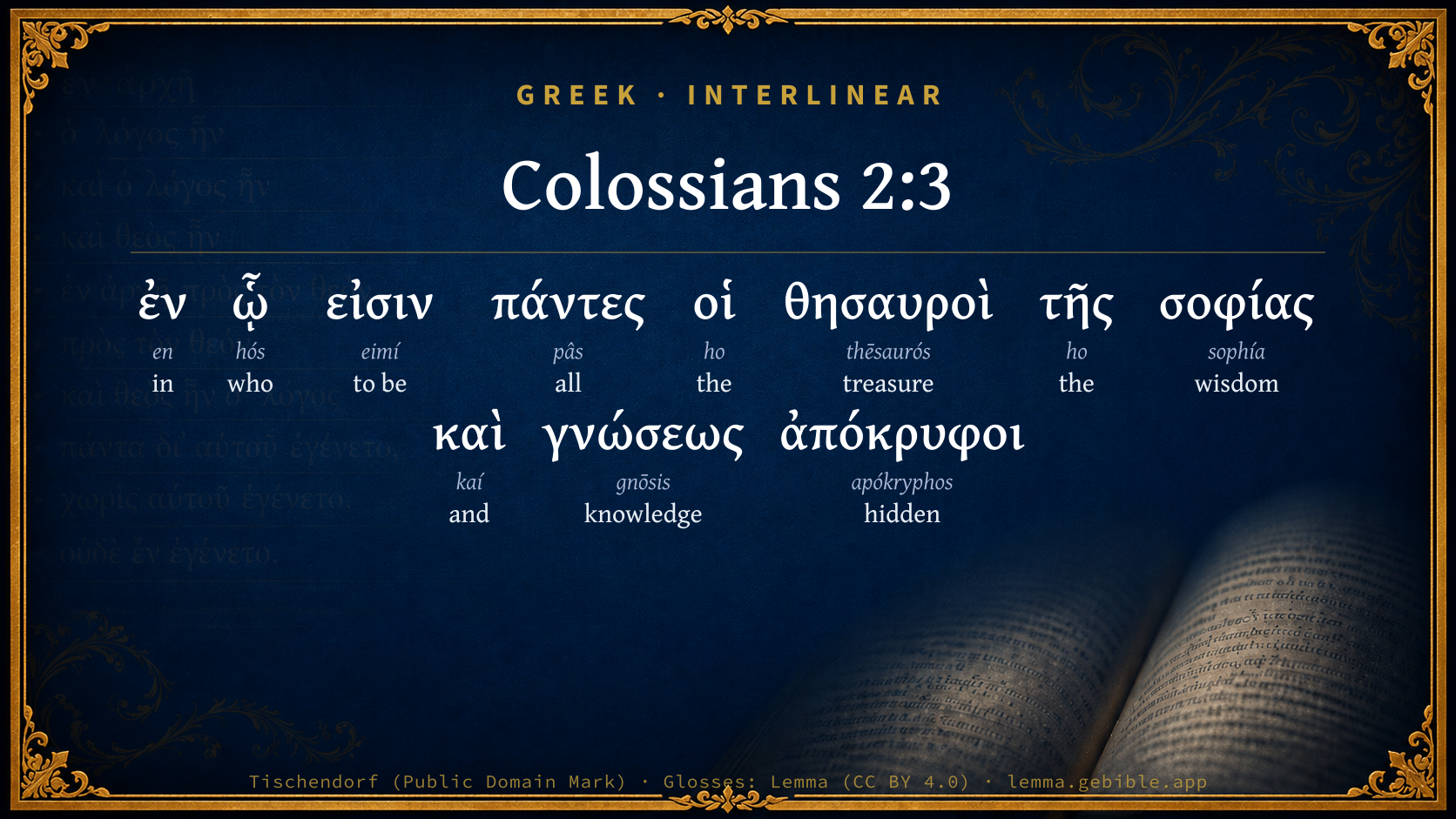
Greek (Tischendorf 8th ed.) Colossians 2:3 appears in the Greek New Testament. The text above is from the Tischendorf 8th edition. Each word links to its Strong’s number and a concise gloss. Click any word for its full Thayer’s Greek Lexicon entry.
Download image
Cite this verse

Colossians 2:3 (World English Bible). Public Domain. Lemma interlinear Bible study tool, https://lemma.gebible.app/v/colossians/2/3.

Show BibTeX & RIS
BibTeX
RIS
English Translation
in whom are all the treasures of wisdom and knowledge hidden.
World English Bible · Public Domain
Download a study sheet

One document with this verse’s original text, its word-by-word gloss line, the meaning frame, cross-references with their text, attributed commentary, and full source and license credits — printable, and it pastes into notes with its structure intact.

This verse Autodidact and up

Study sheet (.html) Plain text (.txt)

A passage Seminary Student

Up to 50 verses in one chapter. A passage sheet keeps up to 6 commentary sources and 12 cross-references per verse, in the order this page ranks them, and says so on the sheet whenever that leaves anything out. Ask for a single verse and you get the Autodidact verse sheet above.

Everything on this page stays free to read, with no account — the sheet is a download of what is already on screen, not access to it.

Want to remove ads? Support Godless Engineer
Compare translations 3

The same verse in 3 English versions, stacked beneath the original-language interlinear above. Click any original word for its lexicon entry.

Each is an independent rendering of the whole verse — the interlinear is not word-aligned to these translations.

Highlighted words mark where these versions differ — a whole-verse word diff, not a word-by-word alignment.

  • World English Bible Public Domain
    in whom are all the treasures of wisdom and knowledge hidden.
  • King James Version Public Domain
    In whom are hid all the treasures of wisdom and knowledge.
  • unfoldingWord Literal Text CC BY-SA 4.0
    in whom all the treasures of wisdom and knowledge are hidden.

unfoldingWord Literal Text — © unfoldingWord, licensed CC BY-SA 4.0. Word-aligned USFM3 via Door43 (git.door43.org/unfoldingWord/en_ult).

Versions to compare (up to 4)

3 of 4 selected

Show all 19 translations

Every available English version of this verse, each an independent rendering of the whole verse.

  • World English Bible Public Domain
    in whom are all the treasures of wisdom and knowledge hidden.
  • Berean Standard Bible Public Domain
    in whom are hidden all the treasures of wisdom and knowledge.
  • Majority Standard Bible Public Domain
    in whom are hidden all the treasures of wisdom and knowledge.
  • King James Version Public Domain
    In whom are hid all the treasures of wisdom and knowledge.
  • American Standard Version (1901) Public Domain
    in whom are all the treasures of wisdom and knowledge hidden.
  • Revised Version (1885) Public Domain
    in whom are all the treasures of wisdom and knowledge hidden.
  • Geneva Bible (1599) Public Domain
    In whom are hid all the treasures of wisedome and knowledge.
  • Douay-Rheims (1899) Public Domain
    In whom are hid all the treasures of wisdom and knowledge.
  • Young's Literal Translation Public Domain
    in whom are all the treasures of the wisdom and the knowledge hid,
  • Literal Standard Version CC BY-SA 4.0
    in whom are all the treasures of the wisdom and the knowledge hid,
  • Unlocked Literal Bible CC BY-SA 4.0
    In him all the treasures of wisdom and knowledge are hidden.
  • unfoldingWord Literal Text CC BY-SA 4.0
    in whom all the treasures of wisdom and knowledge are hidden.
  • Darby Bible Public Domain
    in which are hid all the treasures of wisdom and of knowledge.
  • World Messianic Bible Public Domain
    in whom all the treasures of wisdom and knowledge are hidden.
  • Webster's Bible Public Domain
    In whom are hid all the treasures of wisdom and knowledge.
  • Free Bible Version CC BY-SA 4.0
    In him you can discover all the rich wisdom and knowledge of God.
  • Bible in Basic English Public Domain
    In whom are all the secret stores of wisdom and knowledge.
  • Text-Critical English NT CC BY 4.0
    in whom all the treasures of wisdom and knowledge are hidden.
  • Tyndale New Testament (1534) Public Domain
    in whom are hid all the treasures of wisdom and knowledge.

Literal Standard Version (2020), Covenant Press — licensed CC BY-SA 4.0. Text via the HelloAO Bible API (eBible.org). Unlocked Literal Bible (unfoldingWord) — licensed CC BY-SA 4.0. Text via the HelloAO Bible API (eBible.org). unfoldingWord Literal Text — © unfoldingWord, licensed CC BY-SA 4.0. Word-aligned USFM3 via Door43 (git.door43.org/unfoldingWord/en_ult). Free Bible Version, Dr. Jonathan Gallagher — licensed CC BY-SA 4.0. Text via the HelloAO Bible API (eBible.org).

Word by word

More ways to search: Search by grammar → Find every occurrence → Compare this word →

Practice this passage: Drill this verse → Learn its vocabulary →

About this verse

These counts appear in no published source. They are computed here, from the morphology-tagged text and Lemma’s own curated glosses. What Lemma adds →

11
words
10
distinct lemmas
Pauline Epistles
section

Notable vocabulary

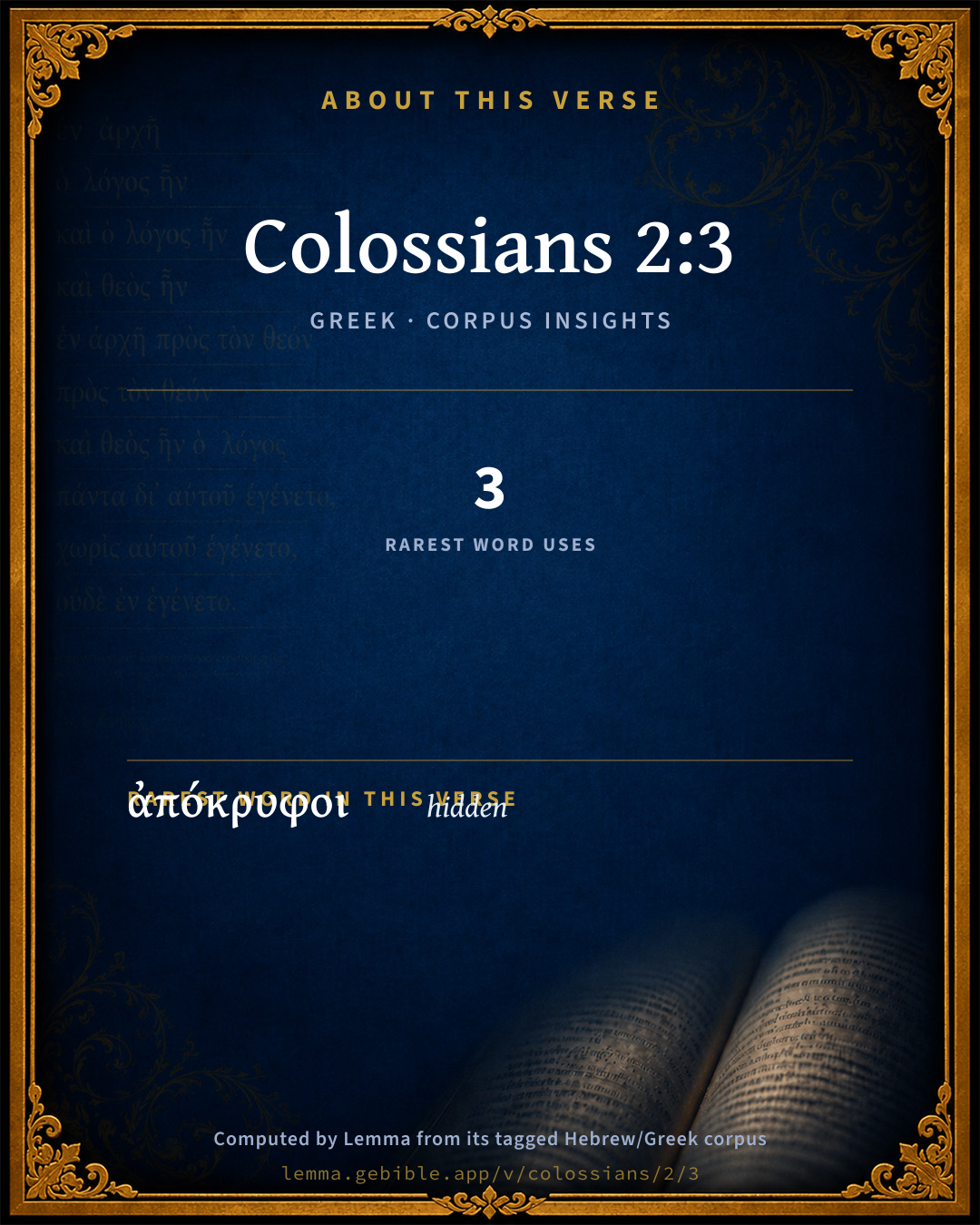
The rarest word here is ἀπόκρυφοι hidden G614 — appearing just 3 times in the whole Greek New Testament.

Shared distinctive vocabulary

ἀπόκρυφοι hidden G614 occurs in 3 verses of the Greek New Testament. Also found in:

Repetition

A word recurs within this verse:

Cross-references

16

Topical passages linked to Colossians 2:3 in the Treasury of Scripture Knowledge — connected by theme and wording, ordered by reader-vote popularity; previews shown in the World English Bible.

  • 1 Corinthians 1:24 but to those who are called, both Jews and Greeks, Christ is the power of God and the wisdom of God.
  • 1 Corinthians 1:30 But of him, you are in Christ Jesus, who was made to us wisdom from God, and righteousness and sanctification, and redemption:
  • Romans 11:33 Oh the depth of the riches both of the wisdom and the knowledge of God! How unsearchable are his judgments, and his ways past tracing out!
  • 1 Corinthians 2:6–8 We speak wisdom, however, among those who are full grown; yet a wisdom not of this world, nor of the rulers of this world, who are coming to nothing.
  • 2 Timothy 3:15–17 From infancy, you have known the sacred writings which are able to make you wise for salvation through faith, which is in Christ Jesus.
  • Ephesians 3:9–10 and to make all men see what is the administration of the mystery which for ages has been hidden in God, who created all things through Jesus Christ;
  • Colossians 1:9 For this cause, we also, since the day we heard this, don't cease praying and making requests for you, that you may be filled with the knowledge of his will in all spiritual wisdom and understanding,
  • Matthew 10:26 Therefore don't be afraid of them, for there is nothing covered that will not be revealed; and hidden that will not be known.
  • Ephesians 1:8 which he made to abound toward us in all wisdom and prudence,
  • Proverbs 2:4 If you seek her as silver, And search for her as for hidden treasures:
  • Colossians 3:16 Let the word of Christ dwell in you richly; in all wisdom teaching and admonishing one another with psalms, hymns, and spiritual songs, singing with grace in your heart to the Lord.
  • Job 28:21 Seeing it is hidden from the eyes of all living, And kept close from the birds of the sky.
  • Revelation 2:17 He who has an ear, let him hear what the Spirit says to the assemblies. To him who overcomes, to him I will give of the hidden manna, and I will give him a white stone, and on the stone a new name written, which no one knows but he who receives it.
  • Colossians 1:19 For all the fullness was pleased to dwell in him;
  • Colossians 3:3 For you died, and your life is hidden with Christ in God.
  • Isaiah 11:2 The Spirit of Yahweh shall rest on him, the spirit of wisdom and understanding, the spirit of counsel and might, the spirit of knowledge and of the fear of Yahweh.

Cross-references courtesy of OpenBible.info (CC BY 4.0).

Commentary

Notes on Colossians 2:3 from classic Christian and Jewish commentators (each source and its license shown beneath its notes). The classic Christian expositions comment on the surrounding passage and are grouped to its opening verse, so a note may address several verses; the Jewish commentaries on the Tanakh (Rashi and others) are per-verse, so they appear only where the commentator wrote on this verse.

Lemma curates 59 commentaries, every one of them public domain or Creative Commons licensed, each selected and text-cleaned for this edition rather than reprinted as found. About our sources →

Tyndale Open Study Notes

Tyndale Open Resources

2:3 Paul builds on 1:15-20: Christ alone is sufficient for our spiritual understanding.

Tyndale Open Study Notes — © Tyndale Open Resources, licensed CC BY-SA 4.0. Text via the HelloAO Bible API.

Bengel's Gnomon

Johann Albrecht Bengel

Col 2:3. Ἐν ᾧ) in Whom, rather in which, viz. the mystery of God and the Father and of Christ. He who possesses this ought to ask for nothing more, so far as wisdom and other good things are concerned. Regarding Christ Himself, the question is taken up at Col 2:9.—εἰσὶ, are) Construe: all hidden treasures are in that mystery [But Engl. Vers. makes ἀπόκρυφοι prædicate, In whom are hid, etc.]: ἀπόκρυφοι, without the article.—πάντες, all, cor responds to the all, Col 2:2.—οἱ θησαυροὶ, treasures) Hence are derived πλοῦτος, the riches, ibid.—τῆς σοφίας, of wisdom) Hence comes the σύνεσις, understanding, ibid.—τῆς γνώσεως, of knowledge) Hence ἐπίγνωσις, the full knowledge,[5] ibid: comp. 1Co 13:12, note.—ἈΠΌΚΡΥΦΟΙ, hidden) for it is a mystery, ibid: comp. 1Co 2:7-8.

[5] Engl. Vers. acknowledgment. Επίγνωσις is more than γνῶσις.—ED.

Bengel's Gnomon of the New Testament — English translation (T&T Clark, Edinburgh, 1860) — public domain. Text from a community e-Sword module.

Meyer's Critical & Exegetical Commentary

Heinrich August Wilhelm Meyer

Col_2:3. Ἐν ᾧ] is to be referred to τοῦ μυστηρίουa remark which applies also in the case of every other reading of the foregoing wordsnot to Christ,[81] as is commonly done with the Recepta, and by Böhmer, Dalmer, and Hofmann even with our reading. The correct reference is given, in connection with the Recepta, by Grotius (against whom Calovius contends), Hammond, Bengel, and Michaelis; and in connection with our reading, by Huther, Schenkel, and Bleek; its correctness appears from the correlation in which ἀπόκρυφοι stands to τοῦ μυστηρ. The destination of this relative clause is to bring out the high value of the ἐπίγνωσις τοῦ μυστηρίου (since in Him, etc.), and that in contrast to the pretended wisdom and knowledge of the false teachers; hence also the emphatic πάντες οἱ θησ. κ.τ.λ.

The σοφία and γνῶσις are here conceived objectively, and the genitives indicate wherein the treasures consist. The distinction between the two words is not, indeed, to be abandoned (Calvin: duplicatio ad augendum valet; comp. Huther and others), but yet is not to be defined more precisely than that γνῶσις is more special, knowledge, and σοφία more general, the whole Christian wisdom, by which we with the collective activity of the mind grasp divine relations and those of human morality, and apply them to right practice. Comp. on Col_1:9.

On θησαυροί, comp. Plato, Phil. p. 15 E: ὥς τινα σοφίας εὑρηκὼς θησαυρόν, Xen. Mem. iv. 2. 9, i. 6. 14; Wis_7:14; Sir_1:22; Bar_3:15.

ἀπόκρυφοι] is not the predicate to εἰσί (so most writers, with Chrysostom and Luther), as if it were ἀποκεκρυμμένοι εἰσιν instead of εἰσὶν ἀπόκρυφοι; for, as it stands, the unsuitable sense would be conveyed: in whom all treasures … are hidden treasures. But neither is it a description of the qualitative how of their being in Him,[82] in so far, namely, as they do not lie open for ordinary perception (Hofmann); for this adverbial use of the adjective (see Kühner, ad Xen. Anab. i. 4. 12, 2:2. 17; Krüger, § 57. 5) would be without due motive here, seeing that the apostle is concerned, not about the mode of the ἐν ᾧ εἰσι, but about the characterizing of the treasures themselves, whereupon the how in question was obvious of itself. We must therefore take ἀπόκρυφοι simply as an attributive adjective to ΘΗΣΑΥΡΟΊ, placed at the end with emphasis: in whom the collective hidden treasures … are contained. Comp. LXX. Isa_45:3; 1Ma_1:23; Mat_13:44. The treasures, which are to be found in the mystery, are not such as lie open to the light, but, in harmony with the conception of the secret, hidden (comp. Matt. l.c.), because unattainable by the power of natural discernment in itself, but coming to be found by those who attain εἰς ἐπίγνωσιν τοῦ μυστηρίου, whereby they penetrate into the domain of these secret riches and discover and appropriate them. The objection to this view of ἈΠΟΚΡ. as the adjective to ΘΗΣ., viz. that there must then have been written ΟἹ ἈΠΟΚΡ. (Bähr, Bleek, Hofmann), is erroneous; the article might have been (1Ma_1:23), but did not need to be, inserted. With the article it would mean: quippe qui absconditi sunt; without the article it is simply: thesauri absconditi (Vulgate), i.e. ἀπόκρυφοι ὄντες, not ΟἹ ὌΝΤΕς ἈΠΌΚΡΥΦΟΙ.

[81] Older dogmatic expositors (see especially Calovius) discover here the omniscience of Christ.

[82] In connection with which Bähr, Baumgarten-Crusius, and Bleek convert the notion of being hidden into that of being deposited for preservation (ἀποκεϊσθαι, Col_1:5).

Meyer — Critical and Exegetical Commentary on the New Testament — English translation by Peter Christie, edited by Frederick Crombie (T&T Clark, 1880) — public domain. Text from a community e-Sword module.

Expositor's Greek Testament

ed. W. Robertson Nicoll

Col 2:3 . ἐν ᾧ may refer to μυστηρίου (Beng., Mey., Alf., Ol., Sod., Haupt, Abb.) or to Χριστοῦ (Ell., Hofm., Lightf., Holtzmann, Findl., Moule). The former is defended on the ground that ἀπόκρ . corresponds to μυστ . It is also urged that μυστ . is the leading idea. On the other hand, if Christ is rightly identified with the mystery, there is no practical difference between the two views, and it is simpler to refer ᾧ to Χ . as the nearer noun. εἰσὶν πάντες οἱ θησαυροὶ τῆς σοφίας καὶ γνώσεως ἀπόκρυφοι . Bengel, Meyer and Alford take ἀπόκρ . as an ordinary adjective with θησαυροὶ , “in whom are all the hidden treasures”. For this we should have expected οἱ ἀπόκρ ., and there is no stress on the fact that the hidden treasures are in Christ, yet the position of the word at the end of the sentence is explained as due to emphasis. Generally Chrysostom has been followed in taking it as the predicate to εἰσὶν , “in whom are hidden all the treasures”. But this is excluded by its distance from the verb. Accordingly it should be taken as a secondary predicate, and thus equivalent to an adverb, “in whom are all the treasures … hidden,” i.e. , in whom all the treasures are, and are in a hidden manner (Hofm., Ell., Lightf., Sod., Haupt, Abb.). The force of the passage then is this; all, and not merely some of, the treasures of wisdom and knowledge are contained in Christ, therefore the search for them outside of Him is doomed to failure. But not only are they in Christ, but they are contained in a hidden way. Therefore they do not lie on the surface, but must be sought for earnestly, as men seek for hidden treasure. They are not matters of external observances, such as the false teachers enjoined, but to be apprehended by deep and serious meditation. If Lightfoot is right in thinking that ἀπόκρ . is borrowed from the terminology of the false teachers, there is the added thought that the wisdom they fancied they found in their secret books was really to be found in Christ alone. But it is hardly likely that there is any such reference here. Even if the allusion to literature were more plausible than it is, there is no evidence that the word was used in this sense so early. Besides it occurs twice with θης . in the LXX. The distinction between σοφίας and γνώσεως is not easy to make here; the former is general, the latter special. Lightfoot says: “While γνῶσις applies chiefly to the apprehension of truths, σοφία super-adds the power of reasoning about them and tracing their relations”. Moule thinks it is God’s wisdom and knowledge that are here attributed to Christ, but this seems uncertain.

The Expositor's Greek Testament, edited by W. Robertson Nicoll (1897–1910) — public domain. Text from a community e-Sword module.

Cambridge Greek Testament for Schools and Colleges

3. ἐν ᾧ; cf. Col 1:14, Col 2:11-12. The antecedent is Χριστοῦ.

εἰσὶν. Its position indicates that it is not a mere copula to ἀποκρυφοί, “are hid,” but is here a substantive verb almost our “lie,” to which ἀποκρυφοί is afterwards added as a secondary predicate; vide infra, and compare Col 3:1, note.

πάντες. Here with the article, contrast Col 2:2. Not merely all as needed or to suit each circumstance, but all in their totality. There is no wisdom, etc., apart from Christ, and in Him there is all.

οἱ θησαυροὶ. For the metaphorical use of θησαυρός in connexion with σοφία, etc., see esp. Pro 2:3-5. Also Sir 1:25 (26), ἐν θησαυροῖς σοφίας παραβολὴ ἐπιστήμης (Heb. not recovered).

Here the word is probably suggested by πλοῦτος in Col 2:2. “Conviction,” however great its “wealth” may be, is only one of the many θησαυροί. On Enoch, § 46. 3, see below s.v. ἀπόκρυφοι.

τῆς σοφίας καὶ γνώσεως. Genitives of apposition, indicating wherein the treasures consist. Observe that the one article shows that they are regarded as sub-divisions of one faculty.

On σοφία cf. Col 1:9, note.

As regards the two words, γνῶσις is the perception and apprehension of external objects, σοφία the power of forming right decisions concerning them. “While γνῶσις is simply intuitive, σοφία is ratiocinative also. While γνῶσις applies chiefly to the apprehension of truths, σοφία superadds the power of reasoning about them and tracing their relations” (Lightfoot).

Observe that thus σοφία bears relation to τῆς συνέσεως in Col 2:2, as does, of course, γνῶσις to ἐπίγνωσιν also there.

They are regarded as possibilities for man to find and exercise. See further under ἀπόκρυφοι.

ἀπόκρυφοι, Mar 4:22 || Luk 8:17†, “hid.” (1) Even if it is possible, with Bengel, supported by Meyer and Alford, to take this as attributive to θησαυροί in spite of the absence of the article, such an interpretation is opposed to N.T. practice, which uses the article very carefully. It is also more forcible to take it predicatively, or, rather, as a secondary predicate to εἰσίν … “In whom lie all the treasures of wisdom and knowledge hid.” For other exx., cf. Col 2:10, Col 3:1.

ἀπόκρυφος regards a thing as out of sight but quite possible to be found.

(2) It is used several times of treasure or its equivalent: Isa 45:3; Dan 11:43 (Theod.); 1Ma 1:23; cf. Pro 2:4, Sym. and Theod. So also Aquila seems to understand Eze 7:22 of the Temple treasury, καὶ μιανοῦσι τὸν ἀπόκρυφόν μου.

So says St Paul here. In Christ are treasures—all the treasures—but they do not lie on the surface, so to speak, and therefore are not perceived by the false teachers; they are hid, to be found only by those who seek earnestly for them.

(3) It has been supposed, especially by Lightfoot (whose note by all means see), that ἀπόκρυφοι here contains an allusion to the esoteric teaching of the false teachers, or perhaps even to their esoteric writings. This is possible but very far from certain. It is worth noticing that there appears to be no evidence at present discovered that ἀπόκρυφος was used of esoteric teaching or writings as early as the date of this Epistle, though undoubtedly it was employed in that sense (at least with reference to writings) by the Gnostic and later teachers. Enoch, xlvi. 3, “The Son of Man … who reveals all the treasures of that which is hidden” (Greek not recovered), is interesting as suggesting that Messiah will reveal treasures, but comes very far short of saying with our passage that they are in Him. It seems to resemble more closely the Samaritan expectation of Messiah discovering to His followers the sacred vessels of the Tabernacle.

Cambridge Greek Testament for Schools and Colleges (Cambridge University Press, 1896; 21 vols, various authors incl. Carr, Maclear, Plummer, Farrar, Lumby, Moule, M. R. James, Simcox) — public domain. Text from a community e-Sword module.

Geneva Bible (1599)

Geneva Bible translators

There is no true wisdom without Christ.

Geneva Bible (1599) marginal notes — public domain. Text via Bolls.life.

Jamieson, Fausset & Brown

Robert Jamieson, A. R. Fausset & David Brown

Translate in the Greek order, "In whom (not as ALFORD, 'in which') mystery; Christ is Himself the 'mystery' (Col 2:2; Ti1 3:16), and to Christ the relative refers) are all the treasures of wisdom and knowledge hidden." The "all" here, answers to "all" in Col 2:2; as "treasures" answer to the "riches"; it is from the treasures that the riches (Col 2:2) are derived. "Are" is the predicate of the sentence; all the treasures ARE in Him; hidden is predicated of the state or manner in which they are in Him. Like a mine of unknown and inexhaustible wealth, the treasures of wisdom are all in Him hidden, but not in order to remain so; they only need to be explored for you to attain "unto the riches" in them (Col 2:2); but until you, Colossians, press after attaining the full knowledge (see on Col 2:2) of them, they remain "hidden." Compare the parable, Mat 13:44, "treasure hid." This sense suits the scope of the apostle, and sets aside ALFORD'S objection that "the treasures are not hidden, but revealed." "Hidden" plainly answers to "mystery" (Col 2:2), which is designed by God, if we be faithful to our privileges, not to remain hidden, but to be revealed (compare Co1 2:7-8). Still as the mine is unfathomable, there will, through eternity, be always fresh treasures in Him to be drawn forth from their hidden state.

wisdom--general, and as to experimental and practical truth; whence comes "understanding" (Col 2:2).

knowledge--special and intellectual, in regard to doctrinal truth; whence comes "the full knowledge" (Col 2:2).

Jamieson, Fausset & Brown — Commentary Critical and Explanatory on the Whole Bible (1871) — public domain (CC PDM 1.0). Text via the HelloAO Bible API.

Adam Clarke's Commentary

Verse 3. In whom are hid] Or rather in which; referring to the mystery mentioned above. In this glorious scheme of Christianity all the treasures-the abundance and excellency, of wisdom and knowledge are contained. No scheme of salvation, or Divine knowledge, ever equalled in its depth and excellency the Gospel plan. A scheme which the wisdom of God alone could devise, and which his power and infinite mercy alone could accomplish.

Adam Clarke's Commentary on the Bible (1810–1826) — public domain. Text from a community e-Sword/MySword module.

John Calvin's Commentaries

3. In whom are all the treasures. The expression in quo (in whom, or in which) may either have a reference collectively to everything he has said as to the acknowledgment of the mystery, or it may relate simply to what came immediately before, namely, Christ. While there is not much difference between the one or the other, I rather prefer the latter view, and it is the one that is more generally received. The meaning, therefore, is, that all the treasures of wisdom and knowledge are hid in Christ — by which he means, that we are perfect in wisdom if we truly know Christ, so that it is madness to wish to know anything besides Him. For since the Father has manifested himself wholly in Him, that man wishes to be wise apart from God, who is not contented with Christ alone. Should any one choose to interpret it as referring to the mystery, the meaning will be, that all the wisdom of the pious is included in the gospel, by means of which God is revealed to us in his Son.

He says, however, that the treasures are hidden, because they are not seen glittering with great splendor, but do rather, as it were, lie hid under the contemptible abasement and simplicity of the cross. For the preaching of the cross is always foolishness to the world, as we found stated in Corinthians. (1 Corinthians 1:18.) I do not reckon that there is any great difference between wisdom and understanding in this passage, for the employment of two different terms serves only to give additional strength, as though he had said, that no knowledge, erudition, learning, wisdom, can be found elsewhere.

John Calvin's Commentaries (1540-1563) — public domain. Text from the Calvin Translation Society English edition (1840s-50s) via the Christian Classics Ethereal Library (ccel.org). Calvin's coverage is partial (roughly two-thirds of the Bible); uncommented books and verses are honest gaps, never fabricated. The 19th-century editor's footnotes and remarks are omitted so the notes are faithfully Calvin's own voice.

Ellicott's Commentary for English Readers

(3) In whom are hid all the treasures.—The order of the original is curious: “in whom are all the treasures of wisdom and knowledge, as hidden treasures.” The word “hidden” (apocryphi) is an almost technical word for secret teaching given only to the initiated; used originally as a term of honour (as the participle of the kindred verb is used in 1Co_2:7-8, “the wisdom of God in mystery, even the hidden wisdom . . . which none of the princes of this world knew”), afterwards, from the character of these “apocryphal” books, coming to signify spurious and heretical. St. Paul evidently takes up here a word, used by the pretenders to a special and abstruse knowledge, and applies it to the “heavenly things” which He alone knows “who is in heaven” (Joh_3:12-13). From our full comprehension they are hidden; if ever we know them, it will not be till “we know even as we are known.” But the previous words show that we can have full practical apprehension of them by our knowledge of Christ, who knows them—a knowledge begun in faith, and perfected chiefly in love.

Wisdom and knowledge.—Comp. Rom_11:33 and 1Co_12:8 (“the word of wisdom” . . . “the word of knowledge”). On the true sense of “wisdom” and its relation to other less perfect gifts, as “prudence,” “intelligence,” “knowledge,” see Note on Eph_1:8. “Knowledge” is clearly the development of wisdom in spiritual perception, as “intelligence” in testing and harmonising such perception, and “prudence” in making them, so tested, the guide of life. The word “knowledge” (gnosis) was the word which, certainly afterwards, probably even then, was the watchword of “Gnosticism”—the unbridled and fantastic spirit of metaphysical and religious speculation then beginning to infest all Christian thought. It can hardly be accidental that St. Paul here, as elsewhere, subordinates it to the higher gift of wisdom.

A Bible Commentary for English Readers, edited by Charles John Ellicott (1878–1897) — public domain. Text from a community e-Sword module.

The Cambridge Bible for Schools and Colleges

gen. ed. J. J. S. Perowne

3. in whom] Christ, the Secret of God, is now characterized as such; the Secret is—Christ as the Treasury of wisdom and knowledge.

are hid &c.] Better, regarding the order of the Greek, in whom are all the treasures, &c., hidden (there). The thought that they are “hidden” is emphasized.—See below, note on “wisdom &c.”

all] So that He is absolutely sufficient, and supposed supplies from elsewhere are a delusion. So “all riches” just above; and Col_1:19.

the treasures] A rich (and frequent) plural.

wisdom and knowledge] Words recurring together Rom_11:33; 1Co_12:8. In such a passage they are scarcely perhaps to be minutely distinguished[82] (as they must be in 1 Corinthians 12); they blend into the one idea of the resources of the Divine Mind. For surely here, as in Romans 11 (a near parallel), it is the wisdom and knowledge of God which are in view; a point not noticed by Ellicott, Alford, or Lightfoot. (There is doubtless a reflected reference here to human speculation, exercised upon the treasures of Divine thought.)

[82] Where wisdom (sophia) and knowledge (gnôsis) have to be distinguished, the essential difference appears to be that sophia is a moral-mental term, gnôsis a term purely mental, or rather one which fixes attention on the cognition of truth simply as such. Conceivably, the man of “knowledge” may stop with a mere sight of truth; the man of “wisdom” reflects upon it, receives it, in a way affecting character and action. The words “wise.” “wisdom”, in the Greek, are thus “never in Scripture ascribed to other than God or good men, except in an ironical sense” (Trench, N.T. Synonyms, 2nd Series).

The treasures of this Divine “wisdom and knowledge” are in Christ “hiddenly” (Ellicott), inasmuch as they are (a) to be found in Him alone, (b) to be found therefore only by entrance into Him, (c) never, even so, to be “found out unto perfection.”—The Greek word, as Lightfoot shews, is in all likelihood borrowed from the heretical vocabulary, and transfigured. The embryo “Gnostic” of St Paul’s days probably, as his successors certainly, gloried in an alleged possession of inner, esoteric, secrets of being and of knowing, treasured in books thence called apocryphal (secret, hidden); a word identical with the Greek adjective here (apocruphoi). (So that, in the Fathers, by “apocryphal” books are not meant the Jewish religious books we commonly call so, but the “secret” literature of the heretical sects.)

Christ is thus the glorious “Apocrypha” (if we may dare to say so) of the Christian; our “esoteric wisdom” is only an ever-deepening insight into Him revealed.—“Jesus Christ is a great Book. He who can indeed study Him in the word of God will know all he ought to know. Humility opens this Divine Book, faith reads in it, love learns from it” (Quesnel).

The Cambridge Bible for Schools and Colleges (gen. ed. J. J. S. Perowne; Cambridge University Press, 1878–1918) — public domain. Text from a community e-Sword module.

John Gill's Exposition

In whom are hid all the treasures of wisdom and knowledge. This may be understood either of the mystery of the Gospel, which contains the rich mines and hidden treasures of all divine truths; so called, because of the richness and intrinsic value and excellency of them; and because of their variety and abundance, being the unsearchable riches of Christ: or of Christ himself; and not so much of his personal wisdom, either as God, being the all-wise God, the wisdom of God, an omniscient Being, that knows all persons and things whatever, within the whole circle of wisdom and knowledge; or as man, whose wisdom and knowledge, though created, was very large and abundant; or as Mediator, on whom the spirit of wisdom and understanding, of counsel and of knowledge, rests; but of that fulness of truth as well as grace, which dwells in him as in its subject and fountain; by whom it comes, and from whom it is derived unto us; and our highest wisdom and knowledge lies in knowing him, whom to know is life eternal; and the excellency of whose knowledge surpasses everything else; it is the greatest riches, and most valuable treasure; nor is there anything worth knowing but what is in Christ, all is laid up in him: and being said to be "hid" in him, shows the excellency of the wisdom and knowledge that is in him only valuable things being hid, or compared to hid treasure; that this cannot be had without knowing him; that it is imperfect in the present state, and is not yet fully and clearly revealed; and therefore should be inquired after, and searched for, and Christ should be applied unto for it: , "treasures of wisdom", is a phrase used by the Targumist (q),

(q) Jonathan ben Uzziel in Exod. xl. 4.

John Gill's Exposition of the Whole Bible (1746–1763) — public domain (CC PDM 1.0). Text via the HelloAO Bible API.

Trapp's Complete Commentary

John Trapp

3 In whom are hid all the treasures of wisdom and knowledge.

Ver. 3. In whom are hid] What so great a matter is it then if we be obscured, and our good parts not so noticed? Usque adeone scire tuum nihil est? (Pers.) Christ was content his treasures should be hidden. In maxima sui mole se minimum ostendunt stellae.

All the treasures of wisdom] Out of Christ then there is no true wisdom or solid comfort to be found. "The depth saith, It is not in me, and the sea saith, It is not with me," Job 28:14. The world’s wizards cannot help us to it, Jer 8:9. Nescio quomodo imbecillior est medicina quam morbus, saith Cicero concerning all philosophical comforts: The medicine is too weak for the disease. And as for wisdom, that of the flesh serves the worldling (as the ostrich’s wings) to make him outrun others upon earth and in earthly things, but helps him never a whit toward heaven. Since the fall, every man hath principium laesum, his brain pin cracked (as to heavenly things), neither can he recover but by getting into Christ.

John Trapp, A Commentary or Exposition upon All the Books of the Old and New Testament (1647–1656) — public domain. Text from a community e-Sword module.

Albert Barnes' Notes on the Bible

In whom - Margin, “wherein.” The more correct translation is “in whom.” The reference is doubtless to Christ, as his name is the immediate antecedent, and as what is affirmed here properly appertains to him.

Are hid - Like treasures that are concealed or garnered up. It does not mean that none of those “treasures” had been developed; but that, so to speak, Christ, as Mediator, was the great treasure-house where were to be found all the wisdom and knowledge needful for people.

All the treasures - It is common to compare any thing valuable with “treasures” of silver or gold. The idea here is, that in reference to the wisdom and knowledge needful for us, Christ is what abundant treasures are in reference to the supply of our wants.

Wisdom - The wisdom needful for our salvation. Notes, 1Co 1:24.

And knowledge - The knowledge which is requisite to guide us in the way to life. Christ is able to instruct us in all that it is desirable for us to know, so that it is not necessary for us to apply to philosophy, or to the teachings of human beings.

Albert Barnes' Notes on the Bible (1834–1885) — public domain. Text from a community e-Sword/MySword module.

Matthew Poole's English Annotations

In whom: this may relate eitter to the Divine mystery, wherein are in abundance all necessary doctrines to consolation and salvation stored up, respecting the foregoing verse; compare 1Co 2:7; Eph 3:3,4; in opposition to the vain show of wisdom seducers did boast of; or, (as the most ancient and modern take it), to Christ, the immediate antecedent: in whom, ( as we render it), i.e. in Christ, considered either:

1. As the object, which being rightly known, we may have all wisdom and perfect knowledge to salvation: he speaks not here of all that Christ knoweth, he reveals not all that in the gospel to us, but what we must know of him that we may be saved. Or:

2. As the subject, because all the treasures of wisdom in order to salvation, are not only known and found out in Christ, but also are hid, do dwell and abide in him as the fountain, what he can give to us for our consolation and perfection.

It had been little pertinent for Paul to have said that all these deep things of God {1Co 2:10} were known to our Lord; but that they are found in him, do dwell in him, are all stored up, displayed, and set forth in him, to be seen through the veil, that is to say his flesh, Heb 10:20, or the infirmity of his cross. The series of the apostle’s discourse, comparing Col 2:8,9, shows it to be thus understood of Christ as the subject and fountain of all saving wisdom, in opposition to the comments of human wisdom which the false doctors did boast of. Continuing the metaphor, he shows from what fund the treasures of saving knowledge may be drawn: by treasures intimating the excellency and abundance thereof; there was some store in the tabernacle of Moses, but very small compared to the abundance certainly to be found in Christ, all else of no worth to the excellency of the knowledge of Christ for consolation, Col 2:2; Phi 3:8; things to be believed and practised are, by way of eminency, Christian wisdom and knowledge. The treasures of which, how and when hid, is to be well considered, because in our translation, and in almost all others, the Greek word we render hid is by trajection put next to the relative whom, whereas it is indeed in the original the last word in the verse, and seems to be expressive rather of what was hid before Christ than what is hid in him. For, as a learned man saith, hidden treasures, as such, seem to be like hidden music, of no regard; or like the hidden talent, Luk 19:20. It not being so easy to think that the apostle in this Epistle teaches, that the secrets which had lain hid from the wise men of the world in the ages past, now were made bare, brought into light, and made known even to babes by Christ, Col 1:26,27, with Luk 10:21; and having just before, Col 2:2, spoken of the understanding and acknowledgment of the mystery of the Father and the Son, what should the riches of glory to the knowledge of the mystery be, but the treasures of wisdom now revealed, heretofore hid, of which continuedly a little after he says that all the fulness of the Godhead dwells in him bodily, i.e. personally, not in a shadow, as it were hid in a cloud, but in flesh that may be really seen and touched? So that it shonld seem best to retain hid as it is placed in the Greek, to this sense; q.d. In Christ are, and dwell in the greatest fulness, all the treasures of wisdom, hid under the law, which are therefore called a mystery, secret, or hidden thing from ages and generations, Col 1:26,27, now made manifest to his saints, they are now not hid in Christ, but made known amongst the Gentiles as God willed. Not then hidden riches, i.e. treasures of wisdom and knowledge of this mystery as of hid treasure, but out of Christ, and before Christ amongst the Jews: for Christ himself is that mystery Col 4:3, not hid after his appearance, but manifested, and manifesting the Father, Joh 1:18. However, if any will rather choose to read, as if in Christ were at present hid all treasures, it is to be understood, stored up, not exposed to the view of every eye, being as in a rich cabinet, not to keep them from being known to men, but rather to make them more precious and desirable. For Christ came when sent of his Father to spread this heavenly wealth. He is the Sun of righteousness, Joh 1:9; the unbelieving must thank themselves if, where he is truly preached, he be hid to them, and his arm be revealed but to a few, Isa 53:1; 2Co 4:3,4; it is their own blinding that they do not savingly discern what is displayed in Christ. Wherefore both may be true in divers respects:

1. Consider the thing in itself, objectively; so treasures of wisdom are evidently laid up in Jesus Christ, and manifested upon his appearance, 1Ti 3:16; Tit 2:11. But:

2. With respect to the eyes and perceptions of men, subjectively, as naturally obscured and corrupted by sin; so natural men, or mere animal men, perceive not in Christ the riches of wisdom and knowledge which are in him as our Mediator, when they look upon him as having no beauty or comeliness for which they should desire him, Isa 53:2; he, as crucified, being to the Jews a stumbling-block and to the Gentiles foolishness, when he is to those of them who are called, the power of God, and the wisdom of God, 1Co 1:23,24. The Lutherans’ inference hence, that omnisciency agrees to Christ’s human nature, is altogether inconsequent; both (as before) because the apostle’s business here is not to acquaint us what Christ himself knoweth, but what is to be known by us, which may be found treasured up in him.

Treasures here in him not being considered absolutely, but comparatively to all the knowledge of men and angels. Yet, from a supposal of an infinite knowledge in Christ, who is God-man in one person, it followeth not that the soul of his human nature knoweth all things.

Matthew Poole's English Annotations on the Holy Bible (1683–1685) — public domain. Text from a community e-Sword/MySword module.

Whedon's Commentary on the Bible

Daniel D. Whedon

3. In whom—Christ, the revealer of God and the truths relating to him. They are in him, hid, until revealed. The great questions of human thought of all the ages centre here, and only in Christ is their solution possible.

Daniel D. Whedon (gen. ed.), Commentary on the Old and New Testaments (1874–1909) — public domain. Text from a community e-Sword module.

The Pulpit Commentary

In whom (or, which) are all the treasures of wisdom and knowledge hidden(ly) (Eph_1:8, 9 3:8; Rom_11:33; 1Co_1:5, 1Co_1:6, 30 2:7; 2Co_4:3) Bengel, Meyer, Alford, and others make the relative pronoun neuter, referring to "mystery;" but "Christ," the nearer antecedent, is preferable (vers. 9, 10; Col_1:16, Col_1:17, Col_1:19) In him the apostle finds what false teachers sought elsewhere, a satisfaction for the intellect as well as for the hearttreasures of wisdom and knowledge to enrich the understanding, and unsearchable mysteries to exercise the speculative reason. "Hidden" is, therefore, a secondary predicate: in whom are these treasures, as hidden treasures" (Ellicott, Lightfoot). (For a similar emphasis of position, compare "made complete," ver. 10, and "seated," (Col_3:1) Meyer and Alford, with the Vulgate, make "hidden" an attributive: "in whom are hidden treasures." Chrysostom and leading versions make it primary predicate: "in whom are hidden," etc., against the order of the words. This word also belongs to the dialect of the mystic theosophists (see note, (Col_1:27: comp. (1Co_2:6-16; Isa_45:3; Pro_2:1-11) (On "wisdom," see note, (Col_1:9) Knowledge (gnwsiv, not ejpignwsiv, ver. 2; (Col_1:9 Col_3:10; for this phrase is more comprehensive) is the more objective and purely intellectual side of wisdom (comp. Rom_11:33)

The Pulpit Commentary (1880–1919), ed. H.D.M. Spence-Jones & Joseph S. Exell — public domain. Text from a community e-Sword module.

Burkitt's Expository Notes on the New Testament

William Burkitt

That is, in Jesus Christ, and in his gospel, are all the treasures of wisdom and knowledge, laid up as in a store-house, and from thence are they only to be expected and derived. The knowledge of Christ and his gospel is an extensive and comprehensive knowledge, a rich and enriching knowledge; the chiefest gain is loss, and the richest treasure is dung, when Christ’s riches are displayed; and after all that we have or can attain unto, of the knowledge of Christ, his works is unsearchable, no finite understanding can reach the depth thereof; for in him are hid all the treasures of wisdom and knowledge.

William Burkitt's Expository Notes on the New Testament (1700–1703) — public domain. Text from a community e-Sword module.

The People's New Testament

B. W. Johnson

3. In whom. In Christ all the treasures, etc., are hidden, and mysteries until revealed. The gospel reveals them and those in Christ know them.

B. W. Johnson's The People's New Testament with Notes (1889–1891) — public domain. Electronic text from the Christian Classics Ethereal Library (CCEL) ThML edition.

International Critical Commentary

3. ἐν ᾧ. The antecedent is probably μυστηρίου, not Χριστοῦ. What the apostle is dwelling on is the greatness of the “mystery” (1:27), and the importance of the knowledge of it, in opposition to the supposed wisdom of the false teachers; hence the statement that “all the treasures,” etc., are contained in it. This is confirmed by the use of ἀπόκρυφοι, which corresponds to μυστήριον. So Alford, Eadie, Meyer, Soden, De Wette, etc.; but Ellicott, Lightfoot, and many comm. refer the ᾧ to Christ. With this latter reference, the wisdom and knowledge are those possessed by Christ as a treasure which He communicates. With the reference to μυστ. the terms have an objective sense, these being characteristics of the Divine plan. These treasures St. Paul calls ἀπόκρυφοι, probably in allusion to the pretended hidden wisdom of the false teachers, which nevertheless was merely superficial and concerned external observances, whereas the true Christian wisdom was inward and profound. These treasures of wisdom are not “kept concealed,” ἀποκεκρυμμένοι, they are “hidden, laid up,” ἀπόκρυφοι; but capable of being discovered. For this reason, as well as on account of the position of the word, ἀπόκρυφοι is not to be construed with εἰσίν as the direct predicate,—a construction which would require it to come next to εἰσίν. Meyer and Alford take the word as attributive, “all the secret treasures.” The absence of the article is against this, although not perhaps fatal; since, as Alford observes, οἱ ἀπόκρυφοι would imply that there were other treasures, only those that are secret being contained, etc. The position of the word, however, suggests that it is a secondary predicate (Ellicott, Lightfoot, v. Soden, al.), “all the treasures, etc., as hidden treasures,” i.e. “hiddenly,” ὥστε παρʼ αὐτοῦ δεῖ πάντα αἰτεῖν. Chrys. “quo verbo innuitur quod pretiosum et magnificum est in Christo non prominere, aut protinus in oculos incurrere hominum carnalium, sed ita latere ut conspiciatur tantummodo ab illis quibus Deus oculos dedit aquilinos, id est, spirituales ad videndum,” Davenant, quoted by Ellicott. The word occurs in connexion with θησαυροί in Isa 45:3, δώσω σοι θησαυροὺς σκοτεινοὺς ἀποκρύφους: also 1 Macc. 1:23, ἔλαβε τοὺς θησαυροὺς τοὺς ἀποκρύφους. On the Gnostic use of the word to designate their esoteric writings, see Lightfoot’s note.1

The expression θησαυρὸς σοφίας is used by Plato, Phileb. 15 E, ὥς τινα σοφίας εὑρηκὼς θησαυρόν, and by Xen. Mem. iv. 2. 9, ἄγαμαί σου διότι οὐκ ἀργυρίου καὶ χρυσίου προείλου θησαυροὺς κεκτῆσθαι μᾶλλον ἢ σοφίας.

σοφίας καὶ γνώσεως. These terms occur together, Rom 9:33, and several times in Eccles. Sept. “While γνῶσις is simply intuitive, σοφία is ratiocinative also. While γνῶσις applies chiefly to the apprehension of truths, σοφία superadds the power of reasoning about them and tracing their relations,” Lightfoot. Augustine’s distinction is that σοφία is “intellectualis cognitio aeternarum rerum”; γνῶσις, “rationalis temporalium,” so that the former pertains to contemplation, the latter to action (De Trin. xii. 20, 25). This, however, is quite opposed to usage. Aristotle, Eth. Nic. i. 1, opposed γνῶσις to πρᾶξις. And in 1Co 13:2, St. Paul connects γνῶσις with the apprehension of eternal μυστήρια.

3. Alford observes, and apparently with justice, that the terms ἀρχαί and ἐξουσίαι are general; and a specific reference to “infernal powers” is not to be assumed unless it is determined by the context, as in Eph 6:12. “Now the words have occurred before in this very passage, ver. 10, where Christ is exalted as κεφαλὴ πάσης ἀρχῆς καὶ ἐξουσίας, and it is hardly possible to avoid connecting our present expression with that, seeing that in τὰς ἀρχὰς καὶ τὰς ἐξουσίας the articles seem to contain a manifest reference to it.” Taking the words, then, in a more general sense, he explains the whole by reference to passages in which the Law is said to have been administered by angels, Gal 3:19, διαταγεὶς διʼ ἀγγέλων: Heb 2:2, ὁ διʼ ἀγγέλων λαληθεὶς λόγος: Act 7:53, ἐλάβετε τὸν νόμον εἰς διαταγὰς ἀγγέλων. Compare Jos. Ant. xv. 5. 3, ἡμῶν τὰ κάλλιστα τῶν δογμάτων, καὶ τὰ ὁσιώτατα τῶν ἐν τοῖς νόμοις διʼ ἀγγέλων παρὰ τοῦ Θεοῦ μαθόντων, “they were the promulgators of the χειρόγραφον τοῖς δόγμασιν.” That writing was first wiped out, and then nailed to the Cross—abrogated and suspended there. “Thus God ἀπεξεδύσατο τὰς ἀρχὰς καὶ τὰς ἐξουσίας—divested Himself of, put off from Himself, that ἀγγέλων διαταγή, manifesting Himself henceforward without a veil in the exalted Person of Jesus.” It is no objection to this “that thus more prominence would be given to angelic agency in the law than was really the fact; the answer is, that the prominence which is given is owing to the errors of the false teachers, who had evidently associated the Jewish observances in some way with the worship of angels.” With reference to this, the statement of Theodoret quoted below on ver. 18 is important, τοὺς ἀγγέλους σέβειν εἰσηγοῦντο, διὰ τούτων λέγοντες δεδόσθαι τὸν νόμον. “St. Paul’s argument will go only to this,—that whatever part the angelic powers may have had, or be supposed to have had in the previous dispensation, all such interposition was now at an end, that dispensation itself being once for all antiquated and put away.” Ritschl’s view is similar. Ellicott’s objection to this view is that it rests on the assumption that the verse refers to Θεός, not Χριστός. But, in fact, it only assumes that the contrary is not proved. The principal objection to taking ὁ Θεός as the subject throughout is the supposed difficulty or impossibility of interpreting ἀπεκδυσάμενος, κ.τ.λ., of God the Father. It is not logical to adopt this argument, and then to reject an interpretation which meets this difficulty on the ground that the subject must be ὁ Χριστός.

International Critical Commentary — older volumes (1896–1929), various authors — public domain. Text from a community e-Sword module.

Vincent's Word Studies in the New Testament

Marvin R. Vincent

Hid [αποκρυφοι] . Only here, Mr 4:22; Luk 8:17. Compare 1Co 2:7. Not to be joined with are, as A. V. Its position at the end of the sentence, and so far from are, shows that it is added as an emphatic secondary predicate. Hence, as Rev., in whom are all the treasures, etc., hidden. For a similar construction, see ch. Col 3:1, "where Christ is on the right hand of God seated (there)." Jas 1:17, "Every perfect gift is from above, coming down." 196 Grammatically, hidden may be taken as an attribute of treasures; "in whom the hidden treasures are contained;" but the other is preferable. The words which immediately follow in ver. 4, suggest the possibility that hidden may convey an allusion to the Apocrypha or secret writings of the Essenes, whose doctrines entered into the Colossian heresy. Such writings, which, later, were peculiar also to the Gnostics, contained the authoritative secret wisdom, the esoteric teaching for the learned few. If such is Paul 's allusion, the word suggests a contrast with the treasures of christian wisdom which are accessible to all in Christ. Wisdom and knowledge. See on Rom 11:33.

Marvin R. Vincent, Word Studies in the New Testament (1887–1900) — public domain. Text from a community e-Sword/MySword module.

Lightfoot's Colossians and Philemon

J. B. Lightfoot

αἱ καρδίαι] They met the Apostle heart to heart, though not face to face. We have here the same opposition of καρδία and πρόσωπον as in 1 Thess. ii. 17, though less directly expressed; see ver. 5.

αὐτῶν] where we should expect ὑμῶν, but the substitution of the third person for the second is suggested by the immediately preceding καὶ ὅσοι. This substitution confirms the interpretation of καὶ ὅσοι already given. Unless the Colossians are included in ὅσοι, they must be excluded by αὐτῶν. Yet this exclusion is hardly conceivable in such a context.

συμβιβασθέντες] ‘they being united, compacted,’ for συμβιβάζειν must here have its common meaning, as it has elsewhere in this and the companion epistle: ver. 19 διὰ τῶν ἁφῶν καὶ συνδέσμων ... συμβιβαζόμενον, Ephes. iv. 16 πᾶν τὸ σῶμα συναρμολογούμενον καὶ συμβιβαζόμενον. Otherwise we might be disposed to assign to this verb here the sense which it always bears in the LXX (e.g. in Is. xl. 13, 14, quoted in 1 Cor. ii. 16), ‘instructed, taught,’ as it is rendered in the Vulgate. Its usage in the Acts is connected with this latter sense; e.g. ix. 22 συμβιβάζων ‘proving,’ xvi. 10 συμβιβάζοντες ‘concluding’; and so in xix. 33 συνεβίβασαν Ἀλέξανδρον (the best supported reading) can only mean ‘instructed Alexander.’ For the different sense of the nominative absolute see the note on iii. 16. The received text substitutes συμβιβασθέντων here. ` ἐν ἀγάπῃ] for love is the σύνδεσμος (iii. 14) of perfection.

καὶ εἰς] ‘and brought unto,’ the thought being supplied from the preceding συμβιβασθέντες, which involves an idea of motion, comp. Joh. xx. 7 ἐντετυλιγμένον εἰς ἕνα τόπον.

πᾶν πλοῦτος] This reading is better supported than either πᾶν τὸ πλοῦτος or πάντα πλοῦτον, while, as the intermediate reading, it also explains the other two.

τῆς πληροφορίας] ‘the full assurance,’ for such seems to be the meaning of the substantive wherever it occurs in the New Testament; 1 Thess. i. 5 ἐν πληροφορίᾳ πολλῇ, Heb. vi. 11 πρὸς τὴν πληροφορίαν τῆς ἐλπίδος, x. 22 ἐν πληροφορίᾳ πίστεως, comp. Clem. Rom. 42 μετὰ πληροφορίας πνεύματος ἁγίου. With the exception of 1 Thess. i. 5 however, all the Biblical passages might bear the other sense ‘fulness’: see Bleek on Heb. vi. 11. For the verb see the note on πεπληροφορημένοι below, iv. 12.

ἐπίγνωσιν] See the note on i. 9.

τοῦ μυστηρίου κ.τ.λ.] ‘the mystery of God, even Christ in whom, etc.,’ Χριστοῦ being in apposition with τοῦ μυστηρίου; comp. i. 27 τοῦ μυστηρίου τούτου ... ὅ ἐστιν Χριστὸς ἐν ὑμῖν, 1 Tim. iii. 16 τὸ τῆς εὐσεβείας μυστήριον, Ὅς ἐφανερώθη κ.τ.λ. The reasons for adopting the reading τοῦ Θεοῦ Χριστοῦ are given in the detached note on various readings. Other interpretations of this reading are; (1) ‘the God Christ,’ taking Χριστοῦ in apposition with Θεοῦ; or (2) ‘the God of Christ,’ making it the genitive after Θεοῦ: but both expressions are without a parallel in St Paul. The mystery here is not ‘Christ,’ but ‘Christ as containing in Himself all the treasures of wisdom’; see the note on i. 27 Χριστὸς ἐν ὑμῖν. For the form of the sentence comp. Ephes. iv. 15, 16 ἡ κεφαλή, Χριστὸς ἐξ οὗ πᾶν τὸ σῶμα κ.τ.λ.

3. πάντες] So πᾶν πλοῦτος ver. 2, πάσῃ σοφίᾳ ii. 28. These repetitions serve to emphasize the character of the Gospel, which is as complete in itself, as it is universal in its application.

J. B. Lightfoot, St Paul's Epistles to the Colossians and Philemon: a revised text with introductions, notes and dissertations (London: Macmillan, 1875) — public domain. Electronic text from Project Gutenberg (ebook #50857). Covers Colossians and Philemon only (the verse-by-verse notes; introductions and dissertations are omitted); Lightfoot's companion Galatians and Philippians volumes are not included, as the available public-domain scans carry garbled Greek that cannot be faithfully reproduced.

Lesson kit

Teaching starters — assembled from the data on this page, not authored interpretation. Every prompt links to the verse data it draws on. Edit before teaching.

Colossians, in the Pauline Epistles, opens this verse with 11 words (10 distinct Greek lemmas). Its most distinctive word is apókryphos (“hidden”). A historical commentator’s framing appears above. Read the whole chapter for the surrounding context.

Discussion questions

  1. What does “hidden” (apókryphos) contribute to the verse as a whole?
  2. How does Mark 4:22, which shares the word «hidden», read alongside this verse?
  3. What does the repetition of “the” (2× in this one verse) do in this verse?
  4. These translations render this verse differently. What is at stake in choosing one wording over another?
  5. Compare how Tyndale Open Study Notes and Bengel's Gnomon read this verse. Where do they agree or differ?

Things to notice

Reading settings

Reading text

Shown beneath each verse's original-language words.

Old Testament
Old Testament edition

Read the OT as the Masoretic Hebrew (MT) or the Greek Septuagint (LXX).

English shown for the Greek Septuagint (in the Hebrew ↔ Greek comparison).

Comparing translations? Open the Compare panel on any verse page to stack up to four side by side.