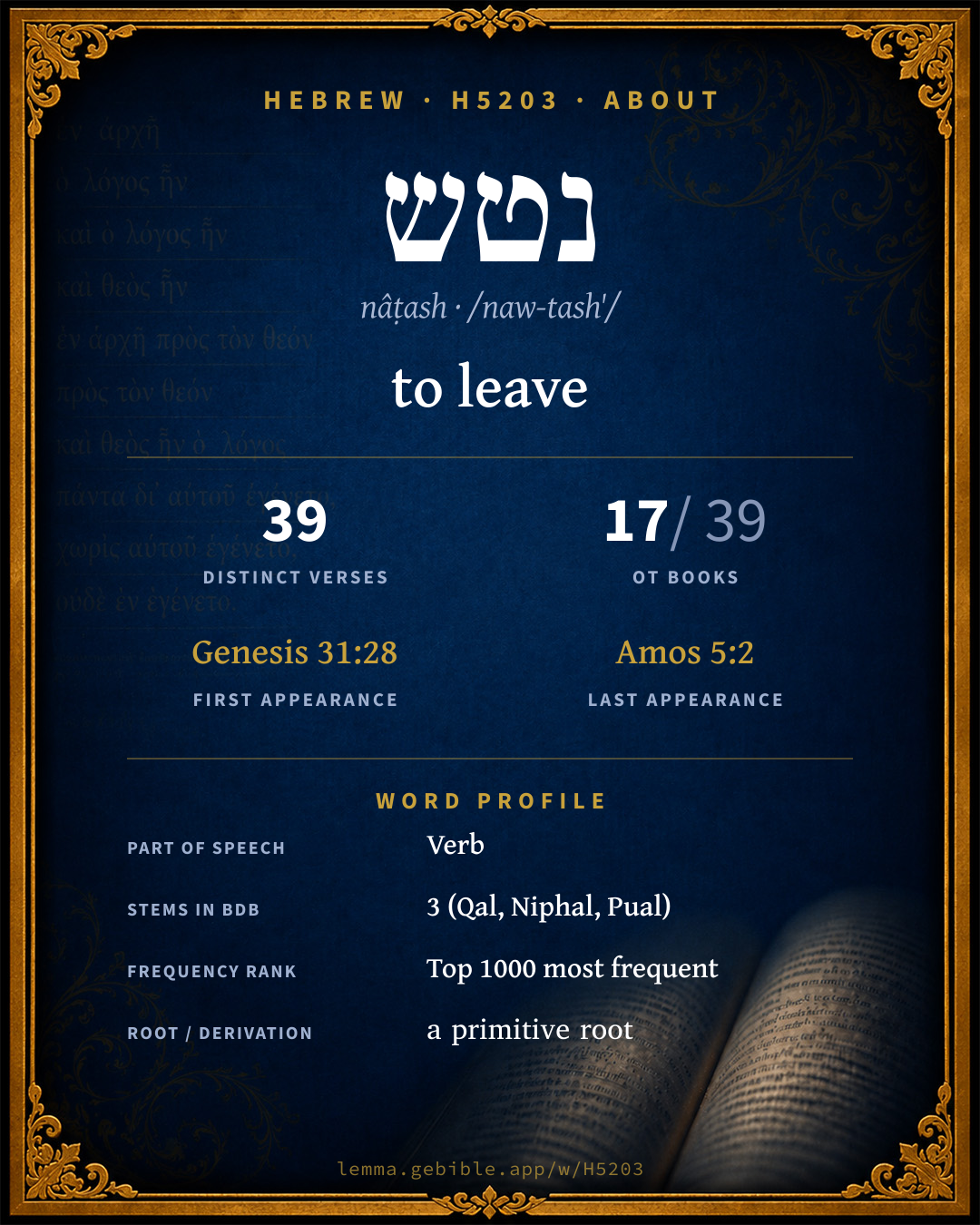
נָטַשׁ
to leave
also: permit, forsake, reject, suffer fuller range ↓
Full lexicon entry — Brown-Driver-Briggs (BDB)
From Brown-Driver-Briggs (BDB)
Where this word appears
See every Qal verb in the Hebrew Bible →
Grammar key — what these labels mean
Part of speech
- Verb
- An action or state-of-being word.
Stem
- Qal
- The basic, simple active stem — the plain form of the verb (“he wrote”). Here: ‘leave’
- Niphal
- Usually the simple passive or reflexive of the Qal (“he was written”). Here: ‘be forsaken’
- Pual
- The passive counterpart of the Piel. Here: ‘only’
Form
- Sequential Imperfect
- An imperfect with prefixed waw — the standard past-narrative form (waw-consecutive imperfect).
- Sequential Perfect
- A perfect with prefixed waw continuing a preceding imperfect or command (waw-consecutive perfect).
- Imperfect
- An incomplete, ongoing, or future action (“he will / would write”).
- Perfect
- A completed action or state — Hebrew marks aspect (completeness) more than strict tense (“he wrote”).
- Jussive
- A third- or second-person volitional form expressing wish or command (“let him write”).
- Participle Passive
- A verbal adjective expressing action received (“written”).
- Imperative
- A direct command (“write!”).
State
- Absolute
- The independent form of a noun, not bound to a following word.
Person
- 3rd Person
- The one spoken about (“he / she / it / they”).
- 1st Person
- The speaker (“I / we”).
- 2nd Person
- The one addressed (“you”).
Gender
- Masculine
- Grammatically masculine.
- Common
- Either gender — not distinguished for this form.
- Feminine
- Grammatically feminine.
Number
- Singular
- One.
- Plural
- More than one (in Hebrew, generally three or more).
Grammatical forms 20 distinct
- Verb, Qal, Sequential Imperfect, 3rd Person, Masculine, Singular 6 times (15%)
- Verb, Qal, Sequential Perfect, 1st Person, Common, Singular 5 times (13%)
- Verb, Niphal, Sequential Imperfect, 3rd Person, Masculine, Plural 3 times (8%)
- Verb, Qal, Imperfect, 3rd Person, Masculine, Singular 3 times (8%)
- Verb, Qal, Jussive, 2nd Person, Masculine, Singular 3 times (8%)
- Verb, Qal, Perfect, 2nd Person, Masculine, Singular 3 times (8%)
- Verb, Qal, Sequential Imperfect, 3rd Person, Masculine, Plural 2 times (5%)
- Verb, Niphal, Perfect, 3rd Person, Common, Plural 2 times (5%)
+12 more forms (13 occurrences)
Parsed forms decoded from the imported morphology (morphhb / Westminster Leningrad Codex — WLC text public domain, morphhb tagging CC BY 4.0), counted across 40 parsed occurrences — not distinct verses.
Every verse where H5203 appears — 39 distinct verses across 17 books. Click any verse to open its interlinear word-by-word view. Verse text shown in the World English Bible for context — . Each verse’s Hebrew form is shown with its reference; the English is not keyword-highlighted, since the data carries no word-level English alignment. Use “Compare translations” on any verse to read it across multiple English versions. This concordance covers the Hebrew Bible; Septuagint (Greek Old Testament) occurrences are not indexed here.
Genesis 1 verse
Exodus 1 verse
Numbers 1 verse
Deuteronomy 1 verse
Judges 2 verses
- Judges 6:13 נְטָשָׁ֣/נוּ Qal pf 3ms + sfx pers 1cp Gideon said to him, Oh, my lord, if Yahweh is with us, why then has all this happened to us? and where are all his wondrous works which our fathers told us of, saying, Did not Yahweh bring us up from Egypt? but now Yahweh has cast us off, and delivered us into the hand of Midian.
- Judges 15:9 וַ/יִּנָּטְשׁ֖וּ conj + Niphal wimpf 3mp Then the Philistines went up, and encamped in Judah, and spread themselves in Lehi.
1 Samuel 7 verses
- 1 Samuel 4:2 וַ/תִּטֹּשׁ֙ conj + Qal wimpf 3fs The Philistines put themselves in array against Israel: and when they joined battle, Israel was struck before the Philistines; and they killed of the army in the field about four thousand men.
- 1 Samuel 10:2 נָטַ֤שׁ Qal pf 3ms When you are departed from me today, then you shall find two men by Rachel's tomb, in the border of Benjamin at Zelzah; and they will tell you, The donkeys which you went to seek are found; and, behold, your father has left off caring for the donkeys, and is anxious for you, saying, What shall I do for my son?
- 1 Samuel 12:22 יִטֹּ֤שׁ Qal impf 3ms For Yahweh will not forsake his people for his great name's sake, because it has pleased Yahweh to make you a people to himself.
- 1 Samuel 17:20 וַ/יִּטֹּ֤שׁ conj + Qal wimpf 3ms David rose up early in the morning, and left the sheep with a keeper, and took, and went, as Jesse had commanded him; and he came to the place of the wagons, as the host which was going forth to the fight shouted for the battle.
- 1 Samuel 17:22 וַ/יִּטֹּשׁ֩ conj + Qal wimpf 3ms David left his baggage in the hand of the keeper of the baggage, and ran to the army, and came and greeted his brothers.
- 1 Samuel 17:28 נָטַ֜שְׁתָּ Qal pf 2ms Eliab his eldest brother heard when he spoke to the men; and Eliab's anger was kindled against David, and he said, Why are you come down? and with whom have you left those few sheep in the wilderness? I know your pride, and the naughtiness of your heart; for you have come down that you might see the battle.
- 1 Samuel 30:16 נְטֻשִׁ֖ים Qal ptcp.pass mp When he had brought him down, behold, they were spread abroad over all the ground, eating and drinking, and dancing, because of all the great spoil that they had taken out of the land of the Philistines, and out of the land of Judah.
2 Samuel 2 verses
1 Kings 1 verse
2 Kings 1 verse
Nehemiah 1 verse
Psalms 3 verses
- Psalms 27:9 תִּטְּשֵׁ֥/נִי Qal juss 2ms + sfx pers 1cs Don't hide your face from me. Don't put your servant away in anger. You have been my help. Don't abandon me, Neither forsake me, God of my salvation.
- Psalms 78:60 וַ֭/יִּטֹּשׁ conj + Qal wimpf 3ms So that he forsook the tent of Shiloh, The tent which he placed among men;
- Psalms 94:14 יִטֹּ֣שׁ Qal impf 3ms For Yahweh won't reject his people, Neither will he forsake his inheritance.
Proverbs 3 verses
- Proverbs 1:8 תִּ֝טֹּ֗שׁ Qal juss 2ms My son, listen to your father's instruction, And don't forsake your mother's teaching:
- Proverbs 6:20 תִּ֝טֹּ֗שׁ Qal juss 2ms My son, keep your father's commandment, And don't forsake your mother's teaching.
- Proverbs 17:14 נְטֽוֹשׁ Qal impv 2ms The beginning of strife is like breaching a dam, Therefore stop contention before quarreling breaks out.
Isaiah 5 verses
- Isaiah 2:6 נָטַ֗שְׁתָּה Qal pf 2ms For you have forsaken your people, the house of Jacob, Because they are filled from the east, With those who practice divination like the Philistines, And they clasp hands with the children of foreigners.
- Isaiah 16:8 נִטְּשׁ֖וּ Niphal pf 3cp For the fields of Heshbon languish, [and] the vine of Sibmah; the lords of the nations have broken down the choice branches of it, which reached even to Jazer, which wandered into the wilderness; its shoots were spread abroad, they passed over the sea.
- Isaiah 21:15 נְטוּשָׁ֗ה Qal ptcp.pass fs For they fled away from the swords, from the drawn sword, and from the bent bow, and from the heat of battle.
- Isaiah 32:14 נֻטָּ֔שׁ Pual pf 3ms For the palace shall be forsaken; the populous city shall be deserted; the hill and the watch-tower shall be for dens forever, a joy of wild donkeys, a pasture of flocks;
- Isaiah 33:23 נִטְּשׁ֖וּ Niphal pf 3cp Your rigging is untied; they could not strengthen the foot of their mast, they could not spread the sail: then was the prey of a great spoil divided; the lame took the prey.
Jeremiah 5 verses
- Jeremiah 7:29 וַ/יִּטֹּ֖שׁ conj + Qal wimpf 3ms Cut off your hair, [Jerusalem], and cast it away, and take up a lamentation on the bare heights; for Yahweh has rejected and forsaken the generation of his wrath.
- Jeremiah 12:7 נָטַ֖שְׁתִּי Qal pf 1cs I have forsaken my house, I have cast off my heritage; I have given the dearly beloved of my soul into the hand of her enemies.
- Jeremiah 15:6 נָטַ֥שְׁתְּ Qal pf 2fs You have rejected me, says Yahweh, you are gone backward: therefore have I stretched out my hand against you, and destroyed you; I am weary with repenting.
- Jeremiah 23:33 וְ/נָטַשְׁתִּ֥י conj + Qal wpf 1cs When this people, or the prophet, or a priest, shall ask you, saying, What is the burden of Yahweh? then shall you tell them, What burden! I will cast you off, says Yahweh.
- Jeremiah 23:39 וְ/נָטַשְׁתִּ֣י conj + Qal wpf 1cs therefore, behold, I will utterly forget you, and I will cast you off, and the city that I gave to you and to your fathers, away from my presence:
Ezekiel 3 verses
- Ezekiel 29:5 וּ/נְטַשְׁתִּ֣י/ךָ conj + Qal wpf 1cs + sfx pers 2ms I will cast you forth into the wilderness, you and all the fish of your rivers: you shall fall on the open field; you shall not be brought together, nor gathered; I have given you for food to the animals of the earth and to the birds of the sky.
- Ezekiel 31:12 וַֽ/יִּטְּשֻׁ֑/הוּ וַֽ/יִּטְּשֻֽׁ/הוּ conj + Qal wimpf 3mp + sfx pers 3ms conj + Qal wimpf 3mp + sfx pers 3ms Strangers, the terrible of the nations, have cut him off, and have left him: on the mountains and in all the valleys his branches are fallen, and his boughs are broken by all the watercourses of the land; and all the peoples of the earth are gone down from his shadow, and have left him.
- Ezekiel 32:4 וּ/נְטַשְׁתִּ֣י/ךָ conj + Qal wpf 1cs + sfx pers 2ms I will leave you on the land, I will cast you forth on the open field, and will cause all the birds of the sky to settle on you, and I will satisfy the animals of the whole earth with you.
Hosea 1 verse
Amos 1 verse
About this entry
At a glance — auto-summarized from this page’s data, not written by a person. Every figure links to its source below. This summary describes the numbers; it doesn’t interpret them.
“to leave” is the headline sense of the Hebrew verb נטש (nâṭash). Scripture first uses it in Genesis 31:28. With 39 verses in 17 books, it is a moderately common word in the Hebrew Bible. The verb spans 3 stems, from Qal to Niphal. From the same root come נטישה. The sections below give every sense, occurrence, and version rendering.
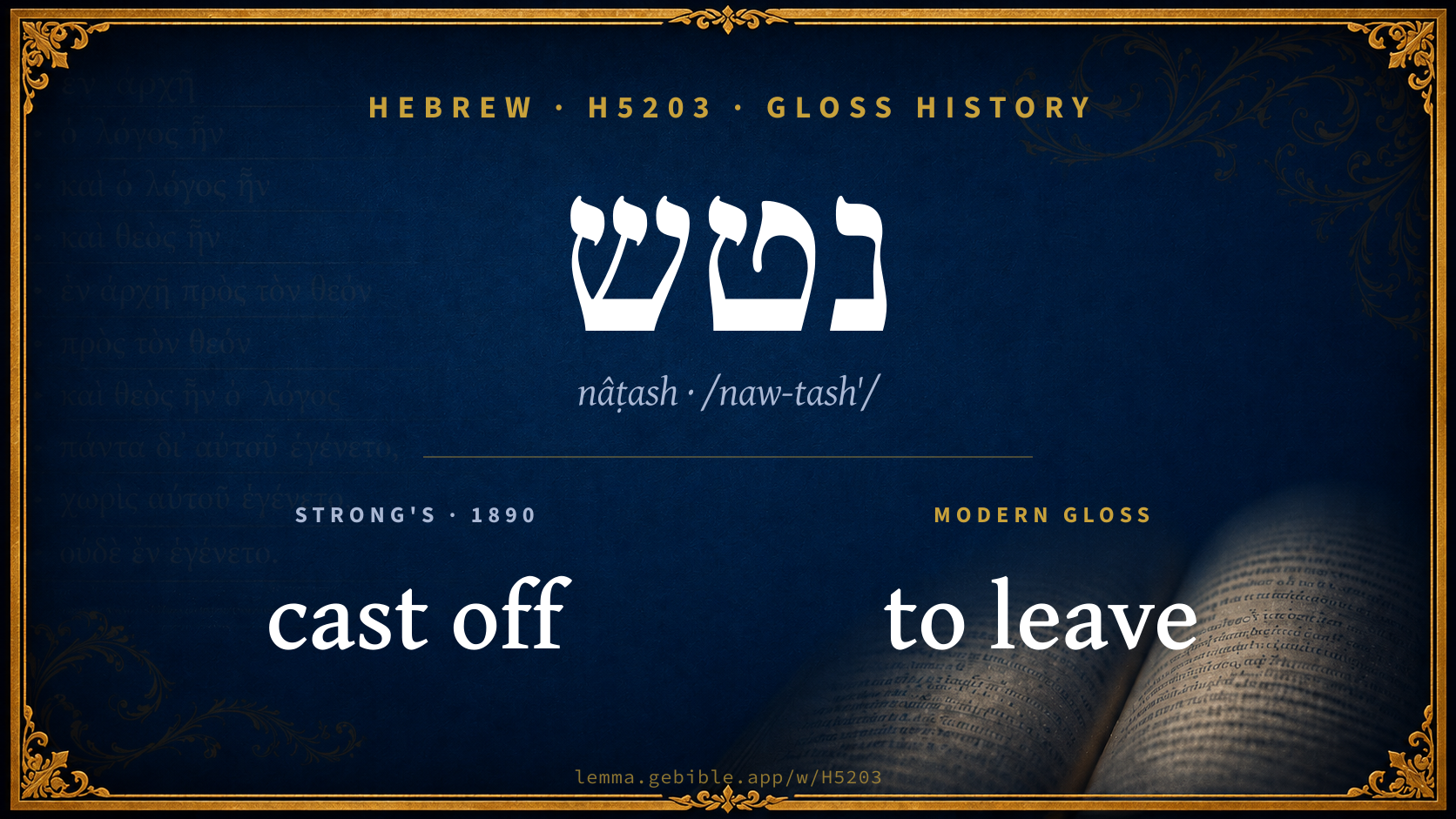
Gloss history
Strong's 1890 vs modern scholarship
About this word
Strong's H5203 catalogs a Hebrew word from the Hebrew Old Testament.
These counts are not copied from any lexicon or concordance. They are computed here, from the morphology-tagged Hebrew Old Testament. What Lemma adds →
- 39
- distinct verses
- The word appears in 39 distinct verses.
- 17 / 39
- OT books
- The word appears in 17 of 39 Old Testament books.
- #909
- by frequency
- Top 1000 most frequent Hebrew words (rank 909 of 8,640 Hebrew words by occurrence).
View all 39 occurrences in the concordance →
By section of the Old Testament
By traditional corpus
Conventional, traditional groupings — biblical authorship is debated, so this is a traditional corpus grouping, not an authorship claim. Each share is this word’s portion of its verses in that division of the Hebrew canon. Each figure is a share of the word’s 39 distinct verses.
- Prophets (Nevi'im) 28 verses · 72%
- Writings (Ketuvim) 7 verses · 18%
- Torah (Pentateuch) 4 verses · 10%
How translations render this word
Counts come from each version’s own published word-to-Strong’s tagging or interlinear alignment — an approximate guide to how each version renders this word, not a word-level alignment the data otherwise carries. Because each total is that version’s own tagged count, the per-version totals vary from one another and need not match the appearance or distinct-verse counts above. These counts may also differ from a printed concordance because Lemma counts each distinctly tagged rendering and does not collapse phrase taggings into a single head-word total. This is a fixed set of word-tagged versions (KJV, ASV, BSB, ULT) and does not change with the reading translation you choose elsewhere. Each version’s license is shown beside its name below (and on Sources).
- King James Version: Forsake 3×, Spread 3×, Have left 2×
- American Standard Version: Spread 3×, Forsake 2×, He forsook 2×
- Berean Standard Bible: Spread out 3×, Abandon 2×, Forsake 2×
- unfoldingWord Literal Text: Forsake 4×, Do 3×, Left 3×
King James Version Public Domain
Renders H5203 across 40 tagged occurrences — most commonly:
Plus 30 renderings that appear only once — usually multi-word phrases or single function words the recovered tagging swept in, not distinct renderings.
American Standard Version Public Domain
Renders H5203 across 40 tagged occurrences — most commonly:
Plus 31 renderings that appear only once — usually multi-word phrases or single function words the recovered tagging swept in, not distinct renderings.
Berean Standard Bible Public Domain
Renders H5203 across 40 tagged occurrences — most commonly:
Plus 27 renderings that appear only once — usually multi-word phrases or single function words the recovered tagging swept in, not distinct renderings.
unfoldingWord Literal Text CC BY-SA 4.0
Renders H5203 across 49 tagged occurrences — most commonly:
Plus 31 renderings that appear only once — usually multi-word phrases or single function words the recovered tagging swept in, not distinct renderings.
9 senses and sub-senses in the full BDB
Hebrew verbs can shift meaning by stem (binyan): Qal is the basic action, Niphal is often passive or reflexive, Piel often intensifies or makes it factitive, and Hiphil is typically causative. The senses below are grouped under the stem BDB assigns to each. This entry also uses Pual (the passive of Piel).
What do BDB’s symbols mean?
BDB uses these scholarly abbreviations:
| Symbol | Meaning |
|---|---|
| 𝔊 | the Septuagint (the ancient Greek translation, LXX) |
| 𝔙 | the Vulgate (the Latin translation) |
| 𝔖 | the Syriac version (the Peshitta) |
| 𝔗 | the Targum (the Aramaic translation) |
| ψ | the Psalms |
| √ | root (the underlying root or stem) |
| ‖ | parallel passage (a synonymous or contrasted parallel) |
| † | the dagger: every passage where the word occurs is cited |
The 9 senses and sub-senses the full Brown-Driver-Briggs lexicon distinguishes for this word, in lexicon order (not ranked by frequency), with BDB’s own verbatim wording and sub-sense lettering. Shown in Hebrew script with BDB’s own scholarly abbreviations. The condensed entry is in the Lexicon Entry tab. See also the Forms in the corpus table below.
Qal
- Pf. 3 ms. נ׳ 1 S 10:2, sf. 1 pl. נְטָשָׁ֫נוּ Ju 6:13; 2 ms. נָמַשְׁתָּ 1 S 17:28, נָמַשְׁתָּה Is 2:6, sf. נְטַשְׁתַּ֫נִי Gn 31:28, וּנְטַשְׁתָּהּ consec. Ex 23:11, etc.; Impf. יִטּשׁ 1 S 12:22 ψ 94:14, יִטּוֹשׁ Ho 12:15, sf. 1 pl. יִטְּשֵׁנוּ 1 K 8:57; 1 pl. נִטּשׁ Ne 10:32, etc.; Imv. נְטוֹשׁ Pr 17:14; Pt. pass. f. נְטוּשָׁה Is 21:15; mpl. נְטֻשִׁים 1 S 30:16;— e.g. 1 Samuel 10:2
- 1. leave, let alone Ex 23:11 (E; = let field lie fallow, ‖ שָׁמַט), cf. וְנִטּשׁ אֶת־הַשָּׁנָה הַשְּׁבִיעִית וּמַשָּׁא כָל־יָ֑ד Ne 10:32 (i.e. leave field fallow and debts unclaimed); obj. quails, let them lie, (עַל loc.) Nu 11:31 (JE), of Amalekites נְטֻשִׁים עַל־פְּנֵי כָל־הָאָרֶץ 1 S 30:16 left to themselves over all the land; וְדָמָיו עָלָיו יִטּוֹשׁ Ho 12:15 and his mortal guilt shall he leave upon him; leave in charge of, entrust to (עַל pers.): sheep 1 S 17:20, 28; baggage v 22. e.g. Exodus 23:11
- 2. usually forsake, abandon, נ׳ דִּבְרֵי הָאֲתֹנוֹת 1 S 10:2 thy father hath abandoned the matter of the asses (ceased to be concerned about them); הָרִיב נְטוֹשׁ Pr 17:14 abandon contention; often subj. י׳, c. acc. pers. Ju 6:13; Is 2:6; 1 S 12:22; 1 K 8:57 (‖ עָזַב) 2 K 21:14; Je 7:29; 12:7 (‖ עָזַב), 23:33, 39 ψ 27:9 (‖ עָזַב), 94:14 (‖ id.); of י׳ leaving Phar. forsaken (on ground, cf. Niph. 1) Ez 29:5 (+ ה loc.), 32:4 (+ ב loc.); abandoning the sanctuary at Shiloh ψ 78:60; of men forsaking God Dt 32:15 (poem), Je 15:6; cf. אַל־תִּטּשׁ תּוֹרַת אִמֶּ֑ךָ Pr 1:8; 6:20; of men abandoning kg. (under fig. of cedar) Ez 31:12(×2). e.g. 1 Samuel 10:2
- 3. permit, only וְלֹא נְטַשְׁתַּנִי לְנַשֵּׁק לְבָנַי וגו׳ Gn 31:28 (E) and hast not permitted me to kiss my sons, etc.—For וַתִּטּשׁ הַמִּלְחָמָה 1 S 4:2 read prob. וַתֵּט (𝔊 ἔκλινεν) Dr Klo Bu, or וַתִּקֶשׁ (קשׁה) grew fierce HPS (Löhr proposes תִּנָּטֵשׁ cf. Ju 15:9 etc.). For חֶרֶב נְטוּשָׁה Is 21:15 (‖ קֶשֶׁת דְּרוּכָה) read perhaps ח׳ לְטוּשָׁה. e.g. Genesis 31:28
Niphal
- Pf. 3 fs. נִטְּשָׁה Am 5:2; 3 pl. נִטְּשׁוּ Is 16:8; 33:23; Impf. 3 mpl. וַיִּנָּֽטְשׁוּ Ju 15:9 + 2 times;— e.g. Amos 5:2
- 1. be forsaken, Am 5:2 she (Isr.) lieth forsaken (עַל loc.). e.g. Amos 5:2
- 2. be loosened or loose (proposes be let alone, left to hang down) of ship’s tackle Is 33:23. e.g. Isaiah 33:23
- 3. be let go, spread abroad, of warriors, Ju 15:9; 2 S 5:18, 22 (all c. ב loc., for purpose of plunder); of tendrils of vine Is 16:8 (fig. of Moab). e.g. Judges 15:9
Pual
- Pf. only אַרְמוֹן נֻטָּ֑שׁ Is 32:14 palaces are abandoned, deserted (‖ הֲמוֹן עִיר עֻזָּ֑ב). e.g. Isaiah 32:14
Senses from the full Brown-Driver-Briggs lexicon (Brown, Driver, Briggs; Oxford 1906 — public domain), digitized via Sefaria, supplemented by the OpenScriptures HebrewLexicon (CC BY 4.0). Full attribution on Sources.
Word origin
vb. leave, forsake, permit (𝔗 forsake; draw off skin of dead animal; Arabic نَطِسٌ = abstinens ab impuro according to Ḳam (Frey));—
— Brown-Driver-Briggs (Oxford 1906, public domain), digitized via Sefaria, supplemented by the OpenScriptures HebrewLexicon (CC BY 4.0). See Sources.
Origin: a primitive root
Jastrow Dictionary
A second Hebrew/Aramaic lexicon for comparison, covering Aramaic and post-biblical (Talmudic, Targumic, Midrashic) usage that the biblical-Hebrew BDB does not. Matched by lemma rather than by Strong’s number, so a lemma may carry more than one Jastrow headword (shown separately below), and the entries cover usage well beyond the Bible.
נָטַשׁ I
- to polish, sharpen. Snh. 95ᵇ (כלום) מגלך נְטוּשָׁה is thy sickle (of death) polished? Sabb. 67ᵃ (in an incantation) חרב שלופה וקלע נטושח the sword is drawn and (the stones of) the sling sharpened.
*נטַשׁ
- , esp. (cmp. מָרַק) to dress a dead animal. Snh. 100ᵇ לא תִנְטושׁ וכ׳ (Ms. M. תפשוט), v. גִּלְדָּנָא.—B. Bath. 110ᵃ נְטוֹשׁ וכ׳ (Ms. M. פשוט; Ar. נשוט), v. נְבֵלְתָּא; (Pes. 113ᵃ פשוט, Ar. נשוט).
נָטַשׁ II
- to sink, drop (cmp. Num. XI, 31); to abandon, let alone, v. infra. Gen. R. s. 75 אם רחקת ונָטַשְׁתָּה וכ׳ if thou wert to reject and abandon Jacob &c.; Yalk. Ps. 653. e.g. Numbers 11:31
- same. Snh. 6ᵇ (ref. to Prov. XVII, 14) לנַטְּשׁוֹ to drop it (the case, to compromise), v. גָּלַע; Tanḥ. Mishp. 6; Y. Snh. I, 18ᵇ לנוֹטְשׁוֹ. e.g. Proverbs 17:14
- to be torn loose, be released. Pesik. Baḥod., p. 154ᵇ ני׳ מחורש וכ׳ (not מחודש) released from one thicket and caught &c.; ib. נו׳; Yalk. Num. 782 נו׳ וכ׳; (Y. Taan. II, 65ᵈ top ניתור, v. נָתַר I; Lev. R. s. 29, a. e. ניתש, v. נָתַשׁ).
נְטַשׁ
- Targ. Ps. XCIV, 14.
- same. Y. Shek. V, 48ᵈ top נטשנה דלא תימות גבן נטשת Ms. M. (v. Rabb. D. S. a. l. p. 42), read: נַטְּשׁוּנָהּ נטשונה … let her go, that she may not die while with us; they did let her go (ed. אפקונה).
A Dictionary of the Targumim, the Talmud Babli and Yerushalmi, and the Midrashic Literature (Marcus Jastrow; London, Luzac, 1903) — Public Domain. Digitized via Sefaria. Digitized via Sefaria. Full attribution on Sources.
Forms in the corpus
The 36 distinct written forms H5203 takes in the Hebrew Bible, most frequent first — each parse links to that stem’s occurrences in the concordance. Hebrew forms include their vowel points and cantillation, so a single lemma takes many written forms.
Same root — word family
Other BDB entries built from the same root as H5203, grouped by Strong’s listed origin. These share a root / origin per the lexicon — not necessarily a shared meaning. Each links to that word’s own entry.
Derived from this word
Compare all same-root words → They share a root, not necessarily a meaning.
Septuagint verse parallels
This word appears in 36 verses that also exist in the Greek Old Testament (Septuagint), out of the 39 Hebrew verses it occurs in. You can read those verses in Greek by switching the Old Testament edition to the Septuagint.
Read these verses in the Septuagint
- Genesis 31:28
- Exodus 23:11
- Numbers 11:31
- Deuteronomy 32:15
- Judges 6:13
- 1 Samuel 4:2
- 2 Samuel 5:18
- 1 Kings 8:57
- 2 Kings 21:14
- Psalms 27:9
- Proverbs 1:8
- Isaiah 2:6
This is a verse-level parallel only — the same verses exist in both the Hebrew and Greek Old Testaments. No word-level Hebrew↔Greek correspondence is claimed: the data carries no such alignment, so no Greek word is shown as this Hebrew word’s translation. Coverage is not total — the Septuagint omits the deuterocanon and renumbers the Psalms, so some Hebrew verses have no direct Greek parallel.