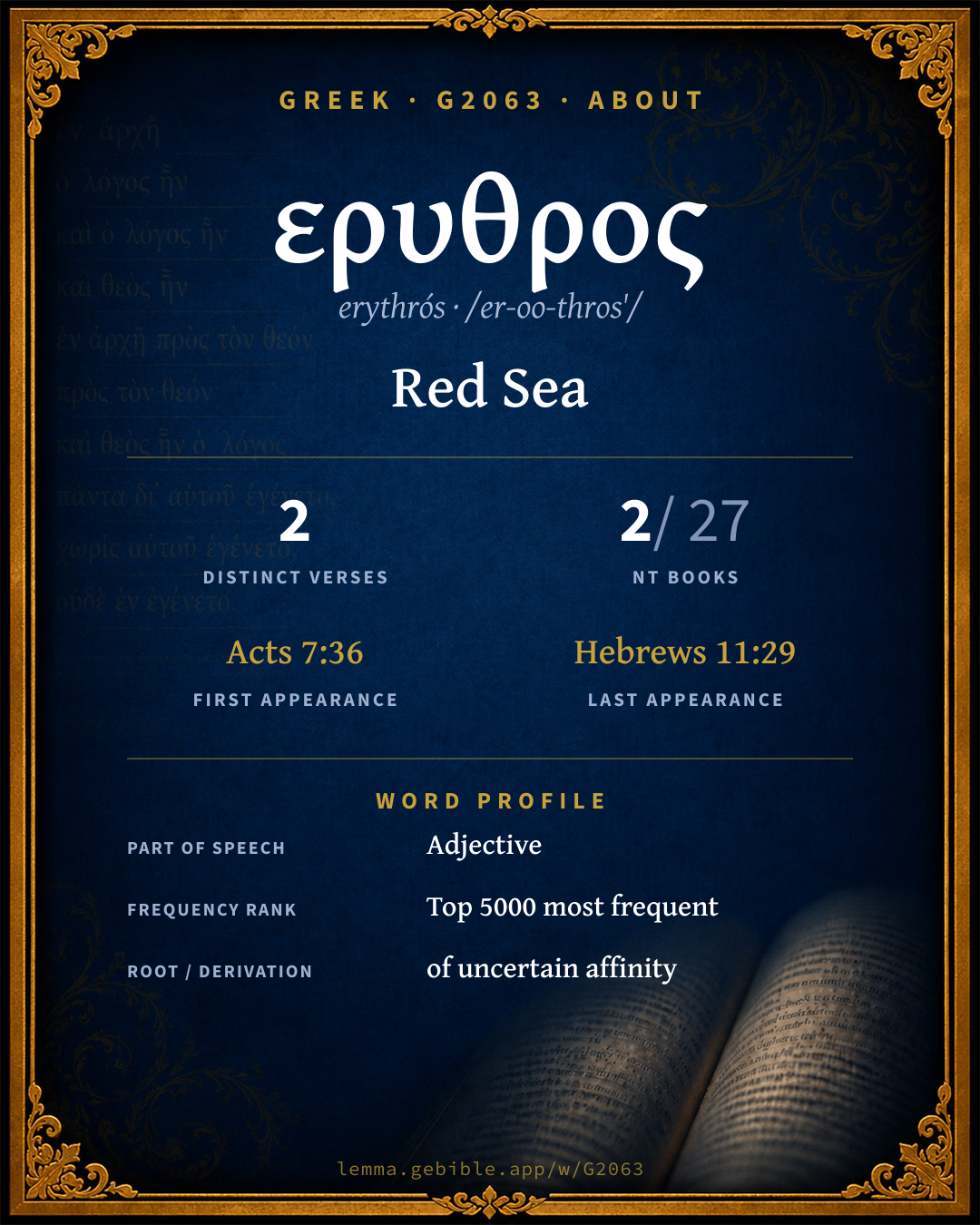
ἐρυθρός
Red Sea
Full lexicon entry — Thayer's Greek Lexicon
From Thayer's Greek Lexicon
Where this word appears
See every Accusative-case word in the Greek New Testament →
Grammar key — what these labels mean
Part of speech
- Adjective
- A word that describes or qualifies a noun.
Case
- Accusative
- The case of the direct object and of extent.
- Dative
- The case of the indirect object, means, or location — “to / for / with / in.”
Gender
- Feminine
- Grammatically feminine.
Number
- Singular
- One.
Grammatical forms
- Adjective, Accusative, Singular, Feminine 1 time (50%)
- Adjective, Dative, Singular, Feminine 1 time (50%)
Parsed forms decoded from the imported morphology (Robinson–Tischendorf, public domain), counted across 2 parsed occurrences — not distinct verses.
Every verse where G2063 appears — 2 distinct verses across 2 books. Click any verse to open its interlinear word-by-word view. Verse text shown in the World English Bible for context — . Each verse’s Greek form is shown with its reference; the English is not keyword-highlighted, since the data carries no word-level English alignment. Use “Compare translations” on any verse to read it across multiple English versions. This concordance covers the Greek New Testament; Septuagint (Greek Old Testament) occurrences of this word are not indexed here.
Acts 1 verse
Hebrews 1 verse
About this entry
At a glance — auto-summarized from this page’s data, not written by a person. Every figure links to its source below. This summary describes the numbers; it doesn’t interpret them.
The Greek name ερυθρος centers on the idea of “Red Sea.” It is rare — just 2 verses in the entire Greek New Testament. Acts dominates its distribution — 1 of 2 verses. First canonically at Acts 7:36, it enters the text early. Dig into 2-verse concordance and the renderings breakdown below.
Gloss history
Strong's 1890 vs modern scholarship
About this word
Strong's G2063 catalogs a Greek word from the Greek New Testament.
These counts are not copied from any lexicon or concordance. They are computed here, from the morphology-tagged Greek New Testament. What Lemma adds →
- 2
- distinct verses
- The word appears in 2 distinct verses.
- 2 / 27
- NT books
- The word appears in 2 of 27 New Testament books.
- #2,678
- by frequency
- Top 5000 most frequent Greek words (rank 2,678 of 5,347 Greek words by occurrence).
View all 2 occurrences in the concordance →
By traditional corpus
Conventional, traditional groupings — biblical authorship is debated, so this is a traditional corpus grouping, not an authorship claim. Some books belong to more than one corpus (Luke is in both the Gospels and the Lukan corpus, and so on), so these shares overlap and need not total 100%. Each figure is a share of the word’s 2 distinct verses.
- Lukan (Luke–Acts) 1 verse · 50%
- Hebrews 1 verse · 50%
How translations render this word
Counts come from each version’s own published word-to-Strong’s tagging or interlinear alignment — an approximate guide to how each version renders this word, not a word-level alignment the data otherwise carries. Because each total is that version’s own tagged count, the per-version totals vary from one another and need not match the appearance or distinct-verse counts above. These counts may also differ from a printed concordance because Lemma counts each distinctly tagged rendering and does not collapse phrase taggings into a single head-word total. This is a fixed set of word-tagged versions (KJV, ASV, BSB, ULT) and does not change with the reading translation you choose elsewhere. Each version’s license is shown beside its name below (and on Sources).
- King James Version: Red 2×
- American Standard Version: Red 2×
- Berean Standard Bible: Red 2×
- unfoldingWord Literal Text: Red 2×
King James Version Public Domain
Renders G2063 across 2 tagged occurrences — most commonly:
American Standard Version Public Domain
Renders G2063 across 2 tagged occurrences — most commonly:
Berean Standard Bible Public Domain
Renders G2063 across 2 tagged occurrences — most commonly:
unfoldingWord Literal Text CC BY-SA 4.0
Renders G2063 across 2 tagged occurrences — most commonly:
Senses in Thayer's
The 1 sense Thayer's distinguishes for this word, in lexicon order (not ranked by frequency or importance). The full entry — with sub-senses — is in the Lexicon Entry tab.
- the Indian Ocean washing the shores of Arabia and Persia…
Word origin
Origin: of uncertain affinity
Of uncertain affinity; red that is (with G2281 ) the red Sea : - red.
— Strong’s Exhaustive Concordance (1890), public domain.
Forms in the corpus
The 2 distinct written forms G2063 takes in the Greek New Testament, most frequent first — each parse links to that case’s occurrences in the concordance.
| Form | Parsing | Example | Uses |
|---|---|---|---|
| ἐρυθρὰν erythràn | Adjective, Accusative, Singular, Feminine | Hebrews 11:29 | 1 |
| ἐρυθρᾷ erythrâ | Adjective, Dative, Singular, Feminine | Acts 7:36 | 1 |
Bible dictionary
Public-domain dictionary articles matched to this entry by name (Red Sea). A biblical name can be shared by more than one person or place, so an article may treat several.
Easton's Bible Dictionary · M. G. Easton, 1897
The sea so called extends along the west coast of Arabia for about 1,400 miles, and separates Asia from Africa. It is connected with the Indian Ocean, of which it is an arm, by the Strait of Bab-el-Mandeb. At a point (Ras Mohammed) about 200 miles from its nothern extremity it is divided into two arms, that on the east called the AElanitic Gulf, now the Bahr el-Akabah, about 100 miles long by 15 broad, and that on the west the Gulf of Suez, about 150 miles long by about 20 broad. This branch is now connected with the Mediterranean by the Suez Canal. Between these two arms lies the Sinaitic Peninsula.
The Hebrew name generally given to this sea is Yam Suph. This word suph means a woolly kind of sea-weed, which the sea casts up in great abundance on its shores. In these passages, Ex. 10:19; 13:18; 15:4, 22; 23:31; Num. 14:25, etc., the Hebrew name is always translated "Red Sea," which was the name given to it by the Greeks. The origin of this name (Red Sea) is uncertain. Some think it is derived from the red colour of the mountains on the western shore; others from the red coral found in the sea, or the red appearance sometimes given to the water by certain zoophytes floating in it. In the New Testament (Acts 7:36; Heb. 11:29) this name is given to the Gulf of Suez.
This sea was also called by the Hebrews Yam-mitstraim, i.e., "the Egyptian sea" (Isa. 11:15), and simply Ha-yam, "the sea" (Ex. 14:2, 9, 16, 21, 28; Josh. 24:6, 7; Isa. 10:26, etc.).
The great historical event connected with the Red Sea is the passage of the children of Israel, and the overthrow of the Egyptians, to which there is frequent reference in Scripture (Ex. 14, 15; Num. 33:8; Deut. 11:4; Josh. 2:10; Judg. 11:16; 2 Sam. 22:16; Neh. 9:9-11; Ps. 66:6; Isa. 10:26; Acts 7:36, etc.).
Smith's Bible Dictionary · William Smith, 1863
+ Name.--The sea known to us as the Red Sea was by the Israelites called "the sea," (Exodus 14:2,9,16,21,28; 15:1,4,8,10,19; Joshua 24:6,7) and many other passages, and specially "the sea of Suph ." (Exodus 10:19; 13:18; 15:4,22; 23:31; Numbers 14:25) etc. This word signifies a sea-weed resembling wool, and such sea-weed is thrown up abundantly on the shores of the Red Sea; hence Brugsch calls it the sea of reeds or weeds . The color of the water is not red. Ebers says that it is of a lovely blue-green color, and named Red either from its red banks or from the Erythraeans, who were called the red people. + Physical description .--In extreme length the Red Sea stretches from the straits of Bab el-Mendeb (or rather Ras Bab el-Mendeb), 18 miles wide. in lat. 12 degrees 40' N., to the modern head of the Gulf of Suez, lat. 30 degrees N., a distance of 1450 miles. Its greatest width may be stated at about 210 miles. At Ras Mohammed, on the north, the Red Sea is split by the granitic peninsula of Sinai into two gulfs; the westernmost, or Gulf of Suez, is now about 150 miles in length, with an average width of about 20, though it contracts to less than 10 miles; the easternmost or Gulf of el-'Akabeh, is about 100 miles long, from the Straits of Tiran to the 'Akabeh, and 15 miles wide. The average depth of the Red Sea is from 2500 to 3500 feet, though in places it is 6000 feet deep. Journeying southward from Suez, on our left is the peninsula of Sinai; on the right is the desert coast of Egypt, of limestone formation like the greater part of the Nile valley in Egypt, the cliff's on the sea margin stretching landward in a great rocky plateau while more inland a chain of volcanic mountains, beginning about lat. 28 degrees 4' and running south, rear their lofty peaks at intervals above the limestone, generally about 15 miles distant. + Ancient limits.--The most important change in the Red Sea has been the drying up of its northern extremity, "the tongue of the Egyptian Sea." about the head of the gulf has risen and that near the Mediterranean become depressed. The head of the gulf has consequently retired gradually since the Christian era. Thus the prophecy of Isaiah has been fulfilled, (Isaiah 11:15; 10:5) the tongue of the Red Sea has dried up for a distance of at least 50 miles from its ancient head. An ancient canal conveyed the waters of the Nile to the Red Sea, flowing through the Wadi-t Tumeylat and irrigating with its system of water-channels a large extent of country. It was 62 Roman miles long, 54 feet wide and 7 feet deep. The drying up of the head of the gulf appears to have been one of the chief causes of the neglect and ruin of this canal. The country, for the distance above indicated, is now a desert of gravelly sand, with wide patches about the old sea-bottom, of rank marsh land, now called the "Bitter Lakes." At the northern extremity of this salt waste is a small lake, sometimes called the Lake of Heropolis; the lake is now Birket-et-Timsah "the lake of the crocodile," and is supposed to mark the ancient head of the gulf. The canal that connected this with the Nile was of Pharaonic origin. It was anciently known as the "Fossa Regum" and the "canal of Hero." The time at which the canal was extended, after the drying up of the head of the gulf, to the present head is uncertain, but it must have been late, and probably since the Mohammedan conquest. Traces of the ancient channel throughout its entire length to the vicinity of Bubastis exist at intervals in the present day. The land north of the ancient gulf is a plain of heavy sand, merging into marsh-land near the Mediterranean coast, and extending to Palestine. This region, including Wadi-t-Tumeylat, was probably the frontier land occupied in pact by the Israelites, and open to the incursions of the wild tribes of the Arabian desert. + Navigation.--The sea, from its dangers and sterile shores, is entirely destitute of boats. The coral of the Red Sea is remarkably abundant, and beautifully colored and variegated; but it forms so many reefs and islands along the shores that navigation is very dangerous, and the shores are chiefly barren rock and sand, and therefore very sparsely inhabited so that there are but three cities along the whole 1450 miles of its west coast--Suez, at the head, a city of 14,000 inhabitants; Sanakin, belonging to Soudan, of 10,000; and Massau, in Albyssinia, of 5000. Only two ports, Elath and Ezion-geber, are mentioned in the Bible. The earliest navigation of the Red Sea (passing by the pre-historical Phoenicians) is mentioned by Herodotus:--"Seostris (Rameses II.) was the first who passing the Arabian Gulf in a fleet of long vessels, reduced under his authority the inhabitants of the coast bordering the Erythrean Sea." Three centuries later, Solomon's navy was built "in Ezion-geber, which is beside Eloth, on the shore of the Red Sea (Yam Suph), in the land of Edom." (1 Kings 9:20) The kingdom of Solomon extended as far as the Red Sea, upon which he possessed the harbors of Elath and Ezion-geber. [Elath, Eloth; EZION-GEBER] It is possible that the sea has retired here as at Suez, and that Ezion-geber is now dry land. Jehoshaphat also "made ships of Tharshish to go to Ophir for gold; but they went not; for the ships were broken at Ezion-geber." (1 Kings 22:48) The scene of this wreck has been supposed to be Edh-Dhahab. The fleets appear to have sailed about the autumnal equinox, and returned in December or the middle of January. The Red Sea, as it possessed for many centuries the most important sea-trade of the East contained ports of celebrity. The Heroopolite Gulf (Gulf of Suez) is of the chief interest; it was near to Goshen, it was the scene of the passage of the Red Sea, and it was the "tongue of the Egyptian Sea." It was also the seat of the Egyptian trade in this sea and to the Indian Ocean. + Passage of the Red Sea .--The passage of the Red Sea was the crisis of the exodus. It is usual to suppose that the most northern place at which the Red Sea could have been crossed is the present head of the Gulf of Suez. This supposition depends upon the erroneous idea that in the time of Moses the gulf did not extend farther to the northward then at present. An examination of the country north of Suez has shown, however, that the sea has receded many miles. The old bed is indicated by the Birket-et Timsah, or "lake of the crocodile," and the more southern Bitter Lakes, the northernmost part of the former probably corresponding to the head of it the at the time of the exodus. It is necessary to endeavor to ascertain the route of the Israelites before we can attempt to discover where they crossed the sea. The point from which they started was Rameses, a place certain in the land of Goshen, which we identified with the Wadi-t-Tumeylat . They encamped at Succoth. At the end of the second day's journey the camping place was at Etham, "in the edge of the wilderness." (Exodus 13:20; Numbers 33:6) Here the Wadi-t-Tumeylat was probably left, as it is cultivable and terminates in the desert. At the end of the third day's march for each camping place seems to mark the close of a day's journey the Israelites encamped by the sea, place of this last encampment and that of the passage would be not very far from the Persepolitan monument at Pihahiroth. It appears that Migdol was behind Pi-hahiroth and on the other hand Baalzephon and the sea. From Pi-hahiroth the Israelites crossed the sea. This was not far from halfway between the Bitter Lakes and the Gulf of Suez, where now it is dry land. The Muslims suppose Memphis to have been the city at which the Pharaoh of the exodus resided before that event occurred. From opposite Memphis a broad valley leads to the Red Sea. It is in part called the Wadi-t-Teeh, or "Valley of the Wandering." From it the traveller reaches the sea beneath the lofty Gebel-et-Takah, which rises in the north and shuts off all escape in that direction excepting by a narrow way along the seashore, which Pharaoh might have occupied. The sea here is broad and deep, as the narrative is generally held to imply. All the local features seem suited for a great event. The only points bearing on geography in the account of this event are that the sea was divided by an east wind. Whence we may reasonably infer that it was crossed from west to east, and that the whole Egyptian army perished, which shows that it must have been some miles broad. On the whole we may reasonably suppose about twelve miles as the smallest breadth of the sea. The narrative distinctly states that a path was made through the sea, and that the waters were a wall on either hand. The term "wall" does not appear to oblige us to suppose, as many have done, that the sea stood up like a cliff on either side, but should rather be considered to mean a barrier, as the former idea implies a seemingly needless addition to the miracle, while the latter seems to be not discordant with the language of the narrative. It was during the night that the Israelites crossed, and the Egyptians followed. In the morning watch, the last third or fourth of the night, or the period before sunrise Pharaoh's army was in full pursuit in the divided sea, and was there miraculously troubled, so that the Egyptians sought to flee. (Exodus 14:23-25) Then was Moses commanded again to stretch out his hand and the sea returned to its strength, and overwhelmed the Egyptians, of whom not one remained alive, Ibid. 26-28. (But on the whole it is becoming more probable that the place where the Israelites crossed "was near the town of Suez, on extensive shoals which run toward the southeast, in the direction of Ayim Musa (the Wells of Moses). The distance is about three miles at high tide. This is the most probable thee Near here Napoleon, deceived by the tidal wave, attempted to cross in 1799, and nearly met the fate of Pharaoh. But an army of 600,000 could of course never have crossed it without a miracle."--Schaff's Through Bible Lands . Several routes and places of crossing advocated by learned Egyptologists can be clearly seen by the accompanying maps. The latest theory is that which Brugsch-bey has lately revived that the word translated Red Sea is "Sea of Reeds or Weeds," and refers to the Serbonian bog in the northeastern part of Egypt, and that the Israelites crossed here instead of the Red Sea. "A gulf profound, as that Serbonian bog . . . where armies whole have sunk."--Milton. And among these armies that of Artarerxes, king of Persia, B.C. 350. But it is very difficult to make this agree with the Bible narrative, and if is the least satisfactory of all the theories.--ED.)
Classic public-domain reference works; full attribution on Sources.
Septuagint usage
The same Greek word ερυθρος appears 24 times in the Greek Old Testament (Septuagint), across 23 verses in 7 books.
- 24
- LXX occurrences
- Tagged occurrences of this Greek word in the Septuagint.
- 23
- verses
- Distinct Septuagint verses containing this word.
- 7 / 39
- OT books
- The word appears in 7 of the 39 Old Testament books.
Sample Septuagint occurrences
- Exodus 10:19 ἐρυθρός
- Numbers 14:25 ἐρυθρός
- Deuteronomy 1:1 ἐρυθρός
- Joshua 2:10 ἐρυθρός
- Ezra 19:9 ἐρυθρός
- Psalms 105:7 ἐρυθρός
- Isaiah 63:2 ἐρυθρός
Septuagint occurrences (same lexeme)
Every verse where the same Strong’s number (G2063) appears in the Greek Septuagint. Verse text shown in the World English Bible for context; the Greek form is the matched word — the English is not keyword-highlighted.
- Exodus 10:19 ἐρυθρός Yahweh turned an exceeding strong west wind, which took up the locusts, and drove them into the Red Sea. There remained not one locust in all the borders of Egypt.
- Exodus 13:18 ἐρυθρός but God led the people around by the way of the wilderness by the Red Sea; and the children of Israel went up armed out of the land of Egypt.
- Exodus 15:4 ἐρυθρός Pharaoh's chariots and his host has he cast into the sea; His chosen captains are sunk in the Red Sea.
- Exodus 15:22 ἐρυθρός Moses led Israel onward from the Red Sea, and they went out into the wilderness of Shur; and they went three days in the wilderness, and found no water.
- Exodus 23:31 ἐρυθρός I will set your border from the Red Sea even to the sea of the Philistines, and from the wilderness to the River; for I will deliver the inhabitants of the land into your hand, and you shall drive them out before you.
- Numbers 14:25 ἐρυθρός Now the Amalekite and the Canaanite dwell in the valley: tomorrow turn you, and get you into the wilderness by the way to the Red Sea.
- Numbers 21:4 ἐρυθρός They traveled from Mount Hor by the way to the Red Sea, to compass the land of Edom: and the soul of the people was much discouraged because of the way.
- Numbers 33:10 ἐρυθρός They traveled from Elim, and encamped by the Red Sea.
- Numbers 33:11 ἐρυθρός They traveled from the Red Sea, and encamped in the wilderness of Sin.
- Deuteronomy 1:1 ἐρυθρός These are the words which Moses spoke to all Israel beyond the Jordan in the wilderness, in the Arabah over against Suph, between Paran, and Tophel, and Laban, and Hazeroth, and Dizahab.
- Deuteronomy 1:40 ἐρυθρός But as for you, turn you, and take your journey into the wilderness by the way to the Red Sea.
- Deuteronomy 2:1 ἐρυθρός Then we turned, and took our journey into the wilderness by the way to the Red Sea, as Yahweh spoke to me; and we compassed Mount Seir many days.
- Deuteronomy 11:4 ἐρυθρός and what he did to the army of Egypt, to their horses, and to their chariots; how he made the water of the Red Sea to overflow them as they pursued after you, and how Yahweh has destroyed them to this day;
- Joshua 2:10 ἐρυθρός For we have heard how Yahweh dried up the water of the Red Sea before you, when you came out of Egypt; and what you did to the two kings of the Amorites, who were beyond the Jordan, to Sihon and to Og, whom you utterly destroyed.
- Joshua 4:23 ἐρυθρός For Yahweh your God dried up the waters of the Jordan from before you, until you were passed over, as Yahweh your God did to the Red Sea, which he dried up from before us, until we were passed over;
- Joshua 24:6 ἐρυθρός I brought your fathers out of Egypt: and you came to the sea; and the Egyptians pursued after your fathers with chariots and with horsemen to the Red Sea.
- Ezra 19:9 ἐρυθρός
- Psalms 105:7 ἐρυθρός He is Yahweh, our God. His judgments are in all the earth.
- Psalms 105:9 ἐρυθρός The covenant which he made with Abraham, His oath to Isaac,
- Psalms 105:22 ἐρυθρός To discipline his princes at his pleasure, And to teach his elders wisdom.
- Psalms 135:13 ἐρυθρός Your name, Yahweh, endures forever; Your renown, Yahweh, throughout all generations.
- Psalms 135:15 ἐρυθρός The idols of the nations are silver and gold, The work of men's hands.
- Isaiah 63:2 ἐρυθρός Why are you red in your clothing, and your garments like him who treads in the wine vat?
These are occurrences of the same Greek lexeme (G2063) in the Septuagint — not a translation of any one Hebrew word. The store carries no word-level Hebrew↔Greek alignment, so no Hebrew original is asserted here. Counts come from the recovered LXX Strong's tagging — high-frequency vocabulary is well covered, while rare or late forms may be untagged — so they reflect tagged occurrences and may slightly undercount.