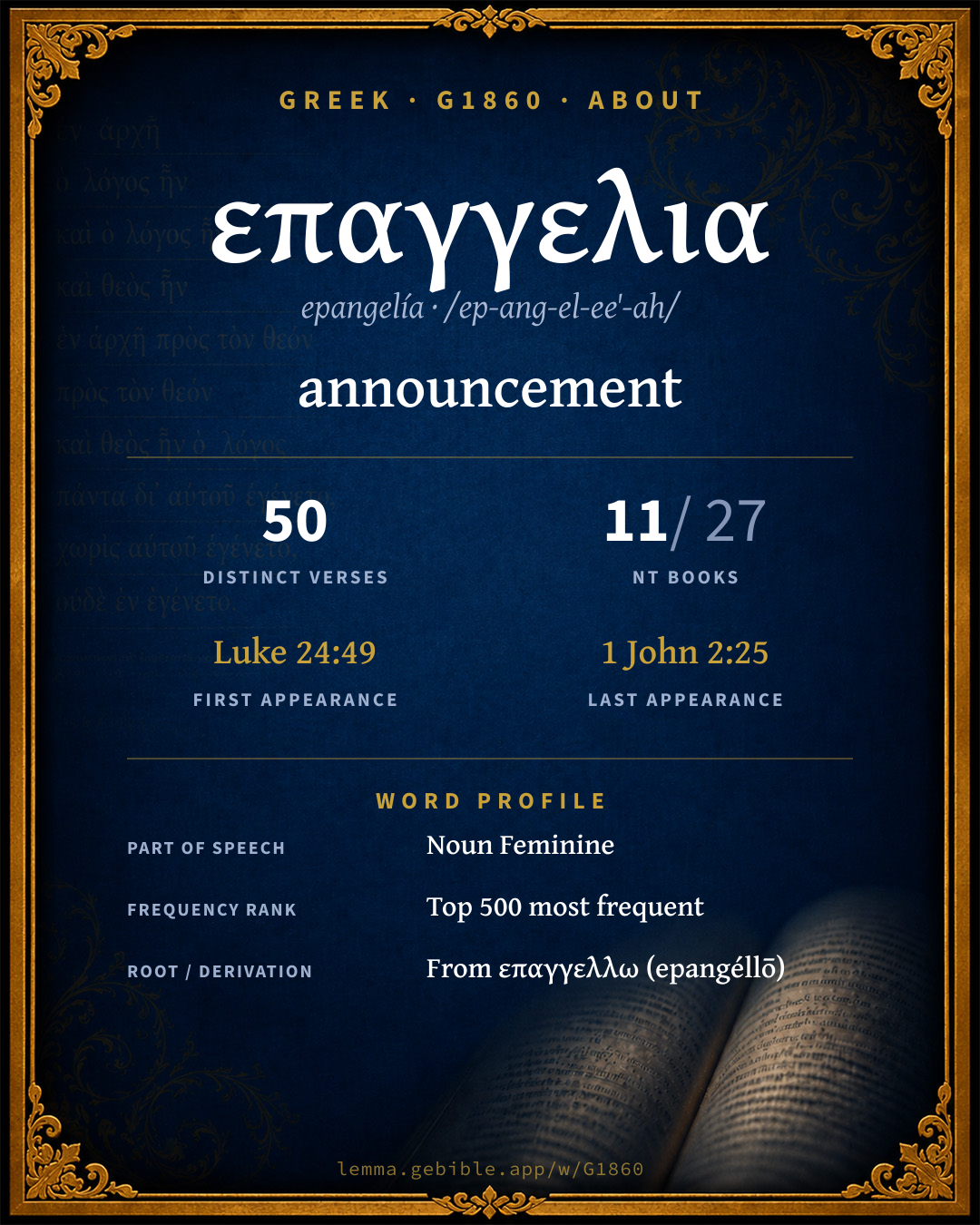
ἐπαγγελία
announcement
‘announcement’ is one of 2 main senses fuller range ↓
Full lexicon entry — Thayer's Greek Lexicon
From Thayer's Greek Lexicon
Where this word appears
See every Accusative-case word in the Greek New Testament →
Grammar key — what these labels mean
Part of speech
- Noun
- A naming word — a person, place, thing, or idea.
Case
- Genitive
- The case of source, possession, or “of” — answers “whose / from what.”
- Accusative
- The case of the direct object and of extent.
- Nominative
- The case of the subject (and the predicate nominative).
- Dative
- The case of the indirect object, means, or location — “to / for / with / in.”
Gender
- Feminine
- Grammatically feminine.
Number
- Singular
- One.
- Plural
- More than one.
Grammatical forms
- Noun, Genitive, Singular, Feminine 17 times (33%)
- Noun, Accusative, Singular, Feminine 16 times (31%)
- Noun, Accusative, Plural, Feminine 6 times (12%)
- Noun, Nominative, Singular, Feminine 6 times (12%)
- Noun, Nominative, Plural, Feminine 3 times (6%)
- Noun, Genitive, Plural, Feminine 2 times (4%)
- Noun, Dative, Plural, Feminine 1 time (2%)
- Noun, Dative, Singular, Feminine 1 time (2%)
Parsed forms decoded from the imported morphology (Robinson–Tischendorf, public domain), counted across 52 parsed occurrences — not distinct verses.
Every verse where G1860 appears — 50 distinct verses across 11 books. Click any verse to open its interlinear word-by-word view. Verse text shown in the World English Bible for context — . Each verse’s Greek form is shown with its reference; the English is not keyword-highlighted, since the data carries no word-level English alignment. Use “Compare translations” on any verse to read it across multiple English versions. This concordance covers the Greek New Testament; Septuagint (Greek Old Testament) occurrences of this word are not indexed here.
Luke 1 verse
Acts 8 verses
- Acts 1:4 ἐπαγγελίαν n acc sg fem Being assembled together with them, he charged them, "Don't depart from Jerusalem, but wait for the promise of the Father, which you heard from me.
- Acts 2:33 ἐπαγγελίαν n acc sg fem Being therefore exalted by the right hand of God, and having received from the Father the promise of the Holy Spirit, he has poured out this, which you now see and hear.
- Acts 2:39 ἐπαγγελία n nom sg fem For to you is the promise, and to your children, and to all who are far off, even as many as the Lord our God will call to himself."
- Acts 7:17 ἐπαγγελίας n gen sg fem "But as the time of the promise came close which God had sworn to Abraham, the people grew and multiplied in Egypt,
- Acts 13:23 ἐπαγγελίαν n acc sg fem From this man's seed, God has brought salvation to Israel according to his promise,
- Acts 13:32 ἐπαγγελίαν n acc sg fem We bring you good news of the promise made to the fathers,
- Acts 23:21 ἐπαγγελίαν n acc sg fem Therefore don't yield to them, for more than forty men lie in wait for him, who have bound themselves under a curse neither to eat nor to drink until they have killed him. Now they are ready, looking for the promise from you."
- Acts 26:6 ἐπαγγελίας n gen sg fem Now I stand here to be judged for the hope of the promise made by God to our fathers,
Romans 8 verses
- Romans 4:13 ἐπαγγελία n nom sg fem For the promise to Abraham and to his seed that he should be heir of the world wasn't through the law, but through the righteousness of faith.
- Romans 4:14 ἐπαγγελία n nom sg fem For if those who are of the law are heirs, faith is made void, and the promise is made of no effect.
- Romans 4:16 ἐπαγγελίαν n acc sg fem For this cause it is of faith, that it may be according to grace, to the end that the promise may be sure to all the seed, not to that only which is of the law, but to that also which is of the faith of Abraham, who is the father of us all.
- Romans 4:20 ἐπαγγελίαν n acc sg fem Yet, looking to the promise of God, he didn't waver through unbelief, but grew strong through faith, giving glory to God,
- Romans 9:4 ἐπαγγελίαι n nom pl fem who are Israelites; whose is the adoption, the glory, the covenants, the giving of the law, the service, and the promises;
- Romans 9:8 ἐπαγγελίας n gen sg fem That is, it is not the children of the flesh who are children of God, but the children of the promise are counted as a seed.
- Romans 9:9 ἐπαγγελίας n gen sg fem For this is a word of promise, "At the appointed time I will come, and Sarah will have a son."
- Romans 15:8 ἐπαγγελίας n acc pl fem Now I say that Christ has been made a minister of the circumcision for the truth of God, that he might confirm the promises given to the fathers,
2 Corinthians 2 verses
- 2 Corinthians 1:20 ἐπαγγελίαι n nom pl fem For however many are the promises of God, in him is the "Yes." Therefore also through him is the "Amen," to the glory of God through us.
- 2 Corinthians 7:1 ἐπαγγελίας n acc pl fem Having therefore these promises, beloved, let us cleanse ourselves from all defilement of flesh and spirit, perfecting holiness in the fear of God.
Galatians 9 verses
- Galatians 3:14 ἐπαγγελίαν n acc sg fem that the blessing of Abraham might come on the Gentiles through Christ Jesus; that we might receive the promise of the Spirit through faith.
- Galatians 3:16 ἐπαγγελίαι n nom pl fem Now the promises were spoken to Abraham and to his seed. He doesn't say, "To seeds," as of many, but as of one, "To your seed," which is Christ.
- Galatians 3:17 ἐπαγγελίαν n acc sg fem Now I say this. A covenant confirmed beforehand by God in Christ, the law, which came four hundred thirty years after, does not annul, so as to make the promise of no effect.
- Galatians 3:18 ἐπαγγελίας ἐπαγγελίας n gen sg fem n gen sg fem For if the inheritance is of the law, it is no more of promise; but God has granted it to Abraham by promise.
- Galatians 3:21 ἐπαγγελιῶν n gen pl fem Is the law then against the promises of God? Certainly not! For if there had been a law given which could make alive, most assuredly righteousness would have been of the law.
- Galatians 3:22 ἐπαγγελία n nom sg fem But the Scriptures shut up all things under sin, that the promise by faith in Jesus Christ might be given to those who believe.
- Galatians 3:29 ἐπαγγελίαν n acc sg fem If you are Christ's, then you are Abraham's seed and heirs according to promise.
- Galatians 4:23 ἐπαγγελίας n gen sg fem However, the son by the handmaid was born according to the flesh, but the son by the free woman was born through promise.
- Galatians 4:28 ἐπαγγελίας n gen sg fem Now we, brothers, as Isaac was, are children of promise.
Ephesians 4 verses
- Ephesians 1:13 ἐπαγγελίας n gen sg fem in whom you also, having heard the word of the truth, the Gospel of your salvation,--in whom, having also believed, you were sealed with the Holy Spirit of promise,
- Ephesians 2:12 ἐπαγγελίας n gen sg fem that you were at that time separate from Christ, alienated from the commonwealth of Israel, and strangers from the covenants of the promise, having no hope and without God in the world.
- Ephesians 3:6 ἐπαγγελίας n gen sg fem that the Gentiles are fellow heirs, and fellow members of the body, and fellow partakers of his promise in Christ Jesus through the Gospel,
- Ephesians 6:2 ἐπαγγελίᾳ n dat sg fem "Honor your father and mother," which is the first commandment with a promise:
1 Timothy 1 verse
2 Timothy 1 verse
Hebrews 13 verses
- Hebrews 4:1 ἐπαγγελίας n gen sg fem Let us fear therefore, lest perhaps a promise being left of entering into his rest, anyone of you should seem to have come short of it.
- Hebrews 6:12 ἐπαγγελίας n acc pl fem that you won't be sluggish, but imitators of those who through faith and patience inherited the promises.
- Hebrews 6:15 ἐπαγγελίας n gen sg fem Thus, having patiently endured, he obtained the promise.
- Hebrews 6:17 ἐπαγγελίας n gen sg fem In this way God, being determined to show more abundantly to the heirs of the promise the immutability of his counsel, interposed with an oath;
- Hebrews 7:6 ἐπαγγελίας n acc pl fem but he whose genealogy is not counted from them has taken tithes of Abraham, and has blessed him who has the promises.
- Hebrews 8:6 ἐπαγγελίαις n dat pl fem But now he has obtained a more excellent ministry, by so much as he is also the mediator of a better covenant, which has been enacted on better promises.
- Hebrews 9:15 ἐπαγγελίαν n acc sg fem For this reason he is the mediator of a new covenant, since a death has occurred for the redemption of the transgressions that were under the first covenant, that those who have been called may receive the promise of the eternal inheritance.
- Hebrews 10:36 ἐπαγγελίαν n acc sg fem For you need endurance so that, having done the will of God, you may receive the promise.
- Hebrews 11:9 ἐπαγγελίας ἐπαγγελίας n gen sg fem n gen sg fem By faith, he lived as an alien in the land of promise, as in a land not his own, dwelling in tents, with Isaac and Jacob, the heirs with him of the same promise.
- Hebrews 11:13 ἐπαγγελίας n acc pl fem These all died in faith, not having received the promises, but having seen them and embraced them from afar, and having confessed that they were strangers and pilgrims on the earth.
- Hebrews 11:17 ἐπαγγελίας n acc pl fem By faith, Abraham, being tested, offered up Isaac. Yes, he who had gladly received the promises was offering up his one and only son;
- Hebrews 11:33 ἐπαγγελιῶν n gen pl fem who, through faith subdued kingdoms, worked out righteousness, obtained promises, stopped the mouths of lions,
- Hebrews 11:39 ἐπαγγελίαν n acc sg fem These all, having had testimony given to them through their faith, didn't receive the promise,
2 Peter 2 verses
- 2 Peter 3:4 ἐπαγγελία n nom sg fem and saying, "Where is the promise of his coming? For, from the day that the fathers fell asleep, all things continue as they were from the beginning of the creation."
- 2 Peter 3:9 ἐπαγγελίας n gen sg fem The Lord is not slow concerning his promise, as some count slowness; but is patient with us, not wishing that any should perish, but that all should come to repentance.
1 John 1 verse
About this entry
At a glance — auto-summarized from this page’s data, not written by a person. Every figure links to its source below. This summary describes the numbers; it doesn’t interpret them.
The Greek noun επαγγελια centers on the idea of “announcement.” Its earliest occurrence is Luke 24:49. It turns up in 50 verses across 11 books, a moderately common footprint. The word gravitates to Hebrews (26%), then Galatians and Acts. Thayer's distinguishes 2 senses for it. Each statement above links to its evidence; the full detail follows below.
Gloss history
Strong's 1890 vs modern scholarship

About this word
Strong's G1860 catalogs a Greek word from the Greek New Testament.
These counts are not copied from any lexicon or concordance. They are computed here, from the morphology-tagged Greek New Testament. What Lemma adds →
- 50
- distinct verses
- The word appears in 50 distinct verses.
- 11 / 27
- NT books
- The word appears in 11 of 27 New Testament books.
- #305
- by frequency
- Top 500 most frequent Greek words (rank 305 of 5,347 Greek words by occurrence).
View all 50 occurrences in the concordance →
By section of the New Testament
By traditional corpus
Conventional, traditional groupings — biblical authorship is debated, so this is a traditional corpus grouping, not an authorship claim. Some books belong to more than one corpus (Luke is in both the Gospels and the Lukan corpus, and so on), so these shares overlap and need not total 100%. Each figure is a share of the word’s 50 distinct verses.
- Pauline corpus 25 verses · 50%
- Hebrews 13 verses · 26%
- Lukan (Luke–Acts) 9 verses · 18%
- General (Catholic) Epistles 3 verses · 6%
- Gospels 1 verse · 2%
- Johannine 1 verse · 2%
How translations render this word
Counts come from each version’s own published word-to-Strong’s tagging or interlinear alignment — an approximate guide to how each version renders this word, not a word-level alignment the data otherwise carries. Because each total is that version’s own tagged count, the per-version totals vary from one another and need not match the appearance or distinct-verse counts above. These counts may also differ from a printed concordance because Lemma counts each distinctly tagged rendering and does not collapse phrase taggings into a single head-word total. This is a fixed set of word-tagged versions (KJV, ASV, BSB, ULT) and does not change with the reading translation you choose elsewhere. Each version’s license is shown beside its name below (and on Sources).
- King James Version: Promise 39×, Promises 12×
- American Standard Version: Promise 35×, Promises 11×
- Berean Standard Bible: Promise 29×, Promises 8×, Promised 7×
- unfoldingWord Literal Text: Promise 39×, Promises 11×
King James Version Public Domain
Renders G1860 across 53 tagged occurrences — most commonly:
Plus 2 renderings that appear only once — usually multi-word phrases or single function words the recovered tagging swept in, not distinct renderings.
American Standard Version Public Domain
Renders G1860 across 52 tagged occurrences — most commonly:
Plus 6 renderings that appear only once — usually multi-word phrases or single function words the recovered tagging swept in, not distinct renderings.
Berean Standard Bible Public Domain
Renders G1860 across 51 tagged occurrences — most commonly:
Plus 7 renderings that appear only once — usually multi-word phrases or single function words the recovered tagging swept in, not distinct renderings. Not rendered by a distinct English word in 1 further occurrence.
unfoldingWord Literal Text CC BY-SA 4.0
Renders G1860 across 54 tagged occurrences — most commonly:
Plus 4 renderings that appear only once — usually multi-word phrases or single function words the recovered tagging swept in, not distinct renderings.
Senses in Thayer's
The 2 senses Thayer's distinguishes for this word, in lexicon order (not ranked by frequency or importance). The full entry — with sub-senses — is in the Lexicon Entry tab.
- announcement
- promise
Word origin
Derived from επαγγελλω (epangéllō) (G1861) — to announce.
From G1861 ; an announcement (for information assent or pledge; especially a divine assurance of good): - message promise.
— Strong’s Exhaustive Concordance (1890), public domain.
Forms in the corpus
The 7 distinct written forms G1860 takes in the Greek New Testament, most frequent first — each parse links to that case’s occurrences in the concordance.
| Form | Parsing | Example | Uses |
|---|---|---|---|
| ἐπαγγελίας epangelías | Noun, Genitive, Singular, Feminine | Acts 7:17 | 23 |
| ἐπαγγελίαν epangelían | Noun, Accusative, Singular, Feminine | Luke 24:49 | 16 |
| ἐπαγγελία epangelía | Noun, Nominative, Singular, Feminine | Acts 2:39 | 6 |
| ἐπαγγελίαι epangelíai | Noun, Nominative, Plural, Feminine | Romans 9:4 | 3 |
| ἐπαγγελιῶν epangeliō̂n | Noun, Genitive, Plural, Feminine | Galatians 3:21 | 2 |
| ἐπαγγελίαις epangelíais | Noun, Dative, Plural, Feminine | Hebrews 8:6 | 1 |
| ἐπαγγελίᾳ epangelía | Noun, Dative, Singular, Feminine | Ephesians 6:2 | 1 |
Same root — word family
Other Thayer's entries built from the same root as G1860, grouped by Strong’s listed origin. These share a root / origin per the lexicon — not necessarily a shared meaning. Each links to that word’s own entry.
Derives from
Shares the same root
Compare all same-root words → They share a root, not necessarily a meaning.
Septuagint usage
The same Greek word επαγγελια appears 3 times in the Greek Old Testament (Septuagint), across 3 verses in 3 books.
- 3
- LXX occurrences
- Tagged occurrences of this Greek word in the Septuagint.
- 3
- verses
- Distinct Septuagint verses containing this word.
- 3 / 39
- OT books
- The word appears in 3 of the 39 Old Testament books.
Sample Septuagint occurrences
- Esther 4:7 ἐπαγγελία
- Psalms 55:9 ἐπαγγελία
- Amos 9:6 ἐπαγγελία
Septuagint occurrences (same lexeme)
Every verse where the same Strong’s number (G1860) appears in the Greek Septuagint. Verse text shown in the World English Bible for context; the Greek form is the matched word — the English is not keyword-highlighted.
- Esther 4:7 ἐπαγγελία Mordecai told him of all that had happened to him, and the exact sum of the money that Haman had promised to pay to the king's treasuries for the Jews, to destroy them.
- Psalms 55:9 ἐπαγγελία Confuse them, Lord, and confound their language, For I have seen violence and strife in the city.
- Amos 9:6 ἐπαγγελία It is he who builds his chambers in the heavens, and has founded his vault on the earth; he who calls for the waters of the sea, and pours them out on the surface of the earth; Yahweh is his name.
These are occurrences of the same Greek lexeme (G1860) in the Septuagint — not a translation of any one Hebrew word. The store carries no word-level Hebrew↔Greek alignment, so no Hebrew original is asserted here. Counts come from the recovered LXX Strong's tagging — high-frequency vocabulary is well covered, while rare or late forms may be untagged — so they reflect tagged occurrences and may slightly undercount.