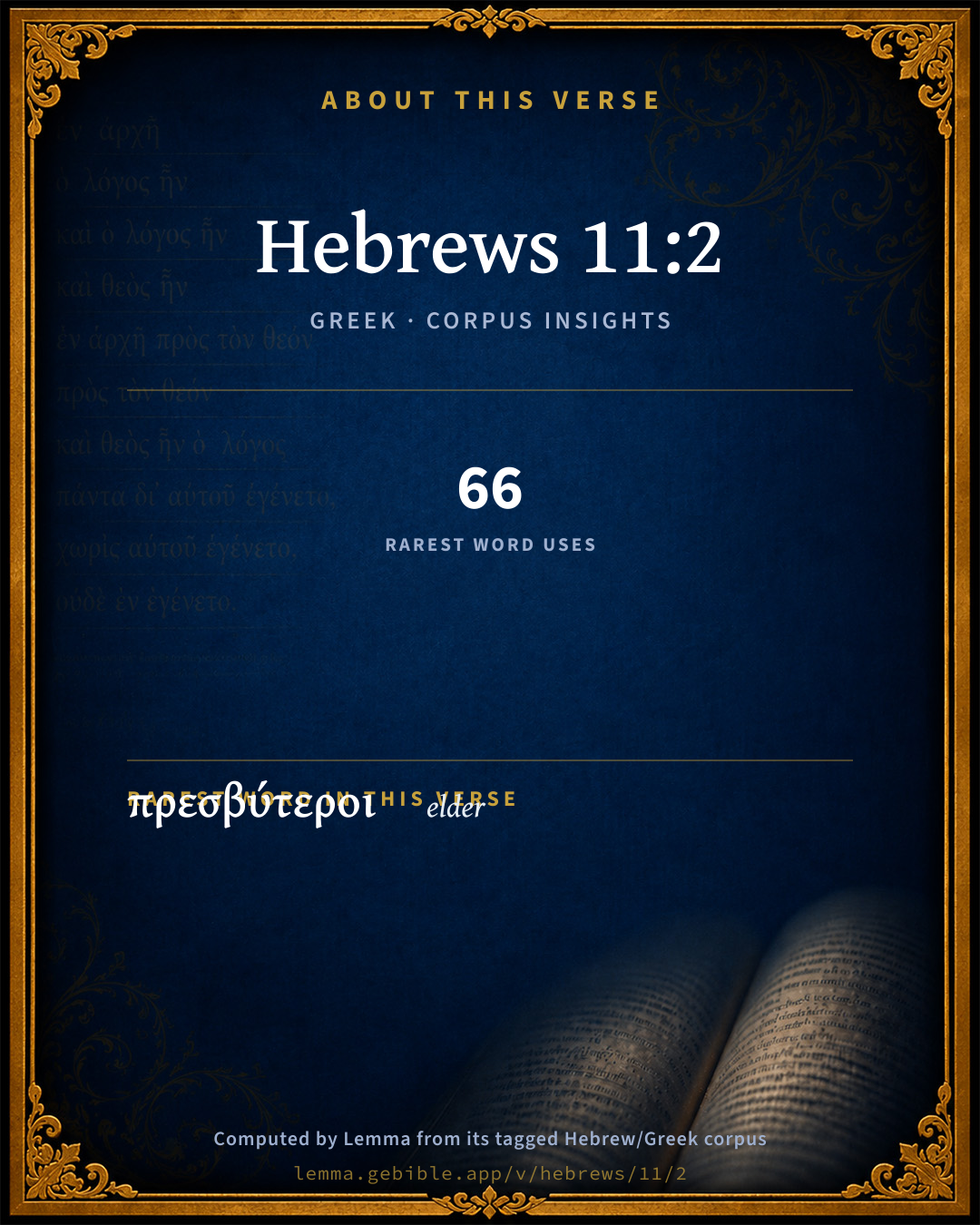
Hebrews 11:2

Greek (Tischendorf 8th ed.) Hebrews 11:2 appears in the Greek New Testament. The text above is from the Tischendorf 8th edition. Each word links to its Strong’s number and a concise gloss. Click any word for its full Thayer’s Greek Lexicon entry.
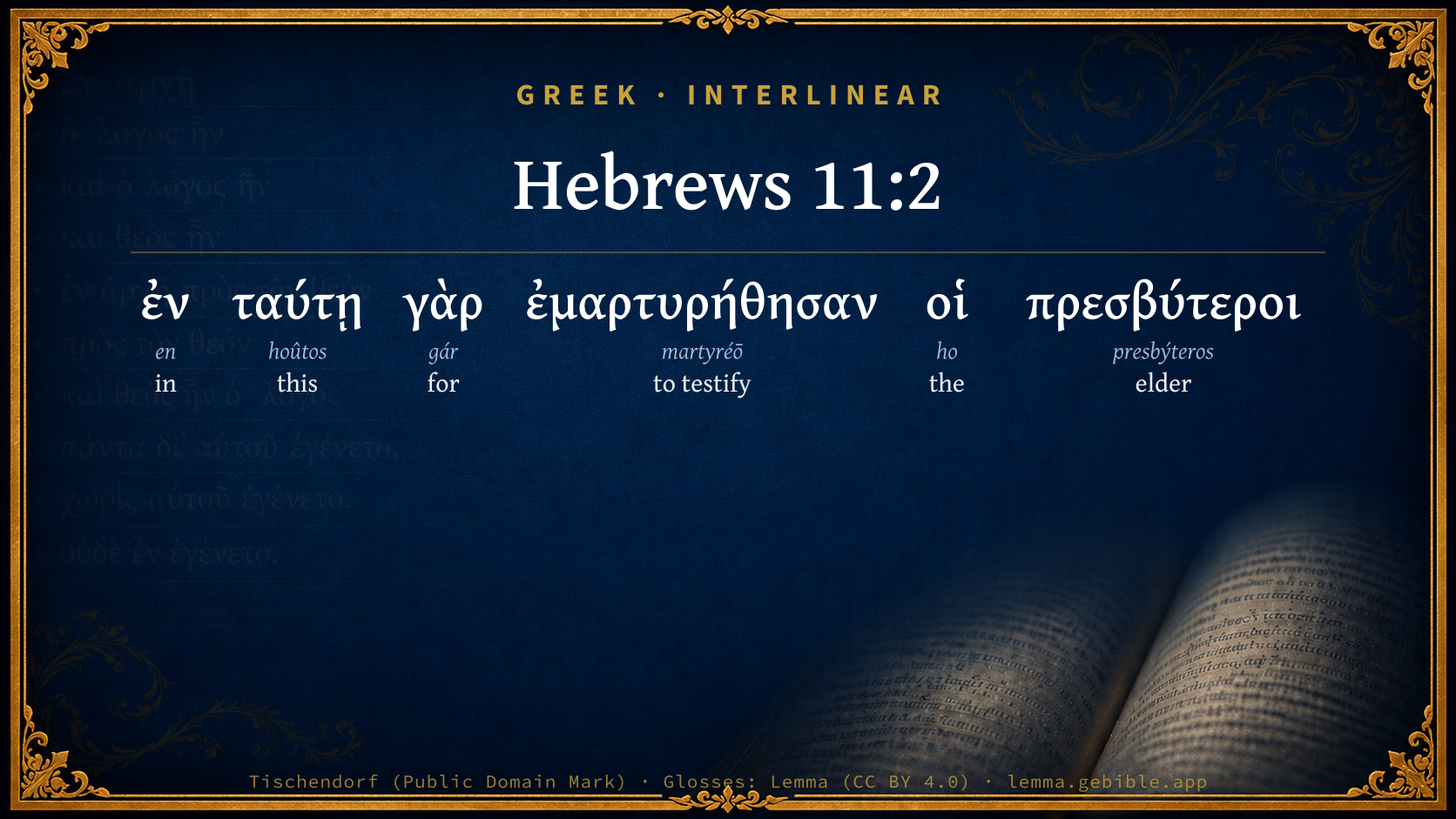
Download image
Cite this verse

Hebrews 11:2 (World English Bible). Public Domain. Lemma interlinear Bible study tool, https://lemma.gebible.app/v/hebrews/11/2.

Show BibTeX & RIS
BibTeX
RIS
English Translation
For by this, the elders obtained testimony.
World English Bible · Public Domain
Download a study sheet

One document with this verse’s original text, its word-by-word gloss line, the meaning frame, cross-references with their text, attributed commentary, and full source and license credits — printable, and it pastes into notes with its structure intact.

This verse Autodidact and up

Study sheet (.html) Plain text (.txt)

A passage Seminary Student

Up to 50 verses in one chapter. A passage sheet keeps up to 6 commentary sources and 12 cross-references per verse, in the order this page ranks them, and says so on the sheet whenever that leaves anything out. Ask for a single verse and you get the Autodidact verse sheet above.

Everything on this page stays free to read, with no account — the sheet is a download of what is already on screen, not access to it.

Want to remove ads? Support Godless Engineer
Compare translations 3

The same verse in 3 English versions, stacked beneath the original-language interlinear above. Click any original word for its lexicon entry.

Each is an independent rendering of the whole verse — the interlinear is not word-aligned to these translations.

Highlighted words mark where these versions differ — a whole-verse word diff, not a word-by-word alignment.

  • World English Bible Public Domain
    For by this, the elders obtained testimony.
  • King James Version Public Domain
    For by it the elders obtained a good report.
  • unfoldingWord Literal Text CC BY-SA 4.0
    For by this the ancients were commended.

unfoldingWord Literal Text — © unfoldingWord, licensed CC BY-SA 4.0. Word-aligned USFM3 via Door43 (git.door43.org/unfoldingWord/en_ult).

Versions to compare (up to 4)

3 of 4 selected

Show all 19 translations

Every available English version of this verse, each an independent rendering of the whole verse.

  • World English Bible Public Domain
    For by this, the elders obtained testimony.
  • Berean Standard Bible Public Domain
    This is why the ancients were commended.
  • Majority Standard Bible Public Domain
    This is why the ancients were commended.
  • King James Version Public Domain
    For by it the elders obtained a good report.
  • American Standard Version (1901) Public Domain
    For therein the elders had witness borne to them.
  • Revised Version (1885) Public Domain
    For therein the elders had witness borne to them.
  • Geneva Bible (1599) Public Domain
    For by it our elders were well reported of.
  • Douay-Rheims (1899) Public Domain
    For by this the ancients obtained a testimony.
  • Young's Literal Translation Public Domain
    for in this were the elders testified of;
  • Literal Standard Version CC BY-SA 4.0
    for by this, the elders were well-attested.
  • Unlocked Literal Bible CC BY-SA 4.0
    For because of this the ancestors were approved for their faith.
  • unfoldingWord Literal Text CC BY-SA 4.0
    For by this the ancients were commended.
  • Darby Bible Public Domain
    For in [the power of] this the elders have obtained testimony.
  • World Messianic Bible Public Domain
    For by this, the elders obtained approval.
  • Webster's Bible Public Domain
    For by it the elders obtained a good report.
  • Free Bible Version CC BY-SA 4.0
    People who lived long ago trusted God and this is what gained them God's approval.
  • Bible in Basic English Public Domain
    For by it our fathers had God's approval.
  • Text-Critical English NT CC BY 4.0
    Because of their faith, the people of old were commended.
  • Tyndale New Testament (1534) Public Domain
    By it the elders were well reported of.

Literal Standard Version (2020), Covenant Press — licensed CC BY-SA 4.0. Text via the HelloAO Bible API (eBible.org). Unlocked Literal Bible (unfoldingWord) — licensed CC BY-SA 4.0. Text via the HelloAO Bible API (eBible.org). unfoldingWord Literal Text — © unfoldingWord, licensed CC BY-SA 4.0. Word-aligned USFM3 via Door43 (git.door43.org/unfoldingWord/en_ult). Free Bible Version, Dr. Jonathan Gallagher — licensed CC BY-SA 4.0. Text via the HelloAO Bible API (eBible.org).

Word by word

More ways to search: Search by grammar → Find every occurrence → Compare this word →

Practice this passage: Drill this verse → Learn its vocabulary →

πρεσβύτεροι
presbýteros
G4245
“elder”
Adjective, Nominative, Plural, Masculine, Comparative
Part of Speech
Adjective
Case
Nominative
Number
Plural
Gender
Masculine
Degree
Comparative
Full Thayer's Definition

Origin: comparative of presbus (elderly)

TDNT: 16:51,9

1. elder, of age, a. the elder of two people b. advanced in life, an elder, a senior 1. forefathers 2. a term of rank or office a. among the Jews 1. members of the great council or Sanhedrin (because in early times the rulers of the people, judges, etc., were selected from elderly men) 2. of those who in separate cities managed public affairs and administered justice b. among the Christians, those who presided over the assemblies (or churches) The NT uses the term bishop, elders, and presbyters interchangeably c. the twenty four members of the heavenly Sanhedrin or court seated on thrones around the throne of God
  1. ἐν en G1722 “in” Preposition
  2. ταύτῃ hoûtos G3778 “this” Demonstrative pronoun, Dative, Singular, Feminine
  3. γὰρ gár G1063 “for” Conjunction
  4. ἐμαρτυρήθησαν martyréō G3140 “to testify” Verb, Aorist, Passive, Indicative, 3rd person, Plural
  5. οἱ ho G3588 “the” Article, Nominative, Plural, Masculine

About this verse

These counts appear in no published source. They are computed here, from the morphology-tagged text and Lemma’s own curated glosses. What Lemma adds →

6
words
6
distinct lemmas
General Epistles
section

Cross-references

2

Topical passages linked to Hebrews 11:2 in the Treasury of Scripture Knowledge — connected by theme and wording, ordered by reader-vote popularity; previews shown in the World English Bible.

  • Hebrews 11:39 These all, having had testimony given to them through their faith, didn't receive the promise,
  • Hebrews 11:4 By faith, Abel offered to God a more excellent sacrifice than Cain, through which he had testimony given to him that he was righteous, God bearing witness with respect to his gifts; and through it he, being dead, still speaks.

Cross-references courtesy of OpenBible.info (CC BY 4.0).

Commentary

Notes on Hebrews 11:2 from classic Christian and Jewish commentators (each source and its license shown beneath its notes). The classic Christian expositions comment on the surrounding passage and are grouped to its opening verse, so a note may address several verses; the Jewish commentaries on the Tanakh (Rashi and others) are per-verse, so they appear only where the commentator wrote on this verse.

Lemma curates 59 commentaries, every one of them public domain or Creative Commons licensed, each selected and text-cleaned for this edition rather than reprinted as found. About our sources →

Joseph Benson's Commentary

Heb 11:2. By it the elders — Our forefathers, or the pious of former ages; obtained a good report — Εμαρτυρηθησαν, received testimony, of God’s approbation of them, or were borne witnesses to by God as persons accepted of him. The word is very comprehensive, implying that God gave a testimony, not only of them, but to them, and they received his testimony, as if it had been the things themselves, of which he testified, Heb 11:4-5; Heb 11:39. Hence they also gave testimony to others, and others testified of them. This chapter is a kind of summary of the Old Testament, in which the apostle comprises the designs, labours, sojournings, expectations, martyrdoms of the ancients. The former of them had a long exercise of their patience; the latter suffered shorter, but sharper trials.

Joseph Benson's Commentary on the Old and New Testaments (1811–1818) — public domain. Text from a community e-Sword module.

Tyndale Open Study Notes

Tyndale Open Resources

11:2 earned a good reputation: Scripture speaks favorably about their lives of faith (see also 11:39).

Tyndale Open Study Notes — © Tyndale Open Resources, licensed CC BY-SA 4.0. Text via the HelloAO Bible API.

Bengel's Gnomon

Johann Albrecht Bengel

Heb 11:2. Ἐν ταύτῃ, in it) in faith, i.e. by faith, in the following verses: κατὰ πίστιν, according to (in) faith; διὰ πίστιν, through faith, Heb 11:13; Heb 11:33.—γὰρ, for) Paul shows the nature of faith from the examples of men in the times of old. Many things, which they hoped for and did not see, subsequently came to pass and were conspicuously seen, the event confirming faith.—ἐμαρτυρήθησαν, obtained a good report) This word is very full of meaning. GOD not only gave His testimony concerning them, but also partly to them. They RECEIVED THE TESTIMONY, an equivalent to the things themselves; comp. Heb 11:4-5; Heb 11:39. From this circumstance, they also became witnesses; so that they themselves might testify to others, and that others might testify concerning them; ch. Heb 12:1.—οἱ πρεσβύτεροι) the elders, who lived both formerly and for a long time. He does not say, οἱ ἀρχαῖοι, the ancients, but the elders, as it were by personification, inasmuch as they still give their powerful testimony, as if they were present; comp. ch. Heb 12:1. This is an excellent summary of the Old Testament, in which the apostle, by a remarkable gradation, comprehends the pursuits of those men of former times—their labours, journeyings, expectations, temptations, martyrdoms; and shows how we ought to seek, in all its fulness, under the veil of history, the substance of doctrine sometimes briefly indicated. Those of them who were earlier, had the exercise of their patience most chiefly during a long period of life; those who were later, in the midst of sharper afflictions.

Bengel's Gnomon of the New Testament — English translation (T&T Clark, Edinburgh, 1860) — public domain. Text from a community e-Sword module.

Meyer's Critical & Exegetical Commentary

Heinrich August Wilhelm Meyer

Heb_11:2. Justification of the characteristics mentioned, Heb_11:1, as those that are essential to the faith. Just this quality of faith was it by which the Old Testament saints were distinguished, and on that account became objects of the divine satisfaction and the divine favour.

ἐν ταύτῃ] not equivalent to διὰ ταύτης (Luther, Vatablus, Calvin, Schlichting, Jac. Cappellus, Grotius, Bengel, Böhme, and the majority; comp. Heb_11:4; Heb_11:39), or: ob eam (Wolf and others), or: touching faith, in point of faith (de Wette, Tholuck, Moll); but: in possession of a faith so constituted (Winer, Gramm., 7 Aufl. p. 362, Obs.; Bleek, Bloomfield, Kurtz).

μαρτυρεῖσθαι] to obtain a testimony, and that according to the connection, a good, commendatory testimony, whether by words or deeds. Oecumenius: ἐμαρτυρήθησαν ὑπὸ θεοῦ εὐηρεστηκέναι αὐτῷ.

οἱ πρεσβύτεροι] the ancients (Schulz: the early ancestors), i.e. the forefathers under the Old Covenant; with the accessory idea of venerableness. A like name of honour, as elsewhere (Heb_1:1, al.) οἱ πατέρες.

Meyer — Critical and Exegetical Commentary on the New Testament — English translation by Peter Christie, edited by Frederick Crombie (T&T Clark, 1880) — public domain. Text from a community e-Sword module.

Geneva Bible (1599)

Geneva Bible translators

He showeth that the Fathers ought to be accounted of, by this virtue.

That is, those Fathers of whom we came: and whose authority and example ought to move us very much.

Geneva Bible (1599) marginal notes — public domain. Text via Bolls.life.

Jamieson, Fausset & Brown

Robert Jamieson, A. R. Fausset & David Brown

For--So high a description of faith is not undeserved; for . . . [ALFORD].

by it--Greek, "in it": in respect to . . . in the matter of," it, "or, as Greek more emphatically, "this."

the elders--as though still living and giving their powerful testimony to the reasonableness and excellence of faith (Heb 12:1). Not merely the ancients, as though they were people solely of the past; nay, they belong to the one and the same blessed family as ourselves (Heb 11:39-40). "The elders," whom we all revere so highly. "Paul shows how we ought to seek in all its fulness, under the veil of history, the essential substance of the doctrine sometimes briefly indicated" [BENGEL]. "The elders," as "the fathers," is a title of honor given on the ground of their bright faith and practice.

obtained a good report--Greek, "were testified of," namely, favorably (compare Heb 7:8). It is a phrase of Luke, Paul's companion. Not only men, but God, gave testimony to their faith (Heb 11:4-5, Heb 11:39). Thus they being testified of themselves have become "witnesses" to all others (Heb 12:1). The earlier elders had their patience exercised for a long period of life: those later, in sharper afflictions. Many things which they hoped for and did not see, subsequently came to pass and were conspicuously seen, the event confirming faith [BENGEL].

Jamieson, Fausset & Brown — Commentary Critical and Explanatory on the Whole Bible (1871) — public domain (CC PDM 1.0). Text via the HelloAO Bible API.

Adam Clarke's Commentary

Verse 2. For by it the elders obtained a good report.] By the elders are meant ancestors, forefathers, such as the patriarchs and prophets, several of whom he afterwards particularly names, and produces some fact from the history of their lives.

It is very remarkable that among the whole there is root one word concerning poor Adam and his wife, though both Abraham and Sarah are mentioned. There was no good report concerning them; not a word of their repentance, faith, or holiness. Alas! alas! did ever such bright suns set in so thick a cloud? Had there been any thing praiseworthy in their life after their fall, any act of faith by which they could have been distinguished, it had surely come out here; the mention of their second son Abel would have suggested it. But God has covered the whole of their spiritual and eternal state with a thick and impenetrable veil. Conjectures relative to their state would be very precarious; little else than hope can be exercised in their favour: but as to them the promise of Jesus was given, so we may believe they found redemption in that blood which was shed from the foundation of the world. Adam's rebellion against his Maker was too great and too glaring to permit his name to be ever after mentioned with honour or respect.

The word εμαρτυρηθησαν, which we translate obtained a good report, literally signifies, were witnessed of; and thus leads us naturally to GOD, who by his word, as the succeeding parts of the chapter show, bore testimony to the faith and holiness of his servants. The apostle does not mention one of whom an account is not given in the Old Testament. This, therefore, is God's witness or testimony concerning them.

Adam Clarke's Commentary on the Bible (1810–1826) — public domain. Text from a community e-Sword/MySword module.

John Calvin's Commentaries

2. For by it the elders, etc. He handles this subject to the end of the chapter — that the fathers obtained salvation and were accepted by God in no other way than by faith.

The Jews indeed had some reasons for paying great deference to the fathers; but a foolish admiration of the fathers had so prevailed among them, that it proved a great hindrance to a thorough surrender of themselves to Christ and to his government. It was occasioned either by ambition or superstition, or by both. For when they heard that they were the blessed and holy seed of Abraham, inflated with this distinction they fixed their eyes on men rather than on God. Then added to this was a false emulation; for they did not consider what was mainly worthy of imitation in their fathers. It thus happened that they became attached to the old ceremonies, as though the whole of religion and perfect holiness consisted in them. This error the Apostle exposes and condemns; and be shows what was the chief excellency of the fathers, in order that their posterity might understand how they might become really like them.

Let us then bear in mind that the main point and the very hinge on which the Apostle’s argument turns is this, — That all the fathers from the beginning of the world, were approved by God in no other way than by being united to him by faith: and this he shows, that the Jews might know that by faith alone they could be bound together in holy unity with the fathers, and that as soon as they renounced faith, they became banished from the Church, and that they were then no longer the legitimate children of Abraham, but a degenerate race and bastards.

John Calvin's Commentaries (1540-1563) — public domain. Text from the Calvin Translation Society English edition (1840s-50s) via the Christian Classics Ethereal Library (ccel.org). Calvin's coverage is partial (roughly two-thirds of the Bible); uncommented books and verses are honest gaps, never fabricated. The 19th-century editor's footnotes and remarks are omitted so the notes are faithfully Calvin's own voice.

Ellicott's Commentary for English Readers

(2) For by it.—Better, For therein the elders had witness borne to them. The connection seems to be this: Faith truly accomplishes all this; for it was in the exercise of such a faith that the elders gained the witness which the Scripture bears (see Heb_11:4-5; Heb_11:39) to them and to their noble deeds. This verse, then, is added to confirm the first.

A Bible Commentary for English Readers, edited by Charles John Ellicott (1878–1897) — public domain. Text from a community e-Sword module.

The Cambridge Bible for Schools and Colleges

gen. ed. J. J. S. Perowne

2. For by it the elders obtained a good report] Lit., “For therein the elders had witness borne to them.” Their “good report” was won in the sphere of faith. The elders—a technical Jewish term (Zekenîm)—means the ancient fathers of the Church of Israel (Heb_1:1).

The Cambridge Bible for Schools and Colleges (gen. ed. J. J. S. Perowne; Cambridge University Press, 1878–1918) — public domain. Text from a community e-Sword module.

John Gill's Exposition

For by it the elders obtained a good report. By whom are meant, not merely old men, or elders in age, but such who lived in ancient times; some before the flood, and to a great age, and others who were in office, civil or ecclesiastical, and were the ancestors and predecessors of the Hebrews; who in general obtained or received a good report from God; that they were the chosen of God, and were justified and accepted with him; that they were the children and friends of God, and should be glorified; and from men, from good men, for their faith and holiness; and from evil men, for their good works: and these also believed the report of the Gospel, and gave a good report of God, and of the good land, and adorned their profession; particularly, Abel received a good report, that he was righteous; and Enoch, that he pleased God, and walked with him; and Noah, that he was a just man, perfect in his generation, and also walked with God; and Abraham, that he was a believer, a friend of God, and one that feared and obeyed him; and Job, that he was a man that feared God, and shunned evil; and Moses, that he was a meek man, and a faithful one; and David, that he was a man after God's own heart, and fulfilled his will; and so others: and they received this report by faith, and as a fruit of it; which shows that faith is no new thing, and that the character of a believer is an old and honourable one. The apostle mentions this, to take off the Hebrews from any esteem of their traditionary elders, who had got a name, not by their faith, but by their traditions; and to engage their imitation of men of antiquity, authority, and wisdom superior to them; and to let them know, unless they had the same faith with their ancestors, it would be a vain thing to boast of descent from them.

For by it the elders obtained a good report. By whom are meant, not merely old men, or elders in age, but such who lived in ancient times; some before the flood, and to a great age, and others who were in office, civil or ecclesiastical, and were the ancestors and predecessors of the Hebrews; who in general obtained or received a good report from God; that they were the chosen of God, and were justified and accepted with him; that they were the children and friends of God, and should be glorified; and from men, from good men, for their faith and holiness; and from evil men, for their good works: and these also believed the report of the Gospel, and gave a good report of God, and of the good land, and adorned their profession; particularly, Abel received a good report, that he was righteous; and Enoch, that he pleased God, and walked with him; and Noah, that he was a just man, perfect in his generation, and also walked with God; and Abraham, that he was a believer, a friend of God, and one that feared and obeyed him; and Job, that he was a man that feared God, and shunned evil; and Moses, that he was a meek man, and a faithful one; and David, that he was a man after God's own heart, and fulfilled his will; and so others: and they received this report by faith, and as a fruit of it; which shows that faith is no new thing, and that the character of a believer is an old and honourable one. The apostle mentions this, to take off the Hebrews from any esteem of their traditionary elders, who had got a name, not by their faith, but by their traditions; and to engage their imitation of men of antiquity, authority, and wisdom superior to them; and to let them know, unless they had the same faith with their ancestors, it would be a vain thing to boast of descent from them.

Hebrews 11:3

heb 11:3

heb 11:3

heb 11:3Through faith we understand that the worlds were framed by the word of God,.... The celestial world, with its inhabitants, the angels; the starry and ethereal worlds, with all that is in them, the sun, moon, stars, and fowls of the air; the terrestrial world, with all upon it, men, beasts, &c. and the watery world, the sea, and all that is therein: perhaps some respect may be had to the distinction of worlds among the Jews; See Gill on Heb 1:2, though the apostle can scarce be thought to have any regard to their extravagant notions of vast numbers of worlds being created: they often speak of three hundred and ten worlds, in all which, they say, there are heavens, earth, stars, planets, &c. (f); and sometimes of eighteen thousand (g); but these notions are rightly charged by Philo (h) with ignorance and folly. However, as many worlds as there are, they are made "by the Word of God"; by Christ, the essential Word of God, to whom the creation of all things is ascribed in Joh 1:1. And this agrees with the sentiments of the Jews, who ascribe the creation of all things to the Word of God, as do the Targumists (i), and Philo the Jew (k). And these are "framed" by the Word, in a very beautiful and convenient order; the heavens before the earth; things less perfect, before those that were more so in the visible world, or terraqueous globe; and things for men, before men, for whom they were; and it is by divine revelation and faith that men form right notions of the creation, and of the author of it, and particularly of the origin of it, as follows:

so that things which are seen: as the heaven, earth, and sea, and in which the invisible things of God, the perfections of his nature, are discerned:

were not made of things which do appear; they were not made from pre-existent matter, but out of nothing, out of which the rude and undigested chaos was formed; and from that invisible mass, covered with darkness, were all visible things brought into a beautiful order; and all from secret and hidden ideas in the divine minds; and this also is the faith of the Jews, that the creation of all things is "out of nothing" (l). There seems to be an allusion to the word used for creation, which signifies to make appear a thing unseen; and is rendered in the Septuagint version by Num 16:30 and Isa 40:26 to show, or make appear; and thus God created, or made to appear, the heavens and earth, which before were not in being, and unseen, Gen 1:1 and created to make, as in Gen 2:3 that is, made them to appear, that he might put them into the form and order they now are.

(f) Misn. Oketzim, c. 3. sect. 12. Targum Jon. in Exod. xxviii. 30. Kettoreth Hassamim in Targum Jon. in Gen. fol. 4. 4. Lex. Cabel. p. 60, 61. (g) T. Bab. Avoda Zara, fol. 3. 2. Yalkut, par. 2. fol. 50. 4. (h) De Opificio, p. 39. (i) Targum Oak. in Deut. xxxiii. 27. & Ben Uzziel in Isa. xlviii. 13. (k) De Opificio, p. 4. & Leg. Alleg. l. 1. p. 44. (l) Tzeror Hammor, fol. 1. 1. Kettoreth Hassamim in Targ. Jon in Gen. fol. 5. 1, 2.

John Gill's Exposition of the Whole Bible (1746–1763) — public domain (CC PDM 1.0). Text via the HelloAO Bible API.

Trapp's Complete Commentary

John Trapp

2 For by it the elders obtained a good report.

Ver. 2. The elders obtained, &c.] Gr. εμαρτυρηθησαν, were attested unto; and are here eternalized in this notable chapter, this little book of martyrs, as one fitly calleth it. Faith honoureth God, and gives him a testimonial, Joh 3:33, such as is that Deu 32:4. God therefore honoureth faith, according to 1Sa 2:30, and gives it his testimonial, as here in this truly named golden legend.

John Trapp, A Commentary or Exposition upon All the Books of the Old and New Testament (1647–1656) — public domain. Text from a community e-Sword module.

Albert Barnes' Notes on the Bible

For by it - That is, by that faith which gives reality to things hoped for, and a certain persuasion to the mind of the existence of those things which are not seen.

The elders - The ancients; the Hebrew patriarchs and fathers.

Obtained a good report - Literally, “were witnessed of;” that is, an honorable testimony was borne to them in consequence of their faith. The idea is, that their acting under the influence of faith, in the circumstances in which they were, was the ground of the honorable testimony which was borne to them in the Old Testament; see this use of the word in Heb 7:8, and in Heb 7:4 of this chapter. Also Luk 4:22; Act 15:8. In the cases which the apostle proceeds to enumerate in the subsequent part of the chapter, he mentions those whose piety is particularly commended in the Old Testament, and who showed in trying circumstances that they had unwavering confidence in God.

Albert Barnes' Notes on the Bible (1834–1885) — public domain. Text from a community e-Sword/MySword module.

Matthew Poole's English Annotations

This is a proof of the first part of faith’s description, that it is the substance of things hoped for; for all the fathers were testified of to have this work of faith in realizing their hopes. πρεσβυτεροι were the fathers and ancestors of these Hebrews, run up through their genealogies to Adam, the special instances of whom follow. These received a testimony or witness, truly and fully from God himself, in some signal acceptance of them, eminent appearances and providences to them, with a Scripture record of them, that through this grace of our Lord Jesus Christ they walked with, worshipped, and pleased God, and were saved by him, even as these Christians; and all this by the same grace of faith, Act 15:17, which wrought kindly in them, and made the invisible things of God to subsist with them.

Matthew Poole's English Annotations on the Holy Bible (1683–1685) — public domain. Text from a community e-Sword/MySword module.

Whedon's Commentary on the Bible

Daniel D. Whedon

2. For—In proof of its high inspiring power is the whole line of heroic examples. Not by it, as an instrument, but rather in it, as a state or condition. It was as in a frame or atmosphere of faith that the worthies were heroes. Its air was an exhilaration and a tonic.

The elders—The men of the olden time, our illustrious spiritual ancestry.

Obtained a good report—Literally, were well witnessed to—received a noble testimony, that is, from God, as Abel and Enoch, in Heb_11:4-5. The witness to them was immediate and direct; and it is also in the whole line verified by the Old Testament record.

Daniel D. Whedon (gen. ed.), Commentary on the Old and New Testaments (1874–1909) — public domain. Text from a community e-Sword module.

The Pulpit Commentary

For in this (i.e. faith, en tauth) the elders obtained a good report; literally were witnessed of; i.e. it was in respect of their faith, which inspired their deeds, that they were praised. (For a similar use of the preposition en , cf. 1Co_11:22, epainesw en, toutw) Thus is introduced the illustrative review of Old Testament instances, the purpose of which has been explained above. It begins from the beginning, Abel being the first example. But in the Old Testament the account of the creation precedes that first recorded instance; and, therefore, it is in the first place fittingly referred to, the existence of an unseen creative power mentally perceived beyond things visible, being the primary article the very foundation of all religious faith (cf. below, ver. 6).

The great characteristic of the elders.

I THE TERM BY WHICH THEY ARE INDICATED. The elders. Those spoken of are these who had lived the life of the flesh centuries before, but the term is not used merely to indicate this fact. We know from the subsequent illustrations that the men of long ago are meant; but there is a much more comprehensive meaning in their being spoken of as presbuteroi. Presbuterov is a relative word, its correlative being newterov . (see 1Pe_5:5) The elder and the younger are to be taken together as part of one community, and the younger are to be in subordination to the elder. These elders are to be thought of, not as the dead, but as the still living. Abraham and Isaac and Jacob are among these elders, and the God of Abraham, Isaac, and Jacob is the God, not of the dead, but of the living. Abraham, or Isaac, or Jacob, or any other of the glorified believers, could have appeared on the Mount of Transfiguration as easily as Moses or Elijah, had this been the necessary thing. And these elders, who have received a good report through faith, are not to be made perfect without us.

II THEIR RELATION TO FAITH. They received a good report. They had witness borne to them. Surely there is great inclusiveness in this word.

1. Their faith stood to them in the place of evidence from experience or observation. They were at the beginning of things. They had no histories, traditions, and customs to fall back on. They had to trust the deepest impulses of their own hearts. We are the inheritors of discoveries and benefits which, in the beginnings of them, can have had little ground but faith.

2. Their faith is the great element which makes them memorable. The good men among them were better men because they were believers. Indeed, the only goodness that can be anything more than a matter of fashion and convention must come through faith. Take faith out of the lives of Noah, Abraham, Jacob, Moses, and you have nothing that should lift these men out of the common multitude. Testimony could be borne as to their faith; but we know that testimony could not be borne to other very desirable qualities in human character. Abraham had no very great regard for truth, and Jacob was utterly disingenuous. But they were believers, and in this one fact was sufficient leverage to secure their ultimate salvation, and make them adequate agents for the Divine purposes.

3. In their faith they become witnesses to us. We see plain results of their faith up to a certain point. We see Noah justified in building the ark. We see Abraham justified in leaving his own country. We see Joseph justified in giving commandment concerning his bones. We do see that he who sows in bare faith reaps a harvest corresponding to his faith. And so we must take heed lest these elders, now being witnesses to us, may one day become witnesses against us. Y.

The Pulpit Commentary (1880–1919), ed. H.D.M. Spence-Jones & Joseph S. Exell — public domain. Text from a community e-Sword module.

John Wesley's Explanatory Notes

By it the elders - Our forefathers. This chapter is a kind of summary of the Old Testament, in which the apostle comprises the designs, labours, sojournings, expectations, temptations, martyrdoms of the ancients. The former of them had a long exercise of their patience; the latter suffered shorter but sharper trials. Obtained a good testimony - A most comprehensive word. God gave a testimony, not only of them but to them: and they received his testimony as if it had been the things themselves of which he testified, ver. 4, 5, 39. Hence they also gave testimony to others, and others testified of them.

John Wesley, Explanatory Notes Upon the Whole Bible (1754–1765) — public domain. Text via the GEBible commentary corpus.

Burkitt's Expository Notes on the New Testament

William Burkitt

Having in the former verse described faith, in this and the following verses he enters upon the just praise and deserved commendation of this divine and excellent grace, which has such an universal influence into all the parts of the Christian life.

In this verse, to commend that faith which he had in the former verse described, he brings in the experience of the elders, or Old Testament saints, all true believers from the foundation of the world, who by faith obtained from God a good testimony, recorded in the holy Scriptures. By it, or through it, as a condition appointed and ordained of God; not for it, or by the worth and influence of it, as the meritorious cause, the elders or saints of God, from the beginning of the world, obtained a good report.

Learn hence, 1. That the Old Testament saints had the same kind of faith that we have, and were saved in the same manner that we are; they had the same promises, the same terms of grace, the same meritorious purchase by the blood of Christ: He is therefore called the Lamb slain from the beginning of the world, slain in God’s purpose and decree, slain in the types and figures of his death; though his blood was not actually shed, yet was it decree to be shed, and so was as effectual to them as to us.

Learn, 2. That the renown of the Old Testament saints was their faith, that made them famous; not their priority in living before us, not their longevity in living many years beyond us, not upon the account of their other graces, which yet rendered them truly excellent, are they said to obtain a good report, but upon the score and account of their faith. Abel was famous for righteousness, Enoch for walking with God, Abraham for obedience, Moses for meekness, but the crown is set upon the head of their faith only; by it the elders obtained, &c.

William Burkitt's Expository Notes on the New Testament (1700–1703) — public domain. Text from a community e-Sword module.

The People's New Testament

B. W. Johnson

2. For by it the elders, etc. The ancient men of God, through faith, so lived, that they have obtained a good name.

B. W. Johnson's The People's New Testament with Notes (1889–1891) — public domain. Electronic text from the Christian Classics Ethereal Library (CCEL) ThML edition.

Cambridge Greek Testament for Schools and Colleges

2. ἐμαρτυρήθησαν. Lit., “For therein the elders had witness borne to them.” Their “good report” was won in the sphere of faith. The elders—a technical Jewish term (זְקֵנִים)—means the ancient fathers of the Church of Israel (Heb 1:1).

Cambridge Greek Testament for Schools and Colleges (Cambridge University Press, 1896; 21 vols, various authors incl. Carr, Maclear, Plummer, Farrar, Lumby, Moule, M. R. James, Simcox) — public domain. Text from a community e-Sword module.

Alford’s Greek Testament

Henry Alford

2.] For (q. d. ‘and so high a description of faith is not undeserved, seeing that …’ The γάρ does not bring in any proof of the foregoing description, only shews that faith is noble enough to be dignified with the offices just named) in (not, “by,” merely: but elemental; in the domain, or region, or matter, of: so ἐπαινέσω ὑμᾶς ἐν τούτῳ, 1Co 11:22: and “vituperari in amicitia,” in Cicero (Del.)) this (not αὐτῇ, “it:” but more graphic and encomiastic: in this it was, that …) the elders (i. e. not merely those who lived before us, but those ancients whom we dignify with the name of elders: cf. Philo de Abrahamo, § 46, vol. ii. p. 39, ὁ γὰρ ἀληθείᾳ πρεσβύτερος, οὐκ ἐν μήκει χρόνου, ἀλλʼ ἐν ἐπαινετῷ βίῳ θεωρεῖται: and Thdrt., τουτέστιν οἱ πάλαι γεγενημένοι, οἱ πρὸ τοῦ νόμου καὶ ἐν τῷ νόμῳ διαλάμψαντες ἅγιοι. Bleek cites Æschin. p. 20. 4, Ὁμήρου, ὃν ἐν τοῖς πρεσβυτάτοις καὶ σοφωτάτοις τῶν ποιητῶν εἶναι τάττομεν. So also οἱ πατέρες, see Rom 9:5: Heb 1:1) were testified of (so reff. In this absolute usage, it is of course implied, that the testimony was a good one. The usage is principally that of St. Luke, Act 6:3; Act 10:22; Act 16:2; Act 22:12. There is no need with Bleek and Lünem. to separate the verb from ἐν ταύτῃ, and supply after ‘hac in fide,’ “constituti” or the like: see on the construction above).

Henry Alford, The Greek Testament (1849–1861) — public domain. Text from a community e-Sword module.

Vincent's Word Studies in the New Testament

Marvin R. Vincent

For by it [εν ταυτη γαρ] . Lit. for in this. Rend. therein : in the sphere and exercise of faith : as believers. Comp. 1Ti 5:10. For introduces a proof of the preceding statement concerning the nature of faith. Faith has power to see and realize the unseen, for the experience of the fathers proves it.

The elders obtained a good report [εμαρτυρηθησαν οι πρεσβυτεροι] . The elders for the more common the fathers : the saints of the O. T. dispensation, many of whose names are recorded in this chapter. Emarturhqhsan, lit. were born witness to. God bore witness to them in the victory of their faith over all obstacles, and their characters and deeds as men of faith were recorded in Scripture. For this use of maturein in the passive, see Act 6:3; Act 10:22; Act 16:12; Rom 3:21; Heb 7:8, 17. Notice that the statement in this verse does not begin the list of examples, which commences with ver. 4, but is closely attached to the definition in ver. 1 as a comprehensive justification of it.

Marvin R. Vincent, Word Studies in the New Testament (1887–1900) — public domain. Text from a community e-Sword/MySword module.

Westcott on Hebrews & the Epistles of John

Brooke Foss Westcott

2. ἐν ταύτῃ γάρ... for herein, as living and acting in this atmosphere of Faith, of Faith by which the future is renlised and the unscon apprehended, the elders had witness borne to them. Theo religious history of man is taken as theo proof of the power which Faith possesses to test and realise tho unsoon.

With ἐν ταύτῃ ἐμαρτ. compare ov. 4 δὲ ἧς dpapr., 39 μαρτυρηθέντες διὰ Philad. 11; ad Ephes. 12; Just. M. Dial. 29 8. f. of τοσοῦτοι δίκαιοι... Hepaprupnyras ὑπὸ τοῦ θεοῦ αὐτοῦ. Μαρτυρεῖσθαι is used absolutely in the

of Ignatius just quoted and in Clem. 1 ad Cor. 17, 18 f. &e.

Faith is indeed the charactoristic of all the Jowish heroes, though Faith, as such, is very little noticed in the Ο. T. The witness is borne to the life which was inspired by Faith.

ol πρεσβύτεροι] Comp. c i. 1 ol πατέρες.

(2) 3—7. Faith as soon in the prophetic records of the old world.

Tho first view of Faith is taken from the brief records of the old world given in Gen. i—ix. It is first laid down that our fundamental view of the origin (and so of the course) of the world rests on Faith (0. 3); and then in Abel, Enoch, Noah, the writer considers three types of Faith under different circumstances, as answering to man’s constitution, to the development of life, to special revelation. Abel recognised the natural obligations of man to God generally, and

Wisd. xiii. 4. 10 expresses a mental as distinguished from a sensuous porception (Mk. viii. 17). The term pois, which is not found in this Epistle, is characteristic of St Paul; 1 Cor. ii 16; Rom. xii. 2; Col. ii. 18; 1 Tim, v. 5.

Κατηρτίσθαι expresses the manifoldness and the unity of all creation; and by the tense marks that the original lesson of creation remains for abiding use and application. Comp. Herm. Mand. i. 1. For καταρτίζειν compare Ο. x. 5; xiii. 21; 1 Thesa. iii.

visiblo order, as one whole, is contrasted with the many elements which fall under the senses.

For γεγονέναι seo John i. 3 note.

Brooke Foss Westcott (1825–1901), The Epistle to the Hebrews (1889) and The Epistles of St John (1883) — public domain (pre-1929). Text recovered from Internet Archive / Google Books OCR scans. Westcott’s Gospel of John commentary is not included (its OCR lost the chapter running-heads required for reliable verse-keying). Some Greek quoted in the Hebrews volume is imperfectly rendered by the OCR.

Lesson kit

Teaching starters — assembled from the data on this page, not authored interpretation. Every prompt links to the verse data it draws on. Edit before teaching.

Hebrews, in the General Epistles, opens this verse with 6 words (6 distinct Greek lemmas). Its most distinctive word is presbýteros (“elder”). A historical commentator’s framing appears above. Read the whole chapter for the surrounding context.

Discussion questions

  1. What does “elder” (presbýteros) contribute to the verse as a whole?
  2. Hebrews 11:39 shares this passage’s theme. How do the two illuminate each other?
  3. The translations on this page render this verse differently — a whole-verse word diff, not a word-by-word alignment. What might account for the different wordings?
  4. Reading how Joseph Benson's Commentary and Tyndale Open Study Notes read this verse, where do the two commentators agree and where do they part?

Things to notice

Reading settings

Reading text

Shown beneath each verse's original-language words.

Old Testament
Old Testament edition

Read the OT as the Masoretic Hebrew (MT) or the Greek Septuagint (LXX).

English shown for the Greek Septuagint (in the Hebrew ↔ Greek comparison).

Comparing translations? Open the Compare panel on any verse page to stack up to four side by side.