
Psalms 119:49

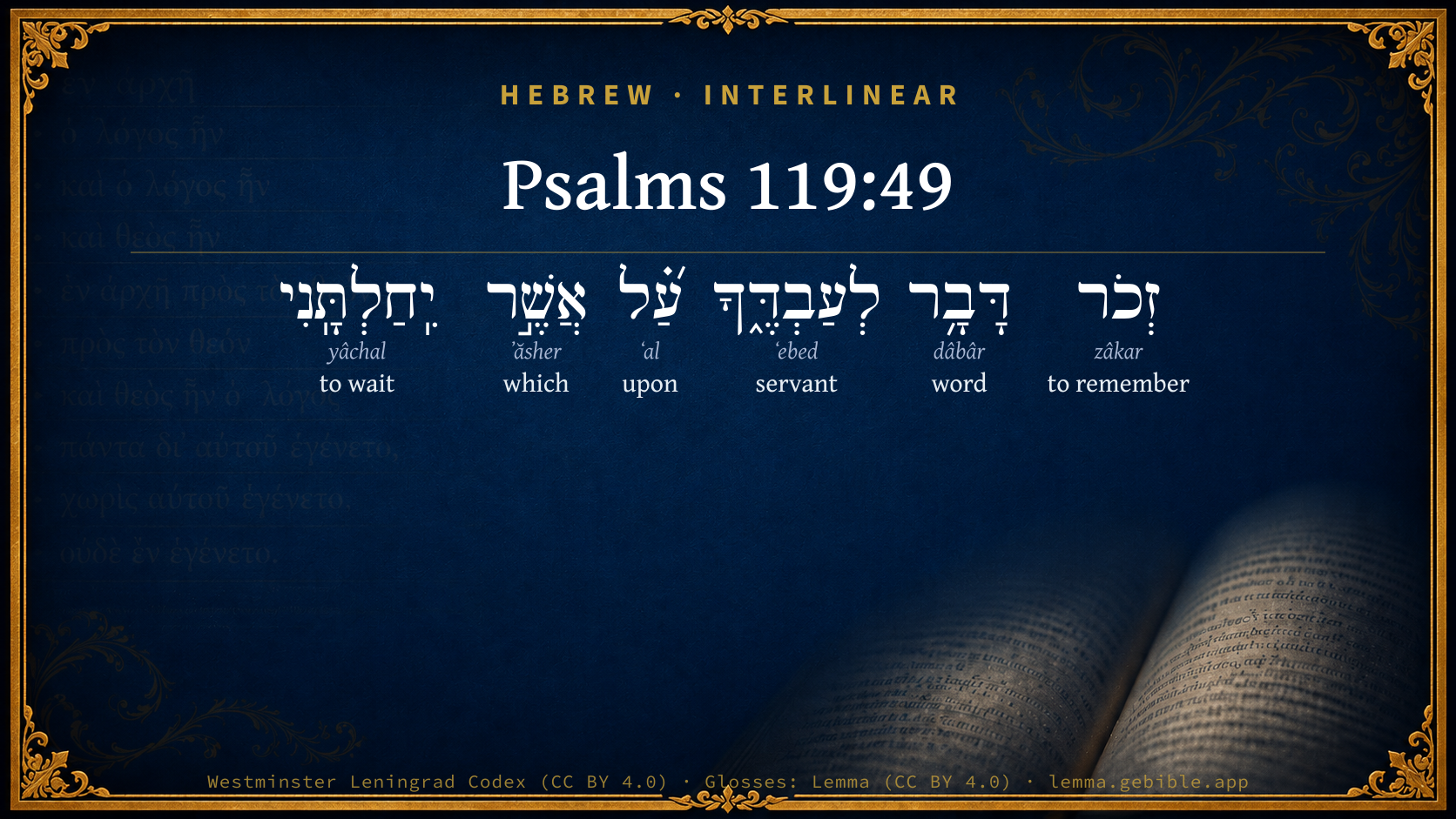
Hebrew (Westminster Leningrad Codex) Psalms 119:49 appears in the Hebrew Old Testament. The text above is from the Westminster Leningrad Codex. Each word links to its Strong’s number, a concise gloss, and parsing drawn from the Open Scriptures Hebrew Bible morphology. Click any word for its full Brown-Driver-Briggs (BDB) entry.
Download image
Cite this verse

Psalms 119:49 (World English Bible). Public Domain. Lemma interlinear Bible study tool, https://lemma.gebible.app/v/psalms/119/49.

Show BibTeX & RIS
BibTeX
RIS
English Translation
Remember your word to your servant, Because you gave me hope.
World English Bible · Public Domain
Download a study sheet

One document with this verse’s original text, its word-by-word gloss line, the meaning frame, cross-references with their text, attributed commentary, and full source and license credits — printable, and it pastes into notes with its structure intact.

This verse Autodidact and up

Study sheet (.html) Plain text (.txt)

A passage Seminary Student

Up to 50 verses in one chapter. A passage sheet keeps up to 6 commentary sources and 12 cross-references per verse, in the order this page ranks them, and says so on the sheet whenever that leaves anything out. Ask for a single verse and you get the Autodidact verse sheet above.

Everything on this page stays free to read, with no account — the sheet is a download of what is already on screen, not access to it.

Want to remove ads? Support Godless Engineer
Compare translations 3

The same verse in 3 English versions, stacked beneath the original-language interlinear above. Click any original word for its lexicon entry.

Each is an independent rendering of the whole verse — the interlinear is not word-aligned to these translations.

Highlighted words mark where these versions differ — a whole-verse word diff, not a word-by-word alignment.

  • World English Bible Public Domain
    Remember your word to your servant, Because you gave me hope.
  • King James Version Public Domain
    Remember the word unto thy servant, upon which thou hast caused me to hope.
  • unfoldingWord Literal Text CC BY-SA 4.0
    Remember the word to your servant by which you have given me hope.

unfoldingWord Literal Text — © unfoldingWord, licensed CC BY-SA 4.0. Word-aligned USFM3 via Door43 (git.door43.org/unfoldingWord/en_ult).

Versions to compare (up to 4)

3 of 4 selected

Show all 17 translations

Every available English version of this verse, each an independent rendering of the whole verse.

  • World English Bible Public Domain
    Remember your word to your servant, Because you gave me hope.
  • Berean Standard Bible Public Domain
    Remember Your word to Your servant, upon which You have given me hope.
  • Majority Standard Bible Public Domain
    Remember Your word to Your servant, upon which You have given me hope.
  • King James Version Public Domain
    Remember the word unto thy servant, upon which thou hast caused me to hope.
  • American Standard Version (1901) Public Domain
    ZAYIN. Remember the word unto thy servant, Because thou hast made me to hope.
  • Revised Version (1885) Public Domain
    Remember the word unto thy servant, because thou hast made me to hope.
  • Geneva Bible (1599) Public Domain
    ZAIN. Remember the promise made to thy seruant, wherein thou hast caused me to trust.
  • Young's Literal Translation Public Domain
    `Zain.' Remember the word to Thy servant, On which Thou hast caused me to hope.
  • Literal Standard Version CC BY-SA 4.0
    [ZAYIN] Remember the word to Your servant, || On which You have caused me to hope.
  • Unlocked Literal Bible CC BY-SA 4.0
    Call to mind your promise to your servant because you have given me hope.
  • unfoldingWord Literal Text CC BY-SA 4.0
    Remember the word to your servant by which you have given me hope.
  • Darby Bible Public Domain
    ZAIN. Remember the word for thy servant, upon which thou hast caused me to hope.
  • World Messianic Bible Public Domain
    Remember your word to your servant, because you gave me hope.
  • Webster's Bible Public Domain
    ZAIN. Remember the word to thy servant, upon which thou hast caused me to hope.
  • Free Bible Version CC BY-SA 4.0
    Remember your promise to me, your servant. It's my only hope.
  • Bible in Basic English Public Domain
    ZAIN Keep in mind your word to your servant, for on it has my hope been fixed.
  • JPS Tanakh (1917) Public Domain
    ZAIN. Remember the word unto Thy servant, because Thou hast made me to hope.

Literal Standard Version (2020), Covenant Press — licensed CC BY-SA 4.0. Text via the HelloAO Bible API (eBible.org). Unlocked Literal Bible (unfoldingWord) — licensed CC BY-SA 4.0. Text via the HelloAO Bible API (eBible.org). unfoldingWord Literal Text — © unfoldingWord, licensed CC BY-SA 4.0. Word-aligned USFM3 via Door43 (git.door43.org/unfoldingWord/en_ult). Free Bible Version, Dr. Jonathan Gallagher — licensed CC BY-SA 4.0. Text via the HelloAO Bible API (eBible.org).

Word by word

More ways to search: Search by grammar → Find every occurrence → Compare this word →

Practice this passage: Drill this verse → Learn its vocabulary →

About this verse

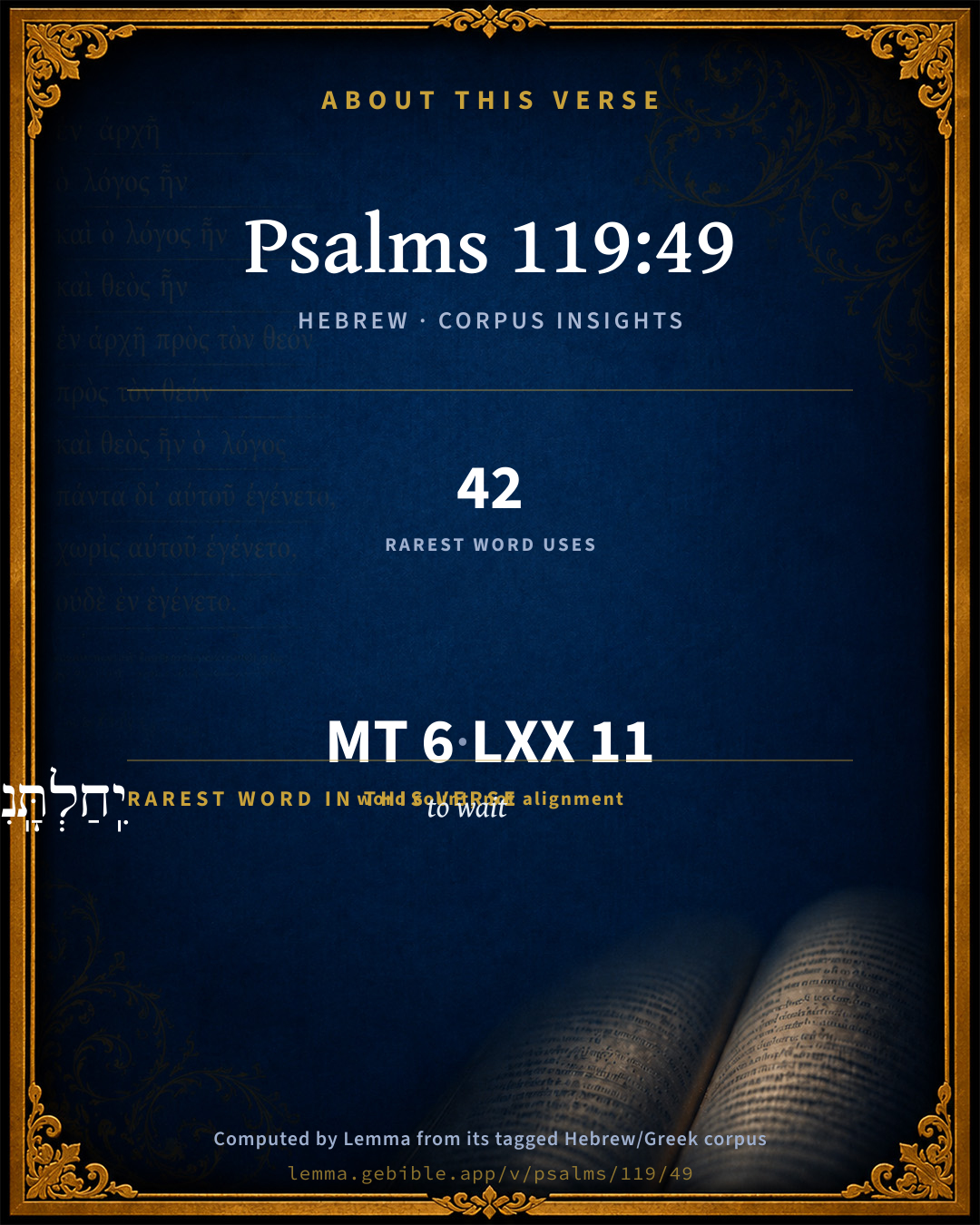
These counts appear in no published source. They are computed here, from the morphology-tagged text and Lemma’s own curated glosses. What Lemma adds →

6
words
6
distinct lemmas
Wisdom
section

Shared distinctive vocabulary

יִֽחַלְתָּֽנִי to wait H3176 occurs in 41 verses of the Hebrew Bible. Also found in:

Grammatical profile

  • 2 verbs
  • 2 nouns
  • 1 preposition
  • 1 particle

Verb forms

  • זְכֹר Qal · Imperative
  • יִֽחַלְתָּֽנִי Piel · Perfect

Hebrew & Septuagint length

In English translation the verse runs 11 words from the Hebrew and 12 from the Septuagint (LXX English) — closely comparable.

A rough comparison of the two English renderings, which tokenize alike — not a word-level alignment.

Word counts can differ between the Hebrew and the Greek without any difference in meaning — e.g. the Hebrew direct-object marker אֵת has no separate Greek word, and Greek often adds the article ὁ.

In the original languages it is 6 Hebrew tokens and 11 Greek tokens — but the two are counted differently (Hebrew bundles its prefixes and suffixes into one token; the Greek is in lemma form), so that isn’t a like-for-like length.

Cross-references

18

Topical passages linked to Psalms 119:49 in the Treasury of Scripture Knowledge — connected by theme and wording, ordered by reader-vote popularity; previews shown in the World English Bible.

  • 2 Samuel 7:25 Now, Yahweh God, the word that you have spoken concerning your servant, and concerning his house, confirm you it forever, and do as you have spoken.
  • Psalms 106:45 He remembered for them his covenant, And repented according to the multitude of his loving kindnesses.
  • Psalms 106:4 Remember me, Yahweh, with the favor that you show to your people. Visit me with your salvation,
  • Psalms 105:42 For he remembered his holy word, And Abraham, his servant.
  • Psalms 119:81 My soul faints for your salvation. I hope in your word.
  • Psalms 71:14 But I will always hope, And will add to all of your praise.
  • Psalms 119:74 Those who fear you will see me and be glad, Because I have put my hope in your word.
  • 1 Peter 1:13 Therefore, prepare your minds for action, be sober and set your hope fully on the grace that will be brought to you at the revelation of Jesus Christ--
  • Isaiah 62:6 I have set watchmen on your walls, Jerusalem; they shall never hold their peace day nor night: you who call on Yahweh, take no rest,
  • Genesis 8:1 God remembered Noah, all the animals, and all the cattle that were with him in the ark; and God made a wind to pass over the earth. The waters subsided.
  • Genesis 32:9 Jacob said, "God of my father Abraham, and God of my father Isaac, Yahweh, who said to me, 'Return to your country, and to your relatives, and I will do you good.'
  • 2 Samuel 5:2 In times past, when Saul was king over us, it was you who led out and brought in Israel: and Yahweh said to you, You shall be shepherd of my people Israel, and you shall be prince over Israel.
  • Job 7:7 Oh remember that my life is a breath. My eye shall no more see good.
  • Psalms 105:2 Sing to him, sing praises to him! Tell of all his marvelous works.
  • Psalms 119:43 Don't snatch the word of truth out of my mouth, For I put my hope in your ordinances.
  • Psalms 119:147 I rise before dawn and cry for help. I put my hope in your words.
  • Romans 15:13 Now may the God of hope fill you with all joy and peace in believing, that you may abound in hope, in the power of the Holy Spirit.
  • 1 Peter 1:21 who through him are believers in God, who raised him from the dead, and gave him glory; so that your faith and hope might be in God.

Cross-references courtesy of OpenBible.info (CC BY 4.0).

Hebrew and Greek witnesses Masoretic Hebrew ↔ Greek Septuagint

The same verse in the two great witnesses to the Old Testament, shown verse-for-verse.

You’re reading Greek Psalm 118 (Hebrew Psalm 119). The Septuagint counts the superscription, so verse numbers can differ from the Hebrew — chapter-level alignment, not verse-by-verse. Numbering follows Rahlfs.

These are two independent witnesses, not word-aligned to each other, and the Septuagint is shown in lemma (dictionary) form.

Hebrew Psalms 119:49 Masoretic · Westminster Leningrad Codex

זְכֹר דָּבָ֥ר לְעַבְדֶּ֑ךָ עַ֝֗ל אֲשֶׁ֣ר יִֽחַלְתָּֽנִי

Remember your word to your servant, Because you gave me hope.

World English Bible · Public Domain

Greek LXX Greek Psalm 118:49 Septuagint · lemma form

ζαι μιμνήσκω ὁ λόγος σύ ὁ δοῦλος σύ ὅς ἐπιἐλπίζω ἐγώ

Remember your words to your servant, wherein you have made me hope.

LXX2012 (modern English Septuagint) · Public Domain

Hebrew: Westminster Leningrad Codex (CC BY 4.0). Greek: Septuagint (public domain); English from LXX2012 (modern English Septuagint) (Public Domain). How the Septuagint differs from the Hebrew →

Commentary

Notes on Psalms 119:49 from classic Christian and Jewish commentators (each source and its license shown beneath its notes). The classic Christian expositions comment on the surrounding passage and are grouped to its opening verse, so a note may address several verses; the Jewish commentaries on the Tanakh (Rashi and others) are per-verse, so they appear only where the commentator wrote on this verse.

Lemma curates 59 commentaries, every one of them public domain or Creative Commons licensed, each selected and text-cleaned for this edition rather than reprinted as found. About our sources →

Trapp's Complete Commentary

John Trapp

Psa 119:49 ZAIN. Remember the word unto thy servant, upon which thou hast caused me to hope.

Ver. 49. Remember thy word] God is not unrighteous to forget, Heb 6:10, yet we must, as his remembrancers, Isa 62:6, put his promises in suit, Eze 36:37.

Upon which thou hast caused me to hope] God giveth us to do what he biddeth us to do, Eze 36:27.

John Trapp, A Commentary or Exposition upon All the Books of the Old and New Testament (1647–1656) — public domain. Text from a community e-Sword module.

The Biblical Illustrator

Joseph S. Exell

Psa_119:49

Remember the Word unto Thy servant, upon which Thou hast caused me to hope.

Pleading prayer

I admire in this psalm very greatly the singular amalgam that we have of testimony, of prayer, and of praise. In one verse the psalmist bears witness, in a second verse he praises, in a third verse he prays. It is an incense made up of many spices, but they are wonderfully compounded and worked together, so as to form one perfect sweetness. My text is a prayer, but there is testimony in it, and there is a measure of praise in it too.

I. The prayer. Remember the Word unto Thy servant.

1. Remember. That prayer is spoken after the manner of men, for God cannot forget.

2. It is language which has some trace of unbelief in it.

3. The intention of him who prayed this prayer was to ask God to remember His Word by fulfilling it. Lord, let me not only be in Thy thoughts, but let me be in Thy acts! Thou hast promised to supply my needs; remember me by supplying my needs. Thou hast promised to forgive my sin; remember me by giving me a sense of pardon. Thou hast premised to help Thy servant, and give me strength according to my day; remember the word by fulfilling Thy Word, and granting strength to me according as I have need of it.

4. Sometimes this word remember is very fitly used, because it seems to the mind that God is likely to remember something else which would be to our loss. Suppose you and I have been walking contrary to God--then the Lord may remember our sin, and He may begin to deal with us in a way of chastisement, and lay us very low. Then is the time to come in with this prayer: Remember the Word unto Thy servant.

II. The pleas which, the psalmist uses.

1. The first is, Remember the Word. It is a blessed plea--the Word; for by the Word upon which God has caused His servant to hope is meant Gods Word. He never makes His people to hope in anybody elses word. Let us consider the power, the dignity, the glory of that Word. This is the greatest of all grounds of assurance.

2. The second plea lies in the words, Thy servant. Remember the Worn unto Thy servant. A man is bound to keep his word to anybody and everybody, but sometimes there may be special persons with whom a failure would be peculiarly dishonourable. Among the rest, a man must be true to his servant.

3. Upon which Thou hast caused me to hope. Lord, I have been hoping on Thy Word, and I have acted upon that hope: I believe the Word to be true, and I have pledged the truth of it. That is good pleading. (C. H. Spurgeon.)

A genuine hope

Hope is an instinct of the soul. As an instinct it implies--

1. An instinctive faith in the existence of a future good;

2. An instinctive faith in the possibility of obtaining it. Hope is either the greatest blessing or curse to a man: a blessing when it is realized, curse when it is disappointed. Notice--

I. The ground of a good hope. The Word--

1. Not human calculations;

2. Not personal merits;

3. The Word . firmer than the everlasting heavens.

II. The author of a good hope. Thou hast caused. God--

1. Inspires it;

2. Directs it;

3. Settles it. (Homilist.)

The Biblical Illustrator, edited by Joseph S. Exell (c. 1880s–1900s) — public domain. Text from a community e-Sword module.

The Treasury of David

Charles H. Spurgeon

Ver. 49. Remember the word unto thy servant. He asks for no new promise, but to have the old word fulfilled. He is grateful that he has received so good a word, he embraces it with all his heart, and now entreats the Lord to deal with him according to it. He does not say, "remember my service to thee, "but "thy word to me." The words of masters to servants are not always such that servants wish their lords to remember them; for they usually observe the faults and failings of the work done, in as much as it does not tally with the word of command. But we who serve the best of masters are not anxious to have one of his words fall to the ground, since the Lord will so kindly remember his word of command as to give us grace wherewith we may obey, and he will couple with it a remembrance of his word of promise, so that our hearts shall be comforted. If God's word to us as his servants is so precious, what shall we say of his word to us as his sons?

The Psalmist does not fear a failure in the Lord's memory, but he makes use of the promise as a plea, and this is the form in which he speaks, after the manner of men when they plead with one another. When the Lord remembers the sins of his servant, and brings them before his conscience, the penitent cries, Lord, remember thy word of pardon, and therefore remember my sins and iniquities no more. There is a world of meaning in that word "remember, "as it is addressed to God; it is used in Scripture in the most tender sense, and suits the sorrowing and the depressed. The Psalmist cried, "Lord, remember David, and all his afflictions": Job also prayed that the Lord would appoint him a set time, and remember him. In the present instance the prayer is as personal as the "Remember me" of the thief, for its essence lies in the words "unto thy servant." It would be all in vain for us if the promise were remembered to all others if it did not come true to ourselves; but there is no fear, for the Lord has never forgotten a single promise to a single believer.

Upon which thou hast caused me to hope. The argument is that God, having given grace to hope in the promise, would surely never disappoint that hope. He cannot have caused us to hope without cause. If we hope upon his word we have a sure basis: our gracious Lord would never mock us by exciting false hopes. Hope deferred maketh the heart sick, hence the petition for immediate remembrance of the cheering word. Moreover, it the hope of a servant, and it is pot possible that a great and good master would disappoint his dependent; if such a master's word were not kept could only be through an oversight, hence the anxious cry, "Remember Our great Master will not forget his own servants, nor disappoint the expectation which he himself has raised: because we are the Lord's, and endeavour to remember his word by obeying it, we may be sure that he think upon his own servants, and remember his own promise by making good."

This verse is the prayer of love fearing to be forgotten, of humility conscious of insignificance and anxious not to be overlooked, of trembling lest the evil of its sin should overshadow the promise, of a desire longing for the blessing, and of holy confidence which feels that that is wanted is comprehended in the word. Let but the Lord remember his promise, and the promised act is as good as done.

Ver. 49. Remember the word unto thy servant, etc. Those that make God's promises their portion, may with humble boldness make them their plea. God gave the promise in which the Psalmist hoped, and the hope by which he embraced the promise. Matthew Henry.

Ver. 49. Remember the word unto thy servant, etc. When we hear any promise in the word of God, let us turn it into a prayer. God's promises are his bonds. Sue him on his bond. He loves that we should wrestle with him by his promises. Why, Lord, thou hast made this and that promise, thou canst not deny thyself, thou canst not deny thine own truth; thou canst not cease to be God, and thou canst as well cease to be God, as deny thy promise, that is thyself. "Lord, remember thy word." "I put thee in mind of thy promise, whereon thou hast caused me to hope." If I be deceived, thou hast deceived me. Thou hast made these promises, and caused me to trust in thee, and "thou never fullest those that trust in thee, therefore keep thy word to me." Richard Sibbes.

Ver. 49. Remember the word unto thy servant, etc. God promises salvation before he giveth it, to excite our desire of it, to exercise our faith, to prove our sincerity, to perfect our patience. For these purposes he seemeth sometimes to have forgotten his word, and to have deserted those whom he had engaged to succour and relieve; in which case he would have us, as it were, to remind him of his promise, and solicit his performance of it. The Psalmist here instructs us to prefer our petition upon these grounds; first, that God cannot prove false to his own word: "Remember thy word; "secondly, that he will never disappoint an expectation which himself hath raised: "upon which thou hast caused me to hope." George Horne.

Ver. 49,52,55. Remember. "I remembered." As David beseeches the Lord to remember his promise, so he protests, in Ps 119:52, that he remembered the judgments of God, and was comforted; and in Ps 119:55, that he remembered the name of the Lord in the night. It is but a mockery of God, to desire him to remember his promise made to us, when we make no conscience of the promise we have made to him. But alas, how often we fail in this duty, and by our own default, diminish that comfort we might have of God's promises in the day of our trouble. William Cowper.

Ver. 49. Thy servant. Be sure of your qualification; for David pleadeth here, partly as a servant of God, and partly as a believer. First, "Remember the word unto thy servant; "and then, "upon which thou hast caused me to hope." There is a double qualification: with respect to the precept of subjection, and the promise of dependence. The precept is before the promise. They have right to the promises, and may justly lay hold upon them, who are God's servants; they who apply themselves to obey his precepts, these only can rightly apply his promises to themselves. None can lay claim to rewarding grace but those who are partakers of sanctifying grace. Make it clear that you are God's servants, and then these promises which are generally offered are your own, no less than if your name were inserted in the promise, and written in the Bible. Thomas Manton.

Ver. 49. Thou hast caused me to hope. Let us remember, first, that the promises made to us are of God's free mercy; that the grace to believe, which is the condition of the promise, is also of himself; for "faith is the gift of God"; thirdly, that the arguments by which he confirms our faith in the certainty of our salvation are drawn from himself, not from us. William Cowper.

Outlines Upon Keywords of the Psalm, By Pastor C. A. Davis.

Ver. 49-56. Hope in affliction. It arises from God's word (Ps 119:49). It produces comfort (Ps 119:50), even in trouble caused by the wicked (Ps 119:51-53). It gladdens the believer's pilgrimage and his holy night seasons (Ps 119:54-56).

Ver. 49.

1. The personality of the word: "The word unto thy servant."

2. The application of the word: "upon which thou hast caused me to hope."

3. The pleading of the word: "Remember the word, "etc.

Ver. 49. The word of hope.

1. God's word the foundation of human hope. (The fact of a revelation. The substance of the revelation.)

2. Particular words of God which have been found peculiarly hope enkindling.

3. The pleading of such words at the throne of grace. C.A.D.

Psalms 119:50*

Charles H. Spurgeon's The Treasury of David (1869–1885) — public domain. Psalms only. Text from a community e-Sword/MySword module.

Joseph Benson's Commentary

ZAIN.

Psa 119:49-50. Remember the word — That is, thy promises; upon which thou hast caused me to hope — By thy command requiring it of me, and by thy grace working it in me. This — Namely, thy word, as is evident both from the foregoing and following words; is my comfort in my affliction — Being the ground of my confidence and hope. “A comfort divine, strong, lasting; a comfort that will not, like all others, fail us when we most want it, in the day of sickness, and at the hour of death, but will always keep pace with our necessities, increasing in proportion as the pleasures of the world and the flesh decrease, and then becoming complete, when they are no more. So powerful is the word of God to revive us when dead, either in sins or in sorrows!”

Joseph Benson's Commentary on the Old and New Testaments (1811–1818) — public domain. Text from a community e-Sword module.

Keil & Delitzsch

C. F. Keil & F. Delitzsch

The eightfold Zajin. God's word is his hope and his trust amidst all derision; and when he burns with indignation at the apostates, God's word is his solace. Since in Psa 119:49 the expression is not דּברך but דּבר, it is not to be interpreted according to Psa 98:3; Psa 106:45, but: remember the word addressed to Thy servant, because Thou hast made me hope (Piel causat. as e.g., נשּׁה, to cause to forget, Gen 41:51), i.e., hast comforted me by promising me a blessed issue, and hast directed my expectation thereunto. This is his comfort in his dejected condition, that God's promissory declaration has quickened him and proved its reviving power in his case. In הליצוּני (הליצוּני), ludificantur, it is implied that the זדים eht taht d are just לצים, frivolous persons, libertines, free-thinkers (Pro 21:24). משׁפּטיך, Psa 119:52, are the valid, verified decisions (judgments) of God revealed from the veriest olden times. In the remembrance of these, which determine the lot of a man according to the relation he holds towards them, the poet found comfort. It can be rendered: then I comforted myself; or according to a later usage of the Hithpa.: I was comforted. Concerning זלעפה, aestus, vid., Psa 11:6, and on the subject-matter, Psa 119:21, Psa 119:104. The poet calls his earthly life "the house of his pilgrimage;" for it is true the earth is man's (Psa 115:16), but he has no abiding resting-place there (Ch1 29:15), his בּית עולם (Ecc 12:5) is elsewhere (vid., supra, Psa 119:19, Psa 39:13). God's statutes are here his "songs," which give him spiritual refreshing, sweeten the hardships of the pilgrimage, and measure and hasten his steps. The Name of God has been in his mind hitherto, not merely by day, but also by night; and in consequence of this he has kept God's law (ואשׁמרה, as five times besides in this Psalm, cf. Psa 3:6, and to be distinguished from ואשׁמרה, Psa 119:44). Just this, that he keeps (observat) God's precepts, has fallen to his lot. To others something else is allotted (Psa 4:8), to him this one most needful thing.

Keil & Delitzsch — Biblical Commentary on the Old Testament (1861–1891) — public domain (CC PDM 1.0). Text via the HelloAO Bible API. (Old Testament only.)

J. A. Alexander on Psalms

Joseph Addison Alexander

49. (Psa 119:49) Remember (thy) word to thy servant, because thou hast made me to hope. The obvious meaning of the first clause is, remember the word (spoken) to thy servant. But Hebrew usage makes it probable, that the first and last words of the clause are to be construed together, so as to mean remember for thy servant, i.e. for his benefit, as in Psa 28:3; Psa 106:45. Word is then absolutely put for promise, as in Psa 56:10, and the meaning of the whole clause is, remember thy promise in compassion to thy servant. The common version of the last clause (upon which, etc.) is forbidden by the facts, that the Hebrew verb is never construed elsewhere with the preposition on, and that Hebrew usage would require a different combination to convey the sense supposed. That the one here used may mean because, is clear from Deu 29:24, 2Sa 3:30. The same verb that means to hope in Psa 119:43 is used as a causative, to make hope, here and in Eze 13:6.

Joseph Addison Alexander, The Psalms Translated and Explained (1850) — public domain. Text from a community e-Sword module.

Tyndale Open Study Notes

Tyndale Open Resources

119:49-56 Zayin (ז): The psalmist asks God to remember his word as the psalmist also remembers God’s word and his name. Remembrance expresses devotion.

Tyndale Open Study Notes — © Tyndale Open Resources, licensed CC BY-SA 4.0. Text via the HelloAO Bible API.

Geneva Bible (1599)

Geneva Bible translators

Though he feel God’s hand still to lie upon him, yet he resteth on his promise, and comforteth himself therein.

Geneva Bible (1599) marginal notes — public domain. Text via Bolls.life.

Matthew Henry's Commentary

Two things David here pleads with God in prayer for that mercy and grace which he hoped for, according to the word, by which his requests were guided: - 1. That God had given him the promise on which he hoped: "Lord, I desire no more than that thou wouldst remember thy word unto thy servant, and do as thou hast said;" see Ch1 17:23. "Thou art wise, and therefore wilt perfect what thou hast purposed, and not change thy counsel. Thou art faithful, and therefore wilt perform what thou hast promised, and not break thy word." Those that make God's promises their portion may with humble boldness make them their plea. "Lord, is not that the word which thou hast spoken; and wilt thou not make it good?" Gen 32:9; Exo 33:12. 2. That God, who had given him the promise in the word, had by his grace wrought in him a hope in that promise and enabled him to depend upon it, and had raised his expectations of great things from it. Has God kindled in us desires towards spiritual blessings more than towards any temporal good things, and will he not be so kind as to satisfy those desires? Has he filled us with hopes of those blessings, and will he not be so just as to accomplish these hopes? He that did by his Spirit work faith in us will, according to our faith, work for us, and will not disappoint us.

Matthew Henry's Commentary on the Whole Bible (1708–1710) — public domain (CC PDM 1.0). Text via the HelloAO Bible API.

Adam Clarke's Commentary

LETTER ז ZAIN. - Seventh Division

Verse 49. Remember the word] Thou hast promised to redeem us from our captivity; on that word we have built our hope. Remember that thou hast thus promised, and see that we thus hope.

Adam Clarke's Commentary on the Bible (1810–1826) — public domain. Text from a community e-Sword/MySword module.

John Calvin's Commentaries

49. Remember thy word. He prays that God would really perform what he promised; for the event proves that he does not forget his word. That he is speaking of the promises we infer from the end of the verse, in which he declares, that cause was given him to hope, for which there would be no place unless grace had been presented to him. In the second verse he asserts, that though God still kept him in suspense, yet he reposed with confidence in his word. At the same time he informs us, that during his troubles and anxieties, he did not search after vain consolation as the world is wont to do who look around them in all quarters to find something to mitigate their miseries; and if any allurements tickle their fancy, they make use of these as a remedy for alleviating their sorrows. On the contrary, the prophet says he was satisfied with the word of God itself; and that when all other refuges failed him, there he found life full and perfect; nevertheless, he covertly confesses, that if he do not acquire courage from the word of God, he will become like a dead man. The ungodly may sometimes experience elevation of spirit during their miseries, but they are totally destitute of this inward strength of mind. The prophet, then, had good reason for stating, that in the time of affliction the faithful experience animation and rigor solely from the word of God inspiring them with life,. Hence, if we meditate carefully on his word, we shall live even in the midst of death, nor will we meet with any sorrow so heavy for which it will not furnish us with a remedy. And if we are bereft of consolation and succor in our adversities, the blame must rest with ourselves; because, despising or overlooking the word of God, we purposely deceive ourselves with vain consolation.

John Calvin's Commentaries (1540-1563) — public domain. Text from the Calvin Translation Society English edition (1840s-50s) via the Christian Classics Ethereal Library (ccel.org). Calvin's coverage is partial (roughly two-thirds of the Bible); uncommented books and verses are honest gaps, never fabricated. The 19th-century editor's footnotes and remarks are omitted so the notes are faithfully Calvin's own voice.

The Cambridge Bible for Schools and Colleges

gen. ed. J. J. S. Perowne

49. upon which] R.V. marg. wherein, a doubtful construction. Better as R.V. because. God’s word of promise has given him hope, and he pleads that God will not forget it. As a faithful servant he ventures to claim a corresponding faithfulness from his Lord.

49–56. Zayin. In the midst of manifold trials God’s law has brought hope, consolation, life, joy.

The Cambridge Bible for Schools and Colleges (gen. ed. J. J. S. Perowne; Cambridge University Press, 1878–1918) — public domain. Text from a community e-Sword module.

John Gill's Exposition

The proud have had me greatly in derision,.... Profane sinners, proud and haughty scorners, that make a jest of religion, and scoff at everything serious and good: these derided the psalmist for his piety and religion, his principles and practices; in which he was a type of Christ, who was both the song of the drunkards, and was derided by the proud and haughty Scribes and Pharisees; as all self-righteous persons are, they who trust in themselves, and despise others, Psa 69:11;

yet have I not declined from thy law; from walking according to it, as a rule of life and conversation; from professing and maintaining the doctrine of the word, the truths of the Gospel, he had knowledge and experience of; and from going on in the ways of God and true religion he was directed in; and this testimony the Lord himself gave of him, Kg1 14:8 see Psa 44:19.

John Gill's Exposition of the Whole Bible (1746–1763) — public domain (CC PDM 1.0). Text via the HelloAO Bible API.

Albert Barnes' Notes on the Bible

Remember the word unto thy servant - This commences a new division of the psalm, in which each verse begins with the Hebrew letter Zayin (ז z) - answering to our “z.” There is nothing special in this portion of the psalm as indicated by the letter. The language here is a prayer that God would not forget what he had promised; that all that he had said might be fulfilled; that the expectations and hopes which he had raised in the mind might be realised. It is language which may be used with reverence, and without any implication that God would forget - as a child might with propriety and love ask a parent to remember a promise which he had made.

Upon which thou hast caused me to hope - That is, All the hope which I have has been excited by thy word; thy promises. I have no other source of hope; I cherish no other hope. I pray now, since that hope has been thus excited in me, that I may realise all I have been led to desire and to expect. The word of God is the only foundation of hope for people; and when our hopes are fairly built on that, we have a right to appeal to God that he will make it good.

Albert Barnes' Notes on the Bible (1834–1885) — public domain. Text from a community e-Sword/MySword module.

Matthew Poole's English Annotations

ZAIN

The word; thy promises.

Caused me to hope, by thy command requiring it of me, and by thy grace working it in me.

Matthew Poole's English Annotations on the Holy Bible (1683–1685) — public domain. Text from a community e-Sword/MySword module.

Whedon's Commentary on the Bible

Daniel D. Whedon

ז, Zain.

49-56. The word… upon which thou hast caused me to hope—In a time of derision and apostasy the psalmist finds strength and delight in the word. Times of persecution and contempt are always times of apostasy. “Because iniquity shall abound, the love of many shall wax cold.” Then, the weak fall away, but the strong, though horrified at the desertion, find in Jehovah their strength and their song. Their earthly life, though they be like Paul and Silas in prison, is enlivened and sweetened with song and praise, and “the listening ear of night” catches the accents of their joy.

Daniel D. Whedon (gen. ed.), Commentary on the Old and New Testaments (1874–1909) — public domain. Text from a community e-Sword module.

The Pulpit Commentary

zZAIN.

Remember the word unto thy servant; i.e. "the word spoken to thy servant." Some special Divine communication made to the writer is perhaps meant. Upon which (rather, because) thou hast caused me to hope (comp. vers. 74, 81, 147).

Vers. 49-72. Comfort in affliction.

Those who construct a philosophy of human life, or who criticize any religious creed that claims their attention, are bound to recognize

I THE SERIOUS FACT OF AFFLICTION. For it is a very large element in our life, and powerfully affects our character. There is not one that has not occasion again and again to say, "in my affliction" (ver. 50). Most of us have, at times, to go much beyond this, and speak of being "afflicted very much" (ver. 107), or are even constrained to say, "Trouble and anguish have taken hold on me "(ver. 43).

1. Sometimes, often indeed, it is due to the injustice, or the cruelty, or the inconsiderateness of men (vers. 51, 61, 69, 78). The very worst suffering is the consequence of the betrayal and the hostility of those we once trusted and loved. (Psa_41:9)

2. Affliction may spring from our religious earnestness (vers. 53, 136). The unbelief, indifference, impiety, immorality, and violence we see or read of constitute a heavy burden upon our soul.

3. God"s apparent delay is another source of trial (ver. 82). "How long, O Lord, how long?" has been the painful cry of all generations of the persecuted and troubled children of God. Beside these are the common, everyday afflictions of sickness, loss, straitness, disappointment, bereavement. Then comes

II THE APPEAL TO GOD. (Vers. 58, 107) While prosperity abounds we may forget God, but as soon as adversity comes we remember him. And those who walk with God in health and joy instantly and naturally look to him when they enter the dark shadows. "Remember me, my God, for good!" "Deliver me! these are the instinctive cries of the burdened heart. We may, as the psalmist does here, plead our close, spiritual relationship to him as a ground of appeal (ver. 153).

III OUR REFUGE IN TIME OF TROUBLE.

1. We rest in God"s promise the "word on which he has caused us to hope". (ver. 49; see Psa_41:1 Psa_46:1 Psa_90:15 Isa 43:2Jo Isa_14:18 Heb_13:5, Heb_13:6, Heb_13:8)

2. We find, in God"s goodness to us in the past, an assurance of his pity at the present time, and his blessing in the future. (ver. 65; Ps 23)

3. We find great comfort in the knowledge we have of God"s character, assured that One so kind (ver. 68) and so faithful (ver. 75) must be leading us by the right and wise way, however strange the path may seem to us.

4. Whatever be taken from us, we always have left to us our God, our Savior himself; and he is our portion (ver. 57); he himself is "our exceeding great reward." No loss, no discomfiture, no betrayal, can take away from us the inestimable treasure of the favor and the friendship of Jesus Christ.

IV ITS ISSUE. (Vers. 67, 71) There are some lessons which we cannot learn in the light, but can learn in the darkness. When all other means fail to affect us, the strong rod of affliction arouses us, and awakens us to the neglected truth. Then we see that to which we had been strangely blind; then we turn from the evil track and the fatal precipice, and enter once more the way of wisdom, the path of life. Instead of a dangerous indulgence is a wise self-restraint; instead of an increasing worldliness is a deepening joy in devotion; instead of questionable companionships is the society of the holy; instead of slackness in service is the steady flame of zeal; instead of half-heartedness is whole-heartedness in our Christian life.

Vers. 49-56. "Songs in the night.

The comfort of God in time of trial is the theme of this section. As to these songs, we are told

I GOD GIVES THEM. (Ver. 49) The Word which it is prayed the Lord would remember is God"s own Word; and it is told what that Word has done me to hope." This God"s Word ever does.

II THEY ARE OUR COMFORT IN AFFLICTION. (Ver. 50) And what a number of these precious words there are! There is no conceivable stress of soul which is not thought of and provided for by some fit and sure word of the comfort of God.

III THEY HOLD US FAST IN THE RIGHT WAY. (Ver. 51) To be held up to scorn and derision is more than most can bear; they give way, yield, and swerve beneath its pitiless power; but not so he to whom the comfort of God is known. The sense of his approval, the gleam of the crown of life, the anticipation of his "well done." and of the joy of the Lord, hold fast the heart, and steady the wavering will. It has ever been so, and will ever be so.

IV THEY BRING TO MEMORY THE VERDICT OF GOD. (Ver. 52) This:

1. When mans verdict has been clearly and cruelly given against us. (Ver. 51) They deemed him a miserable fool

2. When thinking of how God will judge them who are now judging him. He can leave them to his tribunal, whence righteous judgment will go forth.

3. When contemplating the high-handed wickedness of those that forsake Gods Law. (Ver. 58) Burning indignation and horror take hold of him at the sight of them, but again the memory of God"s judgments has been his comfort. The history of Israel had recorded many such judgments.

V THEY HAD BRIGHTENED THE WEARY JOURNEY OF THE DAY AND THE DARK HOURS OF NIGHT. (Vers. 54, 55) "Such songs have power to quiet The restless pulse of care, And come like benediction That follows after prayer. "And the night shall be filled with music, And the cares that infest the day Shall fold their tents like the Arabs, And as silently steal away. (H. W. Longfellow)

VI BUT ONLY THE FAITHFUL CAN HAVE THESE SONGS. (Ver. 56) How true this! The joy of the Lord comes not to the half-hearted and the compromiser and the unfaithful. But to him who keeps God"s precepts they do come. S.C.

Man"s trust a plea for securing God"s faithfulness.

"Because thou hast made me to hope." "Those that make God"s promises their portion may with humble boldness make them their plea." In ordinary life nothing so surely calls forth the best in a man as to be trusted. No persuasion acts on us more forcibly than this, "I must do it for him because he trusts me." We may in everything that is good, or that works out good, rise from man to God, seeing that in God"s image man is made. In another psalm the feeling of God towards the man who trusts him is precisely expressed, (Psa_91:14) "Because he hath set his love upon me, therefore will I deliver him.

I THE GROUND OF MAN"S TRUST IS GOD"S OWN PROMISES. This needs to be opened up both in a lighter and in a deeper sense.

1. Man"s trust rests upon God"s spoken promises. "Whereby are given unto us exceeding great and precious promises." How God makes spoken words the basis of trust may be illustrated in a very precise way from the promises to Adam; (Gen_3:15) Abraham; (Gen_12:2, Gen_12:3) Moses; (Exo_3:7-10) Joshua. (Jos_1:5, etc.) Later on, such books as Isaiah contain most gracious Divine promises. And the wonderful discovery of advancing religious experience, and of increasing knowledge of God"s Word, is that promises in exact adaptation to the ever-varying disposition and circumstance of godly men have been given; so that a man can never be so circumstanced that he need fail to find a written promise on which to ground his trust in God.

2. Man"s trust rests on him who gives the promises. And the promises never fulfill their true purpose unless they lead a man to this higher trust. If we seem to hope in God"s Word, we really hope in him who spoke the Word. When this is seen, it is further seen that if God found it best to change his word to us, that would not affect our trust in him.

II MAN"S TRUST BECOMES AN EFFECTIVE PLEA WITH GOD. Because the honor of God"s Name is bound up in response to trust. Illustrate by Joshua"s plea. (Jos_7:9) Reminding a man of his promise is the highest plea man can use with man. "You told me to trust you." That is just what God has done told us to trust him for life, for redemption. He will remember his Word unto his servants. R.T.

The Pulpit Commentary (1880–1919), ed. H.D.M. Spence-Jones & Joseph S. Exell — public domain. Text from a community e-Sword module.

John Wesley's Explanatory Notes

Thy word - Thy promises.

John Wesley, Explanatory Notes Upon the Whole Bible (1754–1765) — public domain. Text via the GEBible commentary corpus.

Kretzmann's Popular Commentary

Paul E. Kretzmann

Zain. Patience in Persecution and Crosses. —

v. 49. Remember the word unto Thy servant, the reference being to any of the wonderful promises of God in which He assures His servants of His assistance, upon which Thou hast caused me to hope. This is the proper importunity of prayer, to hold the Lord to His promises, Psa 27:8.

v. 50. This is my comfort in my affliction, serving to console and uphold him in his misery; for Thy Word hath quickened me, filled him with new life and strength. The darker the days which come upon the believers, the more eagerly they watch for every ray of light from God’s Word.

v. 51. The proud, the arrogant and frivolous mockers, such as are always found where the true children of God are following the precepts of God’s holy will, have had me greatly in derision; yet have I not declined from Thy Law, in fact, such mockery causes the believer to cling all the more closely to the Word of God.

v. 52. I remembered Thy judgments of old, O Lord, in this case particularly the decisions of God concerning the condemnation of the godless, and have comforted myself, since the righteous judgments of the Lord according to His Word would be sure to be maintained.

v. 53. Horror hath taken hold upon me because of the wicked that forsake Thy Law, that is, he is filled with indignation on account of their wickedness, a holy anger causes him to flare up in zeal for the honor of the Lord and to rebuke the unbelievers with merciless sharpness. At the same time the psalmist is determined to make the Word of God his one rule of life.

v. 54. Thy statutes have been my songs in the house of my pilgrimage, that is, while the godless jeer with songs of mockery, he will uphold his courage with hymns of praise as long as he is in this earthly house of his pilgrimage, knowing that a complete change will take place in the heavenly home.

v. 55. I have remembered Thy name, O Lord, in the night, the quiet of which is conducive to prayerful meditation, and have kept Thy Law, he has been faithful to the Word at all times.

v. 56. This I had, that was his special privilege, because I kept Thy precepts, looking to the Word for directions to guide his conduct at all times. Thus the believers are ever rich and happy in the possession of the Word.

Paul E. Kretzmann, Popular Commentary of the Bible (1921–1924) — public domain. Text from a community e-Sword module.

unfoldingWord translationNotes

Door43 World Missions Community

ZAYIN

This is the name of the seventh letter of the Hebrew alphabet. In the Hebrew language, each line of verses 49-56 begins with this letter.

Call to mind your promise

"Remember your promise." See how you translated this in Psalms 20:3

This is my comfort in my affliction: that your promise has kept me alive

This clause can be restructured. AT: "The reason for my comfort is that your promise has kept me alive in my affliction" (See: Sentence Structure)

translationWords

call

mind

promise

servant

hope

comfort

afflicted

life

unfoldingWord translationNotes — © Distant Shores Media and the Door43 World Missions Community, licensed CC BY-SA 4.0. Source: git.door43.org/Door43/en_tn.

Rashi

Rabbi Shlomo Yitzchaki (Rashi)

Remember a word through which You gave me hope, through Nathan the prophet to your servant.

Rashi on the Tanakh — English translations: “The Judaica Press complete Tanach with Rashi, translated by A. J. Rosenberg” (CC BY 4.0); “Pentateuch with Rashi's commentary by M. Rosenbaum and A.M. Silbermann, 1929-1934” (public domain); “The Metsudah Tanach series, Lakewood, N.J” (CC BY 4.0); and “The Book of Joshua, Metsudah Publications, 1997” (CC BY 4.0). Text via Sefaria.

Lesson kit

Teaching starters — assembled from the data on this page, not authored interpretation. Every prompt links to the verse data it draws on. Edit before teaching.

Psalms, in the Wisdom, opens this verse with 6 words (6 distinct Hebrew lemmas). Its most distinctive word is yâchal (“to wait”). A historical commentator’s framing appears above. Read the whole chapter for the surrounding context.

Discussion questions

  1. What does “to wait” (yâchal) contribute to the verse as a whole?
  2. Genesis 8:12 shares the word «to wait» with this verse. How do the two illuminate each other?
  3. The translations on this page render this verse differently — a whole-verse word diff, not a word-by-word alignment. What might account for the different wordings?
  4. The verb «זְכֹר» is Qal Imperative. How does its form color the action?
  5. Reading how Trapp's Complete Commentary and The Biblical Illustrator read this verse, where do the two commentators agree and where do they part?

Things to notice

Reading settings

Reading text

Shown beneath each verse's original-language words.

Old Testament
Old Testament edition

Read the OT as the Masoretic Hebrew (MT) or the Greek Septuagint (LXX).

English shown for the Greek Septuagint (in the Hebrew ↔ Greek comparison).

Comparing translations? Open the Compare panel on any verse page to stack up to four side by side.