
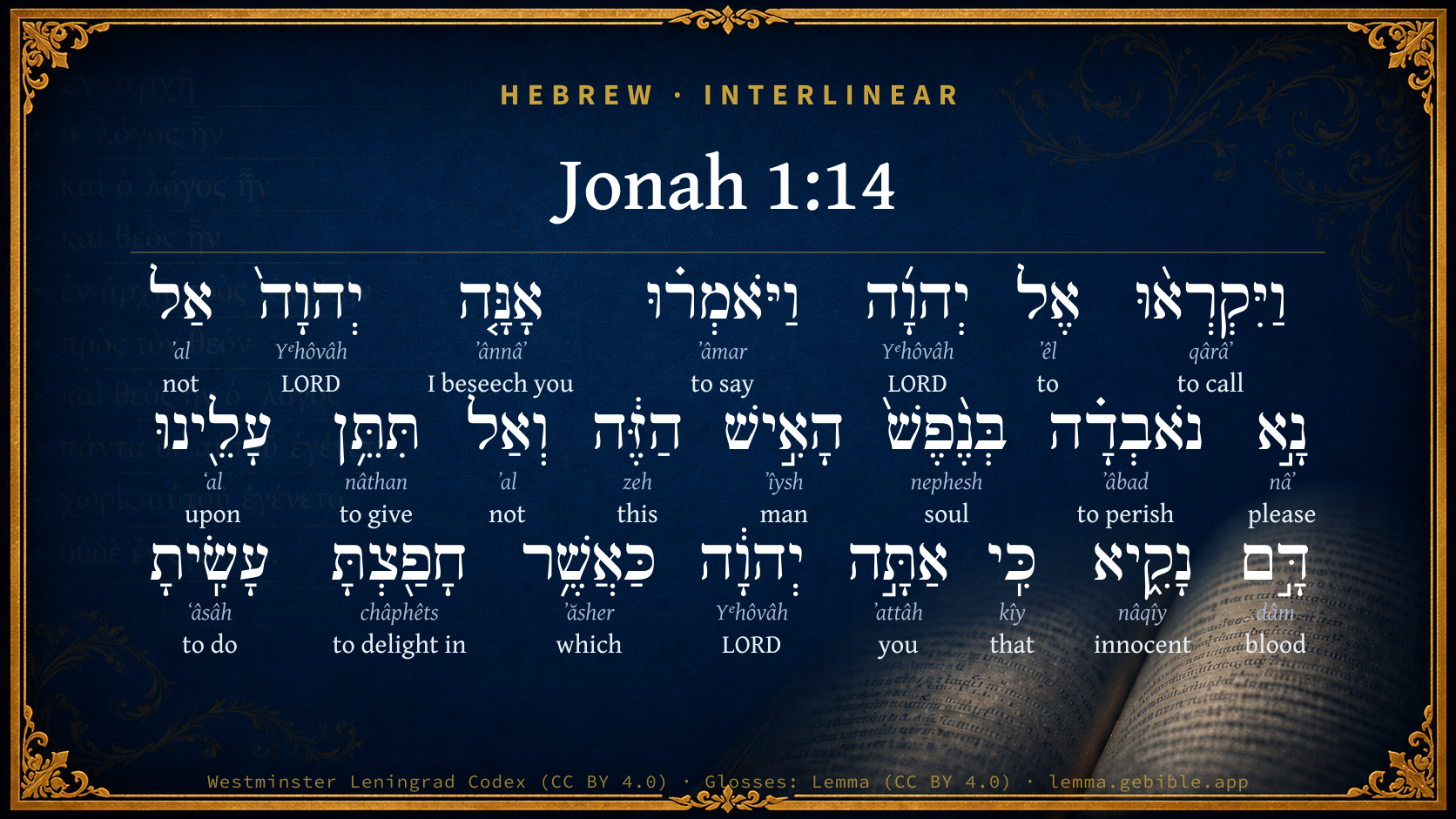
Jonah 1:14

Hebrew (Westminster Leningrad Codex) Jonah 1:14 appears in the Hebrew Old Testament. The text above is from the Westminster Leningrad Codex. Each word links to its Strong’s number, a concise gloss, and parsing drawn from the Open Scriptures Hebrew Bible morphology. Click any word for its full Brown-Driver-Briggs (BDB) entry.
Download image
Cite this verse

Jonah 1:14 (World English Bible). Public Domain. Lemma interlinear Bible study tool, https://lemma.gebible.app/v/jonah/1/14.

Show BibTeX & RIS
BibTeX
RIS
English Translation
Therefore they cried to Yahweh, and said, "We beg you, Yahweh, we beg you, let us not perish for this man's life, and don't lay on us innocent blood; for you, Yahweh, have done as it pleased you."
World English Bible · Public Domain
Download a study sheet

One document with this verse’s original text, its word-by-word gloss line, the meaning frame, cross-references with their text, attributed commentary, and full source and license credits — printable, and it pastes into notes with its structure intact.

This verse Autodidact and up

Study sheet (.html) Plain text (.txt)

A passage Seminary Student

Up to 50 verses in one chapter. A passage sheet keeps up to 6 commentary sources and 12 cross-references per verse, in the order this page ranks them, and says so on the sheet whenever that leaves anything out. Ask for a single verse and you get the Autodidact verse sheet above.

Everything on this page stays free to read, with no account — the sheet is a download of what is already on screen, not access to it.

Want to remove ads? Support Godless Engineer
Compare translations 3

The same verse in 3 English versions, stacked beneath the original-language interlinear above. Click any original word for its lexicon entry.

Each is an independent rendering of the whole verse — the interlinear is not word-aligned to these translations.

Highlighted words mark where these versions differ — a whole-verse word diff, not a word-by-word alignment.

  • World English Bible Public Domain
    Therefore they cried to Yahweh, and said, "We beg you, Yahweh, we beg you, let us not perish for this man's life, and don't lay on us innocent blood; for you, Yahweh, have done as it pleased you."
  • King James Version Public Domain
    Wherefore they cried unto the LORD, and said, We beseech thee, O LORD, we beseech thee, let us not perish for this man's life, and lay not upon us innocent blood: for thou, O LORD, hast done as it pleased thee.
  • unfoldingWord Literal Text CC BY-SA 4.0
    So they cried out to Yahweh and said, “Ah! Yahweh, please do not let us perish on account of the life of this man, and do not put innocent blood upon us, because you, Yahweh, have done just as you desired.”

unfoldingWord Literal Text — © unfoldingWord, licensed CC BY-SA 4.0. Word-aligned USFM3 via Door43 (git.door43.org/unfoldingWord/en_ult).

Versions to compare (up to 4)

3 of 4 selected

Show all 18 translations

Every available English version of this verse, each an independent rendering of the whole verse.

  • World English Bible Public Domain
    Therefore they cried to Yahweh, and said, "We beg you, Yahweh, we beg you, let us not perish for this man's life, and don't lay on us innocent blood; for you, Yahweh, have done as it pleased you."
  • Berean Standard Bible Public Domain
    So they cried out to the LORD: “Please, O LORD, do not let us perish on account of this man’s life! Do not charge us with innocent blood! For You, O LORD, have done as You pleased.”
  • Majority Standard Bible Public Domain
    So they cried out to the LORD: “Please, O LORD, do not let us perish on account of this man’s life! Do not charge us with innocent blood! For You, O LORD, have done as You pleased.”
  • King James Version Public Domain
    Wherefore they cried unto the LORD, and said, We beseech thee, O LORD, we beseech thee, let us not perish for this man's life, and lay not upon us innocent blood: for thou, O LORD, hast done as it pleased thee.
  • American Standard Version (1901) Public Domain
    Wherefore they cried unto Jehovah, and said, We beseech thee, O Jehovah, we beseech thee, let us not perish for this man's life, and lay not upon us innocent blood; for thou, O Jehovah, hast done as it pleased thee.
  • Revised Version (1885) Public Domain
    Wherefore they cried unto the LORD, and said, We beseech thee, O LORD, we beseech thee, let us not perish for this man’s life, and lay not upon us innocent blood: for thou, O LORD, hast done as it pleased thee.
  • Geneva Bible (1599) Public Domain
    Wherefore they cryed vnto the Lord, and said, We beseech thee, O Lord, we beseech thee, let vs not perish for this mans life, and lay not vpon vs innocent blood: for thou, O Lord, hast done, as it pleased thee.
  • Douay-Rheims (1899) Public Domain
    And they cried to the Lord, and said: We beseech thee, O Lord, let us not perish for this man's life, and lay not upon us innocent blood: for thou, O Lord, hast done as it pleased thee.
  • Young's Literal Translation Public Domain
    And they cry unto Jehovah, and say, `We pray Thee, O Jehovah, let us not, we pray Thee, perish for this man's life, and do not lay on us innocent blood, for Thou, Jehovah, as Thou hast pleased, Thou hast done.'
  • Literal Standard Version CC BY-SA 4.0
    And they cry to YHWH, and say, “Ah, now, O YHWH, please do not let us perish for this man’s life, and do not lay innocent blood on us! For You, YHWH, as You have pleased, You have done.”
  • Unlocked Literal Bible CC BY-SA 4.0
    Therefore they cried out to Yahweh and said, “We beg you, Yahweh, we beg you, do not let us perish on account of this man's life, and do not lay upon us the guilt of his death, because you, Yahweh, have done just as it pleased you.”
  • unfoldingWord Literal Text CC BY-SA 4.0
    So they cried out to Yahweh and said, “Ah! Yahweh, please do not let us perish on account of the life of this man, and do not put innocent blood upon us, because you, Yahweh, have done just as you desired.”
  • Darby Bible Public Domain
    And they cried unto Jehovah and said, Ah, Jehovah, we beseech thee, let us not perish for this man's life, and lay not upon us innocent blood: for thou, Jehovah, hast done as it pleased thee.
  • World Messianic Bible Public Domain
    Therefore they cried to the LORD, and said, “We beg you, LORD, we beg you, don’t let us die for this man’s life, and don’t lay on us innocent blood; for you, LORD, have done as it pleased you.”
  • Webster's Bible Public Domain
    Wherefore they cried to the LORD, and said, We beseech thee, O LORD, we beseech thee, let us not perish for this man's life, and lay not upon us innocent blood: for thou, O LORD, hast done as it pleased thee.
  • Free Bible Version CC BY-SA 4.0
    Then they called out to the Lord, “Lord! Please don't kill us for sacrificing this man's life or for spilling innocent blood, for you, Lord, made it happen.”
  • Bible in Basic English Public Domain
    So, crying to the Lord, they said, Give ear to our prayer, O Lord, give ear, and do not let destruction overtake us because of this man's life; do not put on us the sin of taking life without cause: for you, O Lord, have done what seemed good to you.
  • JPS Tanakh (1917) Public Domain
    Wherefore they cried unto the LORD, and said: 'We beseech Thee, O LORD, we beseech Thee, let us not perish for this man's life, and lay not upon us innocent blood; for Thou, O LORD, hast done as it pleased Thee.'

Literal Standard Version (2020), Covenant Press — licensed CC BY-SA 4.0. Text via the HelloAO Bible API (eBible.org). Unlocked Literal Bible (unfoldingWord) — licensed CC BY-SA 4.0. Text via the HelloAO Bible API (eBible.org). unfoldingWord Literal Text — © unfoldingWord, licensed CC BY-SA 4.0. Word-aligned USFM3 via Door43 (git.door43.org/unfoldingWord/en_ult). Free Bible Version, Dr. Jonathan Gallagher — licensed CC BY-SA 4.0. Text via the HelloAO Bible API (eBible.org).

Word by word

More ways to search: Search by grammar → Find every occurrence → Compare this word →

Practice this passage: Drill this verse → Learn its vocabulary →

אָנָּ֤ה
ʼânnâʼ
H577
“I beseech you”
Particle, Interjection
Part of Speech
Particle
Type
Interjection
Full BDB Definition

Origin: apparent contracted from H160 and H4994

TWOT: 122

ah now! I/we beseech you, oh now!, pray now! (participle of entreaty usually followed by the imperative verb)
  1. וַיִּקְרְא֨וּ qârâʼ H7121 “and · to call” Conjunction + Verb, Qal, Sequential Imperfect, 3rd Person, Masculine, Plural
  2. אֶל ʼêl H413 “to” Preposition
  3. יְהוָ֜ה Yᵉhôvâh H3068 “LORD” Noun, Proper
  4. וַיֹּאמְר֗וּ ʼâmar H559 “and · to say” Conjunction + Verb, Qal, Sequential Imperfect, 3rd Person, Masculine, Plural
  5. יְהוָה֙ Yᵉhôvâh H3068 “LORD” Noun, Proper
  6. אַל ʼal H408 “not” Particle, Negative
  7. נָ֣א nâʼ H4994 “please” Particle, Exhortation
  8. נֹאבְדָ֗ה ʼâbad H6 “to perish” Verb, Qal, Cohortative, 1st Person, Common, Plural
  9. בְּנֶ֨פֶשׁ֙ nephesh H5315 “in/at · soul of” Preposition + Noun, Common, Both, Singular, Construct
  10. הָאִ֣ישׁ ʼîysh H376 “the · man” Particle, Definite Article + Noun, Common, Masculine, Singular, Absolute
  11. הַזֶּ֔ה zeh H2088 “the · this” Particle, Definite Article + Pronoun, Demonstrative, Masculine, Singular
  12. וְאַל ʼal H408 “and · not” Conjunction + Particle, Negative
  13. תִּתֵּ֥ן nâthan H5414 “to give” Verb, Qal, Jussive, 2nd Person, Masculine, Singular
  14. עָלֵ֖ינוּ ʻal H5921 “upon · us” Preposition + Suffix, Personal, 1st Person, Common, Plural
  15. דָּ֣ם dâm H1818 “blood” Noun, Common, Masculine, Singular, Absolute
  16. נָקִ֑יא nâqîy H5355 “innocent” Adjective, Adjective, Masculine, Singular, Absolute
  17. כִּֽי kîy H3588 “that” Conjunction
  18. אַתָּ֣ה ʼattâh H859 “you” Pronoun, Personal, 2nd Person, Masculine, Singular
  19. יְהוָ֔ה Yᵉhôvâh H3068 “LORD” Noun, Proper
  20. כַּאֲשֶׁ֥ר ʼăsher H834 “like/as · which” Preposition + Particle, Relative
  21. חָפַ֖צְתָּ châphêts H2654 “to delight in” Verb, Qal, Perfect, 2nd Person, Masculine, Singular
  22. עָשִֽׂיתָ ʻâsâh H6213 “to do” Verb, Qal, Perfect, 2nd Person, Masculine, Singular

About this verse

These counts appear in no published source. They are computed here, from the morphology-tagged text and Lemma’s own curated glosses. What Lemma adds →

23
words
20
distinct lemmas
Prophets
section

Notable vocabulary

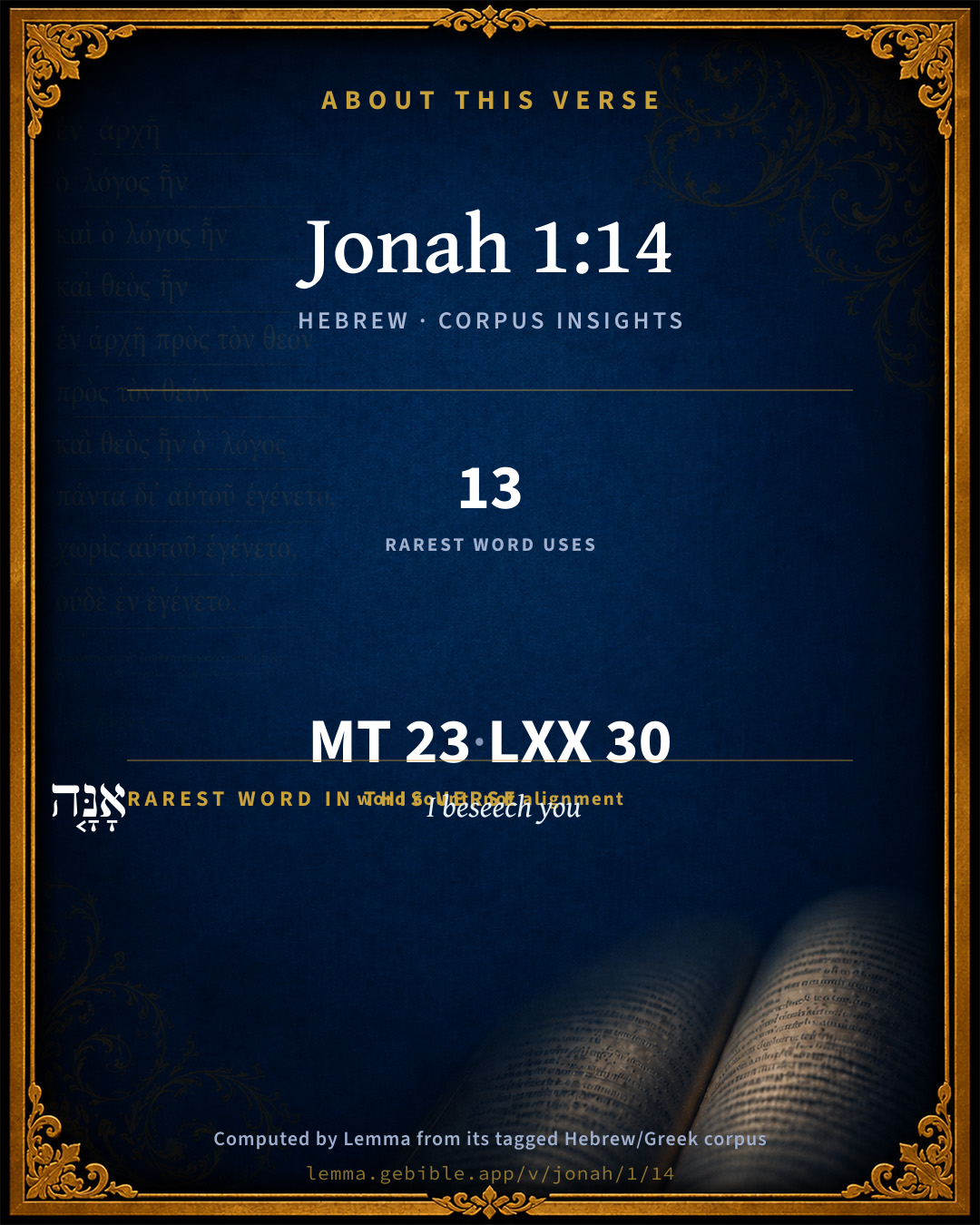
The rarest word here is אָנָּ֤ה I beseech you H577 — appearing just 13 times in the whole Hebrew Bible.

Shared distinctive vocabulary

אָנָּ֤ה I beseech you H577 occurs in 12 verses of the Hebrew Bible. Also found in:

Grammatical profile

  • 6 verbs
  • 6 nouns
  • 1 adjective
  • 2 pronouns
  • 2 prepositions
  • 1 conjunction
  • 5 particles

Verb forms

  • וַיִּקְרְא֨וּ Qal · Sequential Imperfect
  • וַיֹּאמְר֗וּ Qal · Sequential Imperfect
  • נֹאבְדָ֗ה Qal · Cohortative
  • תִּתֵּ֥ן Qal · Jussive
  • חָפַ֖צְתָּ Qal · Perfect
  • עָשִֽׂיתָ Qal · Perfect

Repetition

Words recur within this verse — often emphatic in Hebrew:

  • יְהוָ֜ה LORD H3068 ×3
  • אַל not H408 ×2

Hebrew & Septuagint length

In English translation the verse runs 38 words from the Hebrew and 37 from the Septuagint (LXX English) — closely comparable.

A rough comparison of the two English renderings, which tokenize alike — not a word-level alignment.

Word counts can differ between the Hebrew and the Greek without any difference in meaning — e.g. the Hebrew direct-object marker אֵת has no separate Greek word, and Greek often adds the article ὁ.

In the original languages it is 23 Hebrew tokens and 30 Greek tokens — but the two are counted differently (Hebrew bundles its prefixes and suffixes into one token; the Greek is in lemma form), so that isn’t a like-for-like length.

Cross-references

13

Topical passages linked to Jonah 1:14 in the Treasury of Scripture Knowledge — connected by theme and wording, ordered by reader-vote popularity; previews shown in the World English Bible.

  • Psalms 115:3 But our God is in the heavens. He does whatever he pleases.
  • Psalms 135:6 Whatever Yahweh pleased, that he has done, In heaven and in earth, in the seas and in all deeps;
  • Deuteronomy 21:8 Forgive, Yahweh, your people Israel, whom you have redeemed, and don't allow innocent blood [to remain] in the midst of your people Israel. The blood shall be forgiven them.
  • Ephesians 1:11 in whom also we were assigned an inheritance, having been foreordained according to the purpose of him who works all things after the counsel of his will;
  • Psalms 107:28 Then they cry to Yahweh in their trouble, And he brings them out of their distress.
  • Daniel 4:34–35 At the end of the days I, Nebuchadnezzar, lifted up my eyes to heaven, and my understanding returned to me, and I blessed the Most High, and I praised and honored him who lives forever; for his dominion is an everlasting dominion, and his kingdom from generation to generation.
  • Jonah 1:5 Then the mariners were afraid, and cried every man to his god. They threw the cargo that was in the ship into the sea, to lighten it. But Jonah had gone down into the innermost parts of the ship, and he was laying down, and was fast asleep.
  • Jonah 1:16 Then the men feared Yahweh exceedingly; and they offered a sacrifice to Yahweh, and made vows.
  • Matthew 11:26 Yes, Father, for so it was well-pleasing in your sight.
  • Genesis 9:6 Whoever sheds man's blood, by man will his blood be shed, for in the image of God made he man.
  • Isaiah 26:16 Yahweh, in trouble have they visited you; they poured out a prayer [when] your chastening was on them.
  • Acts 28:4 When the natives saw the creature hanging from his hand, they said one to another, "No doubt this man is a murderer, whom, though he has escaped from the sea, yet Justice has not allowed to live."
  • Ephesians 1:9 making known to us the mystery of his will, according to his good pleasure which he purposed in him

Cross-references courtesy of OpenBible.info (CC BY 4.0).

Hebrew and Greek witnesses Masoretic Hebrew ↔ Greek Septuagint

The same verse in the two great witnesses to the Old Testament, shown verse-for-verse.

These are two independent witnesses, not word-aligned to each other, and the Septuagint is shown in lemma (dictionary) form.

Hebrew Jonah 1:14 Masoretic · Westminster Leningrad Codex

וַיִּקְרְא֨וּ אֶל יְהוָ֜ה וַיֹּאמְר֗וּ אָנָּ֤ה יְהוָה֙ אַל נָ֣א נֹאבְדָ֗ה בְּנֶ֨פֶשׁ֙ הָאִ֣ישׁ הַזֶּ֔ה וְאַל תִּתֵּ֥ן עָלֵ֖ינוּ דָּ֣ם נָקִ֑יא כִּֽי אַתָּ֣ה יְהוָ֔ה כַּאֲשֶׁ֥ר חָפַ֖צְתָּ עָשִֽׂיתָ

Therefore they cried to Yahweh, and said, "We beg you, Yahweh, we beg you, let us not perish for this man's life, and don't lay on us innocent blood; for you, Yahweh, have done as it pleased you."

World English Bible · Public Domain

Greek LXX Jonah 1:14 Septuagint · lemma form

καί ἀναβοάω πρός κύριος καί εἶπον μηδαμῶς κύριος μή ἀποὀλλύω ἕνεκεν ὁ ψυχή ὁ ἄνθρωπος οὗτος καί μή δίδωμι ἐπί ἐγώ αἷμα δίκαιος ὅτι σύ κύριος ὅς τρόπος βούλομαι ποιέω

And they cried to the Lord, and said, Forbid it, Lord: let us not perish for the sake of this man's life, and bring not righteous blood upon us: for you, Lord, have done as you would.

LXX2012 (modern English Septuagint) · Public Domain

Hebrew: Westminster Leningrad Codex (CC BY 4.0). Greek: Septuagint (public domain); English from LXX2012 (modern English Septuagint) (Public Domain). How the Septuagint differs from the Hebrew →

Targum (Aramaic paraphrase)

1

The Targum is the ancient Jewish Aramaic paraphrase of the Hebrew Scriptures — an interpretive translation, not the Hebrew text itself. Onkelos (literal) and Pseudo-Jonathan (expansive) render the Torah, and Jonathan the Prophets. Coverage is partial: where no permissively-licensed English translation exists for a verse, only the Aramaic is shown. This is verse-level text, not a word-by-word alignment to the Hebrew.

  1. Targum Jonathan Prophets (Joshua–Malachi)
    וְצַלִיאוּ קֳדָם יְיָ וַאֲמָרוּ קַבֵּיל בְּעוּתָנָא יְיָ לָא כְעַן נֵיבַד בְּחוֹבַת נְפַשׁ דְגַבְרָא הָדֵין וְלָא תִתֵּן עֲלָנָא חוֹבַת דַם זַכַּאי אֲרֵי אַתְּ יְיָ כְּמָא דְרַעֲוָא קֳדָמָךְ עֲבַדְתָּא:

    And they prayed before the LORD and said: “Receive our pleas, LORD! Let us not now be lost for the guilt of the soul of this man, and do not put upon us the guilt of righteous blood! For You are the LORD; what is desired before You, You do!”

    Targum Jonathan — Aramaic: “Mikraot Gedolot” (public domain). English: “Sefaria Community Translation” (CC0 1.0 (public-domain dedication)); “London "Chaldee Paraphrase," 1871” (public domain). Text via Sefaria.

Commentary

Notes on Jonah 1:14 from classic Christian and Jewish commentators (each source and its license shown beneath its notes). The classic Christian expositions comment on the surrounding passage and are grouped to its opening verse, so a note may address several verses; the Jewish commentaries on the Tanakh (Rashi and others) are per-verse, so they appear only where the commentator wrote on this verse.

Lemma curates 59 commentaries, every one of them public domain or Creative Commons licensed, each selected and text-cleaned for this edition rather than reprinted as found. About our sources →

The Cambridge Bible for Schools and Colleges

gen. ed. J. J. S. Perowne

14. for this man’s life] i. e. for having taken it away. Lit., in the life of this man, according to a well-known use of this Heb. preposition in the sense of ‘in the place of,’ ‘in exchange for.’ So Gen_29:18, “I will serve thee for (lit. ‘in,’ in exchange for) Rachel;” and Deu_19:21, “life for (in) life,” &c.

lay not upon us innocent blood] i. e. the guilt of having shed innocent blood. Comp. Deu_21:8.

for thou, O Lord, &c.] The death of this man is no doing of ours. We are only carrying out Thy declared will. Hold us not, therefore, responsible for it. “That Jonah betook himself to this ship of ours, that the tempest was raised, that Jonah was taken by lot, that he passed this sentence upon himself, all this comes of Thy will.”—Rosenm.

14–16. The openness of these heathens to religious impressions; the readiness with which they acknowledged Jehovah (hitherto to them an unknown God), and addressed no longer to their own gods (Jon_1:5), but to Him their most earnest and humble prayers; their submission to His will (Jon_1:14), and the worship which they subsequently paid and promised Him (Jon_1:15), are all brought out in bold relief, and in strong and (in pursuance of the object of this Book) intended contrast with the conduct of His own people Israel in turning from Him to idols. These heathens, too, reverence and would fain save from death a prophet of Jehovah who has come to them unbidden, and has well-nigh compassed their destruction; Jerusalem “killed the prophets and stoned them that were sent unto her” for her salvation. They shew the utmost tenderness for a single life; Jonah, the prophet of the Lord, is worse than regardless of “more than sixscore thousand” human souls.

The Cambridge Bible for Schools and Colleges (gen. ed. J. J. S. Perowne; Cambridge University Press, 1878–1918) — public domain. Text from a community e-Sword module.

Trapp's Complete Commentary

John Trapp

Jon 1:14 Wherefore they cried unto the LORD, and said, We beseech thee, O LORD, we beseech thee, let us not perish for this man’s life, and lay not upon us innocent blood: for thou, O LORD, hast done as it pleased thee.

Ver. 14. Wherefore they cried unto the Lord] Not unto their false gods, but unto the true Jehovah of whom they had learned something by what they had seen and heard from Jonah. Va torpori nostro.

We beseech thee, O Lord, we beseech thee] A most ardent and affectionate prayer. A natural man may pray from the bottom of his heart, out of a deep sense of his wants; but he cannot give thanks from the bottom of his heart; because void of the love of God and joy of faith. Danaeus noteth from these words that judges ought to pray before they pass sentence of death upon any.

Let us not perish for this man’s life] Which we take away, but full sore against our wills. Wilful murder was ever accounted a heinous crime among the heathens also. Abel’s innocent blood had as many tongues as drops, to cry to heaven against Cain, Gen 4:10, "The voice of thy brother’s blood"; and 2Ki 9:26, "Surely I have seen yesterday the blood of Naboth." Murder ever bleeds fresh in the eye of God; and to him many years, yea, that eternity that is past, is but yesterday. Full well, then, did these men so earnestly deprecate the guilt of innocent blood, which they knew would lie and light heavily.

And lay not upon us innocent blood] Innocent as to us; for he hath done us no hurt, but much good by his piety and patience; whence it is that we are so loth to part with him, after this sort especially.

For thou, O Lord, hast done as it pleaseth thee] Thou hast appointed him to this death, and now callest for him, as we easily collect by the circumstances. Sic quicquid superi voluere, per actum est (Ovid. Metamor. l. 8).

John Trapp, A Commentary or Exposition upon All the Books of the Old and New Testament (1647–1656) — public domain. Text from a community e-Sword module.

Geneva Bible (1599)

Geneva Bible translators

This declareth that the very wicked in their necessities flee unto God for succor and also that they are touched with a certain fear to shed man’s blood, whereas they know no manifest sign of wickedness.

Geneva Bible (1599) marginal notes — public domain. Text via Bolls.life.

Jamieson, Fausset & Brown

Robert Jamieson, A. R. Fausset & David Brown

for this man's life--that is, for taking this man's life.

innocent blood--Do not punish us as Thou wouldst punish the shedders of innocent blood (compare ). In the case of the Antitype, Pontius Pilate washed his hands and confessed Christ's innocence, "I am innocent of the blood of this just person." But whereas Jonah the victim was guilty and the sailors innocent, Christ our sacrificial victim was innocent and Pontius Pilate and nil of us men were guilty. But by imputation of our guilt to Him and His righteousness to us, the spotless Antitype exactly corresponds to the guilty type.

thou . . . Lord, hast done as it pleased thee--That Jonah has embarked in this ship, that a tempest has arisen, that he has been detected by casting of lots, that he has passed sentence on himself, is all Thy doing. We reluctantly put him to death, but it is Thy pleasure it should be so.

Jamieson, Fausset & Brown — Commentary Critical and Explanatory on the Whole Bible (1871) — public domain (CC PDM 1.0). Text via the HelloAO Bible API.

Adam Clarke's Commentary

Verse 14. They cried unto the Lord] Under a conviction that he was the self-existing Being, the Maker of the heavens and the earth, and the author of the present storm, they put up their prayers to him.

Let us not perish for this man's life] They were now about to cast him overboard; but seemed to call God to witness that it was with the utmost reluctance, and only in obedience to his command. There is a parallel passage in the Argonautics, which has been quoted to illustrate this: -

Πολλα δε μερμηριζον ενι φρεσι πευκαλιμησι,

Η μεν αποφθισωσι, και ιχθυσι κυρμα βαλωσιν

Αινολεχη Μμηδειαν, αποτρεψωσι δ' Εριννυν.

Ver. 1171.

"And much they doubted, in their prudent minds,

Whether to kill and cast a prey to fishes

Wretched Medea, and avert their fate." See Newcome.

Adam Clarke's Commentary on the Bible (1810–1826) — public domain. Text from a community e-Sword/MySword module.

John Calvin's Commentaries

I come now to the second verse. They cried, he says, to Jehovah and said, We beseech , Jehovah, let us not perish, we pray, on account of the life of this man, and give not, that is, lay not, innocent blood upon us The Prophet now expresses more fully why the sailors toiled so much to return to port, or to reach some shore, — they were already persuaded that Jonah was a worshipper of the true God, and not only this, but that he was a Prophet, inasmuch as he had told them, as we have seen, that he had fled from the presence of God, because he feared to execute the command which we have noticed. It was therefore pious (reverentia) fear that restrained the sailors, knowing, as they did, that Jonah was the servant of the true God. They, at the same time, saw, that Jonah was already standing for his sin before God’s tribunal, and that punishment was demanded. This they saw; but yet they wished to preserve his life.

Now this place shows, that there is by nature implanted in all an abhorrence of cruelty; for however brutal and sanguinary many men may be, they yet cannot divest themselves of this feeling, — that the effusion of human blood is hateful. Many, at the same time, harden themselves; but they apply a searing iron: they cannot shake off horror, nay, they feel that they are detested by God and by men, when they thus shed innocent blood. Hence it was that the sailors, who in other respects hardly retained a drop of humanity, fled as suppliants to God, when the case was about the death of man; and they said, אנה יהוה, ane Ieve, ‘We beseech Jehovah:’ and the expression is repeated; which shows that the sailors earnestly prayed that the Lord would not impute this as a sin to them.

We hence see that though these men had never known the doctrine of the law, they were yet so taught by nature that they knew that the blood of man is dear and precious in the sight of God. And as to us, we ought not only to imitate these sailors, but to go far beyond them: for not only ought the law of nature to prevail among us, but also the law of God; for we hear what God had formerly pronounced with his own mouth,

‘Whosoever sheddeth man’s blood, shed shall his blood be,’ (Genesis 9:6.)

And we know also the reason why God undertakes to protect the life of men, and that is, because they have been created in his image. Whosoever then uses violence against the life of man, destroys, as far as he can the image of the eternal God. Since it is so, ought not violence and cruelty to be regarded by us with double horror? We ought also to learn another thing from this doctrine: God proves by this remarkable testimony what paternal feeling he manifests towards us by taking our life under his own guardianship and protection; and he even proves that we are really the objects of his care, inasmuch as he will execute punishment and vengeance when any one unjustly injures us. We then see that this doctrine on the one side restrains us, that we may not attempt anything against the lives of our brethren; and, on the other side, it assures us of the paternal love of God, so that being allured by his kindness we may learn to deliver up ourselves wholly to his protection.

I now come to the last clause of the verse, For thou, Jehovah, hast done as it has pleased thee. The sailors clearly prove here that they did not willingly shed innocent blood. How then can these two things agree, — that the blood was innocent, and that they were blameless? They adopted this excuse, — that they obeyed God’s decree, that they did nothing rashly or according to their own inclinations, but followed what the Lord had prescribed: though, indeed, God had not spoken, yet what he required was really evident; for as God demanded an expiation by the death of Jonah, so he designed to continue the tempest until he was thrown into the deep. These things the sailors now put forward. But we must notice, that they did not cast the blame on God, as blasphemers are wont to do, who, while they seek to exempt themselves from blame, find fault with God, or at least put him in their own place: “Why then,” they say, “does he sit as a judge to condemn us for that of which he is himself the author, since he has so decreed?” At this day there are many fanatics who thus speak, who obliterate all the difference between good and evil, as if lust were to them the law. They at the same time make a covert of God’s providence. Jonah wished not that such a thing should be thought of the sailors; but as they well understood that God governed the world justly, though his counsels be secret and cannot be comprehended by us, — as, then, they were thus convinced, they thus strengthened themselves; and though they gave to God the praise due to his justice, they at the same time trembled lest they should be guilty of innocent blood.

We now then see how reverently these men spoke of God, and that so much religious fear possessed them, that they did not rob God of his praise, Thou Jehovah, they said, hast done as it has pleased thee Do they here accuse God of tyranny, as though he confounded all things without any cause or reason? By no means. They took this principle as granted, — that the will of God is right and just, yea, that whatever God has decreed is beyond doubt just. Being then thus persuaded, they took the will of God as the rule for acting rightly: “As thou, Jehovah, hast done as it seemed good to thee, so we are blameless.” But at the same time it is proper also to add, that the sailors do not vainly talk here of the secret providence of God in order to impute murder to him, as ungodly men and profane cavilers do at this day: but as the Lord made known his purpose to them, they show that the storm and the tempest could not be otherwise calmed and quieted than by drowning Jonah: they therefore took this knowledge of God’s purpose as a certain rule to follow. At the same time they fled, as I have said, to God, and supplicated his mercy, lest in a matter so perplexed and difficult he should involve them in the same punishment, as they were constrained to shed innocent blood. We now then apprehend the meaning of this passage. Now it follows —

John Calvin's Commentaries (1540-1563) — public domain. Text from the Calvin Translation Society English edition (1840s-50s) via the Christian Classics Ethereal Library (ccel.org). Calvin's coverage is partial (roughly two-thirds of the Bible); uncommented books and verses are honest gaps, never fabricated. The 19th-century editor's footnotes and remarks are omitted so the notes are faithfully Calvin's own voice.

Ellicott's Commentary for English Readers

(14) Wherefore they cried unto the Lord.—There is presented here, as throughout the book, a strong contrast between the readiness of the heathen to receive religious impressions, and the stubbornness and obstinacy of Israel.

For this man’s life . . .—i.e., for taking it. The law of retaliation was as familiar to them as to the Hebrews (Deu_19:21). (Comp. 2Sa_14:7.)

For thou.—The original is more impressive: For Thou, Jehovah, as it hath phased Thee, Thou hast done. The storm, the lot, the request of the prophet himself, all showed that the sailors were but instruments in carrying out the Divine purpose.

A Bible Commentary for English Readers, edited by Charles John Ellicott (1878–1897) — public domain. Text from a community e-Sword module.

John Gill's Exposition

Wherefore they cried unto the Lord,.... Not unto their gods, but unto the true Jehovah, the God of Jonah, and of the Hebrews; whom they now, by this providence, and Jonah's discourse, had some convictions and knowledge of as the true God; and therefore direct their prayer to him, before they cast the prophet into the sea:

and said, we beseech thee, O Lord, we beseech thee; which repetition shows the ardent, vehemence, and earnestness of their minds in prayer:

let us not perish for this man's life; they were in the utmost perplexity of mind, not knowing well what to do; they saw they must perish by the storm, if they saved his life; and they were afraid their should perish, if they took it away; and which yet they were obliged to do; and therefore had no other way left but to pray to the Lord they might not perish for it; or it be reckoned as their crime, and imputed to them, as follows:

and lay not upon us innocent blood; for so it was to them; he had done no hurt to them since he had been with them, except in being the cause of the storm, whereby they had suffered the loss of their goods; however, had not been guilty of anything worthy of death, as they could observe; and as for his offence against God, they were not sufficient judges of, and must leave it with him: the light of nature teaches men to be tender of the lives of fellow creatures, and to avoid shedding of innocent blood:

for thou, O Lord, hast done as it pleased thee; it appeared to them to be the wilt of God that he should be cast into the sea; from the storm that was raised on his account; from the determination of the lot; from the confession of Jonah, and his declaration of the will of God in this matter, as a prophet of his: they did not pretend to account for it; it was a secret to them why it should be; but it was no other than what he would have done; and therefore they hoped no blame would be laid on them.

John Gill's Exposition of the Whole Bible (1746–1763) — public domain (CC PDM 1.0). Text via the HelloAO Bible API.

Albert Barnes' Notes on the Bible

Wherefore (And) they cried unto the Lord - “They cried” no more “each man to his god,” but to the one God, whom Jonah had made known to them; and to Him they cried with an earnest submissive, cry, repeating the words of beseeching, as men, do in great earnestness; “we beseech Thee, O Lord, let us not, we beseech Thee, perish for the life of this man” (i. e., as a penalty for taking it, as it is said, 2Sa 14:7. “we will slay him for the life of his brother,” and, Deu 19:21. “life for life.”) They seem to have known what is said, Gen 9:5-6. “your blood of your lives will I require; at the hand of every beast will I require it and at the hand of man; at the hand of every man’s brother will I require the life of man. Whoso sheddeth man’s blood, by man shall his blood be shed, for in the image of God made He man” , “Do not these words of the sailors seem to us to be the confession of Pilate, who washed his hands, and said, ‘I am clean from the blood of this Man?’ The Gentiles would not that Christ should perish; they protest that His Blood is innocent.”

And lay not upon us innocent blood - innocent as to them, although, as to this thing, guilty before God, and yet, as to God also, more innocent, they would think, than they. For, strange as this was, one disobedience, their whole life, they now knew, was disobedience to God; His life was but one act in a life of obedience. If God so punishes one sin of the holy 1Pe 4:18, “where shall the ungodly and sinner appear?” Terrible to the awakened conscience are God’s chastenings on some (as it seems) single offence of those whom He loves.

For Thou, Lord, (Who knowest the hearts of all men,) hast done, as it pleased Thee - Wonderful, concise, confession of faith in these new converts! Psalmists said it, Psa 135:6; Psa 115:3. “Whatsoever God willeth, that doeth He in heaven and in earth, in the sea and in all deep places.” But these had but just known God, and they resolve the whole mystery of man’s agency and God’s Providence into the three simple words , as (Thou) “willedst” (Thou) “didst.” “That we took him aboard, that the storm ariseth, that the winds rage, that the billows lift themselves, that the fugitive is betrayed by the lot, that he points out what is to be done, it is of Thy will, O Lord” . “The tempest itself speaketh, that ‘Thou, Lord, hast done as Thou willedst.’ Thy will is fulfilled by our hands.” “Observe the counsel of God, that, of his own will, not by violence or by necessity, should he be cast into the sea. For the casting of Jonah into the sea signified the entrance of Christ into the bitterness of the Passion, which He took upon Himself of His own will, not of necessity. Isa 53:7. “He was offered up, and He willingly submitted Himself.” And as those who sailed with Jonah were delivered, so the faithful in the Passion of Christ. Joh 18:8-9. “If ye seek Me, let these go their way, that the saying might be fulfilled which” Jesus spake, ‘Of them which Thou gavest Me, I have lost none. ‘“

Albert Barnes' Notes on the Bible (1834–1885) — public domain. Text from a community e-Sword/MySword module.

Haydock's Catholic Bible Commentary

Blood. We act thus by his direction, and through necessity.

George Leo Haydock (1774–1849), Haydock's Catholic Family Bible and Commentary, 1859 edition — public domain. Excludes Psalms (Douay-Rheims chapter numbering differs from Protestant) and Deuterocanonical books (Catholic canon only).

Matthew Poole's English Annotations

Wherefore, since all their labour and skill to carry the ship to shore was successless, and they saw no remedy, but they must either follow Jonah’s advice against himself, or drown with him,

they cried, with importunity of mind, and with loud voices too in prayer,

unto the Lord; not now, as in the beginning of the tempest, every man to his god; but, better instructed now, they all cry to Jonah’s God, to Jehovah the true God.

We; they all join in prayer.

Beseech; sue to Mercy for mercy; they plead not innocency or merit, but pray for mercy, and that free. Thee; all sue to God, not to saints or intermediate demons. We

beseech thee; it is repeated to note their vehemency in prayer.

Let us not perish for this man’s life; though he is pointed out by lot, hath advised us hereunto, yet if possible let the tempest cease, and we all be safe; let not him perish, nor we for him: so their first prayer is for safety to Jonah and all in the ship.

Lay not upon us innocent blood: this is the next suit, that if God, by the continued tempest, do peremptorily and irreversibly require Jonah’s life, a person innocent among them, and who had, since he came to them, so demeaned himself, that, should they throw him overboard before they had tried all kind of means for preserving him, they might not be justly accounted barbarous murderers, and God would certainly charge innocent blood upon them; this they deprecate with all earnestness and importunity.

Hast done; sending the tempest, arresting the prophet by it, detecting him by lot, sentencing him by his own mouth, and confirming the condemning sentence by the continuance of the storm, and so leaving us to perish with this offender against thee, or to be thy executioners; this is thine own doing, and it is just because thou doest it.

As it pleased thee; though it be secret to us, and strange in our opinion, yet it is very just and necessary we know, or it would not please thee it should be so.

Matthew Poole's English Annotations on the Holy Bible (1683–1685) — public domain. Text from a community e-Sword/MySword module.

The Pulpit Commentary

They cried unto the Lord. They prayed no longer to their gods, as before (ver. 5), but unto Jehovah, the God of Jonah. Let us not perish for this man"s life. Let us not incur death for taking this man"s life. They seem to know something of the Noachic law that punished murder. (Gen_9:5, Gen_9:6) Lay not upon us innocent blood. Charge us not with the guilt of shedding innocent blood. (Deu_21:8) For thou, O Lord, hast done as it pleased thee. (1Sa_3:18) The whole affair has happened according to thy will. The tempest, the lot, the sentence, are all the working of thy providence. The prophet throughout brings into prominence the contrast between the behaviour of these heathen and his own, and would teach his nation a lesson thereby.

The Pulpit Commentary (1880–1919), ed. H.D.M. Spence-Jones & Joseph S. Exell — public domain. Text from a community e-Sword module.

John Wesley's Explanatory Notes

Unto the Lord - Now they all cry to Jonah's God, to Jehovah. And said - Let us not perish for taking away his life. Hast done - Sending the tempest, arresting the prophet by it, detecting him by lot, sentencing him by his own mouth, and confirming the condemning sentence by the continuance of the storm.

John Wesley, Explanatory Notes Upon the Whole Bible (1754–1765) — public domain. Text via the GEBible commentary corpus.

unfoldingWord translationNotes

Door43 World Missions Community

Therefore

"Because of this" or "Because the sea became more violent"

they cried out to Yahweh

"the men prayed to Yahweh"

do not let us perish on account of this man's life

"Please do not kill us because we caused this man to die" or "We are going to cause this man to die. But please do not kill us"

do not lay upon us the guilt of his death

"please do not blame us for his death" or "do not consider us guilty when this man dies." The author speaks of "guilt" as if it were an object that can be placed on top of a person. It refers to making that person accountable for their actions. (See: Metaphor)

the sea stopped raging

"the sea stopped moving violently" or "the sea became calm"

feared Yahweh very much

"became greatly awed at Yahweh's power"

translationWords

Yahweh

guilt

fear

sacrifice

vow

unfoldingWord translationNotes — © Distant Shores Media and the Door43 World Missions Community, licensed CC BY-SA 4.0. Source: git.door43.org/Door43/en_tn.

Rashi

Rabbi Shlomo Yitzchaki (Rashi)

for the life of this man—I.e, for the sin of laying a hand upon his life.

Rashi on the Tanakh — English translations: “The Judaica Press complete Tanach with Rashi, translated by A. J. Rosenberg” (CC BY 4.0); “Pentateuch with Rashi's commentary by M. Rosenbaum and A.M. Silbermann, 1929-1934” (public domain); “The Metsudah Tanach series, Lakewood, N.J” (CC BY 4.0); and “The Book of Joshua, Metsudah Publications, 1997” (CC BY 4.0). Text via Sefaria.

Lesson kit

Teaching starters — assembled from the data on this page, not authored interpretation. Every prompt links to the verse data it draws on. Edit before teaching.

Jonah, in the Prophets, opens this verse with 23 words (20 distinct Hebrew lemmas). Its most distinctive word is ʼânnâʼ (“I beseech you”). A historical commentator’s framing appears above. Read the whole chapter for the surrounding context.

Discussion questions

  1. What does “I beseech you” (ʼânnâʼ) contribute to the verse as a whole?
  2. Genesis 50:17 shares the word «I beseech you» with this verse. How do the two illuminate each other?
  3. “LORD” occurs 3× in this one verse. What is the effect of the repetition?
  4. These translations render this verse differently; the difference is in the English rendering, not the original. What questions does that raise?
  5. The verb «וַיִּקְרְא֨וּ» is Qal Sequential Imperfect. How does its form color the action?
  6. Reading how The Cambridge Bible for Schools and Colleges and Trapp's Complete Commentary read this verse, where do the two commentators agree and where do they part?

Things to notice

Reading settings

Reading text

Shown beneath each verse's original-language words.

Old Testament
Old Testament edition

Read the OT as the Masoretic Hebrew (MT) or the Greek Septuagint (LXX).

English shown for the Greek Septuagint (in the Hebrew ↔ Greek comparison).

Comparing translations? Open the Compare panel on any verse page to stack up to four side by side.