
Isaiah 38:3

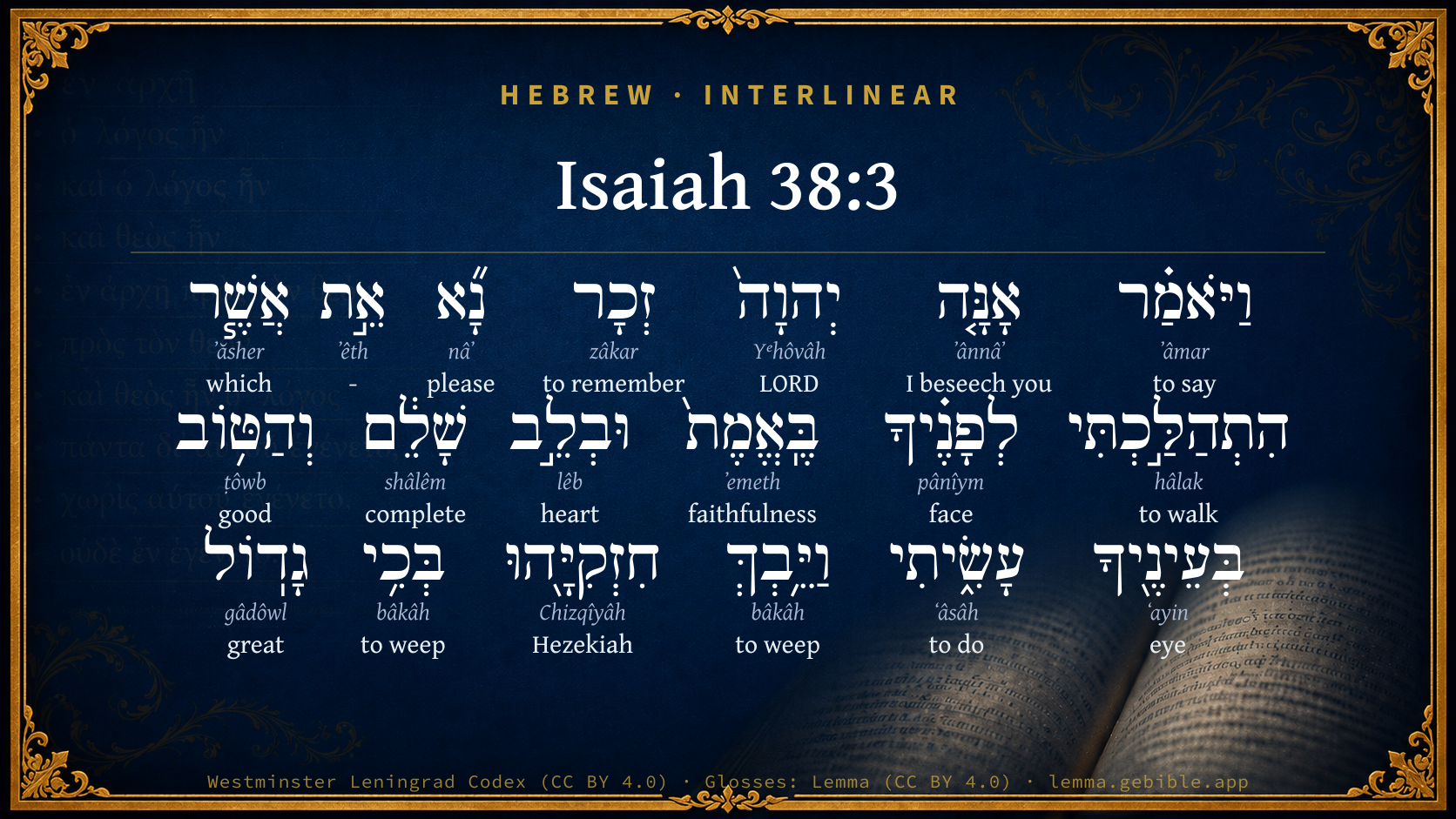
Hebrew (Westminster Leningrad Codex) Isaiah 38:3 appears in the Hebrew Old Testament. The text above is from the Westminster Leningrad Codex. Each word links to its Strong’s number, a concise gloss, and parsing drawn from the Open Scriptures Hebrew Bible morphology. Click any word for its full Brown-Driver-Briggs (BDB) entry.
Download image
Cite this verse

Isaiah 38:3 (World English Bible). Public Domain. Lemma interlinear Bible study tool, https://lemma.gebible.app/v/isaiah/38/3.

Show BibTeX & RIS
BibTeX
RIS
English Translation
and said, Remember now, Yahweh, I beg you, how I have walked before you in truth and with a perfect heart, and have done that which is good in your sight. Hezekiah wept sore.
World English Bible · Public Domain
Download a study sheet

One document with this verse’s original text, its word-by-word gloss line, the meaning frame, cross-references with their text, attributed commentary, and full source and license credits — printable, and it pastes into notes with its structure intact.

This verse Autodidact and up

Study sheet (.html) Plain text (.txt)

A passage Seminary Student

Up to 50 verses in one chapter. A passage sheet keeps up to 6 commentary sources and 12 cross-references per verse, in the order this page ranks them, and says so on the sheet whenever that leaves anything out. Ask for a single verse and you get the Autodidact verse sheet above.

Everything on this page stays free to read, with no account — the sheet is a download of what is already on screen, not access to it.

Want to remove ads? Support Godless Engineer
Compare translations 3

The same verse in 3 English versions, stacked beneath the original-language interlinear above. Click any original word for its lexicon entry.

Each is an independent rendering of the whole verse — the interlinear is not word-aligned to these translations.

Highlighted words mark where these versions differ — a whole-verse word diff, not a word-by-word alignment.

  • World English Bible Public Domain
    and said, Remember now, Yahweh, I beg you, how I have walked before you in truth and with a perfect heart, and have done that which is good in your sight. Hezekiah wept sore.
  • King James Version Public Domain
    And said, Remember now, O LORD, I beseech thee, how I have walked before thee in truth and with a perfect heart, and have done that which is good in thy sight. And Hezekiah wept sore.
  • unfoldingWord Literal Text CC BY-SA 4.0
    and said, “Oh Yahweh, please remember that I have walked about to your face in faithfulness and with a whole heart, and I have done good in your eyes.” And Hezekiah wept a great weeping.

unfoldingWord Literal Text — © unfoldingWord, licensed CC BY-SA 4.0. Word-aligned USFM3 via Door43 (git.door43.org/unfoldingWord/en_ult).

Versions to compare (up to 4)

3 of 4 selected

Show all 18 translations

Every available English version of this verse, each an independent rendering of the whole verse.

  • World English Bible Public Domain
    and said, Remember now, Yahweh, I beg you, how I have walked before you in truth and with a perfect heart, and have done that which is good in your sight. Hezekiah wept sore.
  • Berean Standard Bible Public Domain
    saying, “Please, O LORD, remember how I have walked before You faithfully and with wholehearted devotion; I have done what was good in Your sight.” And Hezekiah wept bitterly.
  • Majority Standard Bible Public Domain
    saying, “Please, O LORD, remember how I have walked before You faithfully and with wholehearted devotion; I have done what is good in Your sight.” And Hezekiah wept bitterly.
  • King James Version Public Domain
    And said, Remember now, O LORD, I beseech thee, how I have walked before thee in truth and with a perfect heart, and have done that which is good in thy sight. And Hezekiah wept sore.
  • American Standard Version (1901) Public Domain
    and said, Remember now, O Jehovah, I beseech thee, how I have walked before thee in truth and with a perfect heart, and have done that which is good in thy sight. And Hezekiah wept sore.
  • Revised Version (1885) Public Domain
    and said, Remember now, O LORD, I beseech thee, how I have walked before thee in truth and with a perfect heart, and have done that which is good in thy sight. And Hezekiah wept sore.
  • Geneva Bible (1599) Public Domain
    And saide, I beseeche thee, Lord, remember nowe howe I haue walked before thee in trueth, and with a perfite heart, and haue done that which is good in thy sight: and Hezekiah wept sore.
  • Douay-Rheims (1899) Public Domain
    And said: I beseech thee, O Lord, remember how I have walked before thee in truth, and with a perfect heart, and have done that which is good in thy sight. And Ezechias wept with great weeping.
  • Young's Literal Translation Public Domain
    and saith, `I pray thee, O Jehovah, remember, I pray Thee, how I have walked habitually before Thee in truth, and with a perfect heart, and that which `is' good in thine eyes I have done;' and Hezekiah weepeth -- a great weeping.
  • Literal Standard Version CC BY-SA 4.0
    and says, “Ah, now, O YHWH, please remember how I have habitually walked before You in truth, and with a perfect heart, and I have done that which [is] good in your eyes”; and Hezekiah weeps [with] a great weeping.
  • Unlocked Literal Bible CC BY-SA 4.0
    He said, “Please, Yahweh, call to mind how I have faithfully walked before you with my whole heart, and how I have done what was good in your sight.” Then Hezekiah wept loudly.
  • unfoldingWord Literal Text CC BY-SA 4.0
    and said, “Oh Yahweh, please remember that I have walked about to your face in faithfulness and with a whole heart, and I have done good in your eyes.” And Hezekiah wept a great weeping.
  • Darby Bible Public Domain
    and said, Ah, Jehovah, remember, I beseech thee, how I have walked before thee in truth and with a perfect heart, and have done that which is good in thy sight. And Hezekiah wept much.
  • World Messianic Bible Public Domain
    and said, “Remember now, LORD, I beg you, how I have walked before you in truth and with a perfect heart, and have done that which is good in your sight.” Then Hezekiah wept bitterly.
  • Webster's Bible Public Domain
    And said, Remember now, O LORD, I beseech thee, how I have walked before thee in truth and with a perfect heart, and have done that which is good in thy sight. And Hezekiah wept bitterly.
  • Free Bible Version CC BY-SA 4.0
    “Please remember Lord how I have followed you faithfully with all my heart. I have done what is good in your sight.” Then Hezekiah cried and cried.
  • Bible in Basic English Public Domain
    O Lord, keep in mind how I have been true to you with all my heart, and have done what is good in your eyes. And Hezekiah gave way to bitter weeping.
  • JPS Tanakh (1917) Public Domain
    and said: 'Remember now, O LORD, I beseech Thee, how I have walked before Thee in truth and with a whole heart, and have done that which is good in Thy sight.' And Hezekiah wept sore.

Literal Standard Version (2020), Covenant Press — licensed CC BY-SA 4.0. Text via the HelloAO Bible API (eBible.org). Unlocked Literal Bible (unfoldingWord) — licensed CC BY-SA 4.0. Text via the HelloAO Bible API (eBible.org). unfoldingWord Literal Text — © unfoldingWord, licensed CC BY-SA 4.0. Word-aligned USFM3 via Door43 (git.door43.org/unfoldingWord/en_ult). Free Bible Version, Dr. Jonathan Gallagher — licensed CC BY-SA 4.0. Text via the HelloAO Bible API (eBible.org).

Word by word

More ways to search: Search by grammar → Find every occurrence → Compare this word →

Practice this passage: Drill this verse → Learn its vocabulary →

אָנָּ֤ה
ʼânnâʼ
H577
“I beseech you”
Particle, Interjection
Part of Speech
Particle
Type
Interjection
Full BDB Definition

Origin: apparent contracted from H160 and H4994

TWOT: 122

ah now! I/we beseech you, oh now!, pray now! (participle of entreaty usually followed by the imperative verb)
  1. וַיֹּאמַ֗ר ʼâmar H559 “and · to say” Conjunction + Verb, Qal, Sequential Imperfect, 3rd Person, Masculine, Singular
  2. יְהוָה֙ Yᵉhôvâh H3068 “LORD” Noun, Proper
  3. זְכָר zâkar H2142 “remember” Verb, Qal, Imperative, 2nd Person, Masculine, Singular
  4. נָ֞א nâʼ H4994 “please” Particle, Exhortation
  5. אֵ֣ת ʼêth H853 “-” Particle, Direct Object
  6. אֲשֶׁ֧ר ʼăsher H834 “which” Particle, Relative
  7. הִתְהַלַּ֣כְתִּי hâlak H1980 “to walk” Verb, Hithpael, Perfect, 1st Person, Common, Singular
  8. לְפָנֶ֗יךָ pânîym H6440 “to/for · face(s) · your” Preposition + Noun, Common, Both, Plural, Construct + Suffix, Personal, 2nd Person, Masculine, Singular
  9. בֶּֽאֱמֶת֙ ʼemeth H571 “in/at · faithfulness” Preposition + Noun, Common, Feminine, Singular, Absolute
  10. וּבְלֵ֣ב lêb H3820 “and · in/at · heart” Conjunction + Preposition + Noun, Common, Masculine, Singular, Absolute
  11. שָׁלֵ֔ם shâlêm H8003 “complete” Adjective, Adjective, Masculine, Singular, Absolute
  12. וְהַטּ֥וֹב ṭôwb H2896 “and · the · good” Conjunction + Particle, Definite Article + Adjective, Adjective, Masculine, Singular, Absolute
  13. בְּעֵינֶ֖יךָ ʻayin H5869 “in/at · eyes · your” Preposition + Noun, Common, Both, Dual, Construct + Suffix, Personal, 2nd Person, Masculine, Singular
  14. עָשִׂ֑יתִי ʻâsâh H6213 “to do” Verb, Qal, Perfect, 1st Person, Common, Singular
  15. וַיֵּ֥בְךְּ bâkâh H1058 “and · to weep” Conjunction + Verb, Qal, Sequential Imperfect, 3rd Person, Masculine, Singular
  16. חִזְקִיָּ֖הוּ Chizqîyâh H2396 “Hezekiah” Noun, Proper
  17. בְּכִ֥י bâkâh H1058 “weeping” Noun, Common, Masculine, Singular, Absolute
  18. גָדֽוֹל gâdôwl H1419 “great” Adjective, Adjective, Masculine, Singular, Absolute

About this verse

These counts appear in no published source. They are computed here, from the morphology-tagged text and Lemma’s own curated glosses. What Lemma adds →

19
words
18
distinct lemmas
Prophets
section

Notable vocabulary

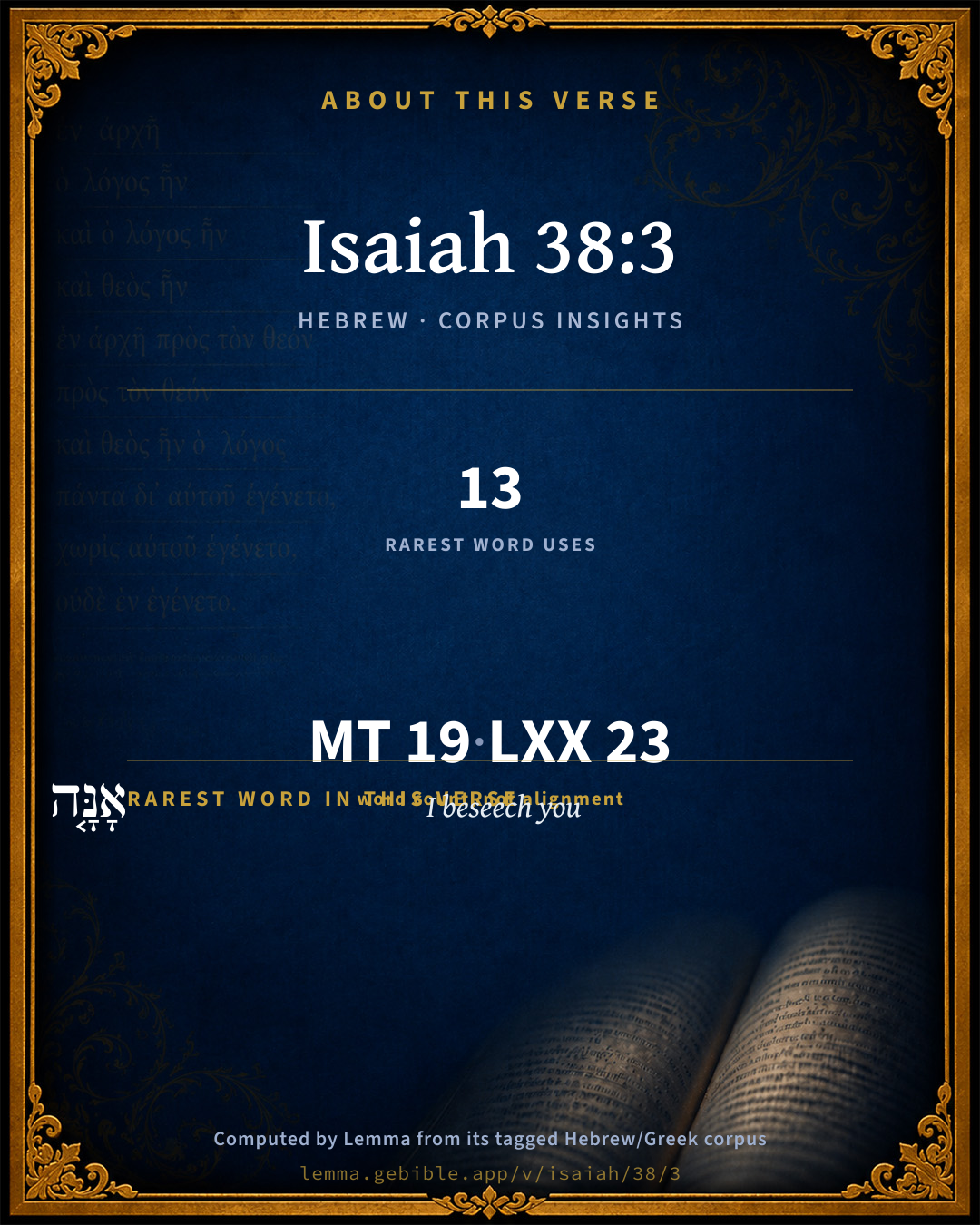
The rarest word here is אָנָּ֤ה I beseech you H577 — appearing just 13 times in the whole Hebrew Bible.

Shared distinctive vocabulary

אָנָּ֤ה I beseech you H577 occurs in 12 verses of the Hebrew Bible. Also found in:

Grammatical profile

  • 5 verbs
  • 7 nouns
  • 3 adjectives
  • 4 particles

Verb forms

  • וַיֹּאמַ֗ר Qal · Sequential Imperfect
  • זְכָר Qal · Imperative
  • הִתְהַלַּ֣כְתִּי Hithpael · Perfect
  • עָשִׂ֑יתִי Qal · Perfect
  • וַיֵּ֥בְךְּ Qal · Sequential Imperfect

Repetition

A word recurs within this verse — often emphatic in Hebrew:

  • וַיֵּ֥בְךְּ to weep H1058 ×2

Hebrew & Septuagint length

In English translation the verse runs 34 words from the Hebrew and 29 from the Septuagint (LXX English) — closely comparable.

A rough comparison of the two English renderings, which tokenize alike — not a word-level alignment.

Word counts can differ between the Hebrew and the Greek without any difference in meaning — e.g. the Hebrew direct-object marker אֵת has no separate Greek word, and Greek often adds the article ὁ.

In the original languages it is 19 Hebrew tokens and 23 Greek tokens — but the two are counted differently (Hebrew bundles its prefixes and suffixes into one token; the Greek is in lemma form), so that isn’t a like-for-like length.

Cross-references

35

Topical passages linked to Isaiah 38:3 in the Treasury of Scripture Knowledge — connected by theme and wording, ordered by reader-vote popularity; previews shown in the World English Bible.

  • Hebrews 5:7 He, in the days of his flesh, having offered up prayers and petitions with strong crying and tears to him who was able to save him from death, and having been heard for his godly fear,
  • Hebrews 6:10 For God is not unrighteous, so as to forget your work and the labor of love which you showed toward his name, in that you served the saints, and still do serve them.
  • Psalms 18:20–27 Yahweh has rewarded me according to my righteousness. According to the cleanness of my hands has he recompensed me.
  • Nehemiah 13:14 Remember me, my God, concerning this, and don't wipe out my good deeds that I have done for the house of my God, and for the observances of it.
  • 2 Chronicles 31:20–21 Thus did Hezekiah throughout all Judah; and he worked that which was good and right and faithful before Yahweh his God.
  • Deuteronomy 6:18 You shall do that which is right and good in the sight of Yahweh; that it may be well with you, and that you may go in and possess the good land which Yahweh swore to your fathers,
  • Nehemiah 5:19 Remember to me, my God, for good, all that I have done for this people.
  • Nehemiah 13:22 I commanded the Levites that they should purify themselves, and that they should come and keep the gates, to sanctify the Sabbath day. Remember to me, my God, this also, and spare me according to the greatness of your loving kindness.
  • John 1:47 Jesus saw Nathanael coming to him, and said about him, "Behold, an Israelite indeed, in whom is no deceit!"
  • 2 Corinthians 1:12 For our boasting is this: the testimony of our conscience, that in holiness and sincerity of God, not in fleshly wisdom but in the grace of God we behaved ourselves in the world, and more abundantly toward you.
  • 1 Chronicles 29:19 and give to Solomon my son a perfect heart, to keep your commandments, your testimonies, and your statutes, and to do all these things, and to build the palace, for which I have made provision.
  • Psalms 6:8 Depart from me, all you workers of iniquity, For Yahweh has heard the voice of my weeping.
  • Psalms 32:2 Blessed is the man to whom Yahweh doesn't impute iniquity, In whose spirit there is no deceit.
  • Psalms 102:9 For I have eaten ashes like bread, And mixed my drink with tears,
  • Psalms 119:80 Let my heart be blameless toward your decrees, That I may not be disappointed.
  • Hosea 12:4 Indeed, he had power over the angel, and prevailed; He wept, and made supplication to him. He found him at Bethel, and there he spoke with us,
  • Genesis 5:22–23 Enoch walked with God after he became the father of Methuselah three hundred years, and became the father of sons and daughters.
  • Genesis 6:9 This is the history of the generations of Noah. Noah was a righteous man, blameless among the people of his time. Noah walked with God.
  • Genesis 17:1 When Abram was ninety-nine years old, Yahweh appeared to Abram, and said to him, "I am God Almighty. Walk before me, and be blameless.
  • 2 Samuel 12:21–22 Then said his servants to him, What thing is this that you have done? you did fast and weep for the child, while it was alive; but when the child was dead, you did rise and eat bread.
  • 1 Kings 2:4 That Yahweh may establish his word which he spoke concerning me, saying, If your children take heed to their way, to walk before me in truth with all their heart and with all their soul, there shall not fail you (said he) a man on the throne of Israel.
  • 2 Kings 18:5–6 He trusted in Yahweh, the God of Israel; so that after him was none like him among all the kings of Judah, nor [among them] that were before him.
  • 1 Chronicles 29:9 Then the people rejoiced, because they offered willingly, because with a perfect heart they offered willingly to Yahweh: and David the king also rejoiced with great joy.
  • 2 Chronicles 16:9 For the eyes of Yahweh run back and forth throughout the whole earth, to show himself strong in the behalf of them whose heart is perfect toward him. Herein you have done foolishly; for from henceforth you shall have wars.
  • 2 Chronicles 25:2 He did that which was right in the eyes of Yahweh, but not with a perfect heart.
  • Ezra 10:1 Now while Ezra prayed and made confession, weeping and casting himself down before the house of God, there was gathered together to him out of Israel a very great assembly of men and women and children; for the people wept very sore.
  • Nehemiah 1:4 It happened, when I heard these words, that I sat down and wept, and mourned certain days; and I fasted and prayed before the God of heaven,
  • Nehemiah 13:31 and for the wood-offering, at times appointed, and for the first fruits. Remember me, my God, for good.
  • Job 23:11–12 My foot has held fast to his steps. His way have I kept, and not turned aside.
  • Psalms 16:8 I have set Yahweh always before me. Because he is at my right hand, I shall not be moved.
  • Psalms 20:1–3 May Yahweh answer you in the day of trouble. May the name of the God of Jacob set you up on high,
  • Psalms 26:3 For your loving kindness is before my eyes. I have walked in your truth.
  • Psalms 101:2 I will be careful to live a blameless life. When will you come to me? I will walk within my house with a blameless heart.
  • 1 John 3:21–22 Beloved, if our hearts don't condemn us, we have boldness toward God;
  • 1 Kings 15:14 But the high places were not taken away: nevertheless the heart of Asa was perfect with Yahweh all his days.

Cross-references courtesy of OpenBible.info (CC BY 4.0).

Hebrew and Greek witnesses Masoretic Hebrew ↔ Greek Septuagint

The same verse in the two great witnesses to the Old Testament, shown verse-for-verse.

These are two independent witnesses, not word-aligned to each other, and the Septuagint is shown in lemma (dictionary) form.

Hebrew Isaiah 38:3 Masoretic · Westminster Leningrad Codex

וַיֹּאמַ֗ר אָנָּ֤ה יְהוָה֙ זְכָר נָ֞א אֵ֣ת אֲשֶׁ֧ר הִתְהַלַּ֣כְתִּי לְפָנֶ֗יךָ בֶּֽאֱמֶת֙ וּבְלֵ֣ב שָׁלֵ֔ם וְהַטּ֥וֹב בְּעֵינֶ֖יךָ עָשִׂ֑יתִי וַיֵּ֥בְךְּ חִזְקִיָּ֖הוּ בְּכִ֥י גָדֽוֹל

and said, Remember now, Yahweh, I beg you, how I have walked before you in truth and with a perfect heart, and have done that which is good in your sight. Hezekiah wept sore.

World English Bible · Public Domain

Greek LXX Isaiah 38:3 Septuagint · lemma form

λέγω μιμνήσκω κύριος ὡς πορεύομαι ἐνώπιόν σύ μετά ἀλήθεια ἐν καρδία ἀληθινός καί ὁ ἀρεστός ἐνώπιόν σύ ποιέω καί κλαίω εζεκιας κλαυθμός μέγας

Remember, O Lord, how I have walked before you in truth, with a true heart, and have done that which was pleasing in your sight. And Ezekias wept bitterly.

LXX2012 (modern English Septuagint) · Public Domain

Hebrew: Westminster Leningrad Codex (CC BY 4.0). Greek: Septuagint (public domain); English from LXX2012 (modern English Septuagint) (Public Domain). How the Septuagint differs from the Hebrew →

Targum (Aramaic paraphrase)

1

The Targum is the ancient Jewish Aramaic paraphrase of the Hebrew Scriptures — an interpretive translation, not the Hebrew text itself. Onkelos (literal) and Pseudo-Jonathan (expansive) render the Torah, and Jonathan the Prophets. Coverage is partial: where no permissively-licensed English translation exists for a verse, only the Aramaic is shown. This is verse-level text, not a word-by-word alignment to the Hebrew.

  1. Targum Jonathan Prophets (Joshua–Malachi)
    וַאֲמַר קַבֵּל בָּעוּתִי יְיָ אִדְכַּר כְּעַן יַת דִי פְלָחִית קֳדָמָךְ בִּקְשׁוֹט וּבְלֵב שָׁלֵם וּדְתַקִין בְּעֵינָךְ עַבְדִית וּבְכָא חִזְקִיָה בְּכִיא סַגִיאָה:

    And said, Hear my prayer, O Lord, remember, I beseech thee, how I have served before Thee in truth, and with a perfect heart, and I have done that which is right in Thy eyes. And Hezekiah wept sore.

    Targum Jonathan — Aramaic: “Mikraot Gedolot” (public domain). English: “Sefaria Community Translation” (CC0 1.0 (public-domain dedication)); “London "Chaldee Paraphrase," 1871” (public domain). Text via Sefaria.

Commentary

Notes on Isaiah 38:3 from classic Christian and Jewish commentators (each source and its license shown beneath its notes). The classic Christian expositions comment on the surrounding passage and are grouped to its opening verse, so a note may address several verses; the Jewish commentaries on the Tanakh (Rashi and others) are per-verse, so they appear only where the commentator wrote on this verse.

Lemma curates 59 commentaries, every one of them public domain or Creative Commons licensed, each selected and text-cleaned for this edition rather than reprinted as found. About our sources →

Trapp's Complete Commentary

John Trapp

Isa 38:3 And said, Remember now, O LORD, I beseech thee, how I have walked before thee in truth and with a perfect heart, and have done [that which is] good in thy sight. And Hezekiah wept sore.

Ver. 3. See 2Ki 20:3 {See Trapp on "2Ki 20:3"}

John Trapp, A Commentary or Exposition upon All the Books of the Old and New Testament (1647–1656) — public domain. Text from a community e-Sword module.

Tyndale Open Study Notes

Tyndale Open Resources

38:3 I have always been faithful to you: Hezekiah’s heart was right with the Lord for most of his reign (2 Kgs 18:1-5), although his dependence on Egypt was a time of weakness when he did not act faithfully (Isa 31:1-9).

Tyndale Open Study Notes — © Tyndale Open Resources, licensed CC BY-SA 4.0. Text via the HelloAO Bible API.

Jamieson, Fausset & Brown

Robert Jamieson, A. R. Fausset & David Brown

He mentions his past religious consistency, not as a boast or a ground for justification; but according to the Old Testament dispensation, wherein temporal rewards (as long life, &c., Exo 20:12) followed legal obedience, he makes his religious conduct a plea for asking the prolongation of his life.

walked--Life is a journey; the pious "walk with God" (Gen 5:24; Kg1 9:4).

perfect--sincere; not absolutely perfect, but aiming towards it (Mat 5:45); single-minded in walking as in the presence of God (Gen 17:1). The letter of the Old Testament legal righteousness was, however, a standard very much below the spirit of the law as unfolded by Christ (Mat. 5:20-48; Co2 3:6, Co2 3:14, Co2 3:17).

wept sore--JOSEPHUS says, the reason why he wept so sorely was that being childless, he was leaving the kingdom without a successor. How often our wishes, when gratified, prove curses! Hezekiah lived to have a son; that son was the idolater Manasseh, the chief cause of God's wrath against Judah, and of the overthrow of the kingdom (Kg2 23:26-27).

Jamieson, Fausset & Brown — Commentary Critical and Explanatory on the Whole Bible (1871) — public domain (CC PDM 1.0). Text via the HelloAO Bible API.

Ellicott's Commentary for English Readers

(3) Remember now, O Lord.—Devout as the prayer is, there is a tone of self-satisfaction in it which contrasts with David’s prayer (Psa_51:1-3). He rests on what he has done in the way of religious reformation, and practically asks what he has done that he should be cut off by an untimely death. The tears may probably have been less egotistic than the words, and, therefore, were more prevailing.

A Bible Commentary for English Readers, edited by Charles John Ellicott (1878–1897) — public domain. Text from a community e-Sword module.

The Cambridge Bible for Schools and Colleges

gen. ed. J. J. S. Perowne

3. with a perfect heart] Lit. “with a whole heart,” one absolutely devoted to Jehovah. Cf. 1Ki_8:61; 1Ki_11:4; 1Ki_15:3; 1Ki_15:14, where the expression occurs with the addition of the words “with Jehovah.” The motive of this prayer is clearly expressed in the Song of Thanksgiving which follows (see Isa_38:11; Isa_38:18-19).

The Cambridge Bible for Schools and Colleges (gen. ed. J. J. S. Perowne; Cambridge University Press, 1878–1918) — public domain. Text from a community e-Sword module.

John Gill's Exposition

Then came the word of the Lord to Isaiah,.... Before he had got out into the middle court, Kg2 20:4,

saying, as follows:

John Gill's Exposition of the Whole Bible (1746–1763) — public domain (CC PDM 1.0). Text via the HelloAO Bible API.

Albert Barnes' Notes on the Bible

And said, Remember now, O Lord, I beseech thee - The object which Hezekiah desired was evidently that his life might be spared, and that he might not be suddenly cut off. He therefore makes mention of the former course of his life, not with ostentation, or as a ground of his acceptance or justification, but as a reason why his limb should not be cut off. He had not lived as many of the kings of Israel had done. He had not been a patron of idolatry. He had promoted an extensive and thorough reformation among the people. He had exerted his influence as a king in the service of Yahweh, and it was his purpose still to do it; and he, therefore, prayed that his life might be spared in order that he might carry forward and perfect his plans for the reformation of the people, and for the establishment of the worship of Yahweh.

How I have walked - How I have lived. Life, in the Scriptures, is often represented as a journey, and a life of piety is represented as walking with God (see Gen 5:24; Gen 6:9; 1Ki 9:4; 1Ki 11:33).

In truth - In the defense and maintenance of the truth, or in sincerity.

And with a perfect heart - With a heart sound, sincere, entire in thy service. This had been his leading aim; his main, grand purpose. He had not pursued his own ends, but his whole official royal influence bad been on the side of religion. This refers to his public character rather than to his private feelings. For though, as a man, he might be deeply conscious of imperfection; yet as a king, his influence had been wholly on the side of religion, and he had not declined from the ways of God.

And have done that which is good - This accords entirely with the account which is given of him in 2Ki 18:3-5.

And Hezekiah wept sore - Margin, as Hebrew, ‘With great weeping.’ Josephus (Ant. x. 2. 1) says, that the reason why Hezekiah was so much affected was that he was then childless, and saw that he was about to leave the government without a successor. Others suppose that it was because his death would be construed by his enemies as a judgment of God for his stripping the temple of its ornaments 2Ki 18:16. It is possible that several things may have been combined in producing the depth of his grief. In his song, or in the record which he made to express his praise to God for his recovery, the main reason of his grief which he suggested was, the fact that he was in danger of being cut off in the midst of his days; that the blessings of a long life were likely to be denied him (see Isa 38:10-12). We have here an instance in which even a good man may be surprised, alarmed, distressed, at the sudden announcement that he must die. The fear of death is natural; and even those who are truly pious are sometimes alarmed when it comes.

Albert Barnes' Notes on the Bible (1834–1885) — public domain. Text from a community e-Sword/MySword module.

Whedon's Commentary on the Bible

Daniel D. Whedon

3. Walked before thee in truth — Hezekiah was conscious of entire rectitude. He had broken with idolatry against great odds. His plans were large for the future. To leave them unfinished was a deep grief. Manasseh was yet unborn, (Isa_38:6, and 2Ki_21:1,) and, so far as appears, the king had no lineal heirs.

Daniel D. Whedon (gen. ed.), Commentary on the Old and New Testaments (1874–1909) — public domain. Text from a community e-Sword module.

The Pulpit Commentary

Remember now, O Lord. Hezekiah was in the full vigour of life thirty-nine years old only. He had probably as yet no son, since Manasseh, who succeeded him, was but twelve (2Ki_21:1, 2Ch_33:1) when Hezekiah died at the age of fifty-four. It was a grievous thing to a Jew to leave no male offspring: it was viewed as a mark of the Divine displeasure to be cut off in the midst of one"s days. (Job_15:32 Job_22:15, 16 Psa_55:23 Pro_10:27 Ecc_7:17) Hezekiah asked himself Had he deserved such a sentence? He thought that he had not. He knew that, with whatever shortcomings, he had endeavoured to serve God, had trusted in him, (2Ki_18:5) cleaved to him, (2Ki_18:6) "departed not from following him, but kept his commandments" (2Ki_18:6) He therefore ventured upon an expostulation and an earnest prayer; and God was pleased to hear the prayer and to grant it. I have walked before thee in truth and with a perfect heart. Compare the unbiased testimony of the authors of Kings and Chronicles. (2Ki_18:3-6 2Ch_29:2 2Ch_31:20, 2Ch_31:21) Under the old dispensation, there was nothing to prevent men from pleading their righteousness before God. (comp. Job_31:4-40 Psa 7:3-2 Psa_18:20-24 Psa_26:1-8, etc.) Hezekiah, however, does not really regard himself as sinless (comp. ver. 17). And Hezekiah wept sore. In the East feelings are but little restrained. Joy shows itself in laughter and shouting, grief in tears and shrill cries. Xerxes wept when he thought of the shortness of human life (Herod., 7:46); the Persians rent the air with load cries at the funeral of Masistius (ibid., 9:24); on the news of the defeat at Salamis all Susa "cried aloud, and wept and wailed without stint" (ibid., 8:99). So David wept for Jonathan (2Sa_1:12) and again for Absalom; (2Sa_19:1) Joash wept when he heard the words of the Law; (2Ki_22:19) Nehemiah wept at the desolation of Jerusalem; (Neh_1:4) the ambassadors of Hezekiah, when disappointed of the object of their embassy, "wept bitterly". (Isa_33:7) No king in the East puts himself under any restraint, if he has an inclination for either tears or laughter.

Man"s fair estimate of his own life.

Hezekiah ventures to say before God, "Ah, Jehovah, remember, I pray, how I have walked before thee in faithfulness and with a whole heart, and have done that which is good in thine eyes." Can a good man rightly appeal to his conscious integrity? David did. Hezekiah may. It is not pious work to get up a case against ourselves. Confessions are too often utterly insincere things. It is right to keenly criticize self, and to recognize, and humble ourselves before God on account of, our sins and frailties; but it magnifies the grace of God to recognize the good in our lives, the established will, the earnest purpose, the persistent endeavour. We must be true to see the good, as well as the evil, and seek to appraise our life as God appraises it. David may speak of his "integrity." Hezekiah may speak of his "perfect walk," his firm resolve to obey and please God. But can such terms as "righteousness" be properly applied to any man? It has been pressed upon us from our childhood, as if it were a self-evident truth, and needed no argument or proof, and contained the whole of the truth, that man has no righteousness of his own. The best things in man are bad. "All our righteousnesses are as filthy rags, and we are all as an unclean thing.

Yet there must be some sense in which man has a personal righteousness. We have known men and women of integrity, right-hearted, sincere, and righteous. David may say, before the heart-searching God, "Judge me according to my righteousness that is in me;" and our Lord distinctly assumed that there is a sense in which man can have a righteousness, when he said, "Except your righteousness shall exceed the righteousness of the scribes and Pharisees." Such a term will not stiffen into one rigid meaning. Sometimes it means right-heartedness, sincerity, and describes the man who is at heart centred on God and virtue. A man may be right at heart, though there may be twists and stains in the conduct. We have a way of speaking of men as being "good at bottom." If we say that as any excuse for men"s sins, we are miserably and shamefully wrong. If we say it in recognition of human frailty, and with discernment of life as the conflict of the human will over the weakness of our bodies, and the disabilities of our circumstances, then it is a true and worthy speech. Many men around us, and even we ourselves, are like David, "good at bottom." The desire of our soul is to the Divine Name. We are pilgrims, indeed, though men may find us wandered away into By-path Meadows, sleeping in arbours, and losing our rolls. Illustrate by the difference between King Saul and King David. Saul failed utterly, because his were sins of will. David failed only temporarily, because his were sins of frailty. David failed in the body-sphere, but Saul in the soul-sphere. Learn to judge your life fairly, and be willing to see, to rejoice in, and to thank God for, what has been and is good. R.T.

The Pulpit Commentary (1880–1919), ed. H.D.M. Spence-Jones & Joseph S. Exell — public domain. Text from a community e-Sword module.

J. A. Alexander on Isaiah

Joseph Addison Alexander

“And he said, Ah Jehovah, remember, I beseech Thee, how I have walked before Thee in truth and with a whole heart, and that which is good in Thine eyes I have done.” The figure of walking before God includes the ideas of communion with Him and subjection to Him, and is therefore more comprehensive than the kindred phrase of walking with Him. By truth we are here to understand sincerity and constancy. This verse is not an angry expostulation, nor an ostentatious self-praise, but an appeal to the only satisfactory evidence of his sincerity.

Joseph Addison Alexander, The Prophecies of Isaiah (1846–1847; New York: Scribner, 1870–1878) — public domain. Text from a community e-Sword module.

Rashi

Rabbi Shlomo Yitzchaki (Rashi)

Please, O Lord (אָנָּה) Where is Your mercy?

Rashi on the Tanakh — English translations: “The Judaica Press complete Tanach with Rashi, translated by A. J. Rosenberg” (CC BY 4.0); “Pentateuch with Rashi's commentary by M. Rosenbaum and A.M. Silbermann, 1929-1934” (public domain); “The Metsudah Tanach series, Lakewood, N.J” (CC BY 4.0); and “The Book of Joshua, Metsudah Publications, 1997” (CC BY 4.0). Text via Sefaria.

Lesson kit

Teaching starters — assembled from the data on this page, not authored interpretation. Every prompt links to the verse data it draws on. Edit before teaching.

Isaiah, in the Prophets, opens this verse with 19 words (18 distinct Hebrew lemmas). Its most distinctive word is ʼânnâʼ (“I beseech you”). A historical commentator’s framing appears above. Read the whole chapter for the surrounding context.

Discussion questions

  1. What does “I beseech you” (ʼânnâʼ) contribute to the verse as a whole?
  2. How does Genesis 50:17, which shares the word «I beseech you», read alongside this verse?
  3. What does the repetition of “to weep” (2× in this one verse) do in this verse?
  4. These translations render this verse differently; the difference is in the English rendering, not the original. What questions does that raise?
  5. «וַיֹּאמַ֗ר» is a Qal Sequential Imperfect verb. How does that grammatical form shape the action described?
  6. Compare how Trapp's Complete Commentary and Tyndale Open Study Notes read this verse. Where do they agree or differ?

Things to notice

Reading settings

Reading text

Shown beneath each verse's original-language words.

Old Testament
Old Testament edition

Read the OT as the Masoretic Hebrew (MT) or the Greek Septuagint (LXX).

English shown for the Greek Septuagint (in the Hebrew ↔ Greek comparison).

Comparing translations? Open the Compare panel on any verse page to stack up to four side by side.