
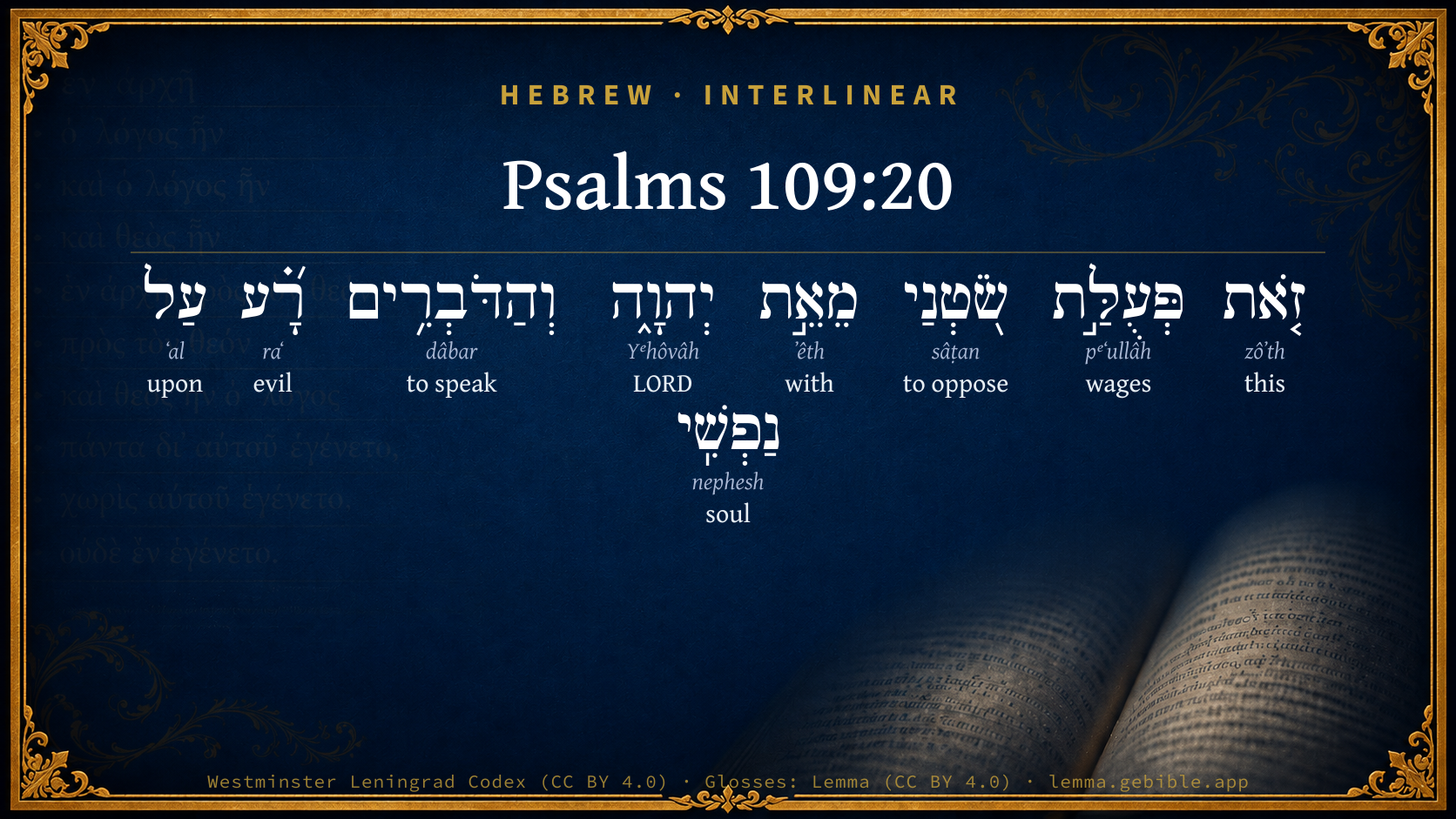
Psalms 109:20

Hebrew (Westminster Leningrad Codex) Psalms 109:20 appears in the Hebrew Old Testament. The text above is from the Westminster Leningrad Codex. Each word links to its Strong’s number, a concise gloss, and parsing drawn from the Open Scriptures Hebrew Bible morphology. Click any word for its full Brown-Driver-Briggs (BDB) entry.
Download image
Cite this verse

Psalms 109:20 (World English Bible). Public Domain. Lemma interlinear Bible study tool, https://lemma.gebible.app/v/psalms/109/20.

Show BibTeX & RIS
BibTeX
RIS
English Translation
This is the reward of my adversaries from Yahweh, Of those who speak evil against my soul.
World English Bible · Public Domain
Download a study sheet

One document with this verse’s original text, its word-by-word gloss line, the meaning frame, cross-references with their text, attributed commentary, and full source and license credits — printable, and it pastes into notes with its structure intact.

This verse Autodidact and up

Study sheet (.html) Plain text (.txt)

A passage Seminary Student

Up to 50 verses in one chapter. A passage sheet keeps up to 6 commentary sources and 12 cross-references per verse, in the order this page ranks them, and says so on the sheet whenever that leaves anything out. Ask for a single verse and you get the Autodidact verse sheet above.

Everything on this page stays free to read, with no account — the sheet is a download of what is already on screen, not access to it.

Want to remove ads? Support Godless Engineer
Compare translations 3

The same verse in 3 English versions, stacked beneath the original-language interlinear above. Click any original word for its lexicon entry.

Each is an independent rendering of the whole verse — the interlinear is not word-aligned to these translations.

Highlighted words mark where these versions differ — a whole-verse word diff, not a word-by-word alignment.

  • World English Bible Public Domain
    This is the reward of my adversaries from Yahweh, Of those who speak evil against my soul.
  • King James Version Public Domain
    Let this be the reward of mine adversaries from the LORD, and of them that speak evil against my soul.
  • unfoldingWord Literal Text CC BY-SA 4.0
    This, the payment of my accusers from Yahweh, and those speaking evil against my soul.

unfoldingWord Literal Text — © unfoldingWord, licensed CC BY-SA 4.0. Word-aligned USFM3 via Door43 (git.door43.org/unfoldingWord/en_ult).

Versions to compare (up to 4)

3 of 4 selected

Show all 18 translations

Every available English version of this verse, each an independent rendering of the whole verse.

  • World English Bible Public Domain
    This is the reward of my adversaries from Yahweh, Of those who speak evil against my soul.
  • Berean Standard Bible Public Domain
    May this be the LORD’s reward to my accusers, to those who speak evil against me.
  • Majority Standard Bible Public Domain
    May this be the LORD’s reward to my accusers, to those who speak evil against me.
  • King James Version Public Domain
    Let this be the reward of mine adversaries from the LORD, and of them that speak evil against my soul.
  • American Standard Version (1901) Public Domain
    This is the reward of mine adversaries from Jehovah, And of them that speak evil against my soul.
  • Revised Version (1885) Public Domain
    This is the reward of mine adversaries from the LORD, and of them that speak evil against my soul.
  • Geneva Bible (1599) Public Domain
    Let this be the rewarde of mine aduersarie from the Lord, and of them, that speake euill against my soule.
  • Douay-Rheims (1899) Public Domain
    This is the work of them who detract me before the Lord; and who speak evils against my soul.
  • Young's Literal Translation Public Domain
    This `is' the wage of mine accusers from Jehovah, And of those speaking evil against my soul.
  • Literal Standard Version CC BY-SA 4.0
    This [is] the wage of my accusers from YHWH, || And of those speaking evil against my soul.
  • Unlocked Literal Bible CC BY-SA 4.0
    May this be the reward of my accusers from Yahweh, of those who say evil things about me.
  • unfoldingWord Literal Text CC BY-SA 4.0
    This, the payment of my accusers from Yahweh, and those speaking evil against my soul.
  • Darby Bible Public Domain
    Let this be the reward of mine adversaries from Jehovah, and of them that speak evil against my soul.
  • World Messianic Bible Public Domain
    This is the reward of my adversaries from the LORD, of those who speak evil against my soul.
  • Webster's Bible Public Domain
    Let this be the reward of my adversaries from the LORD, and of them that speak evil against my soul.
  • Free Bible Version CC BY-SA 4.0
    May all this be the punishment of the Lord on my enemies, on those who speak evil of me.
  • Bible in Basic English Public Domain
    Let this be the reward given to my haters from the Lord, and to those who say evil of my soul.
  • JPS Tanakh (1917) Public Domain
    This would mine adversaries effect from the LORD, and they that speak evil against my soul.

Literal Standard Version (2020), Covenant Press — licensed CC BY-SA 4.0. Text via the HelloAO Bible API (eBible.org). Unlocked Literal Bible (unfoldingWord) — licensed CC BY-SA 4.0. Text via the HelloAO Bible API (eBible.org). unfoldingWord Literal Text — © unfoldingWord, licensed CC BY-SA 4.0. Word-aligned USFM3 via Door43 (git.door43.org/unfoldingWord/en_ult). Free Bible Version, Dr. Jonathan Gallagher — licensed CC BY-SA 4.0. Text via the HelloAO Bible API (eBible.org).

Word by word

More ways to search: Search by grammar → Find every occurrence → Compare this word →

Practice this passage: Drill this verse → Learn its vocabulary →

About this verse

These counts appear in no published source. They are computed here, from the morphology-tagged text and Lemma’s own curated glosses. What Lemma adds →

9
words
9
distinct lemmas
Wisdom
section

Notable vocabulary

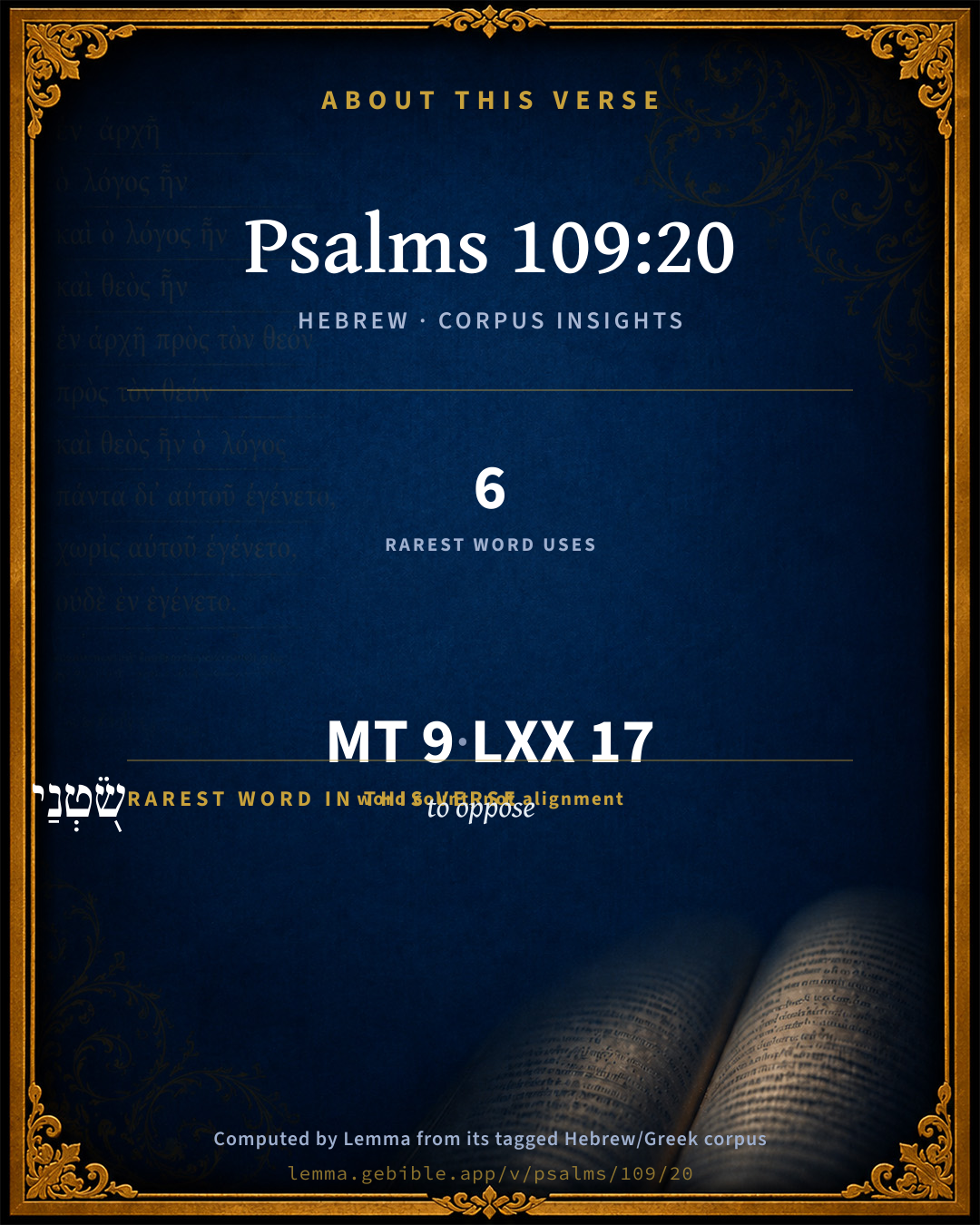
The rarest word here is שֹׂ֭טְנַי to oppose H7853 — appearing just 6 times in the whole Hebrew Bible.

Shared distinctive vocabulary

שֹׂ֭טְנַי to oppose H7853 occurs in 6 verses of the Hebrew Bible. Also found in:

Grammatical profile

  • 2 verbs
  • 3 nouns
  • 1 adjective
  • 1 pronoun
  • 2 prepositions

Verb forms

  • שֹׂ֭טְנַי Qal · Participle Active
  • וְהַדֹּבְרִ֥ים Qal · Participle Active

Hebrew & Septuagint length

In English translation the verse runs 17 words from the Hebrew and 22 from the Septuagint (LXX English) — closely comparable.

A rough comparison of the two English renderings, which tokenize alike — not a word-level alignment.

Word counts can differ between the Hebrew and the Greek without any difference in meaning — e.g. the Hebrew direct-object marker אֵת has no separate Greek word, and Greek often adds the article ὁ.

In the original languages it is 9 Hebrew tokens and 17 Greek tokens — but the two are counted differently (Hebrew bundles its prefixes and suffixes into one token; the Greek is in lemma form), so that isn’t a like-for-like length.

Cross-references

19

Topical passages linked to Psalms 109:20 in the Treasury of Scripture Knowledge — connected by theme and wording, ordered by reader-vote popularity; previews shown in the World English Bible.

  • 2 Timothy 4:14 Alexander, the coppersmith, did much evil to me. The Lord will repay him according to his works,
  • 1 Kings 2:44 The king said moreover to Shimei, You know all the wickedness which your heart is privy to, that you did to David my father: therefore Yahweh shall return your wickedness on your own head.
  • Psalms 94:23 He has brought on them their own iniquity, And will cut them off in their own wickedness. Yahweh, our God, will cut them off.
  • 2 Samuel 17:23 When Ahithophel saw that his counsel was not followed, he saddled his donkey, and arose, and got him home, to his city, and set his house in order, and hanged himself; and he died, and was buried in the tomb of his father.
  • 2 Samuel 18:32 The king said to the Cushite, Is it well with the young man Absalom? The Cushite answered, The enemies of my lord the king, and all who rise up against you to do you hurt, be as that young man is.
  • Psalms 2:5–6 Then he will speak to them in his anger, And terrify them in his wrath:
  • Psalms 2:12 Kiss the son, lest he be angry, and you perish in the way, For his wrath will soon be kindled. Blessed are all those who take refuge in him.
  • Psalms 21:8–12 Your hand will find out all of your enemies. Your right hand will find out those who hate you.
  • Psalms 40:14–15 Let them be disappointed and confounded together who seek after my soul to destroy it. Let them be turned backward and brought to dishonor who delight in my hurt.
  • Psalms 71:10 For my enemies talk about me. Those who watch for my soul conspire together,
  • Psalms 110:1 Yahweh says to my Lord, "Sit at my right hand, Until I make your enemies your footstool for your feet."
  • Psalms 110:5–6 The Lord is at your right hand. He will crush kings in the day of his wrath.
  • Matthew 11:19 The Son of Man came eating and drinking, and they say, 'Behold, a gluttonous man and a drunkard, a friend of tax collectors and sinners!' But wisdom is justified by her children."
  • Matthew 12:24 But when the Pharisees heard it, they said, "This man does not cast out demons, except by Beelzebul, the prince of the demons."
  • Matthew 26:66–67 What do you think?" They answered, "He is worthy of death!"
  • Mark 9:39 But Jesus said, "Don't forbid him, for there is no one who will do a mighty work in my name, and be able quickly to speak evil of me.
  • Luke 19:27 But bring those enemies of mine who didn't want me to reign over them here, and kill them before me.'"
  • 1 Corinthians 12:3 Therefore I make known to you that no man speaking by God's Spirit says, "Jesus is accursed." No one can say, "Jesus is Lord," but by the Holy Spirit.
  • 1 Thessalonians 2:15–16 who killed both the Lord Jesus and their own prophets, and drove us out, and didn't please God, and are contrary to all men;

Cross-references courtesy of OpenBible.info (CC BY 4.0).

Hebrew and Greek witnesses Masoretic Hebrew ↔ Greek Septuagint

The same verse in the two great witnesses to the Old Testament, shown verse-for-verse.

You’re reading Greek Psalm 108 (Hebrew Psalm 109). The Septuagint counts the superscription, so verse numbers can differ from the Hebrew — chapter-level alignment, not verse-by-verse. Numbering follows Rahlfs.

These are two independent witnesses, not word-aligned to each other, and the Septuagint is shown in lemma (dictionary) form.

Hebrew Psalms 109:20 Masoretic · Westminster Leningrad Codex

זֹ֤את פְּעֻלַּ֣ת שֹׂ֭טְנַי מֵאֵ֣ת יְהוָ֑ה וְהַדֹּבְרִ֥ים רָ֝֗ע עַל נַפְשִֽׁי

This is the reward of my adversaries from Yahweh, Of those who speak evil against my soul.

World English Bible · Public Domain

Greek LXX Greek Psalm 108:20 Septuagint · lemma form

οὗτος ὁ ἔργον ὁ ἐν διαβάλλω ἐγώ παρά κύριος καί ὁ λαλέω πονηρός κατά ὁ ψυχή ἐγώ

This is the dealing of the Lord with those who falsely accuse me, and of them that speak evil against my soul.

LXX2012 (modern English Septuagint) · Public Domain

On this verse, Ellicott's Commentary for English Readers discusses the Septuagint’s reading. Read the note in Commentary ↓

Hebrew: Westminster Leningrad Codex (CC BY 4.0). Greek: Septuagint (public domain); English from LXX2012 (modern English Septuagint) (Public Domain). How the Septuagint differs from the Hebrew →

Commentary

Notes on Psalms 109:20 from classic Christian and Jewish commentators (each source and its license shown beneath its notes). The classic Christian expositions comment on the surrounding passage and are grouped to its opening verse, so a note may address several verses; the Jewish commentaries on the Tanakh (Rashi and others) are per-verse, so they appear only where the commentator wrote on this verse.

Lemma curates 59 commentaries, every one of them public domain or Creative Commons licensed, each selected and text-cleaned for this edition rather than reprinted as found. About our sources →

Trapp's Complete Commentary

John Trapp

Psa 109:20 [Let] this [be] the reward of mine adversaries from the LORD, and of them that speak evil against my soul.

Ver. 20. Let this be the reward] Opus vel operae precium. The same Hebrew word signifieth work and wages, Actio et merces, Job 7:2 Isa 49:4; persecutors shall be sure of their payment.

John Trapp, A Commentary or Exposition upon All the Books of the Old and New Testament (1647–1656) — public domain. Text from a community e-Sword module.

The Treasury of David

Charles H. Spurgeon

Ver. 20. This is the summing up of the entire imprecation, and fixes it upon the persons who had so maliciously assailed the inoffensive man of God. David was a man of gentle mould, and remarkably free from the spirit of revenge, and therefore we may here conceive him to be speaking as a judge or as a representative man, in whose person great principles needed to be vindicated and great injuries redressed.

Thousands of God's people are perplexed with this psalm, and we fear we have contributed very little towards their enlightenment, and perhaps the notes we have gathered from others, since they display such a variety of view, may only increase the difficulty. What then? Is it not good for us sometimes to be made to feel that we are not yet able to understand all the word and mind of God? A thorough bewilderment, so long as it does not stagger our faith, may be useful to us by confounding our pride, arousing our faculties, and leading us to cry, "What I know not teach thou me."

Ver. 20-21.

1. David leaves his enemies in the hand of God (Ps 109:20).

2. He puts himself into the same hands (Ps 109:21).

G.R.

Psalms 109:21*

Charles H. Spurgeon's The Treasury of David (1869–1885) — public domain. Psalms only. Text from a community e-Sword/MySword module.

J. A. Alexander on Psalms

Joseph Addison Alexander

20. (Psa 109:20) (Be) this the wages of my adversaries from Jehovah, and of those speaking evil against my soul. The pronoun this in the first clause refers to the whole preceding series of denunciations. The word translated wages means originally work, and secondarily the price or recompence of work or labour, and is so used in the law of Moses. See Lev 19:13. It is here peculiarly appropriate, because it represents the misfortunes of his enemies as the direct fruit of their own misconduct. No single word in English can express this double meaning of the Hebrew. Such is their work and such their wages. The word translated adversaries is a cognate form to that used in Psa 109:6, and might suggest the idea of my Satans; but this would probably convey too much. From Jehovah, their reward or recompence to be expected from him, or already bestowed by him. The description in the last clause includes insult, slander, and malicious plotting.

Joseph Addison Alexander, The Psalms Translated and Explained (1850) — public domain. Text from a community e-Sword module.

Tyndale Open Study Notes

Tyndale Open Resources

109:20 The psalmist appeals to the principle of retribution (see 94:23).

Tyndale Open Study Notes — © Tyndale Open Resources, licensed CC BY-SA 4.0. Text via the HelloAO Bible API.

Geneva Bible (1599)

Geneva Bible translators

For being destitute of man’s help, he fully trusted in the Lord, that he would deliver him.

Geneva Bible (1599) marginal notes — public domain. Text via Bolls.life.

Adam Clarke's Commentary

Verse 20. Let this be the reward of mine adversaries from the Lord, and of them that speak evil against my soul.] Following the mode of interpretation already adopted, this may mean: All these maledictions shall be fulfilled on my enemies; they shall have them for their reward. So all the opposition made by the Jews against our Lord, and the obloquies and execrations wherewith they have loaded him and his religion, have fallen upon themselves; and they are awful examples of the wrath of God abiding on them that believe not.

But is not this verse a key to all that preceded it? The original, fairly interpreted, will lead us to a somewhat different meaning: זאת פעלת שטני מאת יהוה והדברים רע על נפשי zoth peullath soteney meeth Yehovah, vehaddoberim ra al naphshi. "This is the work of my adversaries before the Lord, and of those who speak evil against my soul," or life. That is, all that is said from the sixth to the twentieth verse consists of the evil words and imprecations of my enemies against my soul, laboring to set the Lord, by imprecations, against me, that their curses may take effect. This, which is a reasonable interpretation, frees the whole Psalm from every difficulty. Surely, the curses contained in it are more like those which proceed from the mouth of the wicked, than from one inspired by the Spirit of the living God. Taking the words in this sense, which I am persuaded is the best, and which the original will well bear and several of the Versions countenance, then our translation may stand just as it is, only let the reader remember that at the sixth verse David begins to tell how his enemies cursed HIM, while he prayed for THEM.

Adam Clarke's Commentary on the Bible (1810–1826) — public domain. Text from a community e-Sword/MySword module.

John Calvin's Commentaries

20 Let this be the work from Jehovah. That is, let the gain or reward of the work be from God. In pointing out the work as proceeding immediately from God, he intends to show that, though deprived of all human aid, he yet entertained the hope that God would grant him deliverance, and avenge the injuries of his servant. From this verse we learn that David did not rashly, or unadvisedly, utter curses against his enemies, but strictly adhered to what the Spirit dictated. I acknowledge, indeed, that not a few, while they pretend a similar confidence and hope, nevertheless, recklessly rush beyond the bounds of temperance and moderation. But that which David beheld by the unclouded eye of faith, he also uttered with a zeal becoming a sound mind; for having devoted himself to the cultivation of piety, and being protected by the hand of God, he was aware that the day was approaching when his enemies would meet with merited punishment. From which we also learn, that his trust was placed in God alone, and that he did not regard the persons of men so as to direct his course according as the world smiled or frowned upon him. And, assuredly, whosoever places his dependence on men, shall find that the most trifling incident will annoy him. Therefore, should the whole world abandon us, it becomes us, in imitation of this holy man, to lift up our heads to heaven, and thence look for our defender and deliverer. If it be his intention to employ human instrumentality for our deliverance, he will soon raise up those who will accomplish his purpose. Should he, for the trial of our faith, deprive us of all earthly assistance, instead of regarding that as any reflection upon the glory of his name, we ought to wait until the proper time arrive when he will fully display that decision in which we can calmly acquiesce.

John Calvin's Commentaries (1540-1563) — public domain. Text from the Calvin Translation Society English edition (1840s-50s) via the Christian Classics Ethereal Library (ccel.org). Calvin's coverage is partial (roughly two-thirds of the Bible); uncommented books and verses are honest gaps, never fabricated. The 19th-century editor's footnotes and remarks are omitted so the notes are faithfully Calvin's own voice.

Ellicott's Commentary for English Readers

(20) Reward.—Either “work” or “wages.” The LXX. and Vulg. take it in the former sense, “This is their work who,” &c.

A Bible Commentary for English Readers, edited by Charles John Ellicott (1878–1897) — public domain. Text from a community e-Sword module.

The Cambridge Bible for Schools and Colleges

gen. ed. J. J. S. Perowne

20. Let this be the reward] Or as R.V., This (is) the reward; the wages, as the word implies, which they have earned by their behaviour.

adversaries] See note on Psa_109:4.

The Cambridge Bible for Schools and Colleges (gen. ed. J. J. S. Perowne; Cambridge University Press, 1878–1918) — public domain. Text from a community e-Sword module.

John Gill's Exposition

But do thou for me, O God the Lord, for thy name's sake,.... The sense of the petition is, and which is a prayer of Christ as man, that the Lord God would take his part, be on his side, be present with him, work with him, help and assist him, and that for his own honour and glory, for his truth and faithfulness sake, who had promised him help and assistance, Psa 89:21.

Because thy mercy is good, deliver thou me; or "thy kindness" (g); meaning the lovingkindness of God to Christ, which he always bore to him, and was eminently and superlatively good; which he makes use of as an argument for his deliverance out of all his troubles, and from death itself; see Psa 69:14.

(g) "benignitas tua", Musculus, Junius & Tremellius, Piscator.

John Gill's Exposition of the Whole Bible (1746–1763) — public domain (CC PDM 1.0). Text via the HelloAO Bible API.

Albert Barnes' Notes on the Bible

Let this be the reward of mine adversaries from the Lord,... - The word rendered “reward” means usually work, labor, occupation, business; then, what one earns by his work - reward, recompence, Lev 19:13. The meaning here is, Let them constantly receive these things which I have prayed for Psa 109:6-19; let them be constantly treated in this manner. This is a summing up of his entire wish - his whole desire. It cannot be proved that they did “not deserve” all this; it cannot be shown that if all this came upon them at the hand of God, it would be unjust; it cannot be denied that such things as these, either singly, in groups, or in succession, do actually come upon wicked people; and the prayer in the case “may” have been merely that justice might be done. Still, as before remarked, it is not easy wholly to vindicate the expressed feelings of the psalmist. See the notes at Psa 109:10.

Albert Barnes' Notes on the Bible (1834–1885) — public domain. Text from a community e-Sword/MySword module.

Matthew Poole's English Annotations

Of mine adversaries; of those who were confederate with that arch enemy in his wicked enterprise.

Against my soul; with design to take away my life.

Matthew Poole's English Annotations on the Holy Bible (1683–1685) — public domain. Text from a community e-Sword/MySword module.

Whedon's Commentary on the Bible

Daniel D. Whedon

20. Let this be the reward—Literally, this is the work, or wages, of my adversaries. The word signifies both work and wages, or reward, as Lev_19:13; Pro_10:16

Daniel D. Whedon (gen. ed.), Commentary on the Old and New Testaments (1874–1909) — public domain. Text from a community e-Sword module.

The Pulpit Commentary

Let this be the reward of mine adversaries from the Lord; rather, this is the reward, or the wages. This is what their conduct has earned, and what they have received, or assuredly will receive. And of them that speak evil against my soul (see above, ver. 2).

The Pulpit Commentary (1880–1919), ed. H.D.M. Spence-Jones & Joseph S. Exell — public domain. Text from a community e-Sword module.

John Wesley's Explanatory Notes

That speak evil against my soul - With design to take away my life.

John Wesley, Explanatory Notes Upon the Whole Bible (1754–1765) — public domain. Text via the GEBible commentary corpus.

Lesson kit

Teaching starters — assembled from the data on this page, not authored interpretation. Every prompt links to the verse data it draws on. Edit before teaching.

Psalms, in the Wisdom, opens this verse with 9 words (9 distinct Hebrew lemmas). Its most distinctive word is sâṭan (“to oppose”). A historical commentator’s framing appears above. Read the whole chapter for the surrounding context.

Discussion questions

  1. How does “to oppose” (sâṭan) shape what this verse is saying?
  2. Psalms 38:20 shares the word «to oppose» with this verse. How do the two illuminate each other?
  3. These translations render this verse differently. What is at stake in choosing one wording over another?
  4. The verb «שֹׂ֭טְנַי» is Qal Participle Active. How does its form color the action?
  5. Reading how Trapp's Complete Commentary and The Treasury of David read this verse, where do the two commentators agree and where do they part?

Things to notice

Reading settings

Reading text

Shown beneath each verse's original-language words.

Old Testament
Old Testament edition

Read the OT as the Masoretic Hebrew (MT) or the Greek Septuagint (LXX).

English shown for the Greek Septuagint (in the Hebrew ↔ Greek comparison).

Comparing translations? Open the Compare panel on any verse page to stack up to four side by side.