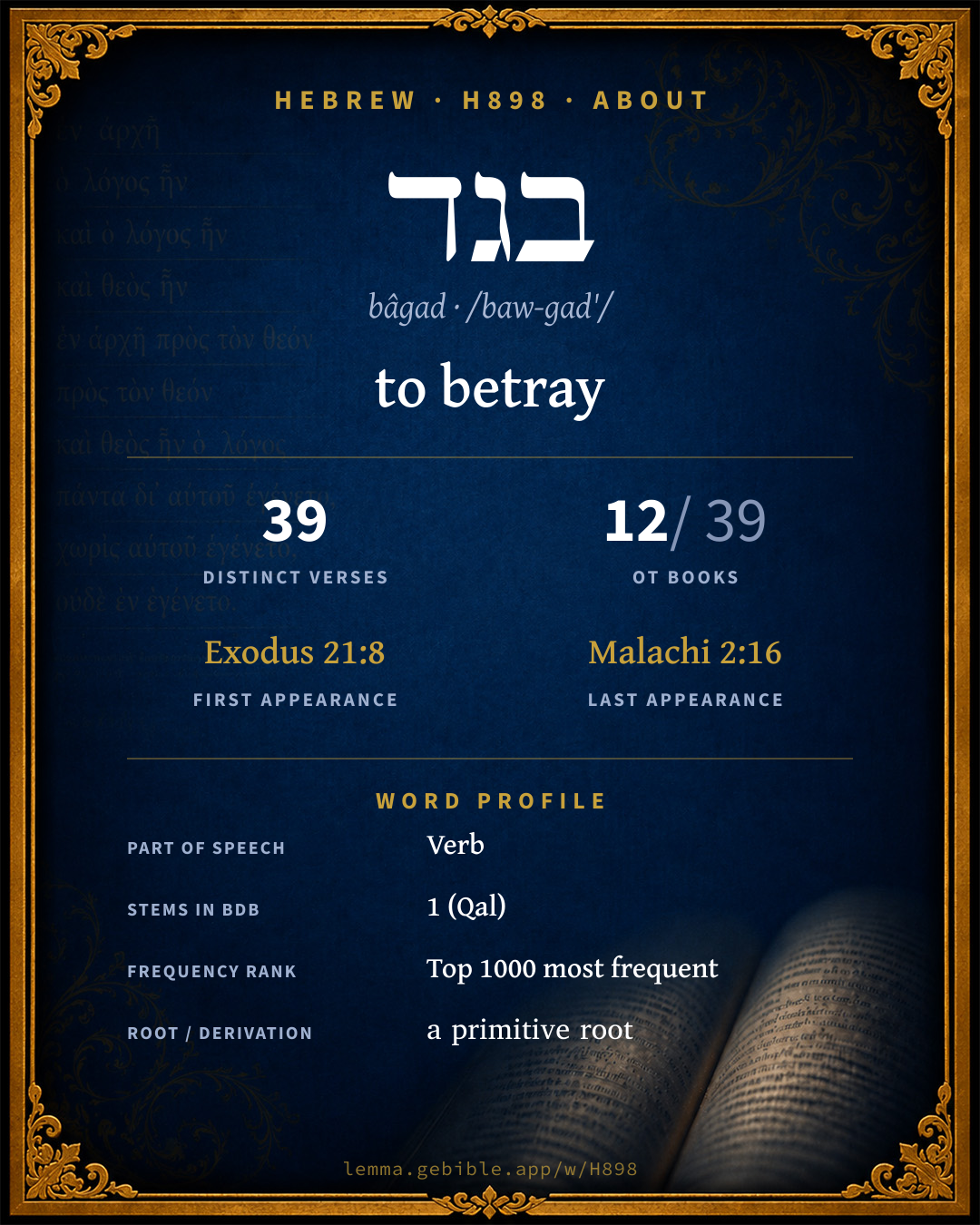
בָּגַד
to betray
‘to betray’ is one of 2 main senses fuller range ↓
Full lexicon entry — Brown-Driver-Briggs (BDB)
From Brown-Driver-Briggs (BDB)
Where this word appears
Grammar key — what these labels mean
Part of speech
- Verb
- An action or state-of-being word.
Stem
- Qal
- The basic, simple active stem — the plain form of the verb (“he wrote”). Here: ‘with’
Form
- Perfect
- A completed action or state — Hebrew marks aspect (completeness) more than strict tense (“he wrote”).
- Participle Active
- A verbal adjective expressing ongoing or characteristic action (“writing / one who writes”).
- Sequential Imperfect
- An imperfect with prefixed waw — the standard past-narrative form (waw-consecutive imperfect).
- Infinitive Absolute
- An unbound verbal noun, often intensifying or standing in for a finite verb.
- Infinitive Construct
- A bound verbal noun, frequently with prepositions (“to write / in writing”).
- Imperfect
- An incomplete, ongoing, or future action (“he will / would write”).
- Jussive
- A third- or second-person volitional form expressing wish or command (“let him write”).
State
- Absolute
- The independent form of a noun, not bound to a following word.
- Construct
- A noun bound to a following noun in a possessive / “of” relationship (the construct chain).
Person
- 3rd Person
- The one spoken about (“he / she / it / they”).
- 2nd Person
- The one addressed (“you”).
- 1st Person
- The speaker (“I / we”).
Gender
- Common
- Either gender — not distinguished for this form.
- Masculine
- Grammatically masculine.
- Feminine
- Grammatically feminine.
Number
- Plural
- More than one (in Hebrew, generally three or more).
- Singular
- One.
Grammatical forms 17 distinct
- Verb, Qal, Participle Active, Masculine, Plural, Absolute 12 times (24%)
- Verb, Qal, Perfect, 3rd Person, Common, Plural 9 times (18%)
- Verb, Qal, Participle Active, Masculine, Singular, Absolute 7 times (14%)
- Verb, Qal, Sequential Imperfect, 3rd Person, Masculine, Plural 2 times (4%)
- Verb, Qal, Infinitive Absolute 2 times (4%)
- Verb, Qal, Perfect, 2nd Person, Masculine, Plural 2 times (4%)
- Verb, Qal, Perfect, 3rd Person, Feminine, Singular 2 times (4%)
- Verb, Qal, Participle Active, Masculine, Plural, Construct 2 times (4%)
+9 more forms (11 occurrences)
Parsed forms decoded from the imported morphology (morphhb / Westminster Leningrad Codex — WLC text public domain, morphhb tagging CC BY 4.0), counted across 49 parsed occurrences — not distinct verses.
Every verse where H898 appears — 39 distinct verses across 12 books. Click any verse to open its interlinear word-by-word view. Verse text shown in the World English Bible for context — . Each verse’s Hebrew form is shown with its reference; the English is not keyword-highlighted, since the data carries no word-level English alignment. Use “Compare translations” on any verse to read it across multiple English versions. This concordance covers the Hebrew Bible; Septuagint (Greek Old Testament) occurrences are not indexed here.
Exodus 1 verse
Judges 1 verse
1 Samuel 1 verse
Job 1 verse
Psalms 5 verses
- Psalms 25:3 הַ/בּוֹגְדִ֥ים ptcl def.art + Qal ptcp.act mp Yes, no one who waits for you shall be shamed. They shall be shamed who deal treacherously without cause.
- Psalms 59:5 בֹּ֖גְדֵי Qal ptcp.act mp cs You, Yahweh God of hosts, the God of Israel, Rouse yourself to punish the nations. Show no mercy to the wicked traitors. Selah.
- Psalms 73:15 בָגָֽדְתִּי Qal pf 1cs If I had said, "I will speak thus;" Behold, I would have betrayed the generation of your children.
- Psalms 78:57 וַֽ֭/יִּבְגְּדוּ conj + Qal wimpf 3mp But turned back, and dealt treacherously like their fathers. They were turned aside like a deceitful bow.
- Psalms 119:158 בֹ֭גְדִים Qal ptcp.act mp I look at the faithless with loathing, Because they don't observe your word.
Proverbs 9 verses
- Proverbs 2:22 וּ֝/בוֹגְדִ֗ים conj + Qal ptcp.act mp But the wicked will be cut off from the land. The treacherous will be rooted out of it.
- Proverbs 11:3 בּוֹגְדִ֣ים Qal ptcp.act mp The integrity of the upright shall guide them, But the perverseness of the treacherous shall destroy them.
- Proverbs 11:6 בֹּגְדִ֥ים Qal ptcp.act mp The righteousness of the upright shall deliver them, But the unfaithful will be trapped by evil desires.
- Proverbs 13:2 בֹּגְדִ֣ים Qal ptcp.act mp By the fruit of his lips, a man enjoys good things; But the unfaithful crave violence.
- Proverbs 13:15 בֹּגְדִ֣ים Qal ptcp.act mp Good understanding wins favor; But the way of the unfaithful is hard.
- Proverbs 21:18 בּוֹגֵֽד Qal ptcp.act ms The wicked is a ransom for the righteous; The treacherous for the upright.
- Proverbs 22:12 בֹגֵֽד Qal ptcp.act ms The eyes of Yahweh watch over knowledge; But he frustrates the words of the unfaithful.
- Proverbs 23:28 וּ֝/בוֹגְדִ֗ים conj + Qal ptcp.act mp Yes, she lies in wait like a robber, And increases the unfaithful among men.
- Proverbs 25:19 בּ֝וֹגֵ֗ד Qal ptcp.act ms Confidence in someone unfaithful in time of trouble Is like a bad tooth, or a lame foot.
Isaiah 4 verses
- Isaiah 21:2 הַ/בּוֹגֵ֤ד בּוֹגֵד֙ ptcl def.art + Qal ptcp.act ms Qal ptcp.act ms A grievous vision is declared to me; the treacherous man deals treacherously, and the destroyer destroys. Go up, Elam; besiege, Media; all the sighing of it have I made to cease.
- Isaiah 24:16 בֹּגְדִ֣ים בָּגָ֔דוּ בּוֹגְדִ֖ים בָּגָֽדוּ Qal ptcp.act mp Qal pf 3cp Qal ptcp.act mp Qal pf 3cp From the uttermost part of the earth have we heard songs: Glory to the righteous. But I said, I pine away, I pine away, woe is me! the treacherous have dealt treacherously; yes, the treacherous have dealt very treacherously.
- Isaiah 33:1 וּ/בוֹגֵ֖ד בָ֣גְדוּ לִ/בְגֹּ֖ד יִבְגְּדוּ conj + Qal ptcp.act ms Qal pf 3cp prep + Qal inf.cs Qal impf 3mp Woe to you who destroy, and you weren't destroyed; and deal treacherously, and they didn't deal treacherously with you! When you have ceased to destroy, you shall be destroyed; and when you have made an end of dealing treacherously, they shall deal treacherously with you.
- Isaiah 48:8 בָּג֣וֹד תִּבְגּ֔וֹד Qal inf.abs Qal impf 2ms Yes, you didn't hear; yes, you didn't know; yes, from of old your ear was not opened: for I knew that you did deal very treacherously, and was called a transgressor from the womb.
Jeremiah 7 verses
- Jeremiah 3:8 בֹּֽגֵדָ֤ה Qal ptcp.act fs I saw, when, for this very cause that backsliding Israel had committed adultery, I had put her away and given her a bill of divorce, yet treacherous Judah, her sister, didn't fear; but she also went and played the prostitute.
- Jeremiah 3:11 מִ/בֹּגֵדָ֖ה prep + Qal ptcp.act fs Yahweh said to me, Backsliding Israel has shown herself more righteous than treacherous Judah.
- Jeremiah 3:20 בָּגְדָ֥ה בְּגַדְתֶּ֥ם Qal pf 3fs Qal pf 2mp Surely as a wife treacherously departs from her husband, so have you dealt treacherously with me, house of Israel, says Yahweh.
- Jeremiah 5:11 בָג֨וֹד בָּגְד֜וּ Qal inf.abs Qal pf 3cp For the house of Israel and the house of Judah have dealt very treacherously against me, says Yahweh.
- Jeremiah 9:2 בֹּגְדִֽים Qal ptcp.act mp Oh that I had in the wilderness a lodging-place of wayfaring men; that I might leave my people, and go from them! for they are all adulterers, an assembly of treacherous men.
- Jeremiah 12:1 בֹּ֥גְדֵי Qal ptcp.act mp cs Righteous are you, Yahweh, when I contend with you; yet would I reason the cause with you: why does the way of the wicked prosper? why are all they at ease who deal very treacherously?
- Jeremiah 12:6 בָּ֣גְדוּ Qal pf 3cp For even your brothers, and the house of your father, even they have dealt treacherously with you; even they have cried aloud after you: don't believe them, though they speak beautiful words to you.
Lamentations 1 verse
Hosea 2 verses
Habakkuk 2 verses
- Habakkuk 1:13 בּֽוֹגְדִ֔ים Qal ptcp.act mp You who have purer eyes than to see evil, and who cannot look on perversity, why do you tolerate those who deal treacherously, and keep silent when the wicked swallows up the man who is more righteous than he,
- Habakkuk 2:5 בּוֹגֵ֔ד Qal ptcp.act ms Yes, moreover, wine is treacherous. A haughty man who doesn't stay at home, who enlarges his desire as Sheol, and he is like death, and can't be satisfied, but gathers to himself all nations, and heaps to himself all peoples.
Malachi 5 verses
- Malachi 2:10 נִבְגַּד֙ Qal impf 1cp Don't we all have one father? Hasn't one God created us? Why do we deal treacherously every man against his brother, profaning the covenant of our fathers?
- Malachi 2:11 בָּגְדָ֣ה Qal pf 3fs Judah has dealt treacherously, and an abomination is committed in Israel and in Jerusalem; for Judah has profaned the holiness of Yahweh which he loves, and has married the daughter of a foreign god.
- Malachi 2:14 בָּגַ֣דְתָּה Qal pf 2ms Yet you say, 'Why?' Because Yahweh has been witness between you and the wife of your youth, against whom you have dealt treacherously, though she is your companion, and the wife of your covenant.
- Malachi 2:15 יִבְגֹּֽד Qal juss 3ms Did he not make one, although he had the residue of the Spirit? Why one? He sought a godly seed. Therefore take heed to your spirit, and let none deal treacherously against the wife of his youth.
- Malachi 2:16 תִבְגֹּֽדוּ Qal impf 2mp For I hate divorce," says Yahweh, the God of Israel, "and him who covers his garment with violence!' says Yahweh of Hosts. "Therefore take heed to your spirit, that you don't deal treacherously.
About this entry
At a glance — auto-summarized from this page’s data, not written by a person. Every figure links to its source below. This summary describes the numbers; it doesn’t interpret them.
At its core, בגד (bâgad) means “to betray.” Where the King James Version says “transgressors,” newer translations reach for “faithless” (Berean Standard Bible) and “treacherous ones” (unfoldingWord Literal Text); the renderings breakdown has the detail. It appears 39 verses across 12 books of the Hebrew Bible, among its moderately common vocabulary. First canonically at Exodus 21:8, it enters the text early. Carrying more than one sense, it rewards its full sense range. Dig into 39-verse concordance and the renderings breakdown below.
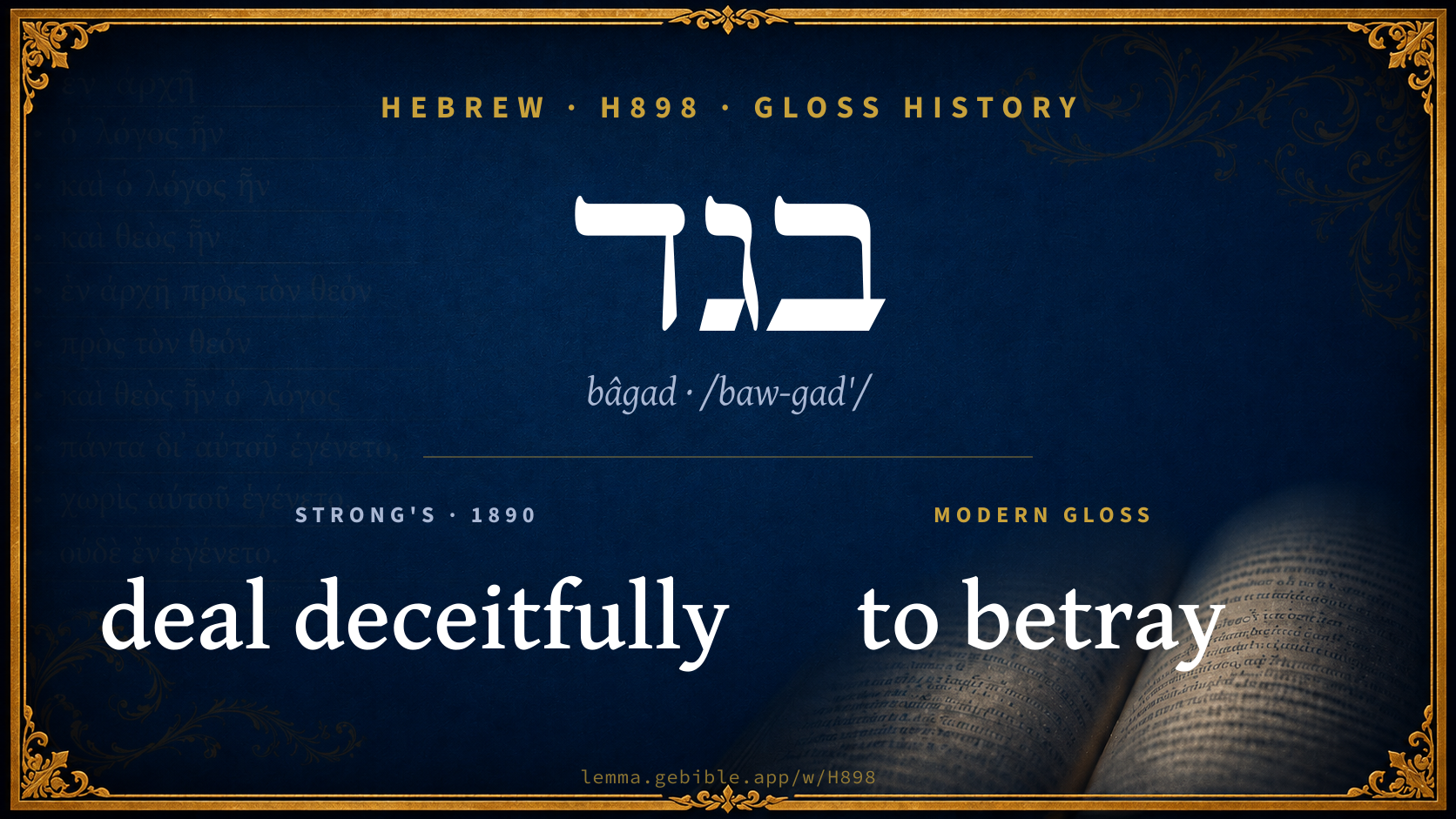
Gloss history
Strong's 1890 vs modern scholarship
About this word
Strong's H898 catalogs a Hebrew word from the Hebrew Old Testament.
These counts are not copied from any lexicon or concordance. They are computed here, from the morphology-tagged Hebrew Old Testament. What Lemma adds →
- 39
- distinct verses
- The word appears in 39 distinct verses.
- 12 / 39
- OT books
- The word appears in 12 of 39 Old Testament books.
- #752
- by frequency
- Top 1000 most frequent Hebrew words (rank 752 of 8,640 Hebrew words by occurrence).
View all 39 occurrences in the concordance →
By section of the Old Testament
By traditional corpus
Conventional, traditional groupings — biblical authorship is debated, so this is a traditional corpus grouping, not an authorship claim. Each share is this word’s portion of its verses in that division of the Hebrew canon. Each figure is a share of the word’s 39 distinct verses.
- Prophets (Nevi'im) 22 verses · 56%
- Writings (Ketuvim) 16 verses · 41%
- Torah (Pentateuch) 1 verse · 3%
How translations render this word
Counts come from each version’s own published word-to-Strong’s tagging or interlinear alignment — an approximate guide to how each version renders this word, not a word-level alignment the data otherwise carries. Because each total is that version’s own tagged count, the per-version totals vary from one another and need not match the appearance or distinct-verse counts above. These counts may also differ from a printed concordance because Lemma counts each distinctly tagged rendering and does not collapse phrase taggings into a single head-word total. This is a fixed set of word-tagged versions (KJV, ASV, BSB, ULT) and does not change with the reading translation you choose elsewhere. Each version’s license is shown beside its name below (and on Sources).
- King James Version: Transgressors 8×, Treacherously 5×, Have dealt treacherously 2×
- American Standard Version: Treacherous 6×, Treacherously 5×, Dealt treacherously 2×
- Berean Standard Bible: Faithless 9×, Break faith 2×, Have betrayed 2×
- unfoldingWord Literal Text: Treacherous ones 6×, And 3×, Ones acting treacherously 3×
King James Version Public Domain
Renders H898 across 49 tagged occurrences — most commonly:
Plus 30 renderings that appear only once — usually multi-word phrases or single function words the recovered tagging swept in, not distinct renderings.
American Standard Version Public Domain
Renders H898 across 49 tagged occurrences — most commonly:
Plus 34 renderings that appear only once — usually multi-word phrases or single function words the recovered tagging swept in, not distinct renderings.
Berean Standard Bible Public Domain
Renders H898 across 46 tagged occurrences — most commonly:
Plus 27 renderings that appear only once — usually multi-word phrases or single function words the recovered tagging swept in, not distinct renderings. Not rendered by a distinct English word in 3 further occurrences.
unfoldingWord Literal Text CC BY-SA 4.0
Renders H898 across 60 tagged occurrences — most commonly:
Plus 32 renderings that appear only once — usually multi-word phrases or single function words the recovered tagging swept in, not distinct renderings.
Senses in the full BDB
What do BDB’s symbols mean?
BDB uses these scholarly abbreviations:
| Symbol | Meaning |
|---|---|
| 𝔊 | the Septuagint (the ancient Greek translation, LXX) |
| 𝔙 | the Vulgate (the Latin translation) |
| 𝔖 | the Syriac version (the Peshitta) |
| 𝔗 | the Targum (the Aramaic translation) |
| ψ | the Psalms |
| √ | root (the underlying root or stem) |
| ‖ | parallel passage (a synonymous or contrasted parallel) |
| † | the dagger: every passage where the word occurs is cited |
The 5 senses and sub-senses the full Brown-Driver-Briggs lexicon distinguishes for this word, in lexicon order (not ranked by frequency), with BDB’s own verbatim wording and sub-sense lettering. Shown in Hebrew script with BDB’s own scholarly abbreviations. The condensed entry is in the Lexicon Entry tab. See also the Forms in the corpus table below.
Qal
- Pf. בָּֽגְדָה Je 3:20 + 14 times; Impf. יִבְגֹּד Mal 2:15 + 5 times; נִבְגַּד Mal 2:10; Inf. abs. בָּגוֹד Is 48:8; Je 5:11; cstr. בְּגֹד Is 33:1; בִּגְדוֹ Ex 21:8; Pt. בֹּגֵד Pr 22:12 + 11 times; בּוֹגֵד Is 33:1 + 10 times—act or deal treacherously, faithlessly, deceitfully, in the marriage relation, in matters of property or right, in covenants, in word and in general conduct. e.g. Jeremiah 3:20
- a. abs. 1 S 14:33; Jb 6:15 ψ 78:57; Is 24:16; 33:1(×2); 48:8 Mal 2:11. Cf. phrases אחי בגדו כמו נחל my brethren have dealt deceitfully as a brook Jb 6:15; בֹּגְדִים בָּגָ֑דוּ וּבֶגֶד בּוֹגְדִים בָּגָ֑דוּ the treacherous have dealt treacherously, yea in treachery have the treacherous dealt treacherously Is 24:16 (striking alliteration); בֹּגְדֵי אָוֶן treacherous in wickedness ψ 59:6. e.g. 1 Samuel 14:33
- b. with בְּ Ex 21:8 (E), Ju 9:23; Is 33:1(×2) Je 3:20; 5:11; 12:6; La 1:2; Ho 5:7; 6:7; Mal 2:10, 14, 15, 16. e.g. Exodus 21:8
- c. c. acc. ψ 73:15. e.g. Psalms 73:15
- d. c. מִן pregnant, בָּֽגְדָה אִשָּׁה מֵרֵעָהּ acteth treacherously (in departing) from her friend Je 3:20. The ptcp. is used Pr 2:22 + 8 times, ψ 25:3; 59:6; 119:158 Is 21:2; 24:16(×2); 33:1 Je 3:8, 11; 9:1 Hb 1:13; 2:5; בֹּגְדֵי בָ֑גֶד dealers treacherously in treachery (very treacherously) Je 12:1. e.g. Jeremiah 3:20
Senses from the full Brown-Driver-Briggs lexicon (Brown, Driver, Briggs; Oxford 1906 — public domain), digitized via Sefaria, supplemented by the OpenScriptures HebrewLexicon (CC BY 4.0). Full attribution on Sources.
Word origin
vb. act or deal treacherously—
— Brown-Driver-Briggs (Oxford 1906, public domain), digitized via Sefaria, supplemented by the OpenScriptures HebrewLexicon (CC BY 4.0). See Sources.
Origin: a primitive root
Jastrow Dictionary
A second Hebrew/Aramaic lexicon for comparison, covering Aramaic and post-biblical (Talmudic, Targumic, Midrashic) usage that the biblical-Hebrew BDB does not. Matched by lemma rather than by Strong’s number, so a lemma may carry more than one Jastrow headword (shown separately below), and the entries cover usage well beyond the Bible.
בָּגַד
- v. infra) to act violently, to rebel, be faithless. Snh. 37ᵃ (allud. to Gen. XXVII, 27) א"ת בְּגָדָיו אלא בּוֹגְדָיו do not read b’gadav (his garments), but bog’dav (his faithless ones). Y. Peah I, 16ᵇ top; Num. R. s. 10, beg.; Cant. R. to V, 16, v. בְּגִידָה.—Mekh. Mishp., N’zikin 3 מאחר שב׳ בה וכ׳ (b’bigdo bah, Ex. XXI, 8) since he &c., treated her contemptuously (opp. to the interpretation of בגדו as his garment, שפירש בגדו עליה he spread his bed-cloth over her). [From Targ. renderings as well as from Agadic interpretations it appears that the primitive meaning of בגד (√בג) is, to tear; also to despise, corresp. to the meanings of √בז; v. Targ. Job VI, 5; Is. XXXIII, 1; Prov. XXI, 18; Snh. 94ᵃ, cit. s. v. בזוזא; Esth. R. to I, 10, cit. s. v. בּוּז; Mekh. l. c.; cmp. also K’thib בג for K’ri בַּז Ezek. XXV, 7.—בֶּגֶד seems to be a piece, web, corresp. in meaning and use to φᾶρος.] e.g. Genesis 27:27
בֶּגֶד
- preced.) web, garment. Men. 40ᵇ היא של ב׳ וכ׳ if (the garment) itself is a web, but its borders are of leather. Ib. the principal element ב׳ בעינן must be a web (in order to require Tsitsith). Mekh. Mishp., N’zikin 3, v. preced. Sabb. 26ᵇ; a. fr.—Pl. בְּגָדִים, constr. בִּגְדֵי. Gen. R. s. 20 ב׳ א"הר Adam’s garments, v. אוֹר II, 3. Yoma 60ᵇ ב׳ לבן the Highpriest’s white garments (for the Day of Atone, Lev. XVI, 4), contrad. to ב׳ זהב gold-embroidered &c. Ib. 68ᵇ; a. fr. e.g. Leviticus 16:4
A Dictionary of the Targumim, the Talmud Babli and Yerushalmi, and the Midrashic Literature (Marcus Jastrow; London, Luzac, 1903) — Public Domain. Digitized via Sefaria. Digitized via Sefaria. Full attribution on Sources.
Forms in the corpus
The 44 distinct written forms H898 takes in the Hebrew Bible, most frequent first — each parse links to that stem’s occurrences in the concordance. Hebrew forms include their vowel points and cantillation, so a single lemma takes many written forms.
| Form | Parsing | Example | Uses |
|---|---|---|---|
| בֹּגְדִ֣ים | Verb, Qal, Participle Active, Masculine, Plural, Absolute | Isaiah 24:16 | 3 |
| בָּ֣גְדוּ | Verb, Qal, Perfect, 3rd Person, Common, Plural | Jeremiah 12:6 | 2 |
| בָּגָ֔דוּ | Verb, Qal, Perfect, 3rd Person, Common, Plural | Hosea 5:7 | 2 |
| וּ֝/בוֹגְדִ֗ים | Verb, Qal, Participle Active, Masculine, Plural, Absolute | Proverbs 2:22 | 2 |
| בָ֣גְדוּ | Verb, Qal, Perfect, 3rd Person, Common, Plural | Isaiah 33:1 | 1 |
| בָג֨וֹד | Verb, Qal, Infinitive Absolute | Jeremiah 5:11 | 1 |
| בָגָֽדְתִּי | Verb, Qal, Perfect, 1st Person, Common, Singular | Psalms 73:15 | 1 |
| בֹ֭גְדִים | Verb, Qal, Participle Active, Masculine, Plural, Absolute | Psalms 119:158 | 1 |
| בֹגֵֽד | Verb, Qal, Participle Active, Masculine, Singular, Absolute | Proverbs 22:12 | 1 |
| בּ֝וֹגֵ֗ד | Verb, Qal, Participle Active, Masculine, Singular, Absolute | Proverbs 25:19 | 1 |
| בְּ/בִגְד/וֹ | Verb, Qal, Infinitive Construct | Exodus 21:8 | 1 |
| בְּגַדְתֶּ֔ם | Verb, Qal, Perfect, 2nd Person, Masculine, Plural | 1 Samuel 14:33 | 1 |
| בְּגַדְתֶּ֥ם | Verb, Qal, Perfect, 2nd Person, Masculine, Plural | Jeremiah 3:20 | 1 |
| בָּ֥גְדוּ | Verb, Qal, Perfect, 3rd Person, Common, Plural | Hosea 6:7 | 1 |
| בָּג֣וֹד | Verb, Qal, Infinitive Absolute | Isaiah 48:8 | 1 |
| בָּגְד֜וּ | Verb, Qal, Perfect, 3rd Person, Common, Plural | Jeremiah 5:11 | 1 |
| בָּגְד֣וּ | Verb, Qal, Perfect, 3rd Person, Common, Plural | Job 6:15 | 1 |
| בָּגְדָ֣ה | Verb, Qal, Perfect, 3rd Person, Feminine, Singular | Malachi 2:11 | 1 |
| בָּגְדָ֥ה | Verb, Qal, Perfect, 3rd Person, Feminine, Singular | Jeremiah 3:20 | 1 |
| בָּגַ֣דְתָּה | Verb, Qal, Perfect, 2nd Person, Masculine, Singular | Malachi 2:14 | 1 |
| בָּגָֽדוּ | Verb, Qal, Perfect, 3rd Person, Common, Plural | Isaiah 24:16 | 1 |
| בֹּ֖גְדֵי | Verb, Qal, Participle Active, Masculine, Plural, Construct | Psalms 59:5 | 1 |
| בֹּ֥גְדֵי | Verb, Qal, Participle Active, Masculine, Plural, Construct | Jeremiah 12:1 | 1 |
| בֹּֽגֵדָ֤ה | Verb, Qal, Participle Active, Feminine, Singular, Absolute | Jeremiah 3:8 | 1 |
| בֹּגְדִ֥ים | Verb, Qal, Participle Active, Masculine, Plural, Absolute | Proverbs 11:6 | 1 |
| בֹּגְדִֽים | Verb, Qal, Participle Active, Masculine, Plural, Absolute | Jeremiah 9:2 | 1 |
| בּֽוֹגְדִ֔ים | Verb, Qal, Participle Active, Masculine, Plural, Absolute | Habakkuk 1:13 | 1 |
| בּוֹגְדִ֖ים | Verb, Qal, Participle Active, Masculine, Plural, Absolute | Isaiah 24:16 | 1 |
| בּוֹגְדִ֣ים | Verb, Qal, Participle Active, Masculine, Plural, Absolute | Proverbs 11:3 | 1 |
| בּוֹגֵ֔ד | Verb, Qal, Participle Active, Masculine, Singular, Absolute | Habakkuk 2:5 | 1 |
| בּוֹגֵֽד | Verb, Qal, Participle Active, Masculine, Singular, Absolute | Proverbs 21:18 | 1 |
| בּוֹגֵד֙ | Verb, Qal, Participle Active, Masculine, Singular, Absolute | Isaiah 21:2 | 1 |
| הַ/בּוֹגְדִ֥ים | Verb, Qal, Participle Active, Masculine, Plural, Absolute | Psalms 25:3 | 1 |
| הַ/בּוֹגֵ֤ד | Verb, Qal, Participle Active, Masculine, Singular, Absolute | Isaiah 21:2 | 1 |
| וַ/יִּבְגְּד֥וּ | Verb, Qal, Sequential Imperfect, 3rd Person, Masculine, Plural | Judges 9:23 | 1 |
| וַֽ֭/יִּבְגְּדוּ | Verb, Qal, Sequential Imperfect, 3rd Person, Masculine, Plural | Psalms 78:57 | 1 |
| וּ/בוֹגֵ֖ד | Verb, Qal, Participle Active, Masculine, Singular, Absolute | Isaiah 33:1 | 1 |
| יִבְגְּדוּ | Verb, Qal, Imperfect, 3rd Person, Masculine, Plural | Isaiah 33:1 | 1 |
| יִבְגֹּֽד | Verb, Qal, Jussive, 3rd Person, Masculine, Singular | Malachi 2:15 | 1 |
| לִ/בְגֹּ֖ד | Verb, Qal, Infinitive Construct | Isaiah 33:1 | 1 |
| מִ/בֹּגֵדָ֖ה | Verb, Qal, Participle Active, Feminine, Singular, Absolute | Jeremiah 3:11 | 1 |
| נִבְגַּד֙ | Verb, Qal, Imperfect, 1st Person, Common, Plural | Malachi 2:10 | 1 |
| תִבְגֹּֽדוּ | Verb, Qal, Imperfect, 2nd Person, Masculine, Plural | Malachi 2:16 | 1 |
| תִּבְגּ֔וֹד | Verb, Qal, Imperfect, 2nd Person, Masculine, Singular | Isaiah 48:8 | 1 |
Same root — word family
Other BDB entries built from the same root as H898, grouped by Strong’s listed origin. These share a root / origin per the lexicon — not necessarily a shared meaning. Each links to that word’s own entry.
Derived from this word
Compare all same-root words → They share a root, not necessarily a meaning.
Septuagint verse parallels
This word appears in 37 verses that also exist in the Greek Old Testament (Septuagint), out of the 39 Hebrew verses it occurs in. You can read those verses in Greek by switching the Old Testament edition to the Septuagint.
Read these verses in the Septuagint
- Exodus 21:8
- Judges 9:23
- 1 Samuel 14:33
- Job 6:15
- Psalms 25:3
- Proverbs 2:22
- Isaiah 21:2
- Jeremiah 3:8
- Lamentations 1:2
- Hosea 5:7
- Habakkuk 1:13
- Malachi 2:10
This is a verse-level parallel only — the same verses exist in both the Hebrew and Greek Old Testaments. No word-level Hebrew↔Greek correspondence is claimed: the data carries no such alignment, so no Greek word is shown as this Hebrew word’s translation. Coverage is not total — the Septuagint omits the deuterocanon and renumbers the Psalms, so some Hebrew verses have no direct Greek parallel.