
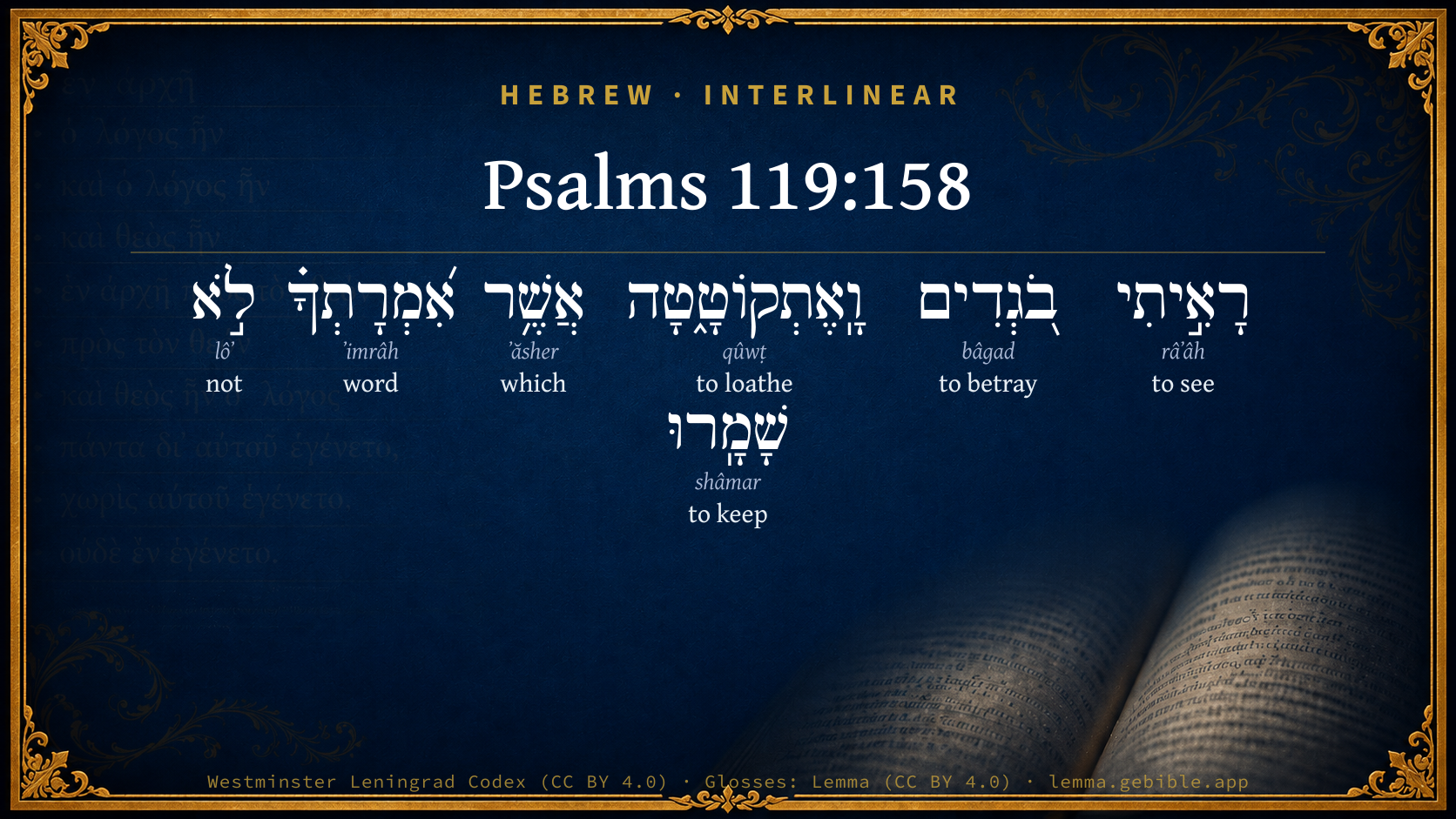
Psalms 119:158

Hebrew (Westminster Leningrad Codex) Psalms 119:158 appears in the Hebrew Old Testament. The text above is from the Westminster Leningrad Codex. Each word links to its Strong’s number, a concise gloss, and parsing drawn from the Open Scriptures Hebrew Bible morphology. Click any word for its full Brown-Driver-Briggs (BDB) entry.
Download image
Cite this verse

Psalms 119:158 (World English Bible). Public Domain. Lemma interlinear Bible study tool, https://lemma.gebible.app/v/psalms/119/158.

Show BibTeX & RIS
BibTeX
RIS
English Translation
I look at the faithless with loathing, Because they don't observe your word.
World English Bible · Public Domain
Download a study sheet

One document with this verse’s original text, its word-by-word gloss line, the meaning frame, cross-references with their text, attributed commentary, and full source and license credits — printable, and it pastes into notes with its structure intact.

This verse Autodidact and up

Study sheet (.html) Plain text (.txt)

A passage Seminary Student

Up to 50 verses in one chapter. A passage sheet keeps up to 6 commentary sources and 12 cross-references per verse, in the order this page ranks them, and says so on the sheet whenever that leaves anything out. Ask for a single verse and you get the Autodidact verse sheet above.

Everything on this page stays free to read, with no account — the sheet is a download of what is already on screen, not access to it.

Want to remove ads? Support Godless Engineer
Compare translations 3

The same verse in 3 English versions, stacked beneath the original-language interlinear above. Click any original word for its lexicon entry.

Each is an independent rendering of the whole verse — the interlinear is not word-aligned to these translations.

Highlighted words mark where these versions differ — a whole-verse word diff, not a word-by-word alignment.

  • World English Bible Public Domain
    I look at the faithless with loathing, Because they don't observe your word.
  • King James Version Public Domain
    I beheld the transgressors, and was grieved; because they kept not thy word.
  • unfoldingWord Literal Text CC BY-SA 4.0
    I have seen the treacherous, and I was disgusted, because they have not kept your word.

unfoldingWord Literal Text — © unfoldingWord, licensed CC BY-SA 4.0. Word-aligned USFM3 via Door43 (git.door43.org/unfoldingWord/en_ult).

Versions to compare (up to 4)

3 of 4 selected

Show all 17 translations

Every available English version of this verse, each an independent rendering of the whole verse.

  • World English Bible Public Domain
    I look at the faithless with loathing, Because they don't observe your word.
  • Berean Standard Bible Public Domain
    I look on the faithless with loathing because they do not keep Your word.
  • Majority Standard Bible Public Domain
    I look on the faithless with loathing because they do not keep Your word.
  • King James Version Public Domain
    I beheld the transgressors, and was grieved; because they kept not thy word.
  • American Standard Version (1901) Public Domain
    I beheld the treacherous, and was grieved, Because they observe not thy word.
  • Revised Version (1885) Public Domain
    I beheld the treacherous dealers, and was grieved; because they observed not thy word.
  • Geneva Bible (1599) Public Domain
    I saw the transgressours and was grieued, because they kept not thy worde.
  • Young's Literal Translation Public Domain
    I have seen treacherous ones, And grieve myself, Because Thy saying they have not kept.
  • Literal Standard Version CC BY-SA 4.0
    I have seen treacherous ones, || And grieve myself, || Because they have not kept Your saying.
  • Unlocked Literal Bible CC BY-SA 4.0
    I view the treacherous with disgust because they do not keep your word.
  • unfoldingWord Literal Text CC BY-SA 4.0
    I have seen the treacherous, and I was disgusted, because they have not kept your word.
  • Darby Bible Public Domain
    I beheld them that deal treacherously, and was grieved; because they kept not thy ùword.
  • World Messianic Bible Public Domain
    I look at the faithless with loathing, because they don’t observe your word.
  • Webster's Bible Public Domain
    I beheld the transgressors, and was grieved; because they kept not thy word.
  • Free Bible Version CC BY-SA 4.0
    Watching these unfaithful people disgusts me because they take no notice of your word.
  • Bible in Basic English Public Domain
    I saw with hate those who were untrue to you; for they did not keep your saying.
  • JPS Tanakh (1917) Public Domain
    I beheld them that were faithless, and strove with them; because they observed not Thy word.

Literal Standard Version (2020), Covenant Press — licensed CC BY-SA 4.0. Text via the HelloAO Bible API (eBible.org). Unlocked Literal Bible (unfoldingWord) — licensed CC BY-SA 4.0. Text via the HelloAO Bible API (eBible.org). unfoldingWord Literal Text — © unfoldingWord, licensed CC BY-SA 4.0. Word-aligned USFM3 via Door43 (git.door43.org/unfoldingWord/en_ult). Free Bible Version, Dr. Jonathan Gallagher — licensed CC BY-SA 4.0. Text via the HelloAO Bible API (eBible.org).

Word by word

More ways to search: Search by grammar → Find every occurrence → Compare this word →

Practice this passage: Drill this verse → Learn its vocabulary →

וָֽאֶתְקוֹטָ֑טָה
qûwṭ
H6962
“and · to loathe”
Conjunction + Verb, Hithpolel, Sequential Imperfect, 1st Person, Common, Singular + Suffix, h
Part of Speech
Conjunction + Verb
Stem
Hithpolel
Form
Sequential Imperfect
Person
1st Person
Gender
Common
Number
Singular
Full BDB Definition

Origin: a primitive root

TWOT: 1996

to loathe, be grieved, feel a loathing - (Qal) to feel a loathing - (Niphal) - to feel loathing against self - to detest - (Hithpolel) to loathe oneself
  1. רָאִ֣יתִי râʼâh H7200 “to see” Verb, Qal, Perfect, 1st Person, Common, Singular
  2. בֹ֭גְדִים bâgad H898 “betraying” Verb, Qal, Participle Active, Masculine, Plural, Absolute
  3. אֲשֶׁ֥ר ʼăsher H834 “which” Particle, Relative
  4. אִ֝מְרָתְךָ֗ ʼimrâh H565 “word · your” Noun, Common, Feminine, Singular, Construct + Suffix, Personal, 2nd Person, Masculine, Singular
  5. לֹ֣א lôʼ H3808 “not” Particle, Negative
  6. שָׁמָֽרוּ shâmar H8104 “to keep” Verb, Qal, Perfect, 3rd Person, Common, Plural

About this verse

These counts appear in no published source. They are computed here, from the morphology-tagged text and Lemma’s own curated glosses. What Lemma adds →

7
words
7
distinct lemmas
Wisdom
section

Notable vocabulary

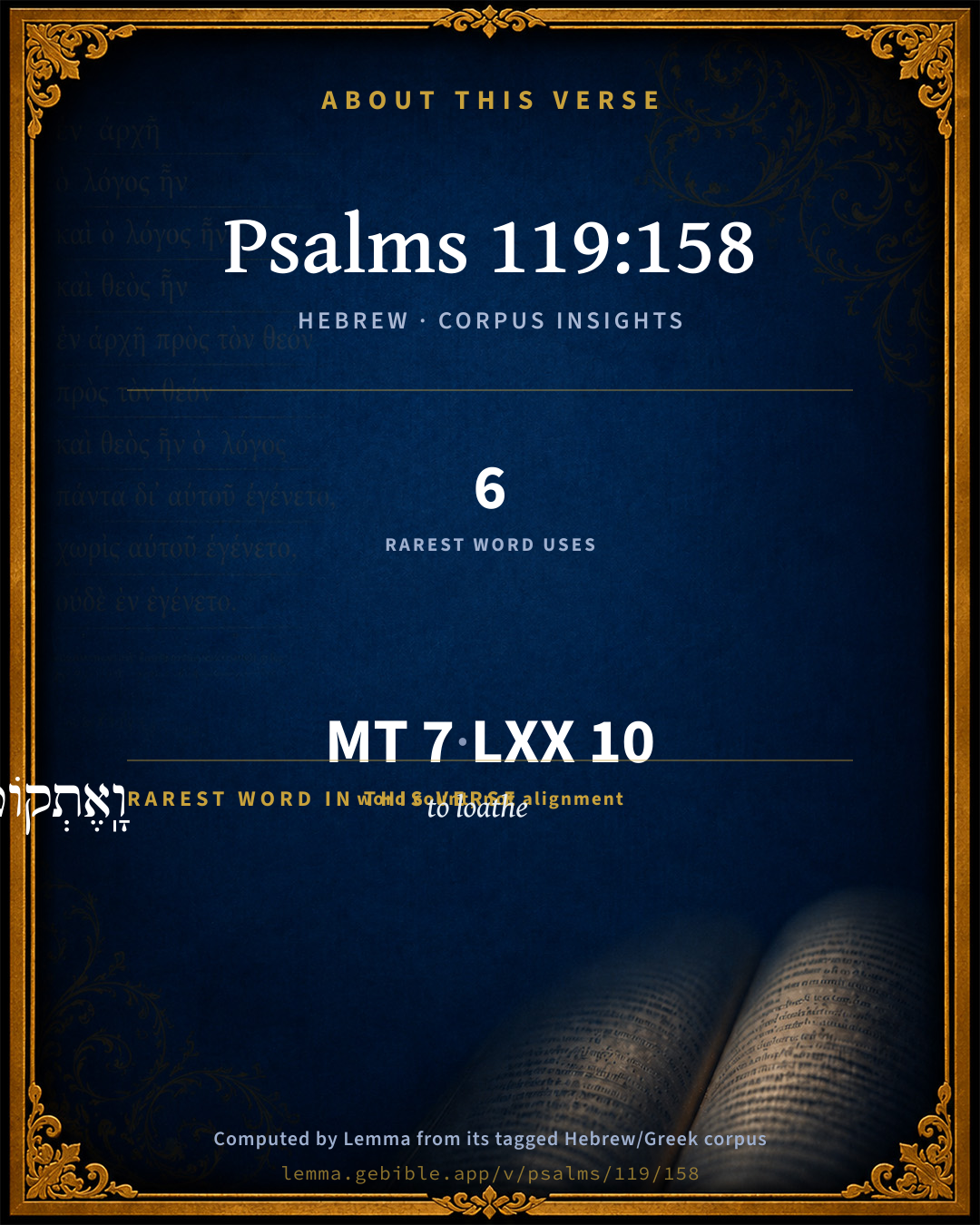
The rarest word here is וָֽאֶתְקוֹטָ֑טָה to loathe H6962 — appearing just 6 times in the whole Hebrew Bible.

Shared distinctive vocabulary

וָֽאֶתְקוֹטָ֑טָה to loathe H6962 occurs in 6 verses of the Hebrew Bible. Also found in:

Grammatical profile

  • 4 verbs
  • 1 noun
  • 2 particles

Verb forms

  • רָאִ֣יתִי Qal · Perfect
  • בֹ֭גְדִים Qal · Participle Active
  • וָֽאֶתְקוֹטָ֑טָה Hithpolel · Sequential Imperfect
  • שָׁמָֽרוּ Qal · Perfect

Hebrew & Septuagint length

In English translation the verse runs 13 words from the Hebrew and 15 from the Septuagint (LXX English) — closely comparable.

A rough comparison of the two English renderings, which tokenize alike — not a word-level alignment.

Word counts can differ between the Hebrew and the Greek without any difference in meaning — e.g. the Hebrew direct-object marker אֵת has no separate Greek word, and Greek often adds the article ὁ.

In the original languages it is 7 Hebrew tokens and 10 Greek tokens — but the two are counted differently (Hebrew bundles its prefixes and suffixes into one token; the Greek is in lemma form), so that isn’t a like-for-like length.

Cross-references

5

Topical passages linked to Psalms 119:158 in the Treasury of Scripture Knowledge — connected by theme and wording, ordered by reader-vote popularity; previews shown in the World English Bible.

  • Psalms 119:53 Indignation has taken hold on me, Because of the wicked who forsake your law.
  • Psalms 139:21 Yahweh, don't I hate those who hate you? Am I not grieved with those who rise up against you?
  • Psalms 119:136 Streams of tears run down my eyes, Because they don't observe your law.
  • Ezekiel 9:4 Yahweh said to him, Go through the midst of the city, through the midst of Jerusalem, and set a mark on the foreheads of the men that sigh and that cry over all the abominations that are done in the midst of it.
  • Mark 3:5 When he had looked around at them with anger, being grieved at the hardening of their hearts, he said to the man, "Stretch out your hand." He stretched it out, and his hand was restored as healthy as the other.

Cross-references courtesy of OpenBible.info (CC BY 4.0).

Hebrew and Greek witnesses Masoretic Hebrew ↔ Greek Septuagint

The same verse in the two great witnesses to the Old Testament, shown verse-for-verse.

You’re reading Greek Psalm 118 (Hebrew Psalm 119). The Septuagint counts the superscription, so verse numbers can differ from the Hebrew — chapter-level alignment, not verse-by-verse. Numbering follows Rahlfs.

These are two independent witnesses, not word-aligned to each other, and the Septuagint is shown in lemma (dictionary) form.

Hebrew Psalms 119:158 Masoretic · Westminster Leningrad Codex

רָאִ֣יתִי בֹ֭גְדִים וָֽאֶתְקוֹטָ֑טָה אֲשֶׁ֥ר אִ֝מְרָתְךָ֗ לֹ֣א שָׁמָֽרוּ

I look at the faithless with loathing, Because they don't observe your word.

World English Bible · Public Domain

Greek LXX Greek Psalm 118:158 Septuagint · lemma form

ὁράω ἀσυνθετέω καί ἐκτήκω ὅτι ὁ λόγιον σύ οὐ φυλάσσω

I saw men acting foolishly, and I pined away; for they kept not your oracles.

LXX2012 (modern English Septuagint) · Public Domain

Hebrew: Westminster Leningrad Codex (CC BY 4.0). Greek: Septuagint (public domain); English from LXX2012 (modern English Septuagint) (Public Domain). How the Septuagint differs from the Hebrew →

Commentary

Notes on Psalms 119:158 from classic Christian and Jewish commentators (each source and its license shown beneath its notes). The classic Christian expositions comment on the surrounding passage and are grouped to its opening verse, so a note may address several verses; the Jewish commentaries on the Tanakh (Rashi and others) are per-verse, so they appear only where the commentator wrote on this verse.

Lemma curates 59 commentaries, every one of them public domain or Creative Commons licensed, each selected and text-cleaned for this edition rather than reprinted as found. About our sources →

Trapp's Complete Commentary

John Trapp

Psa 119:158 I beheld the transgressors, and was grieved; because they kept not thy word.

Ver. 158. I beheld the transgressors, and was grieved] Or, I abhorred them, or, I contended with them; not so much because they were mine as thine enemies.

Because they kept not thy word] Which all men are bound not only to observe, but to preserve as much as may be.

John Trapp, A Commentary or Exposition upon All the Books of the Old and New Testament (1647–1656) — public domain. Text from a community e-Sword module.

The Biblical Illustrator

Joseph S. Exell

Psa_119:158

I beheld the transgressors, and was grieved; because they kept not Thy Word.

Christian grief over transgressors

One of the influences and results of true piety on the heart is to move its sensibilities on behalf of the interests and welfare of others. One example out of many is presented to us in the text, the author of which was most probably Ezra, to whom, as the priest of Jehovah, pertained the duty of purifying the people from their abominations on their return from captivity, and of settling the institutions by which, when restored to the land of their forefathers, they were to be recovered. He had taken a survey of the state of society, both in his own country and in other nations, and his spirit was stirred within him.

I. A contemplation of the prevalent habits and character of mankind. I beheld the transgressors.

1. God has actually established a law for the government of mankind.

2. There is amongst mankind a prevalent and a fearfully extended rebellion against this law.

3. The case of those who are in the attitude of rebellion against the Divine law should, by pious minds, be made the matter of frequent and serious contemplation.

II. A record of the emotions which this contemplation properly and specially produces upon the pious mind. I beheld the transgressors, and was grieved.

1. For what reasons this emotion must be excited.

(1) Because transgression is so insulting to God.

(2) Because transgression is so fatal to the happiness of mankind.

2. To what conduct this emotion should prompt.

(1) To personal nonconformity and separation from the transgressions which we witness, and over which we mourn.

(2) To personal exertion in the diffusion of that truth which God has appointed as the instrument to reconcile and to save. (J. Parsons.)

Tearful concern for the godless

The evangel is not in the first place a denunciation of sin, nor a pronouncement of punishment. It is an announcement of good news. Dr. Dale once said to me in his study that he knew of only one man who had the right to speak of the possibility of a soul being lost. Who is that? I inquired; and he answered, Dwight Lyman Moody. The reason is that he never did it without tears in his voice, and never without passing on to proclaim how that man could be saved. (Campbell Morgan.)

The Biblical Illustrator, edited by Joseph S. Exell (c. 1880s–1900s) — public domain. Text from a community e-Sword module.

J. A. Alexander on Psalms

Joseph Addison Alexander

158. (Psa 119:158) I see traitors and am sickened—(those) who thy saying keep not. The wicked are called traitors against God, their rightful sovereign, as in Psa 25:8. The first verb is the reflexive form of that in Psa 95:10, I sicken (or disgust) myself. The common version of the relative (because) conveys an idea not expressed but understood. There is no need of departing from the strict sense of the pronoun. See and have seen, keep and have kept.

Joseph Addison Alexander, The Psalms Translated and Explained (1850) — public domain. Text from a community e-Sword module.

Geneva Bible (1599)

Geneva Bible translators

My zeal consumed me when I saw their malice and contempt of thy glory.

Geneva Bible (1599) marginal notes — public domain. Text via Bolls.life.

Matthew Henry's Commentary

Here is, 1. David's sorrow for the wickedness of the wicked. Though he conversed much at home, yet sometimes he looked abroad, and could not but see the wicked walking on every side. He beheld the transgressors, those whose sins were open before all men, and it grieved him to see them dishonour God, serve Satan, debauch the world, and ruin their own souls, to see the transgressors so numerous, so daring, so very impudent, and so industrious to draw unstable souls into their snares. All this cannot but be a grief to those who have any regard to the glory of God and the welfare of mankind. 2. The reason of that sorrow. He was grieved, not because they were vexatious to him, but because they were provoking to God: They kept not thy word. Those that hate sin truly hate it as sin, as a transgression of the law of God and a violation of his word.

Matthew Henry's Commentary on the Whole Bible (1708–1710) — public domain (CC PDM 1.0). Text via the HelloAO Bible API.

Adam Clarke's Commentary

Verse 158. I beheld the transgressors, and was grieved] Literally, I was affected with anguish.

Adam Clarke's Commentary on the Bible (1810–1826) — public domain. Text from a community e-Sword/MySword module.

John Calvin's Commentaries

158. I saw the perfidious and child them. In this verse the Psalmist proceeds yet farther, declaring that he was inflamed with a holy zeal when he saw the law of God despised by the wicked. Expositors are not however agreed as to one word in the text, namely the verb אתקוטטה, ethkotatah, which we have rendered chid, some deriving it from קוט, kut, which often signifies to debate or contend with, it being in the conjugation hithpael, while others derive it from קטט karat, which signifies to kill or to destroy. I adopt the former interpretation, because it is more generally received among the learned, and is most appropriate. The Prophet then teaches that he was inflamed with such zeal for the law of God that he could no longer endure the impious mockery directed against it. The verb debate may however be understood as well of the vexation or anger which he felt in himself, as of the rebuke which he openly administered to the despisers of God; and therefore some translate it, I shuddered, or I was grieved “Invasit me horror.” — Piscator.

“C’est a dire, on vient de la pensee a l’effect.” — Fr.

John Calvin's Commentaries (1540-1563) — public domain. Text from the Calvin Translation Society English edition (1840s-50s) via the Christian Classics Ethereal Library (ccel.org). Calvin's coverage is partial (roughly two-thirds of the Bible); uncommented books and verses are honest gaps, never fabricated. The 19th-century editor's footnotes and remarks are omitted so the notes are faithfully Calvin's own voice.

Ellicott's Commentary for English Readers

RESH.

(158) Transgressors.—Better, the faithless (or, traitors).

Was grieved.—The Hebrew is a far stronger word, and the sense is intensified by the rare conjugation: was filled with loathing at; sickened with disgust.

“The recreants I survey,

And loathing turn away.”—KEBLE.

A Bible Commentary for English Readers, edited by Charles John Ellicott (1878–1897) — public domain. Text from a community e-Sword module.

The Cambridge Bible for Schools and Colleges

gen. ed. J. J. S. Perowne

158. I have seen the treacherous dealers and felt loathing,

Because they have not observed thy word.

Apostate Israelites are meant, faithless to the covenant. Far from being attracted by them, he felt disgust and loathing (Psa_139:21) as he watched them and their ways.

The Cambridge Bible for Schools and Colleges (gen. ed. J. J. S. Perowne; Cambridge University Press, 1878–1918) — public domain. Text from a community e-Sword module.

John Gill's Exposition

I rejoice at thy word, as one that findeth great spoil. At having it, which is a distinguishing blessing; all are not favoured with it; and is an inestimable treasure, a field in which a treasure lies; which those that find rejoice at, and especially at the understanding of it, as Kimchi notes: for such only delight in it who spiritually understand it, or have an application of it to them; find it, and eat it, and then it is the joy and rejoicing of their hearts. The doctrines of it are matter of great joy, particularly which concern the grace of God, the person of Christ, and peace, pardon, righteousness, and salvation by him; and each of its promises, which are exceeding great and precious; and, when opened and applied in a time of need, occasion great joy; such as is expressed at finding a great spoil, when much substance comes into the hands of the conqueror, as well as victory. The word is a part of the believer's spiritual armour, by which he overcomes his enemies; as well as it acquaints him with the conquest Christ has obtained over them, and made him a sharer in; and directs him to unsearchable riches, to things more valuable than thousands of gold and silver; so that he has great reason to rejoice at it in such a manner indeed! see Isa 9:2.

.

Psalms 119:163

psa 119:163

psa 119:163

psa 119:163I hate and abhor lying,.... The sin of lying in common conversation, which owes its rise to Satan, the father of lies; is common to human nature, though very dishonourable to it; exceeding unbecoming a professor of religion; and was greatly hated by David, as it ought to be by all good men, Psa 101:7. Or "falsehood" (k); false doctrine; everything contrary to the truth of the word of God, with all false worship, superstition, and idolatry; and this may the rather be thought to be designed, since the law or doctrine of God is opposed to it in the next clause;

but thy law do I love; because holy, just, and true; he being a regenerate man, and having it written on his heart, he loved both the precepts of the law and the doctrines of the Gospel: or, "thy doctrine"; the doctrine concerning God, his mind and will, his grace and love; see Psa 119:97.

(k) "falsitatem", Montanus, Junius & Tremellius, Piscator, Cocceius, Gejerus, Michaelis.

John Gill's Exposition of the Whole Bible (1746–1763) — public domain (CC PDM 1.0). Text via the HelloAO Bible API.

Albert Barnes' Notes on the Bible

I beheld the transgressors - Those who wronged me; those who violated the law of God.

And was grieved - Or, “sickened.” The word used here means commonly to loathe, to nauseate, to sicken. Eze 16:47; Psa 95:10. I was made sad, sorry, sick at heart. I did not look on them with anger; I did not desire to take revenge upon them; I did not return evil for evil. My heart was sad that people would do wrong; that they would expose themselves to such danger. See the notes at Psa 119:136.

Because they kept not thy word - Because they violated thy law; because they were sinners.

Albert Barnes' Notes on the Bible (1834–1885) — public domain. Text from a community e-Sword/MySword module.

Matthew Poole's English Annotations

I observed and considered their ungodly courses.

Matthew Poole's English Annotations on the Holy Bible (1683–1685) — public domain. Text from a community e-Sword/MySword module.

The Treasury of David

Charles H. Spurgeon

Ver. 158. I beheld the transgressors. I saw the traitors; I understood their character, their object, their way, and their end. I could not help seeing them, for they pushed themselves into my way. As I was obliged to see them I fixed my eyes on them, to learn what I could from them.

And was grieved. I was sorry to see such sinners. I was sick of them, disgusted with them, I could not endure them. I found no pleasure in them, they were a sad sight to me, however fine their clothing or witty their chattering. Even when they were most mirthful a sight of them made my heart heavy; I could not tolerate either them or their doings.

Because they kept not thy word. My grief was occasioned more by their sin against God than by their enmity against myself. I could bear their evil treatment of my words, but not their neglect of thy word. Thy word is so precious to me that those who will not keep it move me to indignation; I cannot keep the company of those who keep not God's word. That they should have no love for me is a trifle; but to despise the teaching of the Lord is abominable.

Ver. 158. I beheld the transgressors, and was grieved. Celerinus in Cyprian's Epistles, acquaints a friend with his great grief for the apostasy of a woman through fear of persecution; which afflicted him so much, that at the feast of Easter (the Queen of feasts in the primitive church) he wept night and day, and resolved never to know a moment's delight, till through the mercy of God she should be recovered. Charles Bridges.

Ver. 158. I beheld the transgressors, and was grieved. Oh, if you have the hearts of Christians or of men in you, let them yearn towards your poor ignorant, ungodly neighbours. Alas, there is but a step betwixt them and death and hell: many hundred diseases are waiting ready to seize on them, and if they die unregenerate they are lost for ever. Have you hearts of rock, that cannot pity men in such a case as this? If you believe not the word of God, and the danger of sinners, why are you Christians yourselves If you do believe it, why do you not bestir yourself to the helping of others? Do you not care who is damned, so you be saved? If so, you have sufficient cause to pity yourselves, for it is a frame of spirit utterly inconsistent with grace: should you not rather say, as the lepers of Samaria, is it not a day of glad tidings, and do we sit still and hold our peace 2Ki 7:9. Hath God had so much mercy on you, and will you have no mercy on your poor neighbours? You need not go far to find objects for your pity: look but into your streets, or into the next house to you, and you will probably find some. Have you never an ignorant, an unregenerate neighbour that sets his heart on things below, and neglects eternity? What blessed place do you live in, where there is none such? If there be not some of them in thine own family, it is well; and yet art thou silent? Dost thou live close by them, or meet them in the streets, or labour with them, or travel with them, or sit and talk with them, and say nothing to them of their souls, or the life to come? If their houses were on fire, thou wouldst run and help them; and wilt thou not help them when their souls are almost at the fire of hell? If thou knewest but a remedy for their diseases thou wouldst tell it them, or else thou wouldst judge thyself guilty of their death. Richard Baxter (1615 1691), in "The Saints' Everlasting Rest."

Ver. 158. Grieved, because they kept not thy law. I never thought the world had been so wicked, when the Gospel began, as now I see it is; I rather hoped that every one would have leaped for joy to have found himself freed from the filth of the Pope, from his lamentable molestations of poor troubled consciences, and that through Christ they would by faith obtain the celestial treasure they sought after before with such vast cost and labour, though in vain. And especially I thought the bishops and universities would with joy of heart have received the true doctrines; but I have been lamentably deceived. Moses and Jeremiah, too, complained they had been deceived. Martin Luther.

Ver. 158. Grieved. The word that is here translated "grieved" is from "katat", that signifies to loathe, abhor, and contend. I beheld the transgressors, and I loathed them; I beheld the transgressors, and I abhorred them; I beheld the transgressors, and I contended with them; but not so much because they were mine enemies, as because they were thine. Thomas Brooks.

Ver. 158. The day when I first met Colonel Gardiner at Leicester, I happened to preach a lecture from Ps 114:158: "I beheld the transgressors, and was grieved; because they kept not thy word." I was large in describing that mixture of indignation and grief, strongly expressed by the original word there, with which a good man looks on the varying transgressors of the divine law; and in tracing the causes of that grief, as arising, from a regard to the divine honour, and the interest of a Redeemer, and a compassionate concern for the misery such offenders bring on themselves, and for the mischief they do to the world about them. I little thought how exactly I was drawing Colonel Gardiner's character under each of those heads; and I have often reflected upon it as a happy providence, which opened a much speedier way than I could have expected, to the breast of one of the most amiable and useful friends which I ever expect to find upon earth. We afterwards sung a hymn, which brought over again some of the leading thoughts in the sermon, and struck him so strongly, that on obtaining a copy of it, he committed it to his memory, and used to repeat it with so forcible an accent, as showed how much every line expressed of his very soul. In this view the reader will pardon my inserting it; especially as I know not when I may get time to publish a volume of these serious though artless compositions, which I sent him in manuscript some years ago, and to which I have since made very large additions:

Arise, my tenderest thoughts, arise,

To torrents melt my streaming eyes;

And thou, my heart, with anguish feel

Those evils which thou canst not heal.

See human nature sunk in shame;

See scandals pour'd on Jesus' name;

The Father wounded through the Son;

The world abused, and souls undone.

See the short course of vain delight

Closing in everlasting night;

In flames that no abatement know,

Though briny tears for ever flow.

My God, I feel the mournful scene;

My bowels yearn o'er dying men,

And fain my pity would reclaim,

And snatch the firebrands from the flame.

But feeble my compassion proves,

And can but weep where most it loves;

Thy own all saving arm employ,

And turn these drops of grief to joy.

Philip Doddridge, in "The Life of Colonel Garainer."

Ver. 158. A grievous sight.

1. Transgressors beyond God's bounds.

2. Bounds so kindly set: "thy word."

3. Transgressions so wantonly ungrateful, so terribly dangerous, so fatal.

Ver. 158. Sorrow over sinners.

1. A sight we cannot avoid seeing.

2. A sorrow we ought not to avoid feeling. (See Lot: 2Pe 2:7, 8. Moses: De 9:18, 19. Samuel: 1Sa 15:11 Jer 9:1. Paul: Phm 3:18. Christ: Lu 19:41).

3. A reason we will not avoid endorsing.

Ver. 158. A righteous man cannot but be grieved at the sins of the wicked. He sees in them,

1. The violation of the divine law which he loves.

2. Ungrateful rebellion against the God he worships.

3. Contempt for the gospel of salvation and the blood of Christ.

4. The dominion of Satan, the enemy of his God.

5. The degradation of souls which might have been sacred temples.

6. Prophetic signs of an awful, everlasting retribution.

J.F.

Psalms 119:159*

Charles H. Spurgeon's The Treasury of David (1869–1885) — public domain. Psalms only. Text from a community e-Sword/MySword module.

The Pulpit Commentary

I beheld the transgressors, and was grieved; literally, the treacherous dealers those who dealt treacherously against the Divine covenant. Because they kept not thy Word (comp. ver. 136).

The Pulpit Commentary (1880–1919), ed. H.D.M. Spence-Jones & Joseph S. Exell — public domain. Text from a community e-Sword module.

Lesson kit

Teaching starters — assembled from the data on this page, not authored interpretation. Every prompt links to the verse data it draws on. Edit before teaching.

Psalms, in the Wisdom, opens this verse with 7 words (7 distinct Hebrew lemmas). Its most distinctive word is qûwṭ (“to loathe”). A historical commentator’s framing appears above. Read the whole chapter for the surrounding context.

Discussion questions

  1. How does “to loathe” (qûwṭ) shape what this verse is saying?
  2. How does Psalms 95:10, which shares the word «to loathe», read alongside this verse?
  3. These translations render this verse differently. What is at stake in choosing one wording over another?
  4. «רָאִ֣יתִי» is a Qal Perfect verb. How does that grammatical form shape the action described?
  5. Compare how Trapp's Complete Commentary and The Biblical Illustrator read this verse. Where do they agree or differ?

Things to notice

Reading settings

Reading text

Shown beneath each verse's original-language words.

Old Testament
Old Testament edition

Read the OT as the Masoretic Hebrew (MT) or the Greek Septuagint (LXX).

English shown for the Greek Septuagint (in the Hebrew ↔ Greek comparison).

Comparing translations? Open the Compare panel on any verse page to stack up to four side by side.