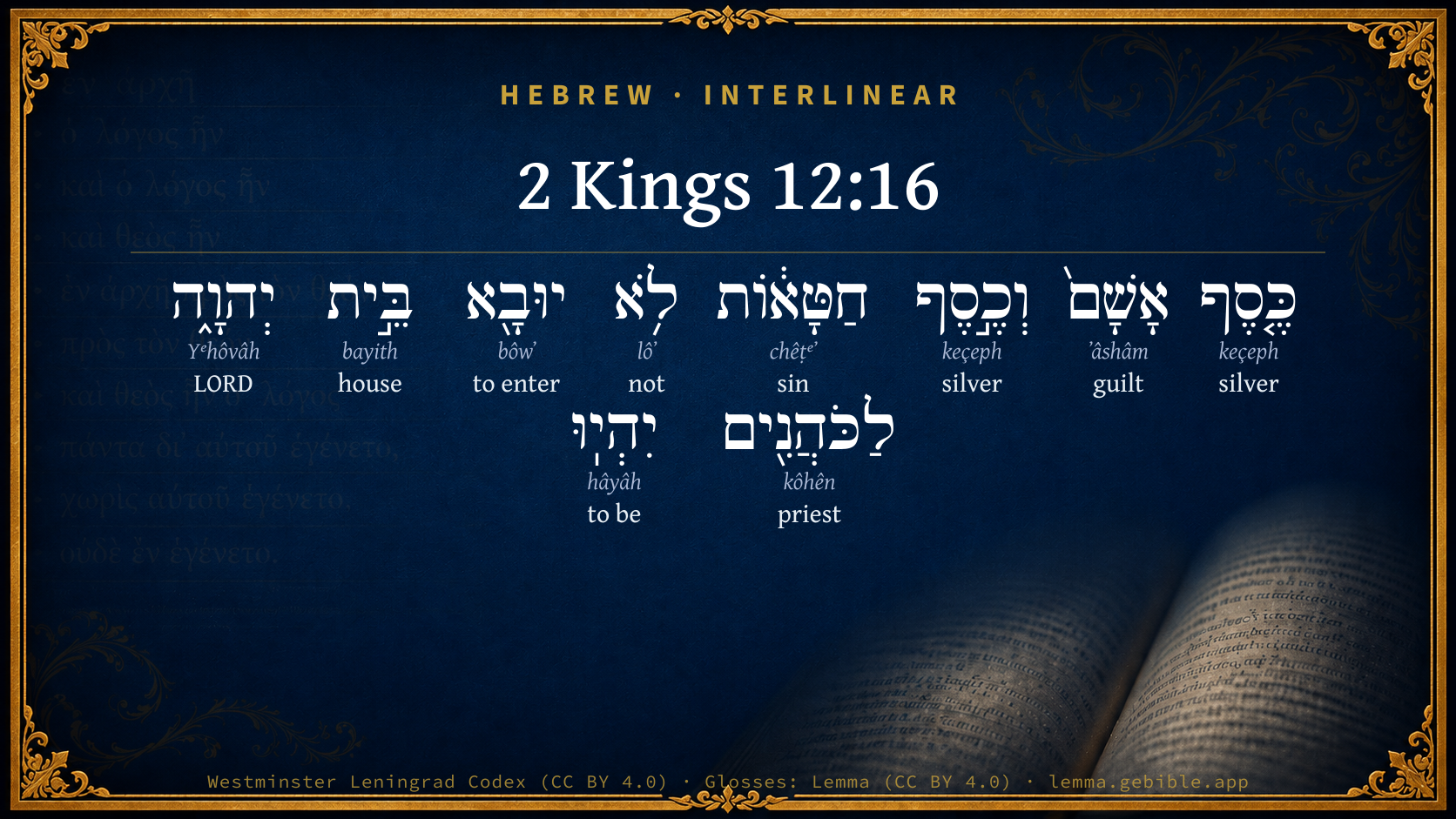
2 Kings 12:16

Hebrew (Westminster Leningrad Codex) 2 Kings 12:16 appears in the Hebrew Old Testament. The text above is from the Westminster Leningrad Codex. Each word links to its Strong’s number, a concise gloss, and parsing drawn from the Open Scriptures Hebrew Bible morphology. Click any word for its full Brown-Driver-Briggs (BDB) entry.
Download image
Cite this verse

2 Kings 12:16 (World English Bible). Public Domain. Lemma interlinear Bible study tool, https://lemma.gebible.app/v/2-kings/12/16.

Show BibTeX & RIS
BibTeX
RIS
English Translation
The money for the trespass-offerings, and the money for the sin-offerings, was not brought into the house of Yahweh: it was the priests'.
World English Bible · Public Domain
Download a study sheet

One document with this verse’s original text, its word-by-word gloss line, the meaning frame, cross-references with their text, attributed commentary, and full source and license credits — printable, and it pastes into notes with its structure intact.

This verse Autodidact and up

Study sheet (.html) Plain text (.txt)

A passage Seminary Student

Up to 50 verses in one chapter. A passage sheet keeps up to 6 commentary sources and 12 cross-references per verse, in the order this page ranks them, and says so on the sheet whenever that leaves anything out. Ask for a single verse and you get the Autodidact verse sheet above.

Everything on this page stays free to read, with no account — the sheet is a download of what is already on screen, not access to it.

Want to remove ads? Support Godless Engineer
Compare translations 3

The same verse in 3 English versions, stacked beneath the original-language interlinear above. Click any original word for its lexicon entry.

Each is an independent rendering of the whole verse — the interlinear is not word-aligned to these translations.

Highlighted words mark where these versions differ — a whole-verse word diff, not a word-by-word alignment.

  • World English Bible Public Domain
    The money for the trespass-offerings, and the money for the sin-offerings, was not brought into the house of Yahweh: it was the priests'.
  • King James Version Public Domain
    The trespass money and sin money was not brought into the house of the LORD: it was the priests'.
  • unfoldingWord Literal Text CC BY-SA 4.0
    The silver of the guilt offering and the silver of the sin offerings was not brought into the house of Yahweh. They were to the priests.

unfoldingWord Literal Text — © unfoldingWord, licensed CC BY-SA 4.0. Word-aligned USFM3 via Door43 (git.door43.org/unfoldingWord/en_ult).

Versions to compare (up to 4)

3 of 4 selected

Show all 18 translations

Every available English version of this verse, each an independent rendering of the whole verse.

  • World English Bible Public Domain
    The money for the trespass-offerings, and the money for the sin-offerings, was not brought into the house of Yahweh: it was the priests'.
  • Berean Standard Bible Public Domain
    The money from the guilt offerings and sin offerings was not brought into the house of the LORD; it belonged to the priests.
  • Majority Standard Bible Public Domain
    The money from the guilt offerings and sin offerings was not brought into the house of the LORD; it belonged to the priests.
  • King James Version Public Domain
    The trespass money and sin money was not brought into the house of the LORD: it was the priests'.
  • American Standard Version (1901) Public Domain
    The money for the trespass-offerings, and the money for the sin-offerings, was not brought into the house of Jehovah: it was the priests'.
  • Revised Version (1885) Public Domain
    The money for the guilt offerings, and the money for the sin offerings, was not brought into the house of the LORD: it was the priests’.
  • Geneva Bible (1599) Public Domain
    The money of the trespasse offring and the money of ye sinne offrings was not brought into the house of the Lord: for it was the Priests.
  • Douay-Rheims (1899) Public Domain
    But the money for trespass, and the money for sine, they brought not into the temple of the Lord, because it was for the priests.
  • Young's Literal Translation Public Domain
    The money of a trespass-offering, and the money of sin-offerings is not brought in to the house of Jehovah -- for the priests it is.
  • Literal Standard Version CC BY-SA 4.0
    The money of a trespass-offering and the money of sin-offerings is not brought into the house of YHWH—it is for the priests.
  • Unlocked Literal Bible CC BY-SA 4.0
    But the money for the guilt offerings and the money for the sin offerings was not brought into the temple of Yahweh, because it belonged to the priests.
  • unfoldingWord Literal Text CC BY-SA 4.0
    The silver of the guilt offering and the silver of the sin offerings was not brought into the house of Yahweh. They were to the priests.
  • Darby Bible Public Domain
    The money of trespass-offerings, and the money of sin-offerings, was not brought into the house of Jehovah: it was for the priests.
  • World Messianic Bible Public Domain
    The money for the trespass offerings and the money for the sin offerings was not brought into the LORD’s house. It was the priests’.
  • Webster's Bible Public Domain
    The trespass-money and sin-money was not brought into the house of the LORD: it was the priests'.
  • Free Bible Version CC BY-SA 4.0
    The money from the guilt offerings and sin offerings was not collected for the Lord's Temple because it belonged to the priests.
  • Bible in Basic English Public Domain
    The money of the offerings for error and the sin-offerings was not taken into the house of the Lord; it was the priests'.
  • JPS Tanakh (1917) Public Domain
    (12-17) The forfeit money, and the sin money, was not brought into the house of the LORD; it was the priests.

Literal Standard Version (2020), Covenant Press — licensed CC BY-SA 4.0. Text via the HelloAO Bible API (eBible.org). Unlocked Literal Bible (unfoldingWord) — licensed CC BY-SA 4.0. Text via the HelloAO Bible API (eBible.org). unfoldingWord Literal Text — © unfoldingWord, licensed CC BY-SA 4.0. Word-aligned USFM3 via Door43 (git.door43.org/unfoldingWord/en_ult). Free Bible Version, Dr. Jonathan Gallagher — licensed CC BY-SA 4.0. Text via the HelloAO Bible API (eBible.org).

Word by word

More ways to search: Search by grammar → Find every occurrence → Compare this word →

Practice this passage: Drill this verse → Learn its vocabulary →

About this verse

These counts appear in no published source. They are computed here, from the morphology-tagged text and Lemma’s own curated glosses. What Lemma adds →

10
words
9
distinct lemmas
Historical
section

Shared distinctive vocabulary

חַטָּא֔וֹת sin H2399 occurs in 34 verses of the Hebrew Bible. Also found in:

Grammatical profile

  • 2 verbs
  • 7 nouns
  • 1 particle

Verb forms

  • יוּבָ֖א Hophal · Imperfect
  • יִהְיֽוּ Qal · Imperfect

Repetition

A word recurs within this verse — often emphatic in Hebrew:

  • כֶּ֤סֶף silver H3701 ×2

Hebrew & Septuagint length

In English translation the verse runs 23 words from the Hebrew and 24 from the Septuagint (LXX English) — closely comparable.

A rough comparison of the two English renderings, which tokenize alike — not a word-level alignment.

Word counts can differ between the Hebrew and the Greek without any difference in meaning — e.g. the Hebrew direct-object marker אֵת has no separate Greek word, and Greek often adds the article ὁ.

Cross-references

8

Topical passages linked to 2 Kings 12:16 in the Treasury of Scripture Knowledge — connected by theme and wording, ordered by reader-vote popularity; previews shown in the World English Bible.

  • Leviticus 7:7 "'As is the sin offering, so is the trespass offering; there is one law for them. The priest who makes atonement with them shall have it.
  • Leviticus 5:15–18 "If anyone commits a trespass, and sins unwittingly, in the holy things of Yahweh; then he shall bring his trespass offering to Yahweh, a ram without blemish from the flock, according to your estimation in silver by shekels, after the shekel of the sanctuary, for a trespass offering.
  • Leviticus 4:24 He shall lay his hand on the head of the goat, and kill it in the place where they kill the burnt offering before Yahweh. It is a sin offering.
  • Leviticus 4:29 He shall lay his hand on the head of the sin offering, and kill the sin offering in the place of burnt offering.
  • Numbers 5:8–10 But if the man has no kinsman to whom restitution may be made for the guilt, the restitution for guilt which is made to Yahweh shall be the priest's; besides the ram of the atonement, by which atonement shall be made for him.
  • Numbers 18:8–9 Yahweh spoke to Aaron, I, behold, I have given you the charge of my heave-offerings, even all the holy things of the children of Israel; to you have I given them by reason of the anointing, and to your sons, as a portion forever.
  • Numbers 18:19 All the heave-offerings of the holy things, which the children of Israel offer to Yahweh, have I given you, and your sons and your daughters with you, as a portion forever: it is a covenant of salt forever before Yahweh to you and to your seed with you.
  • Hosea 4:8 They feed on the sin of my people, And set their heart on their iniquity.

Cross-references courtesy of OpenBible.info (CC BY 4.0).

Hebrew and Greek witnesses Masoretic Hebrew ↔ Greek Septuagint

The same verse in the two great witnesses to the Old Testament, shown verse-for-verse.

These are two independent witnesses, not word-aligned to each other, and the Septuagint is shown in lemma (dictionary) form.

Hebrew 2 Kings 12:16 Masoretic · Westminster Leningrad Codex

כֶּ֤סֶף אָשָׁם֙ וְכֶ֣סֶף חַטָּא֔וֹת לֹ֥א יוּבָ֖א בֵּ֣ית יְהוָ֑ה לַכֹּהֲנִ֖ים יִהְיֽוּ

The money for the trespass-offerings, and the money for the sin-offerings, was not brought into the house of Yahweh: it was the priests'.

World English Bible · Public Domain

Greek LXX 2 Kings 12:16 Septuagint · lemma form

καί οὐ ἐκλογίζομαι ὁ ἀνήρ ὅς δίδωμι ὁ ἀργύριον ἐπί χείρ αὐτός δίδωμι ὁ ποιέω ὁ ἔργον ὅτι ἐν πίστις αὐτός ποιέω

Money for a sin-offering, and money for a trespass-offering, whatever happened to be brought into the house of the Lord, went to the priests.

LXX2012 (modern English Septuagint) · Public Domain

Hebrew: Westminster Leningrad Codex (CC BY 4.0). Greek: Septuagint (public domain); English from LXX2012 (modern English Septuagint) (Public Domain). How the Septuagint differs from the Hebrew →

Targum (Aramaic paraphrase)

1

The Targum is the ancient Jewish Aramaic paraphrase of the Hebrew Scriptures — an interpretive translation, not the Hebrew text itself. Onkelos (literal) and Pseudo-Jonathan (expansive) render the Torah, and Jonathan the Prophets. Coverage is partial: where no permissively-licensed English translation exists for a verse, only the Aramaic is shown. This is verse-level text, not a word-by-word alignment to the Hebrew.

  1. Targum Jonathan Prophets (Joshua–Malachi)
    וְלָא מְחַשְׁבִין עִם גַבְרַיָא דִי יַהֲבִין יַת כַּסְפָּא עַל יְדֵיהוֹן לְמִתַּן לְעָבְדֵי עֱבִידְתָּא אֲרֵי בְהֵימְנוּתָא אִינוּן עָבְדִין:

    (no public-domain English translation for this verse)

    Targum Jonathan — Aramaic: “Mikraot Gedolot” (public domain). English: “Sefaria Community Translation” (CC0 1.0 (public-domain dedication)); “London "Chaldee Paraphrase," 1871” (public domain). Text via Sefaria.

Commentary

Notes on 2 Kings 12:16 from classic Christian and Jewish commentators (each source and its license shown beneath its notes). The classic Christian expositions comment on the surrounding passage and are grouped to its opening verse, so a note may address several verses; the Jewish commentaries on the Tanakh (Rashi and others) are per-verse, so they appear only where the commentator wrote on this verse.

Lemma curates 59 commentaries, every one of them public domain or Creative Commons licensed, each selected and text-cleaned for this edition rather than reprinted as found. About our sources →

Trapp's Complete Commentary

John Trapp

2Ki 12:16 The trespass money and sin money was not brought into the house of the LORD: it was the priests’.

Ver. 16. The trespass money.] Which was for omissions.

And sin money.] Which was for commissions, saith Tostatus. Or for wrongs done the Lord in his holy things, either ignorantly or wittingly, as others will have it.

John Trapp, A Commentary or Exposition upon All the Books of the Old and New Testament (1647–1656) — public domain. Text from a community e-Sword module.

Joseph Benson's Commentary

2Ki 12:16. The trespass-money and sin-money, &c. — “Besides the money paid to the priests for trespasses committed in holy things it is thought that persons living at a distance sent money to the priests to purchase trespass- offerings and sin-offerings, and sacrifice them in their names: and, as they commonly sent more than the sacrifices cost, the surplus became a perquisite, under the name of trespass-money and sin-money.” — Scott. This money was not employed toward the reparation of the house, because, as it follows, it was the priests’: it was given to them for their private use and maintenance.

Joseph Benson's Commentary on the Old and New Testaments (1811–1818) — public domain. Text from a community e-Sword module.

Ellicott's Commentary for English Readers

(16) The.—The definite article should be omitted.

Trespass money and sin money.—See Lev. V. 15-18; Num_5:8; Lev_6:26-29.

Was not brought.—Was not wont to be brought i.e., put into the chest for the restoration fund.

It was the priests’.—Literally to the priests they (these moneys) used to fall, or continued to accrue. The general sense is that the priests were not deprived of their lawful revenues by the new arrangement. They received their ancient dues from the trespass and sin offerings. The change initiated by Jehoash consisted in this, that henceforth gifts intended for the sanctuary itself were kept apart from the gifts intended for the priesthood.

A Bible Commentary for English Readers, edited by Charles John Ellicott (1878–1897) — public domain. Text from a community e-Sword module.

The Cambridge Bible for Schools and Colleges

gen. ed. J. J. S. Perowne

16. The trespass money] R.V. The money for the guilt offerings. ‘Guilt offering’ was adopted by R.V. in Lev_5:1-6 and throughout the law for the ‘trespass-offering’ of A.V., to accord with the verb and the adjective which are rendered in that leading passage ‘to be guilty’ and ‘guilty’. ‘Trespass money’ occurs nowhere else but in this verse.

sin money] R.V. the money for the sin-offering. On this see Lev_5:7-12. ‘Sin money’ is found nowhere else.

it was the priests’] See Lev_14:13. ‘For as the sin-offering is the priest’s, so is the trespass (R.V. guilt) offering’.

The Cambridge Bible for Schools and Colleges (gen. ed. J. J. S. Perowne; Cambridge University Press, 1878–1918) — public domain. Text from a community e-Sword module.

John Gill's Exposition

And the rest of the acts of Jehoash, and all that he did, are they not written in the book of the chronicles of the kings of Judah? In the registers and annals of those princes; some of them are to be met with in Ch2 24:1.

.

2 Kings 12:20

kg2 12:20

kg2 12:20

kg2 12:20And his servants arose,.... This was after he had slain Zechariah the son of Jehoiada, who reproved him for his idolatry; and after a second expedition of the king of Syria, who came to Jerusalem, and spoiled it, and left Jehoash diseased, as is recorded in Ch2 24:23,

and made a conspiracy; not to get the kingdom into their hands, for his son succeeded him, but to avenge the death of Zechariah:

and slew Jehoash in the house of Millo, which goeth down to Silla; these are both names of places; perhaps the latter is mentioned, to distinguish this Bethmillo from Millo in Zion; or rather that itself is meant, and described by the descent from it to a causeway, as Silla may signify, which led to the royal palace.

John Gill's Exposition of the Whole Bible (1746–1763) — public domain (CC PDM 1.0). Text via the HelloAO Bible API.

Albert Barnes' Notes on the Bible

The trespass money and the sin money - In all cases of injury done to another, a man was bound by the Law to make compensation, to the sufferer, if possible; if not, to his nearest kinsman. If the man was dead and had left no kinsman, then the compensation was to be made to the priest Num 5:8. This would form a part of the trespass and sin money. The remainder would accrue from the voluntary gifts made to the priests by those who came to make atonement for sins or trespasses Num 5:10. On the difference between “sins” and “trespasses,” see Lev 5:14 note.

Albert Barnes' Notes on the Bible (1834–1885) — public domain. Text from a community e-Sword/MySword module.

Haydock's Catholic Bible Commentary

Sins. These terms seem to be synonymous, though they may be distinguished, Leviticus iv. 2., and v. 15. If any one forgot to pay tithes, he was bound to make full reparation to the priests; (Tostat) and the money which was given to them by strangers, to offer sacrifice, was not taken from them. (Calmet)

George Leo Haydock (1774–1849), Haydock's Catholic Family Bible and Commentary, 1859 edition — public domain. Excludes Psalms (Douay-Rheims chapter numbering differs from Protestant) and Deuterocanonical books (Catholic canon only).

Matthew Poole's English Annotations

i.e. It was not employed towards the reparation of the house, because, as it follows, it was the priests’; it was given to them for their private use and maintenance.

Quest. If this reason was weighty, how could the money of them that passed the account, or the money that every man was set at, be thus employed, as they were, 2Ki 12:4, for these also may seem to have been the priests’?

Answ. They were not appropriated to the priests, but for the service of the tabernacle of the congregation, as is said of the former, Exo 30:16; or, for the Lord, Lev 27:2,9,14,23.

Matthew Poole's English Annotations on the Holy Bible (1683–1685) — public domain. Text from a community e-Sword/MySword module.

Whedon's Commentary on the Bible

Daniel D. Whedon

16. Trespass money and sin money — Money brought to the priests as a trespass offering or a sin offering, according to the law of Lev_5:15-19. See also Lev_7:7, and Num_18:9.

Daniel D. Whedon (gen. ed.), Commentary on the Old and New Testaments (1874–1909) — public domain. Text from a community e-Sword module.

The Pulpit Commentary

The trespass money. When a man had injured another, he was bound by the Law to make compensation to the injured party at the valuation of the priest, with the addition of one-fifth more than the value (Lev_6:2-6; Num_5:6-8) The compensation was, primarily, to be made to the man himself; secondarily, if he were dead, to his nearest kinsman; finally, if he had left no kinsman, to the priest. And sin money. According to the Law, the priest was entitled to no money with a sin offering; but it seems to have become customary to make the priest who offered it a voluntary gift, to compensate him for his trouble. Such free gifts the priest was by the Law (Num_5:10) entitled to receive. Was not brought into the house of the Lordi.e. it was not deposited in the chest, or applied to the repairs, butit was the priests".

The Pulpit Commentary (1880–1919), ed. H.D.M. Spence-Jones & Joseph S. Exell — public domain. Text from a community e-Sword module.

Keil & Delitzsch

C. F. Keil & F. Delitzsch

The money obtained from trespass-offerings and sin-offerings was not brought into the house of Jehovah, i.e., was not applied to the repairing of the temple, but was left for the priests. In the case of the trespass-offering compensation had to be made for the earthly debt according to the valuation of the priest, with the addition of a fifth in money; and this was assigned to the priests not only in the case of a מעל committed against Jehovah, but also when a neighbour had been injured in his property, if he had died in the meantime (see at Lev 5:16 and Num 5:9). On the other hand, in the case of the sin-offerings the priests received no money according to the law. Most of the commentators therefore assume, that those who lived at a distance had sent money to the priests, that they might offer sin-offerings with it, and what money as over they had retained for themselves. But there is not the slightest trace of any such custom, which is quite at variance with the idea of the sin-offering. It may probably have become a customary thing in the course of time, for those who presented these offerings to compensate the officiating priest for his trouble by a free-will gift.

Keil & Delitzsch — Biblical Commentary on the Old Testament (1861–1891) — public domain (CC PDM 1.0). Text via the HelloAO Bible API. (Old Testament only.)

Rashi

Rabbi Shlomo Yitzchaki (Rashi)

They did not demand and accounting from the men. The supervisors would not make an accounting with the treasurers that the supervisors would give the money—continually—into whose hand to give it to the workers, because they were not suspect in their eyes, for they worked with integrity.

Rashi on the Tanakh — English translations: “The Judaica Press complete Tanach with Rashi, translated by A. J. Rosenberg” (CC BY 4.0); “Pentateuch with Rashi's commentary by M. Rosenbaum and A.M. Silbermann, 1929-1934” (public domain); “The Metsudah Tanach series, Lakewood, N.J” (CC BY 4.0); and “The Book of Joshua, Metsudah Publications, 1997” (CC BY 4.0). Text via Sefaria.

Lesson kit

Teaching starters — assembled from the data on this page, not authored interpretation. Every prompt links to the verse data it draws on. Edit before teaching.

2 Kings, in the Historical, opens this verse with 10 words (9 distinct Hebrew lemmas). Its most distinctive word is chêṭᵉʼ (“sin”). A historical commentator’s framing appears above. Read the whole chapter for the surrounding context.

Discussion questions

  1. The word chêṭᵉʼ carries the sense “sin.” How does it shape the verse?
  2. Genesis 41:9 shares the word «sin» with this verse. How do the two illuminate each other?
  3. “silver” occurs 2× in this one verse. What is the effect of the repetition?
  4. These translations render this verse differently; the difference is in the English rendering, not the original. What questions does that raise?
  5. The verb «יוּבָ֖א» is Hophal Imperfect. How does its form color the action?
  6. Reading how Trapp's Complete Commentary and Joseph Benson's Commentary read this verse, where do the two commentators agree and where do they part?

Things to notice

Reading settings

Reading text

Shown beneath each verse's original-language words.

Old Testament
Old Testament edition

Read the OT as the Masoretic Hebrew (MT) or the Greek Septuagint (LXX).

English shown for the Greek Septuagint (in the Hebrew ↔ Greek comparison).

Comparing translations? Open the Compare panel on any verse page to stack up to four side by side.