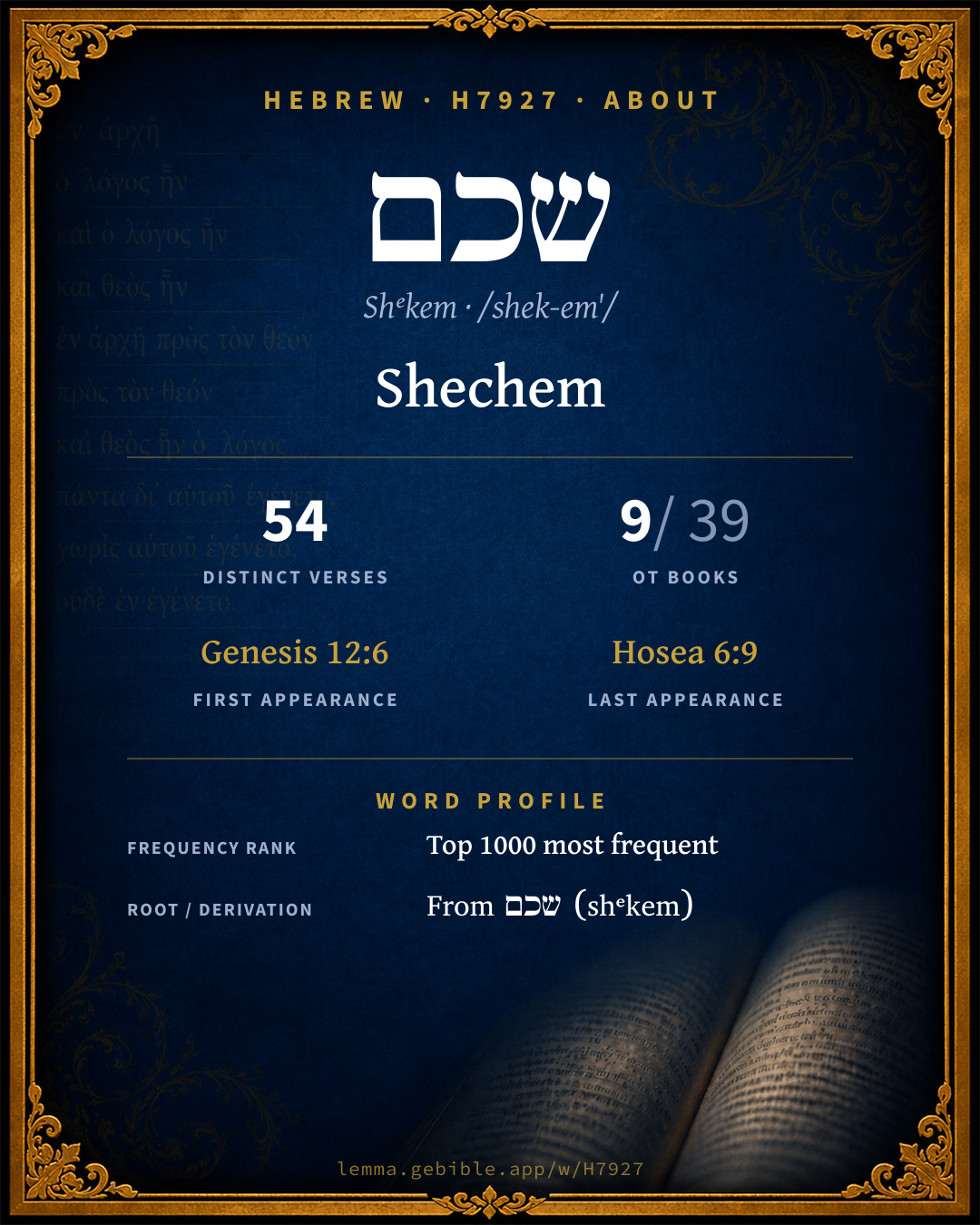
שְׁכֶם
Shechem
BDB lists 3 entries for ‘Shechem’ fuller range ↓
Full lexicon entry — Brown-Driver-Briggs (BDB)
From Brown-Driver-Briggs (BDB)
Where this word appears
Grammar key — what these labels mean
Part of speech
- Noun
- A naming word — a person, place, thing, or idea.
Noun type
- Proper
- A name of a specific person, place, or people (e.g. Abraham, Zion, Israel).
Every verse where H7927 appears in the Book of Jeremiah — 1 distinct verse. Click any verse to open its interlinear word-by-word view. Verse text shown in the World English Bible for context — . Each verse’s Hebrew form is shown with its reference; the English is not keyword-highlighted, since the data carries no word-level English alignment. Use “Compare translations” on any verse to read it across multiple English versions. This concordance covers the Hebrew Bible; Septuagint (Greek Old Testament) occurrences are not indexed here.
Jeremiah
About this entry
At a glance — auto-summarized from this page’s data, not written by a person. Every figure links to its source below. This summary describes the numbers; it doesn’t interpret them.
שכם — transliterated Shᵉkem — is a Hebrew name carrying the sense “Shechem.” It first appears in Genesis 12:6. With 54 verses in 9 books, it is a moderately common word in the Hebrew Bible. Its uses concentrate in Judges (41% of all occurrences). See 54-verse concordance and the renderings breakdown below.
Gloss history
Strong's 1890 vs modern scholarship
About this word
Strong's H7927 catalogs a Hebrew word from the Hebrew Old Testament.
These counts are not copied from any lexicon or concordance. They are computed here, from the morphology-tagged Hebrew Old Testament. What Lemma adds →
- 54
- distinct verses
- The word appears in 54 distinct verses.
- 9 / 39
- OT books
- The word appears in 9 of 39 Old Testament books.
- #611
- by frequency
- Top 1000 most frequent Hebrew words (rank 611 of 8,640 Hebrew words by occurrence).
View all 54 occurrences in the concordance →
By section of the Old Testament
By traditional corpus
Conventional, traditional groupings — biblical authorship is debated, so this is a traditional corpus grouping, not an authorship claim. Each share is this word’s portion of its verses in that division of the Hebrew canon. Each figure is a share of the word’s 54 distinct verses.
- Prophets (Nevi'im) 32 verses · 59%
- Torah (Pentateuch) 17 verses · 31%
- Writings (Ketuvim) 5 verses · 9%
How translations render this word
Counts come from each version’s own published word-to-Strong’s tagging or interlinear alignment — an approximate guide to how each version renders this word, not a word-level alignment the data otherwise carries. Because each total is that version’s own tagged count, the per-version totals vary from one another and need not match the appearance or distinct-verse counts above. These counts may also differ from a printed concordance because Lemma counts each distinctly tagged rendering and does not collapse phrase taggings into a single head-word total. This is a fixed set of word-tagged versions (KJV, ASV, BSB, ULT) and does not change with the reading translation you choose elsewhere. Each version’s license is shown beside its name below (and on Sources).
BDB lists this Strong’s number as 2 distinct words (homographs). Each count above pools all of them and is not split by sense — see the Senses section below. A low-frequency rendering may belong to a different one of those words, not the primary meaning.
- King James Version†: Shechem 51×, Shechem's 2×, Was in shechem 2×
- American Standard Version†: Shechem 52×, Was in shechem 2×
- Berean Standard Bible†: Shechem 52×, Shechem’s 3×
- unfoldingWord Literal Text†: Shechem 56×, Near shechem 2×, Was in shechem 2×
King James Version Public Domain
Renders H7927 across 62† tagged occurrences — most commonly:
Plus 7 renderings that appear only once — usually multi-word phrases or single function words the recovered tagging swept in, not distinct renderings. Not rendered by a distinct English word in 1 further occurrence.
American Standard Version Public Domain
Renders H7927 across 62† tagged occurrences — most commonly:
Plus 8 renderings that appear only once — usually multi-word phrases or single function words the recovered tagging swept in, not distinct renderings.
Berean Standard Bible Public Domain
Renders H7927 across 59† tagged occurrences — most commonly:
Plus 4 renderings that appear only once — usually multi-word phrases or single function words the recovered tagging swept in, not distinct renderings. Not rendered by a distinct English word in 4 further occurrences.
unfoldingWord Literal Text CC BY-SA 4.0
Renders H7927 across 62† tagged occurrences — most commonly:
Plus 2 renderings that appear only once — usually multi-word phrases or single function words the recovered tagging swept in, not distinct renderings.
Senses in the full BDB
What do BDB’s symbols mean?
BDB uses these scholarly abbreviations:
| Symbol | Meaning |
|---|---|
| 𝔊 | the Septuagint (the ancient Greek translation, LXX) |
| 𝔙 | the Vulgate (the Latin translation) |
| 𝔖 | the Syriac version (the Peshitta) |
| 𝔗 | the Targum (the Aramaic translation) |
| ψ | the Psalms |
| √ | root (the underlying root or stem) |
| ‖ | parallel passage (a synonymous or contrasted parallel) |
| † | the dagger: every passage where the word occurs is cited |
The 6 senses and sub-senses the full Brown-Driver-Briggs lexicon distinguishes for this word, in lexicon order (not ranked by frequency), with BDB’s own verbatim wording and sub-sense lettering. Shown in Hebrew script with BDB’s own scholarly abbreviations. The condensed entry is in the Lexicon Entry tab. See also the Forms in the corpus table below.
שכם I
- 1. shoulder (sometimes incl. back of neck; כתף = shoulder-blade):
- a. as bearing burdens, וַיֵּט שׁ׳ לִסְבֹּל Gn 49:15 (poem in J; Issach. under fig. of ass), cf. 21:14 (E), 24:15, 45; Ex 12:34, also Gn 9:23 (all J), Jos 4:5 (E), Ju 9:48; Is 10:27 (‖ צַוָּאר), 14:25 (both fig.), ψ 81:7, so, metaph., of responsibility of rule Is 9:5; 22:22 (symbolized by key), of accusation as (easy) burden Jb 31:36; fig. also לְעָבְדוֹ שׁ׳ אֶחָד Zp 3:9 to serve him (with) one shoulder (as one man), cf. Syriac ܚܰܕ ܟܰܬܦܳܐ. e.g. Genesis 49:15
- b. in statement of Saul’s height, מִשִּׁכְמוֹ וָמַ֫עְלָה גָּבֹהַּ מִכָּל־הָעָם 1 S 9:2, cf. 10:23 and (with play on n.pr.loc. שְׁכֶם) נָתַתִּי לְךָ שׁ׳ אַחַד עַל־אַחֶיךָ Gn 48:22 (E; cf. Dr). e.g. 1 Samuel 9:2
- 2. in gen. back: כְּהַפְנֹתוֹ שִׁכְמוֹ לָלֶכֶת מֵעִם 1 S 10:9; so תְּשִׁיתֵמוֹ שׁ׳ ψ 21:13, i.e. make them turn (in flight; cf. וְאוֹיְבַי נָתַתָּה לִי עֹרֶף 18:41); as beaten מַטֵּה שׁ׳ Is 9:3 (‖ שֵׁבֶט הַנֹּגֵשׂ בּוֹ); more anatom. כְּתֵפִי מִשּׁ׳ תִפּוֹל Jb 31:22 let my shoulder-blade fall from its back.—Ho 6:9 v. ii. שְׁכֶם. e.g. 1 Samuel 10:9
שכם II loc.49 et m.14 (Συχεμ
- 1. district in N. Palestine (prob. shoulder (saddle?) of mount.);—מְקוֹם שׁ׳ Gn 12:6, שְׁכֶ֑מָה 37:14; = city (שְׁכֶם, שְׁכֶ֑מָה, Ho 6:9 שֶׁ֑כְמָה) Jos 24:1; עִיר שׁ׳ Gn 33:18; Ju 8:31 + 20 times Ju 9 (בַּעֲלֵי שׁ׳ v 2 + 12 times, ב׳ מִגְדַּל־שׁ׳ v 46, 47), Ho 6:9 + 21 times (עִיר שׁ׳ Gn 33:18); city of refuge Jos 20:7; 21:21; 1 Ch 6:52.—WMMAs. u. Eur. 394, cp. Egypt. Sa-ka-mà (cf. Jen ZA x (1895) 356); mod. Nablûs (from Rom. name Neapolis); v. BuhlG 200 f. GASmG 332 ff. 345 WilsonHast. DB shechem. e.g. Genesis 12:6
- 2. n.pr.m. (on connexion with 1 cf. Ju 9:28), ‘son’ of Ḥamor, also Gn 33:19; 34:2 + 10 times 34, Jos 24:32. e.g. Judges 9:28
Senses from the full Brown-Driver-Briggs lexicon (Brown, Driver, Briggs; Oxford 1906 — public domain), digitized via Sefaria, supplemented by the OpenScriptures HebrewLexicon (CC BY 4.0). Full attribution on Sources.
Word origin
I. n.m.Zp 3:9 shoulder;—abs. שׁ׳ Gn 48:22 +, שְׁכֶ֑ם 33:19 +, שֶׁ֑כֶם ψ 21:13 (whence orig. *šakm inferred Ol§ 147 a ad fin. Sta§ 199 a; but—ֶ der. from—ִ before ב, BaNB 104 Köii. 1, 67, 506); cstr. שְׁכֶם Gn 9:23; sf. שִׁכְמוֹ 49:15 +, שִׁכְמָה (for שִׁכְמָהּ Ges§ 91 e) Jb 31:22, etc.;—
II. n.pr.loc.49 et m.14 (Συχεμ; 𝔊L often Σίκιμα LagBN 57):
— Brown-Driver-Briggs (Oxford 1906, public domain), digitized via Sefaria, supplemented by the OpenScriptures HebrewLexicon (CC BY 4.0). See Sources.
Derived from שכם (shᵉkem) (H7926) — shoulder.
Jastrow Dictionary
A second Hebrew/Aramaic lexicon for comparison, covering Aramaic and post-biblical (Talmudic, Targumic, Midrashic) usage that the biblical-Hebrew BDB does not. Matched by lemma rather than by Strong’s number, so a lemma may carry more than one Jastrow headword (shown separately below), and the entries cover usage well beyond the Bible.
שָׂכַם
- , Hif. הִשְׂכִּים, v. סָכַם.
שָׁכַם
- , Hif. הִשְׁכִּים (b. h.; [to load, v. Ges. Thes. s. v.,] to rise early; to do a thing early. Ber. 30ᵃ ה׳ לצאת לדרך if one rises early (before sunrise) to go on the road; Tosef. ib. III, 19. Cant. R. to V, 11 (play on שחרות כעורב, ib.; cmp. שׁחַר) מַשְׁכִּים ומעריב (Lev. R. s. 19 משחיר), v. עָרַב II. B. Mets. VII, 1 if one hired working men, ואמר להן להַשְׁכִּים וכ׳ and told them that he expected them to come to their work earlier and go later (than the customary time). Ber. 47ᵇ לעולם יַשְׁכִּים אדם וכ׳ a man should always go early to the house of prayer, that he may succeed in being counted among the earliest ten &c. Ib. 16ᵇ; Y. ib. IV, 7ᵈ bot. ונַשְׁכִּים ונמצא וכ׳ that we may early (in life) obtain &c., v. יִחוּל. B. Kam. 92ᵇ הַשְׁכֵּם ואכול take an early breakfast. Gitt. 7ᵃ הַשְׁכֵּם והערב עליהן והם וכ׳ (omit לבה"מ) pray against them (the tormentors) early and late, and they shall cease of themselves; a. fr.—Bicc. III, 2 ולִמַשְׁכִּים היה וכ׳ and at rising time &c.
שְׁכֶם I
- (b. h.)
- 1. shoulder. Gen. R. s. 53 (ref. to Gen. XXI, 14) שכן דרך עבדים … על שִׁכְמָם for such is the manner of slaves, to carry their filled pitchers on their shoulder; a. e. e.g. Genesis 21:14
- 2. load; trnsf. (cmp. מַשָּׂא, סִבָּלוֹן) portion, share. Gen. R. s. 97, end (ref. to Gen. XLVIII, 22) ש׳ זו הבכורה by sh’khem is meant the share of the first-born; B. Bath. 123ᵃ; a. e. e.g. Genesis 48:22
- 3. mountain range, v. next w.
שְׁכֶם II
- (b. h.)
- 1. pr. n. m. Shechem, son of Hamor the Hivite. Macc. 11ᵃ, a. e., v. גְּזַר. Sot. 22ᵇ, v. שִׁיכְמִי; a. fr.
- 2. pr. n. pl. Shechem in Mount Ephraim. Gen. R. s. 97, end (ref. to Gen. XLVIII, 22, v. preced.) זו ש׳ ודאי it means Shechem in reality. Ib. (in a corrupt passage) לפיכך תהא הש׳ בחלקך therefore shall the district of Sh. (or the mountain range, v. preced.) be in thy share. Ib. בש׳ נפרצה וכ׳ in Sh. did unchastity break out, and thou didst fence it in (setting the example of chastity), therefore &c. Num. R. s. 23, v. נִיפּוֹלִין; a. fr. e.g. Genesis 48:22
A Dictionary of the Targumim, the Talmud Babli and Yerushalmi, and the Midrashic Literature (Marcus Jastrow; London, Luzac, 1903) — Public Domain. Digitized via Sefaria. Digitized via Sefaria. Full attribution on Sources.
Forms in the corpus
The 24 distinct written forms H7927 takes in the Hebrew Bible, most frequent first — each parse links to that state’s occurrences in the concordance. Hebrew forms include their vowel points and cantillation, so a single lemma takes many written forms.
| Form | Parsing | Example | Uses |
|---|---|---|---|
| שְׁכֶ֔ם | Noun, Proper | Genesis 12:6 | 9 |
| שְׁכֶ֑ם | Noun, Proper | Genesis 33:19 | 8 |
| שְׁכֶ֖ם | Noun, Proper | Genesis 34:6 | 6 |
| בִּ/שְׁכֶֽם | Noun, Proper | Genesis 37:12 | 4 |
| שְׁכֶ֛ם | Noun, Proper | 1 Kings 12:1 | 4 |
| שְׁכֶם֙ | Noun, Proper | Genesis 34:11 | 4 |
| שְׁכֶ֑מָ/ה | Noun, Proper | 2 Chronicles 10:1 | 3 |
| שְׁכֶ֣ם | Noun, Proper | Genesis 34:8 | 3 |
| שְׁכֶ֥ם | Noun, Proper | Genesis 34:18 | 3 |
| שְׁכֶֽם | Noun, Proper | Genesis 35:4 | 3 |
| בִּ/שְׁכֶ֔ם | Noun, Proper | Genesis 37:13 | 2 |
| שְׁכֶ֔מָ/ה | Noun, Proper | Judges 9:1 | 2 |
| בִ/שְׁכֶם֒ | Noun, Proper | Joshua 24:32 | 1 |
| בִּ/שְׁכֶ֑ם | Noun, Proper | Judges 9:26 | 1 |
| וּ/שְׁכֶ֣ם | Noun, Proper | 1 Chronicles 7:28 | 1 |
| וּ/שְׁכֶ֥ם | Noun, Proper | Genesis 34:20 | 1 |
| מִ/שְּׁכֶ֞ם | Noun, Proper | Jeremiah 41:5 | 1 |
| שְׁכֶ֗ם | Noun, Proper | Genesis 33:18 | 1 |
| שְׁכֶ֜ם | Noun, Proper | Judges 9:25 | 1 |
| שְׁכֶ֧ם | Noun, Proper | Genesis 34:2 | 1 |
| שְׁכֶ֨ם | Noun, Proper | Genesis 34:13 | 1 |
| שְׁכֶֽמָ/ה | Noun, Proper | Genesis 37:14 | 1 |
| שְׁכֶם֮ | Noun, Proper | Judges 9:2 | 1 |
| שֶׁ֑כְמָ/ה | Noun, Proper | Hosea 6:9 | 1 |
Same root — word family
Other BDB entries built from the same root as H7927, grouped by Strong’s listed origin. These share a root / origin per the lexicon — not necessarily a shared meaning. Each links to that word’s own entry.
Derives from
Shares the same root
Proper names from this root
People and places named from this root — a name, not an additional meaning of the word.
Compare all same-root words → Showing 4 of 5 — not the complete family. 2 of the same-root words are proper names (people or places). They share a root, not necessarily a meaning.
Bible dictionary
Public-domain dictionary articles matched to this entry by name (Shechem). A biblical name can be shared by more than one person or place, so an article may treat several.
Easton's Bible Dictionary · M. G. Easton, 1897
Shoulder. (1.) The son of Hamor the Hivite (Gen. 33:19; 34).
(2.) A descendant of Manasseh (Num. 26:31; Josh. 17:2).
(3.) A city in Samaria (Gen. 33:18), called also Sichem (12:6), Sychem (Acts 7:16). It stood in the narrow sheltered valley between Ebal on the north and Gerizim on the south, these mountains at their base being only some 500 yards apart. Here Abraham pitched his tent and built his first altar in the Promised Land, and received the first divine promise (Gen. 12:6, 7). Here also Jacob "bought a parcel of a field at the hands of the children of Hamor" after his return from Mesopotamia, and settled with his household, which he purged from idolatry by burying the teraphim of his followers under an oak tree, which was afterwards called "the oak of the sorcerer" (Gen. 33:19; 35:4; Judg. 9:37). (See MEONENIM.) Here too, after a while, he dug a well, which bears his name to this day (John 4:5, 39-42). To Shechem Joshua gathered all Israel "before God," and delivered to them his second parting address (Josh. 24:1-15). He "made a covenant with the people that day" at the very place where, on first entering the land, they had responded to the law from Ebal and Gerizim (Josh. 24:25), the terms of which were recorded "in the book of the law of God", i.e., in the roll of the law of Moses; and in memory of this solemn transaction a great stone was set up "under an oak" (comp. Gen. 28:18; 31:44-48; Ex. 24:4; Josh. 4:3, 8, 9), possibly the old "oak of Moreh," as a silent witness of the transaction to all coming time.
Shechem became one of the cities of refuge, the central city of refuge for Western Palestine (Josh. 20:7), and here the bones of Joseph were buried (24:32). Rehoboam was appointed king in Shechem (1 Kings 12:1, 19), but Jeroboam afterwards took up his residence here. This city is mentioned in connection with our Lord's conversation with the woman of Samaria (John 4:5); and thus, remaining as it does to the present day, it is one of the oldest cities of the world. It is the modern Nablus, a contraction for Neapolis, the name given to it by Vespasian. It lies about a mile and a half up the valley on its southern slope, and on the north of Gerizim, which rises about 1,100 feet above it, and is about 34 miles north of Jerusalem. It contains about 10,000 inhabitants, of whom about 160 are Samaritans and 100 Jews, the rest being Christians and Mohammedans.
The site of Shechem is said to be of unrivalled beauty. Stanley says it is "the most beautiful, perhaps the only very beautiful, spot in Central Palestine."
Gaza, near Shechem, only mentioned 1 Chr. 7:28, has entirely disappeared. It was destroyed at the time of the Conquest, and its place was taken by Shechem. (See SYCHAR.)
Smith's Bible Dictionary · William Smith, 1863
(back or shoulder).
+ An important city in central Palestine, in the valley between mounts Ebal and Gerizim, 34 miles north of Jerusalem and 7 miles southeast of Samaria. Its present name, Nablus, is a corruption of Neapolis, which succeeded the more ancient Shechem, and received its new name from Vespasian. On coins still extant it is called Flavia Neapolis. The situation of the town is one of surpassing beauty. It lies in a sheltered valley, protected by Gerizim on the south and Ebal on the north. The feet of these mountains, where they rise from the town, are not more than five hundred yards apart. The bottom of the valley is about 1800 feet above the level of the sea, and the top of Gerizim 800 feet higher still. The sit of the present city, which was also that of the Hebrew city, occurs exactly on the water-summit; and streams issuing from the numerous springs there flow down the opposite slopes of the valley, spreading verdure and fertility in every direction. Travellers vie with each other in the language which they employ to describe the scene that here bursts so suddenly upon them on arriving in spring or early summer at this paradise of the holy land. "The whole valley," says Dr. Robinson, "was filled with gardens of vegetables and orchards of all kinds of fruits, watered by fountains which burst forth in various parts and flow westward in refreshing streams. it came upon us suddenly like a scene of fairy enchantment. We saw nothing to compare with it in all Palestine." The allusions to Shechem in the Bible are numerous, and show how important the place was in Jewish history. Abraham, on his first migration to the land of promise, pitched his tent and built an altar under the oak (or terebinth) of Moreh at Shechem. "The Canaanite was then in the land;" and it is evident that the region, if not the city, was already in possession of the aboriginal race. See (Genesis 12:6) At the time of Jacob's arrival here, after his sojourn in Mesopotamia, (Genesis 33:18; 34) Shechem was a Hivite city, of which Hamor, the father of Shechem, was the headman. it was at this time that the patriarch purchased from that chieftain "the parcel of the field" which he subsequently bequeathed, as a special patrimony, to his son Joseph. (Genesis 33:19; Joshua 24:32; John 4:5) The field lay undoubtedly on the rich plain of the Mukhna, and its value was the greater on account of the well which Jacob had dug there, so as not to be dependent on his neighbors for a supply of water. In the distribution of the land after its conquest by the Hebrews, Shechem fell to the lot of Ephraim, (Joshua 20:7) but was assigned to the Levites, and became a city of refuge. (Joshua 21:20,21) It acquired new importance as the scene of the renewed promulgation of the law, when its blessings were heard from Gerizim and its curses from Ebal, and the people bowed their heads and acknowledged Jehovah as their king and ruler. (27:11; Joshua 24:23-25) it was here Joshua assembled the people, shortly before his death, and delivered to them his last counsels. (Joshua 24:1,25) After the death of Gideon, Abimelech, his bastard son, induced the Shechemites to revolt from the Hebrew commonwealth and elect him as king. (Judges 9:1) ... In revenge for his expulsion after a reign of three years, Abimelech destroyed the city, and as an emblem of the fate to which he would consign it, sowed the ground with salt. (Judges 9:34-45) It was soon restored, however, for we are told in (1 Kings 12:1) ... that all Israel assembled at Shechem, and Rehoboam, Solomon's successor, went thither to be inaugurated as king. here, at this same place, the ten tribes renounced the house of David, and transferred their allegiance to Jeroboam, (1 Kings 12:16) under whom Shechem became for a time the capital of his kingdom. From the time of the origin of the Samaritans, the history of Shechem blends itself with that of this people and of their sacred mount, Gerizim. [Samaria] Shechem reappears in the New Testament. It is the Sychar of (John 4:5) near which the Saviour conversed with the Samaritan woman at Jacob's well. The population of Nablus consists of about 5000, among whom are 500 Greek Christians, 150 Samaritans, and a few Jews. The enmity between the Samaritans and jews is as inveterate still as it was in the days of Christ. The Mohammedans, of course, make up the bulk of the population. The well of Jacob and the tomb of Joseph are still shown in the neighborhood of the town. The well of Jacob lies about a mile and a half east of the city, close to the lower road, and just beyond the wretched hamlet of Balata . The Christians sometimes call it Bir es-Samariyeh-- "the well of the Samaritan woman." The well is deep--75 feet when last measured--and there was probably a considerable accumulation of rubbish at the bottom. Sometimes it contains a few feet of water, but at others it is quite dry. It is entirely excavated in the solid rock, perfectly round, 9 feet in diameter, with the sides hewn smooth and regular. Of all the special localities of our Lord's life, this is almost the only one absolutely undisputed. The tomb of Joseph lies about a quarter of a mile north of the well, exactly in the centre of the opening of the valley. It is a small between Gerizim and Ebal. It is a small, square enclosure of high whitewashed walls, surrounding a tomb of the ordinary kind, but with the peculiarity that it is placed diagonally to the walls, instead of parallel as usual. A rough pillar used as an altar and black with the traces of fire is at the head and another at the foot of the tome. In the walls are two slabs with Hebrew inscriptions, and the interior is almost covered with the names of pilgrims in Hebrew Arabic and Samaritan. Beyond this there is nothing to remark in the structure itself. The local tradition of the tomb, like that of the well is as old as the beginning of the fourth century. + The son of Hamor, the chieftain of the Hivite settlement of Shechem at the time of Jacob's arrival. (Genesis 33:19; 34:2-26; Joshua 24:32; Judges 9:28) + A man of Manasseh, of the clan of Gilead. (Numbers 26:31) + A Gileadite, son of Shemida, the younger brother of the foregoing. (1 Chronicles 7:19)
Hitchcock's Bible Names Dictionary · Roswell D. Hitchcock, 1869
part; portion; back early in the morning
Classic public-domain reference works; full attribution on Sources.
Septuagint verse parallels
This word appears in 52 verses that also exist in the Greek Old Testament (Septuagint), out of the 54 Hebrew verses it occurs in. You can read those verses in Greek by switching the Old Testament edition to the Septuagint.
Read these verses in the Septuagint
- Genesis 12:6
- Joshua 17:7
- Judges 8:31
- 1 Kings 12:1
- 1 Chronicles 7:28
- 2 Chronicles 10:1
- Psalms 60:6
- Jeremiah 41:5
- Hosea 6:9
This is a verse-level parallel only — the same verses exist in both the Hebrew and Greek Old Testaments. No word-level Hebrew↔Greek correspondence is claimed: the data carries no such alignment, so no Greek word is shown as this Hebrew word’s translation. Coverage is not total — the Septuagint omits the deuterocanon and renumbers the Psalms, so some Hebrew verses have no direct Greek parallel.