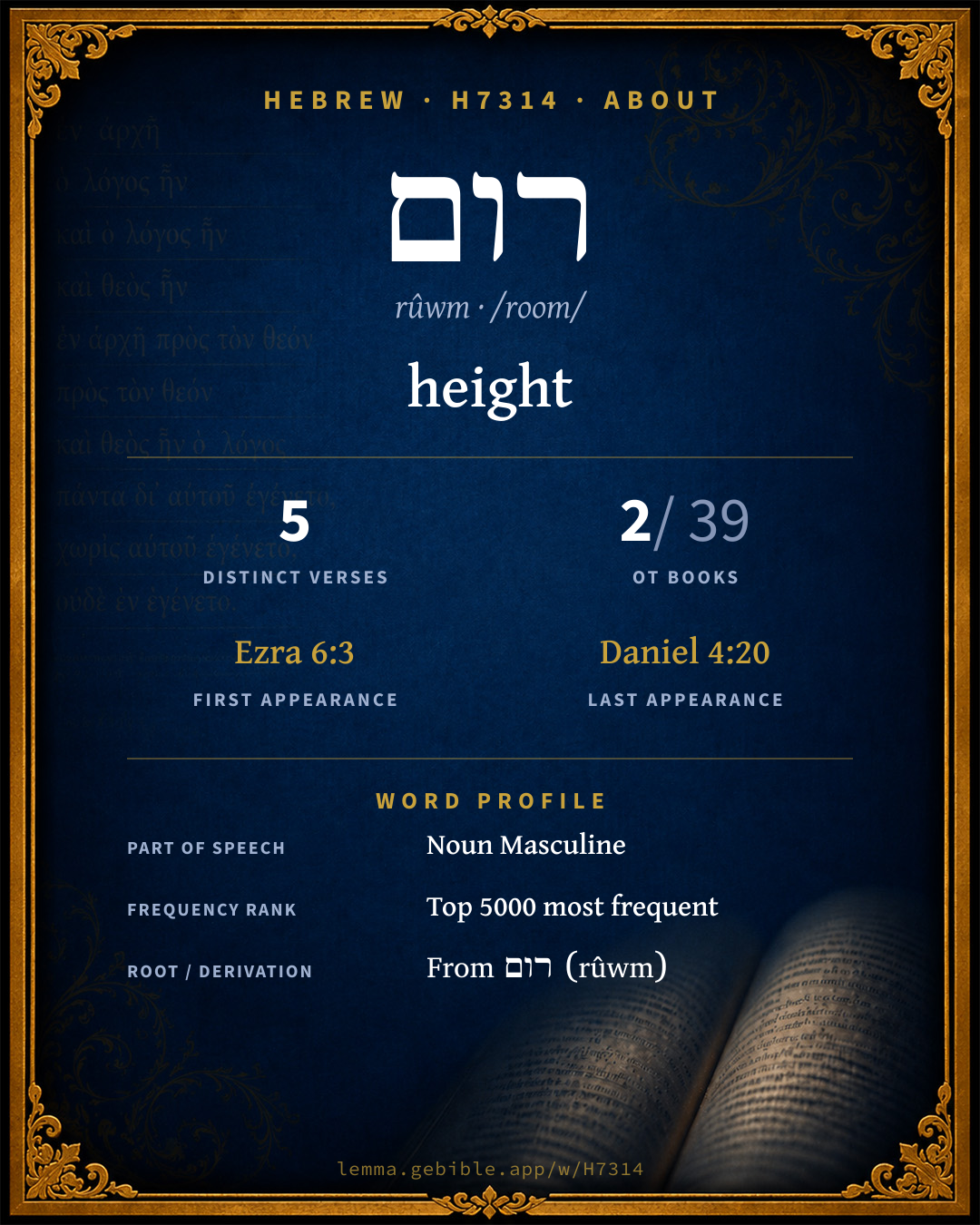
רוּם
height
Full lexicon entry — Brown-Driver-Briggs (BDB)
From Brown-Driver-Briggs (BDB)
Where this word appears
Grammar key — what these labels mean
Part of speech
- Noun
- A naming word — a person, place, thing, or idea.
Noun type
- Common
- A common noun — a general class of person, place, or thing (“king,” “city,” “water”), not a specific name.
State
- Construct
- A noun bound to a following noun in a possessive / “of” relationship (the construct chain).
Gender
- Masculine
- Grammatically masculine.
Number
- Singular
- One.
Every verse where H7314 appears in the Book of Daniel — 4 distinct verses. Click any verse to open its interlinear word-by-word view. Verse text shown in the World English Bible for context — . Each verse’s Hebrew form is shown with its reference; the English is not keyword-highlighted, since the data carries no word-level English alignment. Use “Compare translations” on any verse to read it across multiple English versions. This concordance covers the Hebrew Bible; Septuagint (Greek Old Testament) occurrences are not indexed here.
Daniel
- Daniel 3:1 רוּמֵ/הּ֙ n c ms cs + sfx pers 3ms Nebuchadnezzar the king made an image of gold, whose height was sixty cubits, and the breadth of it six cubits: he set it up in the plain of Dura, in the province of Babylon.
- Daniel 4:10 וְ/רוּמֵ֥/הּ conj + n c ms cs + sfx pers 3ms Thus were the visions of my head on my bed: I saw, and, behold, a tree in the midst of the earth; and the height of it was great.
- Daniel 4:11 וְ/רוּמֵ/הּ֙ conj + n c ms cs + sfx pers 3ms The tree grew, and was strong, and the height of it reached to the sky, and the sight of it to the end of all the earth.
- Daniel 4:20 וְ/רוּמֵ/הּ֙ conj + n c ms cs + sfx pers 3ms The tree that you saw, which grew, and was strong, whose height reached to the sky, and the sight of it to all the earth;
About this entry
At a glance — auto-summarized from this page’s data, not written by a person. Every figure links to its source below. This summary describes the numbers; it doesn’t interpret them.
רום (rûwm) is a Hebrew noun most often rendered “height.” A scarce word — 5 verses in all of the Hebrew Bible. It clusters heavily in Daniel, which alone accounts for 80% of its uses. Scripture first uses it in Ezra 6:3. It clusters with רום and ברם under a shared root. For the data behind this summary, explore the sense tree and the renderings breakdown below.
Gloss history
Strong's 1890 vs modern scholarship
About this word
Strong's H7314 catalogs a Hebrew word from the Hebrew Old Testament.
These counts are not copied from any lexicon or concordance. They are computed here, from the morphology-tagged Hebrew Old Testament. What Lemma adds →
- 5
- distinct verses
- The word appears in 5 distinct verses.
- 2 / 39
- OT books
- The word appears in 2 of 39 Old Testament books.
- #3,337
- by frequency
- Top 5000 most frequent Hebrew words (rank 3,337 of 8,640 Hebrew words by occurrence).
View all 5 occurrences in the concordance →
By traditional corpus
Conventional, traditional groupings — biblical authorship is debated, so this is a traditional corpus grouping, not an authorship claim. Each share is this word’s portion of its verses in that division of the Hebrew canon. Each figure is a share of the word’s 5 distinct verses.
- Writings (Ketuvim) 5 verses · 100%
How translations render this word
Counts come from each version’s own published word-to-Strong’s tagging or interlinear alignment — an approximate guide to how each version renders this word, not a word-level alignment the data otherwise carries. Because each total is that version’s own tagged count, the per-version totals vary from one another and need not match the appearance or distinct-verse counts above. These counts may also differ from a printed concordance because Lemma counts each distinctly tagged rendering and does not collapse phrase taggings into a single head-word total. This is a fixed set of word-tagged versions (KJV, ASV, BSB, ULT) and does not change with the reading translation you choose elsewhere. Each version’s license is shown beside its name below (and on Sources).
BDB lists this Strong’s number as 2 distinct words (homographs). Each count above pools all of them and is not split by sense — see the Senses section below. A low-frequency rendering may belong to a different one of those words, not the primary meaning.
- King James Version†: Height 5×
- American Standard Version†: Height 5×
- Berean Standard Bible†: High 2×, Top 2×
- unfoldingWord Literal Text†: Height 2×, Top 2×
King James Version Public Domain
Renders H7314 across 5† tagged occurrences — most commonly:
American Standard Version Public Domain
Renders H7314 across 5† tagged occurrences — most commonly:
Berean Standard Bible Public Domain
Renders H7314 across 5† tagged occurrences — most commonly:
Plus 1 rendering that appears only once — usually multi-word phrases or single function words the recovered tagging swept in, not distinct renderings.
unfoldingWord Literal Text CC BY-SA 4.0
Renders H7314 across 5† tagged occurrences — most commonly:
Plus 1 rendering that appears only once — usually multi-word phrases or single function words the recovered tagging swept in, not distinct renderings.
34 senses and sub-senses in the full BDB
Hebrew verbs can shift meaning by stem (binyan): Qal is the basic action, Niphal is often passive or reflexive, Piel often intensifies or makes it factitive, and Hiphil is typically causative. The senses below are grouped under the stem BDB assigns to each. This entry also uses Hophal (the passive of Hiphil) and one or more reduplicated stems (the Pōlēl/Pilpēl type), which for hollow or geminate roots behave much like Piel — often intensive or iterative.
What do BDB’s symbols mean?
BDB uses these scholarly abbreviations:
| Symbol | Meaning |
|---|---|
| 𝔊 | the Septuagint (the ancient Greek translation, LXX) |
| 𝔙 | the Vulgate (the Latin translation) |
| 𝔖 | the Syriac version (the Peshitta) |
| 𝔗 | the Targum (the Aramaic translation) |
| ψ | the Psalms |
| √ | root (the underlying root or stem) |
| ‖ | parallel passage (a synonymous or contrasted parallel) |
| † | the dagger: every passage where the word occurs is cited |
The 34 senses and sub-senses the full Brown-Driver-Briggs lexicon distinguishes for this word, in lexicon order (not ranked by frequency), with BDB’s own verbatim wording and sub-sense lettering. Shown in Hebrew script with BDB’s own scholarly abbreviations. The condensed entry is in the Lexicon Entry tab. See also the Forms in the corpus table below.
רום I be high, exalted, rise (OHeb, Ph., Old Aramaic, Palm., all in n.pr.
Qal
- Pf. 3 ms. consec. וְרָם Dt 8:14 +; 3 fs. רָ֫מָה 1 S 2:1 +; וְרָאֲמָה Zc 14:10 v. רָאַם; 3 pl. רָמוּ Pr 30:13 ψ 131:1, רָ֑מּוּ Jb 22:12 (Baer Gi; Ges§ 20 l); Impf. יָרוּם Is 30:18 +, juss. יָרֹם Nu 24:7, וַיָּ֫רָם Ho 13:6 Ez 10:4 [וַיָּרֻם Ex 16:20 v. רמם]; 3 mpl. יְרֻמ֑וּן Is 49:11, etc.; Imv. ms. ר֫וּמָה ψ 21:14 +; Inf. cstr. רוּם Dt 17:20 Ez 10:16, כְּרֻם ψ 12:9 [Bae conj. כֶּרֶם, sf. רוֹמָם Ez 10:17 (Ges§ 72 q); Pt. רָם Is 6:1 +, pl. רָמִים 2:13 +, cstr. רָמֵי 10:33, etc.;— e.g. Deuteronomy 8:14
- 1.
- a. be high, lit. rock (in fig.) ψ 61:3 (מִן comp.); be (set on) high, רָ֑מּוּ Jb 22:12 (of stars), especially pt., = adj., in gen. Is 2:12 (+ גֵּאֶה), of mts. v 14; Dt 12:2, hill Ez 6:13, 20:28; 34:6, throne Is 6:1, trees = tall 2:13 Ez 17:22, cf. (in fig.) Is 10:33 (רָמֵי הַקּוֹמָה); human stature Dt 1:28 (מִן comp.), 2:10, 21; 9:2; רָמִים ψ 78:69 heights (of heaven; ‖ אֶרֶץ); רָמִים of inhab. of heavens Jb 21:22. e.g. Psalms 61:3
- b. especially of י׳, רָם וְנִשָּׂא Is 57:15, cf. ψ 138:6, + עַל־כַּל־הָעַמִּים 99:2, גּוֹיִם 113:4. e.g. Isaiah 57:15
- 2. be raised, uplifted:
- a. of highway Is 49:11 (made high, put in order); voice, Dt 27:14 (pt. = adj.) uplifted. e.g. Isaiah 49:11
- b. fig.: of hand, symbol of might, Dt 32:27, + עַל pers. Mi 5:8; of Isr. in Exodus בְּיָד רָמָה Ex 14:8; Nu 33:3 (both P); of י׳’s hand Is 26:11 ψ 89:14 (‖ תָּעֹז); fig. of presumption Nu 15:30 (P); זְרוֹעַ רָמָה of might Jb 38:15; of eyes, fig. of arrogance Pr 6:17; 30:13 ψ 131:1 (‖ גָּבַהּ לִבִּי), so 18:28, but ‖ 2 S 22:28 of pers.; of heart, fig. of reckless elation, Ho 13:6; Dt 8:14; Ez 31:10 (בְּגָבְהוֹ, ‖ גָּבַהְתָּ בְּקוֹמָה) Dn 11:12, + מִן pers. Dt 17:20; of horn, fig. of triumph 1 S 2:1 (song), ψ 89:25 (v 18 see Hiph.), 112:9, so head 27:6 (+ עַל pers.), 140:9 (join ירומו to v 10, but read יָרִימוּ Che, cf. Hup-Now). e.g. Deuteronomy 32:27
- c. of pers., be exalted (in fig.), king Nu 24:7 (JE; + מִן comp.; ‖ תִּנַּשֵּׂא); of God (י׳, i.e. shew his exaltation) Is 30:18; 2 S 22:47 = ψ 18:47, ψ 21:14; 46:11(×2), + עַל־(הַ)שָּׁמַיִם 57:6, 12; 108:6; עֶבֶד י׳ Is 52:13, י׳’s people ψ 89:17; rebellious 66:7 (Qr; Kt Hiph.: shew exaltation); worthlessness (personif.) ψ 12:9; foe 13:3; city Pr 11:11. e.g. Numbers 24:7
- 3. be lifted, rise, of ark, מֵעַל־הארץ Gn 7:17 (J), so of cherubim Ez 10:16, cf. v 17; כְּבוֹד י׳ v 4 (מֵעַל הַכְּרוּב).—Pr 24:7 v. i. רָאמוֹת p. 910b. e.g. Genesis 7:17
Pōʿlēl
- Pf. 3 fs. sf. רֹמְמָ֑תְהוּ Ez 31:4; 1 s. רוֹמַמְתִּי Is 1:2; 23:4; Impf. 3 ms. יְרוֹמֵם Ho 11:7, sf. יְרוֹמְמֵנִי ψ 27:5, וִירוֹמִמְךָ 37:34; 1 s. sf. וַאֲרֹמְמֶ֑נְהוּ Ex 15:2 (Ges§ 58 i), etc. (אֵרוֹמָם v. Hithpōʿl.); Imv. mpl. רוֹמְמוּ ψ 99:5, 9; Inf. cstr. לְרוֹמֵם Ezr 9:9; Pt. מְרוֹמֵם 1 S 2:7, sf. מְרוֹמְמִי ψ 9:14, f. רוֹמֵמָה 118:16 (מ om., Hup-Now Bae; cf. Köi. 454);— e.g. Ezekiel 31:4
- 1.
- a. raise, rear, children Is 1:2; 23:4 (both ‖ גִּדֵּל). e.g. Isaiah 1:2
- b. cause tree to grow, subj. תְּהוֹם Ez 31:4 (‖ גִּדֵּל). e.g. Ezekiel 31:4
- c. rear, erect, temple Ezr 9:9. e.g. Ezra 9:9
- 2. lift up:
- a. in fig., acc. pers., subj. י׳ ψ 27:5 (+ בְּצוּר); + מִן comp. 2 S 22:49 = ψ 18:49, + מִן from 9:14; acc. om. Ho 11:7 (si vera l., cf. We Now). e.g. Psalms 27:5
- b. raise waves of sea, subj. wind, ψ 107:25. e.g. Psalms 107:25
- c. exalt, acc. pers., subj. י׳ Jb 17:4 (read perhaps תְּרִמֵם, so Bu, cf. Di), ψ 37:34 (+ לָרֶשֶׁת אָ֑רֶץ); acc. om. 1 S 2:7 ψ 118:16 (in victory); subj. wisdom, acc. pers. Pr 4:8, cf. צְדָקָה תְּרוֹמֵם־גּוֹי 14:34. e.g. Job 17:4
- 3. exalt, extol, acc. י׳, ψ 30:2, ‖ אוֹדֶה Is 25:1 ψ 118:28, ‖ הִשְׁתַּחֲווּ 99:5, 9, ‖ הִלֵּל 107:32, ‖ בֵּרַךְ 145:1, ‖ אַנְוֵהוּ Ex 15:2; acc. שֵׁם י׳ ψ 34:4 (‖ גִּדֵּל). e.g. Psalms 30:2
Pōʿlal
- Impf. 3 fpl. תְּרוֹמַמְנָה ψ 75:11 be lifted up, of horns (cf. Qal 2 b); Pf. 3 ms. וְרוֹמַם 66:17 and he was extolled (so Ki al.; but v. רוֹמָם infr.); Pt. מְרוֹמַם Ne 9:5 extolled, of י׳’s name (cf. Pōʿlēl 3), + עַל־בְּרָכָה וג׳. e.g. Psalms 75:11
Hiphil
- Pf. 3 ms. הֵרִים 1 K 11:27 +; 2 ms. הֲרִימוֹתָ 2 K 19:22 ψ 89:43, וַהֲרֵמֹתָ֫ Nu 31:28; 2 mpl. consec. וַהֲרֵמֹתֶם 18:26, etc.; Impf. 3 ms. יָרִים Gn 41:44 +, juss. יָרֵם Nu 17:2; 1 S 2:10, וַיָּ֫רֶם Ex 7:20 +, sf. וַיְרִימֶהָ Gn 31:45, etc.; Imv. ms. הָרֵם Ex 14:16; Is 58:1, הָרִימָה ψ 74:3, etc.; Inf. cstr. הָרִים Is 10:15 +, sf. הֲרִימִי Gn 39:18, etc.; Pt. מֵרִים Ex 35:24 +, etc.;— e.g. 1 Kings 11:27
- 1.
- a. (1) raise, lift, c. acc., hand Ex 17:11 (E), Nu 20:11 (P), + אֶל־י׳ (in oath) Gn 14:22 cf. (אֶל־הַשָּׁמַיִם) Dn 12:7, + ב pers. against 1 K 11:26, 27; feet; פְּעָמִים ψ 74:3, i.e. run (+ ל dir.); hand or foot Gn 41:44 (E), i.e. make any movement (hyperb.); head ψ 110:7 (Assyrian ullû rêšu DlHWB 62a), cf. יָרִימוּ 140:9 (so read, v. Qal 2 b); face, אֶל־י׳ Ezr 9:6; hand of another, subj. י׳, fig. of giving strength to, ψ 89:43, so head 3:4; c. acc. of rod Is 10:15; Ex 14:16 (P), הֵרִים בַּמַּטֶּה 7:20 (E); rod subj., c. acc. rei Is 10:15. (2) raise poor אֶבְיוֹן, c. מִן loc. 1 S 2:8 ψ 113:7. e.g. Exodus 17:11
- b. lift up voice Gn 39:15, 18 (J; both + קָרָא), Is 40:9(×2) (acc. om.), 58:1; Ezr 3:12; + בִּתְרוּעָה Ez 21:27, בַּחֲצֹצְרוֹת 2 Ch 5:13; + ל pers. Is 13:2, לָעָב Jb 38:34, + עָל pers. against 2 K 19:22 = Is 37:23; הֵרִים בְּקוֹל 1 Ch 15:16. e.g. Genesis 39:15
- c. (take into one’s hand and) lift, take up, stone Jos 4:5 (JE; עַל־שִׁכְמוֹ), leg (of sacrif. meal) 1 S 9:24, mantle 2 K 2:13, axe 67 (acc. om.), yoke Ho 11:4 (עַל־לְחֵיהֶם), censers Nu 17:2 (P; + מִבֵּין), ashes Lv 6:3. e.g. Joshua 4:5
- d. set up, erect, stone as מַצֵּבָה Gn 31:45 (E); standard, + אֶל of people Is 49:22, עַל 62:10. e.g. Genesis 31:45
- e. set on high, throne, מִמַּעַל לְכוֹכְבֵי אֵל Is 14:13; nest (subj. נֶשֶׁר) Jb 39:27. e.g. Isaiah 14:13
- f. lift up, exalt, c. acc. pers., subj. י׳ 1 K 14:7; 16:2 ψ 89:20 (all c. מִן), ψ 75:8 (opp. יַשְׁפִּיל); subj. קָלוֹן Pr 3:35, cf. 14:29; c. acc. קֶרֶן, in both good and bad sense (cf. Qal 2 b) 1 S 2:10; La 2:17 (לַמָּרוֹם), ψ 89:18 (Kt; Qr Qal), 92:11; 148:14 ψ 75:5, 6; but 1 Ch 25:5 sound the horn; inf. = exaltation ψ 75:7; 66:7 v. Qal 2 c. e.g. 1 Kings 14:7
- 2. lift up and take away, remove, c. acc. הָעֲטָרָה Ez 21:31; acc. rei + מִן loc. Is 57:14, Lv 2:9; 4:8, 19; 6:8 Nu 18:30, 32; = do away with, גְּרֻשֹׁתֵיכֶם Ez 45:9 (מֵעַל of people), הַתָּמִיד Dn 8:11 (Kt; Qr Hoph.); = set apart, מֶכֶס Nu 31:28 (מִן pers.). e.g. Ezekiel 21:31
- 3. lift off and present, contribute, offer:
- a. to י׳, c. acc. cogn. תְּרוּמָה, Ez 45:13; 48:8, 20; Nu 15:20(×2) (P), Ex 35:24 (P); + לי׳ Ez 45:1; 48:9; Nu 15:19; 18:19, 24; 31:52; תְּרוּמַת י׳ 18:26 (+ מִן rei), v 28, 29 (all P); ת׳ בֵּית־א׳ Ezr 8:25. e.g. Ezekiel 45:13
- b. c. acc. rei, + לְי׳ Lv 22:15. e.g. Leviticus 22:15
- c. contribute, acc. rei, ל pers. (for sacrif.), 2 Ch 30:24(×2;) 35:7, 8 (acc. om.), v 9. e.g. 2 Chronicles 30:24
Hophal
- Pf. 3 ms. הוּרָ֑ם Ex 29:27, הֻרַם Dn 8:11 Qr (Kt Hiph.); Impf. 3 ms. יוּרָם Lv 4:10;—be taken off from (מִן) Lv 4:10 (P), cf. Ex 29:27 (P; ‖ הוּנַף); be abolished Dn 8:11 Qr (cf. Hiph. 2); Bev (after 𝔊) ins. Pt. מוּרָם after הַתָּמִיד v 13. e.g. Exodus 29:27
Hithpōʿl
- Impf. 3 ms. וַיִתְרוֹמֵם וַיִתְגַּדֵּל עַל־כָּל־אֵל Dn 11:36 and he shall exalt and magnify himself above, etc.; 1 s. (ת assim.) אֵרוֹמָ֔ם Is 33:10 (Ges§ 54c Köi. 454) I will raise myself (+ אָקוּם, אֶנָּשֵׂא). e.g. Daniel 11:36
רום II [m.] height, haughtiness (proposes inf.)
- 1. height, loftiness, שָׁמַיִם לָר׳ וָאָרֶץ לָעֹמֶק Pr 25:3; cstr. רוּם עֵינַיִם fig. of haughtiness Is 10:12 (‖ גֹּדֶל לֵבָב), Pr 21:4 (‖ רְחַב־לֵב); so רֻם לִבּוֹ Je 48:29 (‖ גַּאֲוָה, גָּאוֹן, גֹּבַתּ); then alone: e.g. Proverbs 25:3
- 2. haughtiness, רוּם אֲנָשִׁים Is 2:11, 17 (both ‖ גַּבְהוּת). e.g. Isaiah 2:11
Senses from the full Brown-Driver-Briggs lexicon (Brown, Driver, Briggs; Oxford 1906 — public domain), digitized via Sefaria, supplemented by the OpenScriptures HebrewLexicon (CC BY 4.0). Full attribution on Sources.
Word origin
I. vb. be high, exalted, rise (OHeb, Ph., Old Aramaic, Palm., all in n.pr.; Sab. in רים epith. dei et regis Fell ZMG liv (1900), 25f. also in n.pr. Mordtm ib. xxx (1876), 36 SabDenkm No. 14, 1. 1; Arabic رام be high, dial. of Oman (JayakarJA xxi. 813, 875) and Zanzibar (PräZMG xxxiv (1880), 218); Ethiopic in deriv.; Aramaic רָם ܪܘܡ (very often in der. spec. and deriv.));—
II. n.[m.] height, haughtiness (proposes inf.);—abs. ר׳,
— Brown-Driver-Briggs (Oxford 1906, public domain), digitized via Sefaria, supplemented by the OpenScriptures HebrewLexicon (CC BY 4.0). See Sources.
Derived from רום (rûwm) (H7313) — to rise.
Jastrow Dictionary
A second Hebrew/Aramaic lexicon for comparison, covering Aramaic and post-biblical (Talmudic, Targumic, Midrashic) usage that the biblical-Hebrew BDB does not. Matched by lemma rather than by Strong’s number, so a lemma may carry more than one Jastrow headword (shown separately below), and the entries cover usage well beyond the Bible.
רוּם
- (b. h.) [to swing,] to be high, lifted up; to rise. Ab. Zar. 24ᵇ רוֹמִי רומי השיטה Ar. (ed. רוני) rise, rise, acacia (holy ark)!; Gen. R. s. 54 רומי השטה.
- 1. to lift up, raise. Cant. R. to III, 4 (ref. to Ps. LXXV, 8) ישפיל … ויָרִים לכרש וכ׳ he shall lower Belshazzar, and lift up Cyrus and Darius; Yalk. Ps. 812 אני הוא משפיל ומֵרִים I lower and raise; מלכות … מרים he lays low one empire and raises another empire &c.; a. e. e.g. Psalms 75:8
- 2. to take off, remove. Ruth R. to I, 17 (ref. to Ez. XXI, 31) הסר … והָרִים העטרה וכ׳ remove the bonnet from our teachers, and take the crown off the nations; a. e. e.g. Ezekiel 21:31
- to be taken off, esp. to be separated as an offering, priest’s share &c.; to be consecrated. Ḥall. II, 8 שלא הוּרְמָה חלתה (not הורם), v. חַלָּה. Sifré Num. 110 (ref. to Num. IV, 20) את שמוּרָם קודש וכ׳ that which is separated is to be sacred, and the remainder secular, but (no Ḥallah is to be taken,) when both would be sacred. Zeb. V, 6 המורם מהם וכ׳ the same rules apply to what is taken off them for the priest; a. fr. e.g. Numbers 4:20
- to lift up, elevate. Tanḥ. Matt. 6; Num. R. s. 22, end (ref. to Num. XXXI, 9 and XXXII, 1) הא שהשפיל … ור׳ וכ׳ here you see that the Lord lowered the Midianites, and raised the Israelites. Ib. (ref. to I Sam. II, 7) אף … מְרוֹמֵם את זה in the anger which he brings to bear on one, he raises the other. Pesik. R. s. 10 (ref. to Ps. LXXV, 8) משפיל לכל … ומרומם וכ׳ he lowered every one that had part in the worship of the golden calf, and elevated every one that had no part &c. Ib. ועכשיו … אף כך רוֹמֵם ראשם and now that thou hast lifted up my head, lift thou up their head likewise; לך ר׳ ראשם go and lift up their heads (announce to them the divine pardon). Ib. (ref. to Ex. XXX, 12) כל מה שאתה יכול לרוֹמֵם … רוֹמְמָהּ שבאילו לי אתה מְרוֹמֵם (not רומם) in whatever way thou canst elevate that nation elevate it, for by this thou elevatest me. Ex. R. s. 25 ורִימְּמָן הקב"ה וכ׳ (fr. רָמַם) and the Lord raised them above all; a. fr. e.g. Numbers 31:9
- , Nithpol. נִתְרוֹמֵם to be lifted up; to pride one’s self. Y. Ber. IX, 14ᵃ top יתגדל … ויתברך ויִתְרוֹמַם שמך וכ׳ thy Name be magnified … and blessed and lifted up (praised) for &c.; Y. Taan. I, 64ᵃ top; Gen. R. s. 13. Meg. 17ᵇ כיון … מִתְרוֹמֶמֶת קרן וכ׳ when the transgressors cease to exist, the horn of the righteous will be uplifted. Num. R. s. 22; Tanḥ. Matt. 6, a. e. אין אדם מִתְרוֹמֵם, v. רוֹמֵמוּת. Tanḥ. Mick. 3 ונִתְרוֹמְמוּ and they were raised (to power); a. e.—[Yalk. Gen. 79 מתרוממות, read: מְתַמְּרִין, v. תָּמַר.]
רוּם ²
- , to be high. Targ. Ps. LXXXIX, 14. Targ. O. Deut. VIII, 14 וִירַם ed. Berl. (oth. ed. וִירִים, וְרִים); a. fr.—2) to lift; to remove. Targ. Ps. LXXXIX, 18 תְּרִים.—Y. Bets. I, 60ᶜ bot. ורִימוּנָהּ and they lifted it. Y. Snh. X, 29ᵃ bot. כיון דרִימֵיה when he had removed it. Y. Ab. Zar. IV, 43ᵈ מן דרִימוֹן when he had removed them (the stones); a. e.
- 1. to swing; to wave an offering; to uplift. Targ. Ex. VII, 20. Targ. O. ib. XVII, 11 מַרִים ed. Berl. (ed. Vien. יְרִים). Targ. Is. XXX, 28 (h. text להנפה). Targ. Lev. XXIII, 11 (h. text והניף); a. fr.—Part. pass. מְרִים; f. pl. מְרִימָן. Targ. Is. III, 16 (h. text נטויות).
- 2. to lift take off, remove. Lam. R. to V, 5 אֲרִימוּן ראשיה מיניה cut his head off. Y. Ab. Zar. l. c. בחייך דאת מֵרִים אילין וכ׳ by thy life! thou must remove these stones; a. e.
- 1. to be uplifted, rise. Targ. Gen. VII, 17; a. e.
- 2. to be swung, waved (as an offering). Targ. Ex. XXIX, 27 (h. text הונף); a. e.
- 3. to be taken off, removed. Lam. R. to V, 16 והא ניחא ליה דאיתרים רישיה וכ׳ it would have been better for him that his head be cut off rather than do this; Koh. R. to X, 5 נייח הוה דיִיתְּרִים וכ׳; Y. Sot. IX, 24ᵇ sq. נייח ליה אילו איתרים וכ׳.
- to elevate, extol. Targ. Ps. XXXVII, 34. Ib. CXLV, 1. Targ. Y. I Deut. XXXII, 3; a. e.—Part. pass. מְרוֹמַם. Targ. Ps. XVIII, 47 (not מרומֵם); Targ. II Sam. XXII, 47; a. e.—V. מְרָמַם.
- to be lifted up; to be extolled. Targ. Ps. CVII, 25. Ib. LXXV, 11. Ib. CVIII, 6; a. e.—Y. Maas. Sh. IV, end, 55ᶜ את מִתְרוֹמְמָא, v. הֲדָרָא.
- , contr. רוֹרֵם, רָרֵם to elevate. Targ. Ps. IX, 14 מְרוֹרֵם Ms. (ed. מְרוֹמֵם). Ib. XXVII, 5. Targ. Prov. XVII, 19 מְרָרֵים Ms. (ed. מרים, מורים). Ib. XIV, 34.
- , contr. אִתְרוֹרַם, אִתְרָרַם
- 1. to be elevated, rise. Targ. Ps. LVII, 6; 12. Targ. Prov. XI, 11; a. e.
- 2. to be haughty, proud. Ib. XVIII, 12.—Apocopated form: אִתְרַמַּר. Ib. VI, 30 לא למִתְרַמָרוּ וכ׳ ed. (h. text יבוזו) let them not look haughtily down on the thief &c.; v. דְּמַר.
רוּם II
- preced.) height. Ber. 6ᵇ (ref. to כרם זלות, Ps. XII, 9) אלו דברים … ברוֹמוֹ וכ׳ this means the things which stand on the height of the world (sublime things like prayer &c.) and which men treat lightly. Meg. 14ᵃ בני אדם שעומדין ברומו וכ׳ men that stood very high. Midd. II, 3; III, 6 ר׳ מעלה וכ׳ the height of each step was &c. Sifré Deut. 199 גדול השלום שדרי ר׳ וכ׳ peace is something great, for the dwellers on high (angels) need peace; Yalk. ib. 923; a. e. e.g. Psalms 12:9
רוּם ³
- 1. height. Targ. Y. Deut. XI, 18 על ר׳ ידכון on the highest point of your arm (v. גּוֹבַהּ). Targ. Is. XIV, 12, sq. Targ. O. Num. XXIII, 22; a. fr.—Y. Snh. X, 29ᵃ הוה ארונא … לר׳ וכ׳ the ark carried the priests high up and cast them down to the ground. B. Bath. IV, 2; ib. 61ᵃ, v. עוּמְקָא I. Lam. R. to IV, 15 ברוּמְהוֹן (some ed. ברוֹמֵיהֶן, pl.) of their high stature, v. שׁוּף I ch.; Lev. R. s. 16 ברומחין (corr. acc.); a. e.—Pl. רוֹמִין, רוֹמֵי. Sot. 48ᵇ, v. שׁוּט I ch.—V. מְרוֹמָא I.
- 2. haughtiness. Targ. Ps. LXXIII, 8.—V. רָמוּתָא.
A Dictionary of the Targumim, the Talmud Babli and Yerushalmi, and the Midrashic Literature (Marcus Jastrow; London, Luzac, 1903) — Public Domain. Digitized via Sefaria. Digitized via Sefaria. Full attribution on Sources.
Forms in the corpus
The 3 distinct written forms H7314 takes in the Hebrew Bible, most frequent first — each parse links to that state’s occurrences in the concordance. Hebrew forms include their vowel points and cantillation, so a single lemma takes many written forms.
| Form | Parsing | Example | Uses |
|---|---|---|---|
| וְ/רוּמֵ/הּ֙ | Noun, Common, Masculine, Singular, Construct | Daniel 4:11 | 2 |
| רוּמֵ/הּ֙ | Noun, Common, Masculine, Singular, Construct | Daniel 3:1 | 2 |
| וְ/רוּמֵ֥/הּ | Noun, Common, Masculine, Singular, Construct | Daniel 4:10 | 1 |
Same root — word family
Other BDB entries built from the same root as H7314, grouped by Strong’s listed origin. These share a root / origin per the lexicon — not necessarily a shared meaning. Each links to that word’s own entry.
Derives from
Shares the same root
Compare all same-root words → They share a root, not necessarily a meaning.
Septuagint verse parallels
This word appears in 5 verses that also exist in the Greek Old Testament (Septuagint), out of the 5 Hebrew verses it occurs in. You can read those verses in Greek by switching the Old Testament edition to the Septuagint.
Read these verses in the Septuagint
This is a verse-level parallel only — the same verses exist in both the Hebrew and Greek Old Testaments. No word-level Hebrew↔Greek correspondence is claimed: the data carries no such alignment, so no Greek word is shown as this Hebrew word’s translation. Coverage is not total — the Septuagint omits the deuterocanon and renumbers the Psalms, so some Hebrew verses have no direct Greek parallel.