Daniel 4:11

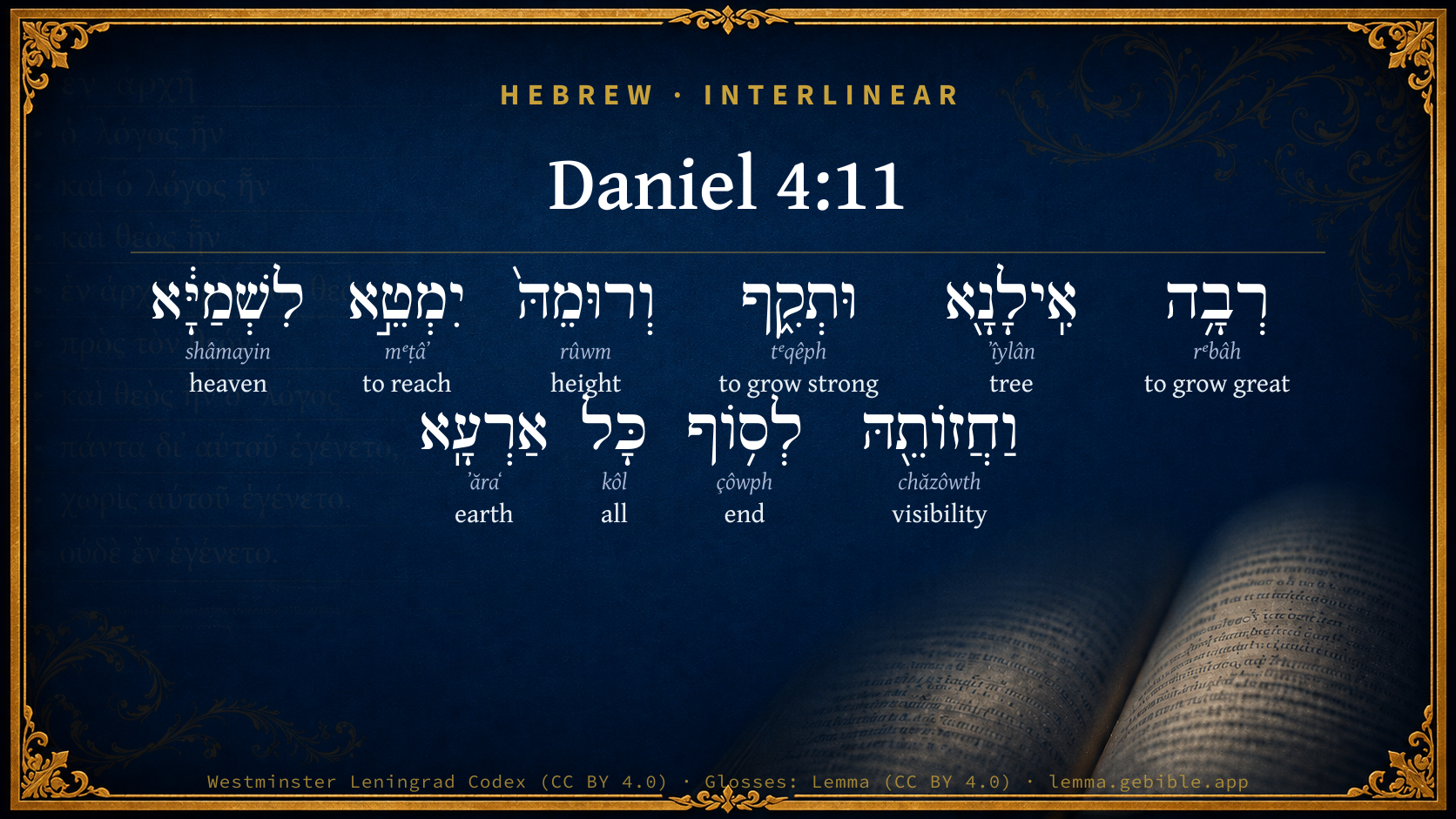
Hebrew (Westminster Leningrad Codex) Daniel 4:11 appears in the Hebrew Old Testament. The text above is from the Westminster Leningrad Codex. Each word links to its Strong’s number, a concise gloss, and parsing drawn from the Open Scriptures Hebrew Bible morphology. Click any word for its full Brown-Driver-Briggs (BDB) entry.
Download image
Cite this verse

Daniel 4:11 (World English Bible). Public Domain. Lemma interlinear Bible study tool, https://lemma.gebible.app/v/daniel/4/11.

Show BibTeX & RIS
BibTeX
RIS
English Translation
The tree grew, and was strong, and the height of it reached to the sky, and the sight of it to the end of all the earth.
World English Bible · Public Domain
Highlights
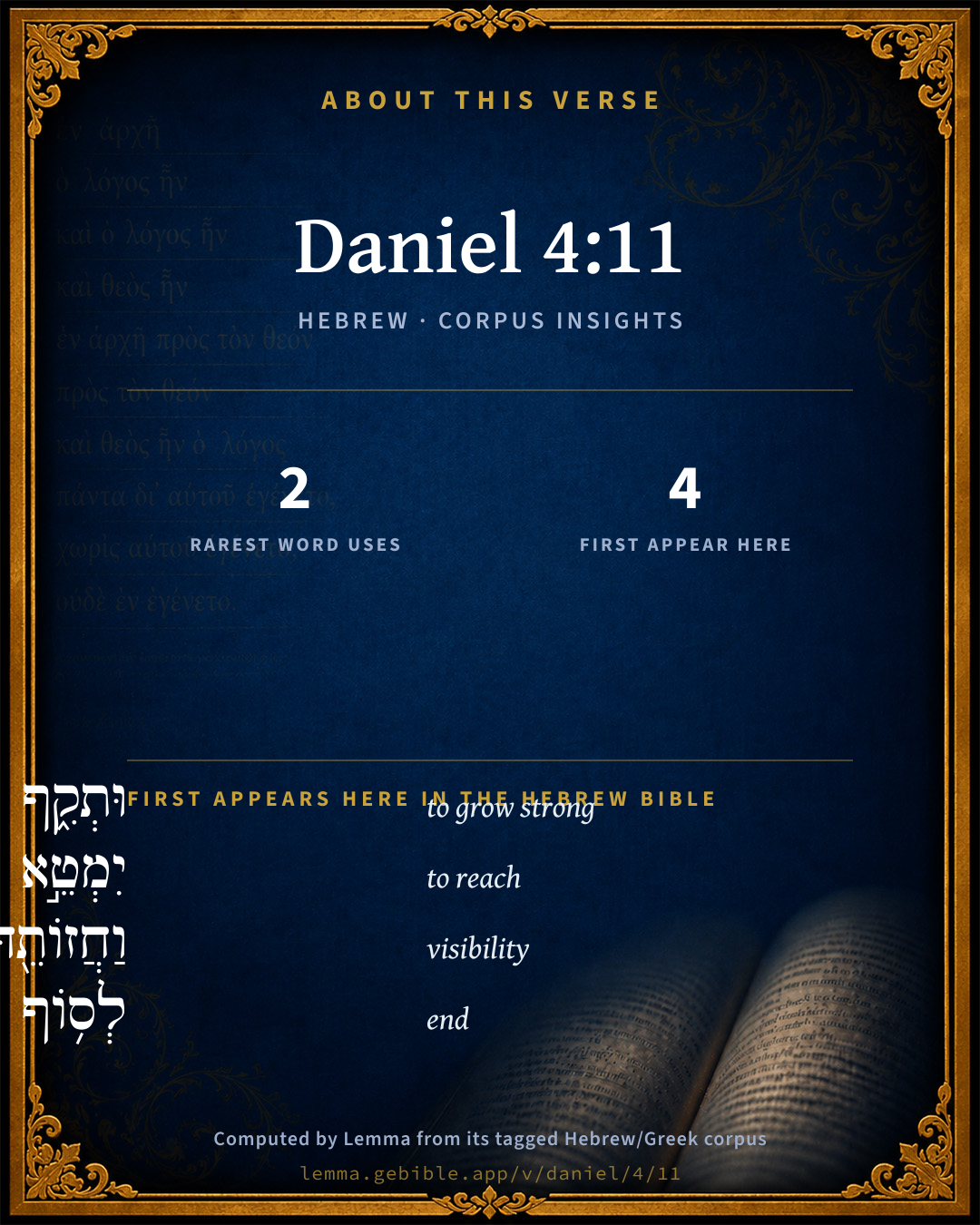
  • 4 first appearances in the Hebrew Bible
Full analysis ↓
Download a study sheet

One document with this verse’s original text, its word-by-word gloss line, the meaning frame, cross-references with their text, attributed commentary, and full source and license credits — printable, and it pastes into notes with its structure intact.

This verse Autodidact and up

Study sheet (.html) Plain text (.txt)

A passage Seminary Student

Up to 50 verses in one chapter. A passage sheet keeps up to 6 commentary sources and 12 cross-references per verse, in the order this page ranks them, and says so on the sheet whenever that leaves anything out. Ask for a single verse and you get the Autodidact verse sheet above.

Everything on this page stays free to read, with no account — the sheet is a download of what is already on screen, not access to it.

Want to remove ads? Support Godless Engineer
Compare translations 3

The same verse in 3 English versions, stacked beneath the original-language interlinear above. Click any original word for its lexicon entry.

Each is an independent rendering of the whole verse — the interlinear is not word-aligned to these translations.

Highlighted words mark where these versions differ — a whole-verse word diff, not a word-by-word alignment.

  • World English Bible Public Domain
    The tree grew, and was strong, and the height of it reached to the sky, and the sight of it to the end of all the earth.
  • King James Version Public Domain
    The tree grew, and was strong, and the height thereof reached unto heaven, and the sight thereof to the end of all the earth:
  • unfoldingWord Literal Text CC BY-SA 4.0
    The tree grew and became strong. Its top reached to heaven, and it was visible to the end of the whole earth.

unfoldingWord Literal Text — © unfoldingWord, licensed CC BY-SA 4.0. Word-aligned USFM3 via Door43 (git.door43.org/unfoldingWord/en_ult).

Versions to compare (up to 4)

3 of 4 selected

Show all 18 translations

Every available English version of this verse, each an independent rendering of the whole verse.

  • World English Bible Public Domain
    The tree grew, and was strong, and the height of it reached to the sky, and the sight of it to the end of all the earth.
  • Berean Standard Bible Public Domain
    The tree grew large and strong; its top reached the sky, and it was visible to the ends of the earth.
  • Majority Standard Bible Public Domain
    The tree grew large and strong; its top reached the sky, and it was visible to the ends of the earth.
  • King James Version Public Domain
    The tree grew, and was strong, and the height thereof reached unto heaven, and the sight thereof to the end of all the earth:
  • American Standard Version (1901) Public Domain
    The tree grew, and was strong, and the height thereof reached unto heaven, and the sight thereof to the end of all the earth.
  • Revised Version (1885) Public Domain
    The tree grew, and was strong, and the height thereof reached unto heaven, and the sight thereof to the end of all the earth.
  • Geneva Bible (1599) Public Domain
    And cried aloude, and said thus, Hew downe the tree, and breake off his branches: shake off his leaues, and scatter his fruite, that the beastes may flee from vnder it, and the foules from his branches.
  • Douay-Rheims (1899) Public Domain
    The tree was great, and strong: and the height thereof reached unto heaven: the sight thereof was even to the ends of all the earth.
  • Young's Literal Translation Public Domain
    become great hath the tree, yea, strong, and its height doth reach to the heavens, and its vision to the end of the whole land;
  • Literal Standard Version CC BY-SA 4.0
    the tree has become great, indeed, strong, and its height reaches to the heavens, and its vision to the end of the whole land;
  • Unlocked Literal Bible CC BY-SA 4.0
    The tree grew and became strong. Its top reached to the heavens, and it could be seen to the ends of the whole earth.
  • unfoldingWord Literal Text CC BY-SA 4.0
    The tree grew and became strong. Its top reached to heaven, and it was visible to the end of the whole earth.
  • Darby Bible Public Domain
    The tree grew, and was strong, and its height reached unto the heavens, and the sight thereof to the end of all the earth.
  • World Messianic Bible Public Domain
    The tree grew and was strong. Its height reached to the sky and its sight to the end of all the earth.
  • Webster's Bible Public Domain
    The tree grew, and was strong, and its hight reached to heaven, and the sight of it to the end of all the earth:
  • Free Bible Version CC BY-SA 4.0
    It grew strong and tall, reaching high into the sky so it could be seen by everyone in the whole world.
  • Bible in Basic English Public Domain
    And the tree became tall and strong, stretching up to heaven, and to be seen from the ends of the earth:
  • JPS Tanakh (1917) Public Domain
    (4-8) The tree grew, and was strong, and the height thereof reached unto heaven, and the sight thereof to the end of all the earth.

Literal Standard Version (2020), Covenant Press — licensed CC BY-SA 4.0. Text via the HelloAO Bible API (eBible.org). Unlocked Literal Bible (unfoldingWord) — licensed CC BY-SA 4.0. Text via the HelloAO Bible API (eBible.org). unfoldingWord Literal Text — © unfoldingWord, licensed CC BY-SA 4.0. Word-aligned USFM3 via Door43 (git.door43.org/unfoldingWord/en_ult). Free Bible Version, Dr. Jonathan Gallagher — licensed CC BY-SA 4.0. Text via the HelloAO Bible API (eBible.org).

Word by word

More ways to search: Search by grammar → Find every occurrence → Compare this word →

Practice this passage: Drill this verse → Learn its vocabulary →

וַחֲזוֹתֵ֖הּ
chăzôwth
H2379
“and · visibility · his”
Adjective, C + Noun, Common, Feminine, Singular, Construct + Suffix, Personal, 3rd Person, Masculine, Singular
Part of Speech
Adjective + Noun
Type
Common
Gender
Feminine
Number
Singular
State
Construct
Full BDB Definition

Origin: from H2370

TWOT: 2725b

view, sight, visibility
  1. רְבָ֥ה rᵉbâh H7236 “to grow great” Adjective, V, Plural
  2. אִֽילָנָ֖א ʼîylân H363 “tree · the” Adjective, N, Common + Particle, Definite Article
  3. וּתְקִ֑ף tᵉqêph H8631 “and · to grow strong” Adjective, C + Verb, Qal, Perfect, 3rd Person, Masculine, Singular
  4. וְרוּמֵהּ֙ rûwm H7314 “and · height · his” Adjective, C + Noun, Common, Masculine, Singular, Construct + Suffix, Personal, 3rd Person, Masculine, Singular
  5. יִמְטֵ֣א mᵉṭâʼ H4291 “to reach” Adjective, V
  6. לִשְׁמַיָּ֔א shâmayin H8065 “to/for · heaven(s) · the” Adjective, R + Noun, Common, Masculine, Plural, Determined + Particle, Definite Article
  7. לְס֥וֹף çôwph H5491 “to/for · end of” Adjective, R + Noun, Common, Masculine, Singular, Construct
  8. כָּל kôl H3606 “all of” Adjective, N, Common
  9. אַרְעָֽא ʼăraʻ H772 “earth · the” Adjective, N, Common + Particle, Definite Article

About this verse

These counts appear in no published source. They are computed here, from the morphology-tagged text and Lemma’s own curated glosses. What Lemma adds →

10
words
10
distinct lemmas
Prophets
section

Notable vocabulary

The rarest word here is וַחֲזוֹתֵ֖הּ visibility H2379 — appearing just 2 times in the whole Hebrew Bible.

First appearance in Scripture

These words make their first canonical appearance in the Hebrew Bible here:

  • וּתְקִ֑ף to grow strong H8631
  • יִמְטֵ֣א to reach H4291
  • וַחֲזוֹתֵ֖הּ visibility H2379
  • לְס֥וֹף end H5491

Shared distinctive vocabulary

וַחֲזוֹתֵ֖הּ visibility H2379 occurs in 2 verses of the Hebrew Bible. Also found in:

Grammatical profile

  • 1 verb
  • 3 nouns
  • 3 adjectives
  • 3 particles

Verb forms

  • וּתְקִ֑ף Qal · Perfect

Hebrew & Septuagint length

In English translation the verse runs 27 words from the Hebrew and 33 from the Septuagint (LXX English) — closely comparable.

A rough comparison of the two English renderings, which tokenize alike — not a word-level alignment.

Word counts can differ between the Hebrew and the Greek without any difference in meaning — e.g. the Hebrew direct-object marker אֵת has no separate Greek word, and Greek often adds the article ὁ.

Cross-references

4

Topical passages linked to Daniel 4:11 in the Treasury of Scripture Knowledge — connected by theme and wording, ordered by reader-vote popularity; previews shown in the World English Bible.

  • Deuteronomy 9:1 Hear, Israel: you are to pass over the Jordan this day, to go in to dispossess nations greater and mightier than yourself, cities great and fortified up to the sky,
  • Daniel 4:21–22 whose leaves were beautiful, and the fruit of it much, and in it was food for all; under which the animals of the field lived, and on whose branches the birds of the sky had their habitation:
  • Matthew 11:23 You, Capernaum, who are exalted to Heaven, you will go down to Hades. For if the mighty works had been done in Sodom which were done in you, it would have remained until this day.
  • Genesis 11:4 They said, "Come, let's build us a city, and a tower, whose top reaches to the sky, and let's make us a name; lest we be scattered abroad on the surface of the whole earth."

Cross-references courtesy of OpenBible.info (CC BY 4.0).

Hebrew and Greek witnesses Masoretic Hebrew ↔ Greek Septuagint

The same verse in the two great witnesses to the Old Testament, shown verse-for-verse.

These are two independent witnesses, not word-aligned to each other, and the Septuagint is shown in lemma (dictionary) form.

Hebrew Daniel 4:11 Masoretic · Westminster Leningrad Codex

רְבָ֥ה אִֽילָנָ֖א וּתְקִ֑ף וְרוּמֵהּ֙ יִמְטֵ֣א לִשְׁמַיָּ֔א וַחֲזוֹתֵ֖הּ לְס֥וֹף כָּל אַרְעָֽא

The tree grew, and was strong, and the height of it reached to the sky, and the sight of it to the end of all the earth.

World English Bible · Public Domain

Greek LXX Daniel 4:11 Septuagint · lemma form

καί ἀναἵστημι ὁ πρωΐ ἐκ ὁ κοίτη ἐγώ καλέω ὁ δανιηλ ὁ ἄρχων ὁ σοφιστής καί ὁ ἡγέομαι ὁ κρίνω ὁ ἐνύπνιον καί διαἡγέομαι αὐτός ὁ ἐνύπνιον καί ὑποδεικνύω ἐγώ πᾶς ὁ σύγκρισις αὐτός

Cut down the tree, and pluck off its branches, and shake off its leaves, and scatter its fruit: let the wild beasts be removed from under it, and the birds from its branches.

LXX2012 (modern English Septuagint) · Public Domain

On this verse, Ellicott's Commentary for English Readers discusses the Septuagint’s reading. Read the note in Commentary ↓

Hebrew: Westminster Leningrad Codex (CC BY 4.0). Greek: Septuagint (public domain); English from LXX2012 (modern English Septuagint) (Public Domain). How the Septuagint differs from the Hebrew →

Commentary

Notes on Daniel 4:11 from classic Christian and Jewish commentators (each source and its license shown beneath its notes). The classic Christian expositions comment on the surrounding passage and are grouped to its opening verse, so a note may address several verses; the Jewish commentaries on the Tanakh (Rashi and others) are per-verse, so they appear only where the commentator wrote on this verse.

Lemma curates 59 commentaries, every one of them public domain or Creative Commons licensed, each selected and text-cleaned for this edition rather than reprinted as found. About our sources →

Trapp's Complete Commentary

John Trapp

Dan 4:11 The tree grew, and was strong, and the height thereof reached unto heaven, and the sight thereof to the end of all the earth:

Ver. 11. The tree grew, and was strong.] See Eze 17:12; Eze 17:24. Plato compareth a man to a tree inverted, with the root above and the branches below. He also calleth him φυτον ουρανιον, a heavenly plant. Homer calleth great men γεγενημενα εχ Dιος ερνη.

John Trapp, A Commentary or Exposition upon All the Books of the Old and New Testament (1647–1656) — public domain. Text from a community e-Sword module.

Tyndale Open Study Notes

Tyndale Open Resources

4:11 The tree . . . reaching high into the heavens possibly alludes to the Tower of Babel (Gen 11:1-9).

Tyndale Open Study Notes — © Tyndale Open Resources, licensed CC BY-SA 4.0. Text via the HelloAO Bible API.

Ibn Ezra

Rabbi Abraham ibn Ezra

[Daniel 4:11] Called loudly (קָרֵ֨א בְחַ֜יִל): [Means called] with strength/power (בְּכֹחַ - be-khoach).

And lop off (וְקַצִּ֣צוּ): [Means] cut/hew it down (כְּרוֹתוּ - k'rotu).

Strip off (אַתַּ֥רוּ): [Means] cause to fall/cast down (הַפִּילוּ - happilu).

Scatter (וּבַדַּ֣רוּ): [Means] scatter/disperse (הָפִיצוּ - hafitzu) or destroy (הַשְׁחִיתוּ - hashchitu).

Flee (תְּנֻ֤ד): [From the root meaning to wander/move restlessly, as in the phrase used regarding Cain in Genesis 4:12, Genesis 4:14]: “moving and wandering” (נָע וָנָד - na va-nad).

Ibn Ezra on the Tanakh — English translations: “Sefaria Community Translation” (CC0 1.0 (public-domain dedication)); “Yalkut, Sifsei Chachomim Chumash, Metsudah Publications, 2009” (CC BY 4.0); and “Commentary of Ibn Ezra on Isaiah - trans. by M. Friedlander, 1873” (public domain). Text via Sefaria.

Ellicott's Commentary for English Readers

(11) The tree grew.—It appeared in the vision to grow gradually larger and larger. According to the LXX., “The sun and moon dwelled in it and gave light to the whole earth.”

The sight thereof—i.e., the tree could be seen from the most distant parts of the known world.

A Bible Commentary for English Readers, edited by Charles John Ellicott (1878–1897) — public domain. Text from a community e-Sword module.

The Cambridge Bible for Schools and Colleges

gen. ed. J. J. S. Perowne

11. grew] was grown.

11, 12. The thoughts expressed by the symbolism of the dream are the central and commanding position taken in the world by Nebuchadnezzar’s kingdom, its power, splendour, and prosperity, and the protection and support afforded by it, not only to those who strictly belonged to it, but also to all others who sought to enjoy the advantages supplied by it.

The Cambridge Bible for Schools and Colleges (gen. ed. J. J. S. Perowne; Cambridge University Press, 1878–1918) — public domain. Text from a community e-Sword module.

John Gill's Exposition

The tree grew, and was strong,.... Grew higher and broader, taller and thicker, increased in boughs and branches, and became strong and stable, that no winds nor storms could move it: this shows the increasing power of Nebuchadnezzar, the enlargement of his dominions, and the stability of his empire:

and the height thereof reached unto heaven; higher than any on earth; expressive of his dominion over all nations and people of the earth; or of his ambition of deity itself; and so Saadiah illustrates it by Isa 14:14. "I will ascend above the heights of the clouds &c.":

and the sight thereof to the end of the earth: being so high, it was seen afar off; the fame of this great monarch reached to the ends of the earth; the eyes of all were turned to him; some looking upon him with wonder, others with envy.

John Gill's Exposition of the Whole Bible (1746–1763) — public domain (CC PDM 1.0). Text via the HelloAO Bible API.

Albert Barnes' Notes on the Bible

The tree grew - Or the tree was “great” - רבה rebâh. It does not mean that the tree grew while he was looking at it so as to reach to the heaven, but that it stood before him in all its glory, its top reaching to the sky, and its branches extending afar.

And was strong - It was well-proportioned, with a trunk adapted to its height, and to the mass of boughs and foliage which it bore. The strength here refers to its trunk, and to the fact that it seemed fixed firmly in the earth.

And the height thereof reached unto heaven - To the sky; to the region of the clouds. The comparison of trees reaching to heaven is common in Greek and Latin authors. - Grotius. Compare Virgil’s description of Fame.

“Mox sese attollit in auras,

Ingrediturque solo, et caput inter nubila condit.” -

“AEn. iv. 176

And the sight thereof to the end of all the earth - It could be seen, or was visible in all parts of the earth. The Greek here for “sight” is κῦτος kutos, “breadth, capaciousness.” Herodotus (“Polymnia”) describes a vision remarkably similar to this, as indicative of a wide and universal monarchy, respecting Xerxes:

“After these things there was a third vision in his sleep, which the magicians (μάγοι magoi) hearing of, said that it pertained to all the earth, and denoted that all men would be subject to him. The vision was this: Xerxes seemed to be crowned with a branch of laurel, and the branches of laurel seemed to extend through all the earth.” The vision which Nebuchadnezzar had here, of a tree so conspicuous as to be seen from any part of the world, was one that would be naturally applied to a sovereign having a universal sway.

Albert Barnes' Notes on the Bible (1834–1885) — public domain. Text from a community e-Sword/MySword module.

Haydock's Catholic Bible Commentary

Branches, to shew that all (Haydock) the king’s subjects should abandon him.

George Leo Haydock (1774–1849), Haydock's Catholic Family Bible and Commentary, 1859 edition — public domain. Excludes Psalms (Douay-Rheims chapter numbering differs from Protestant) and Deuterocanonical books (Catholic canon only).

The Pulpit Commentary

The tree grew, and was strong, and the height thereof reached unto heaven, and the sight thereof to the end of all the earth. This verse is transposed in the Septuagint with the following verse, and is rendered, "And its appearance (orasiv) was great, and its top approached to the heavens, and its breadth (kutov, equivalent to "branches") filled (plhroun) to the clouds all things beneath the heaven and the sun and the moon were, and dwelt in it, and enlightened all the earth." The addition in the last clause is a singular and picturesque one to one standing beneath a spreading tree; sun and moon might pierce with their rays through some thin points in the foliage, but they would seem never to get beyond the widespread branches of the tree, and therefore it would be but a poetical mode of statement to say, "the sun and moon dwelt amid the branches." At the same time, it is not impossible that there was some astronomical legend of the sun and moon and the tree of life. If this proclamation was originally written in cuneiform, there might easily be some difficulty at times in deciphering and fixing in which of a dozen possible senses a given word must be taken. The variation is beyond the region of mere ordinary blundering in Aramaic. On the other hand, it seems too picturesque for the work of a commonplace interpolator. Theodotion in the main agrees with the Massoretic, but instead of "sight thereof," he has "breadth (kotov) thereof," reading some such word as path-ootheh instead of hazotheh. The Peshitta is in close agreement with the received text. To those who, like the Babylonian, believed the earth to he a vast plain, it was not inconceivable that a tree should be so high as to be seen over the whole earth. It is a very suitable symbol of a great world-empire. At the same time, we must remember that the great variation in this verse in the Septuagint makes its authenticity somewhat doubtful.

The Pulpit Commentary (1880–1919), ed. H.D.M. Spence-Jones & Joseph S. Exell — public domain. Text from a community e-Sword module.

Rashi

Rabbi Shlomo Yitzchaki (Rashi)

Crying out loudly crying with might.

Cut down the tree...shake off its branches shake off and cause its branches to fall.

shake off its branches shake off and cause its branches to fall.

and scatter its fruit [as translated,] and scatter its fruit.

the beasts shall wander away from beneath it [as translated,] the beasts shall wander away from beneath it.

Rashi on the Tanakh — English translations: “The Judaica Press complete Tanach with Rashi, translated by A. J. Rosenberg” (CC BY 4.0); “Pentateuch with Rashi's commentary by M. Rosenbaum and A.M. Silbermann, 1929-1934” (public domain); “The Metsudah Tanach series, Lakewood, N.J” (CC BY 4.0); and “The Book of Joshua, Metsudah Publications, 1997” (CC BY 4.0). Text via Sefaria.

Lesson kit

Teaching starters — assembled from the data on this page, not authored interpretation. Every prompt links to the verse data it draws on. Edit before teaching.

Daniel, in the Prophets, opens this verse with 10 words (10 distinct Hebrew lemmas). Its most distinctive word is chăzôwth (“visibility”). A historical commentator’s framing appears above. Read the whole chapter for the surrounding context.

Discussion questions

  1. How does “visibility” (chăzôwth) shape what this verse is saying?
  2. 4 words make their first appearance in Scripture here. What does this debut establish?
  3. How does Daniel 4:20, which shares the word «visibility», read alongside this verse?
  4. These translations render this verse differently; the difference is in the English rendering, not the original. What questions does that raise?
  5. «וּתְקִ֑ף» is a Qal Perfect verb. How does that grammatical form shape the action described?
  6. Compare how Trapp's Complete Commentary and Tyndale Open Study Notes read this verse. Where do they agree or differ?

Things to notice

Reading settings

Reading text

Shown beneath each verse's original-language words.

Old Testament
Old Testament edition

Read the OT as the Masoretic Hebrew (MT) or the Greek Septuagint (LXX).

English shown for the Greek Septuagint (in the Hebrew ↔ Greek comparison).

Comparing translations? Open the Compare panel on any verse page to stack up to four side by side.